
Authors
-
5teveh
-
6bsude
-
abbietoal
-
abigailane30
-
akcharl
-
amycortvriend
-
anfieldbhoy
-
anitawrzesniewska
-
FlowerViolet
-
asteven08
-
aysheaobrien1ca0bcf715
-
bethanyrdavies
-
bonnieleighmiddleton
-
bronaghvh
-
bwilleva
-
charlottejdann
-
cherylgardner2015
-
chris13418861
-
criminologyanon
-
criminologysocietyuon
-
davidjpalmer57
-
Demi King
-
drkukustr8talk
-
ej213
-
finlaywilliams24
-
Francine Bitalo
-
gilliansiddall
-
gregpaillet
-
Gwen
-
haleysread
-
hannahmaysmith
-
hanpearce93
-
helenpoole2
-
helentrinder
-
ifedamilola
-
jackrichmond21
-
jazzie9
-
jesjames50
-
justinkotze
-
kayleighwillis21
-
keziaasante
-
kirstyk196
-
klgrant1
-
liammiles1
-
Lilly Lewis
-
madams1965
-
Maddyk97
-
manosdaskalou
-
marlywindle
-
Maxine
-
meganking046
-
molliekel13
-
Mr_Hari_Parekh
-
nahidatakhtar
-
natalieh2000
-
npetfo
-
Paula Bowles
-
paulsquaredd
-
robynmansfield1
-
saffron_garside
-
Sallek Yaks Musa
-
samc0812
-
samtilley7
-
samuellangley
-
seanrj94
-
shanwareing
-
Shaun Ken-ucheonye
-
sineqd
-
Sophie Rowson
-
spatchett94
-
svr2727
-
tgomesx
-
Tré Ventour-Griffiths
-
tuesdaywoodward23
-
Vaseem Khan Ltd
-
wadzanain7
-
zeechee
-
zo3conneely

“Letters from America”: III
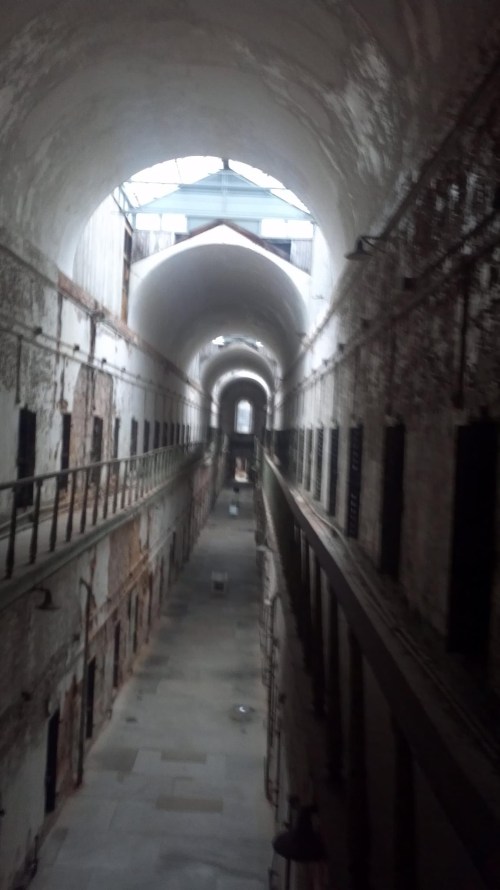 For those of you who follow The Criminology Team on Facebook you might have caught @manosdaskalou and I live from Eastern State Penitentiary [ESP]. In this entry, I plan to reflect on that visit in a little more depth.
We first visited ESP in 2011 when the ASC conference was held in Washington, DC. That visit has never left me for a number of reasons, not least the lengths societies are prepared to go in order to tackle crime. ESP is very much a product of its time and demonstrates extraordinarily radical thinking about crime and punishment. For those who have studied the plans for Jeremy Bentham’s panopticon there is much which is familiar, not least the radial design (see illustration below).

This is an institution designed to resolve a particular social problem; crime and indeed deter others from engaging in similar behaviour through humane and philosophically driven measures. The Philadelphia Society for Alleviating the Miseries of Public Prisons* was philanthropic and guided by religious principles. This is reflected in the term penitentiary; a place for sinners to repent and In turn become truly penitent.
This philosophy was distinct and radical with a focus on reformation of character rather than brutal physical punishment. Of course, scholars such as Ignatieff and Foucault have drawn attention to the inhumanity of such a regime, whether deliberate or unintentional, but that should not detract from its groundbreaking history. What is important, as criminologists, is to recognise ESP’s place in the history of penology. That history is one of coercion, pleading, physical and mental brutality and still permeates all aspects of incarceration in the twenty-first century. ESP have tried extremely hard to demonstrate this continuum of punishment, acknowledging its place among many other institutions both home and abroad.
For me the question remains; can we make an individual change their behaviour through the pains of incarceration? I have argued previously in this blog in relation to Conscientious Objectors, that all the evidence suggests we cannot. ESP, as daunting as it may have been in its heyday, would also seem to offer the same answer. Until society recognises the harm and futility of incarceration it is unlikely that penal reform, let alone abolition, will gain traction.
*For those studying CRI1007 it is worth noting the role of Benjamin Rush in this organisation.
Share this:


“Letters from America”: II

Having only visited Philadelphia once before (and even then it was strictly a visit to Eastern State Penitentiary with a quick “Philly sandwich” afterwards) the city is new to me. As with any new environment there is plenty to take in and absorb, made slightly more straightforward by the traditional grid layout so beloved of cities in the USA.
Particularly striking in Philadelphia are the many signs detailing the city’s history. These cover a wide range of topics; (for instance Mothers’ Day originates in the city, the creation of Walnut Street Gaol and commemoration of the great and the good) and allow visitors to get a feel for the city.
Unfortunately, these signs tell only part of the city’s story. Like many great historical cities Philadelphia shares horrific historical problems, that of poverty and homelessness. Wherever you look there are people lying in the street, suffering in a state of suspension somewhere between living and dying, in essence existing. The city is already feeling the chill winds of winter and there is far worse to come. Many of these people appear unable to even ask for help, whether because they have lost the will or because there are just too many knock backs. For an onlooker/bystander there is a profound sense of helplessness; is there anything I can do?, what should I do?, can I help or do I make things even worse?
The last time I physically observed this level of homelessness was in Liverpool but the situation appeared different. People were existing (as opposed to living) on the street but passers by acknowledged them, gave money, hot drinks, bottles of water and perhaps more importantly talked to them. Of course, we need to take care, drawing parallels and conclusions across time and place is always fraught with difficulty, particularly when relying on observation alone. But here it seems starkly different; two entirely different worlds – the destitute, homeless on the one hand and the busy Thanksgiving/Christmas shopper on the other. Worse still it seems despite their proximity ne’er the twain shall meet.
This horrible juxtaposition was brought into sharp focus last night when @manosdaskalou and I went out for an evening meal. We chose a beautiful Greek restaurant and thought we might treat ourselves for a change. We ordered a starter and a main each, forgetting momentarily, that we were in the land of super sized portions. When the food arrived there was easily enough for a family of 4 to (struggle to) eat. This provides a glaringly obvious demonstration of the dichotomy of (what can only really be described as) greed versus grinding poverty and deprivation, within the space of a few yards.
I don’t know what the answer is , but I find it hard to accept that in the twenty-first century society we appear to be giving up on trying seriously to solve these traumatic social problems. Until we can address these repetitive humanitarian crisis it is hard to view society as anything other than callous and cruel and that view is equally difficult to accept.
Share this:


“Letters from America”: I

This weekend @manosdaskalou and I flew from London to the USA and thus had the opportunity of experiencing two different airports. Travelling is always an insightful – if sometimes physically draining – experience and even more so when crossing continents. It is striking that one of the very first things that you confront upon arriving at your destination (no matter whether home or abroad) is generally a very long queue. There are queues to check in, queues to drop bags, queues for security, queues to get on the plane and to get off the other end. These are followed by yet more queues to enter the country and a wait to collect your bags. All of this is par for the course and perhaps to be expected given the volume of people travelling. What is perhaps more unexpected is the overall patience demonstrated by those in the seemingly endless queues.
I find the airport an interesting no-man’s land where individuals appear to become simply part of a giant machine. Once inside the airport you become subject to the whims and vagaries of the machinery. “Take off your shoes”, “take off your coats, jackets, scarves”, “laptops here”, “bags there’ ,”show your clear plastic bag containing approved liquids”, the list goes on and that’s before you’ve even let the country. If we want to fly we accept these rituals as a price worth paying. However, it is worth considering if many would tolerate such rituals away from this setting?
All of these processes are predicated on an ethos of security and the protection of life and limb. However, we do not insist on such protocols when we use other forms of transport; buses, trains, trams or the tube where similar conditions prevail (i.e.lots of people, baggage etc. moving from place to place. The tactics used in the airport are far more reminiscent of the police station or the prison than they are of travel yet we simply grit our teeth and bear the incongruity and indignity of the situation.
Whilst not suggesting that security is unimportant, it is worth considering that we focus far greater attention on flying than we do on other modes of transport. Of course, for those who fly infrequently this can be absorbed as a part of their travelling experience as predictable as a trip to the duty free shop. On a daily basis, as part of the 9-5 commute, such tactics would bring the world to a grinding halt…
Share this:


Do you consent to read on?

The more eagle-eyed amongst you may have spotted that @manosdaskalou and I are due to present during ‘I Heart Consent’ Week (still plenty of time to book a space!). The topic – ‘Consent in the Classroom’ is one that is close to our hearts and something we have discussed in different environments with different people. In this week’s entry I want to consider why the subject of consent is particularly important for criminologists.
An obvious area to start is research; ethics are fundamental to all of the projects we do from undergraduate all the way through to seasoned academic. Discussions around ensuring participants are able to fully engage in the process of gaining informed consent are imperative. At times this may be viewed as procedural; simply going through the motions but given the sensitivity of much criminological research it has a primacy and an urgency necessary to avoid harm.
The last few weeks have seen a flurry of accusations directed at Hollywood’s “finest” (cf. Harvey Weinstein, Kevin Spacey, Ed Westwick et al.) and government ministers and MPs (cf. Michael Fallon, Stephen Crabb, Kelvin Hopkins et al.). These often, light on factual evidence and heavy on prurient judgement, throw the spotlight once more on the issue of sexual consent. These cases are concerning on many levels and it is apparent from much of the discussion which often ensues whether on television, radio, in the newspapers or on social media, that many people are confused around the very nature of consent. Attempts have been made to counteract these lack of knowledge, often in creative ways; for example ‘Consent: It’s as simple as tea’ but looking at many of the comments, there is still a great deal of work to do. There are also wider issues in relation to consent; the absence of the victims’ consent to have their information paraded to feed the public’s desire for detail Likewise, the nature of summary justice being dispensed (e.g. expulsion from organisations, cancellation of contracts and resignations) deprives suspects of their right to defend themselves in court; there is no option for those suspected to opt for a trial by media.
Notwithstanding, the imperative to understand sexual consent, for Criminology, there is a further complication. When much, if not all crime, criminality and criminal justice, is predicated on the absence of consent, the issue becomes even more tenacious. If we consider that victims don’t consent, offenders may not consent to what ensues; certainly the criminal justice system’s [CJS] apparatus deliberately and meticulously removes consent throughout the process. Even when it comes to the professionals who work within the CJS, they may not consent, rather they are obeying guidance/policy/instructions/orders (delete as appropriate). After all, it cannot be consent if derived at the barrel of a gun, or in a police interview suite or a prison cell or when the economic situation is so bleak you are terrified of losing your job. When there is no room for manoeuvre, there can be no consent. Institutions and individuals may decide that this is a necessary price to pay in respect of crime and punishment, but that decision should never be taken without reflection.
All of the above shows the importance of consent, not only between the sheets, but in all aspects of criminology. Whatever side of criminal justice you might find yourself on, an understanding of consent is essential.
Share this:


Leave my country

One image, one word, one report can generate so much emotion and discussion. The image of the naked girl running away from a napalm bombed village, the word “paedo” used in tabloids to signal particular cases and reports such as the Hillsborough or the Lamy reports which brought centre stage major social issues that we dare not talk about.*
Regardless of the source, it is those media that make a cultural statement making an impact that in some cases transcends their time and forms our collective consciousness. There are numerous images, words and reports, and we choose to make some of these symbols that explain our theory of the world around us.
It was in the news that I saw a picture of a broken window, a stone and a sign next to it: “Leave my country”. The sign was held by an 11 year old refugee with big brown eyes asking why. This is not the only image that made it to the news this week; some days ago following the fatal car crash in New York the image of a 29 year old suspect from Uzbekistan appeared everywhere. These two images are of course unconnected across continents and time but there is some semiology worth noting.
We make sense of the world around us by observing. It is the media that are our eyes helping us to explore this wider world and witness relationships, events and situations that we may never considered possible. It must have been a very different world when over a century ago news of the sinking of the Titanic came through. We store images and words that help us define the way our world functions. In criminology, words are always attached to emotion and prejudice.
I deliberately chose two images: a victimised child and an adult suspect of an act of terror. They have nothing in common other than both appear foreign in the way I understand those who are not like me. Of course neither of these images is personally relatable to me but their story is compelling for different reasons. Then of course as I explore both stories and images, I wonder what is that remains of my understanding of the foreigner?
Last year, the satirical magazine Charlie Hebdo produced a caricature of what would little Aylan would have done if he was to grow up, presented as a sex pest. The caricature caused public outcry but at the time, like this week, I started considering the images and their meanings. Do we put stories together based on the images we see around us? If that is a way of defining and explaining our social world then the imagery of good and bad foreigners, young and old, victims and villains may merge in a deconstruction of social reality that defines the foreigner. In that case and at that point the sign next to the 11 year old may not be voiced but it can become an implicit collective objective.
*At this stage I would like to mention that I was considering to write about the media’s “surprise” over the abuse allegations following revelations for a Hollywood producer but decide not to, due to the media’s attempt to saturate one of the most significant social issues of our times with other studies with varying levels of credibility. We observed a similar situation after the Jimmy Saville case.
Share this:


Tackling Firearms Trafficking: Follow the Gun!

Dr Helen Poole is Deputy Dean in the Faculty of Health and Society and Lead for University of Northampton’s Research Centre for the Reduction of Gun Crime, Trafficking and Terrorism
Last week I attended the 4th Interpol Firearms Forensics Symposium in Dubrovnik, Croatia. This was the second I have attended, having presented the interim findings of the EU Project EFFECT in Singapore in 2015. EFFECT, which I co-lead with Professor Erica Bowen, looked at many aspects of gun crime, but the focus on trafficking became the predominant area of interest from our findings and recommendations following the Paris attacks, and was a strong focus of this year’s event. In particular, the links between organised firearms trafficking and terrorism were a key focus.
The UK is landlocked and has some of the most rigorous firearms licensing regulations and criminal legislation in the World which helps to keep us relatively safe from this threat, but still we are seeing rising rates of gun related crime in the UK, and some of the guns in use are moving from post-conflict areas such as the Balkan region. In 2015 The Shilling Gang were intercepted smuggling a large haul of military grade firearms into the UK via boat, a number of which emanated from Eastern Europe, and we know that firearms, their parts and accessories, are being imported from the US and Africa via both the dark web and the open net. The threat from junk, antique, converted and 3D printed weapons also present a threat.
Approximately 200 law enforcement officers, forensics experts and academics were present at the event, which highlighted two issues above all else: the importance of investigating officers to ‘follow the gun’; and the need for international cooperation to reduce the threat posed by small arms and light weapons. All too often officers will seize a firearm and identify the suspect, and close the case as detected. However, such an approach risks losing valuable intelligence in terms of where the gun came from, where else it might have been used, and the identification of trafficking routes. By using ballistics comparison technology, such as the International Ballistics Intelligence Network (IBIN), it is possible to compare ballistics intelligence to match crime scenes and, when combined with other forms of evidence and intelligence, identify the individuals or organised groups behind the supply of weapons. This may also lead to the detection of more crimes. However, this requires cooperation between nations to share information in a timely way, facilitated in many cases by Interpol, as well as a change in the mindset of detectives. Following the gun may be regarded as merely creating more work for the individual officer or department, and the detection of the individual crime may be required as the only positive outcome required. However, in terms of harm reduction, following the gun is more likely to reduce the number of future victims, and the serious harm caused to families and communities as a result of the number of crime guns in circulation.
Share this:


We all saw it coming: Reflections on the Transforming Rehabilitation Agenda

The recent reforms to the probation service were examined in the BBC Panorama programme ‘Out of Jail: Free to Offend Again?’ The title of the programme struck me with a clear sense of ‘we told you so’ given the warnings and concerns raised by those working within the probation service and colleagues in criminology departments. Just look at #faillinggrayling on twitter – there you can chart the anxiety as the reforms were proposed and then implemented.
The programme began with the case of Connor Marshall who on a night out with friends was attacked by a stranger, David Braddon who had a history of violent offending, along with alcohol and drug misuse. Sadly, Connor died in hospital a few days after the attack and then, the details of David Braddon’s circumstances were revealed, during the review into Connor’s death. David was on probation, under the supervision of ‘Working Links’, a private consortium who took over running of probation for most of Wales, under the new Transforming Rehabilitation (TR) arrangements in 2015. TR promised radical reforms which would privatise the probation service for low and medium risk offenders, with high risk offenders still being managed under the National Probation Service (NPS). Ian Lawrence, General Secretary of the National Association of Probation Officers (NAPO) spoke on the programme about how they warned the government about the risks, due to the extensive re-organisation, costs to the taxpayer and crucially, the impact on public safety. In addition, an internal memo from the Ministry of Justice (MoJ) gave explicit warnings about the danger of the TR failing, citing that an ‘unacceptable drop in operational performance which might lead to delivery failure and reputational damage.’
Connor’s case was described in the programme as an ‘early failure.’ The phrase reminded me of the cold and calculated response when we are told the casualties of war are ‘collateral damage.’ There was a sense of acceptance of failures, given the extent of the reforms. David Braddon had a catalogue of missed appointments and non-compliance, along with becoming increasingly withdrawn, all of which should have been flagged up by those supervising him, and action taken. This reminded me of another pivotal case in probation, which highlighted the impact of over-loading probation officers and not responding properly to those offenders who are clearly at risk and not complying with their supervision. In 2008, Dano Sonnex and Robert Falmer killed two French students in south east London, in a violent attack. The Serious Case Review, focusing on Dano Sonnex, revealed a catalogue of errors, resulting in part from caseworkers in probation being overloaded and inexperienced in dealing with someone with such complex needs as Sonnex. The fact that this occurred in London was worrying when the presenter presented the views of a whistle-blower, working for MTC Novo, a company who was now delivering probation services for low and medium risk cases in London. The premise of TR was that ‘Community Rehabilitation Companies’ (CRCs) would take on expanded caseloads from widening the net for supervision to those on short term sentences, where re-offending rates are particularly high. MTC Novo and Working Links are just two examples of new CRCs now responsible for low and medium risk offenders. The programme then examined the experiences of probation, from the perspective of a service user, probation officers and those involved in inspecting the service.
Sean Grant, out of prison and living with friends reported he had very little contact with MTC Novo, his first appointment took 3 weeks to set up after his release and he had no support to get stable housing in place. He also reported his view was that the service had not improved, compared to his previous contact, and later in the programme, it transpired he was at risk of recall, due to missed appointments which he knew nothing about. This was particularly galling since he had secured work and seemed to be doing everything he needed to do to prevent re-offending, albeit with little help from the probation service.
This experience chimed with the views then given by a ‘whistle-blower’ from within MTC Novo, who reported that the company was now employing fewer fully qualified probation officers, and his caseload had risen from 50 to 76, including some vulnerable offenders who were not getting the intervention they needed. They also cited the problems associated with not having time to build a rapport, with monthly meetings of 20 minutes, asking ‘how will you open up? I don’t know them, they don’t trust me.’ It seems the long held and valued principles of the probation service to ‘advise, assist and befriend’, already eroded by risk management and efficiency drives, were now being further undermined by TR. More worryingly, the probation service as an effective means to reduce re-offending was also undermined, when the same whistle-blower referred to an ‘explosion in re-offending’, including violent offences. For others outside London, probation had become a service which staff described as a ‘mess’ and time spent with clients had fallen from 15 to 2 hours a week, and was also characterised by division and in-efficiency.
Dr Lawrence Burke, Ian Lawrence and Dame Glenys Stacey all agreed that the calls for a rethink on TR were growing louder, the service was in danger of becoming de-stabilised and of putting lives at risk. This feels very much like reform which was imposed on a service which was functioning relatively well – not perfectly – but which is now facing significant issues, all of which were meant to be addressed by TR. The harrowing cases, while still rare events, can cite the failings of probation as contributing to the serious crimes which occurred and therefore, the key aim of the service, to protect the public, is not being met. The rising prison population and especially the continued use of short term prison sentences means the service will continue to be overloaded, while CRC managers continue to cut costs to keep solvent. Therein lies a fundamental problem – making a profit through the management of offenders is not viable, sustainable, advisable or safe. The probation service, much like the NHS, the police and other public services can deliver well and do good work when it is not diverted by concerns over cost savings and trying to deal with increasing workloads.
Susie Atherton
Senior Lecturer in Criminology
Share this:


A Troubling Ambiguous Order?

Sallek is a graduate from the MSc Criminology. He is currently undertaking doctoral studies at Stellenbosch University, South Africa.
Having spent the early years of my life in Nigeria, one of the first culture shock I experienced in the UK was seeing that its regular police do not wield arms. Unsurprising, in my lecture on the nature and causes of war in Africa, a young British student studying in Stellenbosch University also shared a similar but reverse sentiment – the South African police and private security forces wield arms openly. To her, this was troubling, but, even more distressing is the everyday use of most African militaries in society for internal security enforcement duties. This is either in direct conflict to the conventional understanding on the institutions involved in the criminal justice system, or African States have developed a unique and unconventional system. Thus, this raises a lot of questions needing answers and this entry is an attempt to stimulate further, thoughts and debate on this issue.
Conventionally, two spheres make up state security, the internal sphere of policing and law enforcement and the external sphere of defence and war-fighting. However, since the end of the Cold War, distinguishing between the two has become particularly difficult because of the internal involvement of the military in society. Several explanations explain why the military has become an active player in the internal sphere doing security enforcement duties in support of the police or as an independent player. Key among this is the general weakness and lack of legitimacy of the police, thus, the use of the military which has the capacity to suppress violence and ‘insurgence.’ Also, a lack of public trust, confidence, and legitimacy of the government is another key reason States resort to authoritarian practices, particularly using the military to clamp down civil society. The recent protests in Togo which turned ‘bloody’ following violent State repression presents a case in point. The recent carnage in Plateau State, Nigeria where herdsmen of similar ethnic origin as the President ‘allegedly’ killed over fifty civilians in cold blood also presents another instance. The President neither condemned the attacks nor declared a national mourning despite public outcry over the complicity of the military in the massacre.
Certainly, using the military for internal security enforcement otherwise known as military aid to civil authority in society comes with attendant challenges. One reason for this is the discrepancy of this role with its training particularly because military training and indoctrination focuses extensively on lethality and the application of force. This often results to several incidences of human rights abuses, the restriction of civil liberty and in extreme cases, summary extrajudicial killings. This situation worsens in societies affected by sectarian violence where the military assumes the leading role of law enforcement to force the return to peace as is the case in Plateau State, Nigeria. The problem with this is, in many of these States, the criminal justice system is also weak and thereby unable to guarantee judicial remedy to victims of State repression.
Consequently, citizens faced by the security dilemma of State repression and violence from armed groups may be compelled to join or seek protection from opposition groups thereby creating further security quandary. In turn, this affects the interaction of the citizenry with the military thereby straining civil-military relations in the State with the end result been the spinning of violence cycle. It also places huge economic burden with lasting impact on State resources, individuals, and corporate bodies and where the military is predatory, insecurity could worsen. The sectarian violence in Plateau State and the Niger Delta region in Nigeria where such military heavy-handedness remains the source of (in)security shows the weakness of this approach, and unless reconsidered, peace could remain elusive. Thus, now more than ever, this ambiguous (dis)order requires reconsideration for a civil approach to security in Africa.

Share this:


Corrosive substances – A knee-jerk reaction or a sensible solution?

Following the apparent growth in acid attacks the suggestion from Amber Rudd on a potential means of tackling the problem has all the markings of another knee-jerk policy that lacks careful planning and application. The proposal is to restrict the sales of corrosive substances and introduce new, specific legislation for possession and use of such substances against another person. The justification for these suggestions is based on the doubling of attacks between 2012 and 2016-17. Furthermore a 6 month review by National Police Chiefs Council (NPCC) report 400 acid or corrosive substance attacks between October 2016 and April 2017. The impact of such attacks is long lasting and without question, a horrific life changing experience, however is this reaction the right one for all concerned?
The plan to ban the sale of corrosive substances to under 18s in itself may be a sensible idea, if there is careful consultation on what substances are to be included in this blanket approach. A similar approach already exists with the sale of knives, tobacco and alcohol yet the extent to which these policies are a success is a moot point. Policing such an approach will also be considerably challenging because there is currently no clear outline of what the government intends to class as a corrosive substance. If the suggestions that bleach will be on the list then this may prove very difficult, if not impossible to police. Many of the corrosive substances being used today are household names readily available in most local shops and supermarkets, not to mention the internet. When purchasing items subject to restriction on the internet, the only check of age is you clicking a button to confirm it and maybe adding a date of birth, neither of which are particularly secure.
Taking this a step further the other suggestion is the creation of a new offence; possession of a corrosive substance in a public place. Such legislation is modelled on legislation already used to tackle knife offences and offensive weapons whereby a prison sentence of upto 4 years can be issues for possession, with intent to carry out an attack. However, why is such an approach necessary when perpetrators of acid attacks can already receive a life sentence under existing legislation. Is it because of the tremendous success of the approach taken to knife crime? Unlikely, if you consider the resistance by the judiciary to use such an approach which would inevitably lead to much higher prison numbers than we already have. In short, the ‘do it again…threat’ is highly unlikely to act as a deterrence when deterrence as a reason for punishment has long been questionable.
Is this another knee-jerk reaction to media hype? Evidence of another poorly considered policy response driven by political self-interest and the desire to be ‘seen to be doing something’. Many of these attacks have been linked to societies folk devils; youth or personal vendetta’s therefore rather than creating new policy, why not focus on existing measures using them to their full force and improving the services offered to the victims of these heinous crimes. Under existing legislations those convicted of an acid attack can receive a life sentences so why new legislation. Survivors also get a life sentence so surely the more appropriate response is to focus on victim’s needs (physical and psychological) rather than the creation of unnecessary legislation
Share this:


Is freedom too great a price to pay?

The 1st of October was a bad day, I watched the news on television in dismay, as I seem to frequently do these days. Fifty eight people killed and hundreds injured by a gunman in Las Vegas. Over a few days I thought about this and continued watching news bulletins and the discussion on gun control and the right to bear arms. I recall previously seeing Barak Obama on television, lamenting the illegal use of guns in the United States and attempting to convince people that gun possession needed to be controlled. He failed, but from news reports not for the want of trying. The gun lobby and politics were a powerful block on any movement in that direction.
The present incumbent Donald Trump does not seem to have much to say about the matter other than the usual platitudes that come out at a time of national disaster. So my thoughts turned to politics and ideology. I can’t profess to know much about American politics or the American Constitution but as I understand it, the right to bear arms is written into the Constitution. The debate about whether the Second Amendment intended that ordinary citizens had the right to bear arms or the right to bear arms was intended for the militia is one that has continued for many a decade and it seems the courts, not without some dissent, fell on the side of the citizen.
As I continue to try to make sense of it all, I question what was intended by those great people that drafted and redrafted and finally agreed the American Constitution. If the very people that debated and drafted the constitution were to consider the matter now, in contemporary society, knowing the advanced technology and the damage that firearms have caused across America, including the illegal use of firearms in the name of the law, would they have drafted the second amendment in such a way?
Of course we can think about this concept a little wider and apply it to various ideologies across the world. Take the concept of free speech, would those that drafted the various constitutions and rights in many a country have foreseen that the concept of free speech would be used to spread hate against various groups of people? Did they intend that free speech would be used to adulterate and twist religious texts so that hate could be espoused and acted upon?
These rights were drafted and agreed in a different era. Those that espoused them could perhaps not have conceived that they would be abused to the extent they are now or that the concepts would cause so much damage and misery. If we could bring all those great minds together now, would they amend those rights perhaps putting some stipulations on them?
I have a feeling that many a great mind would turn in their graves at these notions and of course I understand it is not quite so simple but I do just wonder? Is freedom too great a price to pay?


