

Owning Success

Having been posed the question about what success might look like for students, I pondered for a few days trying to conjure up an appropriate answer. You might think the answer is simple, after all the Oxford Dictionary defines ‘success’ as ‘The achievement of a desired result or outcome; the accomplishment of an aim or purpose.’ But what is that desired result or outcome? For students and many others, I would suggest that the simple answer that comes readily to mind is a good degree.
Some will have looked beyond this perhaps suggesting that a desired result would be a good degree leading to a good job. But such statements feel a little too simple, what is a good degree and what is a good job? If we were to stick with generally accepted definitions, then a good degree is one where a student obtains a first or a 2:1and a good job is one that is defined as a graduate job. Such definitions though serve to devalue both the achievements of many students and of the jobs that students take up.
Students are all different, come from diverse backgrounds and deal with a plethora of social, economic and personal circumstances. Achievement or what we might deem as success is only truly measured by taking these multiple, often hidden, facets of a student’s life into account. Several of our students find work after university in organisations where the class of degree has little relevance, but the work makes a real difference to society; work in charitable organisations come to mind. What many of these students have demonstrated is that through their studies and engagement with their course they have become able to understand the world through a different, far more critical lens. They can show confidence, have conviction, argue their case, they can provide leadership where it is needed and above all they are able to show empathy, something sadly lacking in contemporary society. And that to me is real success. I
t is not what you can spout out parrot fashion from a book, not an AI generated essay; it is when the light comes on and a student can see what they did not see before, they attempt what they would not attempt before. Success is part of a journey, but one where students have knowledge and skills to navigate to where they, and they alone, want to be. Success is not what others define for you, success is whatever you decide it should be.
Share this:


Are we any closer to justice for Grenfell?
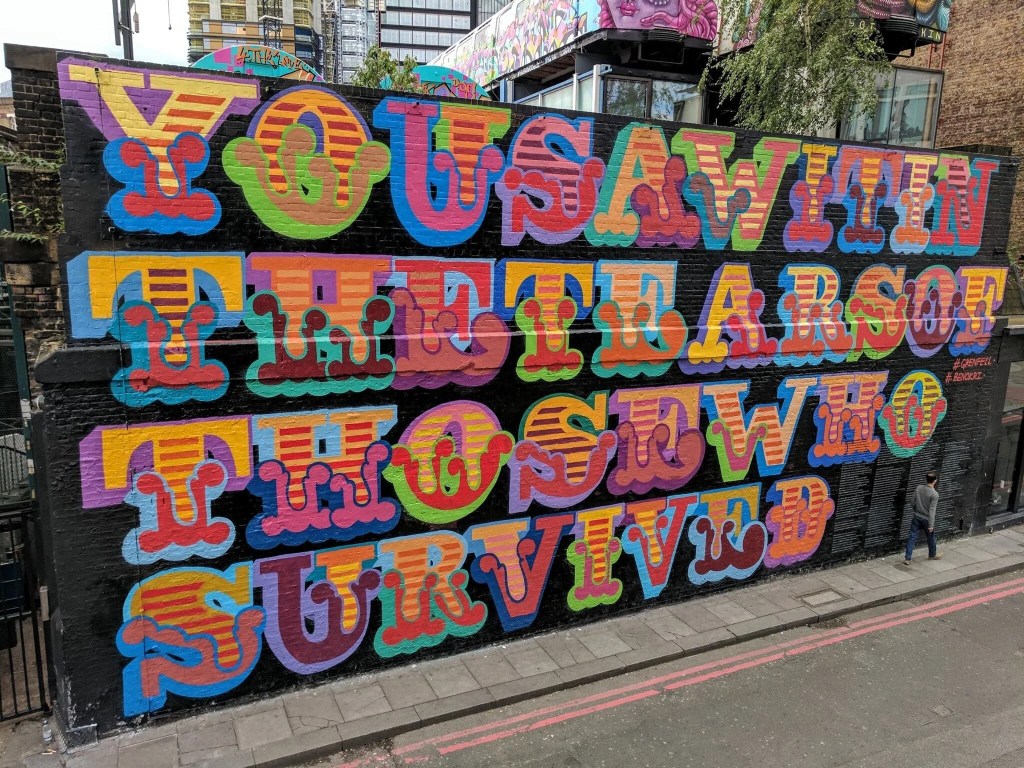
June 14 2026 will mark 9 years since the disaster of Grenfell Tower. This week the Metropolitan Police Service [MPS} announced that they are planning to ‘seek criminal charges against 77 companies and people‘. They are hopeful that the CPS will reach a decision in time for the 10th anniversary commemorations in 2027. This is the culmination of almost 9 years of MPS investigation, c. 11,400 witness statements, 56 interviews under caution, involving 100s of police staff and costing many millions of pounds. In addition, the Grenfell Inquiry (already archived) disclosed over 320,00 documents, received over 1,600 witness statements, and held more than 300 hearings, costing the nation many more millions of pounds. So how is it, that after all this work, all the posing and answering of questions, all the soul searching, discussion and debate, we still seem to be no further in finding justice for the 72 people who died, the many who were harmed, both mentally and physically, those bereaved and their families and friend? Additionally, everyone saw this disaster unfold before their very eyes, whether they were at the scene or vicariously though the media. We all instinctively know what was experienced that night was avoidable, a human made tragedy, a crime, Whilst there is no one law which addresses the scale of this disaster, nevertheless all who bear witness recognise the horror, the injustice and the need for accountability.
Stormzy spoke for many at the Brit Awards in 2018, identifying those responsible as criminals, pointing out that the Criminal Justice System knows very well what to do with them. Many other artists, such as Edwin (below), Chris Ofili, Big Zuu and Lowkey (ft. Kaia) to name but a few, have also utilised their medium to make space for those critical perspectives to be seen and heard. You would think for a country famed for the spread of its CJS throughout its empire and created on the basis of Cesare Becarria’s principles of celerity [swiftness], certainty and severity, that justice would be not only done, but seen to be done. After all millions of people, both home and abroad, witnessed the events of that horrific night and they are watching to see that justice is delivered.

But to return to the start of this blog entry, the MPS announcement has received mixed responses, some are cautiously optimistic that change may eventually come. But many more are frustrated at the time this has taken, the lack of urgency demonstrated by successive governments, the perceived likelihood of any successful prosecutions, the list goes on. Grenfell United capture much of this in their response to the MPS ‘announcement.
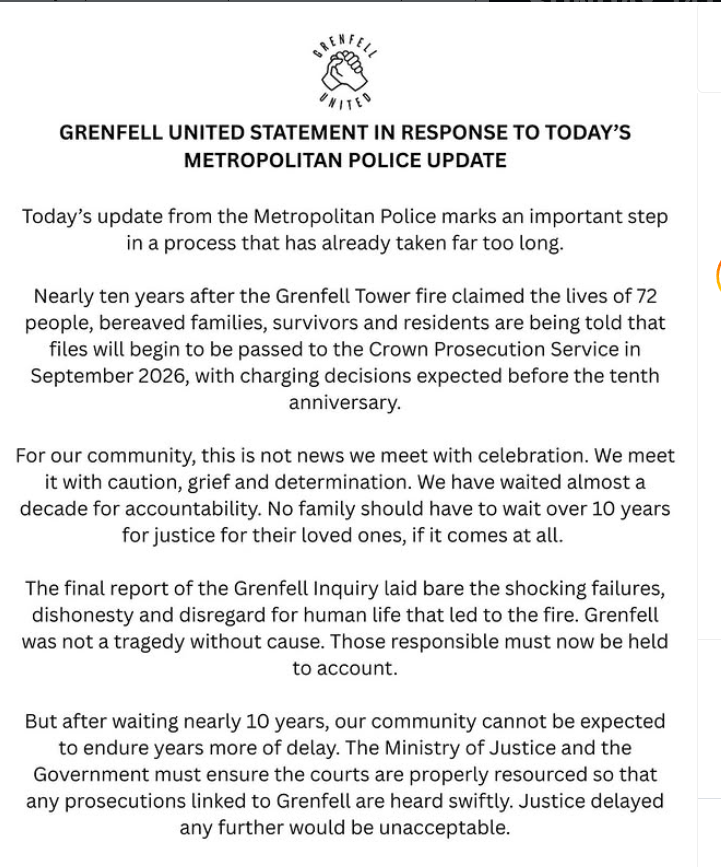
Grenfell United are right to be concerned about the resourcing of the courts. In 2025 the National Audit Office reported that the Crown Court had a outstanding caseload of 67,284. This further increased by December 2025 to 80,203, who knows where it stands now. Just think of all those lives suspended in limbo – victims/survivors, defendants, witnesses, the bereaved and their families/friends – left waiting, unable to move on, unable to reach closure, unable to assess whether justice has been achieved. An institution at breaking point.
So does this mean that we’re now living in a lawless society where anyone can commit crime, no matter how serious, and get away with it? Not really, it just means that the CJS has a different perspective on violence and harm, going for what, in Criminology, we would describe as “low hanging fruit”. Rather than make sense of the complexities contained within Grenfell tower, there are many other crimes to be solved, ones that make the data look impressive. If you don’t believe me have a look at the list below:
- Omega Mwaikambo
- Reis Morris
- Eamon Zada
- Alvin Thompson
- Koffi Kouakou
- Daniel Steventon
- Moses Ettienne
- Antonio Gouveia
- Derrick Peters
- Elaine Douglas
- Tommy Brooks
But what do these names have in common? It may surprise you to know that they have all been convicted of crimes in relation to Grenfell Tower. However, not one of these people were involved in the building, maintenance or oversight of the Tower, neither were they involved in the response on the night or its aftermath. Instead, these people have been convicted of different crimes, ranging from posting photos of the dead on social media, to false claims to residency in Grenfell allowing them to access financial support, to running a cannabis farm within the Tower.
Let’s consider just two of these, survivor Omega Mwaikambo who took photos of a dead victim and posted them to facebook. Within two days of the fire’s outbreak, he was sentenced to three months imprisonment. A man who had lost his home and his belonging, traumatised, is incarcerated. Another example, on 6 March 2018, not even a year after the disaster, courts were able to sentence another survivor, Eamon Zada, to a 12 week suspended prison sentence plus a community service order of 200 hours for growing cannabis.
What this list above tells us is that the CJS has an appetite for justice, it can act with celerity, certainty and severity, when it wants to. It can recognise harm and culpability, but again, only when it wants to. At this point we also need to recognise the repeated well-founded allegations that the CJS operates with partiality and discrimination both in terms of race and gender. Much as I hate to think of crime in terms of triviality/seriousness, recognising the harms inherent in all crime , it is hard to comprehend that for the CJS, the crimes detailed above are seemingly more important than the lives of the former residents of Grenfell Tower.
To answer the question posed in the title, I would say no. Until the CJS, institutions, government and indeed, society changes its view on what is harm, what is crime and who are the dangerous members of our society, we can expect this injustice to continue and unfortunately, be repeated again and again.
Share this:


Data…

As we draw closer to the end of semester 2, Criminology students across the 3 cohorts will have recently submitted, or be in the process of submitting, assessments which contain research data. Glorious criminological research data. CRI1011 have their research report looking at an interview transcript. CRI2013 have their research project looking at observations whilst on a research placement. And the third years submitted their dissertations back in April: lots and lots of different data. But as most research methods students will know, there are strengths and weaknesses to all data, and the data is intrinsically linked to the research question, aims and objectives. But data exists outside of our research bubble as well. Think about how many websites have asked for/taken/stolen/used/stored/sold our data!
Data serves different purposes and has different impacts. Back in September 2025, the Department for Transport published their ‘Reported road casualties Great Britain: motorcycle factsheet’. Some key findings: from 2004-2024 motorcycle traffic decreased by 6%, from 2020-2024 92% of motorcycle killed or serious injured casualties were male and in 2024 340 motorcyclists were killed in Great Britain (Department of Transport, 2025). Some data: but what does it mean? Quantitative data holds an important part in our daily lives as it tends to provide us with the ‘how’s’ and ‘what’s’. So, we can see only 8% of motorcyclists killed or serious injured casualties were female but the factsheet does not tell us how many motorcyclists in Great Britain identify as female? We could think about how many hold a licence but this does not necessarily mean they are active riders. It doesn’t explain why there is such a difference across gender, and there is no data about race. So I guess whilst there is data there is also lots of missing data. And I think this is an important point to remember: quantitative data can be perceived as providing the bigger picture, the quantity, but even then it is often only part of the picture.
The data from the Department of Transport (2025) also doesn’t tell us anything about who these people are: it has reduced them to a percentage. There is no story about who they were, why they ride, where they were going or what their hopes and dreams were. But it does give us an overview: it gives is the what. But I guess the question is do we need the why, the story, the narrative? We are fortunate (although it might not always feel like it) to live in a world full of different types of data! It is a data saturated society in which we live. Often at tip of our fingers, with a tip tap of the keyboard (across devices). But sometimes it can be difficult to manage, to understand and to recognise what’s missing. Data can be overwhelming. It can also be challenging to know you, or someone you know, is part of the data but at the same time be completely absent from it. The riders who have lost their lives in motorcycle accidents are reduced to numbers: they are in the data but who they are is unknown.
As the second years begin to think about their dissertation proposals, it’s a good time to reflect and think about the data we are exposed to, the data we want to collect and the data which already exists. In a society so saturated with data it might not always be relevant to keep adding to it, and instead might be more relevant to think about making sense of some of the data which already exists…
References:
Department of Transport (2025) Reported road casualties Great Britain: motorcycle factsheet [online] Available at: https://www.gov.uk/government/statistics/reported-road-casualties-great-britain-motorcyclist-factsheet-2024/reported-road-casualties-great-britain-motorcyclist-factsheet-2024 [Accessed 14th May 2026].
Share this:

Who owns the past?
The question of whether museums remain relevant comes up often in discussions about heritage and old artifacts. Yet the evidence suggests they continue to play a vital role in modern society. People still visit them in huge numbers, and schools rely on them as living classrooms. According to the Department for Culture, Media and Sport, museums in the UK welcomed over 40 million visitors in the past year, with attendance peaking in the summer months and during school holidays. Clearly, the appetite for museums hasn’t faded.
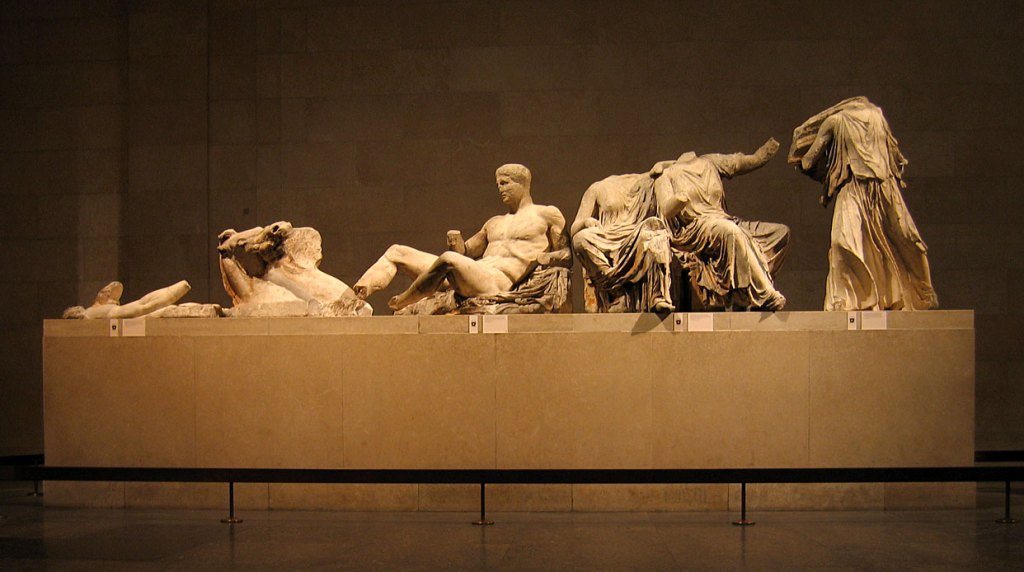
Part of their enduring appeal lies in their diversity. There are museums filled with towering dinosaur skeletons, others dedicated to technology from just a decade ago, and countless spaces in between. Among these institutions, some of the oldest — like the British Museum — continue to spark debate and fascination. Its vast collection spans human history, art and culture from across the world. Within its walls you’ll find globally significant artifacts such as the Parthenon Sculptures, the Rosetta Stone, the Ife Head from the Benin Bronzes, and the enigmatic Hoa Hakananai’a from Rapa Nui.
These objects draw millions not only because they are beautiful or ancient, but because they connect us to stories far larger than ourselves. Whether museums should continue to hold such items is an ongoing conversation — but their relevance, at least in the public imagination, remains undeniable. A statue in a museum can provide some understanding about sculpture and carving techniques but in the case of Hoa Hakananai’a it misses the context of its purpose.
The relevance of museums becomes even more pronounced when the objects they display belong to the heritage of other cultures. Calls for repatriation have grown louder in recent decades, often framed as reminders of a colonial past in which powerful nations acquired “beautiful” or culturally significant objects simply because they had the means to do so. For many communities, these artifacts are not just historical items but living symbols of identity, memory and continuity — and their absence is felt as a loss.
Museums often argue that they preserve artifacts and ensure their longevity for future generations. They present themselves as spaces where millions of visitors can immerse themselves in global culture. That is their position, but recent events, such as the Louvre heist, make it harder to accept this claim without question. Even more troubling is the way many of these artifacts were originally removed from their countries of origin. It is difficult to frame these actions as preservation rather than a form of cultural piracy.
The Parthenon Sculptures are a striking example. They were hacked into transportable pieces in the early 19th century to be displayed in what was intended to be the private museum of a Scottish aristocrat. Their removal took place a decade before Greece gained independence through revolution. When that aristocrat later fell into bankruptcy, he sold the sculptures to the British Museum for half his original asking price. This is just one of many transactions that undermine the argument that such acquisitions were motivated by respect for other cultures. Instead, they reveal a pattern of opportunism that continues to shape the debate today.
Therefore, it becomes reasonable to question whether some museums function as relics of a colonial past — institutions that still hold objects taken under unequal power dynamics. Returning artifacts to the communities and regions they originate from is increasingly seen as a step toward cultural justice. Although the Kingdom of Benin no longer exists in its historical form, the Edo people of Nigeria continue to identify with the bronze casts of the Obas (kings) they depict, and they have long called for their return.
The movement for repatriation is gaining international momentum as governments and museum authorities begin to return culturally significant pieces to their rightful communities. If the history and identity of people are the most important parameters, then why insist on keeping the originals in foreign institutions while offering only copies to the cultures that created them?
This leads to a deeper question: who owns the past? How do we curate the history and culture of peoples who endured colonial rule, displacement, or even extermination? Human history may be collective, but the cultural significance of certain artifacts reminds us that we must confront the crimes of the past — the looting, the violence, and the erasure — and recognise the need for justice for those who were wronged.
In the end, the relevance of museums in the twenty‑first century depends on their willingness to confront the legacies that shaped their collections. These institutions can no longer rely solely on their educational value or their role as guardians of global culture; they must also reckon with the histories of extraction, violence and inequality that brought many treasured objects into their halls. Repatriation is not about emptying museums but about rebalancing relationships, restoring dignity and acknowledging that cultural heritage carries meaning far beyond its aesthetic or historical worth. If museums choose to evolve to collaborate, to return what was taken, and to tell fuller, more honest stories they can remain vital spaces for learning and connection. But their future relevance will be measured not by the number of visitors they attract, but by the integrity with which they address the past and the justice they help shape for the generations to come.

Share this:


A head full of AI free magic

It’s been an interesting few weeks discussing ethics and professionalism with my students, well those that turn up, but that’s a different debate, albeit I guess, in a way linked to the essence of this blog. As usual, my head is full of what a former colleague would describe as ‘magic’. Lots of different seemingly daft ideas, formulated into some narrative that makes sense to me but is difficult to convey to the rest of the world. The latter I’m sure is not peculiar to me, it happens to most people when they have to start writing something, some call it writers’ block, I just call it searching for the starting point. The daft ideas though, I proudly claim as my own. And that is why so often I end up writing a load of ‘stuff’ and then deleting it or at least some of it. In writing, I’m aided by some spell checker built into the software that I’m using and suggestions, also built into the software, about grammar and sentence construction. The latter often hinders rather than anything else, ‘no I do not want to revise the sentence to be more succinct. Your succinctness makes no sense to me and does not convey what I want to say’. A bit of a ramble so far I know, but I’m not going to change it because I want to convey the head full of ‘magic’ phenomenon (those of you that can remember it, can now sing the little ditty that will stick in your head for the rest of the day) and the writing process. You no doubt will have noticed, well those of you that still have a pulse and the will to live, I have made no mention of AI. No use of AI to convey my head full of ‘magic’ ideas, no use of AI to help me start writing. Why, well let me put it to you very succinctly, these are my ideas, it’s my head full of ‘magic’. It does not belong to some machine, whatever appears on this screen, whilst I am writing, is mine and mine alone. I cannot imagine a time when I will be so devoid of thought, ideas, creativity or ability, that I will resort to asking a machine to provide me with the answer or the output. What would the answer look like if I did? Some verbose monologue that is boring, has little or no substance, is devoid of meaning and in the case of academic work, if this were such, is supported by pseudo or obscure, tentatively subject linked, or even fictitious, references. Verbal diarrhoea on screen. If you want evidence of this, ask any discerning academic about more recent student essays. I say discerning for good reason, a reason that I hope to make apparent in a short while.
Let me digress just a little. Recently in the news there has been momentum around the use of mobile phones by young people, or more to the point, what some will say is misuse of phones. Or, the more cynical and critical amongst us might say the abuse of young people by multinational tech giants. There to make money, tech companies have used algorithms, heuristics and goodness knows what to ensure young people are hooked on social media. To their credit, they have also invested vast sums of money trying to limit online abuse and harmful content. But let’s be honest, it’s like farting and then running around with some aerosol to try to cover up the smell. It still stinks but the air is a little better in a few places. Society and government are waking up to the harm caused by the use of technology by young people in this context and we have seen some countries introduce an outright ban on use by under 16s. Something being mooted in this country. Some schools have banned the use of phones in the classroom and as a consequence have seen youngsters returning to healthier past times like playing football or chatting, and of course misbehaving. I would suggest that we have been well behind the curve when it comes to realisation of the harm that is being caused to young people. As parents, we have even colluded in it, albeit more often than not, unwittingly. Those in education systems have probably done the same. But this seemed to creep up on society almost organically, fertilised by businesses whose raison d’être is to make money regardless of cost to humanity. Although they have always dressed it up as progress and of benefit to individuals and society at large. The emperor’s new clothes comes to mind.
But what of AI? There seems to be a clamour by government that as a country we need to jump on the AI bandwagon. AI is being foisted upon us, much the same as social media and the internet has been, by tech companies. We are being told the next generation will need to be AI savvy. But what does that mean? Whilst all of this is going on, there is growing research showing that AI is crippling people’s cognitive abilities. That AI will stop us from being able to analyse and be critical ourselves. Technology does this. Think about spelling, no longer do you need to worry about spelling because it is done for you, grammar, pretty much the same. No need to calculate things in your head, you can use a calculator, no need to remember phone numbers, they are all in your mobile phone, no need think up ideas, AI will do that for you, no need to read, AI will summarise it for you, no need, just no need. I am human but I have no need to think for myself.
And yet, armed with this knowledge individuals in educational institutions plough headlong into promoting AI to their students. This can help you find sources, this can help you when you are devoid of ideas, this can help you make your work better, this can help you …. Stop thinking for yourself. I and most of my colleagues are able to think for ourselves because we have grown up having to. I know what I know now, which as an aside is very little, because I have had to think for myself, work things out for myself. Along the way I have been aided by all sorts of people in all walks of life, but I am who I am because I can think for myself. But educational establishments these days concern themselves almost psychopathically with student numbers, finance and results. There seems to be little understanding of what education really means or for that matter, little concern. Institutional reputations are upheld at all costs, individual reputations forged on sycophantic behaviours with little regard to the impact on students or colleagues. Within this, institutions, driven by government and more importantly business rhetoric make AI central to their vision, their mission.
I wonder whether in a few years’ time there will be an inquiry somewhere, that suggests we have deprived a whole generation of the joy of being human. I wonder whether someone will say those individuals and institutions that so frivolously dabbled with AI, using students in a social experiment, were quite simply morally bankrupt in their drive to further their own ends. And at least some of my students know what Immanuel Kant would say about that!


