
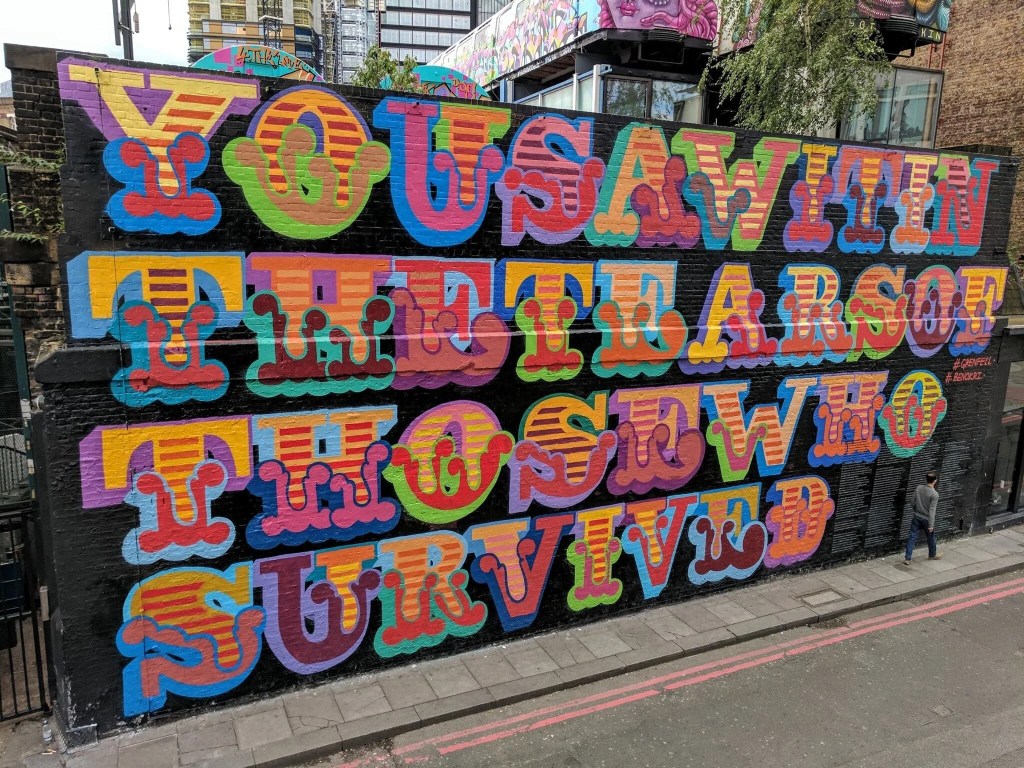
June 14 2026 will mark 9 years since the disaster of Grenfell Tower. This week the Metropolitan Police Service [MPS} announced that they are planning to ‘seek criminal charges against 77 companies and people‘. They are hopeful that the CPS will reach a decision in time for the 10th anniversary commemorations in 2027. This is the culmination of almost 9 years of MPS investigation, c. 11,400 witness statements, 56 interviews under caution, involving 100s of police staff and costing many millions of pounds. In addition, the Grenfell Inquiry (already archived) disclosed over 320,00 documents, received over 1,600 witness statements, and held more than 300 hearings, costing the nation many more millions of pounds. So how is it, that after all this work, all the posing and answering of questions, all the soul searching, discussion and debate, we still seem to be no further in finding justice for the 72 people who died, the many who were harmed, both mentally and physically, those bereaved and their families and friend? Additionally, everyone saw this disaster unfold before their very eyes, whether they were at the scene or vicariously though the media. We all instinctively know what was experienced that night was avoidable, a human made tragedy, a crime, Whilst there is no one law which addresses the scale of this disaster, nevertheless all who bear witness recognise the horror, the injustice and the need for accountability.
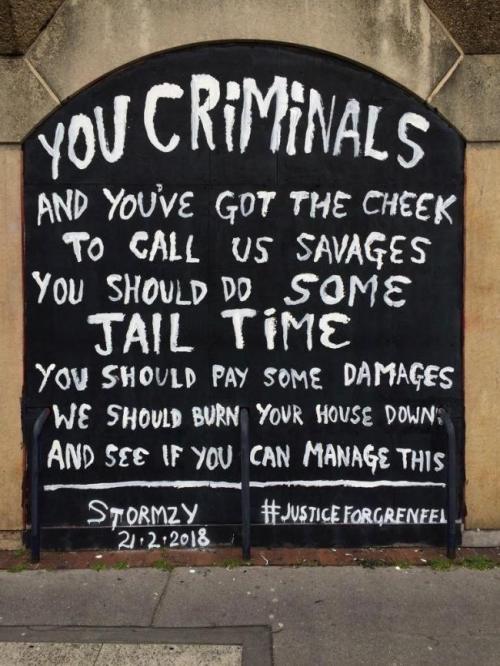
Stormzy spoke for many at the Brit Awards in 2018, identifying those responsible as criminals, pointing out that the Criminal Justice System knows very well what to do with them. Many other artists, such as Edwin (below), Chris Ofili, Big Zuu and Lowkey (ft. Kaia) to name but a few, have also utilised their medium to make space for those critical perspectives to be seen and heard. You would think for a country famed for the spread of its CJS throughout its empire and created on the basis of Cesare Becarria’s principles of celerity [swiftness], certainty and severity, that justice would be not only done, but seen to be done. After all millions of people, both home and abroad, witnessed the events of that horrific night and they are watching to see that justice is delivered.
But to return to the start of this blog entry, the MPS announcement has received mixed responses, some are cautiously optimistic that change may eventually come. But many more are frustrated at the time this has taken, the lack of urgency demonstrated by successive governments, the perceived likelihood of any successful prosecutions, the list goes on. Grenfell United capture much of this in their response to the MPS ‘announcement.
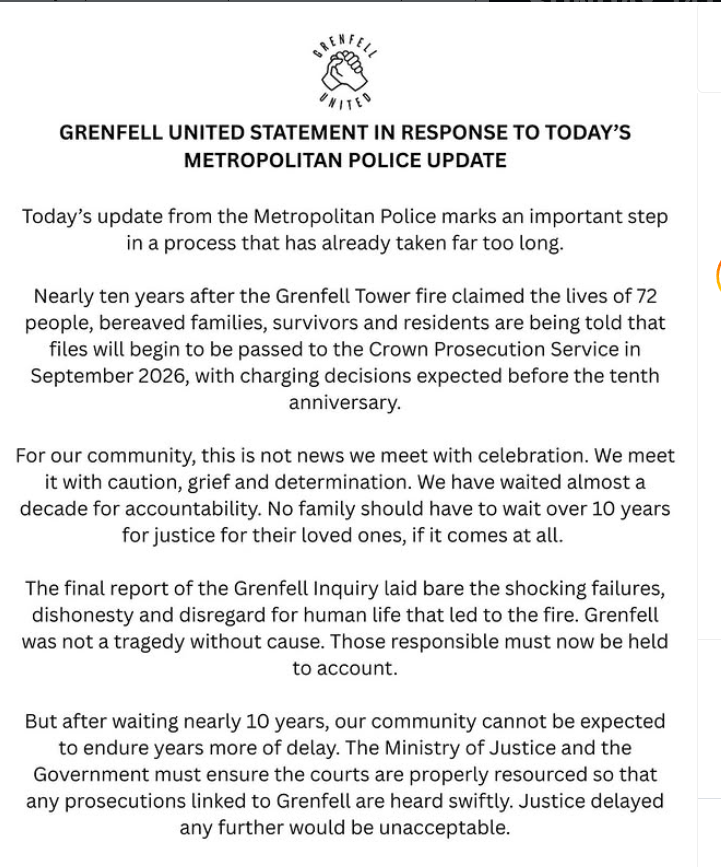
Grenfell United are right to be concerned about the resourcing of the courts. In 2025 the National Audit Office reported that the Crown Court had a outstanding caseload of 67,284. This further increased by December 2025 to 80,203, who knows where it stands now. Just think of all those lives suspended in limbo – victims/survivors, defendants, witnesses, the bereaved and their families/friends – left waiting, unable to move on, unable to reach closure, unable to assess whether justice has been achieved. An institution at breaking point.
So does this mean that we’re now living in a lawless society where anyone can commit crime, no matter how serious, and get away with it? Not really, it just means that the CJS has a different perspective on violence and harm, going for what, in Criminology, we would describe as “low hanging fruit”. Rather than make sense of the complexities contained within Grenfell tower, there are many other crimes to be solved, ones that make the data look impressive. If you don’t believe me have a look at the list below:
- Omega Mwaikambo
- Reis Morris
- Eamon Zada
- Alvin Thompson
- Koffi Kouakou
- Daniel Steventon
- Moses Ettienne
- Antonio Gouveia
- Derrick Peters
- Elaine Douglas
- Tommy Brooks
But what do these names have in common? It may surprise you to know that they have all been convicted of crimes in relation to Grenfell Tower. However, not one of these people were involved in the building, maintenance or oversight of the Tower, neither were they involved in the response on the night or its aftermath. Instead, these people have been convicted of different crimes, ranging from posting photos of the dead on social media, to false claims to residency in Grenfell allowing them to access financial support, to running a cannabis farm within the Tower.
Let’s consider just two of these, survivor Omega Mwaikambo who took photos of a dead victim and posted them to facebook. Within two days of the fire’s outbreak, he was sentenced to three months imprisonment. A man who had lost his home and his belonging, traumatised, is incarcerated. Another example, on 6 March 2018, not even a year after the disaster, courts were able to sentence another survivor, Eamon Zada, to a 12 week suspended prison sentence plus a community service order of 200 hours for growing cannabis.
What this list above tells us is that the CJS has an appetite for justice, it can act with celerity, certainty and severity, when it wants to. It can recognise harm and culpability, but again, only when it wants to. At this point we also need to recognise the repeated well-founded allegations that the CJS operates with partiality and discrimination both in terms of race and gender. Much as I hate to think of crime in terms of triviality/seriousness, recognising the harms inherent in all crime , it is hard to comprehend that for the CJS, the crimes detailed above are seemingly more important than the lives of the former residents of Grenfell Tower.
To answer the question posed in the title, I would say no. Until the CJS, institutions, government and indeed, society changes its view on what is harm, what is crime and who are the dangerous members of our society, we can expect this injustice to continue and unfortunately, be repeated again and again.


