
Authors
-
5teveh
-
6bsude
-
abbietoal
-
abigailane30
-
akcharl
-
amycortvriend
-
anfieldbhoy
-
anitawrzesniewska
-
FlowerViolet
-
asteven08
-
aysheaobrien1ca0bcf715
-
bethanyrdavies
-
bonnieleighmiddleton
-
bronaghvh
-
bwilleva
-
charlottejdann
-
cherylgardner2015
-
chris13418861
-
criminologyanon
-
criminologysocietyuon
-
davidjpalmer57
-
Demi King
-
drkukustr8talk
-
ej213
-
finlaywilliams24
-
Francine Bitalo
-
gilliansiddall
-
gregpaillet
-
Gwen
-
haleysread
-
hannahmaysmith
-
hanpearce93
-
helenpoole2
-
helentrinder
-
ifedamilola
-
jackrichmond21
-
jazzie9
-
jesjames50
-
justinkotze
-
kayleighwillis21
-
keziaasante
-
kirstyk196
-
klgrant1
-
liammiles1
-
Lilly Lewis
-
madams1965
-
Maddyk97
-
manosdaskalou
-
marlywindle
-
Maxine
-
meganking046
-
molliekel13
-
Mr_Hari_Parekh
-
nahidatakhtar
-
natalieh2000
-
npetfo
-
Paula Bowles
-
paulsquaredd
-
robynmansfield1
-
saffron_garside
-
Sallek Yaks Musa
-
samc0812
-
samtilley7
-
samuellangley
-
seanrj94
-
shanwareing
-
Shaun Ken-ucheonye
-
sineqd
-
Sophie Rowson
-
spatchett94
-
svr2727
-
tgomesx
-
Tré Ventour-Griffiths
-
tuesdaywoodward23
-
Vaseem Khan
-
wadzanain7
-
zeechee
-
zo3conneely

Reform: The New Opposition, or an Uncomfortable Hiccup in British Politics

British politics is particularly interesting at the moment, as no one is really sure if we are witnesses to a radical change or if Reform will fizzle out and be a distant memory within 10 years or so (here’s hoping). I’m here to bounce some ideas around, think about the current political climate and just put out some comments about what’s going on. I’m hoping to keep at least light, and possibly short.
It’s structured as starting off with some points that are to Reform’s advantage, including the national political climate. It continues to some things working against Reform, including its sustainability. Considering how Reform has managed to gain such support is kind of weaved into the middle and briefly mentioned at the end.
The Political Climate: Inside the UK
Populism is on the rise, restriction of human rights is increasing and people seem to be getting angrier and more frustrated about politics. On a national level, there is a plethora of individuals who are disillusioned with modern day politics and seeking simple answers to big issues quickly and, unfortunately, right wing populism fills this gap perfectly.
Immigration problems? Ban them and deport them.
Crime problems? Give longer and harsher sentences.
Have a problem with the elite? Let Nigel speak up for the British People and let common sense prevail.
They’re easily digestible, easily understandable solutions to big societal issues and that definitely appeals to people.

We can easily dismiss supporters of any right wing populist party as incorrect, immoral and uneducated. But it is really not as simple as that. When an attractive left wing party is not there to foster a society which is genuinely has the interests of the working class at it’s heart, we open the door for right wing populism to scoop up the working class electorate. Indeed, we can’t totally blame the current ‘Labour’ government for the increase in Reform UK voters, as we can see trends of right wing populism globally, but we can definitely think about whether these UK voters would have gone to Reform UK if Labour was offering a better solution. A solution which had working class people front and centre, providing meaningful change such as education reform, anti-poverty initiatives, workers rights focuses, renationalisation policies and council house stock rebuilding. What we are possibly seeing here are voters with no party to call home, frustrated and without answers, so they seek these things in easily digestible populist parties.
Sustainability: Party Identity and Hypocrisy
Perhaps Reform UK’s biggest stumbling block, in my opinion, is its internal contradictions and its lack of preestablished identity as a party.
The internal contradictions are simple and obvious. Reform UK prides itself on being anti- elitist and anti-establishment but the party is lead by a millionaire bankrolled by aristocrats with a private education. Right wing populist parties are simply an extension of the elite and the establishment; an obvious conclusion if you dig even slightly under the surface. Surely this hypocrisy will be called out soon and listened to?
A slightly more long winded pitfall in the Reform Party (among many others) is its lack of party identity. Labour and even the Tories can rely at least slightly on their voters who vote for them because they always have, because of nostalgia for what the party used to be, because they’re a traditional party. Reform don’t have this. And not only this, but they don’t really have any developed policies; the Conservatives have the idea of low taxes, competitive markets, low regulation. Traditional Labour have higher taxes, redistribution of wealth, working class empowerment, nationalisation. and Reform have…? Immigration freezes, law and order and ‘taking the country back’. I’m not sure if their party identity and policies will keep their momentum moving to the next general election.
However, I do think that if they are able to maintain their momentum and get to the election they may go far, and may possibly overtake the Tories. But I think it rests on two things 1) momentum going into the next election and 2) No proper left wing alternatives emerging between now and then. Unfortunately I think number two is already certain.
The title of this blog, is a sort of tongue in cheek title. I do understand how dire this could be should Reform become positioned as the official opposition. For many people around the UK the effects of pandering to right wing populist racist rhetoric has already been experienced, and it will only get worse if Reform continue to gain popularity. Remember to vote, be politically engaged and speak up, we as young people have a huge role to play as our turn out is generally so low.
Images from https://www.reformparty.uk/ and https://tribunemag.co.uk/2024/07/the-anti-elite-elites-reform-far-right
Share this:


A year on… semantics, semantics and semantics?

In October 2024, I wrote a blog on the recently opened Secure School- Oasis Restore. The shiny new edition to the Children and Young People Secure Estate (CYPSE) in England and Wales. In the introduction I pondered on whether this would bring about change within the CYPSE or if this was more of the same. There were lots of positives to consider with the resources, ethos and style of the new Secure School but I, and many others, had concerns that these changes were just words and would amount to little substance. Serious issues within the YJS such as the use of remand, the increasing number of Black and dual heritage children in the CYPSE (despite the overall downwards trend), the continued use of isolation and the high rates of self-harm all appeared to be forgotten with the unveiling of the new Secure School. However, a year on, and the CYPSE failing children appears to be continuing.
Oasis Restore had to ‘temporarily’ close in the summer of 2025 over safety concerns (BBC, 2025). Upon closer reading, and looking at the Ofsted report from April 2025, the main issue is around doors not being able to close properly due to how they were initially made and the damage they have sustained. The Ofsted report (2025) also highlights the use of physical restraint but is positive in how this is only used as a last resort and recorded effectively. The report claims there is a nurturing environment at Oasis Restore, and is overall relatively positive (Ofsted, 2025). The concern is the harm the displacement will have on the children. And why, a CYPSE institution which has cost approximately £40million, was not built fit for purpose?
The children who are placed in CYPSE, for welfare or justice grounds, are incredibly vulnerable. They have often experienced trauma, oppression and isolation at various stages in their childhood from various people and institutions (especially care and CJS). The reality is, these children have been failed multiple times before their arrival in the CYPSE and these failures continue whilst they are there. Oasis Restore was supposed to be different: it was supposed to help, support, nurture and protect. And whilst that appeared to be very much on the agenda, the closing and displacement of these vulnerable children is going to add to being failed by society. I ended my previous blog, reflecting on John Rawls’ when thinking about justice, if an institution cannot be reformed then it should be abolished. I asked, if it was finally time to abolish the CYPSE. I whole heartedly believe it is.
Bibliography:
Askew, J. (2025) Young Offenders School Closes After Safety Concerns, BBC. [online] Available at: https://www.bbc.co.uk/news/articles/cde3g28gxp4o [Accessed 14.10.25]
End Child Imprisonment (2024) Why child imprisonment is beyond reform: A review of the evidence August 2024. [online] Available at: https://article39.org.uk/wp-content/uploads/2024/08/Why-child-imprisonment-is-beyond-reform.-A-review-of-the-evidence-August-2024.pdf
Share this:


What society do we want to live in?

Recently after using a service, I received an email to provide some online feedback. The questionnaire was asking about the services I received and to offer any suggestions on anything that could be done to improve services. This seems to become common practice across the board regarding all types of services and commercial interactions. This got me thinking…we are asked to provide feedback on a recent purchase, but we are not asked about issues that cut through the way we live our lives. In short, there is value in my opinion on a product that I bought, where is the value in my views of how I would want my community to be. Who’s going to ask me what society I want to live in!
Consumerism may be the reason we get asked questions about products but surely before and above being consumers, aren’t we all citizens? I can make helpful suggestions on what I would like to see in services/products but not on government. We profess democratic rule but the application of vote every now and then is not a true reflection on democracy. As we can offer online surveys for virtually everything, we have ways of measuring trends and reactions, why not use these to engage in a wider public discourse on the way to organise our communities, discuss social matters and engage in a public dialogue about our society.
Our political system is constructed to represent parties of different ideologies and practices offering realistic alternatives to governance. An alternative vision about society that people can come behind and support. This ideological diversion is essential for the existence of a “healthy political democratic process”. This ideological difference seems to be less prevalent in public dialogue with the main political parties focusing their rhetoric on matters that do not necessarily affect society.
Activism, a mechanism to bring about social change is becoming a term that sparks controversy whilst special interest groups maintain and even exert their influence on political parties. This allows private special interests to take the “ear of the government” on matters that matter to them, whilst the general public participate in social discourses that never reach the seat of power.
Asking citizens to be part of the social discussion, unlike customer service, is much more significant; it allows us to be part of the process. Those who have no other way of participating in any part of the system will be castigated to cast their vote and may participate in some party political activities. This leaves a whole heap of everyday issues unaddressed. In recent years the cost of living crisis pushed more people into poverty, food, housing and transport became issues that needed attention, not to mention health, post-covid-19.
These and many more social issues have been left either neglected only to be given the overhead title of crisis but with no action plan of how to resolve them. People affected are voiceless, having to pick up the injustices they suffer without any regard to the long term effects. Ironically the only plausible explanation given now that “Brussels’ rule” and “EU bureaucracy” are out of the picture, has become that of the immigrants. The answer to various complex problems became the people on the boats!
This is a simplification in the way social problems happen and most importantly can be resolved. Lack of social discourse has left the explanation and problem solving of said problems to an old rhetoric founded on xenophobia and discrimination. Simple explanations on social problems where the answer is a sentence tend to be very clear and precise, but very rarely can count the complexity of the problems they try to explain. There is a great disservice to our communities to oversimplify causes because the public cannot understand.
Cynically someone may point out that feedback from companies is not routed in an honest request to understand customer satisfaction but a veiled lip-service about company targets and metrics. So the customer’s response becomes a tradable figure of the company’s objectives. This is very likely the case and this is why the process has become so focused on particular parts of the consumer process. Nonetheless and here is the irony; a private company has some knowledge of a customer’s views on their recent purchase, as opposed to the government and people’s views and expectations on many social issues.
Maybe the fault lies with all of us. The presumption of democratic rule, especially in parliamentary democracies, a citizen is represented by a person they elect every four years. This representation detaches the citizen from their own responsibilities and obligations to the process. The State is happy to have citizens that engage only during elections, something that can be underscored by the way in recent years that protests on key social issues have been curtailed.
That does not sound right! I can provide an opinion over the quality of a chocolate bar or a piece of soap but I cannot express my views as a citizen over war, climate, genocide, immigration, human rights or justice? If we value opinion then as society we ought to make space for opinion to be heard, to be articulated and even expressed. In the much published “British Values” the right to protest stands high whilst comes in conflict with new measures to stop any protests. We are at a crossroads and ultimately we will have to decide what kind of society we live in. If we stop protests and we ban venues for people to express themselves, what shall we do next to curtail further the voices of dissent? It is a hackneyed phrase that we are stepping into a “slippery slope” and despite the fact that I do not like the language, there is a danger that we are indeed descending rapidly down that slope.
The social problems our society faces at any given time are real and people try to understand them and come to terms with them. Unlike before, we live in a world that is not just visual, it relies on moving images. Our communities are global and many of the problems we face are international and their impact is likely to affect us all as people, irrespective of background or national/personal identity. At times like this, it is best to increase the public discourse, engage with the voices of descent. Maybe instead of banning protests, open the community to those who are willing to discuss. The fear that certain disruptive people will lead these debates are unfounded. We have been there before and we have seen that people whose agenda is not to engage, but simply to disrupt, soon lose their relevance. We have numerous examples of people that their peers have rejected and history left them behind as a footnote of embarrassment.
Feedback on society, even if negative, is a good place to start when/if anyone wants to consider, what kind of society I want and my family to live in. Giving space to numerous people who have been vastly neglected by the political systems boosts inclusivity and gives everyone the opportunity to be part of our continuous democratic conversation. Political representation in a democracy should give a voice to all especially to those whose voice has long been ignored. Let’s not forget, representation is not a privilege but a necessity in a democracy and we ensure we are making space for others. A democracy can only thrive if we embrace otherness; so when there are loud voices that ask higher level of control and suppression, we got to rise above it and defend the weakest people in our community. Only in solidarity and support of each other is how communities thrive.
Share this:

LET THEM EAT SOUP

Introduction
What is a can of soup? If you ask a market expert, it is a high-profit item currently pushing £2.30 (branded) in some UK shops[i]. If you ask a historian[ii], it is the very bedrock of organised charity-the cheapest, easiest way to feed a penniless and hungry crowd.
The high price of something so basic, like a £2.30 can of soup, is a massive conundrum when you remember that soup’s main historical job was feeding poor people for almost nothing. Soup, whose name comes from the old word Suppa[iii](meaning broth poured over bread), was chosen by charities because it was cheap, could be made in huge pots, and best of all could be ‘stretched’ with water to feed even more people on a budget[iv].
In 2025, the whole situation is upside down. The price of this simple food has jumped because of “massive economic problems and big company greed[v]. At the same time, the need for charity has exploded with food bank use soaring by an unbelievable 51% compared to 2019[vi]. When basic food is expensive and charity is overwhelmed, it means our country’s safety net is broken.
For those of us who grew up in the chilly North, soup is more than a commodity: it is a core memory. I recall winter afternoons in Yorkshire, scraping frost off the window, knowing a massive pot of soup was bubbling away. Thick, hot and utterly cheap. Our famous carrot and swede soup cost pennies to make, tasted like salvation and could genuinely “fix you.” The modern £2.30 price tag on a can feels like a joke played on that memory, a reminder that the simplest warmth is now reserved for those who can afford the premium.
This piece breaks down some of the reasons why a can of soup costs so much, explores the 250-year-old long, often embarrassing history of soup charity in Britain and shows how the two things-high prices and huge charity demand-feed into a frustrating cycle of managed hunger.
Why Soup Costs £2.30
The UK loves its canned soup: it is a huge business worth hundreds of millions of pounds every year[vii], but despite being a stable market, prices have been battered by outside events.
Remember that huge cost of living squeeze? Food inflation prices peaked at 19.1% in 2023, the biggest rise in 40 years[viii]. Even though things have calmed down slightly, food prices jumped again to 5.1% in August 2025, remaining substantially elevated compared to the overall inflation rate of 3.8% in the same month[ix]. This huge price jump hits basic stuff the hardest, which means that poor people get hurt the most.
Why the drama? A mix of global chaos (like the Ukraine conflict messing up vegetable oil and fertiliser supplies) and local headaches (like the extra costs from Brexit) have made everything more expensive to produce[x].
Here’s the Kicker: Soup ingredients themselves are super cheap. You can make a big pot of vegetable soup at home for about 66p a serving, but a can of the same stuff? £2.30. Even professional caterers can buy bulk powdered soup mix for just 39p per portion[xi].
The biggest chunk of that price has nothing to do with the actual carrots and stock. It’s all the “extras”. You must pay for- the metal can, the flashy label and the marketing team that tries to convince you this soup is a “cosy hug”, and, most importantly everyone’s cut along the way.
Big supermarkets and shops are the main culprits. They need a massive 30-50% profit margin on that can for just putting it on the shelf[xii]. Because people have to buy food to live (you can’t just skip dinner) big companies can grab massive profits, turning something that you desperately need into something that just makes them rich.
This creates the ultimate cruel irony. Historically, soup was accessible because it was simple and cheap. Now, the people who are too busy, too tired or too broke to cook from scratch-the working poor are forced to buy the ready-made cans[xiii]. They end up paying the maximum premium for the convenience they need most, simply because they don’t have the time or space to do it the cheaper way.
How Charity Got Organised
The idea of soup as charity is ancient, but the dedicated “soup kitchen” really took off in late 18th century Britain[xiv].
The biggest reasons were the chaos after the Napoleonic wars and the rise of crowded industrial towns, which meant that lots of people had no money if their work dried up. By 1900 England had gone from a handful of soup kitchens to thousands of them[xv].
The first true soup charity in England was likely La Soupe, started by Huguenot refugees in London in the late 17th Century[xvi]. They served beef soup daily-a real community effort before the phrase “soup kitchen” was even popular.
Soup was chosen as the main charitable weapon because it was incredibly practical. It was cheap, healthy and could be made in enormous quantities. Its real superpower was that it could be “stretched” by adding more water allowing charities to serve huge numbers of people for minimum cost[xvii].
These kitchens were not just about food; they were tools for managing poor people. During the “long nineteenth century” they often fed up to 30% of a local town’s population in winter[xviii]. This aid ran alongside the stern rules of the Old Poor Laws which sorted people into “deserving” (the sick or old) and the ‘undeserving’ (those considered lazy).
The queues, the rules, and the interviews at soup kitchens were a kind of “charity performance” a public way of showing who was giving and who was receiving, all designed to reinforce class differences and tell people how to behave.
The Stigma and Shame of Taking The Soup
Getting a free bowl of soup has always come with a huge dose of shame. It’s basically a public way of telling you “We are the helpful rich people and you are the unfortunate hungry one” Even pictures in old newspapers were designed to make the donors look amazing whilst poor recipients were closely watched[xix].
Early British journalists like Bart Kennedy used to moan about the long, cold queues and how staff would ask “degrading questions” just before you got your soup[xx]. Basically, you had to pass a misery test to get a bowl of watery vegetables, As one 19th Century writer noted, the typical soup house was rarely cleaned, meaning the “aroma of old meals lingers in corners…when the steam from the freshly cooked vegetables brings them back to life”[xxi].
For the recipient, the act of accepting aid became a profound assault on their humanity. The writer George Orwell, captured this degradation starkly, suggesting that a man enduring prolonged hunger “is not a man any longer, only a belly with a few accessory organs”[xxii]. That is the tragic joke here, you are reduced to a stomach that must beg.
By the late 19th Century, people started criticising soup kitchens arguing that they “were blamed for creating the problem they sought to alleviate”[xxiii]. The core problem remains today: giving someone a temporary food handout is just a “band-aid” solution that treats the symptom but ignores the real disease i.e. not enough money to live on.
This critique was affirmed during the Great Depression in Britain, when mobile soup kitchens and dispersal centres became a feature of the British urban landscape[xxiv]. The historical lesson is clear: private charity simply cannot solve a national economic disaster.
The ultimate failure of the system as the historian A.J.P. Taylor pointed out is that the poor demanded dignity. “Soup kitchens were the prelude to revolution, The revolutionaries might talk about socialism, those who actually revolted wanted ‘the right to work’-more capitalism, not it’s abolition[xxv]” They wanted a stable job, not perpetual charity.
Expensive Soup Feeds The Food Bank
The UK poverty crisis means that 7.5 million people (11% of the population) were in homes that did not have enough food in 2023/24[xxvi]. The Trussell Trust alone gave out 2.9 million emergency food parcels in 2024/2025[xxvii]. Crucially, poverty has crept deeper into the workforce: research indicates that three in every ten people referred to in foodbanks in 2024 were from working households[xxviii]. They have jobs but still can’t afford the supermarket prices.
The charities themselves are struggling, hit by a “triple whammy” of rising running costs (energy, rent) and fewer donations[xxix]. This means that many charities have had to cut back, sometimes only giving out three days food instead of a week[xxx]. The safety net in other words is full of holes.
The necessity of navigating poverty systems just to buy food makes people feel trapped and hopeless which is a terrible way to run a country[xxxi].
Modern food banks are still stuck in the old ways of the ‘deserving poor.’ They usually make you get a formal referral—a special voucher—from a professional like a doctor, a Jobcentre person, or the Citizens Advice bureau[xxxii].It’s like getting permission from three different people to have a can of soup.
Charity leaders know this system is broken. The Chief Executive of the Trussell Trust has openly said that food banks are “not the answer” and are just a “fraying sticking plaster[xxxiii].” The system forces a perpetual debate between temporary relief and systemic reform[xxxiv]. The huge growth of private charity, critics argue, just gives the government an excuse to cut back on welfare, pretending that kind volunteers can fix the problem for them[xxxv].
The final, bitter joke links the expensive soup back to the charity meant to fix the cost. Big food companies use inflation to jack up prices and boost profits. Then, they look good by donating their excess stock—often the highly processed, high-profit stuff—to food banks.
This relationship is called the “hunger industrial complex”[xxxvi]. The high-margin, heavily processed canned soup—the quintessential symbol of modern pricing failure—often becomes a core component of the charitable food parcel. The high price charged for the commodity effectively pays for the charity that manages the damage the high price caused[xxxvii]. You could almost call it “Soup-er cyclical capitalism.”
Conclusion
The journey from the 18th-century charitable pot to the 21st-century £2.30 can of soup shows a deep failure in our society. Soup, the hero of cheap hunger relief, has become too pricey for the people who need it most. This cost is driven by profit, not ingredients.
This pricing failure traps poor people in expensive choices, forcing them toward overwhelmed charities. The modern food bank, like the old soup kitchen, acts as a temporary fix that excuses the government from fixing the root cause: low income. As social justice campaigner Bryan Stevenson suggests, “Poverty is the parent of revolution and crime”[xxxviii]. No amount of £2.30 soup can mask the fact that hunger is fundamentally an issue of “justice,” not merely “charity”.
Fixing this means shifting focus entirely. We must stop just managing hunger with charity[xxxix] and instead eliminate the need for charity by making sure everyone has enough money to live and buy their own food. This requires serious changes: regulating the greedy markups on basic food and building a robust state safety net that guarantees a decent income[xl]. The price of the £2.30 can is not just inflation: it’s a receipt for systemic unfairness.
[i]Various Contributors, ‘Reddit Discussion on High Soup Prices’ (Online Forum, 2023) https://www.reddit.com/r/CasualUK/comments/1eooo3o/why_has_soup_gotten_so_expensive
[ii] Philip J Carstairs, ‘A generous helping? The archaeology of Soup Kitchens and their role in post-medieval philanthropy 1790-1914 (PhD Thesis, University of Leicester 2022) https://figshare.le.ac.uk/articles/thesis/A_generous_helping_The_archaeology_of_soup_kitchens_and_their_role_in_post-medieval_philanthropy_1790-1914/21187117?file=37564186
[iii] Soup – etymology, origin & meaning[iii] https://www.etymonline.com/word/soup
[iv] Philip J Carstairs, ‘A generous helping? The archaeology of soup kitchens and their role in post-medieval philanthropy 1790–1914’ (Summary, University of Leicester 2022)(https://figshare.le.ac.uk/articles/thesis/A_generous_helping_The_archaeology_of_soup_kitchens_and_their_role_in_post-medieval_philanthropy_1790-1914/21187117)
[v] ONS, ‘Food Inflation Data, UK: August 2025’ (Trading Economics Data) https://tradingeconomics.com/united-kingdom/food-inflation
[vi] The Trussell Group-End Of Year Foodbank Stats
https://www.trussell.org.uk/news-and-research/latest-stats/end-of-year-stats
[vii] GlobalData, ‘Ambient Soup Market Size, Growth and Forecast Analytics, 2023-2028’ (Market Report, 2023) https://www.globaldata.com/store/report/uk-ambient-soup-market-analysis/
[viii] ONS, ‘Consumer Prices Index, UK: August 2025’ (Summary) https://www.ons.gov.uk/economy/inflationandpriceindices
[ix] Food Standards Agency, ‘Food System Strategic Assessment’ (March 2023) https://www.food.gov.uk/research/food-system-strategic-assessment-trends-and-issues-impacted-by-uk-economic-condition
[x] Wholesale Soup Mixes (Brakes Foodservice) https://www.brake.co.uk/dry-store/soup/ambient-soup/bulk-soup-mixes
[xii] A Semuels, ‘Why Food Company Profits Make Groceries Expensive’ (Time Magazine, 2023) https://time.com/6269366/food-company-profits-make-groceries-expensive/
[xiii] Christopher B Barrett and others, ‘Poverty Traps’ (NBER Working Paper No. 13828, 2008) https://www.nber.org/system/files/chapters/c13828/c13828.pdf
[xiv] Philip J Carstairs, ‘A generous helping? The archaeology of soup kitchens and their role in post-medieval philanthropy 1790–1914’ (Summary, University of Leicester 2022)(https://figshare.le.ac.uk/articles/thesis/A_generous_helping_The_archaeology_of_soup_kitchens_and_their_role_in_post-medieval_philanthropy_1790-1914/21187117
[xv] Philip J Carstairs, ‘A generous helping? The archaeology of soup kitchens and their role in post-medieval philanthropy 1790–1914’ (Summary, University of Leicester 2022)(https://figshare.le.ac.uk/articles/thesis/A_generous_helping_The_archaeology_of_soup_kitchens_and_their_role_in_post-medieval_philanthropy_1790-1914/21187117
[xvi] The Soup Kitchens of Spitalfields (Blog, 2019) https://spitalfieldslife.com/2019/05/15/the-soup-kitchens-of-spitalfields/
[xvii] Birmingham History Blog, ‘Soup for the Poor’ (2016) https://birminghamhistoryblog.wordpress.com/2016/02/04/soup-for-the-poor/
[xviii] [xviii] Philip J Carstairs, ‘A generous helping? The archaeology of soup kitchens and their role in post-medieval philanthropy 1790–1914’ (Summary, University of Leicester 2022)(https://figshare.le.ac.uk/articles/thesis/A_generous_helping_The_archaeology_of_soup_kitchens_and_their_role_in_post-medieval_philanthropy_1790-1914/21187117
[xix] Journal Panorama, ‘Feeding the Conscience: Depicting Food Aid in the Popular Press’ (2019) https://journalpanorama.org/article/feeding-the-conscience/
[xx] Journal Panorama, ‘Feeding the Conscience: Depicting Food Aid in the Popular Press’ (2019) https://journalpanorama.org/article/feeding-the-conscience/
[xxi] Joseph Roth, Hotel Savoy (Quote on Soup Kitchens) https://www.goodreads.com/quotes/tag/soup-kitchens
[xxii] Convoy of Hope, (Quotes on Dignity and Poverty) https://convoyofhope.org/articles/poverty-quotes/
[xxiii] Philip J Carstairs, ‘A generous helping? The archaeology of soup kitchens and their role in post-medieval philanthropy 1790–1914’ (Summary, University of Leicester 2022)(https://figshare.le.ac.uk/articles/thesis/A_generous_helping_The_archaeology_of_soup_kitchens_and_their_role_in_post-medieval_philanthropy_1790-1914/21187117
[xxiv] Science Museum Group, ‘Photographs of Poverty and Welfare in 1930s Britain’ (Blog, 2017) https://blog.scienceandmediamuseum.org.uk/photographs-of-poverty-and-welfare-in-1930s-britain/
[xxv] AJ P Taylor, (Quote on Revolution) https://www.goodreads.com/quotes/tag/soup-kitchens
[xxvi] House of Commons Library, ‘Food poverty: Households, food banks and free school meals’ (CBP-9209, 2024) https://commonslibrary.parliament.uk/research-briefings/cbp-9209/
[xxvii] Trussell Trust, ‘Factsheets and Data’ (2024/25) https://www.trussell.org.uk/news-and-research/latest-stats/end-of-year-stats
[xxviii] The Guardian, ‘Failure to tackle child poverty UK driving discontent’ (2025) https://www.theguardian.com/society/2025/sep/10/failure-tackle-child-poverty-uk-driving-discontent
[xxix] Charity Link, ‘The cost of living crisis and the impact on UK charities’ (Blog) https://www.charitylink.net/blog/cost-of-living-crisis-impact-uk-charities
[xxxi] The Soup Kitchen (Boynton Beach), ‘History’ https://thesoupkitchen.org/home/history/
[xxxii] Transforming Society, ‘4 uncomfortable realities of food charity’ (Blog, 2023) https://www.transformingsociety.co.uk/2023/12/01/4-uncomfortable-realities-of-food-charity-power-religion-race-and-cash
[xxxiii] The Trussell Group-End Of Year Foodbank Stats
https://www.trussell.org.uk/news-and-research/latest-stats/end-of-year-stats
[xxxiv] The Guardian, ‘Food banks are not the answer’ (2023) https://www.theguardian.com/society/2023/jun/29/food-banks-are-not-the-answer-charities-search-for-new-way-to-help-uk-families
[xxxv] The Guardian, ‘Britain’s hunger and malnutrition crisis demands structural solutions’ (2023) https://www.theguardian.com/uk-news/commentisfree/2023/dec/27/britain-hunger-malnutrition->
[xxxvi] Jacques Diouf, (Quote on Hunger and Justice, 2007) https://www.hungerhike.org/quotes-about-hunger/
[xxxvii] Borgen Magazine, ‘Hunger Awareness Quotes’ (2024) https://www.borgenmagazine.com/hunger-awareness-quotes/
[xxxviii] he Guardian, ‘Failure to tackle child poverty UK driving discontent’ (2025) https://www.theguardian.com/society/2025/sep/10/failure-tackle-child-poverty-uk-driving-discontent
[xxxix] Charities Aid Foundation, ‘Cost of living: Charity donations can’t keep up with rising costs and demand’ (Press Release, 2023) https://www.cafonline.org/home/about-us/press-office/cost-of-living-charity-donations-can-t-keep-up-with-rising-costs-and-demand
[xl] The “Hunger Industrial Complex” and Public Health Policy (Journal Article, 2022) https://pmc.ncbi.nlm.nih.gov/articles/PMC9437921/
Share this:


The Journey of a University of Northampton Criminology Graduate

On this Jubilee year, I ponder and reflect on my 3 years as a joint honours Criminology student, and where my life journey has taken me since
In 2012-2015, I did joint honours Criminology and Education studies, and later did the LLM in International Criminal Law and Security at from 2015-2017.
My journey as a Criminology Student alumni has lead me to all sorts of unique pathways.
Having a background in notetaking and student support at different universities, I worked for 6 1/2 years as a Co-op Member Pioneer (8th January 2018-10th August 2024), where, in the community I served, I supported the local police with crime related issues, and mediated between them and the public on crime issues that mattered to them and helped to support the police, as blogged about here ‘As a Member Pioneer Supporting the Police’ . Whilst this role was about connecting communities, supporting charities, causes and local people, I saw the opportunity to help the police and the community on crime related issues.
From December 2019-June 2020, I worked for 6 months in an addiction recovery unit. Here, I learned about addiction on a more deeper and personal level. I was one of 2 members of staff who were not addicts, and so the experience was eye-opening! The staff who had ‘come clean’ from their addictions would talk about their lives before becoming clean, and how they would resort to crime to fund their addictions. It was a vicious cycle for them as they were fighting traumatic battles which lead them down the route of addiction, and could not find their way out.
I was trained on taking phone calls, and spoke with so many devasted individuals who had lost their sons, daughters, husbands and wives to addiction, and were desperate to get them the help they needed. Seeing families torn apart by addiction, and meeting with new clients who had come in to get help and learning about their stories revealed deep sufferings and traumas, some of which were life-changing events, and harrowing cries for help.
I audited medication on a daily basis, worked with the Addiction specialist doctor to make sure all new clients had been seen to, and prepared folders for each client which the support team used in their care plans. I would also create certificates for all clients who had completed their time at the unit, and celebrated in their success.
When COVID struck, I was put on furlough, and later made redundant – such is life XD – Onto my next adventure!
Where am I now?
Fast forward to March 2021; after completing a lengthy job application and job interview, I landed myself a job in the Civil Service working for the Ministry of Justice! I do casework, work with the Judges on progressing cases, I clerked a few hearings previously too. Everyday is different, and every case I work on is different.
I process new claims and with the support of the Legal Officers, issue directions to the parties if any other information is required. I oversee the progress of cases and ensure all correspondence is up to date, all orders have been issued, and the case is ready to be heard.
Each day is different, and I love everything that I do working for the justice system.
Share this:

‘Do or do not, there is no try’

The Red Roses are playing in the rugby union world cup final on Saturday and I, amongst thousands, will be watching it on television with a heady mixture of anticipation, trepidation, excitement, fear and expectation. The England Women’s rugby union team is made up of some very talented individuals that come together as a team to produce some of the most electrifying displays of rugby, that is both mystical and awesome to watch. I won’t just be watching, I’ll be dodging every lunge, wincing at every tackle made, running like the wind, dotting down the ball and willing every kick over, I’ll be totally engrossed.
I will be watching elite athletes at the top of their game, and I know, not one of them got there by chance. To be an elite athlete requires hours of training, a strict dietary regime, and dedication. It requires mental agility, physical strength, sacrifice and focus. To get to the pinnacle of their chosen profession, requires total commitment, ‘Do or do not, there is no try’ (Yoda – The Empire Strikes Back).
We can’t all be elite athletes, for a variety for reasons, but what they demonstrate is that achievement is not chance. My life experience, like that of many others, has shown me that there is no such thing as a free lunch. Success, whatever that looks like, requires hard work, sacrifice and commitment. In any walk of life, people that are successful in what they do, have had to put in a lot of effort and make sacrifices. That effort and those sacrifices often started with study. Whether that’s study at school, further education or higher education, or study outside of the educational environment they have been committed to their learning and achieving the best they could. Some may have better opportunities than others but nonetheless, doing nothing, achieving nothing, rarely qualifies an individual to be a top executive in a company, a top lawyer, surgeon, politician, lecturer, sports person or anything else. Top footballers in both the men’s and women’s games don’t just turn up on a Saturday for a kick around. None of them allow themselves to be distracted from what they want to achieve. Some people may not be academically gifted but their success is predicated on hard work and dedication.
This week we welcome new students to the university and next week we will see familiar faces returning. To all our students I would urge you to remember why you are here, what it is you want to achieve? Education is a right but look around the world and you will see that not many can avail themselves of that right. You are privileged and whilst you may not be able to match the commitment shown by the Red Roses, few of us could, it is worth remembering that no one achieves anything without some commitment and sacrifice. Set your sights high and go for it, we are all willing you on. And like the Red Roses we want to rejoice in your success.
Share this:


Taking a short break….back soon

The academic year 24/25 will shortly come to an end with the last assessments submitted and graded. Here at the Thoughts From the Criminology Team we’re going to take a little break before we jump back into planning for the new academic year. Don’t worry, we’ll be back with lots of interesting entries from August and after all, ‘absence makes the heart grow fonder’.
In the meantime, there’s plenty on the site to explore.
Enjoy your August whatever you are up to!
Share this:


School’s out!

The end of the academic year comes in many forms and guises. The end of the examination period, the submission of a final piece of work, the release of the grades and many more ways you can say that’s the end of this year! Unlike the calendar year, the end of the academic year comes in the summer as a natural end to work. It is like the school year that was shaped centuries ago! The reason for the summer break was the need for the kids to work in the harvest, a tradition that has remained past the agrarian society.
So, what does the end of an academic year signifies? For the students, there is a sense of accomplishment as they have completed their course or level of study. All the hard work, coming to class, long hours of making notes to complete THAT assignment, and all the heartache preparing the exams finally paid off and they can see their labours paying off. It is also a natural intellectual boundary that takes them a step up in the way they see the world through the lens of their subject. For colleagues the end of an academic year is slightly different…the next academic year’s preparation is upon them, the paper that needed writing is now facing a fast-approaching deadline and the resetting of all these priorities as set by management.
Since joining academia, the process of end of summer, has changed significantly from the working on research and scholarly output to administrative tasks! For those interested in a career in academia, on top of working with others, enjoying a discipline and being involved in education a wider question on how well they can handle paperwork, albeit virtual, is part of the job description. That comes as part of the job, always did, it is that it feels more intertwined with what we do.
There is undoubtedly a change in the role education plays in peoples lives especially Higher Education. This is a sector that in the 1970s recruited less than half a million to now being near the three million mark. This massive rise on student number has changed the way we see high education and the role it plays in our society. This is not the education of the elite but the opportunity for all to embrace opportunities and explore areas of interest that will allow them to find themselves, employment, build a career and ultimately a life! Whilst HE is still expanding the job market is becoming increasingly competitive and the cost of living is forcing people to adjust in how they plan the future.
So, what will the future hold for the end of year hiatus? Financially HE is facing challenges, culturally it is under attack, and socially it is being critiqued around whether it offers what it was set up to do. All these are short- and long-term challenges and they are not going away. Some will affect in future, access to HE, others will question the content and the basis of academic freedom and finally with the onset of Ai, the scope of HE itself. Despite all, I am still hopeful that HE is not a degree nor a job opportunity but a moment in any person’s life that takes a step up. It is a very important human need to fulfil curiosity and to embrace a path that wasn’t clear at the beginning of the journey. The first academia was founded in an agora under a tree and maybe we get back to that, but in the end human intellect will need stimulation and that is where, despite all challenges, HE prevails.
Perhaps the future of higher education won’t be defined by buildings or systems, but by the enduring human need to learn, to question, and to grow. Whether under a tree in an agora or through the lens of AI, the pursuit of knowledge remains a profoundly human act—and that is where higher education will always find its purpose.
Share this:


A reflective continuous journey

Over the last few weeks I have been in deep thought and contemplation. This has stemmed from a number of activities I have been involved in. The first of those was the Centre for the Advancement of Racial Equality (CARE) Conference, held on the 1st July. The theme this year was “Illustrating Futures – Reclaiming Race and Identity Through Creative Expressions.” It was a topic I have become both passionate and interested in over the last few years. It was really important to be part of an event that placed racial equality at the heart of its message. There were a number of speakers there, all with important messages. Assoc. Prof. Dr Sheine Peart and Dr Richard Race talked about the experiences of racialised women in higher education. They focused on the micro-aggressions they face, alongside the obstacles they encounter trying to gain promotions, or even to be taken seriously in their roles. Another key speaker during the conference was Dr Martin Glynn, unapologetically himself in his approach to teaching and his journey to getting his professor status. It was a reminder to be authentically yourself and not attempt to fit in an academic box that has been prescribed by others. As I write my first academic book, his authenticity reminded me to write my contribution to criminology in the way I see fit, with less worry and comparison to others. It was also another reminder not to doubt yourself and your abilities because of your background or your academic journey being different to others. Dr Glynn has and continues to break down barriers in and outside of the classroom and reminds us to think outside the box a little when we engage with our young students.
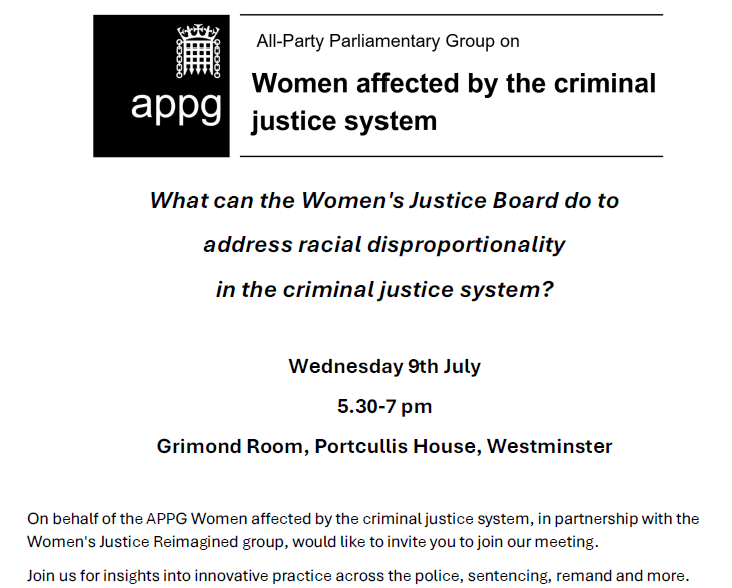
Another key event was the All-Party Parliamentary Group meeting on women in the criminal justice system. The question being addressed at the meeting was ‘What can the Women’s Justice Board do to address racial disproportionality in the criminal justice system?’. It was an opportunity for important organisations and stakeholders to stress what they believed were the key areas that needed to be addressed. Some of the charities and Non-governmental organisations were Hibiscus, Traveller Movement, The Zahid Mubarek Trust. There were also individuals from Head of Anti-slavery and Human Trafficking at HMPPS and the Deputy Mayor for Policing and Crime in London. Each representative had a unique standpoint and different calls for recommendations, ranging from:
• Hearing the voices of women affected in the CJS;
• Having culturally competent and trauma informed CJS staff;
• Ringfenced funding for specialist services and organisations like the ones that were in attendance;
• Knowing who you are serving and their needs;
• Making it a requirement to capture data on race and gender at all stages of the CJS.
It was truly great to be in a room full of individuals so ready to put the hard work in to advocate and push for change. I hope it will be one of many discussions I attend in the future.
Lastly, as I enter the final throes of writing my book on the experiences of Black women in prison I have been reflecting on what I want my book to get across, and who will be able to access it. The book represents the final outcomes of my PhD so to speak:
• To be able to disseminate the words and voices of the women that shared their stories;
• To be able to provide a visual into their lives and highlight the importance of visual research methods;
• To highlight some recommendations for change to reduce some of the pains of imprisonment faced by Black women;
• To call for more research on this group that has been rendered invisible.
Share this:


Why I refuse to join the hate train

In a world drowning in outrage, where every headline screams division and every scroll brings fresh fury, it’s easy to forget something fundamental: there’s still beauty everywhere.
Turn on the news and you’re bombarded with it all—bans, blame, and bitter arguments about who’s ruining what. Immigrants, the wealthy, the homeless, the young, the benefits claimants—everyone’s apparently the problem. It’s a relentless tide of negativity and moaning that can sweep you under if you’re not careful.
But what if we chose differently?
Here are a few things I noticed in the last couple of weeks:
I came across a book that someone left on a park bench with a note: “Free to a good home.” On another late night, a man saw a mother struggling—baby in one arm, shopping bags in the other—and didn’t hesitate to help her to her car. And if you’re thinking “why didn’t she use a trolley?” then you’re part of the problem I’m talking about, because there were no trolleys in that shop.
In another moment, a homeless person was offering water to a runner who’d collapsed in the heat, providing comfort when it mattered most.
Elsewhere, a teacher stayed late for his “troubled” student preparing for exams. When I asked why, he said: “Everyone calls him destructive. I refuse to lose hope. He’s just a slower learner, and I’ll support him as long as it takes.”
In another event, teenagers on bikes formed a protective barrier around an elderly woman crossing the road.
Small acts. Quiet kindness. The stuff that never makes headlines, doesn't trend on social media, and doesn't fuel debates.
The truth is, these things happen everywhere, all the time. While we’re busy arguing about who’s destroying society, society is quietly rebuilding itself through a million small kindnesses. The coffee lady in the Learning Hub who remembers your order. The elderly doorman at Milton Keyens Costco who draws smiley faces on reciepts and hands them to children on their way out, just to see them smile. The neighbour who randomly helps pick up litter in the neighbourhood with her girls every Sunday afternoon. The friend who texts to check in with the simple words “how are you?”
The truth is simple: for every voice spreading hate, there are countless others spreading hope. For every person tearing down, there are builders, healers, and helpers working in the quiet spaces between the noise.
Yes, problems exist. Yes, challenges are real. But so is the grandfather teaching his grandson about dignity and respect. So is the aunty teaching her niece how to bake. So is the library volunteer reading to the shelter dogs. So is the community garden where strangers become neighbours.
Today, I’m choosing to notice the nice. Not because I’m naive, but because I refuse to let the moaning and the loudest voices drown out the most important ones. The ones that remind us we’re more alike than different. The ones that choose connection over division.
Your turn: What nice thing will you notice today? Free your mind, pay attention—you'll see one.
Because in a sea of anger, being gentle isn’t weak or naive—it’s revolutionary.

 Thoughts from the criminology team