
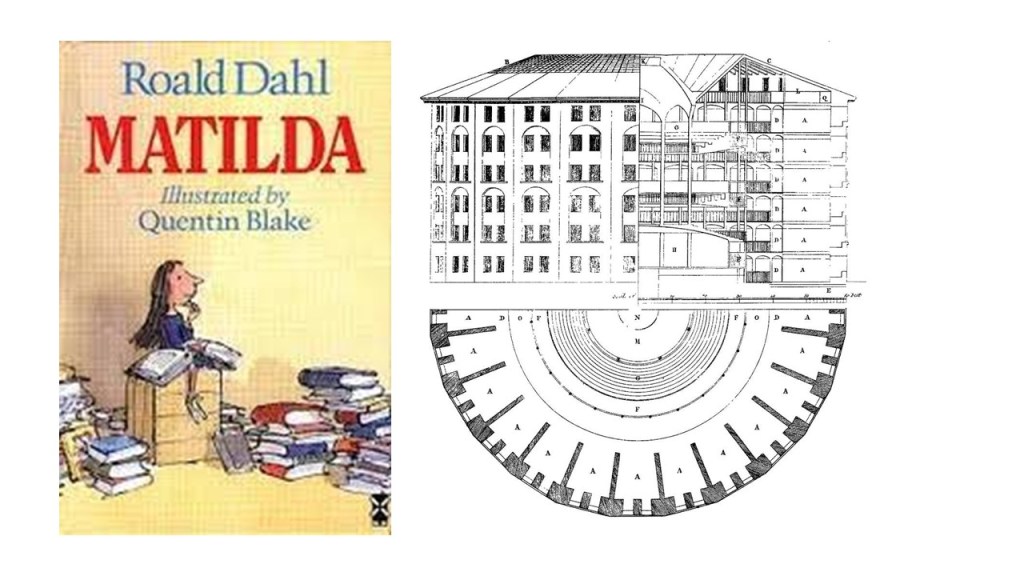
Roald Dahl’s Matilda (1988) tells the tale of a bright young girl’s discovery that she has psychic powers as she seeks to improve the situation of herself and those around her. From an unhappy home life with parents who fail to understand her, to the overthrow of the tyrannical Headmistress of her school, the book explores themes of resistance, rebellion and empowerment. It also subverts the idea that in adult/child relationships the adults hold all the power. Let us consider how theories of power are played out in the story and whether Matilda can affect real and lasting change for herself.
Matilda’s parents do not care for her physically or emotionally and make no attempts to understand her; she is treated as an inconvenience, and her cleverness is mocked and denied. Matilda’s refusal to conform with the wishes of her parents illustrates her own strength and self-assuredness and that despite the many restraints and obstacles placed on her, and on children in general, she continues to be true to herself. Despite her parents’ best efforts, she continues to speak out of turn when she knows the answer, asserts her morals when she realises her father is tricking his customers and continues to borrow and read books from the library after she has been forbidden to do so. Before she has even uncovered her telekinetic powers, she applies herself to devising “suitable punishment[s] for the poisonous parent”, in the hopes of correcting her father’s behaviour and teaching him a lesson.
In Discipline and Punish, Foucault makes several references to the ways in which schools can function as institutions, maintaining power through discipline. Claiming “the prison is like a rather disciplined barracks, a strict school […] but not qualitatively different”.
Crunchem Hall then, is the reverse: a strict school that is not qualitatively different to a prison. It is run as such, and both the children and the staff think of it in these terms. The name of the school itself represents the headmistress, Miss Trunchbull’s, educational philosophy of strict discipline and a breaking down of the children – quite literally ‘crunching them’. She relies not on mutual respect and natural authority but on public spectacles of punishment to keep them in line and Foucault reminds us to “regard punishment as a political tactic”. Examples in the text abound of the ways in which the children and Trunchbull frame the school as prison, as evidenced in the 10-year-old Hortensia’s: “welcome to Borstal”. Hortensia’s role is to warn Matilda and Lavender and tell them of the things she has done to fight back, including putting itching powder in the Trunchbull’s spare underwear and putting golden syrup on her seat: all reasons that she has ended up in “the Chokey”.
As an older character with many stories to tell, the reader is given the impression that things have always been this way and that resistance, though satisfying, is futile. Like a crude iron maiden, the Chokey itself represents the spectacle of punishment, much like Foucault’s spectacle of the scaffold, and is enough to control most of the children and ‘keep them in line’. Hortensia describes it as:
a very tall but very narrow cupboard. The floor is only ten inches square so you can’t sit down or squat in it. You have to stand. And three of the walls are made of cement with bits of broken glass sticking out all over, so you can’t lean against them. […] The door’s got thousands of sharp spiky nails sticking out of it.
A legend within the school and the threat that anyone could be punished at any time, is sufficient to mitigate the children’s behaviour. Aside from Hortensia’s stories of the many times that she has ended up in the Chokey, we hear of no other children being placed in this torture device. It is a symbolic instrument which serves the purpose of controlling the children just by existing. The Trunchbull bases her punishments on hunches and does not care if she is correct, so long as someone gets the blame. Matilda observes that this is what makes her so dangerous to the children, she is unpredictable almost to the point of madness.
Trunchbull repeatedly refers to the students with derogatory and dehumanising names: wart, poisonous pustule, foul carbuncle and othering them in the process. She uses language of crime and punishment when she refers to Bruce Bogtrotter as a “robber bandit” and a “pirate” for stealing a slice of her chocolate cake. Bruce’s punishment is being forced to consume an entire chocolate cake in front of the school, receiving no support or reprieve from the other members of staff – another example of the use of public punishment as spectacle and a means by which to control the children and make it clear who is in charge. This scene frames the battle as adults vs. children; the children united by their status as ‘crusaders’ cheering Bruce on to victory, while Trunchbull remains alone.
She gets away with the punishments she enacts because they are so outrageous and unbelievable that parents wouldn’t believe their children even if they told them – and perhaps they are just as scared of her! Trunchbull epitomises discipline and control, always watching and always ready to deliver a cruel and imaginative punishment, swinging a child by the pigtails, throwing a boy out through the classroom window, picking a child up by the ears and stretching them etc. Education, for her, is about control and stamping out the ‘childness’ in her child pupils. She abhors cleverness and the traits which mark the students out as individual from one another.
The main action of Matilda unfolds within the family home and at school, locations typically associated with adult control and discipline. Ann Alston, following Foucault, notes that families are small institutions where children are first immersed in ideology and learn that there is the possibility of constant surveillance. Children’s bedrooms, she argues, can be simultaneously a source of refuge and safety and a cell within which the child is separated from the adults and a potential site of punishment. The ways in which home and school spaces are organised reconfirm adult power and control; from who has access to which rooms, to the different discipline and rules applied within them, adults appear to hold all the cards. For Foucault, school often involves “enclosure” in a protected place of disciplinary monotony to reduce the inconveniences that come with trying to control a group of bodies in space. The very history of schools and educational establishments points to an exercising of control and power over subjects.
Matilda has limited positive adult role models available to her. A mother who favours looks over books and ignores both her husband’s illegal activities and her daughter. Miss Trunchbull who, whilst representing a self-sufficient woman with a career and an Olympics sports background, loathes children and metes out cruel punishments with no remorse. Not to mention her abuse of Miss Honey and the stealing of her estate. There are many other indicators of Trunchbull’s ‘badness’; she is large, strong, dislikes children, dresses unappealingly and is unmarried – all traits which are unacceptable to the feminine ideal. And finally, there is Miss Honey who, though kind and a good teacher, is so meek and subservient as to be completely ineffectual at saving herself or fully helping the children whom she cares for. If Miss Honey represents the perfect woman, it is damning that she is trapped by her life’s circumstances and unable to break free without the assistance of a child. Trunchbull is made monstrous by her activity and Miss Honey is stuck because of her own passivity.
Matilda is at once a story of supernatural power and a domestic story of the search for a happily-ever-after. Although Matilda achieves many things over the course of the story her goal is to find herself a loving family and the quiet home life she has been missing. Her powers recede once she has liberated Honey and adopted her as a surrogate parent; they were borne of frustration and temporary – “the power had gone. I think I have lost it completely”. Once her life is back on track and her dreams of a perfect family have been realised, she can get back on with the serious business of being a girl. In the ways in which Matilda is, on the surface, just like any other girl with “no outward signs” of her brilliance – she is quiet, unassuming and sensible – Dahl adheres to existing stereotypes of femininity without challenging them. Dahl builds limitations into the powers he gives Matilda, they will be effective just long enough for her to get her happy ending but without having to deal with the implications of a child wielding these powers into future adulthood. “But the fact remained that any five-year-old girl in any family was always obliged to do as she was told” – the message remains in place that children ultimately must defer to their parents. If she were able to keep her abilities, she would remain in a position of greater power over the adults around her and potentially struggle to fit in with the domestic mundanity of her life going forward. Would Miss Honey be so keen to care for her if she were able to wield this power at will? Dahl allows her enough, but not too much. Despite Matilda’s rejection of, or rejection by, her biological family, the end goal for her is still a traditional happy family. Leaving aside the fact that Miss Honey is single and unmarried, she can meet all the requirements that Matilda’s own parents were lacking; an appreciation for fine literature, home cooked meals, cosy domesticity and an active interest in the child’s life and interests.
Matilda reverses traditional adult and child roles by having Matilda (age 5) outsmart her parents, frighten the immovable and dangerous Miss Trunchbull and emancipate her beloved Miss Honey. Repeated references to Matilda being a somewhat “grown-up child” suggest that Dahl sidesteps the issue of giving all the power to a child by making her different and exceptional enough to not really be a child at all. She can talk, read and do advanced mathematics earlier than her peers and is shown to be just as competent, if not more, than the adults. Miss Honey feels comfortable and able to share her very adult worries and concerns with Matilda on an equal footing, but at what cost to Matilda’s childhood? By making Matilda’s achievements far beyond the reach of most children, Dahl ensures that, whilst the character is both empowering and empowered, she is no real threat to the status quo of adult dominance.
Matilda’s revenge echoes Trunchbull’s own disciplinarian techniques: she utilises constant surveillance and the omnipresent threat of punishment when she manifests the ‘ghost’ of Miss Honey’s father, Magnus. Using her telekinesis to manipulate a piece of chalk to write on the blackboard, Matilda spells out a message from the late Doctor; he has seen how Trunchbull treats his daughter, he knows she took away the house and inheritance and if she doesn’t change her ways “I will come and get you […] I am watching you Agatha”. The idea of being watched by hidden or invisible forces connotes a similar threat to Bentham’s Panopticon, discussed at length by Foucault, which has permanent effects even when there is no one actively observing. You do not need to know you are being watched to behave as if you are. The ‘ghost’ makes visible the coercive powers that Trunchbull herself has been using against the children and she is right to fear it – who wants to live with the threat of constant surveillance hanging over them? In this sense, Matilda and Trunchbull are not so different after all; they share similar ideas of punishment and discipline, and both attempt to control or change the behaviour of those around them. Matilda’s power manifests itself in a ‘ghostly’ fashion every time she uses it, and she relies on not being seen to act, playing on the supernatural fears of those around her. The anonymity of Matilda’s actions, or reactions, towards Trunchbull and her parents serves to make them more insidious, and Matilda thus avoids physical confrontation. Readers see Matilda’s behaviour as the triumph of good over evil, as being morally justified, whilst viewing the same behaviour by Miss Trunchbull as abhorrent. But could it be that Matilda is on her way to becoming one of the oppressive adults she loathes?
Works Cited:
Alston, A. The Family in English Children’s Literature Taylor & Francis, 2008.
Dahl, R Matilda, Puffin Books, 2009.
Foucault, M, Discipline and Punish, Penguin Group, 1991.
Images from L-R A copy of Dahl’s Matilda and a blueprint for the Panopticon.


