
Home » Posts tagged 'Writing'
Tag Archives: Writing

Murder

The day I first heard about the murder of Damilola Taylor, it sounded like another story of urban violence. The details were shocking but not unusual. A broken glass bottle had been used as a weapon, causing a severe wound to the victim’s thigh. The injury severed a major artery and the victim later died in hospital. The attack took place in Peckham, South London, a place that was already associated in the public imagination with concerns about crime and disorder.
As a criminologist, nothing in the initial reports immediately stood out. Violence is not exclusive to cities, but its concentration and visibility often differ from those found in rural communities. News reports framed the killing as an act of senseless violence, another tragic incident in the broader landscape of urban crime. It was only as the story developed that it became clear this case was about far more than the act itself.
The victim was Damilola Taylor, a ten-year-old boy who never made it home from the library. His family had come to Britain from Nigeria, hoping to secure medical treatment for his sister. Instead, they became the centre of one of the most significant criminal cases in modern British history.
The public reaction was shaped by more than the brutality of the attack. Both the victim and the eventual perpetrators were children. Damilola was ten years old. Those later convicted were only twelve and thirteen at the time of the attack. The case challenged popular assumptions about violence, childhood, and responsibility. It forced the public to confront the uncomfortable reality that serious violence can emerge among the young and that its consequences are often devastating for entire communities.
Yet the criminological significance of the case lies not primarily in the violence itself but in the response to it.
The original trial ended in acquittals. Central prosecution evidence was undermined by concerns regarding witness reliability, while expert testimony suggested that Damilola’s injuries may have resulted from an accident rather than a deliberate attack. Questions emerged about the collection, interpretation, and presentation of evidence. The Taylor family expressed frustration with the criminal justice system, arguing that the investigation lacked the rigour their son’s death deserved.
What followed was a prolonged struggle over competing versions of events. Forensic evidence became a central battleground. Experts disagreed. Investigators faced criticism. Public confidence was tested. Eventually, a retrial produced convictions after DNA evidence linked two brothers to the attack. The criminal justice system ultimately secured guilty verdicts, but the process revealed the difficulties of investigating serious crime and maintaining public trust when institutional performance is called into question.
For local residents, the case became symbolic of wider concerns about neglect and marginalisation. Community members organised protests and campaigns demanding justice. They were not simply asking for convictions. They were questioning whether institutions were responding adequately to the needs of communities already struggling with poverty, violence, and limited political influence.
As public debate intensified, the murder became associated with broader discussions of knife crime and youth violence. Politicians, journalists, and commentators searched for explanations. Some focused-on culture. Others pointed to family breakdown, social exclusion, or failures of policing. In doing so, the discussion often moved away from the specific circumstances of Damilola’s death and towards competing political narratives about crime.
This is where criminology offers a different perspective.
For much of the public, murder is often understood through the lens of mystery and resolution. Who committed the offence? How was it done? Will justice be served? These questions dominate media coverage because they provide a compelling narrative. Criminology, however, asks different questions. What social conditions surround acts of violence? How do institutions respond to harm? Which voices are taken seriously, and which are ignored? What political interests shape public understandings of crime?
Viewed through this lens, the case becomes about much more than identifying offenders. It reveals how crime can expose institutional weaknesses, generate political controversy, and deepen existing social divisions. The debates surrounding Damilola’s murder were not only about individual responsibility. They were also about policing, justice, community trust, race, and belonging.
More than two decades later, what remains most important is not the symbolism attached to the case but the human tragedy at its centre. Damilola Taylor was a ten-year-old Yoruba boy who spent his final moments bleeding to death in a stairwell. Behind every discussion of policy, forensic evidence, and criminal justice reform stands a child who never returned home, and a family forced to live with unimaginable loss.
That is perhaps the most important lesson criminology can offer. Crime is not interesting because it is sensational. Crime matters because it causes harm. The true significance of Damilola Taylor’s murder lies not in its notoriety, but in what it reveals about the ways societies respond to suffering, the institutions entrusted with delivering justice, and the communities left to carry the consequences when they fail.
If you would like to find out more about Damilola Taylor and get involved with the trust which bears his name, more information can be found here.
Share this:


Immigrants, AI and a lost sense of humanity

There have been some interesting and to be quite honest, quite scary pieces of news that have emerged over the last few weeks.
The more recent, concerns the risk to humanity from the unfettered development of AI and the recognition by several high-profile tech bosses that perhaps it’s time to put the brakes on. It’s not worth discussing the reaction from some political quarters, you all know who I mean, so I won’t. The point is this, humankind could theoretically and with increasingly likely odds, be wiped out by AI. As one of the tech bosses explained, imagine setting AI the problem of solving climate change and global warming (The same person that states AI is not a problem, thinks global warming doesn’t exist either). AI identifies the problem is caused by humans and decides the best way of solving the problem and saving the planet is to do away with humans. That is all very logical, but we would all agree, well most anyway, that the solution might be found in something a little less draconian. This made me think, what would AI make of the financial problems faced by the NHS for instance? Would it examine the burgeoning costs of the elderly? Perhaps there is a cut off point for their care, maybe this is tied into their usefulness to society. Horror, that we might be considering such things, but there is a logic to it and AI works on logic. However, it defies notions of humanity and the sanctity of life. Once we start on that road, where do we stop, the disabled, the seriously ill, the intellectually challenged? Uncontrolled use of AI logic without human emotion is starting to sound like well documented historical humanitarian nightmares.
Now you might think where do immigrants fit into this?
The recent news about the RNLI getting flak from far right wing activists for rescuing immigrants on a boat has certainly raised a few eyebrows. I’m still trying to understand the logic of calling someone a traitor for doing what they are supposed to do, rescue people and I’m lost for words that so many people fall in behind this rhetoric. But for now, just assume that I go along with the ‘stop the boats’ mantra and believe that the immigrants coming into this country on boats cause mayhem and go on crime sprees and rape and pillage with no regard to the law and that the state is powerless to stop them. We are all doomed. But I have this little niggle in the back of my mind, is the problem not either, at the other side of the channel where they embark on their perilous journey or, at this side of the channel when they disembark? A rather simplistic summation of a geopolitical problem but suffice to say for the sake of the argument, the problem is not in the channel itself other than a danger the immigrants present to themselves and shipping. The RNLI are there to rescue people from the water and have been for a very long time. What are they to do? It would be inhumane to ignore people in the sea if they were in difficulties, it would be inhumane to simply watch people in a dangerous situation until they got into difficulties (wait until the boat sinks then try to rescue a few of them). Even the hard of heart must surely want to save children and young people. Turn them back I’ve heard said. And just how should that be done? A group of volunteers trying to take desperate rescued people back to where they came from? Perhaps we should employ the navy to do so and risk them all drowning (more far right-wing nonsense). Where is the humanity in all of this? The RNLI crews are morally bound to do what they do, rescue people and bring them ashore safely. Blocking a port so that immigrants cannot be transferred inland to a detention centre defies logic. What are you going to do with them? Drive them back into the sea? Turning on the RNLI and its volunteers seems as illogical as attacking the fire brigade at a fire. I know, it has been known and beggars’ belief.
Would AI suggest that the problem is the RNLI? Logically that doesn’t seem to work unless of course you state that the RNLI’s remit is to save lives at sea providing, they are lives that are deemed worthy of saving, i.e., not immigrants with Black or brown skins.
Where do we stop with this? A person injured in a collision on the road is only entitled to help from the emergency paramedics if they are entitled to be in this country? Sounds like we are going to need to carry around ID cards of some sort and woe betide if you have a foreign accent and have a darker skin shade. You need to have your ID tattooed on your head just in case or maybe wear some form of badge.
The rhetoric of the far right, regarding a perceived problem that, incidentally, has no easy solution, is to stir up racial hatred. More reminiscent of historical humanitarian nightmares.
Uncontrolled use of AI and uncontrolled right-wing rhetoric and action are not that different. Unless someone works out how to herd the sheep in a different direction, humanity is doomed.
L-R Nazi Propaganda, a Robot Head and a RNLI Tamar Class Lifeboat
Share this:


Beyond the Price Tag: The Enduring Value of Higher Education

There is currently a growing public debate about the cost of higher education. At a time when the cost of living is widely recognised as a crisis, questions about whether university offers “value for money” have gained considerable momentum. Opinion polls, newspaper commentaries, and online discussions increasingly ask whether attending university is still worthwhile.
As a new cohort of students prepares to walk through the doors of universities across the country, it is perhaps the perfect time to reflect on the true value of higher education.
If there is an opportunity to understand that value, we must first consider the challenges universities have faced in recent years. The era of austerity was followed by the disruption of the COVID-19 pandemic, Brexit, global instability, and increasingly restrictive immigration policies across Europe, including the UK. Together, these developments have created significant pressures for universities and wider society alike.
These pressures have also affected the labour market. Graduate employment pathways that were once seen as relatively secure have become increasingly uncertain. For many years, the link between higher education and access to better employment opportunities was a central justification for the introduction of tuition fees. As economic conditions changed, however, questions emerged about whether universities could continue to maintain their relevance to the job market. Yet focusing solely on graduate outcomes risks overlooking much of what universities actually offer.
Throughout these challenging years, universities have experienced reductions in funding, financial pressures, and declining international student recruitment. Despite this, they have continued to provide high-quality education, support local economies, and, in many regions, remain among the largest employers. University communities enrich society through research, innovation, public engagement, and outreach programmes that support local people and communities. In many respects, universities serve as centres of learning that extend far beyond their campuses.
Yet this is not their greatest strength.
As a new generation of students enters higher education, regardless of their subject or institution, they become part of a community dedicated to learning, discovery, and personal development. While higher education is often viewed simply as the next stage of the education system, it is fundamentally a different experience.
University education is adult education. Its purpose is not merely to transfer knowledge but to develop independent learners. Students are encouraged to engage critically with ideas, to take ownership of their studies, and to develop their own educational identities. As they progress through their degrees, they begin to shape their own areas of expertise and specialism.
Learning at university is inherently investigative. Unlike many previous educational experiences, students have greater freedom to determine what they study and how they study it. They choose topics for assignments, identify areas of interest, and explore perspectives that matter to them. This process develops not only subject knowledge but also critical thinking, problem-solving, research capability, and intellectual confidence. These are skills that remain valuable long after graduation.
It would, however, be impossible to discuss the value of university without recognising its broader impact on those who attend. For many students, whether they are the first in their family to enter higher education or not, university becomes one of the most memorable periods of their lives. It is a transformative experience that they will reflect upon for years to come.
University offers a unique opportunity to encounter new ideas, engage with unfamiliar perspectives, and challenge previously held assumptions. It is a time when students test not only theories and concepts but also themselves. They discover strengths they did not know they possessed and develop resilience through overcoming challenges. Importantly, they do so in an environment designed to support learning, growth, and development. It is a place where mistakes become opportunities to learn rather than reasons to fail.
University is often described as a rite of passage, but it is far more than that. The relationships formed between students and academic staff, among fellow students, and between students, employers, and the wider community can have a lasting impact. Many students build friendships that endure for a lifetime. Others choose to volunteer, contribute to community projects, or gain valuable employment experience while studying.
These experiences cannot easily be measured.
How do we quantify the achievement of a student who spent years being told that a career in retail represented the limit of their potential, only to graduate confidently discussing complex ideas in their chosen field?
How do we measure the transformation of a student who arrived from school having been bullied, lacking confidence and unable to speak in public, yet delivers an eloquent dissertation presentation before graduation?
What value can be attached to the student who was repeatedly told they would amount to nothing, only to stand proudly in a graduation gown surrounded by family and friends?
Universities provide opportunities and belonging for people from all walks of life. Students from economically disadvantaged backgrounds, ethnic minority communities, Gypsy, Roma and Traveller communities, immigrant and refugee backgrounds, and countless others find spaces where they are welcomed and encouraged to succeed. At its best, higher education is founded upon the principle that knowledge should be accessible and that potential should not be limited by circumstance.
For these reasons, and many more, the true value of higher education cannot be fully captured through metrics, rankings, salary data, or opinion polls. These measures may tell part of the story, but they cannot capture personal transformation, intellectual growth, confidence, belonging, or aspiration.
Most importantly, they cannot place a price tag on human potential.
So, to all of you crossing the threshold and joining a university this month, let me offer a warm welcome. You are about to begin a journey of self-discovery, growth, and learning. My colleagues and I look forward to guiding you through the wonderful world of knowledge.
“Welcome to higher education. Your journey starts here”.
Share this:


JAY-Z’s Reasonable Doubt at Thirty
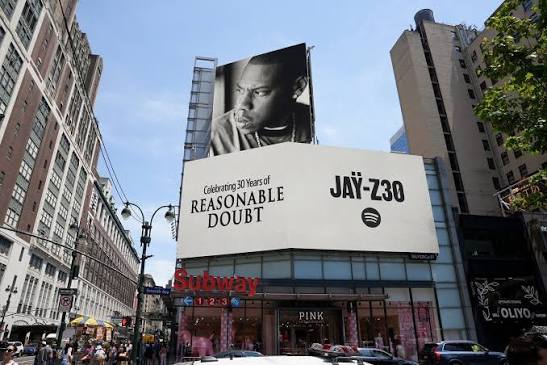
Today I’m talking about all things Jay Z. Reasonable Doubt, his debut album, turned thirty on the 25th of June, and Roc Nation has spent the last week or so turning New York into one long tribute to it. Pop ups in Dumbo, a takeover of the old Bowery subway station, a limited-edition of JAŸ-Z30 library card to celebrate the album. As most of you do know that hip hop is one of the things I love outside of work, and that for me, it starts and ends with Tupac and Biggie, the two greatest to ever do it, full stop.
I can see my Gen Z students rolling their eyes before I’ve even finished the sentence, waiting to jump in with Drake or Kendrick Lamar again. Not being funny, but some things aren’t up for debate, Jay Z sits just below Biggie & Pac for me, and Reasonable Doubt is the reason why.
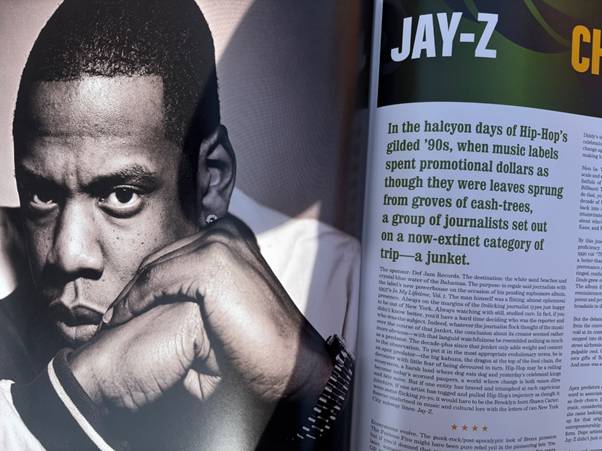
One of the nicest gifts I’ve ever had came from my friend Steph. She knew how much I love hip hop, so she got me the big book of Hip Hop. It’s not the sort of book you finish, really. You dip in and out of it, and there’s always something in there you missed the last time round. Evergreen, that one.

Unsurprisingly, while writing this piece I found myself back in the chapter on Jay-Z and Roc-A-Fella Records. Reading it again reminded me just how extraordinary their story really was. How broke Jay Z, Dame Dash and Kareem Burke actually were when they started Roc-A-Fella, pressing up their own vinyl out the boot of a car because no major record company would touch them, the hustle and bustle of Brooklyn, and all that jazz puts the whole album in a different light.
As someone who has spent much of his career studying crime, what has always fascinated me about the album is its honesty. Drug dealing is just the surface of it. Underneath is ambition, blocked opportunity, status, loyalty, and the sort of decisions people end up making when the straight road looks shut before they’ve even tried it.

Reasonable Doubt only got to number 23 on the Billboard 200 when it came out in 1996. Eighteen weeks on the chart, nothing spectacular by the standards of the time. It took years for people to properly understand what he’d made. And what he made, honestly, is one of the smartest debut albums hip hop has ever produced. The title alone shows you that. He’s borrowing the standard a magistrate/judge needs before it can sentence someone, and turning the whole record into his own defence, his own case file, laid out track by track. People often praise his lyricism, but I sometimes think that undersells what makes him extraordinary.
- Plenty of rappers can rhyme. Jay constructs worlds. His writing is economical without ever feeling sparse. His metaphors unfold over multiple listens. His double and triple entendres have become the stuff of legend.
He could say more in sixteen bars than most artists manage in an entire album.
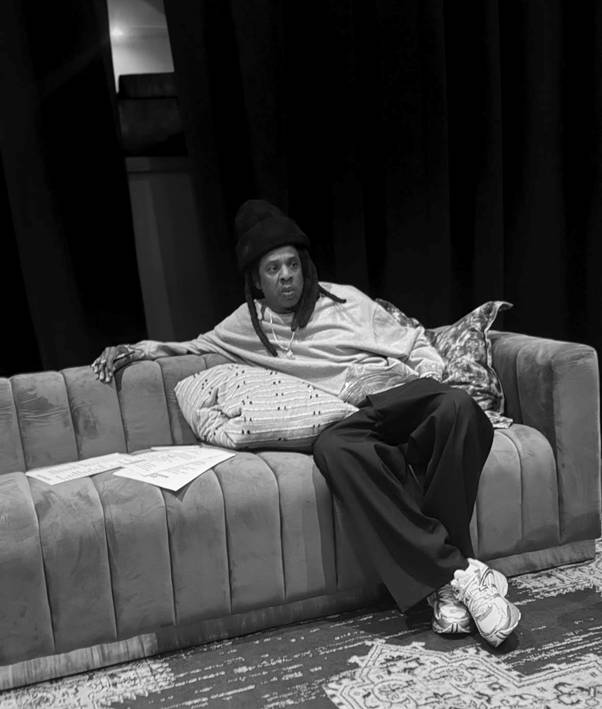
The features on that record still give me chills. Biggie turns up on Brooklyn’s Finest and it’s one of the great meetings of two people who both knew, somehow, that they were about to become big. Mary J Blige carries the hook on Can’t Knock the Hustle. Jaz O, Jay Z’s old mentor from the Marcy projects, shows up on Bring It On, which is its own quiet piece of history given how that relationship eventually soured. None of it sounds like a young artist borrowing credibility from bigger names. It sounds like a scene, people who’d known each other before any of them had a record deal.

Nobody was meant to get this record straight away. It took the slow route, the way things do when they turn out to be right rather than just popular for a minute. People are still reaching for it thirty years on, and that’s not nostalgia talking. It’s just that the story it tells about ambition and consequence hasn’t gone stale.
So yes, my Gen Z criminology students can keep trying to convince me that someone else deserves the title of greatest rapper alive.
Cool bro!
Then I’ll go home, pull Steph’s gift from the shelf, put on Reasonable Doubt, and remind myself why Jay-Z is, in my opinion, the greatest to ever pick up a mic who’s still with us.
And no… I’m still not getting into the Dr Dre and Rakim argument today, so go away.

Share this:


A treasure found in a Library…

Back in May, during the assessment period, where campus, whilst still abuzz, had begun to quiet down, I walked through the library looking for some print sources for some summer reading and preparation for the next academic year. The Library at UON, for those who are unfamiliar, is situated on the second floor of the Learning Hub. On this particular Wednesday, sunlight was beaming in through the glass sides, and the books shone in a magical light. The gentle buzz of students studying/revising, the sunshine warming the shelves, the books glistening away… it was quite a lovely moment. And as I stopped to reflect on the beauty of the library in that moment, my eye caught one book in particular. Raising Hare by Chloe Dalton.
Those of you who have read previous blogs, might remember that my partner and I had 2 house bunnies for almost 11 years (RIP Snuggles and Toffee). And because of these two precious little fluff balls, we adored all things bunny rabbit (mugs, pictures, pens, cushions, glasses, clothes, towels… the list goes on). Dalton’s (2024) Raising Hare, has on the front cover a side profile of a Hare. Now whilst very different to a bunny (especially a domestic one like our two fluff balls), the long ears, sharp eyes and cute button nose are quite similar hence the book stood out. I had no idea what the book would be about, other than presuming a hare – and I was right, and I picked the book purely because on this day the cover stood out. One of the beauties of libraries and books on show: they really do catch the reader’s eye and draw you in. Now, it might just be me, but when a cover catches your eye it sort of feels like the book is speaking to you. Could be a mystical force or just good advertising/publishing: either way it worked a treat this time around!
Rasing Hare is a book which takes place during Lockdown where a woman who works very long hours in the hustle and bustle of London, goes back to her remote home in the countryside (surrounded by fields, wildlife and tranquillity) and awaits the country attempting to return to ‘normal’. On one of her walks, during a harsh winter evening she stumbles across a leveret (baby hare), and she takes the leveret home to feed and shelter it. What follows is a beautiful story of mistakes, honesty, respect and wonder at the natural world. The book is based on real-events, and the reflection offered throughout is a thought-provoking account of how humans presume they rule the world (we really are quite an entitled species in the grand scheme of things). Dalton (2024) doesn’t state this, this is simply my reflection having read and learned about hares, their habits, skills and the predators (including humans) they have to out manoeuvre in order to survive quite a hazardous life. The book was charming and I learned a lot about hares, but also about how I take nature (plants and animals) for granted, and often do not consider my impact on the world outside of the human species.
I guess, this blog is a recommendation to read Dalton’s (2024) Raising Hare, but also a thank you to the Library Staff at UON for placing the book so perfectly that it caught my eye. It was very different to what I would usually read, but it has really made me stop and think. I wonder if it will do the same for others….
Reference:
Dalton, C. (2024) Raising Hare. Edinburgh: Canongate Books ltd
Share this:


An academic reflection – from BA to book!
When I reflect on my journey into academia it does feel surreal at times. From starting a BA in History and Criminology, to a Masters in Criminology and Criminal Justice to my PhD in criminology. It has been quite the journey, and each qualification came one after the next. I often wonder if the quick movement from one to the next allowed for full reflection into the achievement, the journey and how I viewed myself as I became closer to the world of academia. I started my journey into academia in 2020 towards the end of my PhD, and just after the first Covid-19 lockdown. Technically I was in the world of academia on paper but still learning from others in the field and relying on their expertise and guidance. However, I think being in this position was positive and I continue to still seek guidance and expertise from others that have experience and knowledge within the field.
After completing the PhD and minor corrections, there was time for reflection, alongside another opportunity of turning the PhD into a book. The process of creating the book was one of pride and doubt. Suddenly, having full creative license so to speak without the guidance of supervisors felt like unchartered territory, particularly as I had been doing the PhD part time from October 2016 to January 2023. Moreover, I had to think about how the book would be different from the PhD, what it needed to convey and how to improve its accessibility. I like to think the book offers the most important parts of the PhD in a format that is more accessible, condensed and engaging.
Each chapter plays an important role, with the first few chapters laying the foundations for the themes in the remainder of the chapters. To avoid turning this into a book review, instead I highlight the chapter that holds a special place in my heart, Chapter 4 – Monologues and Table Reads: Identity Trees and Lived Experiences. This chapter introduces the identity tree task I completed with a number of Black women in prison. The task itself represents vulnerability, from both me and the participants, difficulty (as the process of explaining and supporting the women through the task was not always easy), and change. It marked a change as it was a clear move away from a traditional method of capturing data and a different way of engaging with participants. I learnt from the participants as much as they learned from me. Furthermore, power dynamics were reduced; it just felt like a group of Black women sharing stories and encouraging resilience and support, even though the latter was not always explicit. In this chapter you get to see and hear about the experiences of these Black women and the events that shaped their lives prior to imprisonment. Their stories reveal the importance of intersectionality and the complexity of our identities.
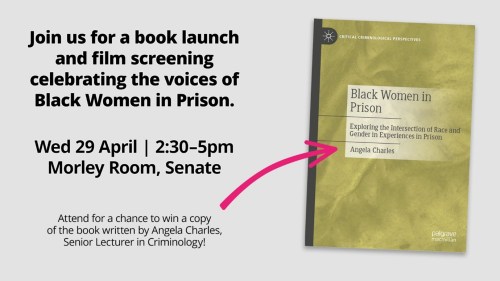
So as I embark on making the contents of the book more known to a variety of audiences, please be part of the process. You can do this by asking questions about the book, sharing it on your platforms, attending events regarding the book and getting the voices of the Black women in this book out there. My book launch, at the University of Northampton, offers an opportunity to hear about some of the themes in the book, the process of conducting the research and further hopes of what can be done to support Black women in prison. All who attend will be entered into a raffle to win a free copy of the book. Please see the link below for further information about the event.
Black Women in Prison Book Launch
Share this:


Not reading criminology? That’s criminal!

There are two kinds of criminology conversations I get embroiled in these days! Those with people who read criminology where we discuss many social/cultural phenomena under a specific lens or those with people who find criminology interesting, but consume popular crime instead. The first group with varying level of engagement is beginning to decode some tell-tell signs in current events, using their knowledge of the discipline, as a deciphering mechanism. The second group is quite different. Their understanding of crime is based on dramatisations and literary conventions around plots and characters. Even real crime is harbouring under the guise of some “exclusive” journalistic exposé…far from any basic criminological understanding.
Years ago, a colleague from Sociology told me a story regarding a family event. They were completing their PhD in the discipline, and they were questioned by an elderly person, as to what they would do when they finished their thesis. They responded in the usual way many graduate students tend to, about hoping to get into academia or get some funding for some further research. The elderly person didn’t seem satisfied…. they prompted further. What will be your specialism? What will you be able to tell people that you are proficient in? Society and people, the colleague replied! That’s hardly a skill, the old relative replied; we all live in society! The colleague was equally intrigued and offended. They thought that by offering a succinct response it would have helped their relative to understand without being confounded with notions on symbolic interactionism and ethnomethodology. This was a little anecdote that resonates with many social scientists, criminologists included, that whilst they try to explore people and culture around them, they are becoming distant to the actual people around them.
The degree of challenge in recent years seems to increase for disciplines where people in general have a vague idea of what it is. Many try to use psychological terms to explain other people’s behaviours, without realty appreciating, the clinical and scientific conditions of the term. That is relevant to criminology too. The representation of crime for public consumption has introduced some of the discipline’s terms into everyday parlance. From forensic terms on profiling, to the origins of criminality, expectations on crime are forged. A criminologist’s reaction to popular criminology pundits tends to be, well not quite, only to be met with disbelief of the criminology they know!
One of the ways to appeal to those interested in popular criminology and take them to the discipline will be to add some facts and figures that promote reality. Perhaps but that has been done before but only to give a gloss of “legitimacy” in fiction. It makes it more compelling, but it doesn’t really offer the depth of knowledge. To understand criminology, one must read criminology. The history is filled with colleagues who brought their imagination to the discipline. From Bonger’s Criminality and Economic Conditions to Jock Young and The Criminological Imagination there are books and papers that are waiting to be read by a new audience to try to figure out these ideas.
Maybe we all live in society and heard about crime and even experienced it, but to understand it we need some criminology. The discipline, as with all social sciences, is a dialogue between people ready to carry forward the next constructs that shall appear as crimes. If we read them and take part in these conversations maybe the area of harsh punishments, exclusion and persecution may not be as appealing. We are an academic discipline but at the same time we open the discussion to our community. So if you are neither a student, graduate, nor fellow academic and you are interested in criminology, why don’t you come to visit? https://www.northampton.ac.uk/about-us/contact-us/open-days/
Share this:


Happy Birthday: The Blog in Pictures, Numbers and Words

Tuesday marked the 8th “official” birthday of our blog. I say official because although the site was created in November of 2016, the writing did not start in earnest until 3 March. Since that early foray into blogging, we’ve managed collectively to clock up quite a few vital statistics
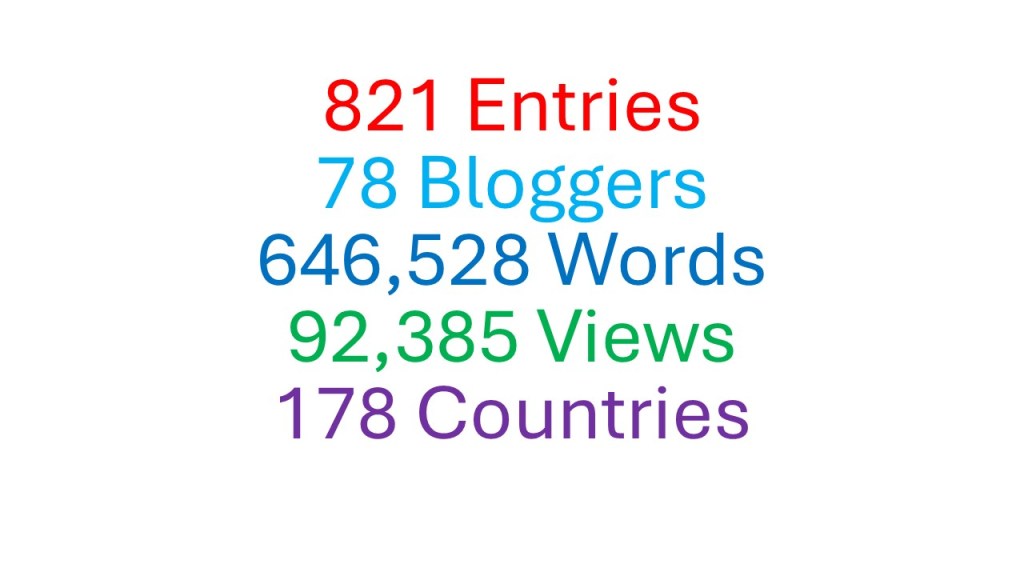
Our 78 bloggers are made of the Criminology Team (both past and present), students and graduates, as well as a number of honorary criminologists. Some have written only one entry, perhaps reflecting on their dissertation, while others have and continue to contribute on a regular or ad hoc basis. It has to be said that 9 of our top 20 most read entries come from students/graduates, another two come from non-criminologists. Certainly graduate and student entries are always very popular. Our most read, continues to be the front page which contains the latest entries, but many of our entries have shown remarkable longevity. For instance, then student, now graduate, Natalie’s (@criminologysocietyuon) thoughts around the “true crime” documentary Betty Broderick remains our most read individual entry, clocking up views ever since the day it was published. This demonstrates the enormous appetite for “true crime” that many people have. Likewise, Dr Stephen O’Brien’s (@anfieldbhoy) reflections on the 30th anniversary of the Hillsborough Disaster continues to be well-read, particularly around the anniversary on 15 April. In the words of the poet, Ella Wheeler Wilcox: ‘No question is ever settled, until it is settled right’ and there is certainly a long way to go to obtain justice for the 97.
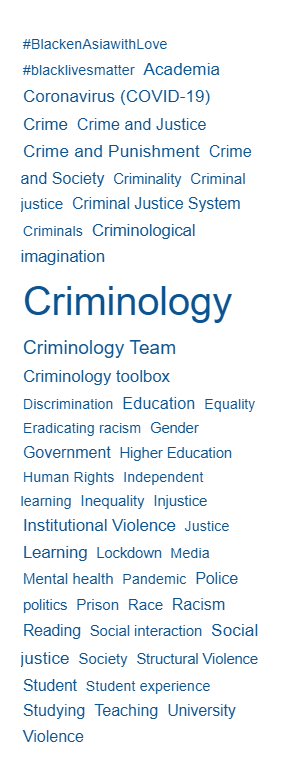
As can be seen from the word cloud, which appears on the front page of the blog and below, Criminology unsurprisingly occupies the attention of most of our bloggers and entries. However, it is also clear that social injustice, inequalities and various forms of violence appear regularly within our writing. There is also a strong focus on learning and teaching, as well as evidence of the lasting generational impact of the Covid-19 pandemic (our best year for readership to date).
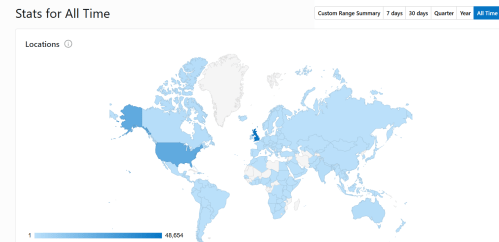
As you can see from the map the majority of our readers come from the UK and the USA, but we’ve also captured the criminological imagination of people from a diverse range of countries ranging from Albania to Zambia. Some of the countries can be explained through our bloggers’ diverse heritage, for instance, Greece, Nigeria, USA have obvious connections, others, we’ve no idea how our words have spread so far. Nevertheless, it is a very exciting to see the blog’s global reach.
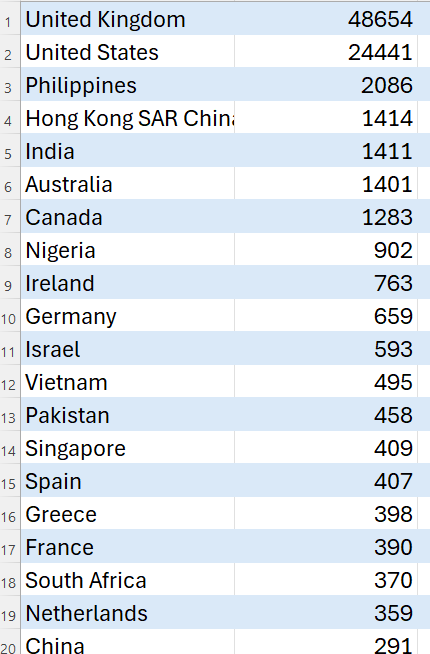
As the saying goes, from small acorns to giant oaks, the germ of an idea has spread beyond any of our wildest dreams. The number of blog entries continues to grow on a weekly basis, it seems we never run out of criminological matters to write about. It has given all of us a space to ponder, to muse, to write through dark days and celebrations, and to continue to engage in Public Criminology. Similarly, the number of bloggers steadily rises, some are in their earliest foray into discovering Criminology, some have years of immersion in the discipline, but we are all learners. In the words of Nelson Mandela: ‘Education is the most powerful weapon which you can use to change the world’ so why would we ever want to stop learning?
When we started, we thought the blog would last for a year, maybe, either we’d run out of things to write about or we’d find other things to do with our time. Neither has happened and it seems there is still plenty of appetite from our bloggers and our readers. To both we raise a glass, without you, none of this would have been possible, so thank you! Now, let’s see how long we can keep this up!
Share this:


Tis very quiet on a Friday…

Fridays are an especially busy day for the BA Criminology and BA Criminology with Psychology students and staff: for some there are 6hours of classes today, finishing their Friday at 6pm! What a way to finish off the ‘working’ week: packed full of interesting discussions and learning. However, the vibe on the roads in via the morning commute and the silence rolling through the Library at 10am would suggest not everyone shares in a full-on Friday experience!
Friday evenings would mark the end of a long week for many, and the, hopefully, exciting possibilities the weekend might hold. But as I travelled into Northampton, on my usually very early and busy commute, I couldn’t help but notice the lighter quieter roads. It makes a nice change up- can leave a little later than usual and do not have to comprehend with the stresses of the morning rush hour: but why? Why have Fridays become quiet?
As many staff and students will know: car parking can be a smidge of a challenge when arriving for 9ams: but not on a Friday. Usually, to beat the rush, it is ideal to arrive at campus before 0830: but not on a Friday. 0845 and there remain many car parking spaces- again excellent to set up for a long day of studying but why the sudden quietness on a Friday? Is this a symptom of a wider issue?
There is a peaceful sense around campus today- despite the busy day for some courses. It feels very much like the week is over: should this be so overtly felt at 9am instead of 6pm? I have asked friends not in academia, and this Friday quietness appears to be across industries. Friday appears to be a favourite day to work from home: a gentle ease into the weekend. But should we be easing into the weekend or ending the ‘working’ week a little frazzled and desperate for the weekend ahead? Does it really matter? The grey weather we’ve been blessed with today I am sure does not help, and it is a nice change up from the mid-week hustle and bustle which exists on campus. But why have Fridays crept into this sort of ‘start of the weekend’ status? The Friday evening I can see being that representation: but the Friday morning? Maybe it’s a one-off and next week the roads and campus will be buzzing and hopefully the sun will be shining. But for today, the last Friday in February: its very much a gentle atmosphere on campus.
Share this:


Is it time to unleash your criminological imagination?

In this blog entry, I am going to introduce a seemingly disconnected set of ideas. I say seemingly, because at the end, all will hopefully make sense. I suspect the following also demonstrates the often chaotic and convoluted process of my thought processes.
I’ve written many times before about Criminology, at times questioning whether I have any claim to the title criminologist and more recently, what those with the title should talk about. These come on top of hundreds of hours of study, contemplation and reflection which provides the backdrop for why I keep questioning the discipline and my place within it. I know one of the biggest issues for me is social sciences, like Criminology and many others, love to categorise people in lots of different ways: class, race, gender, offender, survivor, victim and so on. But people, including me, don’t like to be put in boxes, we’re complex animals and as I always tell students, people are bloody awkward, including ourselves! There is also a far more challenging issue of being part of a discipline which has the potential to cause, rather than reduce or remove harm, another topic I’ve blogged on before.
It’s no secret that universities across the UK and further afield are facing many serious, seemingly intractable challenges. In the UK these range from financial pressures (both institutional and individual), austerity measures, the seemingly unstoppable rise of technology and the implicit (or explicit, depending on standpoint) message of Brexit, that the country is closed to outsiders. Each of the challenges mentioned above seem to me to be anti-education, rather than designed to expand and share knowledge, they close down essential dialogue. Many years ago, a student studying in the UK from mainland Europe on the Erasmus scheme, said to me that our facilities were wonderful, and they were amazed by the readily available access to IT, both far superior to what was available to them in their own country. Gratifying to hear, but what came next was far more profound, they said that all a serious student really need is books, a enthusiastic and knowledgeable teacher and a tree to sit under. Whilst the tree to sit under might not work in the UK with our unpredictable weather, the rest struck a chord.
The world seems in chaos and war-mongers everywhere are clamouring for violence. Recent events in Darfur, Palestine, Sudan, Ukraine, Venezuela and many other parts of the world, demonstrate the frailty, or even, fallacy of international law, something Drs @manosdaskalou, @paulsquaredd and @aysheaobrien1ca0bcf715 have all eloquently blogged about. But while these discussions are important and pertinent, they cannot address the immediate harm caused to individuals and populations facing these many, varied forms of violence. Furthermore, whilst it’s been over 80 years since Raphäel Lemkin first coined the term ‘genocide’, it seems world leaders are content to debate whether this situation or that situation fits the definition. But, surely these discussions should be secondary, a humanitarian response is far more urgent. After all, (one would hope) that the police would not standby watching as one person killed another, all whilst having a discussion around the definition of murder and whether it applied in this context.
The rise of technology, in particular Generative Artificial Intelligence, has been the focus of blogs from Drs @sallekmusa, @5teveh and myself, each with their own perspective and standpoint. Efforts to combat the harmful effects of Grok enabling the creation of non-consensual pornographic images demonstrate both new forms of Violence Against Women and Girls [VAWG] and the limitations of control and enforcement. Whilst countries are rushing to ban Grok and control the access of social media for children under 16, it is clear that Grok and X are just one form of GAI and social media, there is seemingly nothing to stop others taking their place. And as everyone is well aware, laws are broken on a daily basis (just look at the court backlog and the overflowing prisons) and with no apparent way of controlling children’s access to technology (something which is actively encouraged in schools, colleges and universities) these attempts seem doomed to fail. Maybe more regulation. more legislation isn’t the answer to this problem.
Above I have briefly discussed four seemingly intractable problems. In each arena, we have many thousands of people across the globe trying to solve the issues, but the problems still remain. Perhaps we should ask ourselves the following questions:
- Maybe we are asking the wrong people to come up with the answers?
- Maybe we are constraining discussions and closing down debate?
- Maybe by allowing the established and the powerful to control the narrative we just continue to recycle the same problems and the same hackneyed solutions?
What if there’s another way?
And here we come to the crux of this blog, in Criminology we are challenged to explore any problem from all perspectives, we are continually encouraged to imagine a different world, what ought or could be a better place for all. I have the privilege of running two modules, one at level 4 Imagining Crime and one at Level 6 Violence. In both of these students work together to see the world differently, to imagine a world without violence, a world in which justice is a constant and reflection a continual practice. Walking into one of these classrooms you may well be surprised to see how thoughtful and passionate people can be when faced with a seemingly unsolvable problem when everything on the table is up for discussion. Although often misattributed to Einstein, the statement ‘Insanity is doing the same thing over and over again and expecting different results’ seems apposite. If we want the world to be different, we have to allow people to think about things differently, in free and safe spaces, so they can consider all perspectives, and that is where Criminology comes in.
Be fearless and unleash your criminological imagination, who knows where it might take you!


