

Over the last few weeks I have been in deep thought and contemplation. This has stemmed from a number of activities I have been involved in. The first of those was the Centre for the Advancement of Racial Equality (CARE) Conference, held on the 1st July. The theme this year was “Illustrating Futures – Reclaiming Race and Identity Through Creative Expressions.” It was a topic I have become both passionate and interested in over the last few years. It was really important to be part of an event that placed racial equality at the heart of its message. There were a number of speakers there, all with important messages. Assoc. Prof. Dr Sheine Peart and Dr Richard Race talked about the experiences of racialised women in higher education. They focused on the micro-aggressions they face, alongside the obstacles they encounter trying to gain promotions, or even to be taken seriously in their roles. Another key speaker during the conference was Dr Martin Glynn, unapologetically himself in his approach to teaching and his journey to getting his professor status. It was a reminder to be authentically yourself and not attempt to fit in an academic box that has been prescribed by others. As I write my first academic book, his authenticity reminded me to write my contribution to criminology in the way I see fit, with less worry and comparison to others. It was also another reminder not to doubt yourself and your abilities because of your background or your academic journey being different to others. Dr Glynn has and continues to break down barriers in and outside of the classroom and reminds us to think outside the box a little when we engage with our young students.
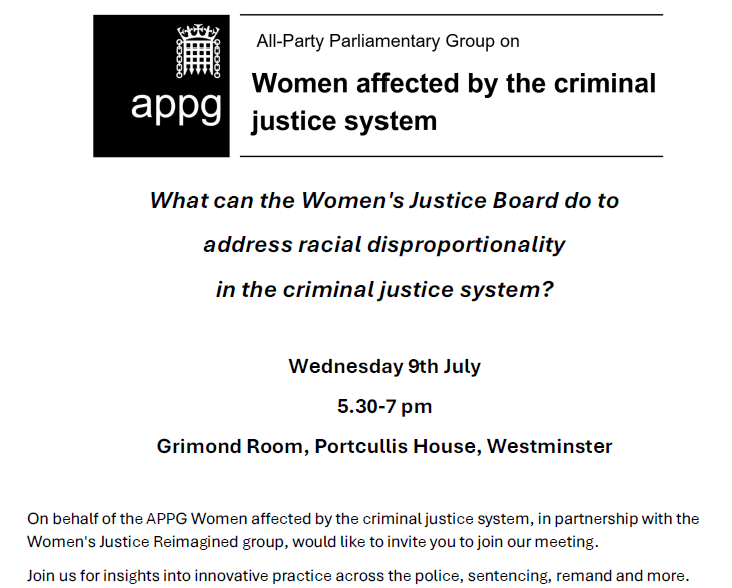
Another key event was the All-Party Parliamentary Group meeting on women in the criminal justice system. The question being addressed at the meeting was ‘What can the Women’s Justice Board do to address racial disproportionality in the criminal justice system?’. It was an opportunity for important organisations and stakeholders to stress what they believed were the key areas that needed to be addressed. Some of the charities and Non-governmental organisations were Hibiscus, Traveller Movement, The Zahid Mubarek Trust. There were also individuals from Head of Anti-slavery and Human Trafficking at HMPPS and the Deputy Mayor for Policing and Crime in London. Each representative had a unique standpoint and different calls for recommendations, ranging from:
• Hearing the voices of women affected in the CJS;
• Having culturally competent and trauma informed CJS staff;
• Ringfenced funding for specialist services and organisations like the ones that were in attendance;
• Knowing who you are serving and their needs;
• Making it a requirement to capture data on race and gender at all stages of the CJS.
It was truly great to be in a room full of individuals so ready to put the hard work in to advocate and push for change. I hope it will be one of many discussions I attend in the future.
Lastly, as I enter the final throes of writing my book on the experiences of Black women in prison I have been reflecting on what I want my book to get across, and who will be able to access it. The book represents the final outcomes of my PhD so to speak:
• To be able to disseminate the words and voices of the women that shared their stories;
• To be able to provide a visual into their lives and highlight the importance of visual research methods;
• To highlight some recommendations for change to reduce some of the pains of imprisonment faced by Black women;
• To call for more research on this group that has been rendered invisible.

 Thoughts from the criminology team