
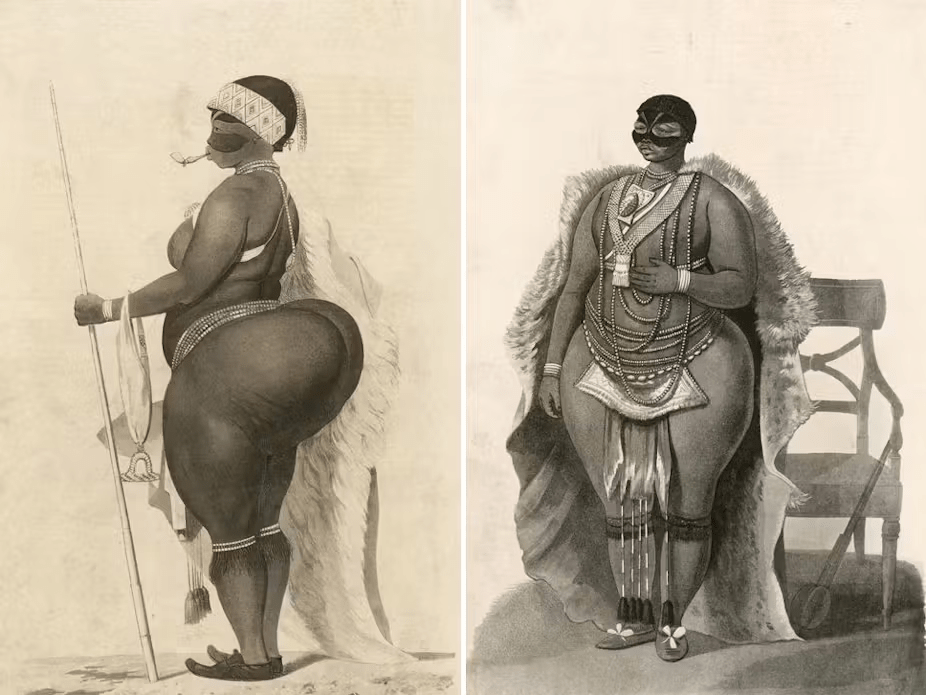
Sarah Baartman. Image source: https://shorturl.at/avLO4
In the 20th century, many groups of people who had been overpowered, subdued, and suppressed by imperialist expansionist movements under arbitrary boundaries began challenging their subjugation. These emancipation struggles resulted in the emergence of quasi-independent, self-governed African nation-states. However, avaricious socio-economic opportunists were aided into political leadership and have continued to perpetuate imperial interests while crippling their own emerging nations. Decades later, it has become clear that these ‘new states’ have become shackled under the grips of strong and powerful men who lead a backward and dysfunctional system with the majority of people impoverished while they enervate justice and political institutions.
Prior to this, the numerous nation states now recognised as African states had developed their distinct social, political, and economic systems which emerged from and reflected their distinctive norms and cultural values. Barring communal disputes and conflicts, robust inter-communal associations, interaction, and commerce subsisted amongst the nations, and paced socio-economic developments were occurring until external incursions under different guises began. Notably, the tripartite monsters of transatlantic slave trade, pillage of natural resources, and colonisation which not only lasted for centuries, disrupted the steady pace and development of these nations. It destroyed all existing social fabric and capital of the people, and forcefully installed a religious, socio-political, and economic systems that are alien to the people.
Ironically, while the transatlantic slave trade and colonialism were perpetuated under the guise of a “civilizing mission,” it took over three centuries for the “civilised” to realise that these abhorrent incursions were far from being civilising, and that they themselves required the civilisation they purported to be administering. However, while one might imagine that this awareness would lead to remorse and guilt-tripped sincere repentance for the pillage, pain, and atrocities, the abolition and relinquishing of political power to natives, the following events symbolized the contrary. Neo-colonialism was born, and international systems and conglomerates have continued the pillage on different fronts as aided by the greedy political class. Thus, it is unsurprising that yet again, strong, and powerful men are revolting against and deposing the self-perpetuating, avaricious socio-economic opportunists who wield political power against the interests of their nations in series of military coup d’état.
It is clear that the legacy of exploitation and subjugation has brought about a new set of challenges. Leaders entrusted with the responsibility of fostering prosperity in their nations often succumbed to personal gain, perpetuating a cycle of exploitation reminiscent of the imperialist era. This grim reality creates a stark contrast: while the majority of citizens are trapped in poverty, a powerful minority wields disproportionate influence, eroding the foundations of justice, economic prosperity, and political stability. As a result, for the vulnerable, seeking safety, economic freedom, and escaping from dysfunctional systems through deadly and illegal migration to other parts of the world becomes the only viable option. However, unbeknownst to many, the lands they risk everything to reach are grappling with their own challenges, including issues of acceptance and association with once labelled ‘uncivilized’ peoples.
Black History Month sheds light on these challenges faced by the black community and other marginalized ethnic groups globally. This year, the theme ‘Saluting our Sisters’ invites us to reflect on the contributions of Black women to society and the challenges they continue to face. It is also important to reflect deeply on how we consciously or unconsciously perpetuate rather than disprove, discourage, and distance ourselves from sustaining and growing the living ghost of the past. As Chimamanda urges, perhaps considering a feminist perspective in our actions, practices, and behaviour can be a powerful step toward recognizing and acknowledging how we perpetuate these problems. Dear Sister, I admire and salute you for your resilience and tenacity in making the world a better place.

 Thoughts from the criminology team