
Home » Learning (Page 5)
Category Archives: Learning
Higher education, students, the strikes and me*

It was somewhat disappointing to read some of the comments purportedly from a university student in our local newspaper the other week. Critical of the current UCU industrial action and its impact on students, the student suggested that lecturers knew what they were signing up for and should just get on with it. I found it interesting and somewhat incongruent with what the national student union stance is (actually, I was livid). I know there has been a response to the article from the local union representative and other comments perhaps suggesting that my previous blog should be read (I wouldn’t think anyone in their right mind would have signed up for what I described). But just to be clear, I signed (or my union did on my behalf) a contract that states I am required to work 37 hours a week with the occasional evening or weekend work and that the normal working week is Monday to Friday. I take the meaning of ‘occasional’ as the definition found in the English dictionary (take your pick as to which one you’d like to use), which is not ‘permanently’ or ‘all of the time’ or ‘ad infinitum’. I can only speak for myself and not for my colleagues, but I don’t mind working a little longer at times and working the weekend to do marking or open days, but I didn’t sign up to be working all of the time. So, for me the industrial action is not just about my working conditions but about a contract, a legal obligation, which I am fulfilling but my employer seems to suggest that I am not because I am not working far in excess of my contracted hours. That to me, is illogical.
I remember a discussion where a senior manager stated that bullying included giving someone excessive workloads. I wonder whether that means that most lecturers are being bullied by management, isn’t there a policy against that? And then I seem to recall that there is some legislation against inequality, would that not include paying lower wages to women, disabled staff and people from minority ethnic groups? Systemic bullying and discrimination, not a pretty picture in higher education.
But perhaps the most important point is that as lecturers we don’t want to impact our student’s education, and this shouldn’t be about us versus the students. It’s what management would like because it detracts from so many issues that plague our higher education system. Students should quite rightly be unhappy with their lot. A system that plunges students into a lifetime of debt that they will rarely if ever be able to repay and at the same time lines the pockets of private companies seems to me to be immoral. A system that requires students to pay extortionate fees for accommodation is completely bonkers especially when it means the less affluent students have to work to afford to live. A system that requires students to study for approximately 46 hours per week in semester time (If we accept that they are entitled to holiday time) seems overly punitive. Couple this with the need to work to afford to live and it becomes unsustainable. Add to that any caring responsibilities or anything else that complicates their lives, and it starts to look impossible. I and my colleagues are not really surprised that so many fail to properly engage, if at all, and that there are so many stressed students and students with mental health issues. Of course, if we add to that individual capabilities, think unconditional offers and low school grades and let’s be honest widening participation becomes simply a euphemism for widening deBt, misery and, more importantly establishment profit.
The students were on strike for one day the other week, someone asked me why, well I rest my case. Whilst I understand student anger about the strikes, that anger is directed at the wrong people. We all signed up for something different and it’s simply not being delivered.
*The first part of this entry can be found here.
Share this:


A Love Letter: in praise of the blog

This is my fourth “love letter”, it follows on from personal dedications to art, poetry and the writing of Agatha Christie. This one is the newest of my “loves” and also marks a celebration.
Yesterday marked the 5th birthday of the Thoughts From the Criminology Team blog. I’ve documented our history before, so don’t want to go over the same ground. However, it is worth mentioning that very soon we will have reached over 50,000 views across 129 countries. (Interesting fact, after the UK and the USA, our next biggest group of readers is based in Hong Kong). We’ve come a very long way from our first cautious forays into the blogsphere and today I want to celebrate the things that I love most about our blog.
First, it provides accountability, it means that even in the most difficult times when writers’ block hits, I have to write. It may not be my best writing, at times it is very loosely structured and when I look back I do wonder what was in my mind. Nevertheless, something was written, which means that something else can be written. It means my ideas are captured and can be explored further, combined with other ideas or even abandoned. Over time it has also enabled me to see what reoccurs enabling me to develop my academic and personal passions.
Second, it provides a refuge and solace for writers (and hopefully readers). This was most obvious during the first year of the Covid-19 pandemic when we were rapidly releasing entries, sometimes on a daily basis. In total in 2020, the blog published 222 separate entries containing 190,226 words. To put that into context, in an “ordinary” year, we generally manage around 90 entries a year. It is fair to say our bloggers have explored this unprecedented time in many different way. This place of refuge and solace has also been very apparent in entries centred on Black Lives Matter. Most recently in can be observed in entries around the recent UCU industrial action, see here, here, here. here and here.*
In August 2011, following soon after the police shooting of Mark Duggan, riots broke out in many of our inner cities. I desperately wanted to discuss what was happening with my colleagues and students, but alas it was peak summer and everyone was away. This brings me to my third point, the blog allows writers to respond quickly to events happening, both in the UK and globally, in a way that isn’t always possible in the classroom (timing, constraints of the timetable and curriculum). For instance, responses to the sexual allegations against Prince Andrew, the Windrush scandal, the murder of George Floyd, and Russia’s invasion of Ukraine to name but a few. It also allows us to take part in national and global initiatives such as Gypsy Roma Traveller History Month and Amplify Melanated Voices giving more space to those too often excluded.
Fourth, it allows writers to focus on issues that are very close to them. For instance, the Hillsborough and Grenfell disasters and Black history. These are extremely difficult to address in a single blog entry, hence they are discussed by a variety of different authors approaching them in diverse ways. What is more important than answers is the space to explore these issues, without censorship and with room for others to also contribute an alternative perspective.
Fifth, the blog provides a place to showcase student and graduate excellence outside of institutional paremeters. For example our now annual ‘First Week Activity‘ offers the opportunity for students to work together to create posters on very current issues. in 2020/21 the criminological issues discussed were Knife Crime, Policing Protest and Creating Covid Criminals and our students demonstrated their criminological knowledge and understanding to a very high standard. The blog also provide a space for our newest (or soon to be) graduates to write about their dissertations as well as students and graduates to write about the things that excite their criminological imagination.
Sixth, it provides space for debate, discussion and most importantly, disagreement. A beautiful example of this is the two entries focusing on policing and racism, here and here. Similarly, discussions around misogyny, femicide and the murders of Sarah Everard and so many other women, here, here and here. Only through thoughtful and empathetic dialogue and exposure to different standpoints can we hope to gain the holistic understanding so imperative to criminology.
Seventh, there are no rules around blog writing, only the constraints provided by the medium. Those that write for the blog are provided with very generic guidance to allow them to decide how best to explore their subject, maybe through a short essay, complete with references, maybe in the style of a news article with lots of images, or perhaps through poetry. The choice is down to the individual blogger and very little in the way of copy editing, beyond the occasional correction of typo goes on behind the scenes.
By now it should be clear that my love for the blog is strong and unwavering. From the smallest of ideas, the blog has grown into something beautiful and inspiring, beyond my imagination in 2017. It has attracted a wonderful collective of very different people coming from all different standpoints and perspectives. Equally important there is space for many more voices to contribute. For sure, there is plenty more we can do, to provide space for more subjects, more bloggers, more perspectives, more initiatives and we will keep striving to offer this. Nevertheless, I am incredibly proud to have played a part and to continue to be involved in this joint enterprise as partners in criminology. Our blog is definitely something worth celebrating and not just on its birthday. To my fellow bloggers, I raise a glass, may we never lose the desire to argue, debate, discuss and continue to learn from each other.

*It is worth noting that in discussions around what constituted Action Short of a Strike [ASOS], the Criminology Team decided that the blog was too important to each of us to consider abandoning it, even for a short period time while industrial action is ongoing.
Share this:


Higher education, the strikes and me
I joined the UCU last year, the first time I’d ever been a member of a union in my 43 years of working life. Admittedly, thirty years of that working life was spent in policing where membership of a union was unlawful. Yes, there was the Police Federation but to be honest it was a bit of a toothless tiger. During my career I saw successive governments hack away at pay and conditions in policing, sometimes only to be halted from catastrophic changes when they thought there might be an all-out mutiny, an example of which was the reaction to the Sheehy Inquiry in the early 1990s. In that policing career I was called upon to be involved in policing of pickets, sometimes peaceful, sometimes not. I never thought about joining a union or being part of a picket and when I started a second career in Higher Education, I didn’t think about it then. But my experiences in higher education over the last few years has driven me to join a union, mismanagement in various guises, has driven me to join.
I thought it somewhat ironic when I first saw the UCU posters declaring ‘we are at breaking point’; too late I thought, I’ve already been broken, and whilst I may have recovered, the scars are still there. Thirty years of policing, with all the horrors, the stresses and the strains didn’t break me, but 7 years of higher education managed to do so.

A couple of years ago, having been ill, resulting a short stay in hospital, I found myself on a farcical fast track of phased return to work. I managed to get back to some form of normality with the help of my colleagues, who took the brunt of my workload; I will return to that later. The new normality was however short lived, Covid hit, and we all went into lockdown and teaching online. It seemed that we might weather the storm and later the same year, amidst reported complaints from students about lockdowns, teaching online and mental health, our institution like nearly every other university in the country vowed there would be face-to-face teaching. And of course, if you promise it, you have to deliver it, particularly if you are under pressure from national student bodies about refunds and the like. As Covid took hold in earnest, as reports came in about people dying in the thousands, as the proliferation of news suggested who were the most vulnerable, and as we saw 50% of our team leave to join other institutions, our managers continued to insist that we do face to face teaching. Three members of staff could work 5 days a week, teaching over 250 students. The maths was confounding, the incredibility of it all was only surpassed by the staggering management determination to ensure that at least 2 hours of face-to-face teaching took place. The breath-taking simple-mindedness saw suggestions of cramming students, 40 at time into hired, poorly ventilated, venues. The risks were quite simply ignored, government guidelines were side-lined as were the university’s promises of a Covid secure environment. It was apparent, nobody cared; all that mattered was delivery of 2 hours of face-to-face teaching. The university had decreed it and so it had to be done.
If that wasn’t bad enough, our team had to endure machinations around how many new staff to advertise for. Three had left to be replaced by two because of the uncertainty around student recruitment. Even when we had ridden the wave of Covid, if we survived it unscathed, we were to be worked to the bone. The fifty to sixty odd hours a week would have to be increased. Nobody cared, just do what you are told and get on with it. Make use of associate lecturers, we were told, when we had very few and they were threatening to leave. Recruit more, from where we asked and what about their training? Such trivial matters were met with stony silence, face to face teaching, that was the mantra.
I remember one meeting, my colleagues will tell you about one meeting, where enough was enough. I was done and I couldn’t do anymore, I didn’t argue, I didn’t get cross, I just stopped, numbed by the sheer callousness and stupidity of it all. Signed off sick with work related stress I was told I was mentally burnt out. I was asked whether I ever switched off from work, the answer was no. Not because I didn’t want to, of course I did. But with lectures to prepare and deliver, with modules to manage, with Blackboard sites to build, with expectations of visiting schools and working open days, with expectations of helping with validations, with the incessant marking and second marking with dissertation tutorials and personal academic tutorship and the myriad of other tasks, I couldn’t switch off. Working evenings and weekends to keep up has been the norm, working even harder to buy space to take annual leave became unmanageable. Hollow words from management suggesting we have to take our annual leave. Hollow because they do not give you the time to do it. An extra closed day was the reward for our hard work, thank you, I worked that day as well. And after my absence from work, another attempt at fast tracking my phased return. And a return to full time work just meant a continuation of the fifty hours plus working week. My colleagues took a lot of work, too much work, to try to help manage workloads. So not just a return to challenging workloads for me but a guilt trip as well, as I felt I hadn’t been pulling my weight. On the one hand the institution makes the right noises, Covid safe environments and occupational health assistance and on the other its managers give scant regard for the human beings that work for them. Utilising outdated and unfathomable workload management tools, they manipulate data to provide a thin veneer of logic and fairness. If ever there were a good example of neo-Taylorism, look no further than higher education.
I’ve been on strike because of what happened to me and because of what is happening to my colleagues across the country. A failure to acknowledge working conditions, a failure to treat staff with dignity and respect and a failure to provide equal opportunity shows how little managers care for higher education vis-a-vis profit. I’ve been on strike because I don’t want my colleagues to be burnt out. I’ve been on strike because I don’t know how else to try to change the future for those that work in higher education. I don’t want to strike, I don’t want to impact my student’s education, but my colleagues are at breaking point, what else should we do?
Share this:


UCU Strike 28 February-2 March 2022
More information around the University and College University [UCU] and the Four Fights Dispute can be found here.
Information about the Northampton branch of UCU can be found here and here.
You can also find out why striking is a criminological issue here: https://thoughtsfromthecriminologyteam.blog/2021/12/10/striking-is-a-criminological-matter/ and here: https://thoughtsfromthecriminologyteam.blog/2022/02/18/united-nations-un-world-day-of-social-justice/
Share this:

UCU Strike 21-22 January 2022
More information around the University and College University [UCU] and the Four Fights Dispute can be found here.
Information about the Northampton branch of UCU can be found here and here.
You can also find out why striking is a criminological issue here: https://thoughtsfromthecriminologyteam.blog/2021/12/10/striking-is-a-criminological-matter/ and here: https://thoughtsfromthecriminologyteam.blog/2022/02/18/united-nations-un-world-day-of-social-justice/
Share this:


Poetry on prisons

Recently in CRI3001 Crime and Punishment we’ve been exploring prison poetry drawn from the volumes published by the fantastic Koestler Arts (some examples and inspiration can be found here). Students were inspired by this to write their own poems on prison and you will find some excellent examples below.
Moonlight
I sing to all of the spiders on the wall
They comfort me from my fear of the unknown
All the sounds outside as I lay here petrified
Of the consequences that lay aheadTime is far behind my state of mind
Noran
Deprived myself of the will to fight
For peaceful nights
Moving on
Longing for the past,
Wanting to go back,
To change our future.
Living with regret,
Feeling sorry for hurting you,
Living in isolation,
Needing to hear from you.
Wondering if you’re doing well,
Do you remember me?
Are you moving on?
Do you like it?
Living on the outside?
Outside of these four walls.
These grey walls entrap me,
Every day I feel smaller.
Unimportant. I’m suffocating.
I hope the world hasn’t changed.
I hope everything stays the same.
So that one day, maybe
I could come back to you
Danique
Trapped,
Between four walls for life.
Non-existent,
I am but a shadow of my past self.
Detached,
No amount of WIFI can ever reconnect what was lost.
A
Prisoner’s Perspective
Prison is an escape, prison is a relief, prison is warm, prison is secure. Prison is easier than the cold, sleepless, torrid nights. Prison is not a punishment. Prison is a consolation.
Prison is lonely, prison is isolated. Prison does not help; it does not rehabilitate. Prison stops the time. Prison fails us.
Prison is opportunistic, prison allows me to be a leader, prison allows people to live in fear of me. Something I never was in the outside world.
Prison isn’t a one fits all, prison is individualised offender to offender. Does prison work? Is Prison effective? Is prison the way forward?
Saiya
I Created This
Pulled up and stopped
Big iron gates spiked with fear and dread
he shouts “Clear” and gates open
with rumbling vibration
Why does this feel like the beginning of the end
Queueing quietly waiting turn for changing clothing
Wishing the view was slightly different
This is my home, the world is now distant
Showers cold and beds so hard
Waiting for the order from the guards
“Dinner served” I hear them shout
Hoping it’s not just bland
Thinking about roast dinners
This is my life, I created this
Given the chance, time and again,
But now this is my life, I created this
SKM
Poetry and other forms of literature offer the opportunity to explore criminological issues in a different medium. They allow for ideas to develop in a more natural way than academic conventions usually allow. As you can see from the poems above, our students rose to the challenge and embraced the opportunity to think differently about Criminology.
Share this:


Striking is a criminological matter

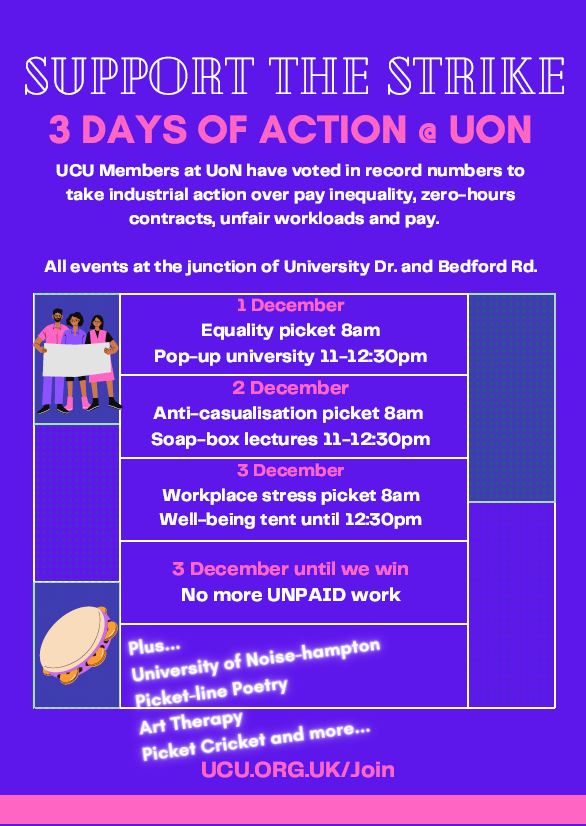
You may have noticed that the University and College Union [UCU] recently voted for industrial action. A strike was called from 1-3 December, to be followed by Action Short of a Strike [ASOS], in essence a call for university workers to down tools for 3 days, followed by a strict working to contract. For many outside of academia, it is surprising to find how many hours academics actually work. People often assume that the only work undertaken by academics is in the classroom and that they spend great chunks of the year, when students are on breaks, doing very little. This is far from the lived experience, academics undertake a wide range of activities, including reading, writing, researching, preparing for classes, supervising dissertation students, attending meetings, answering emails (to name but a few) and of course, teaching.
UCU’s industrial action is focused on the “Four Fights“: Pay, Workload, Equality and Casualisation and this campaign holds a special place in many academic hearts. The campaign is not just about improving conditions for academics but also for students and perhaps more importantly, those who follow us all in the future. What kind of academia will we leave in our wake? Will we have done our best to ensure that academia is a safe and welcoming space for all who want to occupy it?
In Criminology we spend a great deal of time imagining what a society based on fairness, equity and social justice might look like. We read, we study, we research, we think, and we write about inequality, racism, misogyny, disablism, homophobia, Islamophobia and all of the other blights evident in our society. We know that these cause harm to individuals, families, communities and our society, impacting on every aspect of living and well-being. We consider the roles of individuals, institutions and government in perpetuating inequality and disadvantage. As a theoretical discipline, this runs the risk of viewing the world in abstract terms, distancing ourselves from what is going on around us. Thus it is really important to bring our theoretical perspectives to bear on real world problems. After all there would be little point in studying criminology, if it is only to see what has happened in the past.

Criminology is a critique, a question not only of what is but might be, what could be, what ought to be. Individuals’ behaviours, motivations and reactions and institutional and societal responses and actions, combine to provide a holistic overview of crime from all perspectives. It involves passion and an intense desire to make the world a little better. Therefore it follows that striking must be a criminological matter. It would be crass hypocrisy to teach social justice, whilst not also striving to achieve such in our professional and personal lives. History tells us that when people stand up for themselves and others, their rights and their future, things can change, things can improve. It might be annoying or inconvenient to be impacted by industrial action, it certainly is chilly on the picket line in December, but in the grand scheme of things, this is a short period of time and holds the promise of better times to come.
Share this:




Meet the Team: Stephanie Richards, Associate Lecturer in Criminology

A Warm Welcome
Hello all! I would like to introduce myself. My name is Stephanie Richards and I am your Student Success Mentor (SSM). Some of the criminology and criminal justice students would have already had the opportunity to meet me, as I was their Student Success Mentor previously. So, it will be great to touch base with you all and it would also be great for the new cohorts to say hi when you see me on campus.
It is that time of the year when we see new students and our existing students getting ready to tackle the trials of higher education. Being a SSM I am fully aware of the challenges that you will face, and I am here to support you throughout your time at UON. As a previous student I can testify that studying at university is incredibly challenging. The leap from school/ college can be daunting at first. A new building that seems like a maze or the idea of being surrounded by strangers that you probably think you have nothing in common with can be enough to encourage you to run for the hills….stepping into a workshop for the first time can give you a stomach flip, but once you take that first seat in class you will come to realise it does get easier.
Upon reflection of my experience as a new undergraduate student I would have to be honest and express the difficulties that I suffered adjusting to my new way of life. I could not keep my head above the masses of reading, and when I did manage to get some of the seminar prep completed, most of the time I struggled with the new questions and concepts that were posed to me. This will be the experience of most, if not all the new students starting out on their university education. This is part of the complex journey of academia. My advice would be to pace yourself, time management is key, if you struggle to understand the work that has been set, ask for clarity and develop positive relationships with your peers and the staff at UON…………..being part of a strong community will get you through a lot!
My role is not just about assisting the new students that have started their university journey, I am also here to help UONs existing students. Getting back into the swing of studying can be daunting after the summer break. Adjusting to face-to-face education can be an overwhelming process but one that should be embraced. We will all miss our pyjama bottoms and slippers but being back on campus and getting some normality back in your day is worth the sacrifice.
The team of SSM’s are here to support you throughout your journey so please get in touch if you require our assistance. We never want you to feel alone in this journey and we want to assist you the best ways we can. We want you to progress and meet your full learning potential, and to get the most out of your university experience.
Share this:


Meet the Team: Francine Bitalo, Associate Lecturer in Criminology

Hi everyone! My name is Francine Bitalo and I will be your new Student Success Mentor for this year. I am looking forward to meeting and assisting you all in your academic journey. Feel free to contact me for any support.
Being a graduate from the University of Northampton I can relate to you all, I know how challenging student life can be especially when dealing with other external factors. You may go through stages where you doubt your creativity, abilities and maybe even doubt whether the student life is for you. When I look back at when I was a student, I definitely regret not contacting the Student Success Mentors that were available to me or simply utilising more of the university’s support system. It is important for you seek support people like myself are here to help and recommend you to the right people.
Besides everything, Criminology is such an interesting course to study if you are anything like me by the end of it all you won’t view the world the same. Many of you have probably already formed your views on life especially when it comes to understanding crime. Well by the end of it all your ways of viewing the world will enhance and become more complex, theoretical and constructive. The advice I give you all is to enjoy the journey, be open minded and most importantly prepare for exciting debates and conversations.
Look forward to meeting you all.

 Thoughts from the criminology team