
Home » Protest (Page 3)
Category Archives: Protest
Terrorism? No thank you

Recent terrorist attacks in Manchester and the capital, like others that happened in Europe in recent years, made the public focus again on commonly posed questions about the rationale and objectives of such seemingly senseless acts. From some of the earliest texts on Criminology, terrorism has been viewed as one of the most challenging areas to address, including defining it.
There is no denial that acts, such as those seen across the world, often aimed at civilian populations, are highly irrational. It is partly because of the nature of the act that we become quite emotional. We tend question the motive and, most importantly, the people who are willing to commit such heinous acts. Some time ago, Edwin Sutherland, warned about the development of harsh laws as a countermeasure for those we see as repulsive criminals. In his time it was the sexual deviants; whilst now we have a similar feeling for those who commit acts of terror. We could try to apply his theory of differential association to explain some terrorist behaviours. however it cannot explain why these acts keep happening again and again.
At this point, it is rather significant to mention that terrorism (and whatever we currently consider acts of terror) is a fairly old phenomenon that dates back to many early organised and expansionist societies. We are not the first, and unfortunately not the last, to live in an age of terror. Reiner, a decade ago, identified terrorism as a vehicle to declare crime as “public enemy number 1 and a major threat to society” (2007: 124). In fact, the focus on individualised characteristics of the perpetrator detract from any social responsibility leading to harsher penalties and sacrifices of civil liberties almost completely unopposed. As White and Haines write, “the concern for the preservation of human rights is replaced by an emphasis on terrorism […] and the necessity to fight them by any means necessary” (1996: 139).
For many old criminologists who forged established concepts in the discipline, to simply and totally condemn terrorism, is not so straightforward. Consider for example Leon Radzinowicz (1906-1999) who saw the suppression of terror as the State’s attempt to maintain a state of persecution. After all, many of those who come from countries that emerged in the 19th and 20th centuries probably owe their nationhood to groups of people originally described as terrorists. This of course is the age old debate among criminologists “one man’s terrorist is another man’s freedom fighter”. Many, of course, question the validity of such a statement at a time when the world has seen an unprecedented number of states make a firm declaration to self-determination. That is definitely a fair point to make, but at the same time we see age-old phenomena like slavery, exploitation and suppression of individual rights to remain prevalent issues now. People’s movements away from hotbeds of conflict remain a real problem and Engels’ (1820- 1895) observation about large cities becoming a place of social warfare still relevant.
Reiner R (2007), Law and Order, an honest citizen’s guide to crime and control, Cambridge, Polity Press
White R and Haines F (1996), Crime and Criminology, Oxford, Oxford University Press
Share this:


How do you punish the incorrigible?
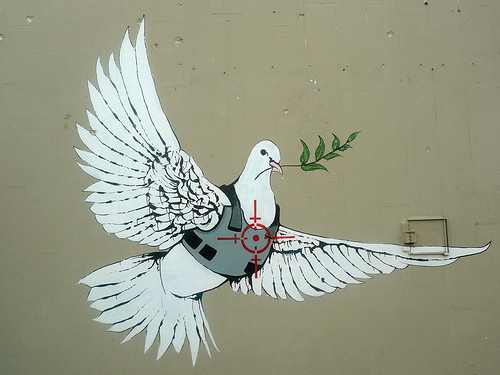
This week saw the (very low key) commemoration of International Conscientious Objectors Day (15 May) which got me thinking about a number of different contemporary issues. Although the events which I describe happened a century ago, the criminalisation, and indeed, punishment of conscience has never truly been resolved.
Conscientious objection in the UK first came to the attention for most after the passing of the Military Services Act 1916. This legislation allowed for the conscription of certain categories of men into the military. The enactment of this law enabled men to be forcibly coerced into military service regardless of their personal and individual aspirations. Subsequent to this, further legislation was passed (Military Training Act 1939, National Service (Armed Forces) Act 1939, National Service Act 1948) continuing this system of coercive enlistment into the military. By default, such legislation also laid the foundations for conscientious objection; after all, without such coercion there is no need to register dissent, simply don’t enlist in the military.
During WWI (and for some considerable time after) Conscientious Objectors [COs] were bullied, cajoled, ridiculed and stigmatised, not to mention, incarcerated, multiple times. In one horrific incident it was alleged that COs were driven to the trenches of France and threatened with a firing squad if they did not comply. Despite this type of treatment the vast majority of COs continued to resist, strongly suggesting that their conscience, moral compass or faith was far stronger than anything the state could throw at them.
In the UK the individual and collective dilemma of the conscientious objector has largely faded into history; although the same cannot be said internationally (for instance; Greece, Israel and the USA). However, their very existence and that of other non-conformists (at different times and places) raises questions around the purpose and supposed effectiveness of incarceration. In essence; what do we do when the “deviant” refuses to conform, how far are we prepared to go, as a society to punish the incorrigible and persistent offender and what do we do when nothing seems to work?
We could attempt the practices used with the WWI COs and keep convicting whilst ratcheting up the tariff of their sentence each time. However, we know from their experiences that this appeared to consolidate their objections and harden their resolve. We can try and talk to individuals in order to help them see the “errors of their ways” but given the conviction held by COs, that the war was fundamentally at odds with their belief system, this is also likely to fail. We could try punishment in the community, but for many of the COs anything which they felt compromised their standpoint was equally resisted, making any such approach also likely to be unsuccessful.
Although the “problem” of the COs no longer exists in 21st century Britain, other individuals and groups have filled the space they have vacated. We could replace the COs with the Black civil rights movement (think Rosa Parks or Martin Luther King) or other protests (think “Tank Man” in Tiananmen Square or Ieshia Evans in Baton Rouge) or those deemed traitors by many (as were the COs) , such as Chelsea Manning, Julian Assange and Edward Snowden. The question remains: is it possible to rehabilitate the heart and mind of someone who is so clear as to their moral standpoint and committed to doing what they perceive to be “the right thing”?
Share this:


The Commodification of Abstinence

The inspiration for this short blog post comes from an incredibly stimulating discussion with some of my second year students studying the criminology module ‘Outsiders’. In class we were discussing how rather than constituting active forms of rebellion that resist the mainstream, various ‘trendy’ acts of so-called deviance, such as graffiti, parkour and ‘rooftopping’, have actually become absorbed into the mainstream consumer culture. Following this we began to discuss ‘new’ ways of resisting. Amongst the ideas offered was the notion of somehow disconnecting ourselves from the now ever-present network of social media and its frequent and avid advertisement of consumer items. Interestingly, having already discussed the tendency for social media’s ‘revolutionary potential’ to be integrated within rather than threaten capitalism (Crary 2013), this proposed disconnect would also require avoiding the latest online driven micro-revolution. The result of this discussion was the idea of ‘going mobile free for a week’.
The problem with this proposed ‘period of abstinence’ is that it becomes another micro-revolution that simply represents a new opportunity for commodification. This is because capitalism has the uncanny ability “to incorporate every attack by integrating the attack into the system” (McGowan 2016:12). It does this by taking the seemingly revolutionary practice and transforming it into a marketable commodity. With this in mind, we started to consider how such periods of abstinence would be integrated and commodified. It was suggested that a number of high-street retailers such as Game and HMV would perhaps have preparatory sales the week before to help us cope with the inevitable upset of ‘going mobile free for a week’. Similar offers would no doubt be made by a range of other providers; why not get into cycling, mountain climbing, or Zumba? That is after buying all the essential gear and merchandise of course. Then, once this period of abstinence is over, what better way to show how ‘resistant’ you were than by posting pictures of, or tweeting about, all the things you got up to during this ‘rebellious’ period; thereby further contributing to the marketing of consumer items.
Rather than representing some form of resistance then, this period of abstinence becomes commodified and successfully integrated into contemporary consumer capitalism. This does not mean that there is no alternative to capitalism, it simply means that if we wish to make a genuine attempt at resistance we should avoid being absorbed or forced into the next ‘trendy’ micro-revolution or simulated rebellion (Hall et al. 2008). Precisely how we do this is of course another matter entirely.
Justin Kotzé, March 2017
References
Crary, J. (2013) 24/7: Late Capitalism and the Ends of Sleep. London: Verso.
Hall, S., Winlow, S. and Ancrum, C. (2008) Criminal Identities and Consumer Culture: Crime, Exclusion and the New Culture of Narcissism. Cullompton: Willan Publishing.
McGowan, T. (2016) Capitalism and Desire: The Psychic Cost of Free Markets. New York: Columbia University Press.

 Thoughts from the criminology team