
Home » Criminology (Page 63)
Category Archives: Criminology

The Criminology Toolbox

Whilst sitting at my desk at work recently I realised just how much I took away with me in my toolbox from my time studying Criminology. I wanted this blog to be about exactly how this discipline has helped me in my personal and working life and the transferable skills I acquired without even realising I was using them.
In 2011 I came to University an 18 year old with a very closed and one sided mind set and this is something I will openly admit to! A memory that I feel will stick with me forever is from a Crime and Society seminar in the first year with @manosdaskalou. I remember openly saying to him that I felt prisoners should not be allowed to have televisions whilst in prison and that they were there to do their sentence and not watch this week’s Hollyoaks (@manosdaskalou you may remember that sour faced girl sat in front of you, although the sour face is still very much there!). I am sure those of you reading will be cursing BUT my self-righteous opinions did change and the more I attended various lectures and seminars, the more I became open to listening to and respecting the opinions of my peers and became further educated about the impact rehabilitation and second chances have on lives.
In my second year I volunteered for an organisation focusing primarily on helping individuals who had been in the Criminal Justice System with gaining employment and education. As soon as I walked through those doors I saw first-hand the positive impact this organisation had on the lives of those using the service.
I had an opportunity to assist on a healthy living course for individuals recovering from drug and alcohol addictions. Some of those attending the course had never taken an exam before or even been in an educational setting and others struggled with reading. I quickly realised the privileged position I was in to be able to even be at University and do things I feel we all take for granted sometimes such as reading. I also provided some advice to a young female who completely freaked out at the idea of taking a multiple choice test. I gave her some tips before that I had acquired from my own experiences. She was so very thankful to me and I will always remember her.
In terms of the other skills I now have in my toolbox, the thought of standing up and presenting in front of my peers at University terrified me, however in doing that I can now confidently stand up in front of my colleagues and bosses to present information and contribute in meetings. I can also provide evidence in court thanks to learning about the criminal process.
Having the opportunity to debate certain issues within the criminological world and society has taught me to have a voice and provide my point in a professional manner whilst listening to others. From the assignments set, to working within a timetable, it has all enabled me to build upon my time management and organisational skills. Working to tight deadlines also does not daunt me especially when I now have work to them daily.
I think we can all be truthful here and say we did groan a little bit when we were given extra reading to do at home and to critically analyse various pieces of text for the next seminar (heaven forbid!). However, being able to analyse a piece of text is a skill I use every day in my job with Northamptonshire Police especially when building court files and reading the fibs and fairy tales that some of our customers can provide. Criminology taught me to be critical of everything around me, take on board criticism and ask questions. I now ensure I stick my head above the parapet and often put the police officers in their place, as they do need it sometimes!
On the whole, I am thankful for the transferable skills I acquired from studying Criminology despite using them daily and not realising until my desk epiphany! I graduated in 2014 with a toolbox of skills ready for the big wide world and I will cherish them always. Who knows, it may even help me with becoming a parent in November!
Share this:


New beginnings

This time of the year, it always feels a bit, well odd! I prepare for the new academic year, in terms of the administrative tasks but most importantly for the academic material. For many years now, I have been returning to the same space, sit on the same chair and talk to the same old people. I am aware that this may demystify the role of the academic, but this is only the obvious side. What I left out from this annual ritual is the most important part of the process; the time used to contemplate content, to reflect on the pedagogies used and to explore new ideas; this is a process whose gestation will commence at the end of the last year and will mature just before the new academic year begins.
This year things are going to be slightly different; the last academic year I was on the old campus and now we have moved to a brand-new campus. Admittedly, this is a very interesting experience so far. In a way, it feels like I have changed employment although I still see the same recognisable faces around. Getting used to the new buildings will take a bit of time, so for those reading this blog, and coming to the campus, please bear with me and of course, if you see me going the wrong direction point me to the right one. This is a year the myself and my colleagues and our students will be discovering the new campus together. This will be a shared experience to remember.
The move to the new campus is also aligned to the way we have developed our institutional pedagogies, although our subject has long been involved in those, either espousing the changemaker ethos or getting involved with local organisations and engaging with the community. We have already been thinking of ways of working with our students to become more civic minded which will help in connecting the academic experience, with a different kind of social learning.
This is a year like all other years, in terms of preparation and planning but at the same time this is a year like no other. It is a year all students and staff will remember beyond their educational experience. Years ago, I told a group of students that the place of study becomes such an important point of reference because as people we combine experiences together. The new campus will shelter the dreams and aspirations of many generations of students and transfigure them into the level of academic maturity that lead our graduates to professional success. The process is so simple and at the same time so incredibly vital. The students who come will progress through their studies, master the importance of becoming independent learners with confidence, who will return to their communities, to enhance them with their knowledge and ability. This is an incredibly satisfying academic process that encouraged myself and many other colleagues to join academia in the first instance.
Let’s have a great new academic year. One of many
Share this:


Racism in the work place

Growing up in a small town and having dealt with racism from a young age; I felt as if getting a degree would prove that I deserve to sit with the top dogs and that would be the end of me experiencing racism.
But I was sadly mistaken. I have experienced racism at 3 out of the 4 jobs I have had since graduating. I never dealt with it head on. I would just apply for other jobs and pray that the next job would be different. Thinking of reporting people for the comments they said was never an option for me as they were managers or supervisors.
Until I had the 3rd person who said a racist comment and I broke down. At this point I was done with running. I reporte d it and it was dealt with. But since then I have been dealing with covert racism. Being the only black person in a department of over 100 people has not been easy. I have not always received the same opportunities as my colleagues. But I never gave up. I might have my melt down for a few hours or days. But I knew I had to work twice as hard as a white person to even get recognition. I have a degree that relates to my occupation and have paid over a £1,000 for courses just to be recognised. Yet, my colleagues never had to pay for those courses.
The truth of the matter is, it has taken centuries for prejudicial thoughts to be embedded in people’s heads. And it will take the same amount of time to get rid of it. That does not excuse it or make it right. All, you can do is work hard and never give up. You should not have to accept being mistreated. Stand up for yourself, no matter what. Do not suffer in silence!
Share this:


Upskirting: A new criminal offence but will the legislation do the job?

Upskirting for anyone who has not come across the term is the act of taking unauthorised pictures under a skirt or kilt to capture images of the crotch area and sometimes genitalia. It tends to happen in crowded public places making it difficult to spot when it is happening. The resulting images are often distributed on the internet, usually interlinked with pornographic or fetish sites and present a multitude of moral and legal issues surrounding privacy, decency and consent. In some instances, the victim is identifiable from the image but in many they are not and are often unaware that such images even exist. This type of behaviour is not new but the development of technology, most notably camera phones has facilitated the practice as has the ability to share these images online. In England and Wales there is currently no specific legislation banning such action because voyeurism only covers private spaces and outraging public decency requires a witness. As such, when victims of upskirting come forward there is currently little scope for prosecution although some successful prosecutions have occurred under the offence of outraging public decency.
Gina Martin, a freelance writer and victim of upskirting launched a campaign to get upskirting recognised as a specific crime and punishable under the Sexual Offences Act. This campaign has gained considerable momentum both publicly and politically and in March 2018 the Voyeurism (Offence) Bill was presented to the House of Commons. The bill was blocked by the objections of one MP on the grounds that there had been a ‘lack of debate’ and thus a breach of parliamentary procedure. The backlash to this objection was interesting, rather than acknowledging that this is a serious issue worthy of parliamentary debate a humiliating and somewhat bullying approach was taken in the form of ‘pants bunting’ being hung outside of his Commons office. While I might not agree with some of the past actions of this MP his argument that new laws need to be debated if we (the UK) are to stand up for freedom and democracy is an important one. Upskirting is a serious breach of privacy and decency and therefore needs proper debate if the resulting legislation is going to be more than a knee-jerk reaction to public outrage. Such legislation often results in the need for multiple revisions in order for it to efficiency and effectively tackle such behaviour. For example, the proposed burden of proof in the original bill alongside the limited scope of the bill[1] would likely have limited prosecutions rather than facilitating them. Unfortunately, with just three months between the original bill and the revised Voyeurism (Offences) (No.2)) Bill, which was successfully introduced to the House of Commons in June 2018, the extent to which sufficient informed debate has occurred remains questionable.
[1] See the comments by Clare McGlynn (professor at Durham University) in Sabbagh and Ankel (2018) Call for upskirting bill to include ‘deepfake’ pornography ban. The Guardian [online] Available at: https://www.theguardian.com/world/2018/jun/21/call-for-upskirting-bill-to-include-deepfake-pornography-ban. [Accessed: 17 August 2018].
Share this:

The Other Side of Intelligence

After I graduated I had a bit of tunnel vision of what I wanted to do. I wanted to either work with young offenders or work with restorative justice. Many opportunities actually came up for me to do several different things, but nothing really worked out and nothing felt right.
I carried on working in retail till February 2018; I was honestly starting to lose hope that I would find something that I would enjoy. I started working for a security company that does many things; from employment vetting to gaining intelligence of various kinds. Although the role is not focused on the criminality side entirely, the theme is very much apparent. I find myself thinking about all the different concepts of criminology and how it ties in to what I am doing.
A big part of my role is intelligence and at first, I didn’t think I would enjoy it because I remember in third year in the module, Violence: Institutional Perspectives*; we looked at the inquiry Stockwell 1; an inquiry into the metropolitan police force following the death of Jean Charles de Menezes. Jean Charles was mistaken by intelligence officers for Hussain Osman, one of the terrorists responsible for the failed bomb attacks in London. This particular inquiry frustrated me a lot, because I just felt like, how is it possible for the police to mistake an individual for an innocent person. I just couldn’t accept when we were going through this case how trained officers were able to fail to identify the correct person, regardless of all the other factors that pointed to Jean Charles being the culprit. However, now being in a similar position I understand more how difficult it actually is to identify an individual and being 100% sure. There have been times in my line of work that I have had to question myself 2, 3, even 8 times if the person I found was really who I was looking for.
I do think I question it a lot more because I know how much my job can affect a person’s life and/or future. I do think criminology has been one of the best decisions I made. I know that I view things differently from other people I work with, even my family. Just little things that people tend not to notice I see myself. Thinking, but could it be because of this, or could it be because of that. Criminology really is part of everyday life, it is everywhere, and knowing everything I know today I wouldn’t have it any other way.
*Now CRI3003 – Violence: From Domestic To Institutional
Share this:

An Officer’s Perspective

Northampton University…. In 2011, I first moved up to Northampton to study criminology and sociology. At the time I had never moved away from home before and it was a somewhat daunting experience. However, now looking back at this, it was one of the best decisions I have made.
Before I set out to go to university I had always said to my family I wanted to join the police force. I chose to study criminology as I believed this was going to help me with joining the police and also provide me with an insight as to what I was potentially going to be letting myself in for.
From studying criminology for three years I learnt about various ideas surrounding police and their interactions with communities, portrayal within the media and about the history of the police and how it has developed into the service we have today.
I remember, in particular, being interested in the way in which the media portrayed the police and the impact this had on how young people, and whether this influenced their opinions on police, so much to the point I completed a dissertation on this topic. This interest came about from a module called YOUTH CRIME AND MEDIA. Ultimately, I found that young people, in particular those aged between 18-25, were influenced by the media and this helped them form their opinions of the police.
Whilst I was at Northampton University, I was a Special Constable for the Metropolitan Police having joined them in 2013, my third year at uni. This began to give me some experience into what the police dealt with on a day to day basis. Although I was only doing this for 16 hours per month, I would recommend this to anybody who is considering joining the police.
Since graduating from Northampton University, I joined the Metropolitan Police as a PC and I have been with the Met now for 2 years. I can honestly say that, when people say this is a job like no other, they are all correct. I go to work not knowing what I am going to encounter from one call to the next. The one thing which has really stood out for me since joining as a PC, and having graduated from university, is how misunderstood the role of police appears to have become. When I was growing up I remember thinking that the role of police was to chase criminals and drive fast cars. However, this nowadays is a small proportion of the work we do and the role of police officers is a lot more diverse and changing daily. We have a lot of interactions with people who are suffering a mental health crisis who may need our assistance because they are feeling suicidal, investigate the disappearance of missing people and even attend calls where someone is suffering a cardiac arrest and a defibrillator is required, as police officers now carry these in their vehicles.
However. I feel the biggest thing that my criminology degree has assisted me with in relation to my job is how I analyse situations. Criminology was largely centred around different theories and analysing these perspectives. On a day to day basis I regularly find myself analysing information provided to me and trying to understand different accounts people provide me with and trying to use these accounts to decide what action needs to be taken. Overall criminology has allowed me to take a step back from somewhat stressful situations and analyse what has happened. This has given me the confidence to present different viewpoints to people and also challenge people at times on controversial topics or viewpoints they may have.
I do think that I took the right path to becoming a police officer; criminology did equip me with various different skills that I utilise in my day-to-day role. I wouldn’t change the path I took. I enjoyed every bit of my degree, and the lecturers were always supportive.
Share this:


“Στον πατέρα μου χρωστώ το ζην, στον δάσκαλό μου το ευ ζειν” To my father I owe living, to my teacher I owe my wellbeing (Alexander the Great)

I remember this phrase from school, among with other ones about the importance of education in life. Since then there have been several years but education is something that we carry with us and as such we take little memories of knowledge like pieces of a gigantic jigsaw that is our lives and put them together. Experience is that glue that makes each piece of knowledge to stick at the right time whenever you want to find the words or feelings to express the world around us. Education plays such an immense part in this process because it give us these words that explain our world a little more clearly, precisely, deeply
This phrase had great resonance with me as I have never known my father and therefore I had no obvious person to relate this to or to have a way to express gratitude for living to anyone (obviously from my paternal family branch). So for a very long time, I immerse myself in education. Teachers in and out of the classroom, living or dead, have left a trail of knowledge with me that defined me, shaped my thoughts and forge some intense memories that is now is my turn to share with my students.
Education has been my refuge, my friend and a place of great discovery. Knowledge has that power to subvert injustice and challenge ignorance. Arguably education comes in different guises and a formal school curriculum sometimes restricts the student into normatives of performance that relegates knowledge into bitesize information, easily digestible and reproduced. The question, of a fellow student of mine who asked, “sir, why do I need algebra?” could have only be met from the bemused teacher’s response…”for your education”! Maybe I am romanticizing my own education and potentially forget that formal compulsory education is always challenging and challenged because of the purpose it is called to play.
Maybe this is why, what I consider of value in education, I have always attributed to my own journey, things that I read without being in any curriculum, or discussions I had with my teachers that took us away from the strict requirements of a lesson plan. The greatest journey in education can start with one of the most basic of observations, situations, words that lead to an entire discussion on many complex ideas, theories and perspectives. These journeys were and are the most rewarding because you realise that behind a question is the accumulated human curiosity spanning the entire history of life.
One of the greatest places for anyone to quench this thirst for learning is the University. In and out of the classroom knowledge is there, ready to become part of a learners’ experience. It is not bestowed in the latest gadget or the most recent software and other gimmicky apparatus but in the willingness to dwell into knowledge, whether it is reading late in the library or having a conversation with fellow students or a tutor (under a tree as one of my students, once professed). Perhaps my trust in education is hyperbolic even obstinate but as I see it, those of us who have the choice, can choose to live or to live well. For the first, we can carry on existing, but for the latter the journey of knowledge is neither a short one nor one that comes easy but at least it will be rewarding.
Share this:


The Ever Rolling Stream Rolls On
Professor Nick Petford is the Vice Chancellor of the University of Northampton.
As we gear up to leave Park Campus for Waterside it is only natural to feel a sense of loss. Park has been a great place to work and play and will hold a special place in many hearts, as summarised nicely by Bethany Davies from the Criminology team in a recent Blog.
When I took up post as VC in September 2010 I inherited a draft master plan for the University Estate. It was clear that the split campus was a concern to the previous management team and that both estates were starting to look tired. There were several options on the table. One was to move Avenue to Park. The other was expansion of Avenue and closer physical integration with Newton. The showcase element was a huge glass dome, bigger than the one at the British Museum, enclosing most of the courtyard space at Avenue under one roof. Both were impractical. Building Avenue on Park would have consumed most of the sports fields and greenery that makes it what it is. And the disruption of turning Park into a building site for 36 months would do little to improve the student or staff experience. But it would have achieved a single university site, unlike the Avenue plan that would have entrenched the status quo (with a big window cleaning bill to boot!). Not long after my arrival, and with a change in the way government wanted to drive the regional growth agenda, the newly established SEMLEP created in Northampton a 16 mile stretch of brownfield land bordering the River Nene as an Enterprise Zone. The rest, as they say, is history.
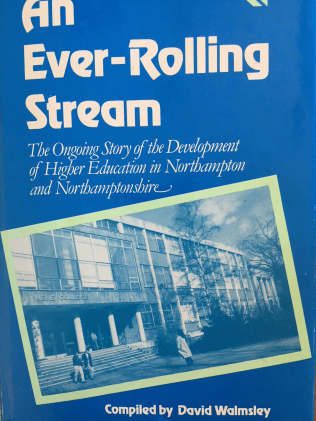
An enduring aspect of higher educational institutions is change. Depending on timing, from a personal viewpoint it can be a slow, almost glacial process. For others, caught up in periods of rapid transition, as we are now, the hurly burley can feel almost overwhelming. But change is always there. And Northampton is no exception. For those suspicious this is more spin than substance I can recommend The Ever Rolling Stream, a book compiled and printed in 1989 by the 567th Mayor of Northampton, David Walmsley, that charts the history of Higher Education in Northampton. In short, the key events culminating in the present University are:
1260: Ancient University
1867: Mechanics Institute
1932: Northampton Technical College (St George’s Avenue)
1967: University of Leicester University Centre, Northampton
1972: Northampton College of Education (Park Campus)
1975: Nene College of Higher Education
1978: The National Leathersellers Centre
1982: Sunley Management Centre
1989: Release from local authority control
1999: University College Northampton
2005: The University of Northampton
2018: Waterside.
The picture is one of periods of relative stability (including a c. 700 year sabbatical!), punctuated by mergers and consolidation. Our most rapid phase of change took place in the six years between 1972 and 1978 and involved the relocation, merger and subsequent closure of four separate educational establishments that ultimately comprise Park Campus as we know it today. Each of these phases would have been a unique cause of excitement, stress, resignations, hope and probable despair! But together they have two things in common – they happened mostly outside our working experience, and (ancient university excepted), ended in success. In our history of relocations and mergers, the inevitable conversations between doubters and advocates are lost in time, one exception being the amalgamation in 1937 of the School of Art in Abington Street, with the Technical College, which seems particularly vexed. Against this backdrop we see Waterside simply as the next stage in our evolution.
The title for Ever Rolling Stream comes from the hymn ‘O God our Help in Ages Past’. It sums up brilliantly the feeling of loss and the inevitability of change:
Time, like an ever-rolling stream,
Bears all its sons away;
They fly forgotten as a dream
Dies at the opening day.
Yes, think kindly of Park, and Avenue, mourn even as others will have done over those antecedents that culminated in our present estate. But don’t think you are the first to do so. Who knows, at some time in the future, staff and students not yet born will be contemplating a move from Waterside to a new horizon, as the ever rolling stream rolls on.
Share this:

Just Keep Swimming

This isn’t going to be the intellectual blog post I had expected myself to write. I am writing this as I am undertaking my post-grad dissertation and in all honesty, I can’t be bothered anymore. And I feel secure in the fact that I am not the only person who feels this and I most certainly will not be the last. Heck, I’ve been close to giving up altogether a handful of times throughout both my under and post-grad. I will be the first to admit that I don’t know how to leave work mode alone when I have deadlines due. And it is only through friends and family that I have to be reminded that all work and no play, doth not make for a mentally healthy Bronagh. I have always struggled separating the two and have been known to cancel or decline plans so I can do work; low and behold, I don’t write a word.
Be mindful of your mental health. You can’t work at it constantly. Between work and uni, you need to allow yourself those stress-free days off so you can produce the best work that you are capable of. I hate to harp on about the most obvious scenario. But as someone who felt bad for taking time off to have fun and as someone who is currently struggling for the motivation to complete this dissertation, just know that you are not alone. It is not uncommon to feel burnt out towards the end of your degree, be it 1 year, 3 years, or more. Just know that you have not come this far to fall at the final hurdle.
My biggest motivation was having friends going through the same situation. Meeting up to go the library so none of us bailed. Telling one another to “shut up, we need some quiet time”, putting headphones in so as not to get dragged into another one-hour chat about that dire television show we all watched the other night. As with everything, it’s all about moderation. You are your own worst enemy, but it is you who will pull yourself out of your slump and show your self-doubt that you are both capable and worthy. This isn’t forever and you will relish those days where you have no deadlines to worry about, but trust me, you will also miss them. Do not let these tough times get the better of you and certainly do not let them put you off any possibilities of further education. The motivation will come and you will get there in the end. Carry on doing the things you enjoy and take everything in your stride.
Just keep swimming, you’ve got this.
Share this:


The Voice Behind the Music

Marginalised voices were the focal point of my dissertation.
My dissertation explored social issues through the musical genres of Rap and Hip-Hop. During the time period of writing my dissertation there was the rising debate surrounding the association of a new genre, Drill music, being linked to the rise in violent crimes by young people in England (London specifically). The following link to an article from the Guardian newspaper will provide a greater insight to the subject matter:
The idea of music having a direct correlation with criminality sweeps issues such as poverty, social deprivation, class and race all under the rug; when in reality these are just a few of the definitive issues that these marginalised groups face. We see prior examples of this in the late 80s, with rap group N.W.A with their song “F*** the police”. The song surrounded the topic of police brutality and brought light to the disgust and outrage of the wider community to this issue. Simultaneously to this, the N.W.A were refused from running concerts as they were accused of starting revolts. The song was made as a response to their environment, but why is freedom of speech limited to certain sectors of society?
In the present day, we see young people having lower prospects of being homeowners, high rates of unemployment, and the cost of living increasing. In essence the rich are getting richer and the poor continue to struggle; the violence of austerity at its finest. Grenfell Tower is the perfect example of this, for the sake of a cheaper cost lives were lost. Simply because these individuals were not in a position to greatly impact the design of their housing. Monetary status SHOULD NOT determine your right to life, but unfortunately in those circumstances it did.
The alienation of young people was also a topic that was highlighted within my research into my dissertation. In London specifically, youth clubs are being closed down and money is being directed heavily towards pensions. An idea would be to invest in young people as this would potentially provide an incentive and subsequently decrease the prospect of getting involved in negative activities.
In no means, was the aim to condone the violence but instead to simply shed light on the issues that young people face. There is a cry for help but the issue is only looked at from the surface as a musical problem. If only it were that simple, maybe considering the voice behind the music would lead to the solution of the problem.


