
Home » Articles posted by Paula Bowles (Page 10)
Author Archives: Paula Bowles

Is education more fun than building a Lego Yellow Submarine? Discuss

This week some students, independently and across the years, introduced me to the novel idea that education should be “enjoyable” and “fun”. Furthermore, if it wasn’t enjoyable, it wasn’t being done right. Given Criminology’s subject matter is often grim, dark, focusing on the worst aspects of humankind, enjoyable and fun are not descriptions that often appear in relation to the discipline. Certainly, such a perspective is not one that I personally recognise; a day at an art gallery, playing Hungry Hippos with two little people, a nice bottle of wine, lunch with friends, building a Lego Yellow Submarine etc are things that I would say are enjoyable, perhaps even fun. But education……I’m not convinced! What follows are my vague ramblings around a subject which is very close to my heart (you are warned!).
All of the enjoyable activities I have described above are ones that I spend very little of my time doing and that to me, is part of their enjoyability (if such a word exists). They are attractive because they are rare and unusual, in my life at least. But education, learning, knowledge are part and parcel of my everyday existence, and dare I say fundamental to who am I. However, does any of this preclude education from being fun? Maybe, I just take for granted my thirst for knowledge in the same way as my thirst for water, just everyday appetites that need to be fed to maintain equilibrium and optimal performance.
I love considering new ideas and new perspectives, particularly if they challenge my thinking and jolt me out of complacency, so I want to consider this concept of enjoyable education. I’ve always been a curious person, there’s lots of questions that I want to know the answer to and they generally begin with “why”? Like all children, I expect I drove my parents mad with the constant questions; never fully satisfied with the answer. I can trace my first early, tentative steps into criminological thinking to when I was a child and regularly had to pass HMP Holloway[1] on the way to various hospital appointments. I used to wonder who lived in this huge, forbidding building, why they were there, what had they done, when would they get out and where would they go? Some decades on, I have answers to some of those questions but I’m still actively searching for the others. This, of course, is experiential learning and children’s books (at that time) offered little by way of answers to such profound criminological questions.

At school, the type of learning I liked best was when I could explore for myself. An experienced and knowledgeable teacher or lecturer explaining complex ideas could open the door so far, but I wanted to find out for myself as much as possible. For me, the best educationalists are those that gently guide and enable, not those who deliver information on demand. They also engender self-confidence and self-discipline encouraging the scholar to take control of their own intellectual journey. All of this leads me to the conclusion that learning is intrinsically neither enjoyable nor fun, although both may be by-products. Education, knowledge, learning, all of these are painful, challenging, at times they appear almost impossible. But! The level of personal satisfaction, achievement and growth means that ‘some kind of happiness is’, not as the Beatles suggest ‘measured out in miles’, but through intellectual endeavour (Lennon and McCartney, 1969). And to answer the essay question I set in the title, Lego has many charms but independent, self-direction is not one of them. Provided you follow the step-by-step illustrated instructions you will have your very own Yellow Submarine, but there are no surprises, whether positive or negative, which means I have no intellectual investment in the process. Furthermore, take the instructions away and I would not be able to recreate this “masterpiece”. Having said that, it does look rather lovely on my book case 🙂
Lennon, John and McCartney, Paul, (1969), Hey Bulldog, [LP]. Recorded by The Beatles in Yellow Submarine, Northern Songs: Apple
[1] HMP Holloway closed its doors for the final time in July 2016.
Share this:


“A Christmas Carol” for the twenty-first century

The build up to Christmas appears more frenetic every year, but there comes a point where you call it a day. This hiatus between preparation and the festivities lends itself to contemplation; reflection on Christmases gone by and a review of the year (both good and bad). Some of this is introspective and personal, some familiar or local and some more philosophical and global.
Following from @manosdaskalou’ recent contemplation on “The True Message of Christmas”, I thought I might follow up his fine example and explore another, familiar, depiction of the festive period. While @manosdaskalou focused on wider European and global concerns, particularly the crisis faced by many thousands of refugees, my entry takes a more domestic view, one that perhaps would be recognised by Charles Dickens (1812- 1870) despite being dead for nearly 150 years.

One of the most distressing news stories this year was the horrific fire at Grenfell Tower where 71 people lost their lives. [1] Whilst Dickens, might not recognise the physicality of a tower block, the narratives which followed the disaster, would be all too familiar to him. His keen eye for social injustice and inequality is reflected in many of his books; A Christmas Carol certainly contains descriptions of gut wrenching, terrifying poverty, without which, Scrooge’s volte-face would have little impact.
In the immediacy of the Grenfell Tower disaster tragic updates about individuals and families believed missing or killed in the fire filled the news channels. Simultaneously, stories of bravery; such as the successful endeavours of Luca Branislav to rescue his neighbour and of course, the sheer professionalism and steadfast determination of the firefighters who battled extremely challenging conditions also began to emerge. Subsequently we read/watched examples of enormous resilience; for example, teenager Ines Alves who sat her GCSE’s in the immediate aftermath. In the aftermath, people clamoured to do whatever they could for survivors bringing food, clothes, toys and anything else that might help to restore some normality to individual life’s. Similarly, people came together for a variety of different celebrity and grassroots events such as Game4Grenfell, A Night of Comedy and West London Stand Tall designed to raise as much money as possible for survivors. All of these different narratives are to expected in the wake of a tragedy; the juxtaposition of tragedy, bravery and resilience help people to make sense of traumatic events.
Ultimately, what Grenfell showed us, was what we already knew, and had known for centuries. It threw a horrific spotlight on social injustice, inequality, poverty, not to mention a distinct lack of national interest In individual and collective human rights. Whilst Scrooge was “encouraged” to see the error of his ways, in the twenty-first century society appears to be increasingly resistant to such insight. While we are prepared to stand by and watch the growth in food banks, the increase in hunger, homelessness and poverty, the decline in children and adult physical and mental health with all that entails, we are far worse than Scrooge. After all, once confronted with reality, Scrooge did his best to make amends and to make things a little better. While the Grenfell Tower Inquiry might offer some insight in due course, the terms of reference are limited and previous experiences, such as Hillsborough demonstrate that such official investigations may obfuscate rather than address concerns. It would seem that rather than wait for official reports, with all their inherent problems, we, as a society we need to start thinking, and more, importantly addressing these fundamental problems and thus create a fairer, safer and more just future for everyone.
In the words of Scrooge:
“A merry Christmas to everybody! A happy New Year to all the world!” (Dickens, 1843/1915: 138)
[1] The final official figure of 71 includes a stillborn baby born just hours after his parents had escaped the fire.
Dickens, Charles, (1843/1915), A Christmas Carol, (Philadelphia: J. B. Lippincott Co.)
Share this:


“Letters from America”: III
 For those of you who follow The Criminology Team on Facebook you might have caught @manosdaskalou and I live from Eastern State Penitentiary [ESP]. In this entry, I plan to reflect on that visit in a little more depth.
We first visited ESP in 2011 when the ASC conference was held in Washington, DC. That visit has never left me for a number of reasons, not least the lengths societies are prepared to go in order to tackle crime. ESP is very much a product of its time and demonstrates extraordinarily radical thinking about crime and punishment. For those who have studied the plans for Jeremy Bentham’s panopticon there is much which is familiar, not least the radial design (see illustration below).
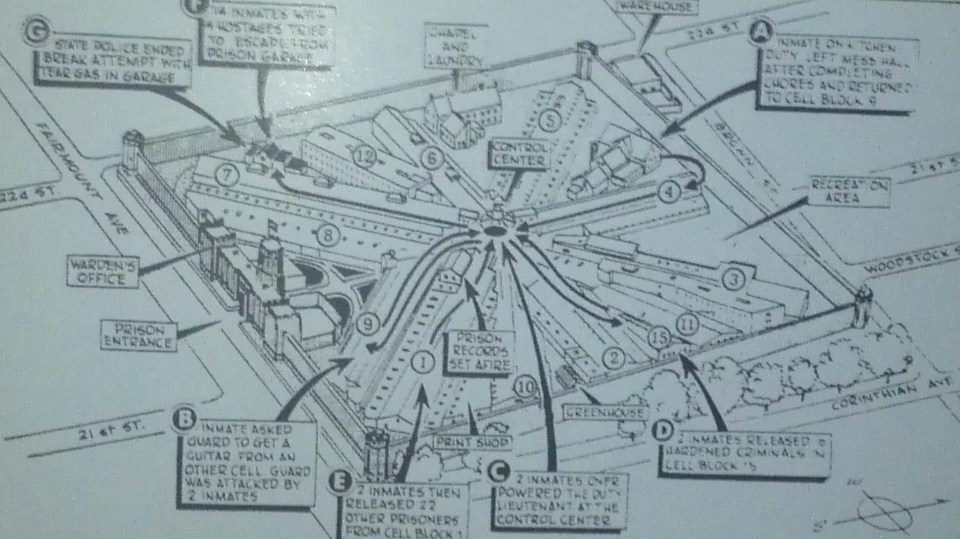
This is an institution designed to resolve a particular social problem; crime and indeed deter others from engaging in similar behaviour through humane and philosophically driven measures. The Philadelphia Society for Alleviating the Miseries of Public Prisons* was philanthropic and guided by religious principles. This is reflected in the term penitentiary; a place for sinners to repent and In turn become truly penitent.
This philosophy was distinct and radical with a focus on reformation of character rather than brutal physical punishment. Of course, scholars such as Ignatieff and Foucault have drawn attention to the inhumanity of such a regime, whether deliberate or unintentional, but that should not detract from its groundbreaking history. What is important, as criminologists, is to recognise ESP’s place in the history of penology. That history is one of coercion, pleading, physical and mental brutality and still permeates all aspects of incarceration in the twenty-first century. ESP have tried extremely hard to demonstrate this continuum of punishment, acknowledging its place among many other institutions both home and abroad.
For me the question remains; can we make an individual change their behaviour through the pains of incarceration? I have argued previously in this blog in relation to Conscientious Objectors, that all the evidence suggests we cannot. ESP, as daunting as it may have been in its heyday, would also seem to offer the same answer. Until society recognises the harm and futility of incarceration it is unlikely that penal reform, let alone abolition, will gain traction.
*For those studying CRI1007 it is worth noting the role of Benjamin Rush in this organisation.
Share this:


“Letters from America”: II

Having only visited Philadelphia once before (and even then it was strictly a visit to Eastern State Penitentiary with a quick “Philly sandwich” afterwards) the city is new to me. As with any new environment there is plenty to take in and absorb, made slightly more straightforward by the traditional grid layout so beloved of cities in the USA.
Particularly striking in Philadelphia are the many signs detailing the city’s history. These cover a wide range of topics; (for instance Mothers’ Day originates in the city, the creation of Walnut Street Gaol and commemoration of the great and the good) and allow visitors to get a feel for the city.
Unfortunately, these signs tell only part of the city’s story. Like many great historical cities Philadelphia shares horrific historical problems, that of poverty and homelessness. Wherever you look there are people lying in the street, suffering in a state of suspension somewhere between living and dying, in essence existing. The city is already feeling the chill winds of winter and there is far worse to come. Many of these people appear unable to even ask for help, whether because they have lost the will or because there are just too many knock backs. For an onlooker/bystander there is a profound sense of helplessness; is there anything I can do?, what should I do?, can I help or do I make things even worse?
The last time I physically observed this level of homelessness was in Liverpool but the situation appeared different. People were existing (as opposed to living) on the street but passers by acknowledged them, gave money, hot drinks, bottles of water and perhaps more importantly talked to them. Of course, we need to take care, drawing parallels and conclusions across time and place is always fraught with difficulty, particularly when relying on observation alone. But here it seems starkly different; two entirely different worlds – the destitute, homeless on the one hand and the busy Thanksgiving/Christmas shopper on the other. Worse still it seems despite their proximity ne’er the twain shall meet.
This horrible juxtaposition was brought into sharp focus last night when @manosdaskalou and I went out for an evening meal. We chose a beautiful Greek restaurant and thought we might treat ourselves for a change. We ordered a starter and a main each, forgetting momentarily, that we were in the land of super sized portions. When the food arrived there was easily enough for a family of 4 to (struggle to) eat. This provides a glaringly obvious demonstration of the dichotomy of (what can only really be described as) greed versus grinding poverty and deprivation, within the space of a few yards.
I don’t know what the answer is , but I find it hard to accept that in the twenty-first century society we appear to be giving up on trying seriously to solve these traumatic social problems. Until we can address these repetitive humanitarian crisis it is hard to view society as anything other than callous and cruel and that view is equally difficult to accept.
Share this:


“Letters from America”: I

This weekend @manosdaskalou and I flew from London to the USA and thus had the opportunity of experiencing two different airports. Travelling is always an insightful – if sometimes physically draining – experience and even more so when crossing continents. It is striking that one of the very first things that you confront upon arriving at your destination (no matter whether home or abroad) is generally a very long queue. There are queues to check in, queues to drop bags, queues for security, queues to get on the plane and to get off the other end. These are followed by yet more queues to enter the country and a wait to collect your bags. All of this is par for the course and perhaps to be expected given the volume of people travelling. What is perhaps more unexpected is the overall patience demonstrated by those in the seemingly endless queues.
I find the airport an interesting no-man’s land where individuals appear to become simply part of a giant machine. Once inside the airport you become subject to the whims and vagaries of the machinery. “Take off your shoes”, “take off your coats, jackets, scarves”, “laptops here”, “bags there’ ,”show your clear plastic bag containing approved liquids”, the list goes on and that’s before you’ve even let the country. If we want to fly we accept these rituals as a price worth paying. However, it is worth considering if many would tolerate such rituals away from this setting?
All of these processes are predicated on an ethos of security and the protection of life and limb. However, we do not insist on such protocols when we use other forms of transport; buses, trains, trams or the tube where similar conditions prevail (i.e.lots of people, baggage etc. moving from place to place. The tactics used in the airport are far more reminiscent of the police station or the prison than they are of travel yet we simply grit our teeth and bear the incongruity and indignity of the situation.
Whilst not suggesting that security is unimportant, it is worth considering that we focus far greater attention on flying than we do on other modes of transport. Of course, for those who fly infrequently this can be absorbed as a part of their travelling experience as predictable as a trip to the duty free shop. On a daily basis, as part of the 9-5 commute, such tactics would bring the world to a grinding halt…
Share this:


Do you consent to read on?

The more eagle-eyed amongst you may have spotted that @manosdaskalou and I are due to present during ‘I Heart Consent’ Week (still plenty of time to book a space!). The topic – ‘Consent in the Classroom’ is one that is close to our hearts and something we have discussed in different environments with different people. In this week’s entry I want to consider why the subject of consent is particularly important for criminologists.
An obvious area to start is research; ethics are fundamental to all of the projects we do from undergraduate all the way through to seasoned academic. Discussions around ensuring participants are able to fully engage in the process of gaining informed consent are imperative. At times this may be viewed as procedural; simply going through the motions but given the sensitivity of much criminological research it has a primacy and an urgency necessary to avoid harm.
The last few weeks have seen a flurry of accusations directed at Hollywood’s “finest” (cf. Harvey Weinstein, Kevin Spacey, Ed Westwick et al.) and government ministers and MPs (cf. Michael Fallon, Stephen Crabb, Kelvin Hopkins et al.). These often, light on factual evidence and heavy on prurient judgement, throw the spotlight once more on the issue of sexual consent. These cases are concerning on many levels and it is apparent from much of the discussion which often ensues whether on television, radio, in the newspapers or on social media, that many people are confused around the very nature of consent. Attempts have been made to counteract these lack of knowledge, often in creative ways; for example ‘Consent: It’s as simple as tea’ but looking at many of the comments, there is still a great deal of work to do. There are also wider issues in relation to consent; the absence of the victims’ consent to have their information paraded to feed the public’s desire for detail Likewise, the nature of summary justice being dispensed (e.g. expulsion from organisations, cancellation of contracts and resignations) deprives suspects of their right to defend themselves in court; there is no option for those suspected to opt for a trial by media.
Notwithstanding, the imperative to understand sexual consent, for Criminology, there is a further complication. When much, if not all crime, criminality and criminal justice, is predicated on the absence of consent, the issue becomes even more tenacious. If we consider that victims don’t consent, offenders may not consent to what ensues; certainly the criminal justice system’s [CJS] apparatus deliberately and meticulously removes consent throughout the process. Even when it comes to the professionals who work within the CJS, they may not consent, rather they are obeying guidance/policy/instructions/orders (delete as appropriate). After all, it cannot be consent if derived at the barrel of a gun, or in a police interview suite or a prison cell or when the economic situation is so bleak you are terrified of losing your job. When there is no room for manoeuvre, there can be no consent. Institutions and individuals may decide that this is a necessary price to pay in respect of crime and punishment, but that decision should never be taken without reflection.
All of the above shows the importance of consent, not only between the sheets, but in all aspects of criminology. Whatever side of criminal justice you might find yourself on, an understanding of consent is essential.
Share this:


Reading is dead, long live the book

The first week of teaching is always a bit of a culture shock. The transition at the end of term from teaching to other activities and vice versa marks a change of tempo and a change of focus. For me, the summer is a time of immersion in reading, thinking and writing. All of these activities continue throughout the year but far less intensively. It’s is perhaps ironic then, that this week’s blog post has left me struggling for ideas…
Previously, I have blogged about the stresses and strains of writing, so this week I thought I might turn my attention to reading; a far more pleasurable personal experience. The first questions is why read? The simple answer is to accumulate knowledge, to find the answer to a question and to educate and entertain. Arguably, all of these purposes can be achieved far more easily by looking on the internet, getting a quick (if not always correct) answer. Why bother learning things when the internet can provide information 24 hours a day? Furthermore, who can fail to find something to entertain and amuse on the television, in the cinema or on the internet? Perhaps the death knell for the old-fashioned art of reading books is sounding with increasing urgency and volume? I disagree!
I learnt to read at around the age of 5 and very quickly I was hooked. Throughout my childhood I was teased for my seeming inability to put a book down even with eating or walking. This never dissuaded me away from the book and even when that one was finished, there would always be another one to take its place. This reading “addiction” has never left me and has meant that I have been able to explore mythical places such as Eastasia, Erewhon, Gilead, Lilliput, Manderley, Narnia and Utopia and without even leaving my armchair. I have explored America, Australia, Botswana, Germany, India, the Netherlands and South Africa to a name a few, not to mention my home city, both over ground and underground. In my reading life, I have travelled on the Orient Express, fought in the American Civil War, WWI and WWII, hidden from Nazis, as well as served prison sentences in Reading Gaol and Robben Island. I have solved crimes with Mikael Blomkvist, Scout Finch, the Famous Five and Hercule Poirot. I have felt the pains of Lady MacBeth, Jane Eyre and the second Mrs de Winter, been left unmoved by Flora Poste and Jay Gatsby and felt terrorised with Joanna Eberhart, Offred and Gregor Samsa.
Whilst the above may illustrate my love of reading, it does not really explain why it is so important to me and my career. For one, it is the only activity that really holds my concentration, particularly for extended periods of time. In the twenty-first century, where life seems so fast-paced and we jump from screen to screen, triggered by notifications as if we are one of Pavlov’s dogs, such a skill requires protection and cultivation. Second, it is intensely independent and personal; I can share stories with others, I can even discuss books in detail, but my reading is my own. Thirdly, and probably the most important for criminology is the opportunity to try someone else’s life for size. The famous line from Harper Lee; that ; ‘[y]ou never really understand a person until you consider things from his point of view – until you climb into his skin and walk around in it’ sums this up beautifully (1960/2006: 30). By reading accounts of crime, criminality, victimisation and criminal justice; even if fictionalised, we have an opportunity to test out ideas, to find out how comfortable we are with responses, actions and penalties. In particular, dystopic novels offer the unique potential to imagine the world differently. Whilst on the surface such texts, as with criminology, are presented as negative; dealing with uncomfortable, frightening and disturbing behaviours and responses, they are ultimately full of hope. The potential for change is both explicit and implicit in dystopic fiction and criminology; all is never lost, hope remains no matter what.
If you still need to be persuaded by my argument for reading everything and anything that can get your hands on, perhaps Beccaria’s words of wisdom will help ‘I should have everything to fear, if tyrants were to read my book, but tyrants never read’ (1872: 18).
And after all, who wants to be a tyrant? Not me!
Beccaria, Cesare, (1872), An Essay on Crimes and Punishments, (Albany: W. C. Little Co.), [online]. Available from: http://oll.libertyfund.org/index.php?option=com_staticxt&staticfile=show.php%3Ftitle=2193&Itemid=27 [Last accessed 24 March 2012]
Lee, Harper, (1960/2006), To Kill A Mockingbird, (London: Arrow Books)
Share this:


Back to school (again)!

Over the last couple of weeks I’ve revisited my life as a student. That’s not to say I haven’t been studying on a regular basis, but the last fortnight or so has seen a return to more “intensive” times. Having c. 20,000 words to prepare for Ph.D transfer, plus a rationale to tie it all together has led to some very late nights, not to mention days in the library. With the presentation still to prepare, not to mention the thesis, this looks likely to continue for some time. As an undergraduate student I was fortunate enough to study full-time and work part-time; this time the roles are reversed.
As an undergraduate, you get into the flow gradually; at the beginning the dissertation appears impossible; how can anyone write 10-12,000 words on just one subject when you’re struggling to write 1,000? By the time you get to that point, the question changes; how can I be expected to get everything I want to say into just 10-12,000 words? The process and progress is gradual and at times, haphazard; when you are in the throes of studying, success can be almost imperceptible. It is only at the end when you can really begin to consider how far you have come, from that early timorous foray into academic life. By the time you get to graduation you have forgotten the anxieties which often go hand-in-hand with academia.
Although I have studied more or less constantly, since taking my first hesitant steps back into education via an Access course, it’s been some time since I have been confronted by word counts and deadlines. For almost a decade, I’ve been setting them for other people rather than be subject to them myself. It’s come as quite a shock!
I’d forgotten how painful writing can be, especially to deadlines, reliving all the old anxieties and noticing the feelings of inadequacy flooding back. Not only trying to satisfy curiosity, develop understanding and construct arguments, there is also the knowledge that this is not private, your output is designed for an audience, albeit small. When I start writing, it is if I am back in primary school, trying to make sentences which not only make sense, but say what you want them to say. Trying to ensure that the words you choose are not going to bore your audience into submission and yet still get your message across. The perpetual internal competition, between wanting to give up and wanting to succeed, seems to grow ever more insistent the more you write.
So why do it? Why not just walk away, do something less painful, less challenging, less meaningful? Why bother with education when you don’t have to? The answer for me, as with all of us, is intensely personal and largely integral to my own sense of being. Even to put my rationale/motivation into words is extremely difficult; I’m not sure I have the words to do justice to the experience. Fortunately, some years ago my daughter did find the words; replace Philosophical/Philosophy with Criminological/Criminology and you’ll get the gist….
The Philosophical Orgasm
Philosophy is difficult. You can read the same piece over and over, making little progress each time, losing faith and on the verge of giving up and then… something happens. The fog clears, everything slots into place, the philosophy offers itself up to you, the tension subsides and your whole being is filled with warmth and understanding; new clarity dawns. This moment is something many of you will be familiar with. It comes on quickly, and strong. And it changes the way you understand forever. You’ve taken it, conquered it, made it yours. Borges sums it up perfectly; in that moment of clarity we become part of something larger than ourselves – we access that shared knowledge (shared, that is, by all those who have gone before, who have walked the same path) and can speak the words as our own. Some people call this the ‘Eureka!’ moment, but I am inclined to say there is even more to it than that. The Ancient Greek εὕρηκα translates roughly as ‘I have found it!’, hence its association with scientific discovery. We can all recall the story of Archimedes jumping out of his bath and running naked through the street exclaiming ‘eureka!’ upon his discovery that the volume of water displaced in his bath was equal to the volume of the part of his body that was submerged. In the case of philosophical understanding, something more personal is going on. It is not merely a case of seeing how concepts operate within arguments – the understanding goes deeper than that, is internalised, changes you. It’s like an orgasm in your mind, that permeates your whole being. The more difficult the philosophy you are trying to grasp, the more intense the orgasm. It isn’t about finding a solution to a problem, it’s about augmenting your ideas in preparation for the next exploration. On each subsequent journey, you’ll take those new ideas along with you. (Saffron Garside).
Share this:


“Sticks and stones will break my bones, but names will never hurt me”

The academic year is almost over and it offers the time and space to think. It’s easy to become focused on what needs to be done – for staff; teaching and marking assessments, for students; studying and writing assessments – which leaves little time to stop and contemplate the bigger questions. But without contemplation, academic life becomes less vibrant and runs the risk of becoming procedural and task oriented, rather than the pursuit of knowledge. Reading becomes a chore instead of a pleasure, mindlessly trying to make sense of words, without actually taking time out to think what does this actually mean. We’re all guilty of trying to fill every minute with activity; some meaningful, some meaningless that we forget to stop, relax and let our minds wander. Similarly, writing becomes a barrier because we focus on doing rather than thinking. With this in mind what follows is not a reasoned academic argument but rather a stream of thought
As some of you will remember, a while ago Manos and I had a discussion around words in Criminology (Facebook Live: 24.10.16). In particular, whether words can, or should, be banned and if there is a way of reclaiming, or rehabilitating language. Differing views have emerged, with some strongly on the side of leaving words deemed offensive to die out, whilst others have argued for reclamation of the very same terms. Others still have argued for the reclamation of language, but only by those who the language was targeted toward.
All this talk made me think about the way we use language in crime and justice and the impact this has on the individuals involved. This can be seen in everyday life with the depiction of criminals and victims, the innocents and the guilty, recidivists and those deemed rehabilitated, but we rarely consider the long-lasting effects of these words on individuals.
The recent commemoration (27.07.17) of the fiftieth anniversary of the Sexual Offences Act 1967 brought some of these thoughts to the forefront of my mind. This legislation partially decriminalised sex between men (aged 21 or over) but only in private, meaning that homosexual relationship were confined and any public expression of affection was still liable to criminal prosecution. This anniversary, coming six months after the passing of “Turing’s Law” (officially, the Policing and Crime Act 2017) made me think about the way in which we recompense these men; historically identified as criminals but contemporaneously viewed in a very different light.
I view the gist of “Turing’s Law” as generally positive, offering the opportunity for both the living and dead, to clear their names and expunge their criminal records. After all it allows society to recognise the wrongs done in the name of the law to a not unsubstantial group of citizens. For me, where this legal righting of wrongs falls down, is in the wording. To offer someone a pardon suggests they are forgiven for their “sins” rather than acknowledging that the law (and society) got it wrong. It does not recognise the harm suffered by these men over the course of their lifetimes; a conviction for sexual offending cannot be shrugged off or easily explained away and leaves an indelible mark. Furthermore, whilst the dead are to be pardoned posthumously, the onus is on the men still living, to seek out their own disregard and pardon.
Share this:


Institutional Violence: unfortunate disaster or crime?

Despite my love of criminology, there are also aspects which I find deeply troubling. One of the earliest things that an undergraduate student learns to parrot is that “crime is a social construct”. Unfortunately, for much criminological research whilst this may be acknowledged it is largely ignored, with the focus firmly on those actions which are defined by law to be criminal. The first of my concerns, is criminology’s potential to do harm all in the name of making contributions to solving the “crime problem”. All this measuring, trying to find out what works, always seems to involve finding innovative ways in which humans can be forced coerced to do another’s bidding. It seems to me that this project is inherently designed to hurt individuals, supposedly in the name of justice.
Another concern is criminology’s seeming inability to address bigger issues, which are often dismissed as some other unspecified form of harm, rather than crime.Those of you who have studied with me are likely to know that my academic interests revolve around institutions and violence. I’m not interested in what they do and how we measure their supposed efficacy and “improve” them – administrative criminology leaves me cold – but the impact of these institutions on individual lives.
Much criminological research focuses on individual motivations for criminality (as reflected in some of our earlier blog entries on cyber crime, murder and manslaughter) and these explanations can offer extraordinary insight. Such individualised explanations often follow the classical tenets of freewill and choice, leading to discussions around punishment, and particularly deterrence. Whilst these offer the promise of understanding crime and criminality they run the risk of decontexualising crime; removing the criminal(s), the victim(s) and the criminal justice system from the environments in which both operate. If we consider events such as the Aberfan (21.10.1966) and Hillsborough (15.04.1989) disasters and more recently the catastrophe of Grenfell Tower; (14.06.2017) individualised criminological explanations make little sense, instead we are faced with complex arguments as to whether or not these are actually crimes. However, the sheer number of deaths and injuries involved in these tragic events cannot simply be dismissed as if they are somehow natural disasters. Furthermore, the violence inherent in all of these events is far bigger than any one individual, making traditional criminological theories appear inadequate.
It would seem that perhaps the concept of institutional violence, although contested, can offer a gateway to a more nuanced understanding of crime and harm. One of my starting points for understanding institutional violence is Steven Lee’s question ‘Is poverty violence?’ (1999: 5). He makes his standpoint explicit and argues that ‘[p]overty results in a whole range of serious physical and psychological harms: higher risks of disease, shortened life spans, stunted mental and emotional development, and inadequate opportunity to lead a meaningful life’ (Lee, 1999: 9).
Such a perspective widens our view of what might be understood as violence, taking it away from the overt (two chaps squaring up after a night out) to something less obvious and arguably more damaging. It also recognises that events such as the fire at Grenfell Tower do not happen in a vacuum but are predicated on historical, social and political factors. Justice for the victims of Grenfell Tower cannot be achieved through blaming individuals and rationalising their actions (important as that may be). What is required is a great deal of soul-searching and an exploration of the wider institutional harms, including poverty. Only then can we really begin to understand the impact of institutional violence on the everyday lives of the residents of Grenfell Tower which ultimately led to such devastation on the night of 14 June 2017.
Lee, Steven, (1999), ‘Is Poverty Violence’ in Deane Curtin and Robert Litke, Institutional Violence, (Amsterdam: Rodopi): 5-12


