
Home » Victimology (Page 3)
Category Archives: Victimology

A smorgasbord of thought (AKA a head full of magic)

Its been a few weeks since I’ve written a blog and whilst there are plenty of topics to pick from, I never quite got my head round writing about anything in depth. I’ve thought about a lot, I never stop thinking about a lot, some it meaningful and some of it not. I like to think that some of the stuff is quite profound but that’s just in my imagination, I think. Anyway, rather than trying to put together some deep and meaningful narrative about the state of the world I thought I’d provide a few highlights.
When I read Jes’ blog the other week about graffiti, I couldn’t help thinking that we do far too much to try to justify and somehow nullify the effects of criminality. For all our theorising and empathising as criminologists, we shouldn’t lose sight of the fact that crime results in victims and being a victim of crime is at best an unpleasant experience. So, I have to disagree with Jes on one point, grafitti is not art, its criminal damage, vandalism if you like. Very rarely have I ever gazed upon a graffiti covered bridge, wall, shop front, shutter, railway station siding or railway carriage and thought to myself, wow that’s nice. Let’s call it what it is.
I think it was the same week that I read a post on ‘LinkedIn’ about the silence surrounding the murder of Julia James, a 53-year-old Police Community Support Officer. The silence the author of the post was referring to was the contrast between the public response to Julia James’ death and that of Sarah Everard, a 33-year-old marketing executive. No vigil, no public outrage, no ‘claim the streets back’. I wondered what dictates the public response to such horrific events. Is it age, occupation, circumstance or just timing?
I watched the news this week somewhat bemused by the response of some industry chiefs and business owners. The airline industry is less than pleased with the government’s approach to relaxing of restrictions around travel and some business owners are apoplectic about the fact that the removal of restrictions might be delayed. It might be a bit simplistic to state this, but it seems that they value business more than lives.
As for those that went on holiday abroad, thinking they wouldn’t need to quarantine when they came back only to find that the rules changed, and they now have to. More fool you, maybe I’ve missed a trick here, but I don’t think the Covid virus and its mutations will wait for you to enjoy the rest of your holiday before spreading a little more. Don’t complain about quarantine nor the cost of testing, you put yourself in that position, now take some responsibility and suck it up instead of blaming someone else.
In a conversation, a friend of mine told me ‘the problem is people don’t like being told what to do’. This was said in the context of Covid and our discussion about the idiots that think any rules or guidance just doesn’t apply to them. The comment did however make me think about a paper I read some time ago by Storch (1975). When the new police were introduced into this country in 1829, there were few who looked upon them favourably. One of the main issues was simply that the populace did not like being restricted in their ‘immoral or illegal’ pastimes. We can have a debate about who makes the rules but it seems to me the most pressing point is that little has changed. Take off the rose-tinted glasses, there never was a golden era of policing, the police have never been liked and never will be. I wonder how the population would act if there were no police though?
I’m a little weary now, all of this thinking and writing has worn me out. Time for a lie down in a darkened room.
Share this:


The UK is not Innocent: “Babylon, for True” #SubnormalABritishScandal
Last December I watched the final entry of Small Axe entitled ‘Education‘, the best entry in my opinion and thus I delivered a blog on the film too. The finale articulated the history behind the schools for the ‘Educationally Subnormal’ [ESN] or ‘special schools’, and it took me back to when I was a nine year-old boy being treated as if I was intellectually inferior or incapable, by my White teachers in comparison to the White children. It turns out I was dyspraxic. The story of Maisie Barrett, however, in the recent documentary Subnormal: A British Scandal resonated. My schooling experience differs from most Black children in Britain today (since I was at private, not state) but the story of Maisie Barrett resonates because she was dyslexic (word blindness in the 1960s/1970s) and simply, like my teachers with my dyspraxia, they did not know how to teach her or me. She was placed in one of those ‘special schools’ really because she happened to be Black and her dyslexia translated as “difficult” to the teachers of the time.
In the 1960s and 1970s, hundreds of Black children in Britain were caught in an education scandal where many were sent to schools designed for the ‘educationally subnormal’. Some children were labelled as “subnormal” by the state, as they were seen to have low intelligence and not fit for the mainstream school system. A decision by the state that would see many (if not all) of these children to grow into adults traumatised by their experience with that childhood trauma impacting their adult lives. What happened in the 1960s and 1970s disproportionately to Black British children of Caribbean descent has an enduring legacy today, where battles are still being fought in the name of race and racism, from Early Years all the way up to higher education [HE] in universities. In the 1944 Education Act, the term “educationally subnormal” entered British lexicon to describe children that the state deemed intellectually deficient.
The people that we now know in the colloquial sense as the Windrush Generation (Caribbeans that came here between 1948-1970), came here to work. This scandal impacted their children and is really an aftershock of the hostility to Caribbean arrival in 1948. My own great-grandparents themselves came to this country from the Caribbean in the late 1950s, early 1960s with some of their children (including my grandmother) coming on her parents’ passports. And I know my maternal great-grandparents were factory workers when they first came. I’m told they went to work at Long and Hambly, a Northamptonshire-based plastics manufacturer. However, these ESN schools should not be relegated to history as the education sector continues to fail Black and Brown students at every level. Whilst back then the state called them ‘special schools’, now we have Pupil Referral Units [PRU] where Black students in schools continue to be placed when they become “too difficult” for the mainstream system of education.
Watching Subnormal, it struck me that whilst it claims this scandal started in the 1960s with the arrival of the Windrush Generation and whilst I earlier claimed it as an aftershock of 1948, I would take this back further. Why were / are Black students being treated as if they were / are less intelligent? In the documentary, Prof. Gus John states “there were many academics who were equating race with lack of intellectual ability [with] the reason for Black underachievement as those children were Black” … academics like Professor Hans Eysenck, a key figure in discourses around race and intelligence in the 1970s. He believed genetics played a role in influenceing intelligence and that “entire racial groups might be genetically condemned to lower intelligence” (Subnormal). These ideas lead to beliefs that Black children were not as capable of academic success as White children. With people like Prof. Eysenck leading on this, it made ESNs not really a national scandal but justifiable … essentially justifying racism with “science.”
Yet, going back to the 18th and 19th centuries we also know that similar ‘race science’ was used to used to justify colonialisms and also enslavement as well as the subjugation of Black people in the Caribbean and the African continent. In her book Superior, Angela Saini traces the origins of race really showing the racial hierachies that existed in that era with White European people at the top and Black people of African descent at the bottom and “what Europeans saw as cultural shortcomings in other populations in the early nineteenth century soon become conflated with how they looked” (p11). So-called ‘race scientists’ drew on physical differences to emphasise us and them and I believe the ideas perpetuated by the Government in constructing the ESNs do not sound too far from the pseudoscientific racial theories that underpinned colonial racial thinking of the 18th and 19th century. Very much followed by the Nazis themselves, inspired by UK-US eugenics creating policies also discriminating based on disabilities, that would have included neurodivergent conditions like dyslexia (or as they called it in the 1970s … word blindness).
Black people being seen as intellectually inferior is a stereotype that goes back to the days of White masters and Black enslaved people. The justifications made for the ESNs were simply an afterthought of the “academic reasonings” made to subjugate Black people on slave plantations. Simply, the UK government were standing on the shoulders of old stereotypes created in the slave polity. When you link this with the hostility to Caribbean arrival, we can then see that the conditions of anti-Blackness have been in Britain since the 16th century. In watching the film, what we saw is ‘race science’ playing out in a contemporary context, as well as eugenics, which was also pioneered by men like Winston Churchill, who the British public saw fit to vote as the Best Briton in 2002, and then have on the £5-note in 2016.
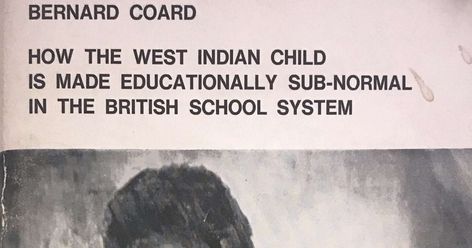
In British schools and universities, we continue to see these same stereotypes playing out (the return of race science, to put it bluntly) but more importantly, this is White supremacy in action. Whilst I enjoyed (if that’s the term), the documentary as it had lots to take away, I felt it was not critical enough. Much alike lots of the documentaries we have received from especially the BBC since the George Floyd killing, they go as far as to say ‘racism is bad and we need to talk about it’ but fall short in naming White supremacy as a social and political system (Mills, 2004). Further to the fact of how institutional Whiteness (White Spaces) allows our structures to continue to centre and frame the emotions of White people in dealing with racist incidents. The scandal that culminated in Bernard Coard’s book How the West Indian Child is Made Educationally Sub-normal in the British School System, was well articulated by the BBC as well as showing the role of Black parents, community leaders and activists, but falls short at showing the overarching system leading us to believe this as an isolated tragedy and not part of complex system that was orchestrated from dot.
We had lots of testimony from the victims as well as parents, community leaders, activists and the like but much akin to so much of the trauma narratives of late, the people that helped facilitate these crimes are nowhere to be seen … we have a victim-focussed narrative with no analysis on the mechanics of the oppression itself. 50 years on, more awareness for sure … but no accountability. The BBC is the establishment broadcaster and it shows. Babylon, for true!
References
Coard, B. (1971) How the West Indian Child is Made Educationally Subnormal in the British School System. In: Richardson, B. Tell it like it is: How our schools fail Black children. Stoke-on-Trent: Trentham Books.
Mills, C (2004) Racial Exploitation and the Wages of Whiteness. In: Yancy, G (ed). What White Looks Like: African American Philosophers on the Whiteness Question. Abingdon: Routledge.
Saini, Angela (2019) Superior: The Return of Race Science. London: 4th Estate.
Ventour, T (2021) The Alternative History Behind the Windrush Scandal. Medium [online]
White Spaces. Institutional Witnesses. White Spaces [online].
Share this:


It’s different now… it happened to me
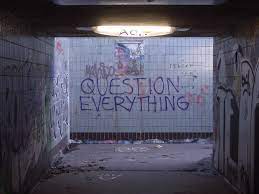
A few weeks ago, @paulaabowles shared an article on the Criminology Facebook page which posed the question of whether graffiti is art or crime. My response was art. And like all art, not all variations, interpretations or styles are for everyone. I know I can look at some graffiti and be quite taken aback at the brightness, boldness and creativity which shines through. I can also look at some and go ‘eugh’. However I have the same reactions to various classical and well-known pieces. My unrefined self does not get all the hype about a number of Picasso’s works (possibly all the ones I have seen). Nevertheless this is the beauty of art: it is down to individual taste.
So for me, I was fairly certain on my opinions and convictions towards graffiti as an art form, and as an example of the CJS further stigmatising and criminalisation young people’s behaviours: something I am certain we are all quite familiar with at this stage in our criminological journey. However those beliefs and informed views were put to the test over the Bank Holiday (BH) Weekend, and in all honesty I think I am still trying to get to grips with them. It is different now…. It happened to me.
Some context: as those of you who have read various blog posts from myself will no doubt remember, my partner runs a small kiosk near one of the Royal Parks in London. Often during the weekends and summer months, I provide an extra pair of hands to help clean and serve during the busier periods. And as a result of the pandemic, my partner finds themselves going from a team of 4 down to just them, and me when I am able to support: this was the case for the BH Weekend. Off we popped, down to London for a day of serving hotdogs, drinks and ice creams. However our day was thrown off course by some ‘ugly’ graffiti all over the front of the kiosk.
My partner was angry, and felt personally attacked (not really sure by who- but guess that’s besides the point). It is not the first time the kiosk has had graffiti on it, but it is the first time I have seen it in person and witnessed my partner’s response. Rather than starting our working day and opening up, we had to clean the graffiti off. My partner set to this: just over 3 hours later some of it has been removed, but so has some of the kiosk’s paint. It looks a mess. We are now at midday and we cannot afford to remain closed and keep cleaning. We have lost 3 hours of trading time to try and remove it, only to remove some of it and some of the kiosk’s paint. I am informed that we shall need to go to B&Q to try and find some graffiti remover: Capitalism wins again! But seeing my partner cleaning for 3 hours, losing the trading hours and for this end result: I can’t help but feel angry, frustrated and in want of some kind of justice. It’s different now… it happened to me.
But what realistically would justice be in the scenario? What do I actually want as a result? I have no idea. I asked my partner who said they just wanted them ‘not to do it’. It is private property, will my partner call the police? Nope: just nuisance annoying behaviour, but not much anyone can do about it. I feel less inclined to call it art. I like my partner’s use of ‘nuisance’ behaviour: it feels very accurate. I do not think my partner was targeted, I think it was available as a surface to be used for that individual or individuals to express themselves. But I am shaken in my previously held convictions. Shouldn’t something be done. We lost 3 hours of trading, the kiosk now needs to be repainted and we shall need to purchase some graffiti remover. All for some expression of ‘art’? Shouldn’t there be some kind of repercussion?
I am not too sure. I also know when this has happened before, and I have not been present to witness the impact it has on my partner and the kiosk I have been very nonchalant about it. ‘Oh dear, that’s frustrating’, ‘ah well, never mind’. But being there and seeing it: I view it differently. And this is something many of us come to grips with when considering hypothetical moral situations and larger ethical questions. We think we will act one way, but if it happened to us: it is quite possible our opinions, informed views and beliefs would change. I still think graffiti is art, but I am not so convinced in my previous assertation that it is not a crime…

Share this:


Lockdown and Locked In

The COVID-19 pandemic has caused a whole range of issues for so many people. Everything from job losses, businesses closing down, people being unable to leave the house, people panic buying and stock piling. There has also been a sharp increase in mental health issues, loneliness, isolation, and fears about what the future holds.
However, one thing that has been reported on, is the increase in domestic violence that has occurred across the country. In April 2020, phone calls to the charity Refuge were up by 49%, (1) and people accessing their website seeking help had increased by 417% (2). As more people are working from home, abusers are at home too, making it harder for survivors of domestic abuse to get away from their partners.
In an effort to combat domestic abuse, and to provide confidential help to survivors, the government launched the ‘Ask for ANI‘ codeword scheme (Action Needed Immediately) whereby a survivor of abuse can go to their local pharmacy and get private and confidential help. Survivors can ask if they want to get help from a domestic violence refuge, or to get the police involved. Everything will be led by the survivor who will be in the private consultation room with the pharmacist helping the survivor (3)
References
(1) Home Office (2021) ‘Domestic Abuse and Risks of Harm Within the Home’ Available online at: https://publications.parliament.uk/pa/cm5801/cmselect/cmhaff/321/32105.htm#_idTextAnchor000 Accessed on 19/02/2021
(2) House of Commons (2020) ‘Home Affairs Committee’ Available online at: https://publications.parliament.uk/pa/cm5801/cmselect/cmhaff/correspondence/HASC-transcript-15-April.pdf – page 24. Accessed on 19/02/2021
(3) HM Government (2020) ‘Guidance for Pharmacies Implementing the Ask for ANI Domestic Abuse Codeword Scheme’ Available online at: https://assets.publishing.service.gov.uk/government/uploads/system/uploads/attachment_data/file/940379/Training_information_-_Ask_for_ANI.pdf Accessed on 19/02/2021
Other Sources
Unlisted (2020) ‘Domestic Abuse Codeword Pharmacy Training Video’ Available online at: https://www.youtube.com/watch?v=OOs3awxx5YU&feature=youtu.be Accessed on 19/02/2021
Share this:


What’s in the future for criminology?

This year marks 20 years that we have been offering criminology at the University of Northampton and understandably it has made us reflect and consider the direction of the discipline. In general, criminology has always been a broad theoretical discipline that allows people to engage in various ways to talk about crime. Since the early days when Garofalo coined the term criminology (still open to debate!) there have been 106 years of different interpretations of the term.
Originally criminology focused on philosophical ideas around personal responsibility and free will. Western societies at the time were rapidly evolving into something new that unsettled its citizens. Urbanisation meant that people felt out of place in a society where industrialisation had made the pace of life fast and the demands even greater. These societies engaged in a relentless global competition that in the 20th century led into two wars. The biggest regret for criminology at the time, was/is that most criminologists did not identify the inherent criminality in war and the destruction they imbued, including genocide.
In the ashes of war in the 20th century, criminology became more aware that criminality goes beyond individual responsibility. Social movements identified that not all citizens are equal with half the population seeking suffrage and social rights. It was at the time the influence of sociology that challenged the legitimacy of justice and the importance of human rights. In pure criminological terms, a woman who throws a brick at a window for the sake of rights is a crime, but one that is arguably provoked by a society that legitimises inequality and exclusion. Under that gaze what can be regarded as the highest crime?
Criminologists do not always agree on the parameters of their discipline and there is not always consensus about the nature of the discipline itself. There are those who see criminology as a social science, looking at the bigger picture of crime and those who see it as a humanity, a looser collective of areas that explore crime in different guises. Neither of these perspectives are more important than the other, but they demonstrate the interesting position criminology rests in. The lack of rigidity allows for new areas of exploration to become part of it, like victimology did in the 1960s onwards, to the more scientific forensic and cyber types of criminology that emerged in the new millennium.
In the last 20 years at Northampton we have managed to take onboard these big, small, individual and collective responses to crime into the curriculum. Our reflections on the nature of criminology as balancing different perspectives providing a multi-disciplinary approach to answering (or attempting to, at least) what crime is and what criminology is all about. One thing for certain, criminology can reflect and expand on issues in a multiplicity of ways. For example, at the beginning of 21st terrorism emerged as a global crime following 9/11. This event prompted some of the current criminological debates.
So, what is the future of criminology? Current discourses are moving the discipline in new ways. The environment and the need for its protection has emerge as a new criminological direction. The movement of people and the criminalisation of refugees and other migrants is another. Trans rights is another civil rights issue to consider. There are also more and more calls for moving the debates more globally, away from a purely Westernised perspective. Deconstructing what is crime, by accommodating transnational ideas and including more colleagues from non-westernised criminological traditions, seem likely to be burning issues that we shall be discussing in the next decade. Whatever the future hold there is never a dull moment with criminology.
Share this:


Stop Protecting the #PervertPrince

In the past six months, I have been reflecting on recent stories that have hit media headlines. Although these topics are extremely important, in my opinion not enough “meaningful” discussion has been had. I’m referring to the sexual exploitation of children – the power imbalance, that powerful men within society have abused and have seeming got away with. I start with Jeffrey Epstein.
Although he was convicted of sexual crimes against children, his conviction is one of deceit. The American justice system let down his victims, disguising the severity of his crimes, allowing him to continue his abuse of power on vulnerable children. He was not charged with paedophilia or rape, the US legal system thought it would be fitting to charge him with solicitation of minors for prostitution.

There are various things that are problematic with this, but one of the biggest problems for me is using minors and prostitution in the same sentence. It annoys me that we tend to view our society as progressive and yet we still label children as prostitutes, forgetting that there is a legal age of consent and no child can be a prostitute as they cannot give consent, as much as the law would suggest. This is reminiscent of the Rotherham sex ring, where police labelled minors as prostitutes, forgetting that they are victims of coercion, exploitation and rape. This ideology quickly moves the emphasis away from the perpetrators of crime while negatively impacting the victim. It is time that we have compassion for the victims of such awful crimes and move away from labelling and blaming.
It makes my blood boil that people have the audacity to argue that the US legal systems failings can be used as an outlet of blame for the relationship that Epstein, Prince Andrew and President Clinton had. Lady Colin Campbell stated that if the US legal system had been more transparent Clinton and the shamed Prince would have made better judgements on their friendship with him. She and others have come to this defence of the ‘upper crust,’ using the American justice system failings as a crutch for their wrongdoings.
Although some may agree with her, I must highlight some glaring points that should be raised, before she states such ludicrous statements – such as: Prince Andrew and Bill Clinton’s advisors would have done thorough background checks on Epstein. This would have identified his crimes and his monstrous ways. They would have disclosed the information that was flagged to them and then warned them against forming relationships with the known predator. If these men had any shred of decency, then they would have kept a distance.
My conclusion as to why they did not, is because they feel they are above the law and do not have to conform to the norms that the rest of society subscribes too. It is all about money and status to them, if you are not one of them, you are not human. This notion was visible when Prince Andrew had his very uncomfortable interview with Emily Maitlis. During the interview he never displayed any kind of remorse for the victims. He didn’t even mention them or their harm. He used phrases like Epstein engaged in activity that is unbecoming rather than condemning his actions and showing any kind of emotion. This reaction, or lack of, has only stretched his credibility. He blazingly lied throughout the interview and his actions have made him look like a bumbling pervert.
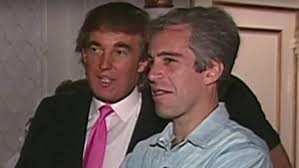
Even though Prince Andrew has demonstrated a lack of morality, the biggest discussion that surrounds this entity is whether he should step down from his royal duties. It seems everyone forgets that he has shown a lack of compassion, he has been pictured with young girls who have accused him and Epstein of violating them. But being a prince trumps all these facts, as he is let off lightly.
He is rich and powerful, and like Epstein, their status has sheltered them from real-world consequences. Epstein is now deceased, but it was all on his terms and once again the victimisation of children has been overshadowed by the circumstances of how he died. The salacious topic of how he managed to commit suicide and whether he was murdered is now big news. As for Prince Andrew, I cannot imagine he will be found guilty and he will not speak publicly about this topic again. Some may demand answers, but he will be protected from any real justice.
It is time that we start opening our eyes and acknowledging the victims of these crime. It is time to make it known that just because you are royalty, a billionaire or a socialite you are not above the law. We need to fight for the voiceless in our society, against the people who abuse their power and stop making excuses for them.
Share this:


100% of the emotional labour, 0% of the emotional reward: #BlackenAsiawithLove

Last night over dinner and drinks, I spoke about race in the classroom with two white, upper-middle-class gay educators. Neither seemed (able) to make any discernable effort to understand any perspective outside their own. I had to do 100% of the emotional labour, and got 0% of the emotional reward. It was very sad how they went on the attack, using both passive and active aggression, yet had the nerve to dismiss my words as ‘victimhood discourse’. This is exactly why folks write books, articles, and blogs like ‘Why I’m No Longer Talking to White People About Race’.
Worse, they both had experienced homophobia in the classroom, at the hands of both students and parents. Nonetheless, they had no ability to contribute to the emotional labour taking place as we spoke about race. Even worse, the one in charge of other educators had only 24 hours earlier performed the classic micro-aggression against me: The brown blur. He walked right past me at our initial meeting as I extended my hand introducing myself while mentioning the mutual friend who’d connected us because, as he said, he was “expecting” to see a white face. He was the one to raise that incident, yet literally threw his hands in the air, nodding his head dismissively as he refused any responsibility for the potential harm caused.
“I’m an adult,” I pled, explaining the difference between me facing those sorts of aggressions, versus the young people we all educate. This all fell on deaf ears. Even worse still, he’d only moments earlier asked me to help him understand why the only Black kid in one of his classes called himself a “real nigger.” Before that, he had asked me to comment on removing the N-word from historical texts used in the classroom, similar to the 2011 debate about erasing the N-word and “injun” from Huckleberry Finn, first published in 1884. According to the Guardian, nigger is “surely the most inflammatory word in the English language,” and “appears 219 times in Twain’s book.”
Again, he rejected my explanations as “victimhood.” He even kept boasting about his own colorblindness – a true red flag! Why ask if you cannot be bothered to listen to the answer, I thought bafflingly? Even worse, rather than simply stay silent – which would have been bad enough – the other educator literally said to him “This is why I don’t get involved in such discussions with him.” They accused me of making race an issue with my students, insisting that their own learning environments were free of racism, sexism and homophobia.
They effectively closed ranks. They asserted the privilege of NOT doing any of the emotional labour of deep listening. Neither seemed capable of demonstrating understanding for the (potential) harm done when they dismiss the experiences of others, particularly given our differing corporealities. I thought of the “Get Out” scene in the eponymously named film.
“Do you have any Black teachers on your staff,” I asked knowing the answer. OK, I might have said that sarcastically. Yet, it was clear that there were no Black adults in his life with whom he could pose such questions; he was essentially calling upon me to answer his litany of ‘race’ questions.
Armed with mindfulness, I was able to get them both to express how their own corporeality impacts their classroom work. For example, one of the educators had come out to his middle-school students when confronted by their snickers when discussing a gay character in a textbook. “You have to come out,” I said, whereas I walk in the classroom Black.” Further still, they both fell silent when I pointed out that unlike either of them, my hips swing like a pendulum when I walk into the classroom. Many LGBTQ+ people are not ‘straight-acting’ i.e. appear heteronormative, as did these two. They lacked self-awareness of their own privilege and didn’t have any tools to comprehend intersectionality; this discussion clearly placed them on the defense.
I say, 100% of the emotional labour and none of the emotional reward, yet this is actually untrue. I bear the fruits of my own mindfulness readings. I see that I suffer less in those instances than previously. I rest in the comfort that though understanding didn’t come in that moment, future dialogue is still possible. As bell hooks says on the first page in the first chapter of her groundbreaking book Killing Rage: Ending Racism: “…the vast majority of black folks who are subjected daily to forms of racial harassment have accepted this as one of the social conditions of our life in white supremacist patriarchy that we cannot change. This acceptance is a form of complicity.” I accept that it was my decision to talk to these white people about race.
I reminded myself that I had foreseen the micro-aggression that he had committed the previous day when we first met. A mutual friend had hooked us up online upon his visit to this city in which we now live. I doubted that she’d mentioned my blackness. Nonetheless, I had taken the chance of being the first to greet our guest, realizing that I am in a much safer space both in terms of my own mindfulness, as well as the privilege I had asserted in coming to live here in Hanoi; I came here precisely because I face such aggression so irregularly in Vietnam that these incidents genuinely stand out.
—
Works mentioned:
Eddo-Lodge, R. (2018). Why I’m No Longer Talking to White People About Race. London: Bloomsbury Publishing.
Hanh, T. (2013). The Art of Communicating. New York: HarperOne.
hooks, b. (1995). Killing rage: Ending racism. New York: Henry Holt and Company, Inc.
Share this:


Congratulations, but no Celebrations

A few weeks ago, Sir Cliff Richard won his high court case against the BBC over the coverage of a police raid on his home, the raid relating to an investigation into historical sex abuse. I remember watching the coverage on the BBC and thinking at the time that somehow it wasn’t right. It wasn’t necessarily that his house had been raided that pricked my conscience but the fact that the raid was being filmed for a live audience and sensationalised as the cameras in the overhead helicopter zoomed into various rooms. A few days later in the sauna at my gym I overheard a conversation that went along the lines of ‘I’m not surprised, I always thought he was odd; paedo just like Rolf Harris’. And so, the damage is done, let’s not let the facts get in the way of a good gossip and I dare say a narrative that was repeated up and down the country. But Sir Cliff was never charged nor even arrested, he is innocent.
The case reminded me of something similar in 2003 where another celebrity Matthew Kelly was accused of child sex abuse. He was arrested but never charged, his career effectively took a nose dive and never recovered. He too is innocent and yet is listed amongst many others on a website called the Creep Sheet. The name synonymous with being guilty of something unsavoury and sinister, despite a lack of evidence. The way some of the papers reported that no charges were to be brought, suggested he had ‘got away with it’.
The BBC unsuccessfully sought leave to appeal in the case of Sir Cliff Richard and is considering whether to take the matter to the appeal court. Their concern is the freedom of the press and the rights of the public, citing public interest. Commentary regarding the case suggested that the court judgement impacted victims coming forward in historical abuse cases. Allegations therefore need to be publicised to encourage victims to come forward. This of course helps the prosecution case as evidence of similar fact can be used or in the view of some, abused (Webster R 2002). But what of the accused, are they to be thrown to the wolves?
Balancing individual freedoms and the rights of others including the press is an almost impossible task. The focus within the criminal justice system has shifted and some would say not far enough in favour of victims. What has been forgotten though, is the accused is innocent until proven guilty and despite whatever despicable crimes they are accused of, this is a maxim that criminal justice has stood by for centuries. Whilst the maxim appears to be generally true in court processes, it does not appear to be so outside of court. Instead there has been a dramatic shift from the general acceptance of the maxim ‘innocent until proven guilty’ to a dangerous precedent, which suggests through the press, ‘there’s no smoke without fire’. It is easy to make allegations, not easy to prove them and even more difficult to disprove them. And so, a new maxim, ‘guilty by accusation’. The press cannot complain about their freedoms being curtailed, when they stomp all over everyone else’s.
Share this:


Public attitudes towards male victimisation

I graduated from the University of Northampton as a Criminology student in July 2016 and not a day goes by where I don’t miss studying. I miss everything about the University experience, from the lectures and seminars, to the countless hours spent working in the library. One of the positive things about being a graduate however, is that any time spent scrolling through social media or binge-watching a Netflix series is guilt-free. There is no dissertation to write or any exams to revise for any more, meaning you can enjoy your leisure time without the dreaded guilt that you’re not spending your time productively. I have, admittedly, taken this privilege too far, and spend far too much time on my phone. Bizarrely, I spend a lot of my time scrolling through comments on social media posts, even when I know there are bound to be comments which will annoy me.
For instance, last month, a video clip from ITV’s ‘This Morning’ emerged on Twitter and Instagram, in which Phillip Schofield and Holly Willoughby interviewed a young male who had suffered as a victim of domestic violence at the hands of his female partner. He revealed how he had been starved, physically and mentally abused by his girlfriend and that his injuries were so severe, they were almost fatal. What was really encouraging to see, were the hundreds of supportive comments left by people online. The majority of people were praising the man for his bravery and recognised that there needs to be much greater awareness for male victimisation. Sadly, the comments that caught my attention were “what a wimp” and “…he shoulda manned up sooner!”. These comments really riled me, as for my own dissertation, I interviewed an organisation specialising in support for male victims of domestic violence. It was shocking to discover the challenges the organisation face in terms of securing public funding, professional support, and most importantly, encouraging male victims to come forward and seek help. One of the over-arching themes which emerged was that men are still very reluctant to seek help, largely due to embarrassment and fears of being ridiculed. There is still a societal perception that men should be able to deal with problems by themselves, and that if they are unable to, they must be “weak”. It is for this reason that these particular comments left by strangers online infuriated me so much. Quite simply, domestic violence is a human issue, not just a gender one. Not only this, but these few words have the potential to be extremely damaging and may deter men who are suffering in silence from getting the help they need.
Over two years have passed since I carried out my research on this topic area and I am still very passionate about it. I have nothing but admiration for the young male on ‘This Morning’ and am hopeful that his bravery will encourage other male victims to seek help. I also hope that the positive comments online will always overshadow the thoughtless, negative ones. Help is out there and no victim, regardless of their gender, should be discouraged from seeking it.
Share this:


Corrosive substances – A knee-jerk reaction or a sensible solution?

Following the apparent growth in acid attacks the suggestion from Amber Rudd on a potential means of tackling the problem has all the markings of another knee-jerk policy that lacks careful planning and application. The proposal is to restrict the sales of corrosive substances and introduce new, specific legislation for possession and use of such substances against another person. The justification for these suggestions is based on the doubling of attacks between 2012 and 2016-17. Furthermore a 6 month review by National Police Chiefs Council (NPCC) report 400 acid or corrosive substance attacks between October 2016 and April 2017. The impact of such attacks is long lasting and without question, a horrific life changing experience, however is this reaction the right one for all concerned?
The plan to ban the sale of corrosive substances to under 18s in itself may be a sensible idea, if there is careful consultation on what substances are to be included in this blanket approach. A similar approach already exists with the sale of knives, tobacco and alcohol yet the extent to which these policies are a success is a moot point. Policing such an approach will also be considerably challenging because there is currently no clear outline of what the government intends to class as a corrosive substance. If the suggestions that bleach will be on the list then this may prove very difficult, if not impossible to police. Many of the corrosive substances being used today are household names readily available in most local shops and supermarkets, not to mention the internet. When purchasing items subject to restriction on the internet, the only check of age is you clicking a button to confirm it and maybe adding a date of birth, neither of which are particularly secure.
Taking this a step further the other suggestion is the creation of a new offence; possession of a corrosive substance in a public place. Such legislation is modelled on legislation already used to tackle knife offences and offensive weapons whereby a prison sentence of upto 4 years can be issues for possession, with intent to carry out an attack. However, why is such an approach necessary when perpetrators of acid attacks can already receive a life sentence under existing legislation. Is it because of the tremendous success of the approach taken to knife crime? Unlikely, if you consider the resistance by the judiciary to use such an approach which would inevitably lead to much higher prison numbers than we already have. In short, the ‘do it again…threat’ is highly unlikely to act as a deterrence when deterrence as a reason for punishment has long been questionable.
Is this another knee-jerk reaction to media hype? Evidence of another poorly considered policy response driven by political self-interest and the desire to be ‘seen to be doing something’. Many of these attacks have been linked to societies folk devils; youth or personal vendetta’s therefore rather than creating new policy, why not focus on existing measures using them to their full force and improving the services offered to the victims of these heinous crimes. Under existing legislations those convicted of an acid attack can receive a life sentences so why new legislation. Survivors also get a life sentence so surely the more appropriate response is to focus on victim’s needs (physical and psychological) rather than the creation of unnecessary legislation

 Thoughts from the criminology team