
Home » Reading (Page 9)
Category Archives: Reading

Just Keep Swimming

This isn’t going to be the intellectual blog post I had expected myself to write. I am writing this as I am undertaking my post-grad dissertation and in all honesty, I can’t be bothered anymore. And I feel secure in the fact that I am not the only person who feels this and I most certainly will not be the last. Heck, I’ve been close to giving up altogether a handful of times throughout both my under and post-grad. I will be the first to admit that I don’t know how to leave work mode alone when I have deadlines due. And it is only through friends and family that I have to be reminded that all work and no play, doth not make for a mentally healthy Bronagh. I have always struggled separating the two and have been known to cancel or decline plans so I can do work; low and behold, I don’t write a word.
Be mindful of your mental health. You can’t work at it constantly. Between work and uni, you need to allow yourself those stress-free days off so you can produce the best work that you are capable of. I hate to harp on about the most obvious scenario. But as someone who felt bad for taking time off to have fun and as someone who is currently struggling for the motivation to complete this dissertation, just know that you are not alone. It is not uncommon to feel burnt out towards the end of your degree, be it 1 year, 3 years, or more. Just know that you have not come this far to fall at the final hurdle.
My biggest motivation was having friends going through the same situation. Meeting up to go the library so none of us bailed. Telling one another to “shut up, we need some quiet time”, putting headphones in so as not to get dragged into another one-hour chat about that dire television show we all watched the other night. As with everything, it’s all about moderation. You are your own worst enemy, but it is you who will pull yourself out of your slump and show your self-doubt that you are both capable and worthy. This isn’t forever and you will relish those days where you have no deadlines to worry about, but trust me, you will also miss them. Do not let these tough times get the better of you and certainly do not let them put you off any possibilities of further education. The motivation will come and you will get there in the end. Carry on doing the things you enjoy and take everything in your stride.
Just keep swimming, you’ve got this.
Share this:


Painting by numbers: The problem with HE.

Tillovision, http://www.Tillovision.com
I read a report the other week about concern over the number of 1st degrees that are being achieved within higher education in the UK (Richmond, 2018) and the fact that the volume of such achievements is devaluing university degrees. I juxtapose this with another report that states that 32% of students do not think they get value for money (Neves and Hillman, 2018) and the result is some soul searching about what it is I’m trying to achieve as a lecturer, aside from survival, and what higher education (HE) is about. A conversation with a friend who works in Information Technology muddies the water even more. He’s a high flyer, jetting backwards and forwards to the USA, solving problems, advising on, and implementing major change projects within large corporations and generally making a lot of money along the way. For him a degree is not as important as the ability to ‘think outside the box’, find solutions to problems and show leadership that enables change or fixes. If you have a degree then you ought to be able to do all these things to some extent, experience will then build on it. He lets on that his company will not touch graduates from certain universities, simply because they do not have the requisite skills or abilities, their degrees are effectively meaningless. A sad generalisation but one that is becoming increasingly prominent amongst employers. One other thing that he was quick to point out is that the ‘real world’ is highly competitive and his company are looking for the best potential.
So, what is higher education all about, higher than what? What is the benchmark and what is the end goal? I have always believed that higher education is about taking students beyond what can be read in books or can be followed in manuals. It is about enhancing the understanding of the world in which we operate, either professionally or socially and being able to redesign or reimagine that world. It is about leadership in its many guises, problem solving and the ability to use initiative and autonomy. It is about moving a student from being able to paint by numbers under supervision to a student that can paint free hand, understanding light and colours, understanding how to capture moods or how to be evocative, a student who uses materials that they want to use, and they are not frightened to do so. It stands to reason that not every student can achieve excellence. If the starting point is the ability to paint by numbers, then some will move only slightly beyond this and some will excel, but only a few will warrant a 1st degree. What is clear though is that the students really ought to be able to paint by numbers before they enter HE otherwise they will need to be taught that skill before they can move on. That then is no longer higher education but further education (FE) and more importantly, it sets students up to fail, if they are being measured against HE standards. An alternative to avoid this potential failure requires HE standards to be lowered to those of FE. In which case what is the point of HE?
So why would I be confused about HE? Well, when students are seen as cash cows, each being worth £9250 a year to an institution, being able to paint by numbers becomes a barrier to recruitment in a highly competitive market. Institutions can help students that do not have the requisite skills, but this requires either extra time before joining the HE course, this has funding implications, or a lot of extra work by the student during the HE course, and this means that students with limited academic ability struggle. A need to retain students over the three-year period of a degree, to ensure institutional financial stability or even viability, becomes problematic. Struggling students have a double whammy, they have to catch up to the starting point for each year, whilst also progressing through the year. The choices are stark for HE institutions, progress students by lowering standards or lose them.
HE institutions are measured on the number of good degrees and it makes for good advertising. There is enough literature around to suggest that such unsophisticated quantitative measures are never a good thing. The complexity of higher education, where there is a heavy reliance on students engaging in their studies (there is something to be said about reading for a degree), puts much of the achievement of grades beyond the control of lecturers or even institutions. The resultant solution appears to be the lowering of assessment standards and teaching to assessments. In effect, HE is falling in line with FE and teaching students to paint by numbers. It is easy to see why there is disquiet then about an increase in 1st degrees and more importantly, in a competitive world, why employers are becoming increasingly concerned about the value of a degree. As for value for money for students, for many, it’s a bit like being charged a fortune to race a Maserati round a track for a day but not being able to drive.
Neves, J. and Hillman, N. (2018) Student Academic Experience Survey report 2018 [online] available at https://www.heacademy.ac.uk/knowledge-hub/student-academic-experience-survey-report-2018 [accessed 20 June 2018]
Richmond, T. (2018) A degree of uncertainty: An investigation into grade inflation in universities. [online] available at, http://www.reform.uk/publication/a-degree-of-uncertainty-an-investigation-into-grade-inflation-in-universities/ [accessed 20 June 2018].
Share this:

That Fat-Tuition: International Students’ Career Prospects

Sallek is a graduate from the MSc Criminology. He is currently undertaking doctoral studies at Stellenbosch University, South Africa.
As an international student studying for my doctorate in South Africa, I have been pushed and compelled to think more and more about life after studies. This push does not often come from the most caring hearts. It would seem some South Africans have been wired to ask every ‘foreign national’ they meet, ‘would you go back to your country when you are done studying?’ The motive for asking this question is not as important for me as the reality packed in the question. This reality is that of the post-PhD blues, a time of unsettling emotions, and transitioning from studying to a career or post-doctoral study. Experience shows that the waiting period stirs emotions of rejection after interviews or for just not being shortlisted and when the value of one’s research and academic competency is questioned. For some the experience is short, others simply return to their former employment, while for many others, it could take a year or two, or even more.
Recently, the thought of graduating and life after the ‘PhD’ has been in my mind, and sometimes, it encroaches into my active study hours. However, this entry does not depict the reality of life after PhD alone. I had this moment after my bachelor degree and even more after my Criminology degree at UoN when I had to consider the thought of returning to my home country. I am certain some international students would relate with this. I have had numerous conversations and have heard the opinions of many on this. However, given that graduation is not only an end, but a new beginning as Helen rightly notes, careful thought out plans, perseverance and patience has helped me navigate these periods.
As the labour market has become more competitive, the need for perseverance, thought-through plans and sometimes, ingenuity has become even more important after studying and receiving beautiful grades. Statistics indicates that a significant percentage of faculty positions are non-permanent appointments and this makes the academic career prospect of young and aspiring researchers unpromising. Outside of the academia, not only is the labour market competitive, but applicants are stifled with years of experience requirements and these issues brings me to the crux of this entry.
Beyond doubt, the cost of studying for international students in most countries is comparably higher than those of ‘home’ students. I do not refer to the economic costs in terms of higher tuition, international registration fee requirements, and other sundry maintenance requirements only. Added to this is the immense social cost such as the loss of personal relationship with family, friends and one’s social network. For some, studying in Europe or the West generally attracts certain prestige and a huge pressure from social-expectation that one will return to begin a lucrative work. But, the reality is far from this. Africa has an existential youthful unemployment crisis, serious insecurity challenges and several countries lack basic infrastructures and social amenities. Hence, after studying, some elect to never return, even if it means keeping that beautiful certificate away, picking a menial job or staying back illegally. After all, besides selling all their possession or borrowing to pay the huge tuition, they have nothing to return to and have to eke out a living. These factors undermines and affects the career prospects of international students.
Share this:

Park Life
Bethany Davies is an Associate Lecturer teaching modules in the first year.
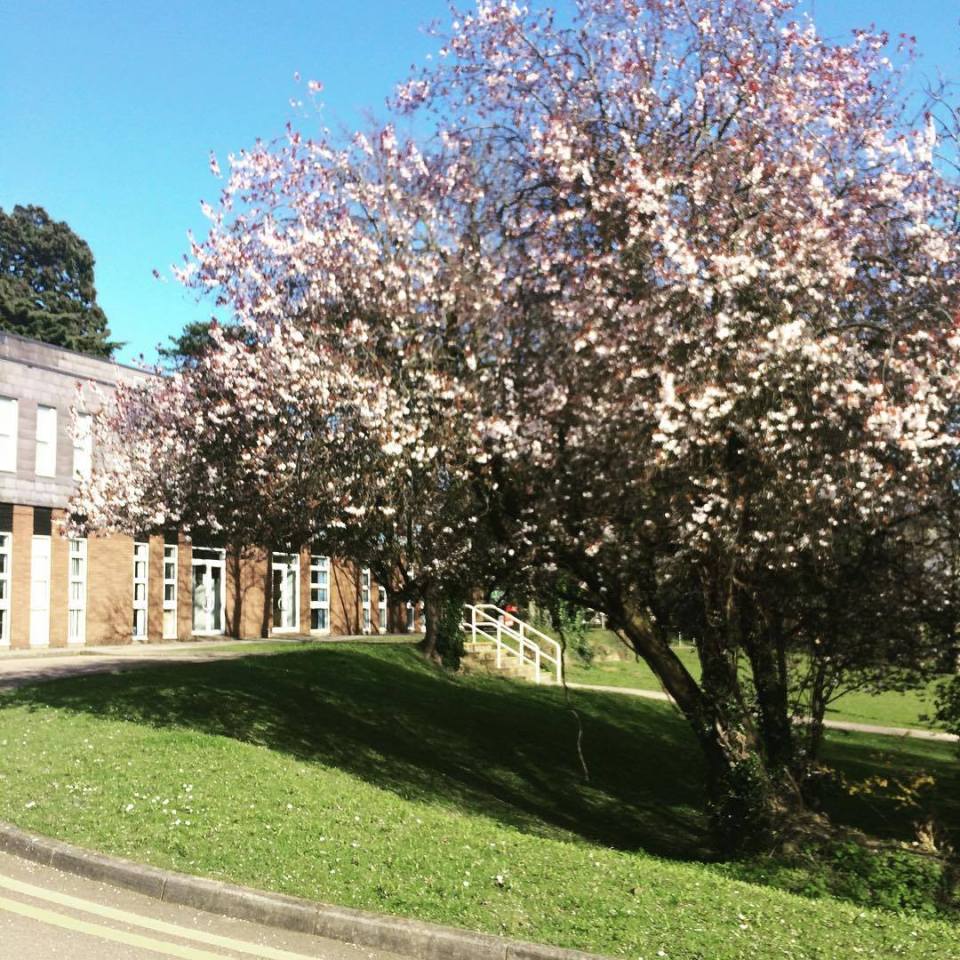
Park Campus has now been an active part of my life for around 7 years. In 2011 , after an open day and ‘taster session’ and a few months of obsessing over UCAS points and student finance, I stepped foot onto Park Campus, filled with anxiety, excitement and Redbull. It only took me a few weeks to work out, that I really did not know what Criminology was. Years later and the questions keep on coming, I may have a better understanding of theories and have new ideas and opinions, but if there is one thing Criminology at Northampton has ever taught me, is; the more you learn, the more you realise you do not know.
Studying Criminology is not for everyone, it requires a lot of passion for things that some may find tedious, such as reading, research and more reading. For many of us and hopefully those still studying Criminology it is also some of the best bits about Criminology. The rewards of reading something not necessarily to produce an essay but just to feed an interest or challenge your own views is a gift Criminology has given me. From discussions with those at the reunion, it was evident that Criminology never really leaves any of us and it does not matter whether you work in a criminological field or not, there are always moments for us to appreciate our time studying Criminology at Northampton.
Park Campus has meant so many different things to me over the years. Firstly, while I would not yet define myself as a fully grown adult by any means (does anyone?) but Park Campus was the starting point of many learning curves for fundamental skills that I needed to experience before entering the ‘working world’. Park Campus was the place I found a love for learning, a place where I could ask questions without the feeling of dread hanging over me, a place I met my current partner and many lifelong friends. When I graduated in 2014, I was unsure what to do next, luckily, I was not alone in that feeling and for the most part, it was down to losing the routine of working towards a particular goal (usually in the form of an essay or exam date).
Park Campus then took on a new meaning for me, when I joined the Criminology team in 2015. I still have a mixture of feelings when I am on campus, a mixture of familiarity and happiness to walk around as if I were still a student, but also a general sense of pride to be part of such a fantastic team. Luckily, as we move to Waterside I will not only still be surrounded by a great team but also each year brings a new cohort of students with views and ideas that I can witness change, inspire or challenge others around them.
While I’m not much of a Blur fan, but I am a fan of a bit of corny writing (hence the soppy blog post), I leave you with the chorus lyrics to Park Life, which I find enjoyably fitting …
All the people
So Many People
And they all go hand in hand
Hand in hand through their Parklife
Share this:

The changing face of criminology

We can profess that those of us in academia get to own a small nugget of knowledge on their chosen subject. This is how specialism is developed and cultivated. We start our long journey into knowledge first by learning the discipline as a whole, going through the different theories and issues, becoming aware of the critical debates, before we embrace the next step of in depth understanding. Little by little knowledge becomes a road full of junctions, intersections and byroads, constantly fueled by one of the most basic but profound parts of human experience, curiosity. Academia, was originally developed by a person looking up in the wider cosmos and wondering; surely there is more to life than this. When the recorded experience aligned with imagination it produced results; civilization emerged as a collective testament of being. Arguably the first ever question, whenever it was posed and however it was phrased, philosophy was born; any attempt to answer it generated reason and logic.
The process of learning is painstaking because education is a process and as such it requires us to grow as we absorb it. This process is never ending because “The eye never has enough of seeing, nor the ear its fill of hearing” to quote Ecclesiastes and therefore learning is lifelong. In academia, in particular, this thirst for knowledge is unquenchable and because of it we progress our respective disciplines further, constantly expanding the boundaries. Anyone of us who had a discussion in or out of a classroom will testify that even on the same topic, with the same material, a seminar is never the same. The main reason for this is, education is active and as a learner I gain from whatever I can relate to and comprehend. Time and time again, I go back to my own learning as I adapt my pedagogy, because to teach is a dialectic; we impart an idea and we let it flourish to those who shall be taking it further.
There is a reason why I am so reflecting of education on this entry; recently we had a reunion of our alumni and in preparation of the event, I was looking back at the way we taught criminology, what changed and how things have progressed. Colleagues, moved on as expected and the student demographics may have changed but the subject is still taught. It is this ongoing process that fascinated me in that reflection. The curriculum and the ideas behind it. As an institution we offer a number of subject areas, criminology included, that other institutions around the world do, but no other institution will have the unique blend of what we offer. This part is quite astounding that in the reproduction of ideas and across the continuity of disciplinary knowledge, there is always a place for originality.
On the day, I could hear the stories from some of our alumni with a latent sense of pride as they spoke with some confidence about their life plans, work commitments and ideas. These were the same people who some years ago, blushed in a seminar from shyness, were anxious about their exam results and worried about their degree classification. Now with confidence, they embrace their education with the realisation that they have just made the first step into a terra incognita… their journey into learning continues. During the next weeks (and hopefully, months), a number of our alumni (and current students) will put pen to paper of their thoughts, on our blog and talk about their experiences and their criminology. We thank them in advance and are looking forward to read their thoughts.
Share this:


Netflix and Study?

Bethany Davies is an Associate Lecturer teaching modules in the first year.
As each year and each term goes by, it brings to light how much more we are all connected through media and also how we use media to socialise and also learn.
Now, watching television, movies and using music to learn is not a new concept, I understand this, but on a personal level, I have found more individuals using television and more specifically, crime documentaries to fuel their interest in criminology and their understanding of elements of the criminal justice system.
I believe firstly, the idea of enjoying, what is termed ‘binge watching’, crime documentaries, an interesting concept. As previously explored on the blog regarding ‘enjoyment’ and ‘fun’ of criminology, the themes in these documentaries are very dark and in most cases, the gorier it is, the more it seems to be enjoyed by some viewers. Each September that rolls around we have the (sometimes dreaded) ‘ice breaker’ session, where we get to know our students and what has made them want to pursue a criminology degree at this University. Within that you will always have some who choose to voice their love of a certain crime TV show. This does not always end at first introductions either, there is often a continuation of comparisons made between that of a serious historical event and that of Netflix documentary (for example) which can often contain more dramatic music and pictures than it does criminological discussion.
The question I would like to present is, do we nourish the idea of using documentaries and crime dramas to keep the interest of those who wish to pursue criminology as a field of learning, or would doing so be disingenuous to what criminology is and neglect the love for reading and debates in criminology? I do not necessarily feel this is a question we have to worry about tremendously as I feel those who seek to study criminology purely based on their love for crime documentaries will either soon realise that there is so much of criminology that does not fit those ideas and either love it or abandon it at that point.
But in years to come these questions may be more significant than they are currently. Especially if used as a tool in universities to attract more students into a certain discipline. There are such large elements of criminology that I feel have to be explored with literature or within a seminar setting with questions and debates, and it can be easy for institutions to say that these elements will always be fundamental to a criminology degree for years to come. However, if other institutions start to use more and more media and visual aids to demonstrate a theory or issue of crime in the future, or what I suspect more as a marketing campaign to attract students, will we conform? There are some articles (from questionable sources) that some institutions are using Snapchat and social media takeovers to help attract students to certain courses, most of which I have read about have been media based, granted. But let’s hope all this drivelling nonsense is just my brain after a long bank holiday weekend and not a possibly looming prospect of the future of criminology, right?
Share this:


The number’s up for quantitative research! Or is it?

As my colleagues will no doubt confirm, I’m not a fan of numbers. Although, I always enjoyed maths, particularly algebra, my distaste for numbers comes when they are applied to people. Whilst I appreciate there are a lot of us, somewhere around 7.6 billion on the planet, the reduction of a human to a number doesn’t sit comfortably. This aversion to numbering people partly stems from academic study of the Holocaust, which was facilitated by the Nazi’s determination to reduce individual human lives first to digits and then to ashes. It also comes from my own lived experience, particularly in education, of knowing that individuals can and do change.
Criminologists such as Stanley Cohen (1988), Nils Christie (1997) and Jock Young (2011) have long recognised the fundamental flaws inherent in much quantitative criminology. They recognise that numbers are often used to obfuscate and confuse, taking readers down a route whereby they are presented as having their own intrinsic meaning, entirely distinct from the people whose data is being manipulated. Furthermore, those numbers are deemed scientific and authoritative, having far more sway than qualitative research predicated on finding meaning in individual lives.
Despite my antipathy to numbers, I have spent the last few months studying attempts to quantify a particular prison population; ex-servicemen. Much of this research is flawed in the same way as recognised by the eminent criminologists above. Instead, of answering what appears on the surface to be a straightforward question, many of these reports struggle to even define what they are trying to measure, let alone make sense of the measurements.
All this has made me think about the way we measure “engagement”. Last week, as you may have noticed from Manos’ entry, was the blog’s first birthday. Underneath, the professional front page lies, what WordPress rather hopefully describes, as ‘Stats’. From here, it is possible to identify the number of visitors per day, month and year, as well as the number of views. There is also a detailed map of the world, displaying all the countries from which these visitors are drawn. In essence, I have enough data to tell you that in our first year we have had 3,748 visitors and 5,124 views from 65 countries.
All of this sounds very encouraging and the team can make statements about how views are up on the period before, or make claims that we have attracted visitors from countries for the first time. If, so inclined, we could even have a leader board of the most popular contributor or entry; thankfully that doesn’t seem appeal to the team. If I wanted to write a report, I could include some lovely, bar or pie charts, even some infographics; certainly if you look below you will see a rather splendid Wordle which displays 233 different categories, used a total of 781 times.
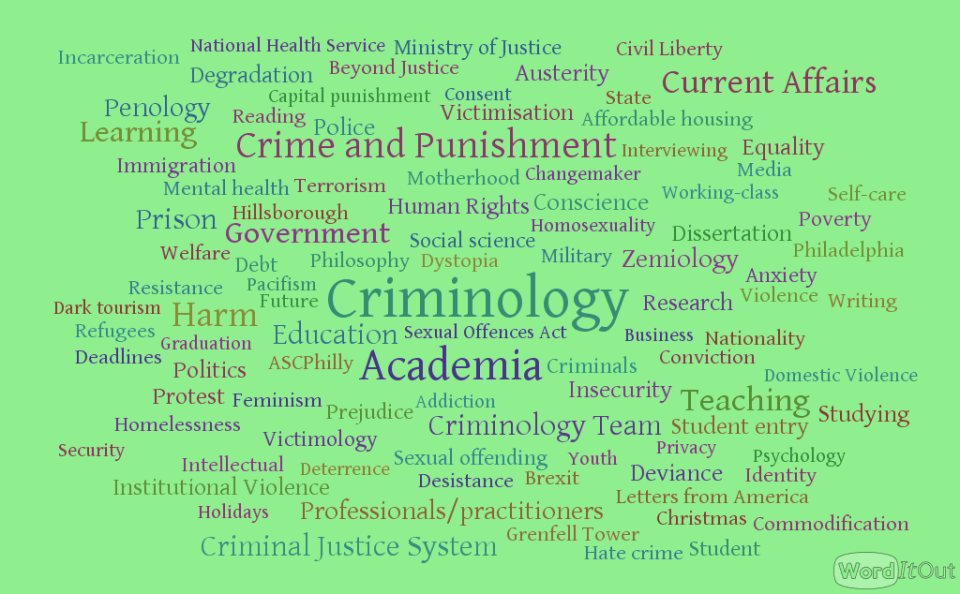
However, what exactly do we know? I would argue, not a lot. We have some evidence that some people have visited the blog at least once, but as to how many are regular readers; we have no clue. Do they read the entries and do they enjoy them? Again, no idea. Maybe they’re just attracted by particular pictures (the evidence would suggest that the Yellow Submarine, Kermit, the Pink Panther and tattoos do exceedingly well).[i] There is some evidence that many of the visitors come via Facebook and Twitter and these offer their own illusion of measurable activity. Certainly, Twitter offers its own ‘Analytics’ which advises me that my tweet containing Manos’ latest blog entry earned an impressive 907 ‘Impressions’, and 45 ‘Engagements’ which equals an ‘Engagement Rate’ of 5%! What any of that means; your guess is good as mine! Does scrolling mindlessly on your newsfeed whilst waiting for the kettle to boil count as an impression or an engagement? Should I be impressed or embarrassed by a 5% engagement rate – who knows? If I add it to my imaginary report, at least I’ll be able to add some more colourful charts to accompany my authoritative narrative. Of course, it will still be largely meaningless but it should look splendid!
More concerning are the repercussions to any such report, which would seem to imply that I had total control over improving such metrics and if they didn’t improve, that would ultimately be down to my inertia, inability or incompetence. Of course, the blog is a voluntary labour of love, created and curated by a group of like-minded individuals… However, if we consider this in relation to criminology and criminal justice, things take a more sinister turn….the numbers may indicate something, but at the end of the day those numbers represent people with their own ideas, concerns and behaviours. Discussions around payment by results seem to miss this vital point, but of course it means that failure to achieve these results can be blamed on individuals and companies. Of course, none of the above denies quantitative data a place within Criminology, but it has to be meaningful and not just a series of statements and charts.
Now, I’ve got my anti-quantitative rant of my chest, I’ll leave the final words to Nils Christie (1997) and his command to make criminology exciting and passionate as befits its subject matter. In his words, avoid ‘[l]ong reports of the obvious. Repetitions. Elaborate calculations leading to what we all know’ (Christie, 1997: 13).
Instead we should always consider:
[h]ow can it be like this? How come that so much criminology is that dull, tedious and intensely empty as to new insights? It ought to be just the opposite, in a science based on material from the core areas of drama. Our theories are based on situations of conflict and heroism, danger and catastrophe, abuses and sacrifices – just those areas where most of our literary heroes find their material. And still so trivial! (Christie, 1997: 13).
Rather than mindlessly churning out quantitative data that looks and is perceived as sophisticated, as criminologists we need to be far more critical. If you don’t believe Christie, what about taking heed of Green Day’s command to ‘question everything? Or shut up and be a victim of authority’ (Armstrong et al., 2000).
References:
Armstrong, Billie Joe, Dirnt, Mike and Cool, Tre, (2000), Warning [LP]. Recorded by Green Day in Warning, Reprise: Studio 880
Christie, Nils, (1997), ‘Four Blocks Against Insight: Notes on the Oversocialization of Criminologists,’ Theoretical Criminology, 1, 1: 13-23
Cohen, Stanley, (1988), Against Criminology, (Oxford: Transaction Books)
Young, Jock, (2011), The Criminological Imagination, (London: Polity Press)
A revised and reworked submission of this entry was published on the British Society of Criminology blog on 1 June 2018.
[i] This point will be “tested under experimental conditions” by the gratuitous inclusion of a picture showing teddy bears “reading”.
Share this:


Why you should trust your work

Bethany Davies is an Associate Lecturer teaching modules in the first year.
It is only human to doubt yourself in certain situations; however, academia can be a problematic situation to doubt your ideas and abilities. It can lead you to change your standpoint unnecessarily and also create so much stress that you give up on an idea or project entirely.
I deal with this less so now since my university experience but still regularly and I felt it may provide comfort to those currently studying or recently graduated, these examples are personal and are only two of many. In particular I want to address doubting your own ideas and work and how important it is to keep challenging those thoughts.
Upon starting university, my first ‘big essay’ (I describe this with humour as it was 3000 words, but as a first year that can seem like quite the ask) was a biographical assignment. This assignment required an interview with a family member or anyone who would be willing to talk to you and to apply that to research by highlighting some key events/accomplishments. I feared writing that essay as I had many friends with parents who were lawyers or grandparents who had been in the war or immigrants. These stories surely would be so interesting and my essay on my dad who worked in a warehouse would be seen as boring, perhaps. This was my first experience with fear and doubt over my work, but then I did the interview, wrote the essay, took a deep breath and submitted. Turns out it was one of my favourite pieces of work and the programme leaders liked it. It was an honest essay and while not glamorous, it was personal to me and that made the approval and grade that more rewarding.
In my second year, I conducted my placement at a probation office and based my research around a case study of one male who was doing an English class and aimed to discuss the success of that class. After around 8 weeks of observations and an interview with the male. I went to my seminar leader at the time (@paulaabowles) in a complete panic and almost teary-eyed. I told her how I felt my research was not good enough because the male was lying to me, in fact he was almost lying to the whole probation experience as he was more or less just turning up to tick the boxes he needed but then conducting his behaviour differently to me in certain situations and the interview. I felt I had failed as a researcher and also as a teacher almost, as I was assisting in the teaching of the class he was in. I was then told some of the great truths of research and also why I had not failed and actually I had done very well. My research was good research and I just had not realised it. The research didn’t find what I wanted it to, in fact it found the opposite, which was still good research. My research which I had titled ‘Playing the system’ had actually proved to not be a failure and my doubts were unnecessary but not anything to be ashamed of. As in my quest at the time to find answers of why was I such a ‘bad researcher’ and interviewer, I found a plethora of other people online and among peers with the same doubts over some great work they had produced.
Whether it be doubts or fear of speaking up in fear of failure or sounding stupid, I hope others may be able to see not only are they not alone, but actually you are normal because of these doubts. We should just maybe work on believing in our work more and not waiting to get the approval of others for those ideas. With this I feel it is fitting to use one of my favourite quotes from Bertrand Russell:
“The whole problem with the world is that fools and fanatics are always so certain of themselves, and wiser people so full of doubts.”
Share this:


Is education more fun than building a Lego Yellow Submarine? Discuss

This week some students, independently and across the years, introduced me to the novel idea that education should be “enjoyable” and “fun”. Furthermore, if it wasn’t enjoyable, it wasn’t being done right. Given Criminology’s subject matter is often grim, dark, focusing on the worst aspects of humankind, enjoyable and fun are not descriptions that often appear in relation to the discipline. Certainly, such a perspective is not one that I personally recognise; a day at an art gallery, playing Hungry Hippos with two little people, a nice bottle of wine, lunch with friends, building a Lego Yellow Submarine etc are things that I would say are enjoyable, perhaps even fun. But education……I’m not convinced! What follows are my vague ramblings around a subject which is very close to my heart (you are warned!).
All of the enjoyable activities I have described above are ones that I spend very little of my time doing and that to me, is part of their enjoyability (if such a word exists). They are attractive because they are rare and unusual, in my life at least. But education, learning, knowledge are part and parcel of my everyday existence, and dare I say fundamental to who am I. However, does any of this preclude education from being fun? Maybe, I just take for granted my thirst for knowledge in the same way as my thirst for water, just everyday appetites that need to be fed to maintain equilibrium and optimal performance.
I love considering new ideas and new perspectives, particularly if they challenge my thinking and jolt me out of complacency, so I want to consider this concept of enjoyable education. I’ve always been a curious person, there’s lots of questions that I want to know the answer to and they generally begin with “why”? Like all children, I expect I drove my parents mad with the constant questions; never fully satisfied with the answer. I can trace my first early, tentative steps into criminological thinking to when I was a child and regularly had to pass HMP Holloway[1] on the way to various hospital appointments. I used to wonder who lived in this huge, forbidding building, why they were there, what had they done, when would they get out and where would they go? Some decades on, I have answers to some of those questions but I’m still actively searching for the others. This, of course, is experiential learning and children’s books (at that time) offered little by way of answers to such profound criminological questions.

At school, the type of learning I liked best was when I could explore for myself. An experienced and knowledgeable teacher or lecturer explaining complex ideas could open the door so far, but I wanted to find out for myself as much as possible. For me, the best educationalists are those that gently guide and enable, not those who deliver information on demand. They also engender self-confidence and self-discipline encouraging the scholar to take control of their own intellectual journey. All of this leads me to the conclusion that learning is intrinsically neither enjoyable nor fun, although both may be by-products. Education, knowledge, learning, all of these are painful, challenging, at times they appear almost impossible. But! The level of personal satisfaction, achievement and growth means that ‘some kind of happiness is’, not as the Beatles suggest ‘measured out in miles’, but through intellectual endeavour (Lennon and McCartney, 1969). And to answer the essay question I set in the title, Lego has many charms but independent, self-direction is not one of them. Provided you follow the step-by-step illustrated instructions you will have your very own Yellow Submarine, but there are no surprises, whether positive or negative, which means I have no intellectual investment in the process. Furthermore, take the instructions away and I would not be able to recreate this “masterpiece”. Having said that, it does look rather lovely on my book case 🙂
Lennon, John and McCartney, Paul, (1969), Hey Bulldog, [LP]. Recorded by The Beatles in Yellow Submarine, Northern Songs: Apple
[1] HMP Holloway closed its doors for the final time in July 2016.
Share this:


Why Volunteer?

Bethany is an Associate Lecturer teaching modules in the first year.
Before I started lecturing at the university, unsurprisingly, I also once attended university as a criminology student. Very similar to the current university experience, I had deadlines, money stress and at times a lack of direction of what I wanted to do. Therefore, firstly, if you have experienced this or if you currently are, then you can find some comfort in knowing that you are not alone.
About 2 months into my first year, my seminar leader mentioned a volunteering opportunity for a mentor role at Milton Keynes Probation Office. I contemplated the idea for a couple of weeks; I was interested in the idea of volunteering, mainly because I had near enough zero work experience at all. I was however complacent in the idea of working for free, which is a common issue for students. However, when I took the plunge and put myself forward for it, it was honestly one of the best decisions and jobs I have ever had.
After getting out of my comfort zone in the first few weeks, In which I had some training about general health and safety and data protection. I suddenly found myself helping out in classes for English, maths, stress management, ICT and even a construction class! In these classes, there were ‘students’ who were issued to attend as part of a court order or had it suggested to them following a meeting with their probation officer. It was very rewarding and made me understand a lot of what I was doing in my modules.
The most important points from this for me that I feel should be shown more to all students is that:
- Time: You can give as much time as you want: I started only helping out in 1 class which lasted less than 2 hours every other week. I increased this to every week when I started my second year and more so again in my third year.
- Money: No, you will not make money, you will however 99% of the time be able to claim your expenses from the company running the volunteer group. I was able to claim for all my train tickets and any lunch I had while volunteering. Also mimicking the above point on time, I was able to still do volunteering alongside university and a part-time
- Experience: This was not only a good experience because I was able to do both my 2nd-year criminology placement at the probation office, but I was also able to interview offenders for my dissertation. But also you have great hands-on experience in the criminal justice field and you might actually help someone who is vulnerable and needs your patience and support.
This post is therefore in no way to make people feel bad for not volunteering or to say its’ easy, as it has many challenges and we are not all in the same position to give up time. However, If you are considering volunteering, whether that be to build up your CV, prepare for placement or you just want to give back for an hour or so. Below are some places currently looking for volunteers and I am sure your criminology expertise will be of use:
SOVA: Probation Volunteering
https://www.sova.org.uk/search-roles
Victim Support
https://www.victimsupport.org.uk/get-involved/volunteer
Safe Families For Children
Step Together ( Supporting Rehabilitation of Ex-Offenders)


