
Home » Reading (Page 9)
Category Archives: Reading

Netflix and Study?

Bethany Davies is an Associate Lecturer teaching modules in the first year.
As each year and each term goes by, it brings to light how much more we are all connected through media and also how we use media to socialise and also learn.
Now, watching television, movies and using music to learn is not a new concept, I understand this, but on a personal level, I have found more individuals using television and more specifically, crime documentaries to fuel their interest in criminology and their understanding of elements of the criminal justice system.
I believe firstly, the idea of enjoying, what is termed ‘binge watching’, crime documentaries, an interesting concept. As previously explored on the blog regarding ‘enjoyment’ and ‘fun’ of criminology, the themes in these documentaries are very dark and in most cases, the gorier it is, the more it seems to be enjoyed by some viewers. Each September that rolls around we have the (sometimes dreaded) ‘ice breaker’ session, where we get to know our students and what has made them want to pursue a criminology degree at this University. Within that you will always have some who choose to voice their love of a certain crime TV show. This does not always end at first introductions either, there is often a continuation of comparisons made between that of a serious historical event and that of Netflix documentary (for example) which can often contain more dramatic music and pictures than it does criminological discussion.
The question I would like to present is, do we nourish the idea of using documentaries and crime dramas to keep the interest of those who wish to pursue criminology as a field of learning, or would doing so be disingenuous to what criminology is and neglect the love for reading and debates in criminology? I do not necessarily feel this is a question we have to worry about tremendously as I feel those who seek to study criminology purely based on their love for crime documentaries will either soon realise that there is so much of criminology that does not fit those ideas and either love it or abandon it at that point.
But in years to come these questions may be more significant than they are currently. Especially if used as a tool in universities to attract more students into a certain discipline. There are such large elements of criminology that I feel have to be explored with literature or within a seminar setting with questions and debates, and it can be easy for institutions to say that these elements will always be fundamental to a criminology degree for years to come. However, if other institutions start to use more and more media and visual aids to demonstrate a theory or issue of crime in the future, or what I suspect more as a marketing campaign to attract students, will we conform? There are some articles (from questionable sources) that some institutions are using Snapchat and social media takeovers to help attract students to certain courses, most of which I have read about have been media based, granted. But let’s hope all this drivelling nonsense is just my brain after a long bank holiday weekend and not a possibly looming prospect of the future of criminology, right?
Share this:


The number’s up for quantitative research! Or is it?

As my colleagues will no doubt confirm, I’m not a fan of numbers. Although, I always enjoyed maths, particularly algebra, my distaste for numbers comes when they are applied to people. Whilst I appreciate there are a lot of us, somewhere around 7.6 billion on the planet, the reduction of a human to a number doesn’t sit comfortably. This aversion to numbering people partly stems from academic study of the Holocaust, which was facilitated by the Nazi’s determination to reduce individual human lives first to digits and then to ashes. It also comes from my own lived experience, particularly in education, of knowing that individuals can and do change.
Criminologists such as Stanley Cohen (1988), Nils Christie (1997) and Jock Young (2011) have long recognised the fundamental flaws inherent in much quantitative criminology. They recognise that numbers are often used to obfuscate and confuse, taking readers down a route whereby they are presented as having their own intrinsic meaning, entirely distinct from the people whose data is being manipulated. Furthermore, those numbers are deemed scientific and authoritative, having far more sway than qualitative research predicated on finding meaning in individual lives.
Despite my antipathy to numbers, I have spent the last few months studying attempts to quantify a particular prison population; ex-servicemen. Much of this research is flawed in the same way as recognised by the eminent criminologists above. Instead, of answering what appears on the surface to be a straightforward question, many of these reports struggle to even define what they are trying to measure, let alone make sense of the measurements.
All this has made me think about the way we measure “engagement”. Last week, as you may have noticed from Manos’ entry, was the blog’s first birthday. Underneath, the professional front page lies, what WordPress rather hopefully describes, as ‘Stats’. From here, it is possible to identify the number of visitors per day, month and year, as well as the number of views. There is also a detailed map of the world, displaying all the countries from which these visitors are drawn. In essence, I have enough data to tell you that in our first year we have had 3,748 visitors and 5,124 views from 65 countries.
All of this sounds very encouraging and the team can make statements about how views are up on the period before, or make claims that we have attracted visitors from countries for the first time. If, so inclined, we could even have a leader board of the most popular contributor or entry; thankfully that doesn’t seem appeal to the team. If I wanted to write a report, I could include some lovely, bar or pie charts, even some infographics; certainly if you look below you will see a rather splendid Wordle which displays 233 different categories, used a total of 781 times.
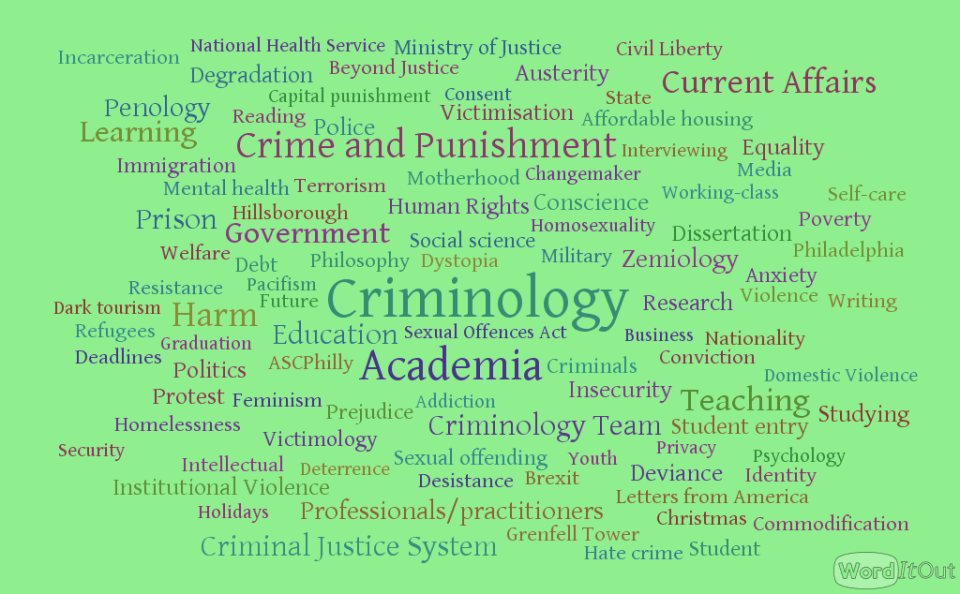
However, what exactly do we know? I would argue, not a lot. We have some evidence that some people have visited the blog at least once, but as to how many are regular readers; we have no clue. Do they read the entries and do they enjoy them? Again, no idea. Maybe they’re just attracted by particular pictures (the evidence would suggest that the Yellow Submarine, Kermit, the Pink Panther and tattoos do exceedingly well).[i] There is some evidence that many of the visitors come via Facebook and Twitter and these offer their own illusion of measurable activity. Certainly, Twitter offers its own ‘Analytics’ which advises me that my tweet containing Manos’ latest blog entry earned an impressive 907 ‘Impressions’, and 45 ‘Engagements’ which equals an ‘Engagement Rate’ of 5%! What any of that means; your guess is good as mine! Does scrolling mindlessly on your newsfeed whilst waiting for the kettle to boil count as an impression or an engagement? Should I be impressed or embarrassed by a 5% engagement rate – who knows? If I add it to my imaginary report, at least I’ll be able to add some more colourful charts to accompany my authoritative narrative. Of course, it will still be largely meaningless but it should look splendid!
More concerning are the repercussions to any such report, which would seem to imply that I had total control over improving such metrics and if they didn’t improve, that would ultimately be down to my inertia, inability or incompetence. Of course, the blog is a voluntary labour of love, created and curated by a group of like-minded individuals… However, if we consider this in relation to criminology and criminal justice, things take a more sinister turn….the numbers may indicate something, but at the end of the day those numbers represent people with their own ideas, concerns and behaviours. Discussions around payment by results seem to miss this vital point, but of course it means that failure to achieve these results can be blamed on individuals and companies. Of course, none of the above denies quantitative data a place within Criminology, but it has to be meaningful and not just a series of statements and charts.
Now, I’ve got my anti-quantitative rant of my chest, I’ll leave the final words to Nils Christie (1997) and his command to make criminology exciting and passionate as befits its subject matter. In his words, avoid ‘[l]ong reports of the obvious. Repetitions. Elaborate calculations leading to what we all know’ (Christie, 1997: 13).
Instead we should always consider:
[h]ow can it be like this? How come that so much criminology is that dull, tedious and intensely empty as to new insights? It ought to be just the opposite, in a science based on material from the core areas of drama. Our theories are based on situations of conflict and heroism, danger and catastrophe, abuses and sacrifices – just those areas where most of our literary heroes find their material. And still so trivial! (Christie, 1997: 13).
Rather than mindlessly churning out quantitative data that looks and is perceived as sophisticated, as criminologists we need to be far more critical. If you don’t believe Christie, what about taking heed of Green Day’s command to ‘question everything? Or shut up and be a victim of authority’ (Armstrong et al., 2000).
References:
Armstrong, Billie Joe, Dirnt, Mike and Cool, Tre, (2000), Warning [LP]. Recorded by Green Day in Warning, Reprise: Studio 880
Christie, Nils, (1997), ‘Four Blocks Against Insight: Notes on the Oversocialization of Criminologists,’ Theoretical Criminology, 1, 1: 13-23
Cohen, Stanley, (1988), Against Criminology, (Oxford: Transaction Books)
Young, Jock, (2011), The Criminological Imagination, (London: Polity Press)
A revised and reworked submission of this entry was published on the British Society of Criminology blog on 1 June 2018.
[i] This point will be “tested under experimental conditions” by the gratuitous inclusion of a picture showing teddy bears “reading”.
Share this:


Why you should trust your work

Bethany Davies is an Associate Lecturer teaching modules in the first year.
It is only human to doubt yourself in certain situations; however, academia can be a problematic situation to doubt your ideas and abilities. It can lead you to change your standpoint unnecessarily and also create so much stress that you give up on an idea or project entirely.
I deal with this less so now since my university experience but still regularly and I felt it may provide comfort to those currently studying or recently graduated, these examples are personal and are only two of many. In particular I want to address doubting your own ideas and work and how important it is to keep challenging those thoughts.
Upon starting university, my first ‘big essay’ (I describe this with humour as it was 3000 words, but as a first year that can seem like quite the ask) was a biographical assignment. This assignment required an interview with a family member or anyone who would be willing to talk to you and to apply that to research by highlighting some key events/accomplishments. I feared writing that essay as I had many friends with parents who were lawyers or grandparents who had been in the war or immigrants. These stories surely would be so interesting and my essay on my dad who worked in a warehouse would be seen as boring, perhaps. This was my first experience with fear and doubt over my work, but then I did the interview, wrote the essay, took a deep breath and submitted. Turns out it was one of my favourite pieces of work and the programme leaders liked it. It was an honest essay and while not glamorous, it was personal to me and that made the approval and grade that more rewarding.
In my second year, I conducted my placement at a probation office and based my research around a case study of one male who was doing an English class and aimed to discuss the success of that class. After around 8 weeks of observations and an interview with the male. I went to my seminar leader at the time (@paulaabowles) in a complete panic and almost teary-eyed. I told her how I felt my research was not good enough because the male was lying to me, in fact he was almost lying to the whole probation experience as he was more or less just turning up to tick the boxes he needed but then conducting his behaviour differently to me in certain situations and the interview. I felt I had failed as a researcher and also as a teacher almost, as I was assisting in the teaching of the class he was in. I was then told some of the great truths of research and also why I had not failed and actually I had done very well. My research was good research and I just had not realised it. The research didn’t find what I wanted it to, in fact it found the opposite, which was still good research. My research which I had titled ‘Playing the system’ had actually proved to not be a failure and my doubts were unnecessary but not anything to be ashamed of. As in my quest at the time to find answers of why was I such a ‘bad researcher’ and interviewer, I found a plethora of other people online and among peers with the same doubts over some great work they had produced.
Whether it be doubts or fear of speaking up in fear of failure or sounding stupid, I hope others may be able to see not only are they not alone, but actually you are normal because of these doubts. We should just maybe work on believing in our work more and not waiting to get the approval of others for those ideas. With this I feel it is fitting to use one of my favourite quotes from Bertrand Russell:
“The whole problem with the world is that fools and fanatics are always so certain of themselves, and wiser people so full of doubts.”
Share this:


Is education more fun than building a Lego Yellow Submarine? Discuss

This week some students, independently and across the years, introduced me to the novel idea that education should be “enjoyable” and “fun”. Furthermore, if it wasn’t enjoyable, it wasn’t being done right. Given Criminology’s subject matter is often grim, dark, focusing on the worst aspects of humankind, enjoyable and fun are not descriptions that often appear in relation to the discipline. Certainly, such a perspective is not one that I personally recognise; a day at an art gallery, playing Hungry Hippos with two little people, a nice bottle of wine, lunch with friends, building a Lego Yellow Submarine etc are things that I would say are enjoyable, perhaps even fun. But education……I’m not convinced! What follows are my vague ramblings around a subject which is very close to my heart (you are warned!).
All of the enjoyable activities I have described above are ones that I spend very little of my time doing and that to me, is part of their enjoyability (if such a word exists). They are attractive because they are rare and unusual, in my life at least. But education, learning, knowledge are part and parcel of my everyday existence, and dare I say fundamental to who am I. However, does any of this preclude education from being fun? Maybe, I just take for granted my thirst for knowledge in the same way as my thirst for water, just everyday appetites that need to be fed to maintain equilibrium and optimal performance.
I love considering new ideas and new perspectives, particularly if they challenge my thinking and jolt me out of complacency, so I want to consider this concept of enjoyable education. I’ve always been a curious person, there’s lots of questions that I want to know the answer to and they generally begin with “why”? Like all children, I expect I drove my parents mad with the constant questions; never fully satisfied with the answer. I can trace my first early, tentative steps into criminological thinking to when I was a child and regularly had to pass HMP Holloway[1] on the way to various hospital appointments. I used to wonder who lived in this huge, forbidding building, why they were there, what had they done, when would they get out and where would they go? Some decades on, I have answers to some of those questions but I’m still actively searching for the others. This, of course, is experiential learning and children’s books (at that time) offered little by way of answers to such profound criminological questions.

At school, the type of learning I liked best was when I could explore for myself. An experienced and knowledgeable teacher or lecturer explaining complex ideas could open the door so far, but I wanted to find out for myself as much as possible. For me, the best educationalists are those that gently guide and enable, not those who deliver information on demand. They also engender self-confidence and self-discipline encouraging the scholar to take control of their own intellectual journey. All of this leads me to the conclusion that learning is intrinsically neither enjoyable nor fun, although both may be by-products. Education, knowledge, learning, all of these are painful, challenging, at times they appear almost impossible. But! The level of personal satisfaction, achievement and growth means that ‘some kind of happiness is’, not as the Beatles suggest ‘measured out in miles’, but through intellectual endeavour (Lennon and McCartney, 1969). And to answer the essay question I set in the title, Lego has many charms but independent, self-direction is not one of them. Provided you follow the step-by-step illustrated instructions you will have your very own Yellow Submarine, but there are no surprises, whether positive or negative, which means I have no intellectual investment in the process. Furthermore, take the instructions away and I would not be able to recreate this “masterpiece”. Having said that, it does look rather lovely on my book case 🙂
Lennon, John and McCartney, Paul, (1969), Hey Bulldog, [LP]. Recorded by The Beatles in Yellow Submarine, Northern Songs: Apple
[1] HMP Holloway closed its doors for the final time in July 2016.
Share this:


Why Volunteer?

Bethany is an Associate Lecturer teaching modules in the first year.
Before I started lecturing at the university, unsurprisingly, I also once attended university as a criminology student. Very similar to the current university experience, I had deadlines, money stress and at times a lack of direction of what I wanted to do. Therefore, firstly, if you have experienced this or if you currently are, then you can find some comfort in knowing that you are not alone.
About 2 months into my first year, my seminar leader mentioned a volunteering opportunity for a mentor role at Milton Keynes Probation Office. I contemplated the idea for a couple of weeks; I was interested in the idea of volunteering, mainly because I had near enough zero work experience at all. I was however complacent in the idea of working for free, which is a common issue for students. However, when I took the plunge and put myself forward for it, it was honestly one of the best decisions and jobs I have ever had.
After getting out of my comfort zone in the first few weeks, In which I had some training about general health and safety and data protection. I suddenly found myself helping out in classes for English, maths, stress management, ICT and even a construction class! In these classes, there were ‘students’ who were issued to attend as part of a court order or had it suggested to them following a meeting with their probation officer. It was very rewarding and made me understand a lot of what I was doing in my modules.
The most important points from this for me that I feel should be shown more to all students is that:
- Time: You can give as much time as you want: I started only helping out in 1 class which lasted less than 2 hours every other week. I increased this to every week when I started my second year and more so again in my third year.
- Money: No, you will not make money, you will however 99% of the time be able to claim your expenses from the company running the volunteer group. I was able to claim for all my train tickets and any lunch I had while volunteering. Also mimicking the above point on time, I was able to still do volunteering alongside university and a part-time
- Experience: This was not only a good experience because I was able to do both my 2nd-year criminology placement at the probation office, but I was also able to interview offenders for my dissertation. But also you have great hands-on experience in the criminal justice field and you might actually help someone who is vulnerable and needs your patience and support.
This post is therefore in no way to make people feel bad for not volunteering or to say its’ easy, as it has many challenges and we are not all in the same position to give up time. However, If you are considering volunteering, whether that be to build up your CV, prepare for placement or you just want to give back for an hour or so. Below are some places currently looking for volunteers and I am sure your criminology expertise will be of use:
SOVA: Probation Volunteering
https://www.sova.org.uk/search-roles
Victim Support
https://www.victimsupport.org.uk/get-involved/volunteer
Safe Families For Children
Step Together ( Supporting Rehabilitation of Ex-Offenders)
Share this:


Reading is dead, long live the book

The first week of teaching is always a bit of a culture shock. The transition at the end of term from teaching to other activities and vice versa marks a change of tempo and a change of focus. For me, the summer is a time of immersion in reading, thinking and writing. All of these activities continue throughout the year but far less intensively. It’s is perhaps ironic then, that this week’s blog post has left me struggling for ideas…
Previously, I have blogged about the stresses and strains of writing, so this week I thought I might turn my attention to reading; a far more pleasurable personal experience. The first questions is why read? The simple answer is to accumulate knowledge, to find the answer to a question and to educate and entertain. Arguably, all of these purposes can be achieved far more easily by looking on the internet, getting a quick (if not always correct) answer. Why bother learning things when the internet can provide information 24 hours a day? Furthermore, who can fail to find something to entertain and amuse on the television, in the cinema or on the internet? Perhaps the death knell for the old-fashioned art of reading books is sounding with increasing urgency and volume? I disagree!
I learnt to read at around the age of 5 and very quickly I was hooked. Throughout my childhood I was teased for my seeming inability to put a book down even with eating or walking. This never dissuaded me away from the book and even when that one was finished, there would always be another one to take its place. This reading “addiction” has never left me and has meant that I have been able to explore mythical places such as Eastasia, Erewhon, Gilead, Lilliput, Manderley, Narnia and Utopia and without even leaving my armchair. I have explored America, Australia, Botswana, Germany, India, the Netherlands and South Africa to a name a few, not to mention my home city, both over ground and underground. In my reading life, I have travelled on the Orient Express, fought in the American Civil War, WWI and WWII, hidden from Nazis, as well as served prison sentences in Reading Gaol and Robben Island. I have solved crimes with Mikael Blomkvist, Scout Finch, the Famous Five and Hercule Poirot. I have felt the pains of Lady MacBeth, Jane Eyre and the second Mrs de Winter, been left unmoved by Flora Poste and Jay Gatsby and felt terrorised with Joanna Eberhart, Offred and Gregor Samsa.
Whilst the above may illustrate my love of reading, it does not really explain why it is so important to me and my career. For one, it is the only activity that really holds my concentration, particularly for extended periods of time. In the twenty-first century, where life seems so fast-paced and we jump from screen to screen, triggered by notifications as if we are one of Pavlov’s dogs, such a skill requires protection and cultivation. Second, it is intensely independent and personal; I can share stories with others, I can even discuss books in detail, but my reading is my own. Thirdly, and probably the most important for criminology is the opportunity to try someone else’s life for size. The famous line from Harper Lee; that ; ‘[y]ou never really understand a person until you consider things from his point of view – until you climb into his skin and walk around in it’ sums this up beautifully (1960/2006: 30). By reading accounts of crime, criminality, victimisation and criminal justice; even if fictionalised, we have an opportunity to test out ideas, to find out how comfortable we are with responses, actions and penalties. In particular, dystopic novels offer the unique potential to imagine the world differently. Whilst on the surface such texts, as with criminology, are presented as negative; dealing with uncomfortable, frightening and disturbing behaviours and responses, they are ultimately full of hope. The potential for change is both explicit and implicit in dystopic fiction and criminology; all is never lost, hope remains no matter what.
If you still need to be persuaded by my argument for reading everything and anything that can get your hands on, perhaps Beccaria’s words of wisdom will help ‘I should have everything to fear, if tyrants were to read my book, but tyrants never read’ (1872: 18).
And after all, who wants to be a tyrant? Not me!
Beccaria, Cesare, (1872), An Essay on Crimes and Punishments, (Albany: W. C. Little Co.), [online]. Available from: http://oll.libertyfund.org/index.php?option=com_staticxt&staticfile=show.php%3Ftitle=2193&Itemid=27 [Last accessed 24 March 2012]
Lee, Harper, (1960/2006), To Kill A Mockingbird, (London: Arrow Books)

 Thoughts from the criminology team