
Home » Reading (Page 6)
Category Archives: Reading

“My Favourite Things”: madams1965

My favourite TV show - So many to chose from! Recently finished Narcos and Narcos Mexico. Currently watching Better Call Saul and The Crown

My favourite place to go - Lyme Regis in Dorset. My parents retired there almost 20 years ago & we go down every Easter to enjoy bracing walks along The Cobb, leisurely lunches in village pubs, and fish and chips on the seafront. It’s the first place we’re going once Lockdown is over!

My favourite city - I have two: New York and Rome. I love the energy of New York, the friendliness of the people, the restaurants, theatres and bars – it just has something indescribable. In contrast, Rome is so laid back and chilled. I could sit outside a café in the Piazza della Rotonda, across from the Pantheon all day, just drinking coffee and watching the world go by, and the occasional street entertainers, before they are moved on by the Carabinieri.

And Heidelberg! Sorry I’m just being greedy now, but that is probably one of the most beautiful cities. And nothing beats a lazy cruise down The Necker River in the sun surrounded by all that lush green German countryside

My favourite thing to do in my free time - Read, read, read! Or watch Netflix! Or travel

My favourite athlete/sports personality - Not a sports fan I’m afraid

My favourite actor - Tom Hardy or Gary Oldman

My favourite author - I’ll read anything by anyone, but Jane Austen stands out from the crowd. I also love biographies

My favourite drink - Edinburgh Gin Rhubarb and Ginger Liqueur with ice and lemonade is beautifully refreshing in summer. In the winter I love a coffee flavoured Baileys with a shot of brandy. And all year round it’s red wine. Anyone will do, I’m not fussy!

My favourite food - As you can tell, I love all food!

My favourite place to eat - At home when my husband cooks his signature lamb pasanda

I like people who - don’t judge others, who are respectful and kind, and who make me laugh.

I don’t like it when people - dominate conversations, interrupt or are dismissive of others. And I don’t like bullies

My favourite book - So many I don’t know where to begin. A few of the best books I’ve read would have to include The Five by Hallie Rubenhold, Fanny and Stella by Neil McKenna, and The Fact of a Body by Alexandria Marzano-Lesnevich. I am currently reading The Poisonwood Bible by Barbara Kingsolver, and before that I read The End of the Affair by Graeme Greene, and One Flew Over the Cuckoo’s Nest by Ken Kesey

My favourite book character - At the moment (because I’m reading it) it’s Rachel from The Poisonwood Bible. She’s the eldest daughter of a bible thumping missionary who took his family to The Congo in the 1960s. Rachel is sassy and funny and thinks she’s worldly-wise at the age of 17 but mispronounces her big grown-up words and is completely oblivious to the danger around her!

My favourite film - There are so many brilliant films that I watch over and over, but my all-time favourite has to be Brokeback Mountain. Apart from the fact that the cinematography and music score are amazing, it’s just a story about such pure love and heartbreak, I cry more each time I watch it

My favourite poem - W. D. Auden’s Funeral Blues

My favourite artist/band - Showing my age here – Johnny Cash, U2, Queen, Elton John, but also Florence and The Machine, Coldplay and Mumford and Sons

My favourite song - Coldplay’s Fix You

My favourite art - I don’t have a favourite but like all sorts from Banksy to Lowry to Monet

My favourite person from history - Jane Austen
Share this:


“My Favourite Things: Cheryl (LLS)
My favourite TV show - Although it finished nearly 18 years ago, I think my favourite has still got to be Buffy the Vampire Slayer. More recently I thought Succession was a great show, mainly because the characters were just so awful

My favourite place to go - The Lake District, but anywhere with mountains and water will do

My favourite city - Reykjavik, Iceland. It’s really laid back, fantastic galleries, museums and architecture

My favourite thing to do in my free time - Is it cliché for a librarian to answer this with reading? I’ve just finished Girl, Woman, Other by Bernadine Evaristo and thought it was amazing. I’ve always got at least two books on the go. Otherwise I really like learning new crafts and do a lot of mixed media type stuff. If you see me with inky fingers, it’s what I’ve been doing

My favourite athlete/sports personality - I don’t really follow team sports, but Jessica Ennis-Hill has had an amazing career. The discipline and determination to excel in such a range of events is extraordinary

My favourite actor – Matt Berry is a terrific comic actor, he never fails to make me laugh. For more serious acting, I really like Elizabeth Moss

My favourite author - impossible to pick just one

My favourite drink - it depends on the time of day, but either a really hot cup of tea or an Aperol spritz

My favourite food - Cheese

My favourite place to eat - my mums, especially if it’s Christmas Day

I like people who - are considerate and don’t mind poking fun at themselves

I don’t like it when people - are rude to or dismissive of people trying to help them

My favourite book - there are different favourites for different times in your life. I still love E. M. Forster’s A Room With a View and Sylvia Plath’s The Bell Jar, which I first read in my teens. Last year I read John Boyne’s The Heart's Invisible Furies which was just brilliant. I love being surprised by a new ‘favourite’

My favourite book character - Little My from Tove Jansson’s Moomins series, she doesn’t take any crap

My favourite film - Stand by Me. It’s an adaptation of a Stephen King short story and never fails to make me have a little cry

My favourite poem - Either 'The Applicant' by Sylvia Plath or Carol Ann Duffy’s 'Prayer'. I wrote my undergrad dissertation on Plath and still love her writing now

My favourite artist/band - I mainly listen to stuff from the 60s and 70’s with quite a bit of 90’s/00’s indie thrown in too; Bowie, Blondie, Blur and the like. I used to love discovering new exciting bands when I was a teenager and it’s something I should make an effort with again

My favourite song - Waterloo Sunset by The Kinks or Back to the Old House by The Smiths

My favourite art - I can’t ever resist a gallery and like a mix of styles, but I do really like John William Waterhouse. I also really like book illustrations (it’s the ex-children’s librarian in me) and Jim Kay’s illustrations in A Monster Calls are just stunning

My favourite person from history - I don’t really have one favourite, but when I visited Norwich I read about Edith Cavell, who was a pioneering British nurse working in Belgium during WW1. She helped injured soldiers on all sides, as well as civilians and later helped around 200 allied soldiers escape to safety. She was eventually caught, tried at court martial for treason and later executed. She was extremely brave and insistent about continuing to help others, even when it endangered herself

Share this:


“My Favourite Things”: Charlotte Dann, Senior Lecturer in Psychology
My favourite TV show - Westworld

My favourite place to go -out for food!

My favourite city - Copenhagen

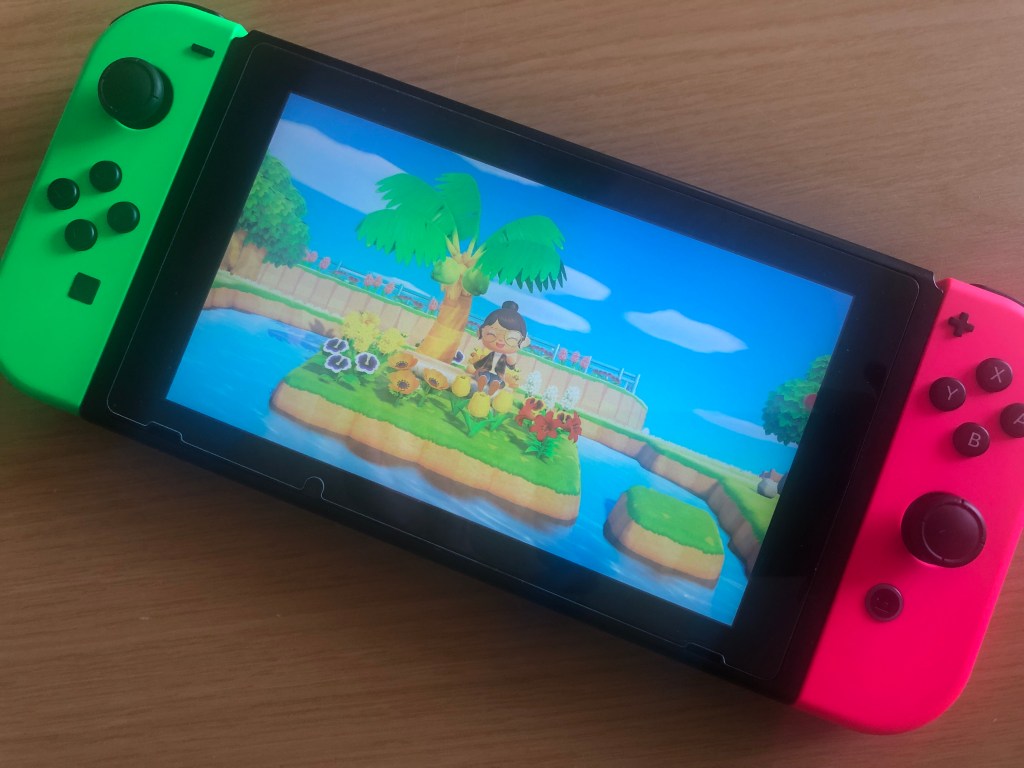
My favourite thing to do in my free time - I’m a gamer, so spend a lot of time on my Switch

My favourite athlete/sports personality - Rafael Nadal (I took Spanish up to A-Level, and had to do a whole project on him and his life – plus I love the tennis!)

My favourite actor – Fiona Shaw – she plays my absolute favourite character in Killing Eve

My favourite author - that’s a hard one! Right now it’s Philip Pullman

My favourite drink - tea (milk two sugars)

My favourite food - a good (medium rare) steak

My favourite place to eat - right now I’m missing Nuovo (Northampton) for Italian food, but I also love Mowgli (in Birmingham) for Indian food

I like people who - take time to actually listen to what you’re saying, undistracted

I don’t like it when people - are rude! Who does?!

My favourite book - I recent read Circe by Madeline Miller, and that’s definitely up there. The Power by Naomi Alderman is also great

My favourite book character - Peeves from Harry Potter 🙂

My favourite film - this does change frequently! At the moment though I still have a lot of love for Midsommar.

My favourite poem - I’m not a huge poetry person, but I did find Milk & Honey from Rupi Kaur interesting (a controversial choice I guess)

My favourite artist/band - The Maccabees, all day everyday

My favourite song - Waiting for the beat to kick in – Dan Le Sac vs. Scroobius Pip

My favourite art - Georgia O’Keefe’s From the Faraway, Nearby, or Maman from Louise Bourgeois

My favourite person from history - Dolly Parton is a queen
Share this:


#CriminologyBookClub: The Yellow Room

In times of crisis it is beneficial to occupy yourself with things to do. This helps us to cope with boredom, and to distract us from the bleakness of reality. What better way to help with this than to start a book club? That’s right, whilst some of us were sitting at home twiddling our thumbs, @paulaabowles had sent us all a book that we were to read and discuss in virtual book club meetings. Little did we know that this book club was to be our very own ray of sunshine during such an unprecedented time.
Our first book is The Yellow Room by Mary Robert Rinehart (dubbed the American Agatha Christie by the blurb, which is generous). Set in Maine (USA) during WWII, this is a classic whodunit crime novel. With the wealthy Spencer family finding themselves tangled in a web of evidence that instigates their involvement with a dead woman that is found in the closet of their holiday home. The book is filled with intrigue and the plot thickens with each chapter, with more and more clues being thrown into the mix. Until too much is thrown in, and what is left of the book is quite simply… a mess.
The book consists of 30 chapters, and we think the club is in agreeance that the first 20-24 chapters are pretty great. Rinehart throws a number of spanners in the works, with near misses, burning hillsides, death by frights, illegitimate children and secret marriages. We all had our theories, some boarding on plagiarism (they know who they are!). However as it turns out a few of us were half right, and then so were some of the others. We will not give away any spoilers, but the ending, the answer we were all waiting for was disappointing and quite frankly we are still not 100% sure who did it, and what was actually done. The leading lady of the book Carol Spencer, dubbed drippy Carol by the club, because she is, well… DRIPPY, does nothing but smoke and drink coffee, whilst surrounded by crime and uncertainty. But, alas, when all is righted, she finds herself in the arms of an arrogant moody man, all happily engaged! Possibly a romance (although a bad one) or possible a classic whodunit (a half decent one), who can tell?
Overall the book was a success: it inspired intrigue and discussion! The virtual book club even more so! A bunch of misfits, gathered together (20minutes after the allotted time because one member of the group is late- @manosdaskalou), discussing the book, thinking about the social context, the characters, and how it is received today. It is a fantastic virtual club consisting of familiar suspects: the princess, the athlete, the criminal, the brain, the basket case, the parent and the “carol” (representations may not be literal or accurate). What will the misfits think of the next book? Will they all agree? Will one read ahead and sit silently and sheepishly, without the others knowing? Stay tuned…
@jesjames50 and @haleysread – founding members of the #CriminologyBookClub
Share this:


RTFQ and the real world

The other day I had occasion to contact Her Majesty’s Revenue and Customs (HMRC) and I did this via a web chat. My query was simply about seeking an explanation regarding tax relief. I compiled my question starting off with ‘good morning, I’ve had my tax code updated and am a little confused.’ I then went on to explain in a few short words where the confusion lay.
The response back was quite familiar, it would be to those that use web chat and quite expected, ‘Thank you for your patience, the next available advisor will be with you shortly. You are 7 in the queue’. Little was I to know at this stage, that my patience was about to be severely tested, not by the waiting time but by the advisor who, to avoid any embarrassment to the real person, we will simply call ‘Jo’. After eight minutes of waiting (not a particularly long time) I was through to Jo and greeted with a request for my details for security.
Once supplied, I was told that Jo would be looking at my record. Jo then responded by telling me that the adjustment in my tax code was due to an underpayment from the 18/19 tax year, explained how much it was and the fact it would be collected through the tax code. Now I should point out, this was not the question I was asking, RTFQ, I wanted to know about an aspect of tax relief and just to add to the confusion, the HMRC website tells me I do not owe any tax from the 18/19 year. The latter makes sense to me because I paid off the amount owed in 19/20. A little agitated I responded with my question again trying to make it a little clearer, as if it wasn’t clear enough. I added to this by asking if my assumptions were perhaps incorrect and if so could Jo tell me when the rules had changed. The response was ‘one moment’. Four minutes later I asked, ‘are you still there?’, the terse response was, ‘yeah, i (sic) am looking through the guidance for you’. This does not bode well!
Trying to be helpful, I responded by explaining the tax relief I received last year, and the fact that I ought to receive it this year, unless of course the rules have changed the response, ‘one moment please’. To be followed by ‘the 480 is from 480.00/40% = 1200 so its at 40%’. Now I’m no Trigger (see Only Fools and Horses) but this mathematical genius has me somewhat perplexed, so I pushed a little further to see if I could get an explanation of this. I ended up with ‘480.00/40% =1200 which is 40% of the 480’.
My patience wearing a little thin now, I asked to speak to a supervisor only to be told there was no supervisor available and ‘They will be telling you the same thing, you can call in to speak to someone else if you want’. So, I can hang up on the web chat, start another and in the lottery of numpties, I will take my chance that I might not get another Jo to answer my query, I think not. To add insult to injury, Jo had just previous to this provided me with an answer that was in fact the basis of my question, we seemed to have gone full circle (RTFQ). In desperation and trying to prevent my blood pressure rising further I tried to draw this to a close by pointing out the problem as I see it, prefixing this with, ‘I’m not trying to be difficult. I just want an explanation as to why …’. I followed this up with, ‘If you cannot answer that, then please just say so’. The response, ‘I have explained to you the best way i (sic) can Stephen’. Now that’s me told! Best not push it further.
I recall first hearing the term RTFQ when I was about to sit a promotion exam. RTFQ the invigilator shouted, before gazing upon my quizzical expression, ‘read the f*** question’ he explained. I frequently remind my students of this mantra before they sit exams, it is one that serves us well, not just at university when sitting exams or completing assignments, but in life. Although I’m not sure that RTFQ is something that Jo needs to prioritise whilst tripping through the wonderment of mathematical equations.
Or maybe, just maybe, it is a new tactic by HMRC to limit enquiries. I certainly won’t be calling back in a hurry.
Share this:


“My Favourite Things”: Bethany
My favourite TV show - I have many. But if I must select just one... Fleabag. I have rewatched several times, I have even read the book (which is more of a script).

My favourite place to go - Peak district, I have several favourite spots within, but overall, it's my favourite place.

My favourite city - Cambridge. It may be more familiarity than anything else, but it does have a charm.

My favourite thing to do in my free time - READ. I have other loves, such as video games and walking. But reading is my everyday pastime.

My favourite athlete/sports personality - Hard one for me, as I'm not really into sports. The only sport I follow which may surprise some is body-building! There's an element of obsession, dedication and art that fascinates me.  So, I will say Kai Greene - but I'm not sure how many will know who this is.

My favourite actor - Tough one, I like most films/TV that has either Bill Hader or Meryl Streep in.

My favourite author - Tough one- Can I give 2 - is that cheating?  Margaret Atwood & Lucy Clarke

My favourite drink - Coca Cola - Full Fat - The good stuff

My favourite food - Bangers & Mash

My favourite place to eat - Anywhere with good food that I don't have to cook myself!

I like people who - Ask Questions. Questions are the stepping-stone before acquiring knowledge.

I don’t like it when people - Assume things stay the same. One of my pet peeves is "Well they should have thought of that before X happened". Things change, feelings change, people's finances change. Therefore, we should try withholding judgement and think how circumstances change.

My favourite book - This one is hard for me. The academic in me says Paul Willis' Learning to Labour, the book opened my mind and genuinely changed my life. But the child in me and the one who loves to explore... The Secret Garden

My favourite book character - This doesn't go in line with my favourite book, but I love the character Charmaine in The Heart Goes Last she's complex but she is also empathetic.

My favourite film - Hocus Pocus - More of a sentimental thing of carving pumpkins every year while watching it!

My favourite poem - While I am not one much for poetry, I adored Rupi Kaur's poetry book Milk and Honey

My favourite artist/band - I have a few, I like The 1975, Alicia Keys, Sam Smith and even some Billie Eilish

My favourite song - Not fitting at all to the above - But - It's Can't help falling in Love

My favourite art - I didn't actually know the name of it till now as I never really thought about it, but what I used to call 'Crazy Stairs' (apparently actually called Relativity by M.C.Escher). It used to be in my Art room at school, I remember thinking it seemed pointless, then I realised that was probably the point.

My favourite person from history - Angela Davis. After I read Women, Race & Class I wanted to explore more – This woman has had a fascinating, challenging, but above all, inspiring life.
… Side note: as I wasn’t asked … Maisie – My dog (pictured) is my favourite…of everything, really. Just look at her, she’s beautiful.

Share this:


Information overload

If you’re anything like me, the last few weeks you’ve probably found yourself fighting your way through a tsunami of information that’s coming from all directions. Notifications are going into overdrive with social media apps, news apps and browsers desperate to deliver more and more content, at ever increasing frequencies. Add to this all the stories, videos and memes friends and family are also sharing and it’s hard to know where to look first. The sheer volume of content makes it harder than ever to know what is fact, fake or opinion. In honesty, it can all be a bit overwhelming.
How do you even begin sorting the information that’s being thrown at you when you can’t keep up with how quickly your news feeds are moving
1. Sort the fact from the fiction
There’s nothing like a pandemic to send the fake news mills into overdrive. Many are easy to spot, the 2020 version of an urban myth (My neighbour’s, brother’s dog is a top civil servant and says….) others are much more sophisticated and purport to be from trusted sources. The Guardian (Mercier, 2020) reports on the danger of these stories and the tragic consequences that can occur when people believe them.
Why are we so susceptible to fake news stories though? They use “truthiness” to play on our fears and biases. If it sounds like something we think could be true, if it confirms our prejudices or worries, we’re more likely to believe it.
Fact checking is more important than ever. Take a moment to think before you share – what is the source? where are their sources? For more tips on spotting fake news check out this guide (IFLA, 2020) or use an independent reputable fact checking site such as Full Fact. This blog article from the Information Literacy Group (Bedford, 2020) pulls together a selection of reliable information sources related to Covid-19.
2. Bursting your bubble
Personalised content from news feeds can be useful, but we often don’t even realise the news stories and content we’re seeing in apps has been chosen by an algorithm. Their purpose is to feed us stories they think we will like, to keep us reading longer. This can be convenient, but it can also be misleading. We get trapped in a filter bubble that feeds us the type of content we like and usually from a perspective that agrees with our own way of thinking.
Sometimes we need to know what else is going on in the world outside our specific areas of interest though and sometimes we need to consider viewpoints we don’t necessarily agree with, so we can make an informed judgement.
These algorithms can also get things wrong. My own Google news feed weirdly seems to think I’m interested in anything vaguely related to British Airways, Coventry City Football Club and Meghan Markle (I’d like to state for the record I’m not particularly interested in any of these things). This is without considering the inherent biases they have built into them, before they even start their work (algorithm bias is a whole other blog article in itself).
It’s human nature to want to hear things that agree with our way of thinking and reinforce our own world view, we follow people we like and admire, we choose news sources that confirm our way of thinking, but there is a risk of missing the bigger picture when sat in our bubble. Rather than letting the news come to you, go direct to several news sources (maybe even some that have a different political leaning to you, if you feel like being challenged). Be active in seeking news stories, rather than passively consuming them.
3. Step away from the news feed (when you need to)
It’s a bit of a balancing act, we need to know enough to be informed and stay safe without spending 24/7 plugged in. We’re not superhuman though and sometimes we need to accept that just because it’s on our feed, we’re not obliged to engage. Give yourself permission to skip stories, mute notifications and be selective when you need to. We all have different saturation points, mine will vary day to day, but listen to yourself and know when it’s time to switch off. If it helps, set reminders on your apps to give you a nudge when you’ve spent a certain amount of time on them. The Mental Health Foundation (2020) have some tips for looking after your mental health in relation to news coverage of Covid-19.
If you need help finding information or want support evaluating sources the Academic Librarian team are offering online tutorials and an online drop-in service. You can also contact us by emailing librarians@northampton.ac.uk
Cheryl Gardner
Academic Liaison Manager, LLS
References
Bedford, D. (2020) Covid-19: Seeking reliable information in difficult times. Information Literacy Group [online]. Available from: https://infolit.org.uk/covid-19-seeking-reliable-information-in-difficult-times/ [Accessed 31/03/2020].
IFLA (2020) How to spot fake news. IFLA [online]. Available from: https://www.ifla.org/publications/node/11174 [Accessed 31/03/2020].
Mental Health Foundation (2020) Looking after your mental health during the Coronavirus outbreak. Mental Health Foundation [online]. Available from: https://mentalhealth.org.uk/publications/looking-after-your-mental-health-during-coronavirus-outbreak [Accessed 31/03/2020]
Mercier, H. (2020) Fake news in the time of coronavirus: how big is the threat? The Guardian [online]. 30th March. Available from: https://www.theguardian.com/commentisfree/2020/mar/30/fake-news-coronavirus-false-information [Accessed 31/03/2020].
Share this:

“My Favourite Things”: Paula
My favourite TV show - I am not really one for television, but I recently stumbled upon a 1960's series, called The Human Jungle, lots of criminological and psychological insight, which I adore. I also absolutely loved Gentleman Jack (broadcast on BBC1 last summer)

My favourite place to go - Wherever I go the first thing I look for are art galleries, so I would have to say Tate Modern. Always something new and thought provoking, alongside the familiar and oft visited treasures

My favourite city - I love cities and my favourite, above all others, is the place I was born, London. The vibrancy, the people, the places, the atmosphere....need I say more?

My favourite thing to do in my free time - Read, read, read, read, read, read, read, read......

My favourite athlete/sports personality - This is tricky, sport isn't really my thing. However, I do have a secret penchant for boxing,  which isn't brilliant for someone who identifies as pacifist, so I'll focus on feminism and pick Nicola Adams

My favourite actor - (Getting easier) Dirk Bogarde

My favourite author - (Too easy) Agatha Christie

My favourite drink - Day or night? If the former, tea....

My favourite food - Chocolate, always

My favourite place to eat - So many to choose from, but provided I am surrounded by people I love, with good food and drink, I'm happy

I like people who - read!

I don’t like it when people - claim to be gender/colour blind....sorry mate, check your privilege

My favourite book - (oooh very, very tricky) Virginia Woolf's A Room of One's Own primarily because of the profound effect it had and continues to have on my understanding

My favourite book character - (Easy, peasy) Hercule Poirot

My favourite film - (Despite my inner feminist screaming nooooooooo) The original Alfie with its wonderful swinging sixties' vibe

My favourite poem - (Decisions, decisions, so many wonderful poems to choose from) I'll plump for Hollie McNish's Mathematics

My favourite artist/band - The Beatles

My favourite song - (Given the previous answer) it has to be Dear Prudence

My favourite art - I love art, but hands down Picasso's Guernica is my favourite piece. To stand in front of that huge painting and consider the horror of war is profound

My favourite person from history - The pacifist, suffragette Sylvia Pankhurst, a beautiful example of the necessity to be confident in your own ethics and principles

Share this:


Solitude.
Time alone, socially with ourselves, can be a truly healing ordeal. When we’re alone, we tend to think. Thinking is hard work. It really takes a disciplined mind to reflect, to look at different items in life and piece them together differently than they are presented to us.…perhaps with more clarity. We may experience anxiety, left with our own thoughts in the solitude of quarantine. From whatever source or another, you may feel anxious about being alone. Develop calming practices. Curate calming activities in your life that bring you peace.
You may experience restlessness. What to do with all that time? Many of you will want to be productive. Do something you enjoy. What do you like to do with your (wrestling) hands? Hold a book? Saw wood? Bake? Knit me a scarf?!?
Whether you enjoy listening to music and talking about the memories and times music evokes, explore what you like to do. Me? I dance, read, write, binge on TV series, and digging my hands in dirt to grow stuff. I especially love propagating plants. I try any plant I can get ahold of. In my garden, I have a beautiful crawling flower I clipped in Barcelona. It spreads over soil and has bright green leaves with bright red flowers that unfold into a star at dusk. Curate creative activities in your life that bring you peace.
Solitude gives us time for introspection – a kind of dialogue with ourselves. We love all forms of art because of the internal dialogue with ourselves as we observe a movie, painting, sculpture, fashion, performance, etc. We know at the heart of each of those creations, there was an artist in solitude.
In my solitude…

First edition
Alice walker sat and wrote The Color Purple with pen and paper. The screenwriters later came along and did the same. Each actor received their own script. On screen we watch Ms. Sofia tell Ms. Celie to “bash Mister’s head in and think about heaven later,” after confronting her for telling her step-son to beat her. Imagine how Oprah read all of THAT from just a few letters to god. On the page, Celie acknowledges her jealousy of Sofia’s power – she’s just as “poor, Black and ugly” as she. She apologizes and reconciles by helping Harpo’s next woman recognize her own power. There’s a whole storyline about this. The book more keenly develops more characters and their transformations. In our solitude, we read The Color Purple and for the first time view it in Technicolor.
In the book, of course, we neither see the bruises and blood nor hear the screams the children must have hears when Mister beats Celie senselessly throughout their marriage. We read how Celie gained the courage to leave this batterer. Oh, and the grandest surprise is that Shug reveals to Celie that God ain’t a man, and he ain’t white, neither. If God were a white man, neither could believe in him, according to the book. Both their redemptions came from there, not as the film shows. In the film, Shug is a floozy who redeems herself by becoming ‘respectable’. The film doesn’t question the heteropatriarchal god, a central narrative in the book.
The book is really queer. Harpo loves to cook, clean and take care of kids while his woman works. Harpo resolves his Oedipal dilemma by accepting that he’s not a patriarch like his father. The film depicts his struggle but not this resolution. In the book, there’s an entire sub-narrative about how Celie’s kids in Africa – raised by her sister Nettie – reject the traditional gender roles. This is only hinted at in the film.

Celie & Shug’s only on-screen kiss
Of course, Celie’s a lesbian, Shug’s bisexual and Mister is cool with their love triangle. In the book, Mister’s redemption is there, literally becoming just a tiny bit more feminist, though still not nearly as the flashy boxer Shug later marries. Another big twist is that in the book is that Shug and her husband split amicably; he moves south of the border with Harpo’s woman, Mary Agnes, to run their very own marijuana plantation.
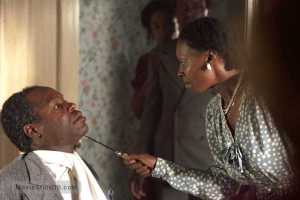
Celie encouraged Mary Agnes to stop people from calling her Squeak, a sub-narrative that only is hinted at in the film’s iconic Thanksgiving scene, aka Celie’s uprising. I love Celie’s nasty retort to Mister’s sinister dad in this scene: “Seem like if he hadn’t been your boy, he might a made somebody a halfway decent man.” Shug helps Mary Agnes have her own singing career, as implied in the Thanksgiving scene when she says she’s leaving with Celie and Shug Avery. In a deep hearty laugh that breaks the dramatic tension, Sofia declares: “Oh, Sofia(‘s) home.”

“You told Harpo to beat me!” Oprah’s breakout character & breakout scene
Self-love and women supporting women are huge themes that can’t be captured in a movie, it needs a whole mini-series to watch at home. Serendipitously, at the end of the scene when their boarding the car, Celie’s hex on Mister is almost taken directly from the pages. “Until you do right by me, ev’ry thing you even think about gonna fail!”
Celie’s Thanksgiving uprising
Finally, in the book, Celie and Mister eventually become friends. Come back with her long-lost kids and the dear sister Nettie he’d banished and “whoop his ass.” I love, love, love the film, but all of this was erased from book to script. I discovered all of this in my solitude.
The Color Purple was originally written as Celie’s prayers, the way she escaped the hell of her existence. In the book, she found this through love. On the paper, we can see that she stops writing to “God” and instead addresses the letters to her sister Nettie, the one who taught her to read (in both versions). The pages, not the movie, clearly reveal this spiritual transformation. Celie continues to write to Nettie, not knowing anything of her fate, only having found the old letters Mister had stashed away for years. Their love was so strong that in her solitude, writing the letters brought her peace. Curate writing activities that bring you peace.

The revised book cover following the film’s success
Do you keep a journal, dabble in poetry, admire the prose in your head? Set aside time as a family for writing and reading. Experience solitude together. Share your work. Curate activities that bring you peace. Use this quarantine to strengthen your capacity to love.
Share this:

A Love Letter: in praise of Agatha Christie

For most of my life, I have been an avid reader of all types of books. As my family will confirm, from childhood, I was never without a book. As an adult, I have regularly selected coats with large pockets and bags purely on the basis that they can hold a book. As many students will attest, my answer to most academic questions is “read, read and read some more”. Despite the growth of the internet and other media, which as @drkukustr8talk has noted recently, diverts and subverts our attention and concentration, reading remains my first and truest love.
This, my third ‘Love Letter’, focuses on my favourite author, above all others, Agatha Christie. I have previously dedicated ‘Love Letters’ to poetry, and art. Both of these forms took a long time for me to develop my understanding of and my love for. This ‘Love Letter’ is slightly different.
I first discovered Christie’s novels when I was about 12, since then they have formed a regular backdrop to my life. They act as a comfort blanket when I am tired, stressed, sad or away from home. I have read and reread everything she wrote and know the stories inside and out. Despite my decades of adoration, it remains challenging to know exactly what it is that appeals to me so much about Christie’s novels.
Perhaps it is the symmetry, the fact that for Christie every crime has a solution. Conceivably, given my pacifist tendencies, it could be the absence of explicit violence within her books. Maybe it’s Christie use of stereotypical characters, who turn out to be anything but. You don’t have to look very far to find the oh-so suspicious foreigner, who turns out to be a caring father (Dr Jacob Tanois) or the shell-shocked former military man trained in violence, who metamorphosises into a rather lonely man, who suffers from epilepsy (Alexander Cust). In all these cases, and many others, Christie plays with the reader’s prejudices, whatever they might be, and with deft sleight of hand, reveals that bias as unfounded.
To be honest, until relatively recently, I did not think much about the above, reading Christie was so much part of my life, that I took it very much for granted. All that changed in 2017, when I spotted a ‘Call for Chapters’
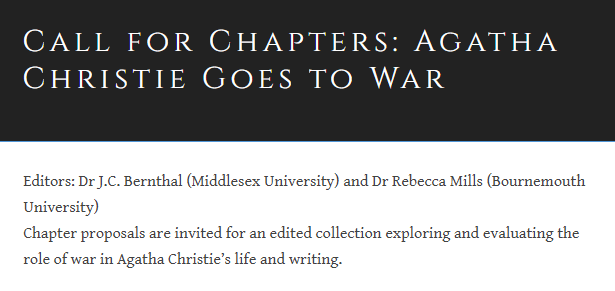
It seemed too good an opportunity to miss, after all I had spent a lifetime reading Christie, not to mention more than a decade studying war and crime. After all, what did I have to lose? I submitted an abstract, with no real expectation that someone who had never studied fiction academically, would be accepted for the volume. After all, who would expect a criminologist to be interested in the fictional writing of a woman who had died over 40 years ago? What could criminology learn from the “golden age” of “whodunnit” fiction?
Much to my surprise the abstract was accepted and I was invited to contribute a chapter. The writing came surprisingly easy, one of very few pieces of writing that I have ever done without angst. Once I got over the hurdle of forcing myself to send my writing to strangers (thank you @manosdaskalou for the positive reassurance and gentle coercion!) , what followed was a thoroughly pleasant experience. From the guidance of the volume’s editors , Drs J. C. Bernthal and Rebecca Mills, to the support from many colleagues, not mention the patience of Michelle (Academic Librarian) who restrained from strangling me whilst trying to teach me the complexities of MLA. Each of these people gave me confidence that I had something different to say, that my thinking and writing was good enough.
Last week, my copy of the book arrived. It was very strange to see my chapter in print, complete with my name and a brief biography. Even more surreal was to read the editors’ introduction and to see my work described therein, with its contribution to the volume identified. I doubt many people will ever read my chapter, it is published in a very expensive academic book destined for academics and libraries. Nevertheless, I have left the tiniest of marks in academic literature and perhaps more importantly, publicly acknowledged my love for the writing of Agatha Christie.
The finished article:
Bowles, Paula, (2020), ‘Christie’s Wartime Hero: Peacetime Killer’ in Rebecca Mills and J. C. Bernthal, Agatha Christie Goes to War, (Abingdon: Routledge): 28-45

 Thoughts from the criminology team