
Home » Poverty (Page 4)
Category Archives: Poverty

Covid -19: An opportunity too good to miss
And so, vast swathes of the country have gone into a new lock down (tier 4). We all must have known in hearts that this was coming and those of us that are not in tier 4 will be wondering just when the new lock down will hit us. We can all moan about our ruined Christmas and feel bitterly disappointed about not seeing relatives and friends. We can blame Boris for this monumental cock up, but we have to face facts, Covid -19 is here and something has to be done to stop the spread of the disease.
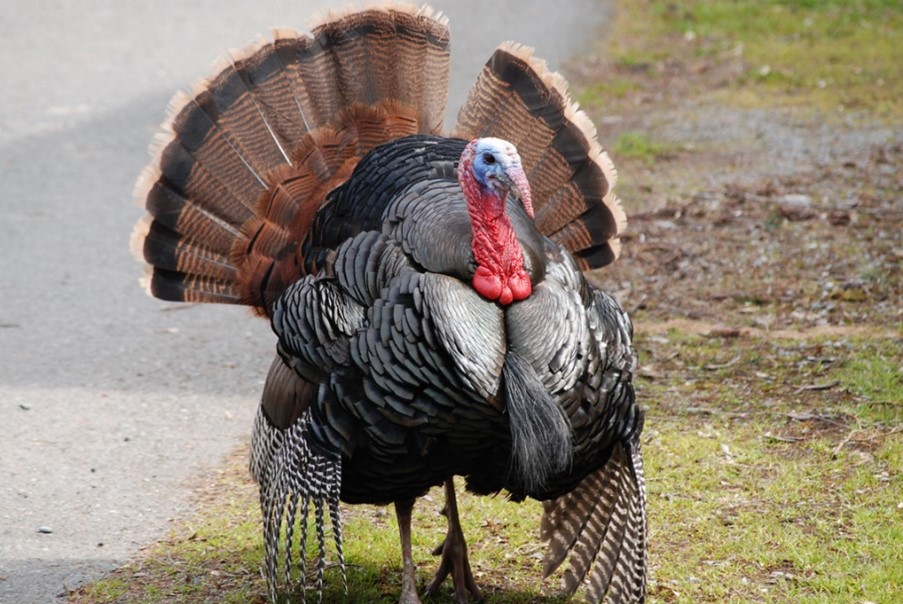
I, like so many, am upset that I will not be able to see my family in person this Christmas but over the last few days I began to wonder just how much of a hardship that is. There was a man on the news the other day that was moaning about the Christmas restrictions, he and his wife had a 15 lb turkey that was now going to waste. My first thought was, so you’d rather catch Covid you *^&$£” **. But this morning I thought, aren’t you lucky to have a 15lb turkey and, as my wife and I discussed whether we will be having a roast on Christmas day and the Sunday after, I thought aren’t I lucky too. There are two things that strike me, I’m able to have what food I want on Christmas day and I’m saving a bloody fortune not having to have all the family round or take them out for Christmas dinner and drinks. The pandemic has some upsides.
But, this is the crux of the matter, how can I sit down to my Christmas lunch knowing that I have money I would have spent sitting in the bank when there are people out there who will be wondering right now, not about the massive turkey, or the family not coming round, or whether to have chicken on Christmas day and Sunday but, whether they can feed themselves and their family tomorrow, let alone Christmas day. We could of course blame Boris and his government (a very rational decision) but judging by Reece Mogg’s comments the other day, they have little interest. We could just ignore it, don’t think about it, pretend all is well and on Christmas day raise a glass to our nearest and dearest and those that we are missing. But as we must face facts that Covid – 19 is here, so must we face facts that people, real people, are starving in this country. It shouldn’t be like that, but it is.
So my wife and I have decided that we will work out how much extra we would have spent this Christmas, by going out, by going to parties, by catering for family and we will spend that money on food and give it to a food bank. It won’t be very much in the greater scheme of things, but it will be something. I’m not writing this blog to say how marvellous we are, far from it, but rather to challenge all of you to do the same. Even a little extra in your shopping before Christmas is going to make a huge difference. Let’s turn this Christmas into one we can remember for the right reasons and turn the Covid- 19 pandemic into an opportunity that we seized for the good.
Please see below for a list of local and national organisations helping families this Christmas and throughout the year:
AmplifiedNN Community Group
AmplifiedNN Festive Family Fundraiser
Northamptonshire Food Poverty Network
Share this:


Some lessons from the lockdown
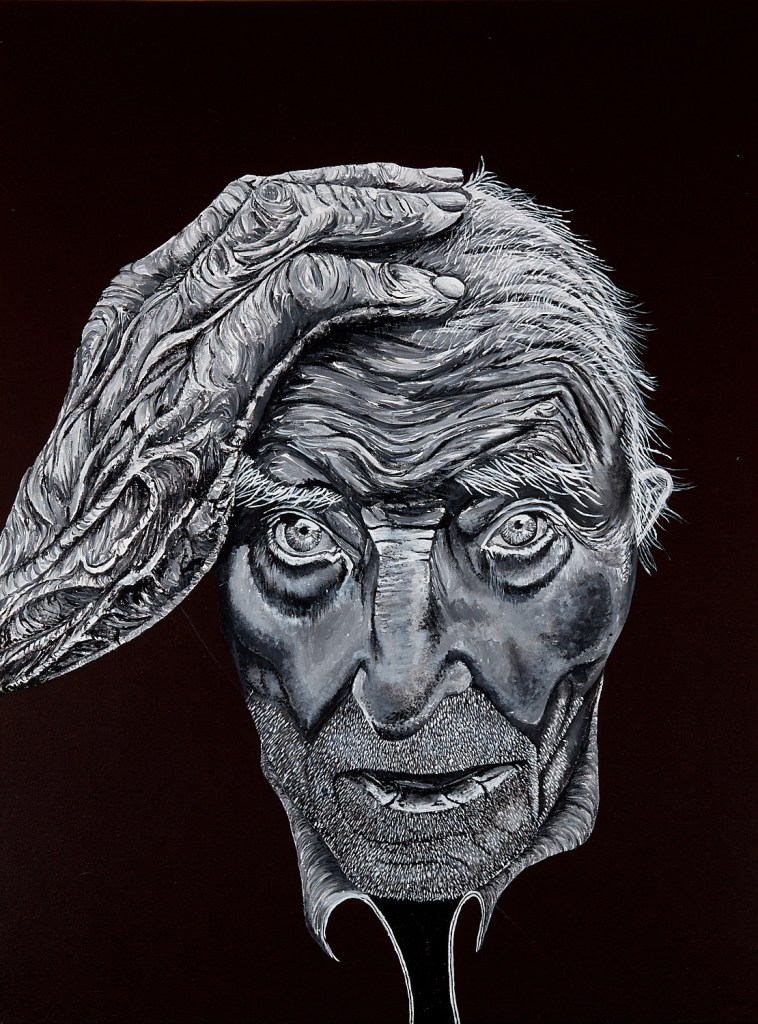
Koestler Arts (2019), Another Me: The Redwoods Centre (secure mental health unit), James Wood QC Silver Award for Portrait, 2019
In March 23, 2020, the UK went into lockdown. The advice given, albeit conflicting in parts, was clear. Do not leave your home unless absolutely necessary, banning all travel and social interactions. This unprecedented move forced people to isolate at home for a period, that for some people will come to an end, when the WHO announces the end of the pandemic. For the rest of us, the use of a face mask, sanitiser and even plastic gloves have become modern day accessories. The way the lockdown was imposed and the threat of a fine, police arrest if found outside one’s home sparked some people to liken the experience with that of detention and even imprisonment.
There was definite social isolation during the pandemic and there is some future work there to be done to uncover the impact it has had on mental health. Social distancing was a term added to our social lexicon and we discovered online meetings and working from home. Schools closed and parents/guardians became de facto teachers. In a previous blog entry, we talked about the issues with home schooling but suffice to say many of our friends and colleagues discovered the joys of teaching! On top of that a number of jobs that in the past were seeing as menial. Suddenly some of these jobs emerge as “key professions”
The first lesson therefore is:
Our renewed appreciation for those professions, that we assumed just did a job, that was easy or straightforward. As we shall be coming back eventually to a new normality, it is worth noting how easy it will be to assign any job as trivial or casual.
As online meetings became a new reality and working from home, the office space and the use of massive buildings with large communal areas seemed to remain closed. This is likely to have a future impact on the way business conduct themselves in the future.
Second lesson:
Given how many things had to be done now, does this mean that the multi occupancy office space will become redundant, pushing more work to be done from home. This will alter the way we divide space and work time.
During the early stages of the lockdown, some people asked for some reflection of the situation in relation to people’s experiences in prisons. The lockdown revealed the inequality of space. The reality is that for some families, space indicated how easy is to absorb the new social condition, whilst other families struggled. There is anecdotal information about an increase on mental health and stress caused from the intensive cohabitation. Several organisations raised the alarm that since the start of the lockdown there has been a surge in incidents of domestic violence and child abuse. The actual picture will become clearer of the impact the lockdown had on domestic violence in future years when comparisons can be drawn. None the less it reveals an important issue.
Third lesson:
The home is not always the safest place when dealing with a global pandemic. The inequality of space and the inequality in relationships revealed what need to be done in the future in order to safeguard. It also exposed the challenges working from home for those that have no space or infostructure to support it.
In the leading up to the lockdown many households of vulnerable people struggled to cope with family members shielding from the virus. These families revealed weaknesses in the welfare system and the support they needed in order to remain in lockdown. Originally the lack of support was the main issue, but as the lockdown continued more complex issues emerged, including the financial difficulties and the poverty as real factors putting families at risk.
Fourth lesson:
Risk is a wider concern that goes beyond personal and family issues. The lockdown exposed social inequality, poverty, housing as factors that increase the vulnerability of people. The current data on Covid-19 fatalities reveal a racial dimension which cannot longer be ignored.
During the lockdown, the world celebrated Easter and commemorated Mayday, with very little interaction whilst observing social distancing. At the end of May the world watched a man gasping for breath that died in police custody. This was one of the many times the term police brutality has related to the dead of another black life. People took to the streets, protested and toppled a couple of statues of racists and opened a conversation about race relations.
Fifth lesson:
People may be in lockdown, but they can still express how they feel.
So, whilst the lockdown restrictions are easing and despite having some measures for the time being, we are stepping into a new social reality. On the positive side, a community spirit came to the surface, with many showing solidarity to those next to them, taking social issues to heart and more people talked of being allies to their fellow man. It seems that the state was successful to impose measures that forced people indoors that borderline in totalitarianism, but people did accept them, only as a gesture of goodwill. This is the greatest lesson of them all in lockdown; maybe people are out of sight, appear to be compliant in general but they are still watching, taking note and think of what is happening. What will happen next is everyone’s guess.
Share this:


Volunteering Matters

Some people volunteer because they have to, I volunteer because I want to. From a personal perspective I knew that the foodbank was the place that I wanted to be at.
I started volunteering in 2016, doing just 1 day a week and as the years have gone by it has meant more hours spread over a couple of days, especially during the Christmas holidays which are incredibly busy. Proving that many volunteers are necessary and needed to help keep it going.
It is a place that suits me because its local and fits around my studies. I am able to learn new skills and gain insightful knowledge. The volunteers are very welcoming and warm people. However, over the years I’ve noticed a dramatic increase in the use of the foodbank and its diversity. In theory, its usage should be on the decrease.
Within the foodbank, we deal with some very complex individuals who require different approaches. It sounds cliché, but I volunteer to make a difference and eradicate the myth that the foodbank is used for those in society that are labelled as people who can’t budget properly.
I have found that service users are predominantly people living on low incomes. People who are working on zero hours contracts; or have reduced hours and having their wages topped up with benefits like Universal Credit. As a result, they just don’t have enough money coming in; leaving hardly anything for essentials such as food and heat. I found during my research that many families have been without electricity, that means no cooking facilities or warmth! Pushing them further into poverty. In this day and age people should not be without the basics.
In my time as a volunteer I have met some lovely people who have been affected by different adverse life events and it is heartbreaking to witness, but equally by giving something back I can see their eyes light up when they are given their food parcels. I feel I am learning to be more compassionate. However, if the person has no access to electricity how are they supposed to cook or provide a meal for their children without electricity?
On a weekly basis we see many different people from so many backgrounds; from civil servants, to social workers and the homeless. Service users can often be emotional and sometimes defensive, who feel they don’t deserve to be given food because they are working. The foodbank does not discriminate, it sees everyone as equal.
What does that say about the world we live in? That being food poor or food insecure is something that must stay hidden and not be talked about…people living with food insecurity would rather go without, than ask for help. The basic income does not cover the essentials such as food after paying bills.
It makes me mad that poverty is an accepted part of society and service users state they feel undervalued and unaccepted. The question that must be asked ‘Is poverty violence? The answer is a resounding YES, due to the structures within society that prevent people living with food insecurity from accessing food. Therefore, locking them into poverty, preventing them from moving out of the cycle of deprivation.
It is left to charitable organisations to do whatever they can to help that person to be able to eat and survive. But how long can these charities go on for? The Trussell Trust began in 2000 in the UK….
Children and families should not be going without food, as it is a fundamental right that everyone should have access to the basics. Food insecurity is more prominent now than ever with The Trussell Trust (2020) reporting an increase of 81% in emergency food parcels.
The foodbank is available to help people to access a 3 day food parcel to ‘see them through” a difficult period in their lives. During my time spent conducting my dissertation within the foodbank, food poverty was a combination of a variety of reasons such as low income, often together with a contributory factor such as an adverse life event. For example, the loss of employment or breakdown of a relationship which will only add more shame and stigma. The foodbank is not just about giving away free food, it’s about offering a safe place to sit and get warm and service users can relax, tell their stories and feel free for as long as they can, before they have to face more challenges from the world.
Furthermore, some in society see the foodbank as the sticking plaster that holds the poor in society together. I would say that without the foodbank many people would be committing crimes or be starving. Some politicians have stated that food banks are the heart of community cohesion. The only time I have seen the local MP at our foodbank is for a photo opportunity. The poor in society are forgotten and its about time they weren’t!
The service users are people who are neglected by society and the government, who by definition, make them feel they are to blame for their situation. By visiting the foodbank we show them respect and compassion.
Share this:


8 Kids and Judging
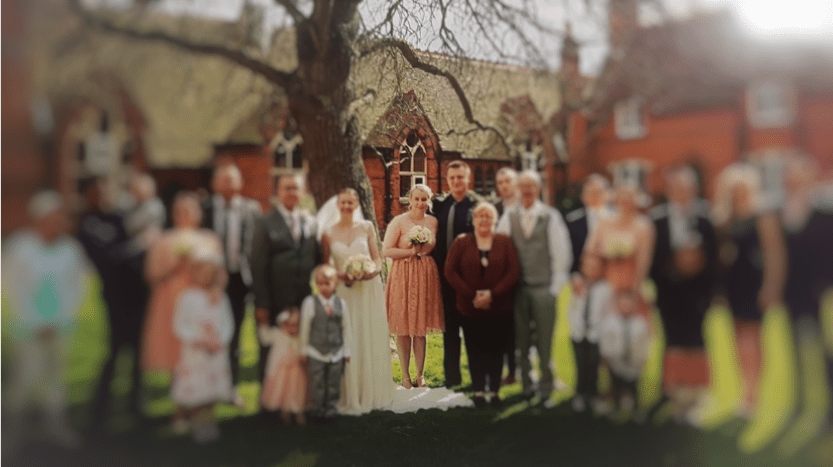
Written by @bethanyrdavies with contributions from @haleysread
Big Families are unique, the current average family size is 2.4 (Office for National Statistics, 2017) which has declined but remained as such for the past decade. Being 1 of 8 Children is unique, it’s an interesting fact both myself and Haley (also a former graduate and also 1 of 8) both fall back on when you have those awful ice breakers and you have to think of something ‘special’ about yourself.
There is criminological research which identifies ‘large families’ as a characteristic for deviance in individuals (Farrington & Juby, 2001; Wilson, 1975). It’s argued alongside other family factors, such as single-parent households, which maybe more people are familiar with in those discussions. In fact, when looking for criminological research around big families, I didn’t find a great deal. Most of what I found was not looking at deviance but how it affects the children, with suggestions of how children in big families suffer because they get less attention from their parents (Hewitt et al. 2011). Which may be the reality for some families, but I also think it’s somewhat subjective to determine an amount of time for ‘attention’ rather than the ‘quality’ of time parents need to spend with children in order to both help fulfil emotional and cognitive needs. This certainly was not the case from both Haley’s and experience.
When I first thought about writing this piece and talking to Haley about her experiences. I did question myself on how relevant this was to criminology. The answer to that I suppose depends on how you perceive the vastness of criminology as an academic field. The family unit is something we discuss within criminology all the time, but family size is not always the focus of that discussion. Deviance itself by definition and to deviate from the norms of society, well I suppose myself and Haley do both come from ‘deviant’ families.
However, from speaking with Haley and reflecting on my own experience, it feels that the most unique thing about being part of a large family, is how others treat you. I would never think to ask anyone or make comments such as; “How much do your parents earn to look after you all?” or “Did they want a family that big or was it lots of accidents?” or even just make comments, about how we must be on benefits, be ‘Scroungers’ or even comments about my parents sexual relationship. Questions and comments that both I and Haley have and occasionally still experience. Regardless of intent behind them, you can’t help but feel like you have to explain or defend yourself. Even as a child when others would ask me about my family, I had always made a point of the fact that we are all ‘full siblings’ as if that could protect me from additional shame , shame that I had already witnessed in conversations and on TV, with statements such as “She’s got 5 kids all different dads”. Haley mentioned how her view of large families was presented to her as “Those on daytime television would criticise large families” and “A couple of people on our street would say that my parents should stop having kids as there are enough of us as it is.”
Haley and I grew up in different parts of the UK. Haley grew up in the Midlands and describes the particular area as disadvantaged. Due to this Haley says that it wasn’t really a problem of image that the family struggled financially, as in her area everyone did, so therefore it was normal. I grew up in a quite affluent area, but similar to Haley, we were not well-off financially. My childhood home was a council house, but it didn’t look like one, my mum has always been house proud and has worked to make it not look like a council house, which in itself has its own connotations of the ‘shame’ felt on being poor, which Haley also referenced to me. It was hard to even think of labeling us as ‘poor’, as similar to Haley, we had loads of presents at Christmas, we still had nice clothes and did not feel like we were necessarily different. Though it appears me and Haley were also similar in that both our dads worked all the hours possible, I remember my dad worked 3 jobs at one point. I asked my dad about what it was like, he said it was very hard, and he remembers that they were working so hard because if they went bankrupt, it would be in the newspaper and the neighbors would see. Which I didn’t even know was something that happened and has its own name and shame the poor issues for another post. Haley spoke of similar issues and the stress of ‘childcare and the temporary loss of hot water, electric and gas.’
The main points that came from both mine and Haley’s discussions were actually about how fun it is to have a large family, especially as we were growing up. It may not seem like it from my earlier points around finance, but while it was a factor in our lives, it also didn’t feel as important as actually just being a part of that loving family unit. Haley put it perfectly as “I loved being part of a large family as a child. My brothers and sisters were my best friends”. We spoke of the hilarity of simple things such as the complexities of dinner times and having to sit across multiple tables to have dinners in the evening. I had brothers and sisters to help me with my homework, my eldest sister even helped me with my reading every night while I was in primary school. Haley and I both seemed to share a love for den making, which when your parents are big into DIY (almost a necessity when in a big family) you could take tools and wood to the forest and make a den for hours on end. There is so much good about having a large family that I almost feel sorry for those who only believe the negatives. This post was simply to share a snippet of my findings, as well as mine and Haley’s experience. At the very least I hope it will allow others to think of large families in an alternative way and to realise the problems both me and Haley experienced, weren’t necessarily solely linked to our family size, but rather attitudes around social norms and financial status.
References:
Juby, H. and Farrington, D., 2001. Disentangling the Link between Disrupted Families and Delinquency: Sociodemography, Ethnicity and Risk Behaviours. The British Journal of Criminology, 41(1), pp.22-40.
Office for National Statistics. (2017). Families and households in the UK, Available at: https://www.ons.gov.uk/peoplepopulationandcommunity/birthsdeathsandmarriages/families/bulletins/familiesandhouseholds/2017 (Accessed: 5th June 2020).
Regoli, R., Hewitt, J. and DeLisi, M., 2011. Delinquency In Society. Boston: McGraw-Hill Higher Education.
Wilson, H., 1975. Juvenile Delinquency, Parental Criminality and Social Handicap. The British Journal of Criminology, 15(3), pp.241-250.
Share this:


Please don’t clap or cheer

In an uncomfortable irony, my regular blog entry has fallen on the 8 May 2020, the seventy-fifth anniversary of the end of World War 2 in Europe. I say uncomfortable because I find this kind of commemoration particularly challenging to comprehend, given my pacifist tendencies. I’m therefore going to take a rather circuitous route through this entry.
On the 20 March 2020 I wrote the first Thoughts from the Criminology team blog entry (focused on Covid-19), just a few hours after the University had moved to virtual working. Since then the team has tackled the situation in a variety of different ways. In that I detailed my feelings and observations of life, as we knew it, suddenly coming to abrupt halt. Since then we have had 7 weeks of lockdown and it is worth taking stock of where we are currently.
At present the UK has recorded over 30,000 deaths attributed to the virus. These figures are by necessity inaccurate, the situation has been moving extremely fast. Furthermore, it is incredibly challenging to attribute the case of death, particularly in cases where there is no prior diagnosis of Covid-19. There has been, and remains a passionate discourse surrounding testing (or the lack of it), the supplies of Personal Protective Equipment (or the lack of it) and the government’s response (or lack of) to the pandemic. Throughout there has been growing awareness of disparity, discrimination and disproportionality. It is clear that we are not in all this together and that some people, some groups, some communities are bearing the brunt of the current crisis.
Having studied institutional violence for many years, it is evident that the current pandemic has shown a spotlight on inequality, austerity and victimisation. The role of institutions has been thrown into sharp relief, with their many failings in full view of anyone who cared to look. In 1942, Beveridge was clear that his “five giant evils” could have been addressed, prior to World War 2, yet in the twenty-first century we have been told these are insurmountable. Suddenly, in the Spring of 2020, we find that councils can house the homeless, that hungry children can be fed, that money can be found to ensure that those same children have access to educational resources. We also find that funds can be located to build emergency hospitals and pay staff to work there and across all other NHS sites.
Alongside this new-found largesse, we find NHS staff talking about the violences they face. The violence of being unable to access the equipment they need to do their jobs, the violence of being deprived of regular breaks, the violence of racism, which many staff face both internally and externally. We hear similar tales from care workers, supermarkets workers, delivery drivers, the list goes on. Yet we are told by the government that we are all in this together. This we are told, is demonstrated by gathering on doorsteps to clap the NHS and carers. It can be compared with the effort of those during World War II, or so we are told. If we just invoke that “Blitz Spirit” “We’ll Meet Again” at the “White Cliffs of Dover”.
However, such exhortations come cheap, it costs nothing in time, or money, to clap, or to sing war time songs. To do so puts a veneer of respectability and hides the violent injustices inherent in UK society and the government which leads it. It disguises and obfuscates the data that shows graphic racial and social economic disparity in the death toll. Similarly, it avoids discussion of the role that different individuals, groups and communities play in working to combat this horrible virus. As a society we have quickly forgotten discussions around deserving/undeserving poor, the “hostile environment” and those deemed “low-skilled”. It camouflages the millions of people who are terrified of unemployment, poverty and all of the other injustices inherent within such statuses. It hides the fact that these narratives are white and male and generally horribly jingoistic by ignoring the contribution of anyone, outside of that narrow definition, to WWII and to the current pandemic. It is trite and demonstrates an indifference to human suffering across generations.
Let’s stop focusing on the cheap, the obvious and the trite and instead, once this is over, treat people (all people) with respect. Pay decent wages, enable access to good quality nutrition, education, health care, welfare and all of the other necessities for a good life. And by all means commemorate the anniversary of whatever you like, but do not celebrate war, the biggest violence of all, without which many more lives would be improved.
Share this:


A song for Terry. #BlackenAsiaWithLove
A song for Terry.
Terry was just six when he died.
Not a long time spent on this Earth,
But enough to make himself known to the universe.
There were many obstacles in life waiting for boys like Terry.
If life is a vast ocean, then he only sailed a meager ferry.
Terry was born in a place, in a time and
In a body that didn’t count much –
A poor, southern Black boy and such.
He was loved, for sure,
I’d see his grandmother kiss him every morning,
As she sent Terry off to school.
Like mine,
Terry’s household didn’t look like those on TV.
None of ours did.
There weren’t any of those Cosby kids.
But Terry was like my brother, my dear friend.
I looked forward to walking to school with Terry each day.
He always had something interesting to say.
Terry and I were in the same class.
He lived across the street,
And our school was just a few blocks away.
There and back,
I wanted to be by his side.
Sometimes I would walk to my grandparents’ after school,
And momma would pick me up after work.
No sooner did we get home and settled did I ask to go outside and play,
With Terry.
Our story was short-lived.
Two kids on the block,
On the poor side of town,
We lived cocooned in a world of luxury:
We were cared for and we were safe.
Everyone on the block looked out for all the kids;
There were no strangers around home base.
But, we also lived
In a time and place of misery,
Where things like poverty,
Would determine your destiny,
And all the dreams we would dream,
Would have to fight the sun to live.
A handsome little brown boy,
And a finely picked mini ‘Fro.
An easy smile,
And an easy-going way about him.
Terry was a nice guy.
And did I mention he was loved?
He was not the most popular kid in class –
Naw, everybody feared that guy!
Terry was the one everyone liked.

For Valentine’s day,
The whole class exchanged heart-shaped candies and notes with one another-
All in pink, my favorite color.
My one time of year to shine!
I was so excited to choose one especially for Terry, my brother:
Will you be my Valentine?
Even the teacher got along with him.
Terry never got in trouble.
He got sad-eyed when any of us got marched off to get paddled.
At lunch, I’d always sit with Terry.
Terry got free lunch, and
Peanut butter and jelly is what I got when momma packed mine!
We’d hurry to the front of the line,
And finish our food quickly,
So we could go to the play area the rest of the time.
I didn’t like milk, but Terry did.
And he didn’t care for apple sauce, but I did.
Sometimes we’d split:
Half a piece of pizza for half my sandwich.
We’d trade.
We didn’t keep score, but
We were always even.
There, right in the middle of the cafeteria,
Smack in the middle of the school,
Was a large, carpeted recreational area.
There, we’d play and everything was cool.
After lunch, but also before and after school,
We could climb and crawl,
Spin and jump,
Run and hide,
Seek and find,
And holler as loud as we’d want.
Teachers would monitor from nearby, but
They left us alone and took their break-time.
Our teachers would even rotate who had this monitoring job to do.
We weren’t a rowdy bunch,
So, there were no fights to break-up.
There were neither hoops nor balls to tussle over.
No nets, no bats –
No competition and all that.
Just a space…
Where us kids could be free.
We were free.
Terry died in the middle of first grade.
We had found out from our teacher that Terry was sick,
We’d all heard of sickle cell, many in our own families, like mine.
But none of us knew what it means.
We knew Terry was not always sturdy.
One time he’d had a bad bout with asthma.
Our teacher helped him take his inhaler,
That she’d showed us where it was kept in her desk drawer.
Now, she was telling us that Terry was just spending a few days in the hospital.
The whole class avidly awaited Terry’s return.
She didn’t know more than that,
I needed to know when Terry’d be back.
I knocked on his door, one day
On the way home from school,
To tell his grandmother I hoped Terry’d be ok.
I knew my grandmother would be heartbroken if anything like that happened to one of us.
Kids that little aren’t supposed to die.
Not here, and not of diseases we can’t even see.
Even at that age, I knew this just shouldn’t be.
And yet turn on the TV,
Every day we see signs and symptoms of little Black boys’ morbidity.
Whether from war or starvation in distant lands, or
Dilapidation and disease on these burning sands.
Just like what was happening to Terry:
A casualty of a neglectful society.
I didn’t get to mourn Terry,
Didn’t have some cathartic corral with our classmates about
The fun times we had or how much we missed him.
There was no school counselor coming to our class –
No one explaining the cycle of life, nor
Asking us about our feelings.
I knew how I felt.
I loved Terry, and knew the way I loved him was seen as peculiar;
I couldn’t let anyone know about this one-sided affair.
I was sad, and all this was unfair.
What would I say?
We were only 6 years old, and
Terry was the first boy I ever loved.
—
 In memory of Muhammed Ali, another Black boy who survived those same streets and corridors.
Share this:


Solitude.
Time alone, socially with ourselves, can be a truly healing ordeal. When we’re alone, we tend to think. Thinking is hard work. It really takes a disciplined mind to reflect, to look at different items in life and piece them together differently than they are presented to us.…perhaps with more clarity. We may experience anxiety, left with our own thoughts in the solitude of quarantine. From whatever source or another, you may feel anxious about being alone. Develop calming practices. Curate calming activities in your life that bring you peace.
You may experience restlessness. What to do with all that time? Many of you will want to be productive. Do something you enjoy. What do you like to do with your (wrestling) hands? Hold a book? Saw wood? Bake? Knit me a scarf?!?
Whether you enjoy listening to music and talking about the memories and times music evokes, explore what you like to do. Me? I dance, read, write, binge on TV series, and digging my hands in dirt to grow stuff. I especially love propagating plants. I try any plant I can get ahold of. In my garden, I have a beautiful crawling flower I clipped in Barcelona. It spreads over soil and has bright green leaves with bright red flowers that unfold into a star at dusk. Curate creative activities in your life that bring you peace.
Solitude gives us time for introspection – a kind of dialogue with ourselves. We love all forms of art because of the internal dialogue with ourselves as we observe a movie, painting, sculpture, fashion, performance, etc. We know at the heart of each of those creations, there was an artist in solitude.
In my solitude…

First edition
Alice walker sat and wrote The Color Purple with pen and paper. The screenwriters later came along and did the same. Each actor received their own script. On screen we watch Ms. Sofia tell Ms. Celie to “bash Mister’s head in and think about heaven later,” after confronting her for telling her step-son to beat her. Imagine how Oprah read all of THAT from just a few letters to god. On the page, Celie acknowledges her jealousy of Sofia’s power – she’s just as “poor, Black and ugly” as she. She apologizes and reconciles by helping Harpo’s next woman recognize her own power. There’s a whole storyline about this. The book more keenly develops more characters and their transformations. In our solitude, we read The Color Purple and for the first time view it in Technicolor.
In the book, of course, we neither see the bruises and blood nor hear the screams the children must have hears when Mister beats Celie senselessly throughout their marriage. We read how Celie gained the courage to leave this batterer. Oh, and the grandest surprise is that Shug reveals to Celie that God ain’t a man, and he ain’t white, neither. If God were a white man, neither could believe in him, according to the book. Both their redemptions came from there, not as the film shows. In the film, Shug is a floozy who redeems herself by becoming ‘respectable’. The film doesn’t question the heteropatriarchal god, a central narrative in the book.
The book is really queer. Harpo loves to cook, clean and take care of kids while his woman works. Harpo resolves his Oedipal dilemma by accepting that he’s not a patriarch like his father. The film depicts his struggle but not this resolution. In the book, there’s an entire sub-narrative about how Celie’s kids in Africa – raised by her sister Nettie – reject the traditional gender roles. This is only hinted at in the film.

Celie & Shug’s only on-screen kiss
Of course, Celie’s a lesbian, Shug’s bisexual and Mister is cool with their love triangle. In the book, Mister’s redemption is there, literally becoming just a tiny bit more feminist, though still not nearly as the flashy boxer Shug later marries. Another big twist is that in the book is that Shug and her husband split amicably; he moves south of the border with Harpo’s woman, Mary Agnes, to run their very own marijuana plantation.
Celie encouraged Mary Agnes to stop people from calling her Squeak, a sub-narrative that only is hinted at in the film’s iconic Thanksgiving scene, aka Celie’s uprising. I love Celie’s nasty retort to Mister’s sinister dad in this scene: “Seem like if he hadn’t been your boy, he might a made somebody a halfway decent man.” Shug helps Mary Agnes have her own singing career, as implied in the Thanksgiving scene when she says she’s leaving with Celie and Shug Avery. In a deep hearty laugh that breaks the dramatic tension, Sofia declares: “Oh, Sofia(‘s) home.”

“You told Harpo to beat me!” Oprah’s breakout character & breakout scene
Self-love and women supporting women are huge themes that can’t be captured in a movie, it needs a whole mini-series to watch at home. Serendipitously, at the end of the scene when their boarding the car, Celie’s hex on Mister is almost taken directly from the pages. “Until you do right by me, ev’ry thing you even think about gonna fail!”
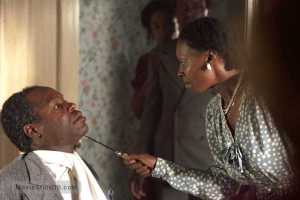
Celie’s Thanksgiving uprising
Finally, in the book, Celie and Mister eventually become friends. Come back with her long-lost kids and the dear sister Nettie he’d banished and “whoop his ass.” I love, love, love the film, but all of this was erased from book to script. I discovered all of this in my solitude.
The Color Purple was originally written as Celie’s prayers, the way she escaped the hell of her existence. In the book, she found this through love. On the paper, we can see that she stops writing to “God” and instead addresses the letters to her sister Nettie, the one who taught her to read (in both versions). The pages, not the movie, clearly reveal this spiritual transformation. Celie continues to write to Nettie, not knowing anything of her fate, only having found the old letters Mister had stashed away for years. Their love was so strong that in her solitude, writing the letters brought her peace. Curate writing activities that bring you peace.

The revised book cover following the film’s success
Do you keep a journal, dabble in poetry, admire the prose in your head? Set aside time as a family for writing and reading. Experience solitude together. Share your work. Curate activities that bring you peace. Use this quarantine to strengthen your capacity to love.
Share this:

Someday at Christmas. #BlackenAsiaWithLove
Now that folks have returned to their normal lives, and the Christmas credit card bills have arrived, let’s reflect on the reason for the season. To get you in the mood, the writer suggests listening to Stevie Wonder’s Someday at Christmas alongside this read; lyrics included here.
Someday at Christmas men won’t be boys
Playing with bombs like kids play with toys
Today’s divisions are so profound, and illiberal tribalism runs so deep, that I believe only art can speak to them – they not hearing me when people like me speak. I’m clearly not an illiberal tribe member, and as soon as I open my mouth, my ‘proper’ American English is dismissed alongside the liberal elite media, Hollywood, etc. The tribe dismisses us, I surmise, due to our training and faith in the transformative power of critical thinking.
“If Republicans ran on their policy agenda alone,” clarifies one article from a prominent liberal magazine, “they would be at a disadvantage. So they have turned to a destructive politics of white identity, one that seeks a path to power by deliberately dividing the country along racial and sectarian lines.” This is lit-er-ally happening right now as the presidential impeachment hearings follows party-not-morality lines. Conservatives are voting along their tribe to support the so-called leader of the free world. Are they free?
Words like ‘diversity’ sound threatening to today’s illiberal thinkers. Those who tout PC-culture as going too far may as well go ahead and admit that they are anti-evolution! Those who denounce implicit racial bias have little to say about any form of racism, save for its so-called ‘reverse’. Those who would rather decry ‘feminism’ as man-hating have little to say about actual misogyny. Yet, it is the liberal candidate/leader/thinker who is held to a higher standard. Are we free?
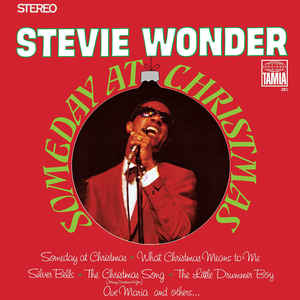 Someday in a world where men are free
Maybe not in time for you and me
But someday at Christmastime
We are in an era of supreme conservative/illiberal tribalism. That’s the unique We are in an era of supreme conservative/illiberal tribalism. That’s the unique ties that bind America’s 45, to Britain’s BJ to Germany’s AFD, France’s infamous National Front (now in its second generation), Italy’s Lega Nord, Austria’s FPO– yes, the F is for ‘freedom’- all the way to India’s leading Islamaphobe. Let’s not forget Poland’s tiki-torch bearing PiS party that filthy-up the European Parliament joined by their brethren from Denmark to Estonia to Belgium and beyond.

EU’s Right-wingers!
Illiberal tribes are tricking masses of those inside cultures of power into voting against their own interests. This is not, as many commentators have noted, to suggest that their so-called liberal alternatives are virtuous. Of course not, but it’s clear that masses can be motivated through fear of the other, whereas organizing around widening the pool of cooperation and humane concern is simply not sexy.
Someday at Christmas there’ll be no tears
All men are equal and no men have fears
Today’s brand of conservatism is an entire illiberal ethic that clearly must be cultivated from birth. Either you get it, or you don’t. Imagine the folks they’re turning against, and tuning out in order to hold onto those values. Imagine the teacher, friend, colleague, schoolmate, neighbour of ‘foreign’ origin that a Brexiteer must wipe away from their consciousness in order to support the anti-EU migration that fueled the campaign. The ability to render folks as ‘other’ is not an instantaneous predicament. It’s well cultivated like a cash crop, say cotton, cane or tobacco! Going to the ballot box to support bigots can’t be an easy feat when we’re literally surrounded by the type of diversity we seek to eliminate.
Someday at Christmas man will not fail
Hate will be gone love will prevail
There are those who voted for Brexit under some false notion of British independence, despite clear and present evidence of British inter-dependence. Perhaps no nation has been more inter-dependent on its neighbors and former colonies than the British Isles. Yet this illiberal disease is global. Imagine the rich diversity of the Indian sub-continent, yet look squarely at the Hindu nationalism sweeping India right now (as if the Taj Mahal weren’t a global treasure that just happens to have a few mosques on board). Plus, I’m not the first to point out that the Jesus racists celebrate was Jewish and spent most of his life in what we now call the Arab world. No nativity scene without foreigners!
Maybe not in time for you and me
But someday at Christmastime
‘Someday at Christmas’ was written in 1967 for Stevie Wonder, then a 17-year-old bulwark of Motown. Wonder wasn’t yet writing all his songs, yet he was already introduced as the ‘Profit of Soul’. In 1980, he sang: “Why has there never been a holiday, yeah/Where peace is celebrated,” in a song aimed at getting Reagan to declare Rev. Dr. Martin Luther King Jr.’s birthday a national holiday. Wonder won. Happy MLK day!
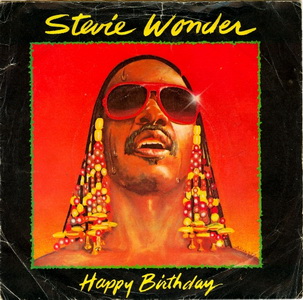
Naturally, looking back we have to wonder if one could have predicted the impact Wonder would soon have on American music. He’d dominate pop music once he set out on his own, set his fingers to funk instead of pop, and began to bare his soul.
Someday at Christmas we’ll see a Man
No hungry children, no empty hand
One happy morning people will share
Our world where people care
In the summer of ‘67, Wonder’d released another record, I Was Made to Love Her, featuring plenty of his infamous harmonica solos. ‘Someday at Christmas’ was released four years before the other most infamous Christmas message song, John Lennon’s War Is Over. SMH, I get goose-bumps hearing a kids’ chorus sing melancholically “War is over/If you want it.” Much of the world was at war then, struggling to comprehend the incomprehensible devastation meted out on the tiny southeast Asian nation of Vietnam, from where I pen this piece – a virtuoso clash of titans. It’s not surprising that those two troubadours began their careers in popcorn pop, yet had to leave the genre to deliver their most potent, fiercest messages.

Motown was decisively a Popular music machine, specifically crafted to appeal to the wider/whiter masses. Motown steered clear away from ‘message’ songs, a real keel in the heal of the likes of Stevie, Marvin Gaye and eventually Michael Jackson. Each of those Motown troubadours has penned plenty of songs of freedom and ecology, and the ethical interdependence between the two. Those guys must be liberals. Ugh!
Share this:


Ho ho homeless: Boris and reasons to be cheerful.
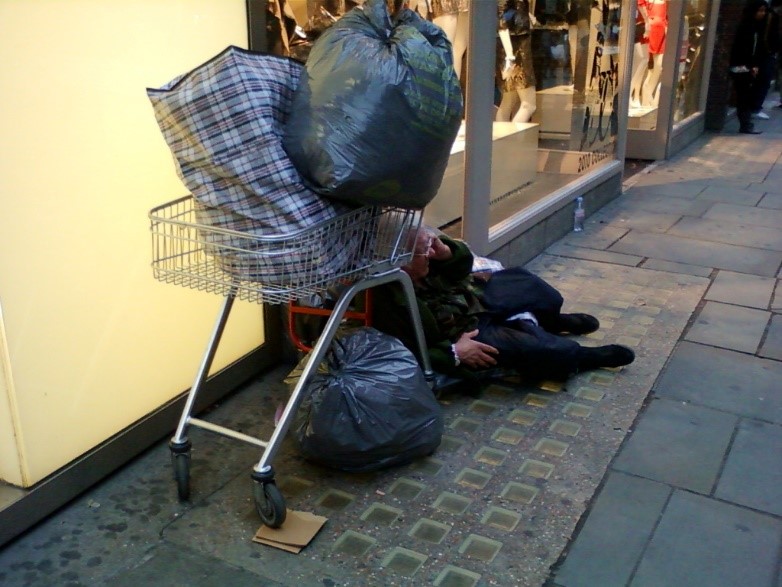
“Homeless Rough Sleeper” by Deadly Sirius is licensed under CC BY-NC-ND 2.0
A week has passed since the election and our political parties have had time to reflect on their victory or demise. With such a huge majority in parliament, we can be certain, whether we agree with it or not, that Brexit will be done in one form or another. The prime minister at the first meeting of his cabinet, and as if on cue ready for my blog, in front of the cameras repeated the pre-election promise of 40 extra hospitals and 50,000 extra nurses.
Putting aside my cynicism and concern about how we, as a country, are going to grow enough money trees without our foreign agricultural workers after Brexit, I welcome this much needed investment. I should add here that in the true sense of fairness, pre-election, other parties were likewise offering wonderful trips to fairyland, with riches beyond our wildest dreams. Trying to out trump each other, they managed to even out trump Trump in their hyperbole.
However, rather appropriately as it turns out, whilst sitting in the waiting room at a general hospital on election day, I read a couple of disturbing articles in the i newspaper. Pointing to the fact that makeshift shelters are becoming increasingly common in British cities one article quoted statistics from Homeless Link showing that rough sleeping had increased by 165% since 2010 (Spratt, 2019). Alongside, another article stated that A&E admissions of homeless patients had tripled in the last eight years with 36,000 homeless people attending in the last year (Crew 2019). Whilst I am always cautious regarding statistics, the juxtaposition makes for some interesting observations.
The first being that the promised investment in the NHS is simply a sticking plaster that attempts to deal with the symptoms of an increasingly unequal society.
The second being that the investment will never be enough because groups in society are becoming increasingly marginalised and impoverished and will therefore become an increasing burden on the NHS.
Logic, let alone the medical profession and others, leads me to conclude that if a person does not have enough to eat and does not have enough warmth then they are likely to become ill both physically and probably mentally. So, alongside the homeless, we can add a huge swathe of the population that are on the poverty line or below it that need the services of the NHS. Add to this those that do not have job security, zero-hour contracts being just one example, have massive financial burdens, students another example, and it is little wonder that we have an increasing need for mental health services and another drain on NHS resources. And then of course there are the ‘bed blockers’, a horrible term as it suggests that somehow, it’s their fault, these are of course the elderly, in need of care but with nowhere to go because the social care system is in crises (As much of the right-wing pre-Brexit rhetoric has espoused, “It’ll be better when all the foreigners that work in the system leave after Brexit”). It seems to me that if the government are to deal with the crises in the NHS, they would be better to start with investment in tackling the causes, rather than the symptoms*.
Let me turn back to the pre-election promises, the newspaper articles, and another post-election promise by Boris Johnson.
My recollection of the pre-election promises was around Brexit, the NHS, and law and order. We heard one side saying they were for the people no matter who you were and the other promising one nation politics. I don’t recall any of them specifically saying they recognised a crisis in this country that needed dealing with urgently, i.e. the homeless and the causes of homelessness or the demise of the social care system. Some may argue it was implicit in the rhetoric, but I seem to have missed it.
In her article, Spratt (2019:29) quotes a Conservative candidate as saying that ‘nuisance council tenants should be forced to live in tents in a middle of a field’. Boris Johnson’s one nation politics doesn’t sound very promising, with friends like that, who needs enemies?**
* I have even thought of a slogan: “tough on poverty, tough on the causes of poverty”. Or maybe not, because we all know how that worked out under New Labour in respect of crime.
** The cynical side of me thinks this was simply a ploy to reduce the number of eligible voters that wouldn’t be voting Conservative but, I guess that depends on whether they were Brexiteers or not.
Crew, J. (2019) Homeless A&E admissions triple. i Newspaper, 12 Dec 2019, issue 2824, pg. 29.
Spratt, V. (2019) ‘You Just didn’t see tents in London or in urban areas on this scale. It’s shocking’: Makeshift shelters are becoming increasingly common in British cities. i Newspaper, 12 Dec 2019, issue 2824, pg. 29.
Share this:


Empathy Amid the “Fake Tales of San Francisco”*
This time last week, @manosdaskalou and I were in San Francisco at the American Society of Criminology’s conference. This four-day meeting takes place once a year and encompasses a huge range of talkers and subjects, demonstrating the diversity of the discipline. Each day there are multiple sessions scheduled, making it incredibly difficult to choose which ones you want to attend.
Fortunately, this year both of our two papers were presented on the first day of the conference, which took some of the pressure off. We were then able to concentrate on other presenters’ work. Throughout discussions around teaching in prison, gun violence and many other matters of criminological importance, there was a sense of camaraderie, a shared passion to understand and in turn, change the world for the better. All of these discussions took place in a grand hotel, with cafes, bars and restaurants, to enable the conversation to continue long after the scheduled sessions had finished.
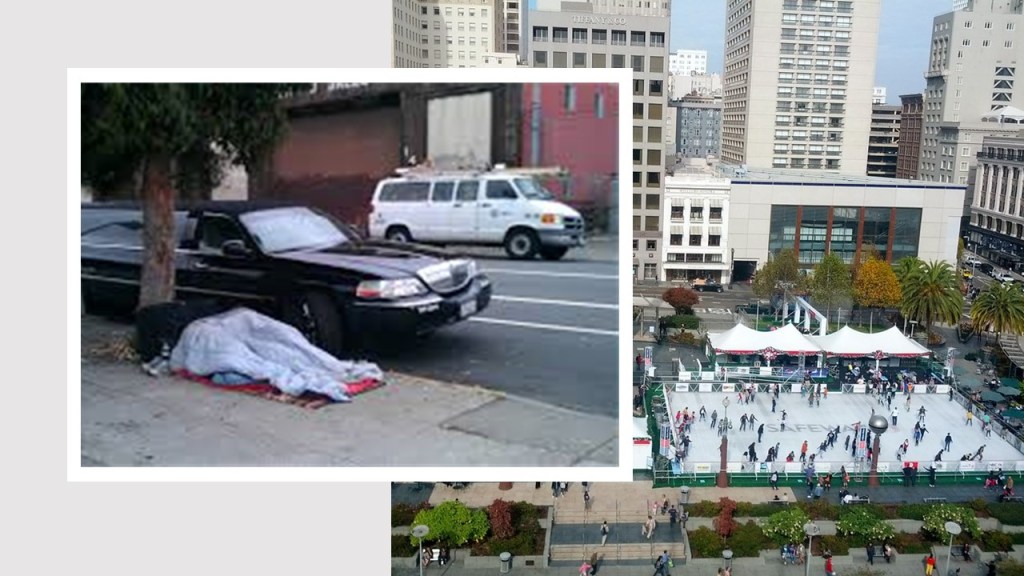
Outside of the hotel, there is plenty to see. San Francisco is an interesting city, famous for its Golden Gate Bridge, the cable cars which run up and down extraordinarily steep roads and of course, criminologically speaking, Alcatraz prison. In addition, it is renowned for its expensive designer shops, restaurants, bars and hotels. But as @haleysread has noted before, this is a city where you do not have to look far to find real deprivation.
I was last in San Francisco in 2014. At that point cannabis had been declassified from a misdemeanour to an infraction, making the use of the drug similar to a traffic offence. In 2016, cannabis was completely decriminalised for recreational use. For many criminologists, such decriminalisation is a positive step, marking a change from viewing drug use as a criminal justice problem, to one of public health. Certainly, it’s a position that I would generally subscribe to, not least as part of a process necessary to prison abolition. However, what do we really know about the effects of cannabis? I am sure my colleague @michellejolleynorthamptonacuk could offer some insight into the latest research around cannabis use.
When a substance is illegal, it is exceedingly challenging to research either its harms or its benefits. What we know, in the main, is based upon problematic drug use, those individuals who come to the attention of either the CJS or the NHS. Those with the means to sustain a drug habit need not buy their supplies openly on the street, where the risk of being caught is far higher. Thus our research population are selected by bad luck, either they are caught or they suffer ill-effects either with their physical or mental health.
The smell of cannabis in San Francisco is a constant, but there is also another aroma, which wasn’t present five years ago. That smell is urine. Furthermore, it has been well documented, that not only are the streets and highways of San Francisco becoming public urinals, there are also many reports that public defecation is an increasing issue for the city. Now I don’t want to be so bold as to say that the decriminalisation of cannabis is the cause of this public effluence, however, San Francisco does raise some questions.
- Does cannabis cause or exacerbate mental health problems?
- Does cannabis lead to a loss of inhibition, so much so that the social conventions around urination and defecation are abandoned?
- Does cannabis lead to an increase in homelessness?
- Does cannabis increase the likelihood of social problems?
- Does the decriminalisation of cannabis, lead to less tolerance of social problems?
I don’t have any of the answers, but it is extremely difficult to ignore these problems. The juxtaposition of expensive shops such as Rolex and Tiffany just round the corner from large groups of confused, homeless people, make it impossible to avoid seeing the social problems confronted by this city. Of course, poor mental health and homelessness are not unique to San Francisco or even the USA, we have similar issues in our own town, regardless of the legal status of cannabis. Certainly the issue of access to bathroom facilities is pressing; should access to public toilets be a right or a privilege? This, also appears to be a public health, rather than CJS problem, although those observing or policing such behaviour, may argue differently.
Ultimately, as @haleysread found, San Francisco remains a City of Contrast, where the very rich and the very poor rub shoulders. Unless, society begins to think a little more about people and a little less about business, it seems inevitable that individuals will continue to live, eat, urinate and defection and ultimately, die upon the streets. It is not enough to discuss empathy in a conference, no matter how important that might be, if we don’t also empathise with people whose lives are in tatters.
*Turner, Alex, (2006), Fake Tales of San Francisco, [CD]. Recorded by Arctic Monkeys in Whatever People Say I Am, That’s What I’m Not, The Chapel: Domino Records

 Thoughts from the criminology team