
Home » Learning (Page 7)
Category Archives: Learning

Meet the team – Amy Cortvriend, Lecturer in Criminology
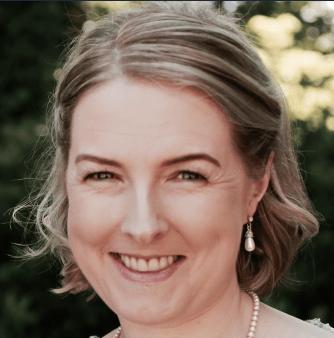
I am one of the new members of the criminology team at UoN and have joined from the University of Manchester where I have been a teaching assistant (probably the equivalent of associate lecturer at UoN) for the last couple of years while I’ve been working on my PhD. I’m looking forward to my new role as lecturer in criminology and hopefully at some point meeting students in real life, face to face. It’s a bit strange starting a new job in a new town when I’m still sat in my living room in Manchester, but the rest of the team have made me feel welcome regardless.
My journey into criminology is a funny one. I did life the opposite to many people, having my first child at 16. When my second child went to school I decided to return to education and as I didn’t have A-levels I has to undertake an Access diploma to get into university. I was required to choose three subjects and at first, I opted for English literature because I love(d) reading (I’m sure I still love reading but I’ve not read anything non-work related for a long time). I picked sociology because it sounded interesting and the same with history. At the last minute I swapped history to criminology and never looked back. From my first lesson I knew this was my future, although at that point I wasn’t sure how.
I always had imposter syndrome and never thought my work was good enough (still do today but we’ll save that for another blog post), but my Access tutor believed in me and suggested I apply to the University of Manchester. As I was a mature student, I had to attend an interview with two of the lecturers. I was super nervous, but I got a place and never left. The undergraduate degree was difficult at times because there were only a couple of mature students and they eventually dropped out. I wasn’t in halls and had kids at home, so I didn’t have the same student experience as many of my cohort, however I made some great friends particularly those who stayed to undertake our MRes.
I finished my undergraduate degree with a first and was awarded a scholarship for my research Masters’ then luckily got another studentship for my PhD which is near completion and here I am. Since I’m teaching research methods modules this year my students will be pleased to know that my BA (Hons) and MRes were heavily focussed on research methods and my PhD has given me three years of real-life research experience. My dissertations and thesis have all followed my research interests in the psychology of victimisation and border criminology. My PhD thesis explores the victimisation of refugees and how they cope. That’s all I will say about my research right now, but I will write another blog about it at some point. Probably when I’ve finished writing it and the hard work is a distant memory.
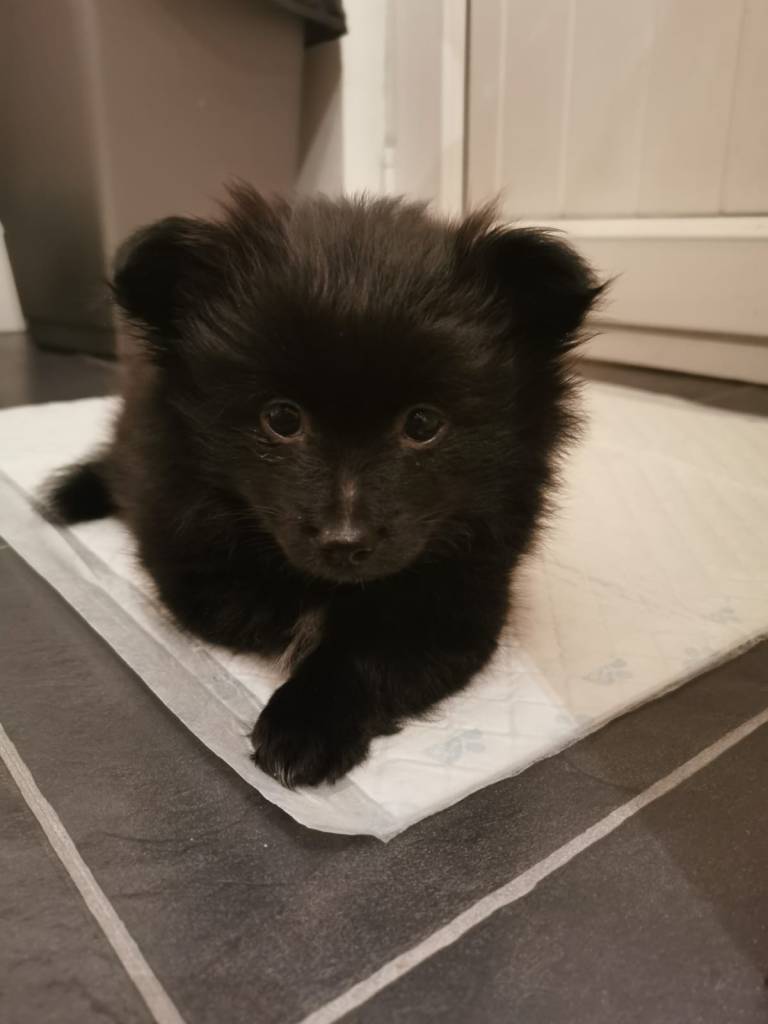
On a personal note, the daughter I had at 16 is now grown up and lives on her own and my youngest is a sassy 14-year-old girl. We have also just got our Pomeranian puppy Prince. In my free time I’m usually doing something active. I’m a Crossfitter and many of my closest friends are gym friends so the gym is both my mental health crutch and my social life. When I do eventually sit down, I love a good box set. I’m currently watching The Morning Show with Jennifer Aniston and Reese Witherspoon. Recommendations via email are welcome.
Now you know a little bit about me. I’ll look forward to getting to know all the criminology students soon, either virtually or face to face. Hopefully some of you will put your cameras on at least for a day so that when we eventually meet, I’ll know who you are.
Share this:


My Criminology Journey: Haley

The start of my criminology journey is not very exciting. I am not fully sure of how or why I ended up studying the subject. I was advised to study hairdressing at school as my predicted grades were not good enough for university, but the idea of trusting myself with a pair of scissors was very unnerving. I had a dilemma at college as I was unable to decide whether I wanted to study healthcare or construction – two courses which bore no similarity. In the end I give up trying to make decisions and studied A Levels because that was what my friends were doing.
University may as well have been on Mars at this point, as it was completely mysterious and unknown to me. Whilst at college, I was asked by my tutor to go to an open day at Oxford University. I saw this as an opportunity to unmask this university ‘thing’ for what it really was, so I agreed to go. I felt completely out of place throughout the day and found myself gobsmacked by the sheer privilege of the place, the culture and the students etc. At the same time, I was fascinated by the available courses, so I decided to continue my studies into higher education.
My first attempt at university did not go as well as I had intended it to. I had other issues to contend with at the time, so I dropped out after two weeks. However, in 2010 I enrolled at the UoN and never really left. I had a great time studying criminology at UoN as I thought that my course was very interesting and the teaching staff (aka @paulaabowles and @manosdaskalou) were spectacular.
I did not realise this it at the time but I was well prepared for critical criminological discussions because I came from a background where people would be demonized for a whole host of social problems – it was clear to me at the time that this was unfair. Whilst enjoying the course content I did have to make a considered effort to improve on my writing skills, but it was worth the effort as this improvement worked wonders on my grades. As an undergraduate, I used my overdraft and savings from working part-time jobs to go travelling at the end of each academic year, this was beneficial for helping me to understand criminological issues outside of the UK.
In 2015 I began teaching as an associate lecturer at UoN and I really enjoyed it. I also completed an MA degree in Social Research. To fast-forward to today, I now work as a lecturer in criminology – and this really is, beyond my wildest dreams!
Studying is not always a smooth ride for some, but if you work hard, you never know where you might end up.

Share this:

Road trip
In all fairness a road trip is a metaphor for life. We live in perpetual motion, moving forward and going from place to place. Our time is spent through journeys in our space, through the time of our lifespan. Alone or with others, planned or unplanned journeys are to happen. That is life as it is.
Sometimes of course a road trip is nothing more than an actual trip in a countryside, quickly to be forgotten replaced by the next one! On this occasion, I shall try to narrate it as it happened, as it is fresh in my mind and the images can be vividly recalled. Maybe in future it would serve as a reminder, but on this occasion, it is merely a reminder of a very odd trip! At this stage, I would like to state that no humans nor animals were hurt during this road trip.
I am driving on one of the island’s country roads, the road is narrow going through the lush pine forest, some sycamore trees on the side. The track is leading up and down the mountainous path. The scenery is scenic and probably the reason people choose it. The road alternates views from the forest, the valleys, the canyons and the sea in the distance. Hues of green, and blue everywhere; and the smell. The pines joined with thyme and other fragrant herbs, a combination that gives the air that scent I cannot describe. The light blue of the sky meet the Aegean blue in the distance.
As per usual, on a road trip I prepare my maps, and plan the route in advance, but just in case I also keep an eye on the road in case there is a change. On this occasion, the public works are working wonders; the street signs are non-existent so I opted out. Interestingly instead of traffic information there were signs but not about the road ahead. Somewhere is the midst of the journey there is the first sign about Jesus. According to the sign “He is the truth, the way and the life”. I am unsure about the destination, but at least Jesus is aware. The next couple of signs involve Jesus and his teachings whilst the last one is making me feel a bit uncomfortable. “Jesus died for your sins” it proclaims! Ok fair enough, let’s say that he did. Any chance of knowing also whereabouts I am and where I am heading. The route continues with further signs until we come to a stop.
Finally, more signs. On this occasion there are some holy sites and monasteries. One of them is of a Saint most revered that apparently most of his body rests in a nearby location, (minus an arm and a shin). Later, I discover the Saint helps sick children and those who suffer from cancer. Admirable, considering that he’s almost 300 years dead. Still no actual traffic information on the road! At least the signs got me reading of a fascinating man long gone. It is fascinating reading on beliefs and miracles. Within them they hold peoples’ most secret expectations, those that under normal circumstances, they dare not to speak about. This is a blog post for another time; back on the road trip and almost two hours on the journey.
At this point, a herd of cows who have been lunching on the side of the road, decided to take a nap on the road. To be honest, it is only one of them who is blocking the way, but the rest are near idly watching. At this stage, I come to a stop waiting for the cow to move. The cow who was napping opened her eyes and looks at me, I look back, she looks away and continues to lay motionless in the middle of the road. I briefly evoke the Saint. Nothing. I am contemplating Jesus and still nothing. After some time, around an hour of cow staring I am going for my last resort. I get out of the car and promise that unless the cow moves, I shall part with vegetarianism. Now I am openly threatening the cow to eat her. This is when nature retaliates. A flock of goats join the cow. They meander around me and the stubborn bovine. The road is now akin to a petting zoo.
I employ a trick I picked up from cowboy films. I raise my hat, luckily, I am wearing a hat, weaving my arms furiously and making sounds. The cow is despondent at first and the goats just talk back. After a few minutes I have managed to get the cow to move and the goats are now at the side of the road. That’s my opportunity to leave. As I turn back, I notice another car behind me; they are also travelers who begin to applaud my efforts at husbandry. The road is clear, and I am on my way.
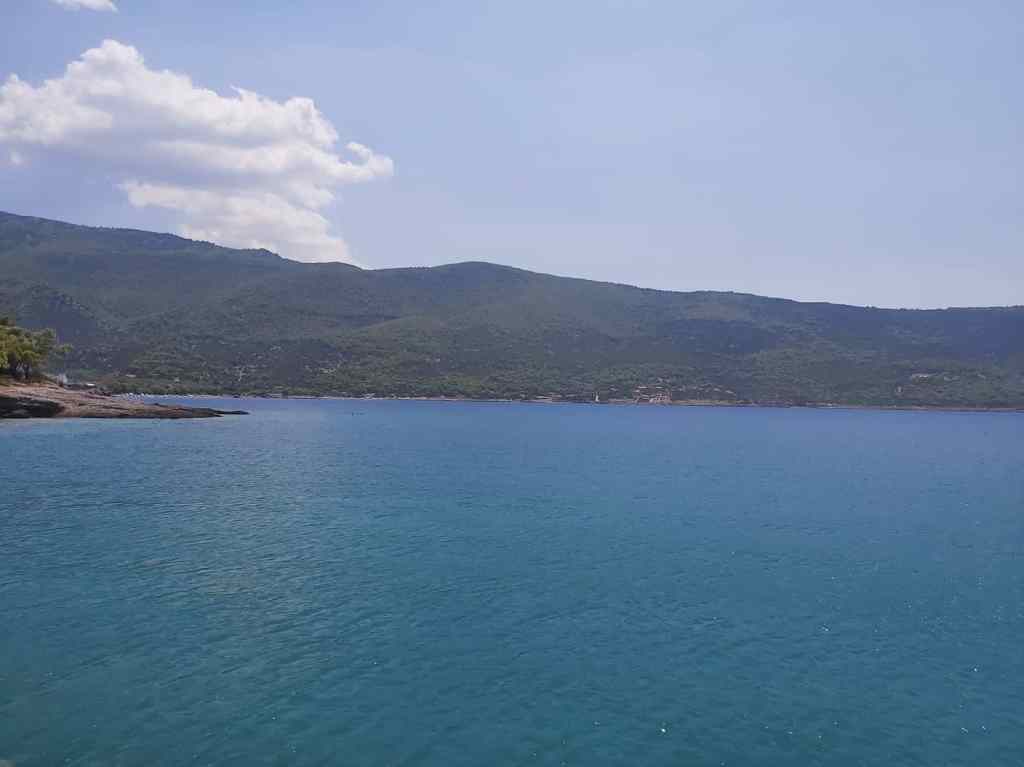
The next hour is less eventful although the road is still hairpinned; now it’s heading downwards and from the mountains its heading to the sea. I arrive at the sea way over the expected time and I manage to find a spot to park. One the wall, next to the spot someone wrote “you vote for them every four years like cows”. The writing is black, so I assume an anarchist, or maybe the author had a similar driving experience to me, or it’s just an unfortunate metaphor. The sea is cool and the views of the sea and in the distance a group of islands, spectacular. There are hot springs near by but in this weather the sea is more than enough. After all that drive, a stop at a local taverna is inevitable. Speciality dish mosxaraki or beef stew! I think the Saint is testing me!
On the way back, the road is empty. The cows rest on the side of the road. I slow down, I look out…they look away. At a local coffee shop a patron asks for the Covid-special coffee. I suppose a joke about the thing that occupies everyone’s mind. He doesn’t wear a mask and doesn’t seem to believe this pandemic “nonsense”. I was wondering if he is related to the stubborn cow. The trip ended and it formed another of those planned road trips. There was nothing spectacular about it. There is however the crux of my point. Like life, most of our roadtrips are unspectacular on their own. It is what we remember of them that matters. In the last months millions of people went into lockdown. Their lives seemed to stand still; a road trip can also be a metaphor, provided we don’t forget the details.
Share this:


“Things you need to know about criminology”: A student perspective – Natalie Humphrey, 1st Year student

We are all living in very strange times, not sure when life will return to normal...but if you're thinking about studying criminology, here is some advice from those best placed to know!

The most important module to my understanding of criminology is: At the beginning of the year I believed the True Crime module to be the most important in understanding why crimes are caused. However, I quickly learned that these are not always the best source of information! The Science module is the basis of Criminology in the first year, laying down where it emerged, with Lombroso and Bertillon. I believe these figures are important to understand to grasp criminology.


The academic criminology book you must read:
The SAGE dictionary of Criminology has helped me with the basics of the subject. If there was something I became stuck on, this book would usually have an explanation for it. It also has examples which make it much easier to apply

The academic journal article you must read:
Attitudes towards the use of Racial/Ethical Profiling to Prevent Crime and Terrorism, by Johnson, D et al.(2011)
I came across this article when researching my Independant Project on racial stereotyping. It goes into the systematic racism that black people face and how disproportionate racism truly is. With more recently, the George Floyd case, this is still a very prominent article that is true to date

The criminology documentary you must watch:
I am a lover of many true crime documentaries and am always first to watch the new one that has been added to Netflix! The famous ones, such as Ted Bundy’s confession tapes, are fascinating to me, Bundy especially. However, there are many injustices that need to be addressed, not just the notorious serial killers. Jeffrey Epstein’s new documentary is very important in understanding sexual abuse that happened to over 200 underage girls. Athlete A also shows the sexual abuse of underage girls who were part of USA gymnastics.

The most important criminologist you must read:
Becker stood out to me this year as a very important figure. Understanding how young people are so heavily influenced by the labels people and society give, so much so it can shape their lives. Even older people can be easily labelled. This was quite surprising to me at the beginning of my studies.

Something criminological that fascinates me:
DNA and fingerprinting are fascinating to me. I find the science behind the discovery of what occurred at a crime scene and how they unpick it very interesting. This is definitely something I would like to study further.

The most surprising thing I know about criminology is:
It is a much wider subject than I first thought, it involves so much more than you could imagine. It questions everything in society.

The most important thing I've learnt from studying criminology is:
I have learned how unjust our criminal justice system is and how much, we as individuals, stereotype every person we meet. I’ve become more aware of this and have a better understanding of what needs to change.

The most pressing criminological problem facing society is:
Racism is a massive problem today. The racism black people face, especially in the US, is hard to understand as a white woman, but difficult to even contemplate people are treated in such ways. George Floyd, as I mentioned before, was killed because of his race. Problems like this would not happen to a white male, especially when his alleged crime was not violent. Young black men are labelled by the media to be seen as a thug and dangerous, causing many to be assumed of acts they just would not commit. Jane Elliott’s experiment on racism and eye colour from the 1970s is still a lesson that needs to be learned today!

When family and friends ask, I tell them criminology is:
Its more than it seems. Most just think it's about crime, which yes it is, but there is so much more to it. It is not one subject, it is so many put together. Science, psychology, sociology for example.

Share this:

Some lessons from the lockdown
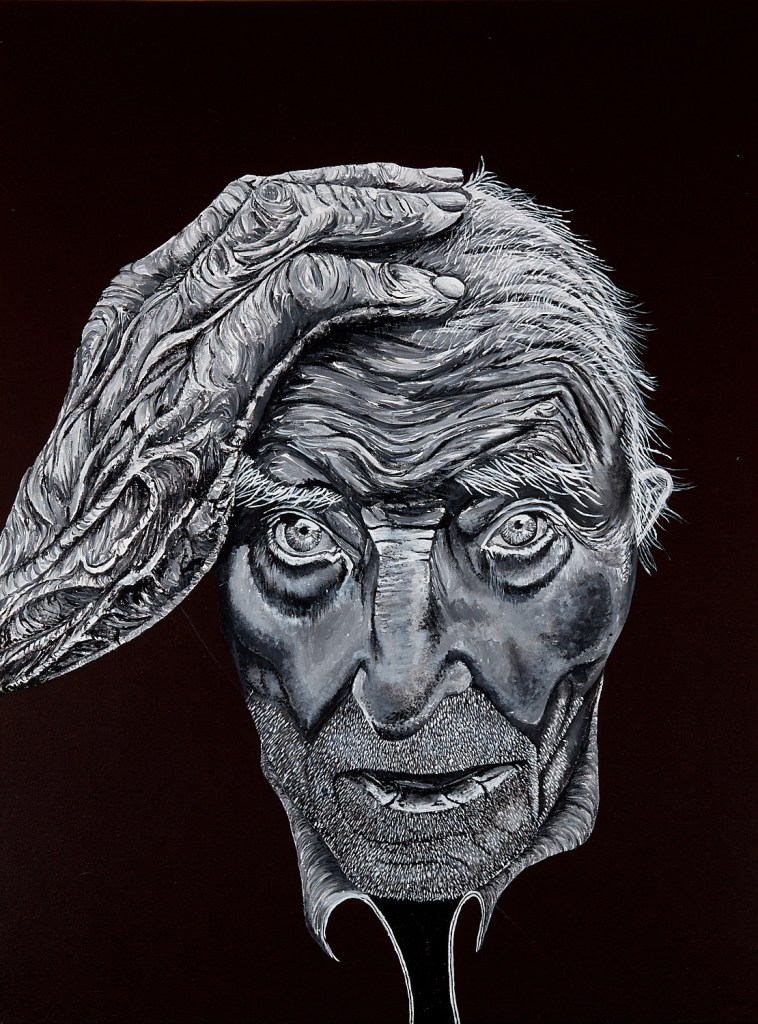
Koestler Arts (2019), Another Me: The Redwoods Centre (secure mental health unit), James Wood QC Silver Award for Portrait, 2019
In March 23, 2020, the UK went into lockdown. The advice given, albeit conflicting in parts, was clear. Do not leave your home unless absolutely necessary, banning all travel and social interactions. This unprecedented move forced people to isolate at home for a period, that for some people will come to an end, when the WHO announces the end of the pandemic. For the rest of us, the use of a face mask, sanitiser and even plastic gloves have become modern day accessories. The way the lockdown was imposed and the threat of a fine, police arrest if found outside one’s home sparked some people to liken the experience with that of detention and even imprisonment.
There was definite social isolation during the pandemic and there is some future work there to be done to uncover the impact it has had on mental health. Social distancing was a term added to our social lexicon and we discovered online meetings and working from home. Schools closed and parents/guardians became de facto teachers. In a previous blog entry, we talked about the issues with home schooling but suffice to say many of our friends and colleagues discovered the joys of teaching! On top of that a number of jobs that in the past were seeing as menial. Suddenly some of these jobs emerge as “key professions”
The first lesson therefore is:
Our renewed appreciation for those professions, that we assumed just did a job, that was easy or straightforward. As we shall be coming back eventually to a new normality, it is worth noting how easy it will be to assign any job as trivial or casual.
As online meetings became a new reality and working from home, the office space and the use of massive buildings with large communal areas seemed to remain closed. This is likely to have a future impact on the way business conduct themselves in the future.
Second lesson:
Given how many things had to be done now, does this mean that the multi occupancy office space will become redundant, pushing more work to be done from home. This will alter the way we divide space and work time.
During the early stages of the lockdown, some people asked for some reflection of the situation in relation to people’s experiences in prisons. The lockdown revealed the inequality of space. The reality is that for some families, space indicated how easy is to absorb the new social condition, whilst other families struggled. There is anecdotal information about an increase on mental health and stress caused from the intensive cohabitation. Several organisations raised the alarm that since the start of the lockdown there has been a surge in incidents of domestic violence and child abuse. The actual picture will become clearer of the impact the lockdown had on domestic violence in future years when comparisons can be drawn. None the less it reveals an important issue.
Third lesson:
The home is not always the safest place when dealing with a global pandemic. The inequality of space and the inequality in relationships revealed what need to be done in the future in order to safeguard. It also exposed the challenges working from home for those that have no space or infostructure to support it.
In the leading up to the lockdown many households of vulnerable people struggled to cope with family members shielding from the virus. These families revealed weaknesses in the welfare system and the support they needed in order to remain in lockdown. Originally the lack of support was the main issue, but as the lockdown continued more complex issues emerged, including the financial difficulties and the poverty as real factors putting families at risk.
Fourth lesson:
Risk is a wider concern that goes beyond personal and family issues. The lockdown exposed social inequality, poverty, housing as factors that increase the vulnerability of people. The current data on Covid-19 fatalities reveal a racial dimension which cannot longer be ignored.
During the lockdown, the world celebrated Easter and commemorated Mayday, with very little interaction whilst observing social distancing. At the end of May the world watched a man gasping for breath that died in police custody. This was one of the many times the term police brutality has related to the dead of another black life. People took to the streets, protested and toppled a couple of statues of racists and opened a conversation about race relations.
Fifth lesson:
People may be in lockdown, but they can still express how they feel.
So, whilst the lockdown restrictions are easing and despite having some measures for the time being, we are stepping into a new social reality. On the positive side, a community spirit came to the surface, with many showing solidarity to those next to them, taking social issues to heart and more people talked of being allies to their fellow man. It seems that the state was successful to impose measures that forced people indoors that borderline in totalitarianism, but people did accept them, only as a gesture of goodwill. This is the greatest lesson of them all in lockdown; maybe people are out of sight, appear to be compliant in general but they are still watching, taking note and think of what is happening. What will happen next is everyone’s guess.
Share this:


“Things you need to know about criminology”: A student perspective – Mary Adams, recent Graduate and mature student.
We are all living in very strange times, not sure when life will return to normal...but if you're thinking about studying criminology, here is some advice from those best placed to know!

The most important module to my understanding of criminology is: I would have to say they are all equally important for understanding different aspects of Criminology. In first year I loved The Science of Crime which showed how things have evolved over time, and that what we now see as funny was actually cutting edge in its day. True Crime also makes you look beyond the sensational headlines and separate fact from fiction. In second year Crime & Justice gave a brilliant grounding in the inner workings, and failings, of the criminal justice system. And in third year, the Violence module explores personal and institutional violence, which is especially relevant in current times

The academic criminology book you must read: Becker’s Outsiders and Cohen’s Folk Devils and Moral Panics are a must. I also found Hopkins-Burke’s An Introduction to Criminological Theory and Newburn’s Criminology essential reading for first year as well as Finch & Fafinski’s Criminological Skills. For second year I recommend Davies, Croall & Tyrer’s Criminal Justice. If you choose the Violence module in third year you will be grateful for Curtin & Litke’s Institutional Violence. And don’t forget Foucault’s Discipline & Punish!

The academic journal article you must read:
There are so many excellent journal articles out there, it’s difficult to choose! Some of my favourites have been:
'Alphonse Bertillon & the measure of man' by Farebrother & Champkin;
'Bad Boys, Good Mothers & the ‘’Miracle’’ of Ritalin by Ilina Singh';
'Detainee Abuse & the Ethics of Psychology' by Kathryn French;
'Attachment, Masculinity & Self-control' by Hayslett-McCall & Bernard;
'Grenfell, Austerity & Institutional Violence' by Cooper & Whyte;
'The Phenomenology of Paid Killing' by Laurie Calhoun;
'A Utilitarian Argument Against Torture Interrogation of Terrorists' by J. Arrigo.

The criminology documentary you must watch:
Without a doubt, a must-see is the Panorama documentary London Tower Fire: Britain’s Shame. I would also highly recommend the movie The Stanford Prison Experiment

The most important criminologist you must read:
Of course you must read Lombroso, Beccaria & Bentham. I also enjoyed reading work by feminist criminologists like Pat Carlen, Carol Smart & Sandra Walklate. And of course, Angela Davis is a must!

Something criminological that fascinates me:
What fascinates me is how the powers that be, and a good proportion of the public, cannot seem to realise that social injustice is one of the major factors behind why people commit crime. And the fact that putting more & more people in prison is seen as a ‘good’ thing is mind-boggling!

The most surprising thing I know about criminology is:
The fact that it is such a diverse subject & incorporates so many other disciplines

The most important thing I've learnt from studying criminology is:
Question everything! Don’t take anything at face-value. Try to look beyond the attention grabbing headlines to find out the real story. Read, read, read!

The most pressing criminological problem facing society is:
Unfortunately I think there are many pressing problems facing society today, the main ones being social injustice & inequality, systemic racism, institutional violence, and mass incarceration


When family and friends ask, I tell them criminology is:
Some people joke that I’m learning how to be a criminal! Others think it’s all about locking people up! I tell them it’s all about looking at the mechanisms in-built in our society that disadvantage & discriminate against whole groups of people, and that, unless we are part of the rich & powerful elite, any one of us could find ourselves in the ‘out’ group at any time. I also tell them to stop reading The Daily Mail, vote Labour, and question everything!!
Share this:

“Things you need to know about criminology”: A student perspective: ej213
We are all living in very strange times, not sure when life will return to normal...but if you're thinking about studying criminology, here is some advice from those best placed to know!

The most important module to my understanding of criminology is: True Crime - this module highlights the fact that cases you have seen in the media and in films may not be accurate due to the true crime genre exaggerating facts for entertainment. Whilst, this module does not cover quite as much theory as others, it gives the chance to explore cases and discover the truth underneath the exaggeration. Love this module.

The academic criminology book you must read:
The Oxford Handbook of Criminology (sixth edition) - I was recommended this book at an open day and there was rarely an assessment I couldn't find some background knowledge for in this book. It is a great tool.

The academic journal article you must read:
Testosterone and masculinity

The criminology documentary you must watch:
FBI: Cold Cases - it is a Netflix original I think but it shows how crimes committed 20 or 30 years ago can be solved due to modern technology. Really interesting especially if you have an interest in forensics.

The most important criminologist you must read:
Either Lombroso or Marx.

Something criminological that fascinates me:
The fact that crime is defined by the wealthy meaning that the prisons are mostly filled with the lower classes due to the upper classes' crimes being seen as victimless

The most surprising thing I know about criminology is:
That criminology is a relatively recent study

The most important thing I've learnt from studying criminology is:
There is rarely one answer so long as you can support your argument

The most pressing criminological problem facing society is:
This could be an essay in itself. I guess I would have to say poverty because 14 million people (2019/20) still live in poverty and these people are not going to have the same advantages or prospects in education or the workplace meaning they are more likely to commit crime in order to survive

When family and friends ask, I tell them criminology is:
Amazing and the most interesting course I have chosen to study because it never had a definite answer which I guess can make it complex however, the debates within the course are great to participate in because it is interesting to hear another's perspective but also voice my own. It is also very inclusive in its module content which is great

Share this:


“Things you need to know about criminology”: A student perspective – Bonnie Middleton (2017-2020)
We are all living in very strange times, not sure when life will return to normal...but if you're thinking about studying criminology, here is some advice from those best placed to know!

The most important module to my understanding of criminology is: All of them! Every module contributes to your understanding of Criminology and all are different and enjoyable. Personally, my favourite module was Violence: From Domestic to Institutional in Year 3; this module ties together everything you know about Criminology; the reasons why we are subjective as criminologists and our ability to look beyond the scope of what we know.

The academic criminology book you must read:
Outsiders: Studies in the sociology of deviance (1963) by Howard Becker. Albeit a dated book, its ideas are relevant and relate to many criminological such as; how and why criminals are labelled and stigmatised; why are the youth demonised; why people reject the norms and values of society and become criminals in doing so.

The academic journal article you must read:
This is a hard one. Articles are great for discovering new ideas and methodologically testing theories. I would recommend reading: Arrigo, J. (2004). A Utilitarian Argument Against Torture, Interrogation of Terrorists. Science and Engineering Ethics. 10(3), pp. 543-572. This article poses many questions for a criminologist which enlightens you to think subjectively and challenge your own views; which is what Criminology is all about. From reading this article you will learn to think critically when faced with a challenging dilemma; the rights of a terrorist and how can the law can be tailored to fit the crime.

The criminology documentary you must watch:
Where do I begin? Louis Theroux and Stacey Dooley are both great journalists and documentary makers. If I had to pick one, I would recommend watching the BBC’s documentary on Grenfell If you watch this documentary you must consider; the government’s response; who is accountable; why are the residents of Grenfell still in temporary accommodation. These are the sorts of questions you should be asking as someone studying Criminology.

The most important criminologist you must read:
Familiarise yourself with the ideas of Lombroso, this will aid your understanding on how criminological theory and ideas have developed overtime through biological, psychological and sociological standpoints.

Something criminological that fascinates me:
Domestic abuse. I had done my dissertation on this as I have a great interest in male dominance and power over women, especially in intimate relationships. Gender plays a key role in this which when examined in depth, will change your view on gender paradigms.

The most surprising thing I know about criminology is: Criminality was believed by Lombroso to be inherited and that criminals possessed physical defects, criminality would be measured by the size and shape of particular body parts; this was later discredited. I can remember learning this in first year and it fascinated me.

The most important thing I've learnt from studying criminology is:
To not judge a book by its cover and to not take everything at face value. Do not be afraid to challenge other’s standpoints and beliefs. Thinking critically is the most important skill to have, search deeper into issues and apply your own thoughts and experiences.

The most pressing criminological problem facing society is:
Mass incarceration and reoffending rates. The UK is yet to move away from the ‘tough on crime’ approach favouring law and order and punishment. The penal system needs to be reformed to ensure offenders are rehabilitated to break the cycle of criminality; definitely educate yourself on political party’s manifesto’s and what they say about crime and justice before voting.

When family and friends ask, I tell them criminology is: I tell family and friends that criminology is such a broad field of study; we look at law, psychology, science, sociology, politics, penal systems, criminal justice organisations, media and much more. From this, you attain the ability to think critically and reflect, it can help you in many situations not just criminological issues. It is an incredibly insightful and enlightening field to study; it opens up many opportunities.
Share this:


Ask the expert, if you can find one

It was around four years ago I discovered the title of ‘Doctor’ extended beyond medical staff. I’m not sure many people outside of the academic world fully understand or have any reason to know the order in which post nominal letters are awarded or titles are given. Gaining the title of ‘doctor’ at the very beginning of any academic journey, seems so distantly part of any future plan, its barely imaginable. Some career paths seem wildly ambitious. Wanting to be an ‘expert’ in your field for the humble student, feels much like aspiring to become an astronaut midway through a physics degree.
Once you enter the world of academia, the titles people hold seem to determine an awful lot of their credibility. It’s rare to find a university lecturer who isn’t working towards doctoral qualification, most already have one. The papers, books and research journals are filled with the knowledge of individuals who once were nothing more than students. I often wonder though, at what point someone becomes an expert? At what point, (if ever) do the most academically qualified individuals refer to themselves as experts within a narrow area of their field.
The government often talks about relying on ‘expert’ evidence. Watching the experts stand beside the PM discussing the current pandemic, they appear uneasy, particularly when questions are raised about a different expert having a contradicting opinion. One thing I feel quite sure of is that experts seem to rarely agree. As Bertrand Russell (1927/42) states, “even when all the experts agree, they may well be mistaken” . Maybe that’s because it’s questionable if anyone can ever truly know everything on a given subject area.
The scientific committee seems to be buzzing with accusations that the experts are not quite what they seem. The ‘data scientists’ advising government and sitting on SAGE are not all from a background which comfortably implies they are qualified to discuss virology or immunology. In the background lingers the fact with such a new virus, with so little known about it, expert knowledge in a narrow sense, is undoubtedly in its infancy and will probably require some degree of hindsight later on.
In the past week one of the UK’s leading experts has resigned from his job after breaking his own guidance. Meanwhile the public watched Matt Hancock ‘snap’ at an opposition MP in parliament. A woman who despite being no more of an ‘expert’ than himself, at least has experience as a qualified A&E doctor to base her opinions and views on. It seems last week’s experts and heroes are this week’s victims in the ongoing witch-hunt for someone to blame.
I’ve started to wonder if labelling someone an ‘expert’ is something other people do to install confidence that a piece of research being relied upon is credible, rather than the experts referring to themselves that way. There’s almost an assumption of arrogance for anyone who dares to protest that their knowledge should be recognised with a title, outside of the academic world anyway. Maybe people simply don’t understand what it took to reach that level of knowledge in the first place.
I’ve looked a lot at ‘labelling’ within the criminological context and it seems to me the labels that are attached to us, almost always seem to come from someone else. In an age of self-proclaimed ‘internet experts’ the real experts, it seems are hard to find.
Reference
Russell, Bertrand (1927/1942) cited in The Collected Papers of Bertrand Russell: A Fresh Look at Empiricism, 1927-42, edited by by John Slater and Assisted by Peter Köllner, (London: Routledge)
Share this:


“My Favourite Things”: Saffron Garside

My favourite TV show - It's probably Peep Show, I've rewatched it so many times and it doesn't stop being funny. I often find myself quoting it to other people too and it's what I put on when I don't want to think about anything

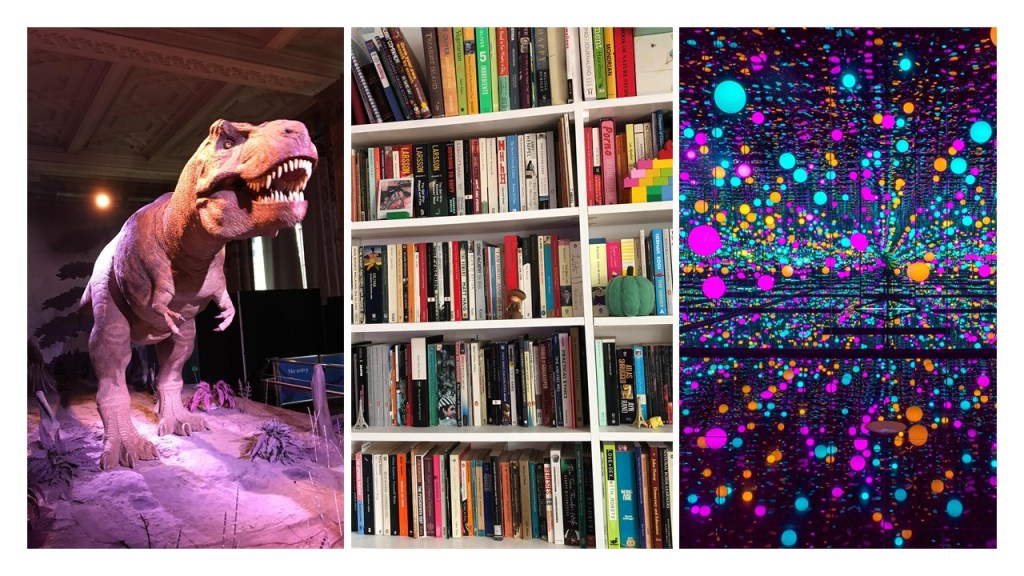
My favourite place to go - The Natural History Museum has been my favourite place to go for a very long time - the building is beautiful and you could spend days in there and still not see everything. I learn something new every time I go. I also love taking the kids there now - some stuff is still the same as when I was small like the T-Rex and the earthquake room! It'll be one of the first places we go when museums and galleries reopen

My favourite city - It's definitely Paris - it really reminds me of London in a lot of ways, it feels small and big at the same time and there is so much to see and do there. I was lucky enough to go at the beginning of March on a surprise trip - it was fun to be a tourist and we walked so much!

My favourite thing to do in my free time - Read! If I'm not doing something else then I'm usually reading. I carry a book everywhere just in case I get a couple of minutes to read. I'm in two book clubs so always juggling a few books at once

My favourite athlete/sports personality - I'm not a big sports fan and I'm not sure this counts but the kids and I have been loving doing PE with Joe Wicks. It's been great for keeping us moving during the lockdown and it's a pretty big commitment to show up every day. He always seems so positive

My favourite actor - Edward Norton. I think I've seen nearly all the films he's ever been in!

My favourite author - It's too difficult to choose. I really like Chuck Palahniuk and I've reread the Harry Potter series by J.K. Rowling a lot of times!

My favourite drink - I'm not sure you can beat a good cup of tea. It's about the most comforting thing I can think of and it's never not a good time to put the kettle on

My favourite food - caramel shortbread - but it has to be one of the really good ones (no digestive base!) and you need a good chocolate to caramel ratio!

My favourite place to eat - Every Sunday my husband and I take it in turns to cook a big family meal (complete with pudding!) and we play lots of board games after. It's one of my favourite times in the week and it always feels special.

I like people who - are enthusiastic about life and the things they are learning about, who want to share stories and make spontaneous decisions

I don’t like it when people - don't communicate their feelings or try to resolve things through conversation - I think things would often be simpler if people tried to talk about things honestly

My favourite book - I think my favourite book of all time is Treasure Island by Robert Louis Stevenson it's such a good adventure story and bits of it are really scary!

My favourite book character - Bilbo Baggins! I really enjoyed The Hobbit as a child and my kids love it so much we've already read it together twice. There is something wonderful about how his character develops throughout his quest - he goes from being a reluctant adventurer to the person holding the whole thing together. He isn't motivated by greed or fame and commits himself to seeing it through. Whenever he feels disheartened he dreams of the comforts of home; cooked meals, a boiling kettle, a warm fire

My favourite film - Fight Club is easily my favourite film- great actors, great soundtrack, great twist!

My favourite poem - Wild Geese by Mary Oliver. She's my absolute favourite poet and it felt like magic when I first discovered her! She writes about nature with such reverence and wonder

My favourite artist/band -  For more than half my life it's been Green Day so I think I am stuck with them now!

My favourite song - In My Mind - Amanda Palmer. I really, really love this song - positive messages and ukulele, what more do you need?

My favourite art - I don't know if I have a very favourite piece of art - I love going to a modern art gallery like the Tate Modern in London or the Centre Pompidou in Paris and just spending hours losing myself in all the emotions that get stirred up. I really love the work of Yayoi Kusama but haven't been lucky enough to see her art in person yet

My favourite person from history - Mary Anning made some really important fossil discoveries but didn't really get the recognition she deserved during her lifetime. Plus she was struck by lightning as a baby, which is a pretty cool story!

 Thoughts from the criminology team