
Home » Law (Page 3)
Category Archives: Law

More Grotesque Black Death #BlackenAsiaWithLove
Each time I turn on the news I see more black death.
It’s grotesque. In my country, ‘Merika, there are peaceful protestors all around the country combatting police violence. Initially, when George Floyd was murdered, these peaceful protests spread across the world, as folks rose in solidarity for peace against white supremacy in America. Many more Black bodies have died in dubious police circumstances since. In the popular rhetoric, sadly, the peaceful protestors are held to account for the violence sweeping our streets. One of Dr. King’s major battles was to convince a people who’d been born into a nation of violence, how to be peaceful; we are a nation born of violence. Dr. King believed and taught that “non-violent resistance… [is] a courageous confrontation of evil by the power of love” (King, Stride, 80). That was just to boycott the local busses in the 1950’s. Working people choosing to spend their hard-earned money as they pleased, and still Jim and Jane Crow showed up to verbally and physically harass each one of them. By the 60’s Black university students worked in solidarity with students of all colors to teach, preach and practice non-violent civil disobedience.

It’s in bad faith to focus on the rioters and overlook those attempting to exercise their first amendment rights. I say “attempting,” because even the lone Black woman in Kentucky house of representatives, Attica Scott, can be arrested in our hometown for peacefully protesting #JusticeForBreonnaTaylor, #AtticaScott4Ky. Without the 1st amendment, there’s no second. And let’s not forget all those anti-mask protestors that showed up at city and state halls around the country – in 2020 – armed to the teeth, so-called peacefully protesting any ordinance to protect ‘us’ from the spread of CoVit. How peacefully will the po-po resolve this conflict instigated by their own violence? The white supremacist way, of course. Look at 45, head hood and chief of their klan. “’Cause God’s stopped keeping score,” as George Michael sang.
Back then leading the cause of segregation, we had white supremacists like 4-term Alabama governor George Wallace, and Birmingham public safety commissioner, Bull Connor, (in)famous for sending in fire hoses and attack dogs against children peacefully protesting. Right now, there are all kinds of icons named after ole George. Just a few years ago, I went to my little cousin’s high school basketball game in Tallassee, Alabama, and the public high school gym was named after good ole George’s wife, who’d held onto his governorship for a bit because law forbade him from serving consecutive terms. It’s as if only a few strong survivors believe us when we speak about how white supremacy has its hooves on our necks. It tuns out 8 minutes and 46 seconds changed that.

Read, will you, what good ole George said in a 1986 interview about sending in troops to squash the peaceful protests in Birmingham, after those four little girls got bombed in the 16th Street Baptist Church, on a Sunday in September 1963. As you’d expect, no one was held to account. The good governor says:
“I sent Colonel Lingo there because they were, there was some trouble there, we tried to maintain law and order, we’re not trying to maintain segregation there, it was a matter of law and order, and uh, as I recall that nobody got hurt in any of the things, in the demonstrations, uh, except that whoever those evil mean, minded men were who had something to do with the blowing up of that church.”

Sound familiar? Sounds like 45. Like then, today’s protestors are regularly intimidated and assaulted by the police and troops. This too often seals the cycle of violence instigated by the police, who are further instigated by the commanders and their chief.
It’s grotesque, and understandably, even more grotesque to look at, if you’ve rarely looked at it before, tucked it away, and not thought about it because it did not impact your daily life. “It’s hard to love, there’s so much to hate,” and you sang along. You knew it was happening, but your eyes betrayed you, and because you didn’t see it in your neighborhood, in your schools and streets, you let your faith in humanity go.
You let yourself believe that we, Black people, did something to deserve to be the nightly feature on the news: Weather, sports, celebrities, national headlines, and the local Black criminal; that’s literally fed into our homes each night on the news. And if you’ve been spending your time with Fox and ilk, then certainly you’ve been trained in a language that pits them against us, and posits losers and sinners against the righteous folks like you who are just trying to make it in this world. How could the Blacks live such a radically different existence? You lie to yourself and say that they can’t, that all the opportunities they lose are theirs alone. It’s all down to individual decisions, just like you. We each chose our own fates, right? There’s no system, and certainly no systemic oppression. F #MeToo, too, you say… at home with only the family and kids to hear. The kids repeat it at school, grow up and vote like that. They cycle repeats, whiteness is rendered, effectively, invisible. Only the Blacks are not acting right.

Share this:


Ignorance is bliss: the problem with education

I woke up this morning with a feeling of the weight of the world on my shoulders. My problems are insignificant compared to many others, but I did think, wouldn’t it be nice to get off this merry-go-round. Wouldn’t it be nice if I could stop thinking about the injustices in the world and the part I play in them, how the problems might be solved, how best I can do my job online and give all of my students what they need, how best I can deal with tricky relationships at work and do my best for all concerned How I might ensure that my family are looked after and take on significant responsibilities in looking after the interests of an elderly relative whilst ensuring fairness all round. How can I do the right thing and not send myself into bouts of depression?
And as I thought of all of these things I came to an interesting question. Is it better to be ignorant, inept and irresponsible?
If I was ignorant, if I didn’t bother to watch the news, to critique, to engage in discussion, to think about the social world and my place in it. If I was to carry on in blissful ignorance of what is going on around me would I not be happier? If I am not aware of social injustices, then it would be easy to take a stance that what matters is simple, law and order for instance. I could become a Sun reader, more interested in the pictures than the content. The headlines would capture my imagine for a nano second and I could simply agree about how terrible this or that issue is before blissfully moving on to something else. I don’t know what everyone else is complaining about, I’m alright Jack, or should that be Jill, I must stop thinking.
If I was inept, I make a bit of an assumption here that I’m not, I guess others will judge, then that ineptitude would ensure that I wasn’t given any responsibilities, well none that really mattered. Cock things up a few times and suddenly you find that nobody wants to give you the work and nobody really wants to do any work to deal with your ineptitude, and nobody thanks them if they do. In other words, you are ‘quids in’, minimal work and nobody on your back. Couple this with blissful ignorance and life is so much easier.
If I was irresponsible, or at least seen as that, then I wouldn’t be asked to take on responsibility and all of the ramifications that go with it. No longer asked to do something that is important and has significant ramifications if you cock it up. That takes us back to ineptitude, being inept leads to no responsibility, being irresponsible gives the appearance of being inept. If I am blissfully ignorant of what people might think of me or what I might have cocked up, then no need to worry.
The only fly in the ointment here, is that in being educated, I am able to write this blog. I am able to place myself in society and sadly acknowledge my part in it. I pride myself in doing a good job and I don’t shy away from responsibility although I might get there kicking and screaming at myself for the angst and inner turmoil it sometimes creates. Knowledge is powerful, education gives you knowledge and self-awareness. The greater the knowledge the greater the self-awareness, the greater the self-awareness, the greater the thirst for knowledge. Unfortunately, there is nothing blissful to be found there though.
Share this:


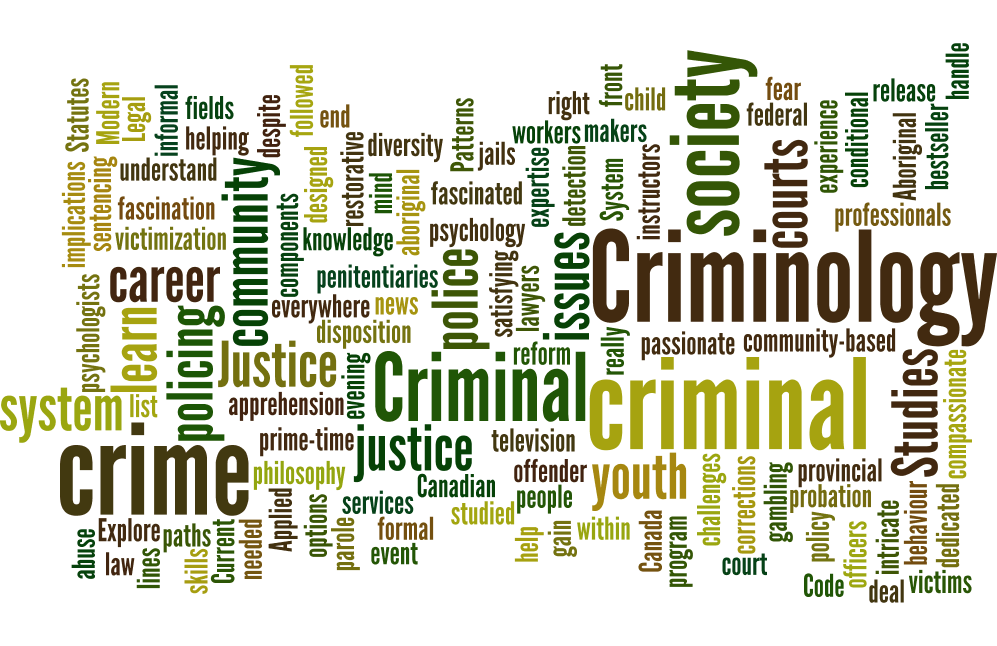
“Things you need to know about criminology”: A student perspective – Bonnie Middleton (2017-2020)

We are all living in very strange times, not sure when life will return to normal...but if you're thinking about studying criminology, here is some advice from those best placed to know!

The most important module to my understanding of criminology is: All of them! Every module contributes to your understanding of Criminology and all are different and enjoyable. Personally, my favourite module was Violence: From Domestic to Institutional in Year 3; this module ties together everything you know about Criminology; the reasons why we are subjective as criminologists and our ability to look beyond the scope of what we know.

The academic criminology book you must read:
Outsiders: Studies in the sociology of deviance (1963) by Howard Becker. Albeit a dated book, its ideas are relevant and relate to many criminological such as; how and why criminals are labelled and stigmatised; why are the youth demonised; why people reject the norms and values of society and become criminals in doing so.

The academic journal article you must read:
This is a hard one. Articles are great for discovering new ideas and methodologically testing theories. I would recommend reading: Arrigo, J. (2004). A Utilitarian Argument Against Torture, Interrogation of Terrorists. Science and Engineering Ethics. 10(3), pp. 543-572. This article poses many questions for a criminologist which enlightens you to think subjectively and challenge your own views; which is what Criminology is all about. From reading this article you will learn to think critically when faced with a challenging dilemma; the rights of a terrorist and how can the law can be tailored to fit the crime.

The criminology documentary you must watch:
Where do I begin? Louis Theroux and Stacey Dooley are both great journalists and documentary makers. If I had to pick one, I would recommend watching the BBC’s documentary on Grenfell If you watch this documentary you must consider; the government’s response; who is accountable; why are the residents of Grenfell still in temporary accommodation. These are the sorts of questions you should be asking as someone studying Criminology.

The most important criminologist you must read:
Familiarise yourself with the ideas of Lombroso, this will aid your understanding on how criminological theory and ideas have developed overtime through biological, psychological and sociological standpoints.

Something criminological that fascinates me:
Domestic abuse. I had done my dissertation on this as I have a great interest in male dominance and power over women, especially in intimate relationships. Gender plays a key role in this which when examined in depth, will change your view on gender paradigms.

The most surprising thing I know about criminology is: Criminality was believed by Lombroso to be inherited and that criminals possessed physical defects, criminality would be measured by the size and shape of particular body parts; this was later discredited. I can remember learning this in first year and it fascinated me.

The most important thing I've learnt from studying criminology is:
To not judge a book by its cover and to not take everything at face value. Do not be afraid to challenge other’s standpoints and beliefs. Thinking critically is the most important skill to have, search deeper into issues and apply your own thoughts and experiences.

The most pressing criminological problem facing society is:
Mass incarceration and reoffending rates. The UK is yet to move away from the ‘tough on crime’ approach favouring law and order and punishment. The penal system needs to be reformed to ensure offenders are rehabilitated to break the cycle of criminality; definitely educate yourself on political party’s manifesto’s and what they say about crime and justice before voting.

When family and friends ask, I tell them criminology is: I tell family and friends that criminology is such a broad field of study; we look at law, psychology, science, sociology, politics, penal systems, criminal justice organisations, media and much more. From this, you attain the ability to think critically and reflect, it can help you in many situations not just criminological issues. It is an incredibly insightful and enlightening field to study; it opens up many opportunities.
Share this:


Empower like Michelle

If you go to Freshers’, you will probably think this is for White people. But you’ve got to occupy your space. Better get used to occupying your space now because you’ll have to fight wherever you go, university or otherwise. Don’t let that deter you from your goals but more vitally, don’t let anybody make you feel bad about yourself. Don’t be silent in the discussions on slavery or the prison system. Use your voice, a sonicboom in the seminar. Don’t be mute to appease the White fragility of your peers, or even your lecturers and personal academic tutors.

You worked hard to get here, so occupy your space. Fill these spaces with jollof rice and jerk chicken and calypso and steel drums – the guts, determination and sheer willpower your parents and grandparents had when they arrived all those years ago. Don’t ever feel that you have to dilute your opinions for White consumption, or tell bitesize histories for the masses. In that Business class, talk loud about the Cheshire and Lancashire cotton mills written in the blood of African-American slaves.
Students, you might get lecturers that call you angry, who will have a hard time coming to terms with their own prejudice and White privilege. You will see that within a few weeks of studying. But keep your head down and think about graduation. Come and speak to me at the Students’ Union if you have any worries or just want to vent. Sometimes it’s just about finding solace in someone that gets it. Cry into that cheeky Nando’s. Buy that weave. Write a damn good assignment and prove all the naysayers wrong.
You will also find lecturers that are willing to listen to your experiences of racism and prejudice. They will implore you to write a dissertation that’s personal to you. You will find lecturers that give a shit, and will stand by you to the very end – who will say it’s absolutely fine to lace your dissertation with personal history – roots, rocks, and rebellion – academic staff that are activists in their own right (but will never openly admit it!)
Write about the politics of Black hair. Write about the Windrush Scandal or the legacy of colonialism on the Black body, or even Black men and mental health. Write every assignment for your aunties, who live in headwraps, talking in Twi and give you sound advice. Write in ruthless rebellion to the White Eurocentric reading of your degree, break the colour bar in style!
You will likely not relate to your course content. You will find it reflects the experiences of White people. No Afropean stories. No love for Sarah Forbes on History, or the Slave Trade cases of the 1700s on Law – the cases that helped forge the legal profession into what it is today. Or even the racial theories of the 18th and 19th century that we living in the remnants of – not Edward Long’s History of Jamaica nor the Black writers that top bestsellers lists. Write about a decolonised curriculum and inclusive course content.
When your lecturers make no allusion to American Slavery when you study the Industrial Revolution, give them the evilest evils you can muster. And challenge them on it. Leave them shook. Educate your “woke” White friends on why this is important. And when it comes to race, don’t feel you need to talk about race just because you’re the only non-White person in the class.
When you come to university, you will feel the urge to be someone that you are not just to fit in. BE YOU. You will try studenty things. JUST DO YOU. You’ll go out drinking, even if you don’t normally drink. You will join every society at Union Day and your emails will be chocka block. You’ll change your accent and “be friends” with people you dislike to conform to social norms. You will then admit you hate going out out and prefer a good book, or one of my poetry nights or just a chat with good people in your halls.
Tell yourself “Black is beautiful.” You know it, I know it. But there are people out there that’ll try to make you feel bad about your culture, as is life. Come back to campus in January with that Angela Davis afro, or be a dreadlock rastaman. Play cricket, like Jofra Archer or play football like Raheem Sterling. And, your hair is not an exotic specimen to gawked at and touched like a museum exhibit. Remember, say no. No means no. Always.

Black students, walk with pride. YOU DO YOU. Be united. You’ll see quickly that there are forces that are waiting for you to make a mistake. To fail. To point the finger. You’ll see quickly that failure is racialised and that failure in a White person is not as bad. You’ll see that we live in a society that doesn’t include you in its definition of beauty standards. So girls, when someone says “You’re pretty for a dark-skinned girl,” pay them no mind. Find beauty in your melanin. Find your tribe. Sisterhood is paramount.
When someone asks “Where are you from?” – it’s fine to say London or Milton Keynes or any British town or city. You do not need to entertain them when they ask “Where are you really from?” You can be British and African. You can be British and Caribbean. You belong here. You can just be British. And that is also fine. Previously, you’d not have found events that represent Black people or felt inclusive. But my philosophy is “Black History Month is every month, 365 days a year.” October, November forever. See me!
Listen, you might be made to feel conscious of your otherness and not everyone will get your “I Am Proud of My Blackness” mentality. Not everyone will understand the nuanced politics of Blackness at Northampton. That even in inaction, the supposed “woke” White people are still complicit in racism. And remember it isn’t YOUR JOB to explain what is racist and what is not. Do not take on that emotional labour. You are not the mouthpiece for Black people, and you don’t have to be.
You will have days where you will say “I hate this town, I want to go home – there is no culture and nothing to do” but Northampton can work for you. There are other communities of African and Caribbean here where you will be welcomed with rice and stew. You will find family and community.

And you are not alone. There are a lot of us here. Build communities. Join the resident ACS (African-Caribbean Society). Empower yourselves. Come to see me, as your Student Union representative. Look after each other. Be good to yourselves and one another – and above all, enjoy it.
Yours,
Tré Ventour
Vice President BME
Northampton Students’ Union
Share this:


When the Police takes to Tweeter HashTags to Seek ‘Justice’

https://twitter.com/PoliceNG/status/1159548411244371969?s=20)
I am tempted to end this blog in one sentence with the famous Disney lyrics, “disaster is in the air” but this may do no justice to the entry as it lacks a contextual background. So last week, Nigerian Twitter was agog with numerous tweets, retweets, comments, and reactions following the news that soldiers of the Nigerian Army had allegedly killed one civilian and three police personnel in the line of duty. A brief summary of the case is that the killed police personnel had arrested an alleged notorious and ‘wanted’ kidnaper and were transporting him to a command headquarters when they ran into a military checkpoint. Soldiers at the checkpoint allegedly opened fire at close range, killed the police who were said to have attempted identifying themselves, and freed the handcuffed ‘kidnapper.’
In a swift reaction, a Joint Investigation Panel comprised of the Police and the Army was constituted to investigate the incident. Notwithstanding this, the Police took to their Twitter handle @PoliceNG calling out for justice and expressing dissatisfaction and concerns in what metamorphosed into series of threads and hashtags – #WhereIsEspiritDCorp and #ProvideAnswersNigerianArmy. Ordinarily, this should have aroused and generated wide condemnation and national mourning, but, the comments, tweets and reactions on twitter suggests otherwise. While Nigerians expressed sympathy to the victims of the unfortunate incident, they also took to the social media platform to unravel their anger with many unleashing unsympathetic words and re-stating their distrust in the Police. In fact, it was the strong opinion of many that the incident was just a taste of their medicine as they often infringe on the rights of civilians daily, and are notoriously stubborn and predatory.
Certainly, this issue has some criminological relevance and one is that it brings to light the widely debated conversation on the appropriateness and the potency of deploying the military in society for law enforcement duties which they are generally not trained to do. Hence, this evokes numerous challenges including the tendency for it to make civilians loathe to interact with the military. I have previously argued that the internal use of the Nigerian military in law enforcement duties has exacerbated rather than ameliorated insecurity in several parts of the country. As with this instance, this is due to the penchant of the military to use force, the unprofessional conduct of personnel, and a weak system of civil control of the military to hold personnel accountable for their actions.
Similarly, this issue has also raised concerns on the coordination of the security forces and the need for an active operational command which shares security information with all the agencies involved in internal security. However, the reality is that interagency feud among the numerous Nigerian security agencies remains a worrying concern that not only undermine, but hinders the likelihood for an effective coordination of security activities.
Another angle to the conversation is that the social media provides a potent weapon for citizens to compel response and actions from state authorities – including demanding for justice. However, when the police is crippled and seemingly unable to ensure the prosecution of rights violations and extrajudicial killings, and they resort to twitter threads and hashtags to call out for justice, overhauling the security architecture is extremely necessary.
Share this:


The struggle is real

© Jonathan McHugh
Stephanie is a BA Criminology graduate of 2019 and was motivated to write this blog through the experience of her own dissertation.
Last year was a very important time for me, during my second year of studying Criminology I began doing a work placement with Race Act 40, which was an oral history project to celebrate 40 years of the Race Relations Act 1974. The interviews that were conducted during my placement allowed me to get a variety of in-depth stories about racial inequalities of Afro-Caribbean migration settlers in the UK. During my time with the Race Act 40 project it became clear to me that the people who had volunteered their stories had witnessed a long line of injustices from not only individuals within society, but also institutions that makeup the ‘moral fabric’ within society. When exploring whether they have seen changes post and pre-Race Relations they insisted that although the individual within society treated them better and accepted them post-Race relations, to an extent there is a long way to go to improve the hostile relationships that has been formed with politicians and police.
The notion of hostility between politicians and the Afro-Caribbean community was reinforced, as the UK was going through the Windrush scandal which affected the core of every Afro-Caribbean household within the UK. This was extremely important for me as both paternal and maternal grandparents were first generation Windrush settlers. During the scandal my father became extremely anxious and the ramifications of the Windrush scandal hit home when some of his friends that came to the UK in 1961, the same time as he did, were detained and deported on the grounds of them being ‘illegals’. The UK Government used their ‘Hostile Environment’ policy to reintroduce Section 3 paragraph 8 of the Immigration Act 1971, which puts burden of proof on anyone that is challenged about their legal status in the UK’.
The UK government was ‘legally’ able to deport Caribbean settlers, as many of them did not have a British passport and could not prove their legal right to be in the UK and the Home Office could not help them prove their legal rights because all archival documents had been destroyed. This was a hard pill to swallow, as the United Kingdom documents and preserves all areas of history yet, overnight, the memory of my family’s journey to the UK was removed from the National Archives, without any explanation or reasoning. The anxiety that my father felt quickly spread over my whole family and while I wanted to scream and kick down doors demanding answers, I used my family’s history and the experiences of other Black people under British colonial rule as the basis for my dissertation. The hostility that they faced stepping off the Windrush echoed similar hostility they were facing in 2018, the fact that the British government had started deporting people who were invited into the country as commonwealth workers to build a country that had been torn apart as a corollary of war was a slap in the face.
Under Winston Churchill’s government, officials were employed to research Black communities to prove they were disproportionately criminal as a strategy to legally remove them from the UK and although they did not have any evidence to prove this notion the government did not apologize for the distasteful and racist treatment they demonstrated. It is hard to convince Black people in 2019 that they are not targets of poor similar treatment when they have been criminalised again and documents have been destroyed to exonerate them from criminality.
A final thought:
I have outlined the reasons why this topic has been important to me and my advice to any Criminology student who is going to be writing a dissertation is, to find a topic that is important and relevant to you, if you are passionate about a topic it will shine through in your research.
Share this:


Teaching Criminology….Cui Bono?

Following several conversations with students and reflecting on another year of studying it got me thinking, what is or can be the quintessentially criminological issue that we can impart onto them? It is always interesting to hear from others how your ideas are transferred into their notes, phrases and general understanding. I think that there are a few things that are becoming clear early on, like the usual amazement of those outside the discipline who hear one studying criminology; a reverence as if the person reading the subject is on a par with those committing the deed. There is a natural curiosity to crime in all walks of life and those seen closer to the topic, attract part of that curiosity.
There are however some more profound issues relating to criminology that are neither clear nor so straightforward. The discipline is an amalgamation of thoughts and theories making it incredibly difficult to pinpoint a generic appreciation for the discipline. Some of us like the social discourses relating to social injustice, a matter traditionally closer to sociology or social work, while others ponder the conceptual dynamics of human behaviour, mostly addressed in philosophical debates, then there are those who find the individual characteristics and personality socio-dynamic dimensions intriguing. These distinct impressions will not only inform our understanding but will also provide each of us with a perspective, a way of understanding criminology at a granular level.
In criminological discourses, informed by law, I used to pose the old Latin question: Cui bono (who benefits)? A question posed by the old legal experts to trace liability and responsibility of the act committed. Obviously in their view crime is a choice committed freely by a deviant mind. But then I was never a legal expert, so my take on the old question was rather subversive. The question of who benefits can potentially lay the question of responsibility wide open, if it is to be looked from a social harm perspective. The original question was incredibly precise to identify a person for the benefit of a trial. That’s the old criminal evidence track.
Taking this question outside the forensic setting and suddenly this becomes quite a loaded query that can unpack different responses. Cui bono? Why are we talking about drug abuse as a crime and not about tax avoidance? Why is the first regarded a crime, whilst the second is simply frowned upon? Cui bono? When we criminalise the movement of people whose undocumented by we have very little information for those who have procured numerous properties in the country? If our objection is on transparency of movement then there is clearly a difference of how this is addressed. Cui bono? When we identify violence at interpersonal level and we have the mechanisms to suppress it, but we can engage in state violence against another state without applying the same mechanisms? If our objection is the use of violence, this is something that needs to be addressed regardless of the situation, but it is not. Ironically some of the state violence, may contribute to the movement of people, may contribute to the exploitation of population and to the use of substances of those who returned home broken from a violence they embraced.
Our criminology is merely informed from our perspective and it is my perspective that led me to those thoughts. I am very sure that another colleague would have been making a series of different connections when asked “Cui Bono?”
Share this:


Majority Verdicts and Reasonable Doubt

Recently I attended an Inside Justice Live Crime event hosted by Anglia Law School at Anglia Ruskin University. The last speaker for the evening was Kevin Lane who is trying to have his wrongful conviction overturned, during his discussion he mentioned that he was found guilty of murder by a 10-2 majority verdict. It came as quite a shock to me to hear that majority verdicts are used for murder charges in England.
In 1994 Robert Magill was shot dead by a hitman while walking his dog in Hertfordshire, two men fled the scene in a BMW car. In 1995 Lane and a co-accused were charged with the murder of Magill. The prosecution alleged that Lane had received payment for this murder and submitted that fingerprints were found in bin liners in the car. Police were unable to link Lane to the scene of the crime, were unable to prove he had received payment, and he has always maintained his innocence.
There were a number of limitations and concerns in this case – the murder weapon was never recovered, two prime suspects who were brought to the police’s attention soon after the murder were not properly investigated and were later found to have an inappropriate relationship with the investigating police officer, and there were on going disclosure problems. Further, in 2002 the investigating officer was sent to prison for four years of conspiracy to steal £160,000 from the Hertfordshire Police and misconduct in a public office. (This is a very brief summary of a complicated case).
A majority verdict is used when the jury cannot reach a unanimous verdict and where the jury consists of usually 12 jurors and at least 10 or 11 agree (depending on the jurisdiction) – under certain conditions the judge is able to accept the jury’s verdict. The provision of a majority verdict is generally used when a prescribed period of time has elapsed, and the judge is satisfied that the jury are unlikely to reach a unanimous verdict after further deliberation. Majority verdicts have been used in England since 1974 and were originally introduced to prevent the intimidation or bribing of jurors.
While I am aware of majority verdicts, as they are used in Queensland, Australia (where I completed my legal education). Majority verdicts cannot be used for murder trials, for an offence which has mandatory life imprisonment as a penalty, and Commonwealth offences. The overall concern with majority verdicts is that if the jury is unable to reach a unanimous decision then they cannot be said to have reached a decision ‘beyond a reasonable doubt’ which is the standard of proof for criminal matters, and as a consequence have demonstrated reasonable doubt.
Unanimous jury verdicts have been part of the common law since the 14thcentury. Prior to 1866, if a jury could not reach an agreement they could be ‘carried around in a wagon with the court without meat or drink, fire or candle until they were starved or frozen into agreement.’ We have obviously come a long way since the days of locking jurors up and separating them from their family and friends until they reached a decision.
Using unanimous verdicts is argued to reduce the risk of convicting an innocent person, that unanimity is a fundamental feature of a jury trial, it leads to better deliberation, and that disagreement in a jury is not unreasonable. When considering the issue from the perspective of the accused, majority verdicts place them at a great disadvantage when one considers that the prosecution has much more resources. There are already a number of contributors to wrongful convictions which the accused needs to contest with, and the fact that appeals are very difficult.
It can be argued there are benefits for majority verdicts – they reduce the instance of a hung jury (where the accused is neither acquitted or convicted) and the potential for a retrial (and the economic cost associated for a criminal justice system which is already overloaded). Majority verdicts are said to overcome problems with ‘rogue’ jurors, bribery and intimidation. The use of majority verdicts allows there to be finality in the case for the victim/s, the accused, the family and friend of the victim/s and accused, and the community.
Personally, I believe that in the interest of justice majority verdicts should not be used in serious criminal cases – such as murder and offences which carry mandatory life imprisonment penalty. These cases are much too serious and if reasonable doubt is present then this should be recognised. In Kevin Lane’s case he would not have been convicted, served 18 years in prison, and still be trying to overturn his conviction.
Further reading
Cowdery, N. (2007). Majority jury verdicts. Reform Issue. 90, 18-19.
Garrett, B.L. & Neufeld, P.J. (2009). Invalid forensic science testimony and wrongful convictions. Virginia Law Review. 95(1), 1-97.
Gray, A. (2009). A guarantee right to trial by jury at state level? Australian Journal of Human Rights. 15(1), 97-125.
Roberts, S. & Weathered, L. (2009). Assisting the factually innocent: The contradictions and compatibility of Innocence Projects and the Criminal Cases Review Commission. Oxford Journal of Legal Studies. 29(1), 43-70.
Sankoff, P. (2006). Majority jury verdicts and the Charter of Rights and Freedoms. UBC Law Review. 39(2), 333-369.
Share this:


The roots of criminology; the past in the service of the future;

In a number of blog posts colleagues and myself (New Beginnings, Modern University or New University? Waterside: What an exciting time to be a student, Park Life, The ever rolling stream rolls on), we talked about the move to a new campus and the pedagogies it will develop for staff and students. Despite being in one of the newest campuses in the country, we also deliver some of our course content in the Sessions House. This is one of the oldest and most historic buildings in town. Sometimes with students we leave the modern to take a plunge in history in a matter of hours. Traditionally the court has been used in education primarily for mooting in the study of law or for reenactment for humanities. On this occasion, criminology occupies the space for learning enhancement that shall go beyond these roles.
The Sessions House is the old court in the centre of Northampton, built 1676 following the great fire of Northampton in 1675. The building was the seat of justice for the town, where the public heard unspeakable crimes from matricide to witchcraft. Justice in the 17th century appear as a drama to be played in public, where all could hear the details of those wicked people, to be judged. Once condemned, their execution at the gallows at the back of the court completed the spectacle of justice. In criminology discourse, at the time this building was founded, Locke was writing about toleration and the constrains of earthy judges. The building for the town became the embodiment of justice and the representation of fairness. How can criminology not be part of this legacy?
There were some of the reasons why we have made this connection with the past but sometimes these connections may not be so apparent or clear. It was in one of those sessions that I began to think of the importance of what we do. This is not just a space; it is a connection to the past that contains part of the history of what we now recognise as criminology. The witch trials of Northampton, among other lessons they can demonstrate, show a society suspicious of those women who are visible. Something that four centuries after we still struggle with, if we were to observe for example the #metoo movement. Furthermore, from the historic trials on those who murdered their partners we can now gain a new understanding, in a room full of students, instead of judges debating the merits of punishment and the boundaries of sentencing.
These are some of the reasons that will take this historic building forward and project it forward reclaiming it for what it was intended to be. A courthouse is a place of arbitration and debate. In the world of pedagogy knowledge is constant and ever evolving but knowing one’s roots allows the exploration of the subject to be anchored in a way that one can identify how debates and issues evolve in the discipline. Academic work can be solitary work, long hours of reading and assignment preparation, but it can also be demonstrative. In this case we a group (or maybe a gang) of criminologists explore how justice and penal policy changes so sitting at the green leather seats of courtroom, whilst tapping notes on a tablet. We are delighted to reclaim this space so that the criminologists of the future to figure out many ethical dilemmas some of whom once may have occupied the mind of the bench and formed legal precedent. History has a lot to teach us and we can project this into the future as new theoretical conventions are to emerge.
Locke J, (1689), A letter Concerning Toleration, assessed 01/11/18 https://en.wikisource.org/wiki/A_Letter_Concerning_Toleration
Share this:


Student support

I recently read Melanie Reynolds’s article in The Guardian ‘Working-class lecturers should come out of the closet,’ and it resonated with me. I was the first generation in my family to go to university and it was difficult. I grew up in a poor socio-economic position, received government allowances, there was a stigma to this, and unspoken expectation that you kept this hidden. When I turned 18 I moved out of home and went to university, from the start I was supporting myself. I worked in a pizza shop, a convenience store, a sandwich shop, and a call centre. I lived pay day to pay day. Starting university felt like learning a new language to me, it was a shock.
I remember one of my first assignments I handed in. I had to print it on lined foolscap paper because I didn’t have any printer paper and I couldn’t afford to buy any. It is all well and good to tell a student to be prepared – trust me I would’ve been if I had the money. This meant I couldn’t afford to print at university either (before the days of online submission!). But I also didn’t know how to print at the university at that stage and I didn’t want to let on to anyone that I didn’t know how, I already felt like I stood out. It seemed that everyone around me had this innate understanding of how everything worked. It seemed like a simple thing, but it was hard to ask for help.
Another time I lost my student card on the train and when I got on the bus to go to university the bus driver asked for it. He stayed at the stop while I literally went through every compartment in my bag looking for it, with everyone watching it just brought feelings of shame. I had to pay an adult fare in addition to the three-zone student fare I had already paid, and those couple of dollars extra made a big difference to me, considering I knew I would also need to replace my student card.
I didn’t feel like I belonged, I didn’t know anyone at university, I didn’t know what services were available, even if I did I would have felt like I was wasting their time – taking away time for ‘real’ students. It was difficult to watch other students be involved in activities and wonder how they found the time and the money. Being in law school made me feel like I didn’t dress right, didn’t talk properly, that I was not connected to the legal profession because no one in my family was a lawyer or judge, I was an impostor. It was very isolating.
What can I say to help – it will get better? That you’ll get over the feelings of impostor syndrome? It does get a little better, for me it took time, realising that I was not alone in these feelings, that many students had the same questions, and to build the confidence to speak up. There was a lot of pressure to succeed and this is something you need to manage.
I try to be open about my experiences with my students so that they may feel more comfortable approaching me with their issues. To me there are no stupid questions. One of my most disliked words is ‘just’ – ‘well you just do this’ the expectation that you’ll ‘just’ know. I don’t expect my students to ‘just’ know. When I ask students to tell me when they are having difficulties I truly mean it. This is my job and it is the university’s job to support you. Starting university can be overwhelming. So, remember students ALWAYS ask me for help, email, phone or in-person.
What can we do as educators? Universities and their staff need to be pro-active in connecting with students and providing assistance – not ‘do you need help?’ but ‘what can I do to help?’ We need to seek to bridge the gap and bring equity to our students, not just equality.
For all students there are support services available to you at the University of Northampton, please take advantage of them.

 Thoughts from the criminology team