
Home » Articles posted by Paula Bowles (Page 6)
Author Archives: Paula Bowles

How literature failed me as a black student

My name is Francine Bitalo, I am 21 years old and a Criminology undergraduate at the University of Northampton. Coming from a black African background I have always had a strong interest in the Criminal Justice System and its treatment towards different groups in society.
My dissertation was based on the impact of police practices such as stop and search on young black men and their families. Whilst statistics present the alarming racial disproportionately which exist in many areas in the criminal justice system, it fails to portray the long-lasting effects it has had on Black families. For example, the daily harassment and differential treatment subjected to young Black men has forced black families to reinvent themselves to conform to institutional racism. Coming from a Black family myself and having male family member, the findings in my dissertation quickly became personal to me, as I could constantly relate them to…
View original post 650 more words
Share this:


Please don’t clap or cheer

In an uncomfortable irony, my regular blog entry has fallen on the 8 May 2020, the seventy-fifth anniversary of the end of World War 2 in Europe. I say uncomfortable because I find this kind of commemoration particularly challenging to comprehend, given my pacifist tendencies. I’m therefore going to take a rather circuitous route through this entry.
On the 20 March 2020 I wrote the first Thoughts from the Criminology team blog entry (focused on Covid-19), just a few hours after the University had moved to virtual working. Since then the team has tackled the situation in a variety of different ways. In that I detailed my feelings and observations of life, as we knew it, suddenly coming to abrupt halt. Since then we have had 7 weeks of lockdown and it is worth taking stock of where we are currently.
At present the UK has recorded over 30,000 deaths attributed to the virus. These figures are by necessity inaccurate, the situation has been moving extremely fast. Furthermore, it is incredibly challenging to attribute the case of death, particularly in cases where there is no prior diagnosis of Covid-19. There has been, and remains a passionate discourse surrounding testing (or the lack of it), the supplies of Personal Protective Equipment (or the lack of it) and the government’s response (or lack of) to the pandemic. Throughout there has been growing awareness of disparity, discrimination and disproportionality. It is clear that we are not in all this together and that some people, some groups, some communities are bearing the brunt of the current crisis.
Having studied institutional violence for many years, it is evident that the current pandemic has shown a spotlight on inequality, austerity and victimisation. The role of institutions has been thrown into sharp relief, with their many failings in full view of anyone who cared to look. In 1942, Beveridge was clear that his “five giant evils” could have been addressed, prior to World War 2, yet in the twenty-first century we have been told these are insurmountable. Suddenly, in the Spring of 2020, we find that councils can house the homeless, that hungry children can be fed, that money can be found to ensure that those same children have access to educational resources. We also find that funds can be located to build emergency hospitals and pay staff to work there and across all other NHS sites.
Alongside this new-found largesse, we find NHS staff talking about the violences they face. The violence of being unable to access the equipment they need to do their jobs, the violence of being deprived of regular breaks, the violence of racism, which many staff face both internally and externally. We hear similar tales from care workers, supermarkets workers, delivery drivers, the list goes on. Yet we are told by the government that we are all in this together. This we are told, is demonstrated by gathering on doorsteps to clap the NHS and carers. It can be compared with the effort of those during World War II, or so we are told. If we just invoke that “Blitz Spirit” “We’ll Meet Again” at the “White Cliffs of Dover”.
However, such exhortations come cheap, it costs nothing in time, or money, to clap, or to sing war time songs. To do so puts a veneer of respectability and hides the violent injustices inherent in UK society and the government which leads it. It disguises and obfuscates the data that shows graphic racial and social economic disparity in the death toll. Similarly, it avoids discussion of the role that different individuals, groups and communities play in working to combat this horrible virus. As a society we have quickly forgotten discussions around deserving/undeserving poor, the “hostile environment” and those deemed “low-skilled”. It camouflages the millions of people who are terrified of unemployment, poverty and all of the other injustices inherent within such statuses. It hides the fact that these narratives are white and male and generally horribly jingoistic by ignoring the contribution of anyone, outside of that narrow definition, to WWII and to the current pandemic. It is trite and demonstrates an indifference to human suffering across generations.
Let’s stop focusing on the cheap, the obvious and the trite and instead, once this is over, treat people (all people) with respect. Pay decent wages, enable access to good quality nutrition, education, health care, welfare and all of the other necessities for a good life. And by all means commemorate the anniversary of whatever you like, but do not celebrate war, the biggest violence of all, without which many more lives would be improved.
Share this:


New Heroes for the Twenty-First Century? (Clue: they don’t wear khaki)
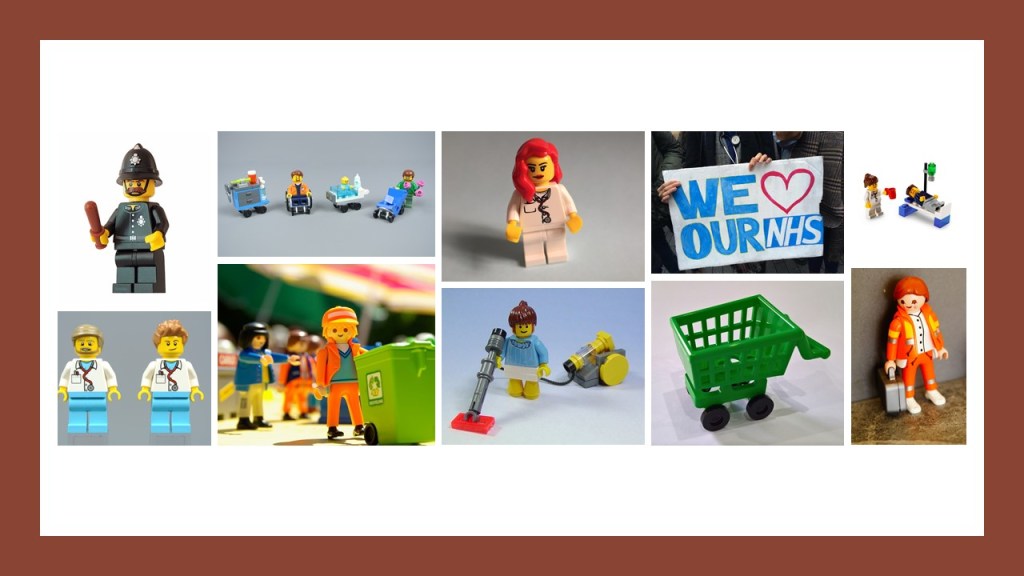
I have blogged before on the way in which society seems to choose what to remember and what to forget. Similarly, I have mused on remembrance, the poppy and the increasing militarisation inherent in paying homage to Britain’s war generation. In the current crisis, despite the despair, I sense a change in our understanding of the term heroism, which I will explore further below.
In the 20th century there was concerted focus on idolising the military man and his function within British society. This is unsurprising, it is not for nothing that Camus describes this period as ‘the century of fear’ (1946/2007: 27). This period was, and remains remarkable, for the two world wars, as well as a variety of other conflicts, within which Britain was involved (along with many other nations). The two world wars provide foundations for the way in which the twentieth-century is discussed and understood, with substantial periods of time often delineated into the short-hand of pre-war, inter-war and post-war.
Although only twenty years in, it is clear that the twenty-first century, cannot be described as peaceful. Rather it has continued with the same approach to international relations, often argued to be immoral, if not illegal, of using military violence to obtain, what Britain views as, reasonable and tangible gains. Whether we focus on Afghanistan, Iran, Iran, Libya, Sierra Leone or Syria, British military might is deemed appropriate, proportionate and necessary (as least in Britain). Certainly, a number of authors have already dubbed our current century, as being in a perpetual, ‘war without end’ (cf. McAlister, 2002, Tertrais, 2004, Schwartz, 2008).
However, in 2020 the world is facing a far more challenging enemy, one which threatens us all, Coronovirus, or as it is more scientifically known, Covid-19. More importantly this is an enemy that cannot be shot, exploded, tortured or conquered in the traditional, well-worn ways of warfare. Instead, this crisis calls for a different kind of hero, one who does not have recourse to an arsenal of increasingly, terrifying weapons.
As with the war, there are two distinctly different experiences, those on the front line and those who are not. Each group has a role to play, for some they will take their lives in their hands, on a daily basis, to tend to the sick, to deliver supplies to organisations, communities and individuals, to maintain vital services. This group will see things, again and again, that are upsetting, that will test their resolve, their empathy, their patience, good-humour and their confidence. For others, their role is to stay out of the way, to stay indoors, to ensure that the disease does not spread further. Each group will have their own tales to tell to each other, as well as to the generations which will follow.

Once this is all over, once we emerge from our enforced isolation, we will have a return to some kind of “normality”, yet this experience is unlikely to disappear from our individual and collective memories. As our forebears, had the war experience to shape their lives, and that of those who followed them (in many unexpected ways), so shall we have a similar defining moment. Whilst the hero of the twentieth century was indisputably a white, straight, able bodied, (nominally) Christian man dressed in khaki, the hero of the twenty-first century will appear in a variety of diverse guises. From the supermarket worker to the school teacher to the carer to the paramedic to the police officer to the undertakers to the cleaners to the small business owners to the scientists, to the nurses, paramedics, doctors, surgeons and all the others, each are serving on the front line of the fight against coronavirus. They are women, men, Black, Asian, white, Muslim, Buddhist, Sikh, Christian and atheist, they are young and old, they are experienced professionals and those just starting out on their working lives, they are well-renumerated, they are poorly paid, they have fears and anxieties, families, friends, and those that love and fear for their safety.
These people have little in common but their humanity and they are redefining heroism second by second, minute by minute, hour by hour, day by day.

References
Calhoun, Laurie, (2002), ‘The Phenomenology of Paid Killing,’ The International Journal of Human Rights, 6, 1: 1-18
Camus, Albert, (1946/2007), Neither Victims Nor Executioners: An Ethic Superior to Murder, tr. from the French by Dwight Macdonald, (Eugene: Wipf and Stock Publishers)
McAlister, Melani, (2002), ‘A Cultural History of the War without End,’ The Journal of American History, 89, 2: 439-455
Tertrais, Bruno, (2004), War Without End, (New York: The New Press)
Schwartz, Michael, (2008), War Without End: The Iraq Debacle in Context, (Chicago: Haymarket Books)
Share this:

“My Favourite Things”: Paula

My favourite TV show - I am not really one for television, but I recently stumbled upon a 1960's series, called The Human Jungle, lots of criminological and psychological insight, which I adore. I also absolutely loved Gentleman Jack (broadcast on BBC1 last summer)

My favourite place to go - Wherever I go the first thing I look for are art galleries, so I would have to say Tate Modern. Always something new and thought provoking, alongside the familiar and oft visited treasures

My favourite city - I love cities and my favourite, above all others, is the place I was born, London. The vibrancy, the people, the places, the atmosphere....need I say more?

My favourite thing to do in my free time - Read, read, read, read, read, read, read, read......

My favourite athlete/sports personality - This is tricky, sport isn't really my thing. However, I do have a secret penchant for boxing,  which isn't brilliant for someone who identifies as pacifist, so I'll focus on feminism and pick Nicola Adams

My favourite actor - (Getting easier) Dirk Bogarde

My favourite author - (Too easy) Agatha Christie

My favourite drink - Day or night? If the former, tea....

My favourite food - Chocolate, always

My favourite place to eat - So many to choose from, but provided I am surrounded by people I love, with good food and drink, I'm happy

I like people who - read!

I don’t like it when people - claim to be gender/colour blind....sorry mate, check your privilege

My favourite book - (oooh very, very tricky) Virginia Woolf's A Room of One's Own primarily because of the profound effect it had and continues to have on my understanding

My favourite book character - (Easy, peasy) Hercule Poirot

My favourite film - (Despite my inner feminist screaming nooooooooo) The original Alfie with its wonderful swinging sixties' vibe

My favourite poem - (Decisions, decisions, so many wonderful poems to choose from) I'll plump for Hollie McNish's Mathematics

My favourite artist/band - The Beatles

My favourite song - (Given the previous answer) it has to be Dear Prudence

My favourite art - I love art, but hands down Picasso's Guernica is my favourite piece. To stand in front of that huge painting and consider the horror of war is profound

My favourite person from history - The pacifist, suffragette Sylvia Pankhurst, a beautiful example of the necessity to be confident in your own ethics and principles

Share this:


Never fear…. Spring is almost here

https://shop.royalacademy.org.uk/david-hockney-arrival-of-spring-poster
There is no doubt, we are living in a time of crisis. Everywhere we look there are signs of disorder, disruption and chaos, impinging on our real and virtual lives. You can see it in the faces of family, friends, colleagues, the old and the young from children to pensioners, and everyone in between. There is nothing else on anyone’s lips beyond what they’ve heard, what they’ve seen, how they’ve prepared, or haven’t for this human disaster. Scientific words like Covid-19, Coronavirus, criminological words such as isolation, criminalisation and newly minted words; social distancing are being pushed into conversations. These appear alongside the more prosaic questions, which shops have bread? toilet rolls? milk? eggs? Is this open, is that open, can I get there, am I allowed to go out?
Over the past week I have seen this fear develop, evolve and spread. It threatens to swallow us all up in our panic. Many people, myself included, are desperately trying to maintain the everyday, the mundane, some routine, some semblance of normality. My institution is trying to be supportive, lots of extra email, how to move your teaching online, what advice to give students, how to look after your mental and physical health and that of others, at a time like this. All of this advice is well-intentioned and aims to alleviate fear, after all scientia potentia est, or so we are told.
The problem with trying to recreate our real lives in a virtual environment is far more profound than simply changing our modes of operation. When people are worried, frightened and saddened, no amount of pretending that it is “business as usual” will distract them from the everyday lived experience. We can pretend, but when you are worried about your own health, that of your family, when you don’t know where you are going to be able to get the basics of life from, and for many, how on earth you will be able to pay for it with limited or no income, everything else pales into insignificance.
So far we have seen so much evidence of privilege: those that aren’t worried because they’re healthy, those that stockpile food and other essential products, because they can afford to and those that isolate themselves in the lap of luxury, because they have access to money, property and contacts. All of which feeds the fear by the second, minute and hour. Competing with this negativity are the stories around kindness, the narratives from the NHS, the police, carers, shop workers, the list goes on showing that the human spirit is still burning strong, that we have a choice about our behaviour, our thoughts and our feelings. That we can make a difference, if only we want to.
This week has felt like a nightmare, so dark, so stressed, the walls are closing in on all of us, forcing us into confinement. We look out of the window and nobody is moving outside. It has all the ingredients of my favourite genre, dystopic fiction, but this time we’re all fully immersed and we have no idea how the novel ends. How many will die, how many will find their finances, relationships, employment, education disrupted and/or destroyed?
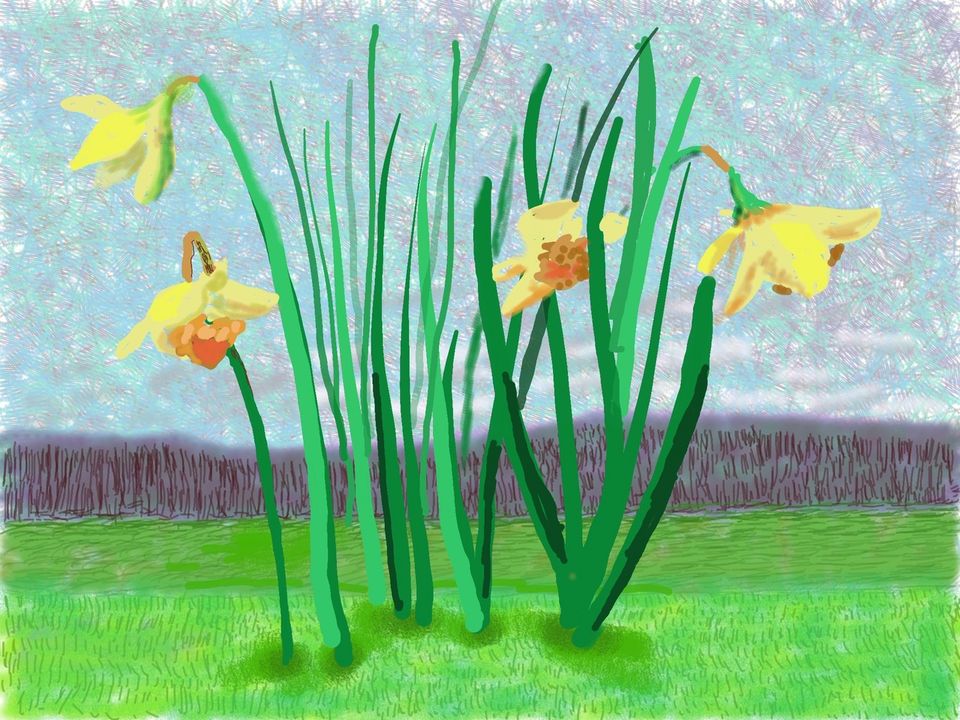
That changed for me yesterday, when I stumbled upon a message from the artist David Hockney. The message was incredibly simple ‘Do remember they can’t cancel the spring’. I should declare in advance, I am a little biased, he’s one of my favourite artists, but with Hockney’s simple statement he touched on a profound truth. We are humans, infinitely resourceful, extremely adaptable, incredibly social.
Look after yourselves and each other, if not face to face, then virtually. Check in, touch base and create a life line for each other. But also remember to take some time away from the screens, look out of the window and remember the world is still a beautiful place, filled with many wonders, including humankind.
https://www.theartnewspaper.com/comment/a-message-from-david-hockney-do-remember-they-can-t-cancel-the-spring?fbclid=IwAR2iA8FWDHFu3fBQ067A7Hwm187IRfGVHcZf18p3hQzXJI8od_GGKQbUsQU
Share this:


“TW3” in Criminology
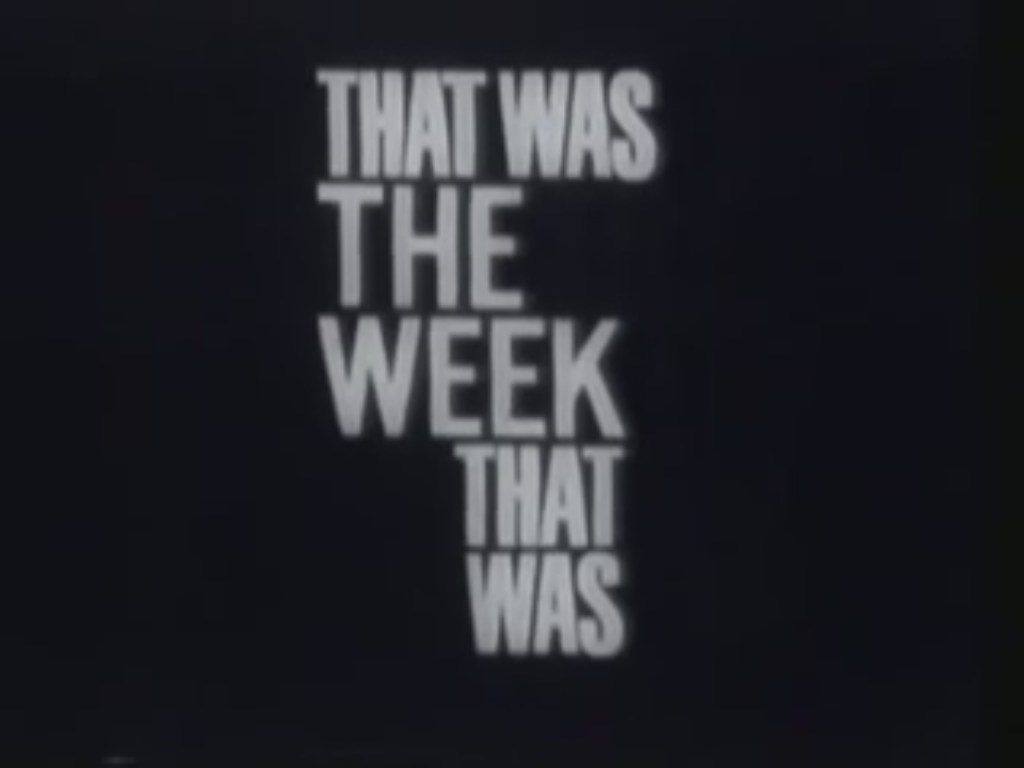
In the 1960s, or so I am told, there was a very popular weekly television programme called That Was The Week That Was, informally known as TW3. This satirical programme reflected on events of the week that had just gone, through commentary, comedy and music. Although the programme ended before I was born, it’s always struck me as a nice way to end the week and I plan to (very loosely) follow that idea here.
This week was particularly hectic in Criminology, here are just some of the highlights. On Monday, I was interviewed by a college student for their journalism project, a rather surreal experience, after all, ‘Who cares what I think?’
On Tuesday, @manosdaskalou and I, together with a group of enthusiastic third years, visited the Supreme Court in London. This trip enabled a discussion which sought to unpack the issue of diversity (or rather the lack of) within justice. Students and staff discussed a variety of ideas to work out why so many white men are at the heart of justice decisions. A difficult challenge at the best of times but given a new and urgent impetus when sat in a courtroom. It is difficult, if not impossible, to remain objective and impartial when confronted with the evidence of 12 Supreme Judges, only two of which are women, and all are white. Arguments around the supposed representativeness of justice, falter when the evidence is so very stark. Furthermore, with the educational information provided by our tour guide, it becomes obvious that there are many barriers for those who are neither white nor male to make their way through the legal ranks.

Wednesday saw the culmination of Beyond Justice, a module focused on social justice and taught entirely in prison. As in previous years, we have a small ceremony with certificate presentation for all students. This involves quite a cast, including various dignitaries, as well as all the students and their friends and family. This is always a bittersweet event, part celebration, part goodbye. Over the months, the prison classroom leaves its oppressive carceral environment behind, instead providing an intense and profound tight-knit learning community. No doubt @manosdaskalou and I will return to the prison, but that tight-knit community has now dissipated in time and space.

On Thursday, a similarly bitter-sweet experience was my last focused session this year on CRI3003 Violence: From Domestic to Institutional. Since October, the class has discussed many different topics relating to institutional violence focused on different cases including the deaths of Victoria Climbié, Blair Peach, Jean Charles de Menezes, as well as the horror of Grenfell. We have welcomed guest speakers from social work, policing and the fire service. Discussions have been mature, informed and extremely sensitive and again a real sense of a learning community has ensued. It’s also been my first experience of teaching an all-female cohort which has informed the discussion in a variety of meaningful ways. Although I haven’t abandoned the class, colleagues @manosdaskalou and @jesjames50 will take the reins for a while and focus on exploring interpersonal violence. I’ll be back before the end of the academic year so we can reflect together on our understanding of the complexity of violence.
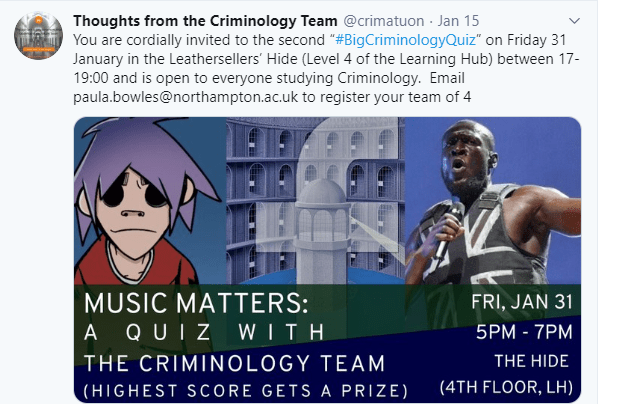
Finally, Friday saw the second ever #BigCriminologyQuiz and the first of the new decade. At the end of the first one, the participants requested that the next one be based on criminology and music. Challenge completed with help from @manosdaskalou, @treventoursu, @svr2727, @5teveh and @jesjames50. This week’s teams have requested a film/tv theme for the next quiz so we’ll definitely have our work cut out! But it’s amazing to see how much criminological knowledge can be shared, even when you’re eating snacks and laughing. [i]
So, what can I take from my criminological week:
- Some of the best criminological discussions happen when people are relaxed
- Getting out of the classroom enables and empowers different voices to be heard
- Getting out of the classroom allows people to focus on each and share their knowledge, recognising that
- A classroom is not four walls within a university, but can be anywhere (a coach, a courtroom a prison, or even the pub!)
- A new environment and a new experience opens the way for discord and dissent, always a necessity for profound discussion within Criminology
- When you open your eyes and your mind you start to see the world very differently
- It is possible (if you try very hard) to ignore the reality of Friday 31 January 23:00 ☹
- It is possible to be an academic, tour guide, mistress of ceremonies and quiz mistress, all in the same week!
Here’s looking forward to next week….not least Thursday’s Changemaker Awards where I seem to have scored a nomination with my #PartnerinCriminology @manosdaskalou.
[i] The first quiz was won by a team made up of 1st and 2nd years. This week’s quiz was won by a group of third years. The next promises to be a battle royale 😊 These quizzes have exposed, just how competitive criminologists can be….
Share this:


“Back to the future”: 2019 A Year of Violence?

When I was young, 2020 seemed like the stuff of science fiction. Programmes like Tomorrow’s World held the promise of a future full of leisure, with technology taking the strain in all aspects of human life. Now we’re in 2020 it appears we have plenty of technology, but whether it adds or subtracts from the lived human experience, is still very much up for discussion. Certainly, it is increasingly difficult to separate work from leisure with the liquidity technology brings.
As is traditional for this time of year, the mind turns to reflection on the year gone by. This year is no different, after all it, like many others, has been packed with both good and bad experiences. Personally, 2019 was challenging in a number of different arenas, my patience, temerity and resilience have been tested in many novel ways. Events have caused me to reflect upon my own values and philosophies and my moral and ethical compass has been and continues to be tested. I don’t intend to go into lots of detail here, but it feels to me as if violence is increasingly impinging on all aspects of life. The first few days of 2020 suggests this perception is likely to continue with Trump’s decision to assassinate ‘Iran’s top general and second most powerful official, Qassem Suleimani’.
In December, 2019 we saw yet another general election. Whatever your particular persuasion, it is difficult to view British politics as anything other than increasingly personalised and aggressive. Individuals such as David Lammy MP, Diane Abbott MP, Caroline Dinenage MP, as well as campaigners such as Gina Miller and Greta Thunberg are regularly attacked on twitter and through other media. However, it is not all one sided, as Drillminster showed us in 2018 with his artistic triumph Political Drillin. It is clear that these verbal attacks are beginning to become part and parcel of political life. Such behaviour is dangerous, on many levels, political discourse is a necessity in a mature democracy and shutting up discordant voices cannot lead to unity in the UK.
In November, we were shocked and horrified by the terrorist attack at Fishmonger’s Hall. This attack on colleagues involved in prison education, raised questions around individual and collective decisions to engage with criminology with convicted criminals. Nevertheless, despite such horrific violence, the principles and practice of prison higher education remain undaunted and potentially, strengthened.
October, saw the publication of Grenfell Phase 1. This document identifies some of the issues central to the horrific fire at Grenfell Tower in 2017. Whether this and later publications can ever really make sense of such complexity, offer the victims and survivors comfort and go some way to ensuring justice for all those involved, remains to be seen. Those who have studied CRI3003 Violence with me are likely to be cynical but it is early days.
For much of September, the focus was on the prorogation of parliament and the subsequent court case. As with December, there were many complaints about the violence of language used both inside and outside parliament. Particularly, notable was the attack on MP Jess Phillips’ constituency office and arguments around the inflammatory language used by PM Boris Johnson.
In August, the media published video footage of Prince Andrew with his friend, the convicted sex offender Jeffrey Epstein. This story rumbles to the end of the year, with more allegations made toward the prince, culminating in an infamous interview which threatens to continue unabated.
July saw the end of a trial into modern slavery, leading to prison sentences for 8 of those involved. The judge concluded that slavery was still thriving in the UK, often ‘hiding in plain sight’. What support is available to those subjected to this violence, is not clear, but prison sentences are unlikely to make any material benefit to their lives.
In June, shocking footage emerged of MP Mark Field forcibly removing a female protester. Strikingly his colleague, MP Johnny Mercer tweeted ‘if you think this is “serious violence” you may need to recalibrate your sensitivities’. After some years teaching around violence, I have no idea what Mr Mercer feels qualifies as violence, but putting your hands on another’s throat would seem to a reasonable starting point.
May saw attention drawn to the media, with the racism of Danny Baker and inherent cruelty of the Jeremy Kyle Show. Arguments which followed suggest that, for many, neither were seen as problematic and could be dismissed as so-called “entertainment”.
April saw the collapse of the first trial of David Duckenfield, police commander at the 1989 Hillsborough disaster. Although put on trial again, later in the year, he was found not guilty on the 28 November, 2019. The chair of the Hillsborough Family Support Group, Margaret Aspinall perhaps spoke for everyone involved when she asked ‘When 96 people – they say 95, we say 96 – are unlawfully killed and yet not one person is accountable. The question I’d like to ask all of you and people within the system is: who put 96 people in their graves? Who is accountable?’ After 30 years, it seems justice is still a long way away for the victims, survivors and their families.
After years of growth in life expectancy, in March the Institute and Faculty of Actuaries published data suggested that this was no longer the case in the UK. Although they offered no conclusions as to why this was the case, evidence indicating that the ideology of austerity costs lives, cannot be discounted.
In February, the Office for National Statistics announced homicidal knife crime was at the highest level for over 70 years. Despite harsher sentences for those carrying knifes, evidence from the College of Policing indicates that such penalties exacerbate rather than improve the situation.
The new year began with squabbling about Brexit and the expected impact on Northern Ireland. On the 20 January 2019 a bomb detonated in Londonderry, fortunately with no injuries. For those of us old enough to remember “The Troubles”, footage of the incident brings back many horrific memories. Nevertheless, discussions around Northern Ireland and Brexit continue throughout 2019 and into 2020, with little regard for the violence which has ensued in the past.
Many events have happened in 2019, as with every other year and what stays in the mind is an individual matter. I feel that my world has become more violent, or maybe I have just become more attuned to the violence around me. I make no apology for my adherence to pacifist ideology, but this perspective has been and no doubt, will continue to be challenged. I must consider whether there comes a time when ideology, values, philosophy, temerity and resilience, are little more than good old-fashioned stubbornness. Until that point of no return comes, I will stand my ground and for every violent action that occurs, I will try my best to work toward a better world, once in which equality, peace and social justice reign supreme.
Share this:

OUT NOW: Agatha Christie Goes to War

Exciting news! I’m thrilled to reveal that Agatha Christie Goes to War, a book of essays I
co-edited with Dr Rebecca Mills, has been
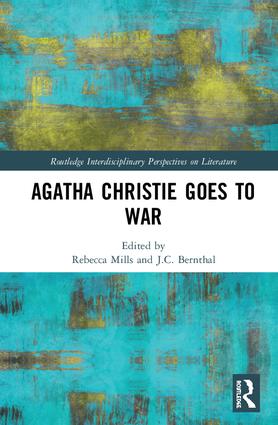
published by Routledge. You can get it in hardback or e-book form, for your library or yourself. My author copies arrived last week, and they’re quite a thing to behold.
Agatha Christie has never been substantially considered as a war writer, even though war is a constant presence in her writing. This interdisciplinary collection of essays considers the effects of these conflicts on the social and psychological textures of Christie’s detective fiction and other writings, demonstrating not only Christie’s textual navigation of her contemporary surroundings and politics, but also the value of her voice as a popular fiction writer reflecting popular concerns. Agatha Christie Goes to War introduces the ‘Queen of Crime’ as an essential voice in the discussion of war, warfare, and twentieth century…
View original post 443 more words
Share this:

A Love Letter: in praise of Agatha Christie

For most of my life, I have been an avid reader of all types of books. As my family will confirm, from childhood, I was never without a book. As an adult, I have regularly selected coats with large pockets and bags purely on the basis that they can hold a book. As many students will attest, my answer to most academic questions is “read, read and read some more”. Despite the growth of the internet and other media, which as @drkukustr8talk has noted recently, diverts and subverts our attention and concentration, reading remains my first and truest love.
This, my third ‘Love Letter’, focuses on my favourite author, above all others, Agatha Christie. I have previously dedicated ‘Love Letters’ to poetry, and art. Both of these forms took a long time for me to develop my understanding of and my love for. This ‘Love Letter’ is slightly different.
I first discovered Christie’s novels when I was about 12, since then they have formed a regular backdrop to my life. They act as a comfort blanket when I am tired, stressed, sad or away from home. I have read and reread everything she wrote and know the stories inside and out. Despite my decades of adoration, it remains challenging to know exactly what it is that appeals to me so much about Christie’s novels.
Perhaps it is the symmetry, the fact that for Christie every crime has a solution. Conceivably, given my pacifist tendencies, it could be the absence of explicit violence within her books. Maybe it’s Christie use of stereotypical characters, who turn out to be anything but. You don’t have to look very far to find the oh-so suspicious foreigner, who turns out to be a caring father (Dr Jacob Tanois) or the shell-shocked former military man trained in violence, who metamorphosises into a rather lonely man, who suffers from epilepsy (Alexander Cust). In all these cases, and many others, Christie plays with the reader’s prejudices, whatever they might be, and with deft sleight of hand, reveals that bias as unfounded.
To be honest, until relatively recently, I did not think much about the above, reading Christie was so much part of my life, that I took it very much for granted. All that changed in 2017, when I spotted a ‘Call for Chapters’
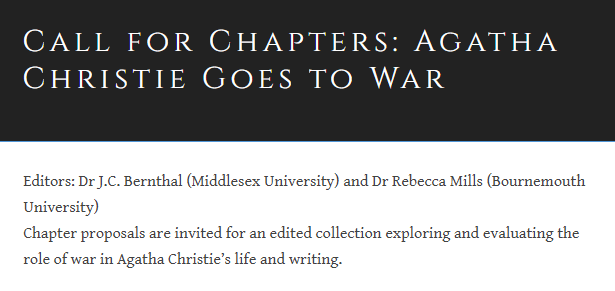
It seemed too good an opportunity to miss, after all I had spent a lifetime reading Christie, not to mention more than a decade studying war and crime. After all, what did I have to lose? I submitted an abstract, with no real expectation that someone who had never studied fiction academically, would be accepted for the volume. After all, who would expect a criminologist to be interested in the fictional writing of a woman who had died over 40 years ago? What could criminology learn from the “golden age” of “whodunnit” fiction?
Much to my surprise the abstract was accepted and I was invited to contribute a chapter. The writing came surprisingly easy, one of very few pieces of writing that I have ever done without angst. Once I got over the hurdle of forcing myself to send my writing to strangers (thank you @manosdaskalou for the positive reassurance and gentle coercion!) , what followed was a thoroughly pleasant experience. From the guidance of the volume’s editors , Drs J. C. Bernthal and Rebecca Mills, to the support from many colleagues, not mention the patience of Michelle (Academic Librarian) who restrained from strangling me whilst trying to teach me the complexities of MLA. Each of these people gave me confidence that I had something different to say, that my thinking and writing was good enough.
Last week, my copy of the book arrived. It was very strange to see my chapter in print, complete with my name and a brief biography. Even more surreal was to read the editors’ introduction and to see my work described therein, with its contribution to the volume identified. I doubt many people will ever read my chapter, it is published in a very expensive academic book destined for academics and libraries. Nevertheless, I have left the tiniest of marks in academic literature and perhaps more importantly, publicly acknowledged my love for the writing of Agatha Christie.
The finished article:
Bowles, Paula, (2020), ‘Christie’s Wartime Hero: Peacetime Killer’ in Rebecca Mills and J. C. Bernthal, Agatha Christie Goes to War, (Abingdon: Routledge): 28-45
Share this:


Empathy Amid the “Fake Tales of San Francisco”*
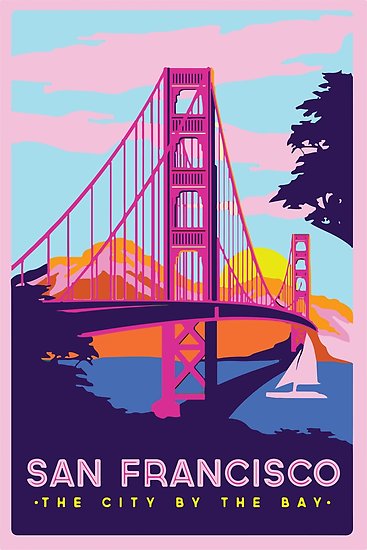
This time last week, @manosdaskalou and I were in San Francisco at the American Society of Criminology’s conference. This four-day meeting takes place once a year and encompasses a huge range of talkers and subjects, demonstrating the diversity of the discipline. Each day there are multiple sessions scheduled, making it incredibly difficult to choose which ones you want to attend.
Fortunately, this year both of our two papers were presented on the first day of the conference, which took some of the pressure off. We were then able to concentrate on other presenters’ work. Throughout discussions around teaching in prison, gun violence and many other matters of criminological importance, there was a sense of camaraderie, a shared passion to understand and in turn, change the world for the better. All of these discussions took place in a grand hotel, with cafes, bars and restaurants, to enable the conversation to continue long after the scheduled sessions had finished.
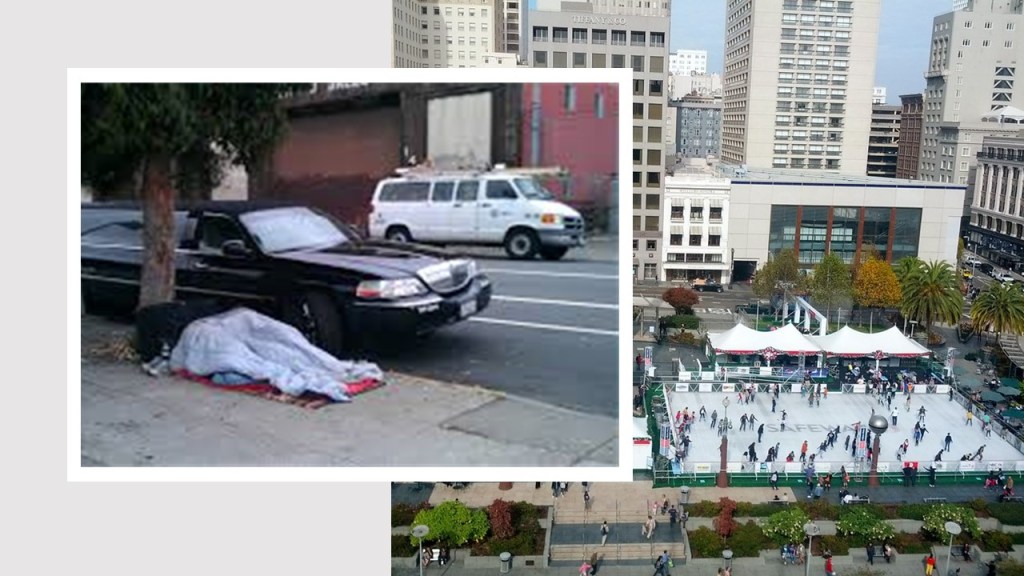
Outside of the hotel, there is plenty to see. San Francisco is an interesting city, famous for its Golden Gate Bridge, the cable cars which run up and down extraordinarily steep roads and of course, criminologically speaking, Alcatraz prison. In addition, it is renowned for its expensive designer shops, restaurants, bars and hotels. But as @haleysread has noted before, this is a city where you do not have to look far to find real deprivation.
I was last in San Francisco in 2014. At that point cannabis had been declassified from a misdemeanour to an infraction, making the use of the drug similar to a traffic offence. In 2016, cannabis was completely decriminalised for recreational use. For many criminologists, such decriminalisation is a positive step, marking a change from viewing drug use as a criminal justice problem, to one of public health. Certainly, it’s a position that I would generally subscribe to, not least as part of a process necessary to prison abolition. However, what do we really know about the effects of cannabis? I am sure my colleague @michellejolleynorthamptonacuk could offer some insight into the latest research around cannabis use.
When a substance is illegal, it is exceedingly challenging to research either its harms or its benefits. What we know, in the main, is based upon problematic drug use, those individuals who come to the attention of either the CJS or the NHS. Those with the means to sustain a drug habit need not buy their supplies openly on the street, where the risk of being caught is far higher. Thus our research population are selected by bad luck, either they are caught or they suffer ill-effects either with their physical or mental health.
The smell of cannabis in San Francisco is a constant, but there is also another aroma, which wasn’t present five years ago. That smell is urine. Furthermore, it has been well documented, that not only are the streets and highways of San Francisco becoming public urinals, there are also many reports that public defecation is an increasing issue for the city. Now I don’t want to be so bold as to say that the decriminalisation of cannabis is the cause of this public effluence, however, San Francisco does raise some questions.
- Does cannabis cause or exacerbate mental health problems?
- Does cannabis lead to a loss of inhibition, so much so that the social conventions around urination and defecation are abandoned?
- Does cannabis lead to an increase in homelessness?
- Does cannabis increase the likelihood of social problems?
- Does the decriminalisation of cannabis, lead to less tolerance of social problems?
I don’t have any of the answers, but it is extremely difficult to ignore these problems. The juxtaposition of expensive shops such as Rolex and Tiffany just round the corner from large groups of confused, homeless people, make it impossible to avoid seeing the social problems confronted by this city. Of course, poor mental health and homelessness are not unique to San Francisco or even the USA, we have similar issues in our own town, regardless of the legal status of cannabis. Certainly the issue of access to bathroom facilities is pressing; should access to public toilets be a right or a privilege? This, also appears to be a public health, rather than CJS problem, although those observing or policing such behaviour, may argue differently.
Ultimately, as @haleysread found, San Francisco remains a City of Contrast, where the very rich and the very poor rub shoulders. Unless, society begins to think a little more about people and a little less about business, it seems inevitable that individuals will continue to live, eat, urinate and defection and ultimately, die upon the streets. It is not enough to discuss empathy in a conference, no matter how important that might be, if we don’t also empathise with people whose lives are in tatters.
*Turner, Alex, (2006), Fake Tales of San Francisco, [CD]. Recorded by Arctic Monkeys in Whatever People Say I Am, That’s What I’m Not, The Chapel: Domino Records

 Thoughts from the criminology team