

The Problem Was Never Just the Predator

Two cases have recently occupied newspaper headlines. One concerns the conviction of a high-profile media personality for rape and sexual assault offences, while another relates to an ongoing police investigation into allegations of sexual misconduct. I will not name either individual here, as I do not wish to contribute further to their notoriety.
Ten years ago, Dame Janet Smith published her landmark report on Jimmy Savile. The almost 800-page report identified sexual misconduct against 72 individuals and exposed a range of troubling organisational failures. More difficult still were its broader conclusions. The report described a culture in which sexual harassment was tolerated, complaints were not pursued, influential individuals were protected, and “macho” attitudes were allowed to flourish. There was a pattern of silence, deference and institutional inaction.
One of the report’s key recommendations was that organisations should use its findings as an opportunity to ensure that history would not repeat itself. Yet a decade later, we are still discussing powerful men who abuse their position and the cultures that enable them to do so.
In the recent conviction, the sentencing judge described a sexual predator whose celebrity status appeared to foster a sense of entitlement and arrogance towards women. Despite concerns raised by those around him, he continued to be treated as valuable “talent”. The females who were victimised faced a long and difficult journey towards justice, with some allegations dating back more than 25 years.
So why does it feel as though we are once again confronting the very issues Dame Janet Smith warned about?
The individual and the institution
When cases of sexual violence emerge, public attention often focuses on the individual perpetrator. The offender is portrayed as an anomaly, separate from an otherwise fair and functioning society. While individual responsibility is essential, this perspective can obscure wider organisational and institutional failings.
The Savile report (Smith, 2016) was not the first inquiry to identify cultural problems within organisations, and unfortunately, it is unlikely to be the last. The existence of enabling cultures means these issues extend beyond the actions of a single person. This does not absolve perpetrators of responsibility. Their actions remain their own and they must be held accountable for them. However, accountability should also extend to examining the organisational environments in which these behaviours are allowed to persist.
Complaints processes and organisational responses
Where organisations have been criticised for their handling of sexual misconduct, there is often a disconnect between language and action. Many institutions make strong public commitments to equality, inclusion and wellbeing. Yet when a complaint is raised, the impulse can be to manage it informally in order to minimise reputational damage.
Informal resolution may have a place in some workplace disputes. However, where there are allegations of harassment, intimidation, abuse or entrenched cultures of aggression, organisations have a duty to take formal concerns seriously and investigate them properly. For more on this read Sara Ahmed’s excellent book Complaint!
Women as credible witnesses
One of the most significant issues highlighted by the #MeToo movement was the question of credibility. The movement emerged because many survivors felt that they were not believed when they disclosed their experiences of abuse and harassment.
Whatever criticisms have been directed at #MeToo, its central message remains relevant: sexual harassment and abuse continue to be widespread problems, including within workplaces. Survivors must feel able to come forward without fearing disbelief, hostility or retaliation.
The persistence of rape myths
In sentencing the convicted celebrity, Mr Justice Bennathan specifically referred to the use of rape myths in the defence’s arguments. Such myths have existed for generations and have long been criticised by campaigners, advocacy organisations and survivors.
Rape myths shift attention away from perpetrators and onto victims. They create doubt, minimise harmful behaviour and contribute to cultures in which abuse can be ignored or excused. Challenging these myths remains an essential part of preventing sexual violence.
How do we stop history from repeating itself?
If we want real change rather than another decade of apologies, we need to commit to practical action:
- Believe survivors when they speak up. Too much energy is spent worrying about false accusations, leaving far too little space and support for those who have actually experienced abuse.
- Dismantle toxic workplace cultures. Actively build environments where macho posturing and casual misogyny are challenged rather than rewarded.
- Enforce zero tolerance. Sexual harassment and violence must carry real, immediate consequences, regardless of who the perpetrator is.
- Protect whistleblowers. Empower staff at every level to call out unacceptable behaviour without fear of losing their jobs or damaging their careers.
- Take quiet warnings seriously. When people raise reservations or share concerns about a colleague’s conduct, listen to them early rather than waiting for a formal crisis.
- Never put “talent” above safety. No amount of ratings, revenue, or star power makes a person more valuable than the well-being of the people around them.
- Look for patterns, not excuses. When confronted with inappropriate behaviour, stop dismissing it as a “one-off” or a misunderstanding, and investigate the culture enabling it.
- Reject rape myths. Challenge victim-blaming narratives wherever they appear, from office gossip to the courtroom.
- Keep the conversation open. Silence protects abusers; open, honest dialogue removes their cover.
- Value people as human beings. When workplaces treat staff as disposable resources, dehumanisation follows—and abuse becomes much easier to ignore.
These are just a few starting points. What else do you think needs to change? Leave your thoughts in the comments below.
Share this:

Power, Punishment and Panopticism in Roald Dahl’s Matilda: A Foucauldian Reading
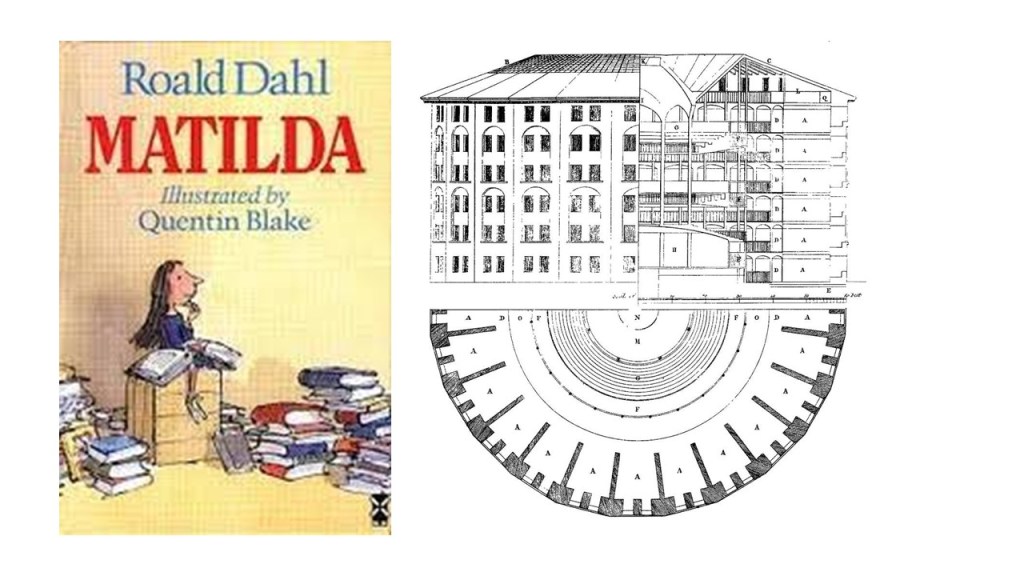
Roald Dahl’s Matilda (1988) tells the tale of a bright young girl’s discovery that she has psychic powers as she seeks to improve the situation of herself and those around her. From an unhappy home life with parents who fail to understand her, to the overthrow of the tyrannical Headmistress of her school, the book explores themes of resistance, rebellion and empowerment. It also subverts the idea that in adult/child relationships the adults hold all the power. Let us consider how theories of power are played out in the story and whether Matilda can affect real and lasting change for herself.
Matilda’s parents do not care for her physically or emotionally and make no attempts to understand her; she is treated as an inconvenience, and her cleverness is mocked and denied. Matilda’s refusal to conform with the wishes of her parents illustrates her own strength and self-assuredness and that despite the many restraints and obstacles placed on her, and on children in general, she continues to be true to herself. Despite her parents’ best efforts, she continues to speak out of turn when she knows the answer, asserts her morals when she realises her father is tricking his customers and continues to borrow and read books from the library after she has been forbidden to do so. Before she has even uncovered her telekinetic powers, she applies herself to devising “suitable punishment[s] for the poisonous parent”, in the hopes of correcting her father’s behaviour and teaching him a lesson.
In Discipline and Punish, Foucault makes several references to the ways in which schools can function as institutions, maintaining power through discipline. Claiming “the prison is like a rather disciplined barracks, a strict school […] but not qualitatively different”.
Crunchem Hall then, is the reverse: a strict school that is not qualitatively different to a prison. It is run as such, and both the children and the staff think of it in these terms. The name of the school itself represents the headmistress, Miss Trunchbull’s, educational philosophy of strict discipline and a breaking down of the children – quite literally ‘crunching them’. She relies not on mutual respect and natural authority but on public spectacles of punishment to keep them in line and Foucault reminds us to “regard punishment as a political tactic”. Examples in the text abound of the ways in which the children and Trunchbull frame the school as prison, as evidenced in the 10-year-old Hortensia’s: “welcome to Borstal”. Hortensia’s role is to warn Matilda and Lavender and tell them of the things she has done to fight back, including putting itching powder in the Trunchbull’s spare underwear and putting golden syrup on her seat: all reasons that she has ended up in “the Chokey”.
As an older character with many stories to tell, the reader is given the impression that things have always been this way and that resistance, though satisfying, is futile. Like a crude iron maiden, the Chokey itself represents the spectacle of punishment, much like Foucault’s spectacle of the scaffold, and is enough to control most of the children and ‘keep them in line’. Hortensia describes it as:
a very tall but very narrow cupboard. The floor is only ten inches square so you can’t sit down or squat in it. You have to stand. And three of the walls are made of cement with bits of broken glass sticking out all over, so you can’t lean against them. […] The door’s got thousands of sharp spiky nails sticking out of it.
A legend within the school and the threat that anyone could be punished at any time, is sufficient to mitigate the children’s behaviour. Aside from Hortensia’s stories of the many times that she has ended up in the Chokey, we hear of no other children being placed in this torture device. It is a symbolic instrument which serves the purpose of controlling the children just by existing. The Trunchbull bases her punishments on hunches and does not care if she is correct, so long as someone gets the blame. Matilda observes that this is what makes her so dangerous to the children, she is unpredictable almost to the point of madness.
Trunchbull repeatedly refers to the students with derogatory and dehumanising names: wart, poisonous pustule, foul carbuncle and othering them in the process. She uses language of crime and punishment when she refers to Bruce Bogtrotter as a “robber bandit” and a “pirate” for stealing a slice of her chocolate cake. Bruce’s punishment is being forced to consume an entire chocolate cake in front of the school, receiving no support or reprieve from the other members of staff – another example of the use of public punishment as spectacle and a means by which to control the children and make it clear who is in charge. This scene frames the battle as adults vs. children; the children united by their status as ‘crusaders’ cheering Bruce on to victory, while Trunchbull remains alone.
She gets away with the punishments she enacts because they are so outrageous and unbelievable that parents wouldn’t believe their children even if they told them – and perhaps they are just as scared of her! Trunchbull epitomises discipline and control, always watching and always ready to deliver a cruel and imaginative punishment, swinging a child by the pigtails, throwing a boy out through the classroom window, picking a child up by the ears and stretching them etc. Education, for her, is about control and stamping out the ‘childness’ in her child pupils. She abhors cleverness and the traits which mark the students out as individual from one another.
The main action of Matilda unfolds within the family home and at school, locations typically associated with adult control and discipline. Ann Alston, following Foucault, notes that families are small institutions where children are first immersed in ideology and learn that there is the possibility of constant surveillance. Children’s bedrooms, she argues, can be simultaneously a source of refuge and safety and a cell within which the child is separated from the adults and a potential site of punishment. The ways in which home and school spaces are organised reconfirm adult power and control; from who has access to which rooms, to the different discipline and rules applied within them, adults appear to hold all the cards. For Foucault, school often involves “enclosure” in a protected place of disciplinary monotony to reduce the inconveniences that come with trying to control a group of bodies in space. The very history of schools and educational establishments points to an exercising of control and power over subjects.
Matilda has limited positive adult role models available to her. A mother who favours looks over books and ignores both her husband’s illegal activities and her daughter. Miss Trunchbull who, whilst representing a self-sufficient woman with a career and an Olympics sports background, loathes children and metes out cruel punishments with no remorse. Not to mention her abuse of Miss Honey and the stealing of her estate. There are many other indicators of Trunchbull’s ‘badness’; she is large, strong, dislikes children, dresses unappealingly and is unmarried – all traits which are unacceptable to the feminine ideal. And finally, there is Miss Honey who, though kind and a good teacher, is so meek and subservient as to be completely ineffectual at saving herself or fully helping the children whom she cares for. If Miss Honey represents the perfect woman, it is damning that she is trapped by her life’s circumstances and unable to break free without the assistance of a child. Trunchbull is made monstrous by her activity and Miss Honey is stuck because of her own passivity.
Matilda is at once a story of supernatural power and a domestic story of the search for a happily-ever-after. Although Matilda achieves many things over the course of the story her goal is to find herself a loving family and the quiet home life she has been missing. Her powers recede once she has liberated Honey and adopted her as a surrogate parent; they were borne of frustration and temporary – “the power had gone. I think I have lost it completely”. Once her life is back on track and her dreams of a perfect family have been realised, she can get back on with the serious business of being a girl. In the ways in which Matilda is, on the surface, just like any other girl with “no outward signs” of her brilliance – she is quiet, unassuming and sensible – Dahl adheres to existing stereotypes of femininity without challenging them. Dahl builds limitations into the powers he gives Matilda, they will be effective just long enough for her to get her happy ending but without having to deal with the implications of a child wielding these powers into future adulthood. “But the fact remained that any five-year-old girl in any family was always obliged to do as she was told” – the message remains in place that children ultimately must defer to their parents. If she were able to keep her abilities, she would remain in a position of greater power over the adults around her and potentially struggle to fit in with the domestic mundanity of her life going forward. Would Miss Honey be so keen to care for her if she were able to wield this power at will? Dahl allows her enough, but not too much. Despite Matilda’s rejection of, or rejection by, her biological family, the end goal for her is still a traditional happy family. Leaving aside the fact that Miss Honey is single and unmarried, she can meet all the requirements that Matilda’s own parents were lacking; an appreciation for fine literature, home cooked meals, cosy domesticity and an active interest in the child’s life and interests.
Matilda reverses traditional adult and child roles by having Matilda (age 5) outsmart her parents, frighten the immovable and dangerous Miss Trunchbull and emancipate her beloved Miss Honey. Repeated references to Matilda being a somewhat “grown-up child” suggest that Dahl sidesteps the issue of giving all the power to a child by making her different and exceptional enough to not really be a child at all. She can talk, read and do advanced mathematics earlier than her peers and is shown to be just as competent, if not more, than the adults. Miss Honey feels comfortable and able to share her very adult worries and concerns with Matilda on an equal footing, but at what cost to Matilda’s childhood? By making Matilda’s achievements far beyond the reach of most children, Dahl ensures that, whilst the character is both empowering and empowered, she is no real threat to the status quo of adult dominance.
Matilda’s revenge echoes Trunchbull’s own disciplinarian techniques: she utilises constant surveillance and the omnipresent threat of punishment when she manifests the ‘ghost’ of Miss Honey’s father, Magnus. Using her telekinesis to manipulate a piece of chalk to write on the blackboard, Matilda spells out a message from the late Doctor; he has seen how Trunchbull treats his daughter, he knows she took away the house and inheritance and if she doesn’t change her ways “I will come and get you […] I am watching you Agatha”. The idea of being watched by hidden or invisible forces connotes a similar threat to Bentham’s Panopticon, discussed at length by Foucault, which has permanent effects even when there is no one actively observing. You do not need to know you are being watched to behave as if you are. The ‘ghost’ makes visible the coercive powers that Trunchbull herself has been using against the children and she is right to fear it – who wants to live with the threat of constant surveillance hanging over them? In this sense, Matilda and Trunchbull are not so different after all; they share similar ideas of punishment and discipline, and both attempt to control or change the behaviour of those around them. Matilda’s power manifests itself in a ‘ghostly’ fashion every time she uses it, and she relies on not being seen to act, playing on the supernatural fears of those around her. The anonymity of Matilda’s actions, or reactions, towards Trunchbull and her parents serves to make them more insidious, and Matilda thus avoids physical confrontation. Readers see Matilda’s behaviour as the triumph of good over evil, as being morally justified, whilst viewing the same behaviour by Miss Trunchbull as abhorrent. But could it be that Matilda is on her way to becoming one of the oppressive adults she loathes?
Works Cited:
Alston, A. The Family in English Children’s Literature Taylor & Francis, 2008.
Dahl, R Matilda, Puffin Books, 2009.
Foucault, M, Discipline and Punish, Penguin Group, 1991.
Images from L-R A copy of Dahl’s Matilda and a blueprint for the Panopticon.
Share this:


A word from a Criminologist in Society

Following the first session of CRI2013, I will be completely honest, I was scared. The rigid amount of self-determination and motivation required initially felt overwhelming as many worries arouse in my head, what was I going to research? How am I going to do it? How is a research diary useful? How hard is an ethical statement? However, following complementing CRI2013, I can undoubtedly say that taking this module was one of the best decisions I have ever made.
My research centred around the crown court of Northamptonshire, that led to myself spending two weeks in the courts during the easter break. Being within such a place to collect real world contemporary data was incredibly eye-opening and very enjoyable. Not only this, but it also emphasised the practicality and usefulness of a research diary that I initially couldn’t understand. Initially, keeping the diary and attempting to be constantly honest and reflective felt tedious, however, as the weeks passed it became incredibly useful as a tool for reflection and data collection critical for various learning outcomes, so be patient and trust the process!
Now, I cannot emphasise enough to listen to Jes when she states that the ethical statement is not as easy as it seems! As a person who believed the ethical statement would be easy, it does require time and significant consideration, however, its totally worth it. As I have, you will gain a far deeper understanding of how to complete an ethical statement than those who didn’t take this module that is undeniably critical for third year.
Finally, a massive thank you to @jesjames50! During this module Jes was endlessly supportive and unbelievably helpful, there truly couldn’t be anyone better to lead this module, and I couldn’t be more grateful for her guidance.
Share this:


Here we go again… medical misogyny continues

Rant time!
Back in August, I received a letter and text from the NHS telling me the time had come for my cervical screening- joy of joy! Women between the ages of 25- 64 years are invited for their cervical screening every 5 years. For many women, the process is simple, the procedure (if you can call it that, it’s a swab for those who aren’t aware) is also simple. But for some, the experience can be daunting, and painful. The letter tells you to book on ASAP, the text provides a link, and reminds you of the importance of attending your screening. Hesitate I do not – I book on!
The first available appointment is the end of October (2 months away!). Not ideal: in August, as many staff and students will be aware, our timetables haven’t settled and are subject to changes. Trying to select a day I don’t think I’ll have classes is basically guess work at this stage. Guess I do, and guess accurately I’ve managed. Well done me! The letter contains information on why the screening is done, what is looked for and to request a female nurse if preferred…. Erm yes! There is also information about brining/requesting a chaperone if required – good to see. But I cannot find any information about what happens if women are on their periods or pregnant. Must not matter (spoiler alert: I’m wrong. It matters!).
Rock up to my appointment (2 months down the line), currently on day 2 of my period. Bleeding heavy, managing horrific cramps, light-headedness whilst having had minimal sleep (standard day 2 joys for me). I walk rather than drive to the appointment (safety first). When I am eventually called into the room, it’s confirmed I am there for a cervical screening, but I interrupt to inform them I have a tampon in and assume I need to take this out before the swab is taken. Oh no! I cannot have the cervical screening today as they cannot take it when people are bleeding (something to do with if a positive or abnormal result they cannot differentiate between the cells). I am told I should have cancelled and re-arranged. I should not have booked the appointment for when I was on my period and that I need to book an appointment for when I am not bleeding. I should have known.
Well… why should I have known? I had looked on the links sent with the link to book the appointment and I couldn’t find anything about bleeding. I was asked why I had not ‘simply asked AI’ if I was unsure. Great. Dr’s surgeries suggesting I use AI to ask medical questions… that doesn’t feel appropriate. I figure I don’t have time to list off all the issues I have with AI, and I’m not sure the nurse would care. I also have this pesky issue of a chronic illness which means my periods resemble Niagara Falls, cramps often leave me immobile and they are irregular (which basically means they show up whenever they feel like it and last from anywhere between 3-8 days): fun for me! So how can I ensure I book a time I’m not bleeding? I track my periods so I have general idea when I should roughly start bleeding- but I’m often early or late, rarely am I on time. And if there isn’t an appointment available then, what do I do?
I leave the appointment having re-arranged for a few weeks later when I should be blood free (fingers crossed). But I feel angry, deflated, exhausted and emotional. I have just had to defend why I didn’t know, why I wouldn’t use AI and how I am supposed to book appointments on a system which is based on the assumption that women have regular periods. Oh how little still appears to be known about women’s bodies. Or is this it is known and it is deliberately ignored? Either way, I’ll add it to my tally of b*****it medical experiences where my body is the issue, rather than the system and assumptions made which leave women on the fringes of proper medical care.
I have since done some deeper digging: the NHS web page does have information about bleeding and pregnancy: https://www.nhs.uk/tests-and-treatments/cervical-screening/how-to-book/
So not knowing is on me- although why this wasn’t included in the link sent from the Drs when booking I don’t know. Also, as a 25 year old new to the joys of a smear test, why would you be thinking about this? I overthink and was basically panicking about remembering to take the tampon out if required (forgetting you have a tampon in has quite serious consequences- and is something I frequently struggle with due to the sheer number I go through). Feels like pretty essential information. Also, appointments months away, on the assumption that women track or are regular with their bleeding is such a ridiculous approach. I mean, there is a significant possibility myself (and others) will be in a consistent cycle (unlike their periods) of booking and then re-arranging appointments until finally their menstrual cycles align with the NHS calendar… and by then months or years could have passed with the possibility of dire consequences. So…guess it’s just a regular day at the office then for women and healthcare…
Share this:

Why choosing a research placement module was the best decision I made

Taking Criminologists in Society (CRI2013) in second year was the best academic decision I could have made for myself. It’s not an easy module, it is actually the complete opposite, and it is definitely not one you can leave until the last minute. Out of all my modules, CRI2013 demanded the most reading, preparation, organisation, and time. But I would still recommend it to anyone who isn’t afraid of hard work and wants to push themselves outside their comfort zone. Through this module, I secured a volunteering role with a domestic abuse charity supporting female survivors which has opened up doors for me in regard to future employment. I discovered that transcribing interviews and thematic analysis is far more challenging and time-consuming than textbooks make out and proved to myself that I can confidently present on a topic I’m genuinely passionate about even when I am quizzed about it.
Preparing for the dissertation:
Choosing a research-heavy module was a gamble, especially because my lowest grade previously came from research methods in year 1 but I knew that if I wanted to feel confident going into my dissertation in third year, I needed to face that challenge head-on and CRI2013 was the best way to do that. Thankfully I was right and it turned out to be the perfect preparation and has left me so much more confident in my ability to actually conduct real life research.
In many ways, CRI2013 is a mini‑dissertation because you design a project, complete an ethical form (which needs to be a lot more thorough than you would expect), conduct real fieldwork, analyse your findings, and write up a full research report. Whilst a 3000 research report sounds intimidating, I actually found it restrictive because I had so much to discuss by the time I started writing. This is because I had free reign to choose a topic to research that I was genuinely interested in, just like with the dissertation which allowed me to enjoy the materials I was engaging with as well as my time out in the field.
This experience has also significantly shaped my dissertation direction. After examining support offered to survivors after abuse, I am now interested in exploring the support and advice available before abuse occurs. Due to this, the literature I engaged with during my placement has been invaluable, giving me a strong literature bank to build upon for my literature review as well as to utilise for the methodology section and ethical statement.
Having the opportunity to complete an ethics form 1-on-1 with a lecturer is great as you won’t receive the same level of support at level 6. I now know what is expected by the committee to be granted ethical approval.
Finally, it’s also worth noting that completing a Level 5 research placement is a unique opportunity. Your module lead will help you every step of the way so whilst it is an independent piece of research don’t let that put you off because you will be given as much help and advice as you need and I would say make the most of it! It is also a great opportunity to network with organisations and agencies as a small research placement may secure you further employment or volunteering opportunities with them like mine did or at the very least open doors to other agencies they work with.
The reality of finding a placement:
My biggest piece of advice? Don’t take it personally when organisations can’t offer you a placement. I went into the module knowing I wanted to focus on victims of crime, so I emailed local organisations expecting plenty of options. The reality was very different. I faced rejections, delays, and complete silence. Eventually, one organisation which happened to be an hour’s drive away finally agreed to meet with me five weeks after the module started. So don’t get too attached to the idea of a specific organisation or location, you have to be open‑minded. Look at every organisation you could realistically travel to and reach out as early as possible. Time moves quickly, and placements take longer to secure than you think.
What to do while you’re waiting?
The weeks where I didn’t know whether I’d even secure a placement were stressful. But the best advice I can give is to start reading anyway. Even if you can’t begin your literature review, you can start reading for your methodology and methods section. Think about what type of research you want to conduct, how you would like to do it and get started on the ethics form. The more groundwork you do early, the easier everything becomes later. Because once you do secure a host, everything speeds up. Your thirty hours in the field fly by, and suddenly you’re juggling a 3,000‑word report, a presentation, and other assessments all at once. “Little and often” genuinely is the key. You cannot leave this module until the end.
The ethics form:
As mentioned above, do not underestimate the work that goes into your ethical statement. No stone will be left unturned when it comes to the university being reassured that your research will be ethically conducted. You have to consider risks to yourself, the participants and to the university. Confidentiality, anonymity, health and safety factors, who your participants will be and what risks they might face all have to be considered. Most importantly you have to justify your research as to why its necessary and ethically sound. We all had many drafts of our ethical statements before they were signed off, so again give yourself plenty of time to complete them and don’t be offended when they’re picked apart.
The challenge and reward of real fieldwork:
This module had me writing an abstract, introduction, critical literature review, methodology and methods section, findings, and discussion. But the hardest part wasn’t the writing for me it was conducting the actual research entirely on my own.
Walking into a room full of strangers, explaining my project, and then spending thirty hours taking fieldnotes in a room full of strangers who were opening up about horrific acts of violence was nerve‑wracking and uncomfortable at times. But it pushed me in ways no other module has. I got to speak to the CEO and her employees about the challenges domestic abuse charities face when providing support, the rewards their hard work provides them, and I observed the difference they make to women’s lives first-hand. I even had the opportunity to conduct an interview with the CEO which was a great experience and something I never imagined I’d be confident enough to do. It has shown me that if this were a method I would like to adopt for the dissertation, I am more than capable of doing that.
Transcribing an interview and doing thematic analysis across pages of scribbled notes and a full transcript is tough, stressful, and time‑consuming but I did it. Figuring out my researcher positionality and keeping a research diary was challenging too, yet it really helped me understand myself as a researcher which again will be useful for the dissertation especially due to the similarities between my research focus.
Why should you consider this module?
If you want a challenge and if you want to walk into third year feeling prepared CRI2013 is worth every hour you put into it. It’s demanding but you will finish the module not just with a grade, but with real research experience you can talk about in interviews, put on your CV, and genuinely be proud of. I was proud to present my research, and I was proud to watch my peers do the same because our hard work paid off.


