
Home » Posts tagged 'Writing' (Page 2)
Tag Archives: Writing

Technology: one step forward and two steps back
I read my colleague @paulaabowles’s blog last week with amusement. Whilst the blog focussed on AI and notions of human efficiency, it resonated with me on so many different levels. Nightmarish memories of the three E’s (economy, effectiveness and efficiency) under the banner of New Public Management (NPM) from the latter end of the last century came flooding back, juxtaposed with the introduction of so-called time saving technology from around the same time. It seems we are destined to relive the same problems and issues time and time again both in our private and personal lives, although the two seem to increasingly morph into one, as technology companies come up with new ways of integration and seamless working and organisations continuously strive to become more efficient with little regard to the human cost.
Paula’s point though was about being human and what that means in a learning environment and elsewhere when technology encroaches on how we do things and more importantly why we do them. I, like a number of like-minded people are frustrated by the need to rush into using the new shiny technology with little consideration of the consequences. Let me share a few examples, drawn from observation and experience, to illustrate what I mean.
I went into a well-known coffee shop the other day; in fact, I go into the coffee shop quite often. I ordered my usual coffee and my wife’s coffee, a black Americano, three quarters full. Perhaps a little pedantic or odd but the three quarters full makes the Americano a little stronger and has the added advantage of avoiding spillage (usually by me as I carry the tray). Served by one of the staff, I listened in bemusement as she had a conversation with a colleague and spoke to a customer in the drive through on her headset, all whilst taking my order. Three conversations at once. One full, not three quarters full, black Americano later coupled with ‘a what else was it you ordered’, tended to suggest that my order was not given the full concentration it deserved. So, whilst speaking to three people at once might seem efficient, it turns out not to be. It might save on staff, and it might save money, but it makes for poor service. I’m not blaming the young lady that served me, after all, she has no choice in how technology is used. I do feel sorry for her as she must have a very jumbled head at the end of the day.
On the same day, I got on a bus and attempted to pay the fare with my phone. It is supposed to be easy, but no, I held up the queue for some minutes getting increasingly frustrated with a phone that kept freezing. The bus driver said lots of people were having trouble, something to do with the heat. But to be honest, my experience of tap and go, is tap and tap and tap again as various bits of technology fail to work. The phone won’t open, it won’t recognise my fingerprint, it won’t talk to the reader, the reader won’t talk to it. The only talking is me cursing the damn thing. The return journey was a lot easier, the bus driver let everyone on without payment because his machine had stopped working. Wasn’t cash so much easier?
I remember the introduction of computers (PCs) into the office environment. It was supposed to make everything easier, make everyone more efficient. All it seemed to do was tie everyone to the desk and result in redundancies as the professionals, took over the administrative tasks. After all, why have a typing pool when everyone can type their own reports and letters (letters were replaced by endless, meaningless far from efficient, emails). Efficient, well not really when you consider how much money a professional person is being paid to spend a significant part of their time doing administrative tasks. Effective, no, I’m not spending the time I should be on the role I was employed to do. Economic, well on paper, fewer wages and a balance sheet provided by external consultants that show savings. New technology, different era, different organisations but the same experiences are repeated everywhere. In my old job, they set up a bureaucracy task force to solve the problem of too much time spent on administrative tasks, but rather than look at technology, the task force suggested more technology. Technology to solve a technologically induced problem, bonkers.
But most concerning is not how technology fails us quite often, nor how it is less efficient than it was promised to be, but how it is shaping our ability to recall things, to do the mundane but important things and how it stunts our ability to learn, how it impacts on us being human. We should be concerned that technology provides the answers to many questions, not always the right answers mind you, but in doing so it takes away our ability to enquire, critique and reason as we simply take the easy route to a ready-made solution. I can ask AI to provide me with a story, and it will make one up for me, but where is the human element? Where is my imagination, where do I draw on my experiences and my emotions? In fact, why do I exist? I wonder whether in human endeavour, as we allow technology to encroach into our lives more and more, we are not actually progressing at all as humans, but rather going backwards both emotionally and intellectually. Won’t be long now before some android somewhere asks the question, why do humans exist?
Share this:

How to make a more efficient academic
Against a backdrop of successive governments’ ideology of austerity, the increasing availability of generative Artificial Intelligence [AI] has made ‘efficiency’ the top of institutional to-do-lists’. But what does efficiency and its synonym, inefficiency look like? Who decides what is efficient and inefficient? As always a dictionary is a good place to start, and google promptly advises me on the definition, along with some examples of usage.

The definition is relatively straightforward, but note it states ‘minimum wasted effort of expense’, not no waste at all. Nonetheless the dictionary does not tell us how efficiency should be measured or who should do that measuring. Neither does it tell us what full efficiency might look like, given the dictionary’s acknowledgement that there will still be time or resources wasted. Let’s explore further….
When I was a child, feeling bored, my lovely nan used to remind me of the story of James Watt and the boiling kettle and that of Robert the Bruce and the spider. The first to remind me that being bored is just a state of mind, use the time to look around and pay attention. I wouldn’t be able to design the steam engine (that invention predated me by some centuries!) but who knows what I might learn or think about. After all many millions of kettles had boiled and he was the only one (supposedly) to use that knowledge to improve the Newcomen engine. The second apocryphal tale retold by my nan, was to stress the importance of perseverance as essential for achievement. This, accompanied by the well-worn proverb, that like Bruce’s spider, if at first you don’t succeed, try, try again. But what does this nostalgic detour have to do with efficiency? I will argue, plenty!
Whilst it may be possible to make many tasks more efficient, just imagine what life would be like without the washing machine, the car, the aeroplane, these things are dependent on many factors. For instance, without the ready availability of washing powder, petrol/electricity, airports etc, none of these inventions would survive. And don’t forget the role of people who manufacture, service and maintain these machines which have made our lives much more efficient. Nevertheless, humans have a great capacity for forgetting the impact of these efficiencies, can you imagine how much labour is involved in hand-washing for a family, in walking or horse-riding to the next village or town, or how limited our views would be without access (for some) to the world. We also forget that somebody was responsible for these inventions, beyond providing us with an answer to a quiz question. But someone, or groups of people, had the capacity to first observe a problem, before moving onto solving that problem. This is not just about scientists and engineers, predominantly male, so why would they care about women’s labour at the washtub and mangle?
This raises some interesting questions around the 20th century growth and availability of household appliances, for example, washing machines, tumble driers, hoovers, electric irons and ovens, pressure cookers and crock pots, the list goes on and on. There is no doubt, with these appliances, that women’s labour has been markedly reduced, both temporally and physically and has increased efficiency in the home. But for whose benefit? Has this provided women with more leisure time or is it so that their labour can be harnessed elsewhere? Research would suggest that women are busier than ever, trying to balance paid work, with childcare, with housekeeping etc. So we can we really say that women are more efficient in the 21st century than in previous centuries, it seems not. All that has really happened is that the work they do has changed and in many ways, is less visible.
So what about the growth in technology, not least, generative AI? Am I to believe, as I was told by Tomorrow’s World when growing up, that computers would improve human lives immensely heralding the advent of the ‘leisure age’? Does the increase in generative AI such as ChatGPT, mark a point where most work is made efficient? Unfortunately, I’ve yet to see any sign of the ‘leisure age’, suggesting that technology (including AI) may add different work, rather than create space for humans to focus on something more important.
I have academic colleagues across the world, who think AI is the answer to improving their personal, as well as institutional, efficiency. “Just imagine”, they cry, “you can get it to write your emails, mark student assessment, undertake the boring parts of research that you don’t like doing etc etc”. My question to them is, “what’s the point of you or me or academia?”.
If academic life is easily reducible to a series of tasks which a machine can do, then universities and academics have been living and selling a lie. If education is simply feeding words into a machine and copying that output into essays, articles and books, we don’t need academics, probably another machine will do the trick. If we’re happy for AI to read that output to video, who needs classrooms and who needs lecturers? This efficiency could also be harnessed by students (something my colleagues are not so keen on) to write their assessments, which AI could then mark very swiftly.
All of the above sounds extremely efficient, learning/teaching can be done within seconds. Nobody need read or write anything ever again, after all what is the point of knowledge when you’ve got AI everywhere you look…Of course, that relies on a particularly narrow understanding which reduces knowledge to meaning that which is already known….It also presupposes that everyone will have access to technology at all times in all places, which we know is fundamentally untrue.
So, whatever will we do with all this free time? Will we simply sit back, relax and let technology do all the work? If so, how will humans earn money to pay the cost of simply existing, food/housing/sanitation etc? Will unemployment become a desirable state of being, rather than the subject of long-standing opprobrium? If leisure becomes the default, will this provide greater space for learning, creating, developing, discovering etc. or will technology, fueled by capitalism, condemn us all to mindless consumerism for eternity?
Share this:


25th Year Reflection
I have been part of Criminology at UON as BA Criminology student, then Associate Lecturer then Lecturer in Criminology for about 13 years in total. My last reflection on my Criminology journey was in 2020 as I had just embarked on my new role as a Lecturer in Criminology. Every now and then I reflect on how lucky I am to be able to have a job role which has the potential to encourage a passion for learning, reading, writing, critical thinking as well as other life skills.
When reflecting on the 25th year Criminology anniversary I think mostly of the old Park Campus that I used to frequent and study at as a student. It had quite a nice feel to it and there was also enough surrounding nature for a famous badger to make this place part of its habitat! There were less books available online when I was an undergraduate compared to today so I have fond memories of going to the library often to have a browse and coming away with as many criminology related books that I could fit in my bag at once. Finding places where I could study for hours that were less frequented than the main library also gave me a bit of a buzz. There also used to be a Pavilion bar near to where the majority of exams would take place, one of my favorite past time memories is sipping on a beer in the Pavilion just after the end of my final third year Criminology exam season, (whilst secretly thinking of how I thought the exams went much better than expected).
When reflecting I am also reminded of how lecturers like Dr @manosdaskalou and Dr @paulaabowles can be incredibly inspirational and influential at guiding academic paths (such as my own!). The re-occurring ideas that ‘criminology is everywhere’ and that we should ‘question everything’ has boded well for helping me to make difficult decisions and in thinking about how I interacted with people when I was working within crime related industries.
In more recent years staff and students have moved to a new campus, have worked and studied through the challenges that come with Covid-19 and contextual uncertainties. This year has had some highlights for me, such as working on a new module Imagining Crime. Whereby we used inspiration from the novel 1984 by George Orwell to task students with committing weekly ‘thought crimes’ by seeing/hearing/reading about something criminological and questioning this by using critical thinking. Listening to the development of critical thinking via the ‘thought crime’ method has been a delight. The flexible, creative and multidisciplinary nature of criminology is also quite fabulous for maintaining interest in criminology over a long period of time but also for venturing into new and less explored areas. For instance, staff and students in Imagining Crime had the pleasure of attending a guest speaker session with @saffrongarside about children’s literature and the environment this academic year – at a time when Northampton itself seemed to be struggling to cope with flooding. Of course, this did highlight the importance of seeing environmental issues as criminological issues, but also the importance of considering children’s books as criminologically cultural artifacts, was something completely new and intriguing for me. I also gained a lot from hearing what our students (who are predominantly) young people think about environmental issues outside of the mainstream media angles that I have seen.
To round up, I loved my student life whilst studying BA Criminology and I am sure many others will say ‘ditto to that’. Long may the love for Criminology at UON continue!
Share this:


Reflections and Perspectives from an Ex-masters Student and Current PhD Student
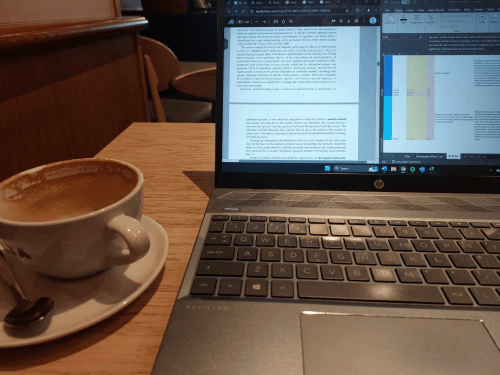
Back in September, I submitted my final dissertation for my Master of Science in International Social Policy and Welfare. The masters was not what I expected at all, but at the same time it was pretty much what I anticipated.
During my undergraduate degree, I never really felt that my socio-economic status effected my time at university that much. Of course, it did to a certain level, but it never felt overt. Perhaps the more diverse student population made me feel that way, as going to university and studying at undergraduate level is an opportunity that a range of people get, from a range of backgrounds. Since finishing my masters and beginning my PhD level study, I’m starting to appreciate how entering postgraduate study as a working class person can be particularly challenging. Applying for my masters, and my PhD, was extremely challenging as I didn’t know anyone else who had done it previously, being the first in my family and peers to continue so far with formal education.
In light of this, I really wanted to write this entry sharing some of the things I have learnt and realised during my postgraduate study. Hopefully this could maybe reach someone who is the first of their family or circle of friends, for whatever reason, to take the step into postgraduate education.
For context, my masters was a year at Anglia Ruskin University and entirely course work based with a fifteen thousand word dissertation carried out in the third semester. Here are some of my most prominent realisations and things to consider about postgraduate study in the social sciences.
1- A masters is not like a repeat of the third year of your undergraduate degree:
So perhaps I was slightly naïve when I started my masters thinking this would be the case. I thought I’d be writing 2,500- 3,000 word essays every so often then calling it a day, maybe 3,500 at a push. This wasn’t the case, some of my essays were 3,500 words, but the majority were 4,000 or 6,000 words typically. It felt daunting to start of with, but as you explore issues more critically, widely and with greater complexity, the word count really does get used up easily.
2- You might get to practise your presentation skills:
As someone who doesn’t typically enjoy presenting, this was difficult for me. But often your masters peer group is smaller, and your topic is really tailored to what you want to study, so its not as bad as doing it at undergraduate level, at my university, three out of the four modules I took involved some presenting.
3- The dissertation sounds scary to start off with:
I started my masters just under four months after finally finishing my undergraduate dissertation, so I had the stress and exertion still fresh in my mind. I was nervous thinking about how I was going to conduct research and write up a 15,000 word masters dissertation, especially as the dissertation module only formally started in the final semester (12 weeks before submission). But the whole point of education is learning how to do things you currently cannot do, if I attempted to do my research and masters dissertation in the first month of the course, I would have probably catastrophically failed, but that’s sort of the whole point. Writing lengthier essays, exploring ideas further and practising applying theoretical frameworks to other issues prepared me for the dissertation.
4- Make a Gantt chart:
Linked to number 3, my Gantt chart saved my life during my dissertation. You can easily make one on Excel, I also broke down my work into week chunks, and at the top I wrote any social commitments so I had a clear idea on how much work I could realistically aim to get done each week. You can see lots of examples of this time management strategy online by searching for google images of Gantt charts, below is an example of the one I’ve made for my PhD.

5- Read, read, read:
Demonstrate that you have wider understanding of a concept, that goes beyond the lectures and seminars. And read for pleasure too, reading long documents is a skill and skills need practise and rehearsal! But if there is a key document/ paper that you simply just can’t get into the groove of, copy and paste the text into a word document and use the text to speech function and listen to it like a podcast.
6- It’s really independent:
At my university, we had six hours of face to face contact per week. So this means a lot of independent study. I found trying to maintain self discipline and routine more helpful than maintaining motivation; motivation is something that can be really unstable depending on your mood, and you can’t necessarily gain motivation when you don’t have it. But sticking to routines and developing an environment of self discipline is something you have a bit more control over, but remember to carve rest periods into that routine.
7- A word on using AI:
Universities often have their own policy on using AI. Personally, I would avoid it and I haven’t used it for any of my university work across both degrees and I’m not planning on doing so for my PhD. However, that being said, if you do want to use it, check the university’s AI policy, clarify with your lecturers, double check information with additional sources and do not use it just to do your work. I know some students use it to gather preliminary sources or to time manage. For one of my Masters module, three people used AI to make their presentations, and it was painfully obvious, very embarrassing for them and it is academic misconduct.
8- Consider PhD options a few months into your masters:
Being extremely early on in my PhD journey (I started the programme in January) I can only give one piece of advice regarding it so far. Start considering things to do with your PhD a few months into your masters. I didn’t realise how extensive the application processes are, most universities will ask you to create a research proposal- universities I looked at ranged between a 1,000- 2,500 word count- and some ask for an academic and professional CV. Choosing a university isn’t as simple as undergrad or even masters study, you need to find a university that has supervisors that supervise the topic you want to research, then they sometimes like you to identify an appropriate supervisor and send the research proposal draft to them before submitting an application. Some supervisors may then want to talk to you about your research multiple times before recommending you to apply/ giving an offer to you. But don’t panic if you leave it later, or can’t cope with thinking about those things during your masters. I only started seriously applying a month after my Masters finished, and I still had just enough time to figure it all out and get it done in time.
Share this:


A Love Letter to Criminology at UON


In 2002, I realised I was bored, I was a full-time wife and parent with a long-standing part-time job in a supermarket. I first started the job at 15, left at 18 to take up a job at the Magistrates’ court and rejoined the supermarket shortly after my daughter was born. My world was comfortable, stable and dependable. I loved my family but it was definitely lacking challenge. My daughter was becoming increasingly more independent, I was increasing my hours and moving into retail management and I asked myself, is this it? Once my daughter had flown the nest, could I see myself working in a supermarket for the rest of my life? None of this is to knock those those that work in retail, it is probably the best training for criminology and indeed life, that anyone could ask for! I got to meet so many people, from all backgrounds, ethnicities, ages, religions and classes. It taught me that human beings are bloody awkward, including myself. But was it enough for me and if it wasn’t, what did I want?
At school, the careers adviser suggested I could work in Woolworths, or if I tried really hard at my studies and went to college, I might be able to work for the Midland Bank (neither organisation exists today, so probably good I didn’t take the advice!). In the 1980s, nobody was advocating the benefits of university education, at least not to working-class children like me. The Equal Pay Act might have been passed in 1970 but even today we’re a long way from equality in the workplace for women. In the 1980s there was still the unwritten expectation (particularly for working class children from low socio economic backgrounds) that women would get married, have children and perhaps have a part-time job but not really a career….I was a textbook example! I had no idea about universities, knew nobody that had been and assumed they were for other people, people very different from me.
That changed in 2002, I had read something in a newspaper about a Criminology course and I was fascinated. I did not know you could study something like that and I had so many questions that I wanted to answer. As regular readers of the blog will know I’m a long-standing fan of Agatha Christie whose fiction regularly touches upon criminological ideas. Having been born and raised in North London, I was very familiar with HMP Holloway’s buildings, both old and new, which raised lots of questions for a curious child, around who lived there, how did they get in and out and what did they do to the women held inside. Reading suffragette narratives had presented some very graphic images which further fed the imagination. Let’s just say I had been thinking about criminology, without even knowing such a discipline existed.
Once I was aware of the discipline, I needed to find a way to get over my prejudices around who university was for and find a way of getting in! To cut a long story short, I went to an Open Day and was told, go and get yourself an access course. At the time, it felt very blunt and reinforced my view that universities weren’t for the likes of me! Looking back it was excellent advice, without the access course, I would never have coped, let alone thrived, after years out of education.
In 2004 I started reading BA Criminology, with reading being the operant word. I had been an avid reader since early childhood (the subject of an earlier blog) and suddenly I was presented with a license to read whatever and whenever I wanted and as much as I could devour! For the first time in my life, people could no longer insist that I was wasting time with my head always in a book, I had “official” permission to read and read, I did! I got the chance to read, discuss, write and present throughout the degree. I wrote essays and reports, presented posters and talked about my criminological passions. I got the chance to undertake research, both empirical and theoretical, and lawks did I revel in all this opportunity. Of course, by looking back and reflecting, I forget all the stresses and strains, the anxieties around meeting so many new people, the terror of standing up in front of people, of submitting my first assessment, of waiting for grades….but these all pale into insignificance at the end and three years goes so very quickly….
In the summer of 2007, I had a lovely shiny degree in Criminology from the University of Northampton, but what next? By this point, I had the studying bug, and despite my anticipation that university would provide all the answers, I had a whole new set of questions! These were perhaps more nuanced and sophisticated than before but still driving me to seek answers. As I said earlier, human beings are awkward and at this point I decided, despite my earlier passion, I didn’t want to be put in a box labelled “Criminology“. I felt that I had finally cracked my fear of universities and decided to embark on a MA History of Medicine at Oxford Brookes. I wanted to know why Criminology textbooks and courses still included the racist, sexist, disablist (and plenty more) “theories” of Cesare Lombroso, a man whose ideas of the “born criminal” had been discredited soon after they were published.
But again the old fears returned….what did I know about history or medicine? What if the Criminology degree at Northampton hadn’t been very good, what if they just passed everyone, what if I was kidding myself? Everything at Brookes felt very different to Northampton, everyone on the course had studied BA History there. Their research interests were firmly centred on the past and on medicine, nursing, doctoring, hospitals and clinics and there was me, with my ideas around 20th century eugenics, a quasi-scientific attempt to rationalise prejudice and injustice. Along with studying the discipline, I learnt a lot about how different institutions work, I compared both universities on a regular basis. What did I like about each, what did I dislike. i thought about how academics operate and started to think about how I would be in that profession.
I successfully completed the MA and began to think maybe Northampton hadn’t given me good grades out of our pity or some other misplaced emotion, but that I had actually earnt them. I was very fortunate, I had maintained connection with Criminology at UON, and had the opportunity to tip my toe in the water of academia. I was appointed as an Associate Lecturer (for those not familiar with the title, it is somebody who is hourly paid and contribute as little or as much as the department requires) and had my first foray into university teaching. To put it bluntly, I was scared shitless! But, I loved every second in the classroom, I began to find my feet, slowly but surely, and university which had been so daunting began to seep into my very being.
Fast forward to 2025, I have been involved with UON for almost 22 years, first as a student, then as an academic, achieving my PhD in the process It is worth saying that the transition is not easy, but then nothing worth having ever is. I have gained so much from my studies, my relationship with two universities and the experiences I have had along the way. It is fair to say that I have shed many tears when studying, but also had some of my very highest highs, learning is painful, just watch a small child learning to read or write.
Hopefully, over the past decades I have repaid some of the debt I owe to the academics that have taught me, coached me, mentored me and supported me (special mention must go to @manosdaskalou who has been part of my journey since day 1). My life looks very different to 2002 and it is thanks to so many people, so many opportunities, the two universities that have provided me with a home from home and all of the students I have had the privilege to engage with.
I am so delighted to have been part of Criminology at UON’s 25 years of learning and teaching. To my colleagues, old and new, students, graduates and everyone I have met along the way, I raise my glass. Together we have built something very special, a community of people committed to exploring criminological ideas and making the world an equitable place.
Share this:


Book blurbs: a necessity or frill?

I have always been, and imagine I will always be, a lover of books. Until the summer of last year, it has always been physical books. The feel, the smell, the shock when you drop it as you’re drifting off to sleep, the dampness of pages when you’ve picked it up too quickly after getting out of a pool or the sea on holiday and that beautiful crinkle crisp after the page dries. Physical books are beautiful (even the ugly ones). And this holds for academic sources, non-fiction books and novels! One of the joys of selecting a book (new or often second-hand charity gems), is reading the blurb. It might give you a brief introduction to characters you are following, or if an academic source it might provide you with a brief list of topics the book navigates. The blurb might also contain some quotations and reviews expressing the ‘excellence’ or ‘gripping’ nature of the book. And whilst this is generally a positive feature, since reading e-books (where I do not read the blurb or even access the blurb), I have started to wonder if the blurb is actually a hinderance to the potential reader…
Now, this entry is not to debate the great debate of the 21st century: e-book versus book. But rather the format of an e-book not having a blurb per se versus the blurb on the back of a book. I am fortunate enough to have a Kindle: one of my most prized possessions. It’s beautiful, it can be read in all environments (warmth setting and light setting is incredible), it’s lightweight and fits in almost all of my bags and many of my pockets #notsponsored, but I have never read a blurb of a book on the Kindle, and I can’t work out if I’m missing out or if this is actually an improvement of the ‘book selection’ process.
Some positives of not accessing the blurb on the e-readers is it has opened up my reading list astronomically. I have read and loved books I am certain I would never have picked up or purchased had I read what they were about. Some have been heavy, taxing reads but so worth it in the end, others have been bizarre and wonderful but not something I would have ever recommended to myself. Had these been physical books, having read the blurb, these would have been left by me on the shelf and therefore I would have lost out on the joy, wonder and sadness that these books had to offer.
There are of course issues with not reading the blurbs and these issues reinforce the importance of the feature as a necessity and not just a frill. I have also read a number of books I quite simply wish I hadn’t. And had I read the blurb I would have known not to start these monstrosities (once I’ve started, unfortunately my brain makes me finish – commitment [even to books] is important to my brain). I have also read some incredible books but at the wrong time: again had I read the blurb I would have known that this book is not a sensible choice given my headspace.
The issue is most likely me, rather than whether blurbs are actually necessary or just frill. And I’d imagine it’s better to have them and not use them, them not have them and miss them. But if they aren’t being used, they have no purpose and become redundant. Is this a wider symptom of the rise of the e-book or just a side-effect that no one else is concerned about but me? I do not know. But I find it strange how heavily I rely on blurbs with physical books and how void they are with e-books. Are e-books the beginning of the end for blurbs or am I over think this? Penny for your thoughts?

Share this:


An annual reflection and a glance to the year ahead!

As we complete the last day before the Christmas break, I encourage you to sit back and reflect on what you have achieved this academic term. Some of you will have started university for the first time and will be getting to grips with the processes, the assessments, the staff and the learning styles of the university. Some of you will be navigating second year and the new expectations of you at this level, learning to move beyond discussion to instead evaluation and being critical, honing your research skills in preparation for your dissertations in the next academic year. For some of you this may have been a hard journey and one that will progress into the second semester, but please know that this will build up your skills and your confidence, turning you into the academic you need to be in order to succeed.
For some of you, you will have moved into your third and final year. With this comes more independence, and some of this may feel uncertain, confusing, and a bit unknown. Please know that again this does not last and you will find your feet. Whether that is a lightbulb moment with your dissertation, or finally finding the right article that helps you to write your essay. For those of you that have exams coming up in January, make sure you can enjoy the festivities and take a well earned break. But when you find those moments where you’re bored and have nothing to do, and you start to think about your criminology course, I think that will be a good indication to pick up a book, to read through your notes, or to practice some exam questions.
On a personal note as I reflect on this year there are things I am definitely proud to have achieved, and things I would like to work on in the future. One of my biggest achievements this year was completing my PhD. It has been a long, difficult journey, spanning over eight years, but the feeling of successfully completing my viva, making those final changes, and the recognition I feel when discussing my research to various people reminds me of its importance. The special moment of my graduation. At my graduation my research title was read aloud, I was applauded, and then welcomed into the academic community onstage to be seated with fellow academics such as my supervisors. This was a special moment I will cherish and having family there was all the more memorable and precious. Whilst the PhD journey has come to an end, new opportunities arise, so keep an eye out in 2025 for further publications!
In addition, this year, I navigated my new job at the University of Northampton. In the 12 months I’ve been here I have learnt a lot from colleagues, from the faculty, and from other departments. Looking ahead, the road is one of change and adjustment, but I am optimistic and ready for whatever changes may come.
I wish everyone a wonderful and restful Christmas. Like myself, I hope you return in the New Year with renewed energy ready to tackle any new adventures with poise and determination. Remember to push yourselves to get to the best version of you!

 Thoughts from the criminology team