
Home » State Violence (Page 2)
Category Archives: State Violence

Christmas Toys

In CRI3002 we reflected on the toxic masculine practices which are enacted in everyday life. Hegemonic masculinity promotes the ideology that the most respectable way of being ‘a man’ is to engage in masculine practices that maintain the White elite’s domination of marginalised people and nations. What is interesting is that in a world that continues to be incredibly violent, the toxicity of state-inflicted hegemonic masculinity is rarely mentioned.
The militaristic use of State violence in the form of the brutal destruction of people in the name of apparent ‘just’ conflicts is incredibly masculine. To illustrate, when it is perceived and constructed that a privileged position and nation is under threat, hegemonic masculinity would ensure that violent measures are used to combat this threat.
For some, life is so precious yet for others, life is so easily taken away. Whilst some have engaged in Christmas traditions of spending time with the family, opening presents and eating luxurious foods, some are experiencing horrors that should only ever be read in a dystopian novel.
Through privileged Christmas play-time with new toys like soldiers and weapons, masculine violence continues to be normalised. Whilst for some children, soldiers and weapons have caused them to be victims of wars with the most catastrophic consequences.
Even through children’s play-time the privileged have managed to promote everyday militarism for their own interests of power, money and domination. Those in the Global North are lead to believe that we should be proud of the army and how it protects ‘us’ by dominating ‘them’ (i.e., ‘others/lesser humans and nations’).
Still in 2023 children play with symbolically violent toys whilst not being socialised to question this. The militaristic toys are marketed to be fun and exciting – perhaps promoting apathy rather than empathy. If promoting apathy, how will the world ever change? Surely the privileged should be raising their children to be ashamed of the use of violence rather than be proud of it?
Share this:


Festive messages, a legendary truce, and some massacres: A Xmas story

Holidays come with context! They bring messages of stories that transcend tight religious or national confines. This is why despite Christmas being a Christian celebration it has universal messages about peace on earth, hope and love to all. Similar messages are shared at different celebrations from other religions which contain similar ecumenical meanings.
The first official Christmas took place on 336 AD when the first Christian Emperor declared an official celebration. At first, a rather small occasion but it soon became the festival of the winter which spread across the Roman empire. All through the centuries more and more customs were added to the celebration and as Europeans “carried” the holiday to other continents it became increasingly an international celebration. Of course, joy and happiness weren’t the only things that brought people together. As this is a Christmas message from a criminological perspective don’t expect it to be too cuddly!
As early as 390 AD, Christmas in Milan was marked with the act of public “repentance” from Emperor Theodosius, after the massacre of Thessalonica. When the emperor got mad they slaughtered the local population, in an act that caused even the repulson of Ambrose, Bishop of Milan to ban him from church until he repented! Considering the volume of people murdered this probably counts as one of those lighter sentences; but for people in power sentences tend to be light regardless of the historical context.
One of those Christmas celebrations that stand out through time, as a symbol of truce, was the 1914 Christmas in the midst of the Great War. The story of how the opposing troops exchanged Christmas messages, songs in some part of the trenches resonated, but has never been repeated. Ironically neither of the High Commands of the opposing sides liked the idea. Perhaps they became concerned that it would become more difficult to kill someone that you have humanised hours before. For example, a similar truce was not observed in World War 2 and in subsequent conflicts, High Commands tend to limit operations on the day, providing some additional access to messages from home, some light entertainment some festive meals, to remind people that there is life beyond war.
A different kind of Christmas was celebrated in Italy in the mid-80s. The Christmas massacre of 1984 Strage Di Natale dominated the news. It was a terrorist attack by the mafia against the judiciary who had tried to purge the organisation. Their response was brutal and a clear indication that they remained defiant. It will take decades before the organisation’s influence diminishes but, on that date, with the death of people they also achieved worldwide condemnation.
A decade later in the 90s there was the Christmas massacre or Masacre de Navidad in Bolivia. On this occasion the government troops decided to murder miners in a rural community, as the mine was sold off to foreign investors, who needed their investment protected. The community continue to carry the marks of these events, whilst the investors simply sold and moved on to their next profitable venture.
In 2008 there was the Christmas massacre in the Democratic Republic of Congo when the Lord’s Resistance Army entered Haut-Uele District. The exact number of those murdered remains unknown and it adds misery to this already beleaguered country with such a long history of suffering, including colonial ethnic cleansing and genocide. This country, like many countries in the world, are relegated into the small columns on the news and are mostly neglected by the international community.
So, why on a festive day that commemorates love, peace and goodwill does one talk about death and destruction? It is because of all those heartfelt notions that we need to look at what really happens. What is the point of saying peace on earth, when Gaza is levelled to the ground? Why offer season’s wishes when troops on either side of the Dnipro River are still fighting a war with no end? How hypocritical is it to say Merry Christmas to those who flee Nagorno Karabakh? What is the point of talking about love when children living in Yemen may never get to feel it? Why go to the trouble of setting up a festive dinner when people in Ethiopia experience famine yet again?
We say words that commemorate a festive season, but do we really mean them? If we did, a call for international truce, protection of the non-combatants, medical attention to the injured and the infirm should be the top priority. The advancement of civilization is not measured by smart phones, talking doorbells and clever televisions. It is measured by the ability of the international community to take a stand and rehabilitate humanity, thus putting people over profit. Sending a message for peace not as a wish but as an urgent action is our outmost priority.
The Criminology Team, wishes all of you personal and international peace!
Share this:


What value life in a far-off land?

Watching the BBC news and for that matter any other news broadcast has become almost unbearable. Over the last three weeks or so the television screen has been filled with images of violence, grief, and suffering. Images of innocent men, women and children killed or maimed or kidnapped. Images of grieving relatives, images of people with little or no hope. And as I watch I am consumed by overwhelming sadness and as I write this blog, I cannot avoid the tears welling up. And I am angry, angry at those that could perpetuate such crimes against humanity. I will not take sides as I know that I understand so little about the conflict in Israel, Gaza, and the surrounding area, but I do feel the need to comment. It seems to me that there is shared blame across the countries involved, the region, and the rest of the world.
As I watch the news, I see reports of protest across many countries, and I see a worrying development of Islamophobia and Antisemitism. The conflict is only adding fuel to the actions of those driven by hatred and it provides plenty of scope for politicians in the West and other countries, to pontificate, and partake in political wrangling and manoeuvring before showing their abject disregard for morality and humanity. The fact that Hamas, as we are constantly reminded by the BBC, is a proscribed terrorist organisation, proscribed by most countries in the west, including the United Kingdom, seems to give carte blanche to western politicians to support crimes against humanity, to support murder and terrorism. How else can we describe what is going on?
The actions of Hamas should and quite rightly are to be condemned, any action that sees the killing of innocent lives is wrong. To have carried out their recent attacks in Israel in such a manner was horrendous and is a reminder of the dangers that the Israeli people face daily. But the declaration by Israel that it wants to remove Hamas from the face of the earth would, and could, only lead to one outcome, that being played out before our very eyes. The approach seems to be one of vengeance, regardless of the human cost and regardless of any rules of war or conflict or human dignity. How else can the bombing and shelling of a whole country be explained? How else can the blockading of a country to bring it to the brink of disaster be justified? How do we explain the forced migration of innocent people from one part of a country to another only to find that the edict to move led them into as dangerous a place as that they moved from? There seems to be a very sad irony in this, given the historical perspectives of the Israeli nation and its people.
We don’t know what efforts are going on behind the scenes to attempt to bring about peace but the outrageous comments and actions or omissions by some western politicians beggar belief. From Joe Biden’s declaration ‘now is not the time for a ceasefire’ to our government’s and the opposition’s policy that a pause in the conflict should occur, but not a ceasefire, only demonstrates a complete lack of empathy for the plight of Palestinian people. If not now, at what time would it be appropriate for a ceasefire to occur? It seems to me, as a colleague suggested, politicians and many others seem to be more concerned about accusations of antisemitism than they are about humanity. Operating in a moral vacuum seems to be par for the government in the UK and unfortunately that seems to extend to the other side of the house. Just as condemning the killing of innocent people is not Antisemitic nor too are the protests about those killings a hate crime. Our home secretary seems to have nailed her colours to the mast on that one but I’m not sure if its xenophobia, power lust or something else being displayed. Populism and a looming general election seems to be far more important than innocent children’s lives in a far off land.
The following quote seems so apt:
‘…. politicians must shoulder their share of the blame. And individuals too. Those ordinary citizens who allowed themselves to be incited into hatred and religious xenophobia, who set aside decades, sometimes centuries of friendship, who took up sword and flame to terrorise their neighbours and compatriots, to murder men, women, and children in a frenzy of bloodlust that even now is difficult to comprehend (Khan, 2021: 323).’[1]
If you are not angry, you should be, if you do not cry, then I ask why not? This is not the way that humanity should behave, this is humanity at its worst. Just because it is somewhere else, because it involves people of a different race, colour or creed doesn’t make it any less horrendous.

Khan, V. (2021) Midnight at Malabar House, Hodder and Stoughton: London.
[1] Vaseem Khan was discussing Partition on the Indian subcontinent, but it doesn’t seem to matter where the conflict is or what goes on, the reasons for it are so hard to comprehend.
Share this:


For Tyre’s last Five badges. (spoken word)
The badges you wear were betrayed the very instant you flashed your sights on me.
You had nothing good in mind from the start.
I was doomed from the beginning.
By the time the brutality started,
The senselessness of it all kept my body numb to the assault.
“What did I do,” I keep asking, as
Your brutal blows, strongholds and punches bend my body into painful pretzels.
While y’all’ve got me firmly pressed against the pavement, y’all yell:
“Get on the ground.”
Pressed on the ground, I say disarmingly:
“You guys are really doing a lot right now.”
My calmness stands out against all your unwavering aggressions.
Yet, you continue to play the same game: “Get on the ground.”
Beneath the ground there is only hell, and yet
My face pressed against the gravel by your hooves feels like hell, right here, right now.
‘Watching the world wake up from history.’
As if wielding your fists and batons, tasers and bullets don’t threaten me enough,
There are five of you, and
Each of you is massive.
Each of you …highly trained, experienced, and tremendously pumped up.
I am a little weasel sized up against any one of you, and
You are a mob of five.
Too weak to lift my own self, two officers hoisted me up by my limp arms, blood streaming from my head and outta ev’ry orifice, voice too weak to shout. I’m beaten badly, and yet you continue to brutalise me.
Manhandled.
I stumble up, firmly in your grasp, and all I do is plead, which gave enough time for another officer to grab a baton.
He quickly came back with the baton, screaming “give us your hands,” while the two officers still restrained me by these very same hands.
You continually scream “Stop resisting,” while
At least two if not three of you all strangling some part of my body.
The agony is immense.
You’re a pack on the hunt.
You chase me down, and
Torture and kick me more feverishly for running away.
I am in a battle for my life, you…
You are in a battle for your manhood.
“Bruh, you say, and words like these are the same words used to connect us to one another.
The words you use to abuse me could be endearing in another context.
Yet you have the nerve to call me “bruh,” and beat your brother to death.
‘I was alive and I waited, waited’
Waited for your humanity to show up,
Waited for justice to be served to me equally.
‘I was alive and I waited, waited,’ waited three days in the hospital…and
Neither justice nor your humanity ever showed up.

Share this:


Unravelling the Niger Coup: Shifting Dynamics, Colonial Legacies, and Geopolitical Implications

On July 26, the National Council for Safeguarding the Homeland (CNSP) staged a bloodless coup d’état in Niger, ousting the civilian elected government. This is the sixth successful military intervention in Africa since August 2020, and the fifth in the Sahel region. Of the six core Sahelian countries, only Mauritania has a civilian government. In 2019, it marked its first successful civilian transition of power since the 2008 military intervention, which saw the junta transitioning to power in 2009 as the civilian president.
Military intervention in politics is not a new phenomenon in Africa. Over 90% of African countries have experienced military interventions in politics with over 200 successful and failed coups since 1960 – 1, (the year of independence). To date, the motivation of these interventions revolves around insecurity, wasteful and poor management of state resources, corruption, and poor and weak social governance. Sadly, the current situation in many African countries shows these indicators are in no short supply, hence the adoption of coup proofing measures to overcome supposed coup traps.
The literature evidences adopting ethnic coup proofing dynamics and colonial military practices and decolonisation as possible coup-proofing measures. However, the recent waves of coups in the Sahel defer this logic, and are tilting towards severing ties with the living-past neocolonial presence and domination. The Nigerien coup orchestrated by the CNSP has sent shockwaves throughout the region and internationally over this reason. Before the coup, Mali and France had a diplomatic row. The Malian junta demanded that France and its Western allies withdraw their troops from Mali immediately. These troops were part of Operation Barkhane and Taskforce Takuba. A wave of anti-French sentiments and protests resulted over the eroding credibility of France and accusation of been an occupying force. Mohamed Bazoum, the deposed Nigerien president, accepted the withdrawn French troops and its Western allies in Niger. This was frowned at by the Nigerien military, and as evidenced by the bloodless coup, similar anti-French sentiments resulted in Bazoum’s deposition.
The ousting of President Bazoum resulted in numerous reactions, including a decision by the Economic Community of West African States (ECOWAS), of which Niger is a member and is currently chaired by Nigerian President Bola Ahmed Tinubu. ECOWAS demanded the release and reinstatement of President Bazoum, imposed economic sanctions, and threatened military intervention with a one-week ultimatum. Some argued that the military intervention is unlikely, and some member states pledged support to the junta. At the end of the ultimatum, ECOWAS activated the deployment of its regional standby force but it remains unclear when it will intervene and what the rules of engagement will be. Nonetheless, the junta considers any such act as an aggression, and in addition to closing its airspace, it is understood to have sought support from Wagner, the Russian mercenary.
Amongst the citizenry, while some oppose the military intervention, there is popular support for both the intervention and the military with thousands rallying support for the junta. On 6 August, about 30,000 supporters filled the Niamey stadium chanting and applauding the military junta as they parade the crowd-filled stadium. Anti-French sentiments including a protest that led to an attack on the French embassy in Niger followed the declaration of the coup action. In the civil-military relations literature, when a military assumes high political roles yet has high support from society over such actions, it is considered as a popular praetorian military (Sarigil, 2011, p.268). While this is not a professional military attribute (Musa and Heinecken, 2022), it is nonetheless supported by the citizenry.
In my doctoral thesis, I argued that in situations where the population is discontent and dissatisfied with the policies of the political leadership, a civil-military relations crisis could result. I argued that “as citizens are aware that the military is neither predatory nor self-serving, they are happy trusting and supporting the military to restore political stability in the state. It is possible that in situations where political instability becomes intense, large sections of the citizenry could encourage the military to intervene in politics” (Musa, 2018, p.71). The recent waves of military intervention in Africa, together with anti-colonial sentiments evidences this, and further supports my argument on the role of the citizenry in civil-military relations. For many Nigeriens including Maïkol Zodi who leads an anti-foreign troops movement in Niger, the coup symbolises the political independence and stability that Francophone Africa has long desired.
Thus, as the events continue to unfold, I would like to end this blog with some questions that I have been thinking about as I try to make sense of this rather complex military intervention. The intervention is affecting international relations and has the potential to destabilise the current power balance between the major powers. It could also lead to a military conflict in Africa, which would be a disaster for the continent.
- How have recent coups in the Sahel region signalled a shift away from colonial legacies, and how are these sentiments reshaping political dynamics?
- What is the significance of the diplomatic tensions between Mali and France, and how might they have influenced the ousting of President Bazoum and the reactions to it?
- Given the surge in military interventions in politics across the Sahel region, how does this trend reflect evolving dynamics within the affected countries, and does this has the potential to spur similar interventions in other African States?
- What lessons can be drawn from Mauritania’s successful transition from military to civilian rule in 2019, and how might these insights contribute to diplomatic discussions around possible transition to civilian rule in Niger?
- Are the decisions of ECOWAS influenced by external pressures, how effective is ECOWAS’s approach to addressing coups within member states, and how does the Niger coup test the regional organization’s capacity for conflict resolution?
- To what extent do insecurity, mismanagement of resources, corruption, and poor governance collectively contribute to the susceptibility of African nations to military interventions?
- How can African governments strike a balance between improving the quality of life and coup-proofing measures, and which is most effective for preventing or mitigating the risk of military interventions?
- What are the potential ramifications of the coup on the geopolitical landscape, especially in terms of altering power dynamics among major players?
- What are the implications of the coup for regional stability, and how might it contribute to the potential outbreak of conflict and could it destabilize ongoing counterterrorism efforts and impact cooperation among countries in addressing common security threats?
- Why do widespread demonstrations of support for the junta underscore the sentiments of political independence and stability that resonate across Francophone Africa?
- Given the complexities of the situation, what measures can be taken to ensure long-term stability, governance improvement, and democratic progress in Niger?
- Ultimately, is the western midwifed democracy in Africa serving its purpose, and given the poor living conditions of the vast populace in African countries as measured against all indices, can these democracies serve Africans?
Navigating these questions is essential for comprehending the implications of the coup and the potential outcomes for Niger and its neighbours. In an era where regional stability and international relations are at stake, a nuanced understanding of these multifaceted issues is imperative for shaping informed responses and sustainable solutions.
References
Musa, S.Y. (2018) Military Internal Security Operations in Plateau State, North Central Nigeria: Ameliorating or Exacerbating Insecurity? PhD, Stellenbosch University. Available from: https://scholar.sun.ac.za/handle/10019.1/104931. [Accessed 7 March 2019].
Musa, S.Y., Heinecken, L. (2022) The Effect of Military (Un)Professionalism on Civil-Military Relations and Security in Nigeria. African Security Review. 31(2), 157–173.
Sarigil, Z. (2011) Civil-Military Relations Beyond Dichotomy: With Special Reference to Turkey. Turkish Studies. 12(2), 265–278.
Share this:


Tyre Nichols’ last bird’s eye view.
[Spoken Word/Read aloud]

After my death, the New York Times reported that you all gave me “at least 71 commands.”
“Many were contradictory or impossible,” the Times tweeted.
In a mob frenzy throughout the whole ordeal, y’all kept shouting at me over each other.
When I couldn’t comply – and even when I did manage to obey– you…(SMH)
“Responded with escalating force.”
Hmph!
NYT’s tweet is cleverly crafted, with a photo – a bird’s eye view of us from the street camera.
There we see 4 of you hunched down on me, pressing my whole body against the ground.
The 5th thug is lunging toward me with a weapon.
After my death, I wonder how y’all will explain this footage –
Knowing the nature of these viral tweets?
I’ve personally reposted too many posts of Black bodies in my exact position to count.
I know I didn’t have to do anything to get here,
Knowing this brings me no comfort in this moment.
All of your commands ignore my humanity.
I am powerless and yet you persist.
In the many video angles of your fatal attack, we all see that…
Each of you had so many chances to just stop!
I’ve always tried to make sense of such lethal violence.
I try to understand the who, what and why of your attack that led to my death.
You had me pinned and pressed to the ground when you kept barking:
“Get on the ground.”
When you kept yelling, one after the other, “Give me your hands,”
Two or three of you were already bending my arms backward and forward with force.
I contort myself and try to comply, yet
You keep screaming “Stop resisting,” meanwhile,
At the same time, two or three of you are manhandling some part of me, at all times.
At the end when you leaned my beaten-up, bleeding, limp body against your car,
One of you snaps-n-shares pictures of me with colleagues and friends.
He’s proud and reaching out to folks who’ll pat him on the back for his latest accomplishment.
During the whole attack, I notice this is the only time he’s cool. He smiles.
He’s clearly used to this exact same rush, this exact same thrill.
I’m more disappointed than angered by his grin.
Mine is an all-American honor killing –
Most just get shot, but many have been tortured just like me.
We see this is how too many of his brethren defend their shield.
Where was I to go?
Appeal to the other officers on the scene whose negligence is pristine?
I tried to run, you captured me, which provoked more torture; nowhere feels safe.
Why was I being terrorized?
And by you, who’ve pledged to protect us from (this) terrorism and (this) thug behavior.
What was I to do?
Flight, freeze or fight.
I am tiny compared to any one of you, y’alls combat training and y’alls five big bodies built-up for battle.
I am a fly; you act like lords.
“Bruh,” you call me, but there is no evidence of brotherliness here.
Or, does your fraternity honor and practice such sadomasochistic rituals?
I like skateboarding and photography, another magazine writes, trying to digest my senseless murder.
Yet the videos of me captured for the world to see are
“…absent all beauty and sterilized of hope.”
When would this end?
Would I have to die for you to stop.
How had I possibly provoked this attack?
Who was I to obey?
You? You’re no good, like Linda Ronstadt said:
You’re no good. You’re no good. Baby, you’re no gooooooood…..
You’re no good.
Or perhaps good in your god’s eyes?
Or, are you God?
No.
You’re not anybody’s God, but…
You play one out here on these streets.
Now, you’re playing my God… my life is keenly in your fists.
Yes! These unceasing murders that I’ve seen – not just mine now–
Is what makes this place hell on Earth in the here and now.
So perhaps y’all’re just agents of the devil,
A force unleashed from the depths upon these streets.
“Momma,” I cry out as loud as I can, and you continue to holler obscenities at me.
Momma used to say all people are fundamentally good,
But lately, I’ve felt fundamentally unsure, and now I’m convinced.
“I didn’t do anything,” I plea, rolling on the ground with my hands behind my back.
Y’all kick me.
“Mom,” I cry out again.
I will die here alone.
No mother should lose her child like this.
The agony inside now, as I call out to my momma, is not for her help,
But because I can already feel her pain once she hears how I’m dying.
Since momma fought for the public release of the videos of my attack,
My name is a hashtag and we have been written about a plenty.
“Every Black mother knows she is a split second,” one newspaper writes,
“… a quirk of chance, from joining a lineage of suffering that stretches back through Mamie Elizabeth Till-Mobley…”
When she saw y’all in court for my kidnapping, assault, oppression, and murder,
Momma said you didn’t even have the courage to look her in the face.
Cowards.
Momma said you’re gonna see her each time you are called to see the judge.
-END-
Photo:
NPR OBITUARIES: “Tyre Nichols loved skateboarding. That’s how his friends say they’ll remember him.”
Share this:


Is the cost of living crisis just state inflicted violence

Back in November 2022, social media influencer Lydia Millen was seen to spark controversy on the popular app ‘TikTok’ when she claimed that her heating was broken, so she therefore was going to check into the Savoy in London.
Her video, which she filmed whilst wearing an outfit worth over £30,000, sparked outrage on the app and across popular social media platforms. People began to argue that her comment was not well received in our current social climate, where people have to choose whether they should spend money on heating or groceries. For many, no matter your financial situation, problems with heating rarely resorts in a luxury stay in London.
With pressure mounting, Lydia decided to reply to comments on her video. When one individual stated “My heating is off because I can’t afford to put it on”, Lydia replied “It’s honestly heart breaking I just hope you know that other people’s realities can be different and that’s not wrong”. Sorry, Lydia; it is wrong. Realities are not different; they are miles apart. This is clearly seen in the fact that the National Institute of Economic and Social Research estimate that 1.5 million households in the UK over the next year will be landed in poverty (NIESR, 2022).
Ultimately, this is a social issue. Like Lydia said, in a society in which individuals are stratified based on their economic, cultural and social capital, we are conditioned to believe that this is just the way it is, and therefore, it is not wrong that other people have different realities. However, for me, it is not ‘different realities’, it is a matter of being able to eat and be warm versus being able to stay in a luxury hotel in London.
So, why is this a criminological issue? The cost of living crisis is simply just state inflicted poverty. Alike to Lydia with her social following, the government have the power to make change and use their position in society to remedy cost of living issues, but they don’t. This is not a mark of their failure as a government, it is a mark of their success. You only have to look at the government’s complete denial surrounding social issues to realise that this was their plan all along, and the longer this denial continues, the longer they succeed. This is seen in the case of Lydia Millen, who has acted as a metaphor for the level of negligence in which the government exercises over its citizens. Ultimately, for Lydia, it is very easy to tuck yourself into a luxury bed in the Savoy and close the curtains on the real world. The people affected by the crisis are not people like Lydia Millen, they are everyday people who work 40+ hours a week, and still cannot make ends meet. For the government, the cost of living crisis is the perfect way to separate the wheat from the chaff.
Ultimately, the cost of living crisis is not too dissimilar to the strikes that the UK is currently experiencing. Alike to the strikes, the cost of living crisis was always going to happen at the hands of a negligent government. The only way we can begin to address this problem is by giving our support, by supporting strikes all across the country, and by standing up for what is right. After all, the powers in our country have shown that our needs as a society are not a priority, so it is time to support ourselves.
“Injustice anywhere is a threat to justice everywhere.” ― Martin Luther King Jr.
References:
National Institute of Economic and Social Research (2022) What Can Be Done About the Cost-of-Living Crisis? NIESR [online]. Available from: https://www.niesr.ac.uk/blog/what-can-be-done-about-the-cost-of-living-crisis [Accessed 23/01/23].
Share this:


The Problem is Bigger than Tate
While there are many things that have got under my skin lately, it seems that every time I go on social media, turn on the television, or happen to have a conversation, the name Andrew Tate is uttered. His mere existence is like a virus, attacking not only my brain and soul but it seems a large population of the world. His popularity stems from his platform followed by thousands of men and young boys (it’s known as the ‘Real World’).
His platform ‘educating’ men on working smarter not harder has created a ‘brotherhood’ within the manosphere that celebrates success and wealth. Tate is framed as a man’s man, physically strong, rich and he even has a cigar attached to his hand (I wonder if he puts it down when he goes to the bathroom). It seems many of his aspiring followers want to mimic his fast rich lifestyle.
This seems to be welcomed, especially now when the price of bread has significantly risen (many of his followers would sell the closest women in their life for a whiff of his cigar, and of course to be deemed to have an Insta-desirable lifestyle). While this ideology has gained hype and mass traction in recent years (under the Tate trademark) it seems that his narcissistic, problematic image and what he stands for has only just been deemed a problem … due to his recent indiscretions.
There is now outrage in UK schools over the number of young boys following Tate and his misogynistic ideology. But I cannot help but ask … why was this not an issue before? I am aware of rape culture, victim blaming, sexual harassment, and systems of silence at every level of the UK education establishment. The launch of ‘Everyone’s Invited’ shone a light on the problematic discourse, so why are we only seeing that there is a problem now?
There are many reasons why there’s a delayed outrage, and I would be here all day highlighting all the problems. So, I will give you a couple of reasons. The first is the Guyland ideology: many Tate supporters who fall into the cultural assumption of masculinity expect to be rewarded for their support, in ways of power and material possession (this includes power over women and others deemed less powerful). If one does not receive what they believe they are owed or expected, they will take what they believe they are owed (by all means necessary).
There is also a system of silence within their peer group which is reinforced by parents, female friends, the media, and those that are in administrative power. The protection of toxic behavior has been continuously put under the umbrella of ‘boys will be boys’ or the idea that the toxic behavior is outside the character of the individual or not reflective of who they truly are.
I will go one step further and apply this to the internalised patriarchy/misogyny of the many women that came out and supported Jeremy Clarkson when he callously attacked Meghan. While many of the women have their individual blight with Meghan for reasons I do not really care to explore, by supporting the rhetoric spewed by Clarkson, they are upholding systemic violence against women.
The third point is that capitalism overthrows humanity and empathy in many ways. All you need to do is to look at a history books, it seems that lessons will never be learned. The temptation of material possessions has overthrown morality. The media gives Tate a platform and in turn Tate utters damaging ideology. This brings more traffic to the platforms that he is on and thus more money and influence….after all he is one of the most googled people in the world.
The awareness of the problematic behaviour and the total disregard for protecting women and girls from monsters like Tate shows, how the outrage displayed by the media about harms against victims such as Sabina Nessa and Sarah Everard is performative. The news coverage and the discussion that centred on the victimisation of these two women have easily been forgotten. If the outrage is real then why are we still at a point where we are accepting excuses and championing misogyny under the guise of freedom of speech, without challenging the harm it really does.
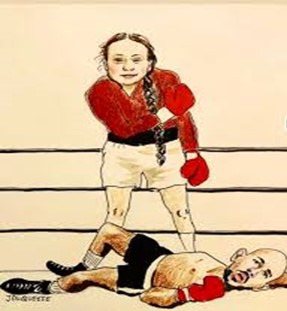
It seems that society is at a point of total desensitization where there is more interest in Tate losing an argument with Greta Thunberg, posing with a cigar on an exotic beach for likes, than really acknowledging the bigger picture. Andrew Tate has been accused of rape and human trafficking. The worst thing is, this is not the first time that he has been accused of horrific crimes – and with the audio evidence that was released to the press recently, he should be in prison. But with the issues that permeate the Met police there is no surprise as to why he has been given the green light to continue his violent behaviour. But this is not just a UK issue. There has been a large amount of support overseas with young men and boys marching in masses in support of Tate, so I cannot be surprised that he was able to and continues to build a platform that celebrates and promotes horrendous treatment of women.
For many the progression of a fair and equal society is an aspiration, but for the supporters of the Tate’s in the world they tend to lean on the notion that they are entitled to more, and to acquire what they think they are owed, and will behave to the extreme of toxicity. While it is easy to fixate on a pantomimic villain like Tate to discuss his problematic use of language and how this translates in schools, the bigger picture of institutionalised patriarchy is always being missed.
It is important to unpick the toxic nature of our society, to understand the contributing factors that have allowed Andrew Tate and others like him to be such influential figures.
Share this:


The Origins of Criminology

The knife was raised for the first time, and it went down plunging into naked flesh; a spring of blood flowed cascading and covering all in red. The motion was repeated several times. Abel fell to his death and according to scriptures this was the first crime. Cain who wielded the knife roamed the earth until his demise. The fratricide that was committed was the first recorded murder and the very first crime. A colleague tried to be smart and pointed that the first crime is Eve’s violation in the garden with the apple, but I did point out that according to Helena Kennedy QC, she was framed! In the least Eve’s was a case of entrapment which is criminological but leaves the first crime vacant. So, murder it is! A crime of violence that separates aggressor and victim.
The response to this crime is retribution. In the scriptures a condemnation to insanity. In later years this crime formed the basis of the Mosaic Law inclusive of the 10 commandments and death as the indicative punishment. In the Ancien Régime the punishment became a spectacle on deterrence whilst the crowds denounced the evildoer as they were wheeled into the square! In modern times this criminality incorporated rehabilitation to offer the opportunity for the criminal to repent and make amends.
‘The first man who having enclosed a piece of ground bethought himself of saying “This is mine”’! This is an alternative interpretation of the first crime, according to Jean-Jacques Rousseau (1762/1993: 192). In The Social Contract he identifies the first crime very differently from the scriptures. In this case the crime is not directed at a person but the wider community. The usurping of land or good in any manner that violates the rights of others is crime because it places individualism ahead of the common good. As in this crime there is no violence against the person, the way in which we respond to it is different. Imperialism as a historical mechanism accepts the infringement of property, rights, and human rights as a necessity in human interactions. The law here is primarily protected for the one who claims the land rather than those who have been left homeless. In this case, crime is associated with all those mechanisms that protect privilege and property. Soon after titles of land emerged and thereafter titles of people owning other people follow. The land becomes an empire, and the empire allows a man and his regime to set the laws to protect him and his interests. Traditionally empires change from territories of land to centres of government and control of people. The land of the English, the land of the Finnish, the land of the Zulu. In this instance the King become a figure and custom law subverts natural law to accommodate authority and power.
These two “original” crimes represent the diversity in which criminology can be seen; one end is the interpersonal psychological rendition of criminality based on the brutality of violence whilst on the other end is an exploration of wider structural issues and the institutional violence they incorporate. The spectrum of variety criminology offers is a curse and a blessing in one. From one end, it makes the discipline difficult to specify, but it also allows colleagues to explore so many different issues. Regardless of the type of crime category for any person attracted to the discipline there is a criminology for all.
Between these two polar apart approaches, it is interesting to note their interaction. In that it can be seen the interaction of the social and historical priorities of crime given at any given time. This historical positivism of identifying milestones of progression is an important source of understanding the evolution of social progression and movements. Let’s face it, crime is a social construct and as such regardless of the perspective is indicative of the way society prioritises perceptions of deviance.
Arguably the crimes described previously denote different schools of thought and of course the many different perspectives of criminology. A perfectly contorted discipline that not only adapts following the evolution of crime but also theorises criminality in our society. When you are asked to describe criminology, numerous associations come to mind, “the study of crime and criminality” the “discipline of criminal behaviours” “the social construction of crime” “the historical and philosophical understanding of crime in society across time” “the representation of criminals, victims, and agents in society”. These are just a few ways to explain criminology. In this entry we explore the origins of two perspectives; theology and sociology; image that the discipline is influenced by many other perspectives; so consider their “origin” story. How different the first crime can be from say a psychological or a biological perspective. The origins of criminology is an ongoing tale of fascinating specialisms.
Rousseau, Jean-Jacques, (1762/1993), The Social Contract and Discourses, tr. from the French by G.D.H. Cole, (London: Everyman’s Library)
Share this:


Food Banks: The Deserving vs Undeserving

A term that has been grating on me recently is ‘hard work’. I have had a recent bout of watching lots of television. From my observations it appears that more commentators within the media have grasped the idea that the continued need for Food Banks in the United Kingdom is awful. Yet commentators still continue with the same old deserving/undeserving tripe which has existed for centuries (which CRI2002 students are well-aware of). That being, that we should be concerned about food banks… ‘because now even hard-working people are using them!’, aka those within formal (preferably full-time) employment.
What is it that is not being said by such a statement? That being unable to survive off benefits is perfectly fine for people who are unemployed as they do not deserve to eat? If that is the case perhaps a reconsideration of the life experiences of many unemployed people is needed.
To provide some examples, a person might claim unemployment benefits because they are feeling mentally unwell or harmful to themselves but a variety of concerns have prevented them from seeking additional support and claiming sickness benefits, in this situation working hard on survival might be prioritised over formal employment. Another person might sacrifice their work life to work hard to unofficially care for relatives who have slipped through cracks and are unknown to social services, whilst not reaching out for support due to fear/a lack of trust social services – they have good reasons to be concerned. Some people might have dropped out of formal employment due to experiencing a traumatic life event(/s) which means that they now need to work hard on their own well-being. Or, shock-horror, people may be claiming unemployment benefits because they are working hard post-pandemic to find a job which pays enough for them to survive.

Let’s not forget that many of those who access Food Banks are on sickness benefits because they cannot work due to experiencing a physical and/or mental health disability. The underserving/deserving divide appears to be further blurred these days as those who claim sickness benefits are frequently accused of being benefits cheats and therefore undeserving of benefits and Food Bank usage. Even so, the acknowledgement of disability and Food Bank usage within the media is rare.
Is it really ok to perceive that the quality of a person’s life and deserved access to necessities should depend on their formal employment status?
There is twisted logic in the recent conservative government discourse about hard work. There is the claim that if we all work hard we will reap the rewards, yet in the same breath ‘deserving hard workers’ are living from payslip to payslip due to the cost of living crisis, poor quality pay and employment. Hence the need to use Food Banks.
The conservatives hard working mantra that all people can easily gain employment is certainly a prejudiced assumption. With oppressive, profit seeking, exploitative and poor quality employment there is little room allowed for humans to deal with their personal, family life pains and struggles which makes job retention very difficult. Perhaps the media commentators need a re-phrase: It is awful that any person needs to use a Food Bank!

 Thoughts from the criminology team