Home » State Violence (Page 3)
Category Archives: State Violence

The Origins of Criminology

The knife was raised for the first time, and it went down plunging into naked flesh; a spring of blood flowed cascading and covering all in red. The motion was repeated several times. Abel fell to his death and according to scriptures this was the first crime. Cain who wielded the knife roamed the earth until his demise. The fratricide that was committed was the first recorded murder and the very first crime. A colleague tried to be smart and pointed that the first crime is Eve’s violation in the garden with the apple, but I did point out that according to Helena Kennedy QC, she was framed! In the least Eve’s was a case of entrapment which is criminological but leaves the first crime vacant. So, murder it is! A crime of violence that separates aggressor and victim.
The response to this crime is retribution. In the scriptures a condemnation to insanity. In later years this crime formed the basis of the Mosaic Law inclusive of the 10 commandments and death as the indicative punishment. In the Ancien Régime the punishment became a spectacle on deterrence whilst the crowds denounced the evildoer as they were wheeled into the square! In modern times this criminality incorporated rehabilitation to offer the opportunity for the criminal to repent and make amends.
‘The first man who having enclosed a piece of ground bethought himself of saying “This is mine”’! This is an alternative interpretation of the first crime, according to Jean-Jacques Rousseau (1762/1993: 192). In The Social Contract he identifies the first crime very differently from the scriptures. In this case the crime is not directed at a person but the wider community. The usurping of land or good in any manner that violates the rights of others is crime because it places individualism ahead of the common good. As in this crime there is no violence against the person, the way in which we respond to it is different. Imperialism as a historical mechanism accepts the infringement of property, rights, and human rights as a necessity in human interactions. The law here is primarily protected for the one who claims the land rather than those who have been left homeless. In this case, crime is associated with all those mechanisms that protect privilege and property. Soon after titles of land emerged and thereafter titles of people owning other people follow. The land becomes an empire, and the empire allows a man and his regime to set the laws to protect him and his interests. Traditionally empires change from territories of land to centres of government and control of people. The land of the English, the land of the Finnish, the land of the Zulu. In this instance the King become a figure and custom law subverts natural law to accommodate authority and power.
These two “original” crimes represent the diversity in which criminology can be seen; one end is the interpersonal psychological rendition of criminality based on the brutality of violence whilst on the other end is an exploration of wider structural issues and the institutional violence they incorporate. The spectrum of variety criminology offers is a curse and a blessing in one. From one end, it makes the discipline difficult to specify, but it also allows colleagues to explore so many different issues. Regardless of the type of crime category for any person attracted to the discipline there is a criminology for all.
Between these two polar apart approaches, it is interesting to note their interaction. In that it can be seen the interaction of the social and historical priorities of crime given at any given time. This historical positivism of identifying milestones of progression is an important source of understanding the evolution of social progression and movements. Let’s face it, crime is a social construct and as such regardless of the perspective is indicative of the way society prioritises perceptions of deviance.
Arguably the crimes described previously denote different schools of thought and of course the many different perspectives of criminology. A perfectly contorted discipline that not only adapts following the evolution of crime but also theorises criminality in our society. When you are asked to describe criminology, numerous associations come to mind, “the study of crime and criminality” the “discipline of criminal behaviours” “the social construction of crime” “the historical and philosophical understanding of crime in society across time” “the representation of criminals, victims, and agents in society”. These are just a few ways to explain criminology. In this entry we explore the origins of two perspectives; theology and sociology; image that the discipline is influenced by many other perspectives; so consider their “origin” story. How different the first crime can be from say a psychological or a biological perspective. The origins of criminology is an ongoing tale of fascinating specialisms.
Rousseau, Jean-Jacques, (1762/1993), The Social Contract and Discourses, tr. from the French by G.D.H. Cole, (London: Everyman’s Library)
Share this:


Food Banks: The Deserving vs Undeserving

A term that has been grating on me recently is ‘hard work’. I have had a recent bout of watching lots of television. From my observations it appears that more commentators within the media have grasped the idea that the continued need for Food Banks in the United Kingdom is awful. Yet commentators still continue with the same old deserving/undeserving tripe which has existed for centuries (which CRI2002 students are well-aware of). That being, that we should be concerned about food banks… ‘because now even hard-working people are using them!’, aka those within formal (preferably full-time) employment.
What is it that is not being said by such a statement? That being unable to survive off benefits is perfectly fine for people who are unemployed as they do not deserve to eat? If that is the case perhaps a reconsideration of the life experiences of many unemployed people is needed.
To provide some examples, a person might claim unemployment benefits because they are feeling mentally unwell or harmful to themselves but a variety of concerns have prevented them from seeking additional support and claiming sickness benefits, in this situation working hard on survival might be prioritised over formal employment. Another person might sacrifice their work life to work hard to unofficially care for relatives who have slipped through cracks and are unknown to social services, whilst not reaching out for support due to fear/a lack of trust social services – they have good reasons to be concerned. Some people might have dropped out of formal employment due to experiencing a traumatic life event(/s) which means that they now need to work hard on their own well-being. Or, shock-horror, people may be claiming unemployment benefits because they are working hard post-pandemic to find a job which pays enough for them to survive.

Let’s not forget that many of those who access Food Banks are on sickness benefits because they cannot work due to experiencing a physical and/or mental health disability. The underserving/deserving divide appears to be further blurred these days as those who claim sickness benefits are frequently accused of being benefits cheats and therefore undeserving of benefits and Food Bank usage. Even so, the acknowledgement of disability and Food Bank usage within the media is rare.
Is it really ok to perceive that the quality of a person’s life and deserved access to necessities should depend on their formal employment status?
There is twisted logic in the recent conservative government discourse about hard work. There is the claim that if we all work hard we will reap the rewards, yet in the same breath ‘deserving hard workers’ are living from payslip to payslip due to the cost of living crisis, poor quality pay and employment. Hence the need to use Food Banks.
The conservatives hard working mantra that all people can easily gain employment is certainly a prejudiced assumption. With oppressive, profit seeking, exploitative and poor quality employment there is little room allowed for humans to deal with their personal, family life pains and struggles which makes job retention very difficult. Perhaps the media commentators need a re-phrase: It is awful that any person needs to use a Food Bank!
Share this:

‘By order of the Peaky Blinders’: GRT History Matters

Once Gypsy Roma and Traveller (GRT) history month commences Gypsy and Traveller histories are largely ignored. This is on par with the the erasure of GRT history and contemporary culture within mainstream Britain. Given this, I was surprised that the very popular Peaky Blinders starred Birmingham based main characters and their families who appear to be Brummies, of Romany, Gypsy and Irish Traveller heritage.
In many ways representation within Peaky Blinders is problematic, it is typical that once GRT people appear as main characters their lifestyles are associated with gangs, sex and violence. But there are a lot of positives, the episodes are filled with fabulous costumes, interesting characters, plots, settings and music. There is certainly a lot of pride that comes with the representation of Birmingham based lives of mixed heritage Gypsy and Traveller families on screen.
Peaky Blinders is set in a time era which is just after WWI and appears to end in the 1930s. Whilst the series is fictional, there are many parallels that can be drawn between the lives of the fictional main character Tommy Shelby and his family and the real-life lived histories of Gypsy and Traveller people.
Peaky Blinders does well to de-mythisise the assumption that Gypsy and Traveller people do not mix with gorgers and do not participate within mainstream society. To illustrate, Tommy and his brother’s fought in WWI and experienced the damaging aftereffects of war participation. In reality, despite previously being subjected to British colonial practices and being treated with distain by the State many British Gypsy and Traveller people would have had no choice but to fight in this war due to conscription. Many would have lost their lives because of this.
Note that Tommy’s family mostly lived within housing and were working within mainstream industrial society. In reality, in industrial cities like Birmimgham many nomadic Gypsy and Traveller lifestyles would have been under threat due to land purchases made by gorgers for the purpose of building factories and housing (Green, 2009). Upon purchase of this land nomadic groups would be evicted from it, this would have left many homeless, with the increased the pressure to assimilate. This would result in work life changes, hence, Gypsy and Traveller people worked alongside gorgers in factories, where the pay and conditions would have been poor (Green, 2009).
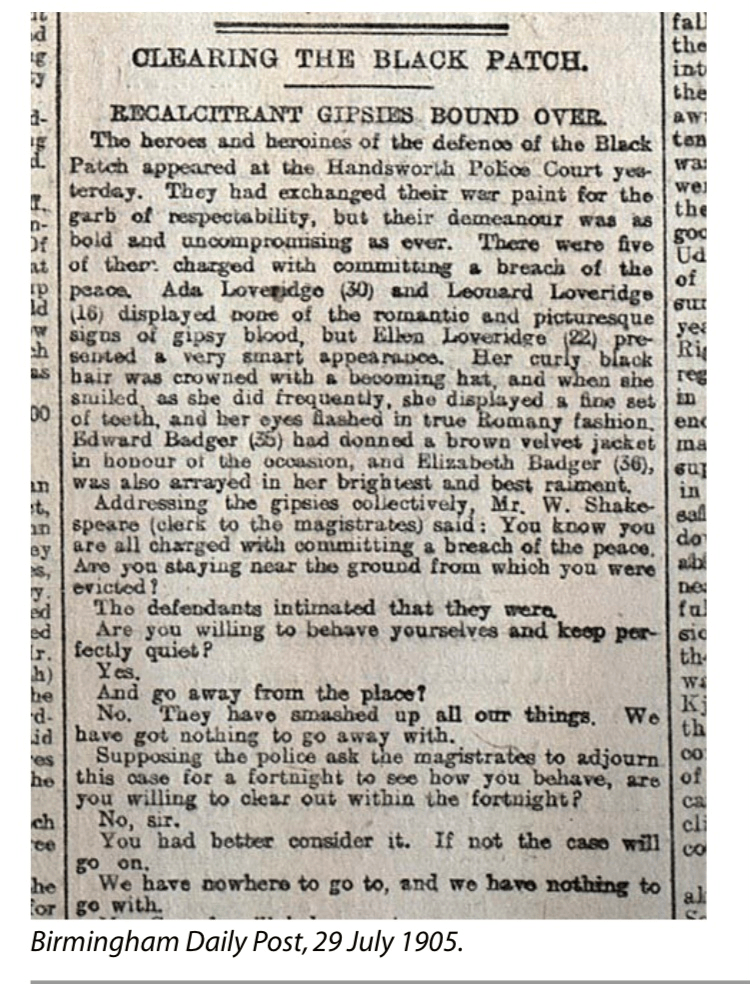

Just like prejudice in reality, even when living within housing Tommy and his family experience prejudice from within and outside of their own community. Tommy is referred to as a ‘dirty didicoi’ seemingly due to the perception of his mixed heritage and not being of ‘full-blooded’ Gypsy stock. In response to an anti-gypsy slur Tommy mocks stereotypes by stating that as well as his day job he ‘also sells pegs and tells fortunes’.
Towards the end of Peaky Blinders the promotion of fascism by elite figures is central to the storyline. Just as in reality, there was the development of the British Union of Fascists political party. Prejudice and fascist ideas contributed to categorising Gypsys as an inferior race. Whilst Peaky Blinders ends before WWII it is harrowing to know that these ideas influenced the extermination of Roma and Gypsies during the Nazi regime. Many British Gypsy and Traveller soldiers lives would have also been lost in fighting the Nazi’s in WWII due to this.
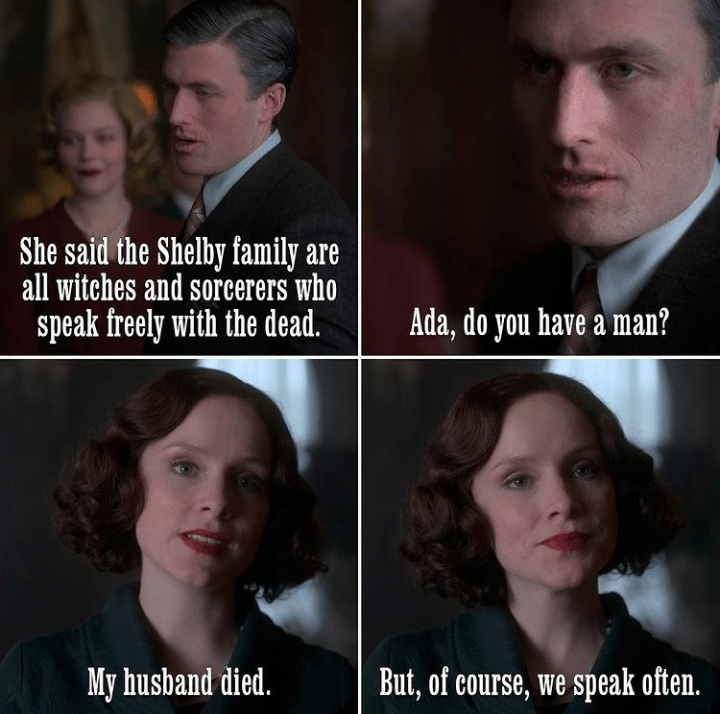
It is unfortunate that the women have less screen time in Peaky Blinders, but their personalities did shine. Ada’s character and response to prejudice is ace, whether this is responding to street hecklers, an elite eugenicist women’s ethnic cleansing ideas, or her son’s prejudice towards his sister. When her son refers to his sister as a ‘thing’ and states that she would ‘get them killed’ as she was a Black-mixed race child she responds by stating, ‘where will they send you Karl?’ whilst making him aware that he could also be subjected to persecution due to having a Jewish father and a Gypsy mother.
This year marks the end of Peaky Blinder’s episodes, the last episode is great. Tommy returns to his roots – choosing to end his days with his horse, wagon and photographs of his family. But he then wins against all the odds! Unfortunately, whilst Peaky Blinders has been celebrated there is less celebration of Gypsy and Traveller ethnicities, these were completely ignored within the documentary The Real Peaky Blinders.
Through whitewashing Gypsy and Traveller peoples histories are frequently denied. To adapt David Olusoga’s words, ‘[Gypsy and Traveller] history is British history’. An awareness of Roma Gypsy and Traveller history should not only reside with Gypsies and Travellers alone, or exist at the margins, as these are connected to all of us. As Taylor and Hinks (2021) indicate, if there is increased awareness that past and present themes of percecution this might enable increased support for Gypsy, Roma and Traveller rights – this is vital.
References:
Olusoga, D. (2016) Black and British: A forgotten History, BBC [online].
Taylor, B. and Hinks, J., (2021). What field? Where? Bringing Gypsy, Roma and Traveller History into View. Cultural and social history, 18(5), pp.629–650.
Share this:


Youth or Adult: can you tell?

This week’s blog begins with a game: youth or adult, secure estate in England and Wales. Below are some statements, and you simply need to guess (educated guesses please), whether the statement is about the youth, or adult secure estate. So, are the statements about children in custody (those under the age of 18 years old) or adults in custody (18+). When you’re ready…
- 70% decrease in custody in comparison to 10 years ago
- Segregation, A.K.A Solitary Confinement, used as a way of managing the most difficult individuals and those who pose a risk to themselves or others
- Racial disproportionality in relation to experiencing custody and being remanded to custody
- Self-harm is alarmingly high
- 1/3 have a known mental health disability
- Homelessness after release is a reality for a high proportion of individuals
- Over half of individuals released from custody reoffend, this number increases when looking at those sentenced to 6months of less
How many did you answer youth secure estate, and how many adult secure estate? Tally up! Did you find a 50/50 split? Did you find it difficult to answer? Should it be difficult to spot the differences between how children and adults are treated/experience custody?
All of the above relate specifically to children in custody. The House of Commons Committee (2021) have argued that the secure estate for children in England and Wales is STILL a violent, dangerous set of environments which do little to address the needs of children sentenced to custody or on remand. Across the academic literature, there is agreement that the youth estate houses some of the most vulnerable children within our society, yet very little is done to address these vulnerabilities. Ultimately we are failing children in custody! The Government said they would create Secure Schools as a custody option, where education and support would be the focus for the children sent here. These were supposed to be ready for 2020, and in all fairness, we have had a global pandemic to contend with, so the date was pushed to 2022: and yet where are they? Where is the press coverage on the positive impact a Secure School will make to the Youth estate? Does anyone really care? A number of Secure Training Centres (STCs) have closed down across the past 10 years, with an alarmingly high number of the institutions which house children in custody failing Ofsted inspections and HM Inspectorate of Prisons (2021) found violence and safety within these institutions STILL a major concern. Children experience bullying from staff, could not shower daily, experience physical restraint, 66% of children in custody experienced segregation which was an increase from the year prior (HM Inspectorate of Prisons, 2021). These experiences are not new, they are re-occurring, year-on-year, inspection after inspection: when will we learn?
The sad, angry, disgusting truth is you could have answered ‘adult secure estate’ to most of the statements above and still have been accurate. And this rings further alarm bells. In England and Wales, we are supposed to treat children as ‘children first, offenders second’. Yet if we look to the similarities between the youth and adult secure estate, what evidence is there that children are treated as children first? We treat all offenders the same, and we treat them appallingly. This is not a new argument, many have raised the same points and concerns for years, but we appear to be doing very little about it.
We are kidding ourselves if we think we have a separate system for dealing with children who commit crime, especially in relation to custody! It pains me to continue seeing, year on year, report after report, the same failings within the secure estate, and the same points made in relation to children being seen as children first in England and Wales: I just can’t see it in relation to custody- feel free to show me otherwise!
References:
House of Commons Committees (2021) Does the secure estate meet the needs of young people in custody? High levels of violence, use of force and self-harm suggest the youth secure estate is not fit for purpose [Online]. Available at: https://houseofcommons.shorthandstories.com/justice-youth-secure-estate/index.html. [Last accessed 4th April 2022].
HM Inspectorate of Prisons (2021) Children in Custody 2019-2020: An analysis of 12-18-year-old’s perceptions of their experiences in secure training centres and young offender institutions. London: Her Majesty’s Inspectorate of Prisons.
Share this:


Protect international law

In criminological discourses the term “war crime” is a contested one, not because there are no atrocities committed at war, but because for some of us, war is a crime in its own right. There is an expectation that even in a war there are rules and therefore the violation of these rules could lead to war crimes. This very focused view on war is part of a wider critique of the discipline. Several criminologists including, Ruggiero, DiPietro, McGarry and Walklate, to name a few, have argued that there is less focus on war as a crime, instead war is seen more as part of a metaphor used in response to social situations.
As far back as the 1960s, US President Johnson in his state of the union address, announced “The administration today here and now declares unconditional war on poverty in America”. What followed in the 1964 Economic Opportunity Act, was seen as the encapsulation of that proclamation. In some ways this announcement was ironic considering that the Vietnam war was raging at the time, 4 years before the well documented My Lai massacre. A war crime that aroused the international community; despite the numbers of soldiers involved in the massacre, only the platoon leader was charged and given a life sentence, later commuted to three and a half years incarceration (after a presidential intervention). Anyone can draw their own conclusion if the murder of approximately 500 people and the rape of women and children is reflected in this sentence. The Vietnam war was an ideological war on communism, leaving the literal interpretation for the historians of the future. In a war on ideology the “massacre” was the “collateral damage” of the time.
After all for the administration of the time, the war on poverty was the one that they tried to fight against. Since then, successive politicians have declared additional wars, on issues namely drugs and terror. These wars are representations of struggles but not in a literal sense. In the case of drugs and terrorism criminology focused on trafficking, financing and organised crimes but not on war per se. The use of war as a metaphor is a potent one because it identifies a social foe that needs to be curtailed and the official State wages war against it. It offers a justification in case the State is accused being heavy handed. For those declaring war on issues serves by signalling their resolve but also (unwittingly or deliberately) it glorifies war as an cleansing act. War as a metaphor is both powerful and dangerous because it excuses State violence and human rights violations. What about the reality of war?
As early as 1936, W.A Bonger, recognised war as a scourge of humanity. This realisation becomes ever more potent considering in years to come the world will be enveloped in another world war. At the end of the war the international community set up the international criminal court to explore some of the crimes committed during the war, namely the use of concentration camps for the extermination of particular populations. in 1944 Raphael Lemkin, coined the term genocide to identify the systemic extermination of Jews, Roma, Slavic people, along with political dissidents and sexual deviants, namely homosexuals.
In the aftermath of the second world war, the Nuremberg trials in Europe and the Tokyo trials in Asia set out to investigate “war crimes”. This became the first time that aspects of warfare and attitudes to populations were scrutinised. The creation of the Nuremberg Charter and the outcomes of the trials formulated some of the baseline of human rights principles including the rejection of the usual, up to that point, principle of “I was only following orders”. It also resulted in the Nuremberg Code that set out clear principles on ethical research and human experimentation. Whilst all of these are worthwhile ideas and have influenced the original formation of the United Nations charter it did not address the bigger “elephant” in the room; war itself. It seemed that the trials and consequent legal discourses distanced themselves from the wider criminological ideas that could have theorised the nature of war but most importantly the effects of war onto people, communities, and future relations. War as an indiscriminate destructive force was simply neglected.
The absence of a focused criminological theory from one end and the legal representation as set in the original tribunals on the other led to a distinct absence of discussions on something that Alfred Einstein posed to Sigmund Freud in early 1930s, “Why war?”. Whilst the trials set up some interesting ideas, they were criticised as “victor’s justice”. Originally this claim was dismissed, but to this day, there has been not a single conviction in international courts and tribunals of those who were on the “victors’” side, regardless of their conduct. So somehow the focus changed, and the international community is now engaged in a conversation about the processes of international courts and justice, without having ever addressed the original criticism. Since the original international trials there have been some additional ones regarding conflicts in Yugoslavia and Rwanda. The international community’s choice of countries to investigate and potentially, prosecute has brought additional criticism about the partiality of the process. In the meantime, international justice is only recognised by some countries whilst others choose not to engage. War, or rather, war crimes become a call whenever convenient to exert political pressure according to the geo-political relations of the time. This is not justice, it is an ad hoc arrangement that devalues the very principles that it professes to protect.
This is where criminology needs to step up. We have for a long time recognised and conceptually described different criminalities, across the spectrum of human deviance, but war has been left unaccounted for. In the visions of the 19th and 20th century social scientists, a world without war was conceptualised. The technological and social advancements permitted people to be optimistic of the role of international institutions sitting in arbitration to address international conflicts. It sounds unrealistic, but at the time when this is written, we are witness to another war, whilst there are numerous theatres of wars raging, leaving a trail of continuous destruction. Instead of choosing sides, splitting the good from the bad and trying to justify a just or an unjust war, maybe we should ask, “Why war”? In relation to youth crime, Rutherford famously pondered if we could let children just grow out of crime. Maybe, as an international community of people, we should do the same with war. Grow out of the crime of war. To do so we would need to stop the heroic drums, the idolisation of the glorious dead and instead, consider the frightened populations and the long stain of a violence which I have blogged about before: The crime of war
Share this:

No April Fools
The first of April has consisted of a steep 54% rise in what energy company’s can charge customers for using energy, with further rises set to occur in October. This coincides with rises to other bills such as council tax, national insurance and water within a climate of inflation. Previous to this many were struggling to make ends meet…what are these people supposed to do now?
Russia’s atrocities and Covid-19 have been blamed for the steep price increases and inflation. I suspect that employers will be using this as a reason to not increase the persistent low rises in wages that workers are receiving, all whilst their bosses are becoming richer and richer. Of course, both Russia and Covid will have a significant impact on the economy, however, it does not take a genius to be aware that people have been struggling to survive well before this, hence terms like, food poverty, period poverty and fuel poverty predate these issues. Also, so do the persistent low rises in wages for workers.
Apparently, MPs are due a £2,200 pay rise which whilst it seems low (2.7%) compared to inflation, a few MPs themselves (such as Zarah Sultana) have stated that they do not need this pay rise as they already receive a high paying wage.
Oh, and let us not forget that the increasing energy prices will ensure that privatised fuel companies such as Shell and BP continue to profit, with a predicted profit of £40 BILLION for this year.
Meanwhile benefits for those who are not formally employed and spend a higher proportion of money on household bills and rent are set to increase by 3.1% – a rise which will not cover these price increases.
How is it that employers and the State cannot afford to pay people more – but can ensure high wages for the already rich, privileged and powerful?
It is not surprising that the government’s measures to deal with the problem, such as one-off payments and energy loans, have been heavily criticised as inadequate and significantly failing to support the lowest income homes. The government employs a group of elites and many are completely out of touch with reality. Apparently the man presiding over these measures, millionaire Rishi Sunak and his billionaire wife, often donate to charitable causes, such as donating £100,000 to Rishi’s former elitist private school. Because a private school in need is a pressing cause…yeah right!

The opposition parties have rightly criticised the Conservatives take on this but listening to Keir Starmer’s bumbling take on what Labour would do to solve these issues is also worrying. During an interview he stated that windfall tax could be a solution ‘for right now’ with no feasible long term plan. My usual vote for Labour in May will be damage control against more Tory time in power.
A long term TAX on THE RICH to use this money to support those that need it is not even that simple, given that the government accepts donations from the super-rich it is unlikely that decisions would be made to genuinely reduce inequality between the rich and poor. The world will never be a better place if those in power continue to focus on their own interests and huge profits in place of looking after people. The rise in energy prices on the first of this month was no April Fools’ joke…I really wish that it was.
Share this:


Auschwitz – secrets of the ground
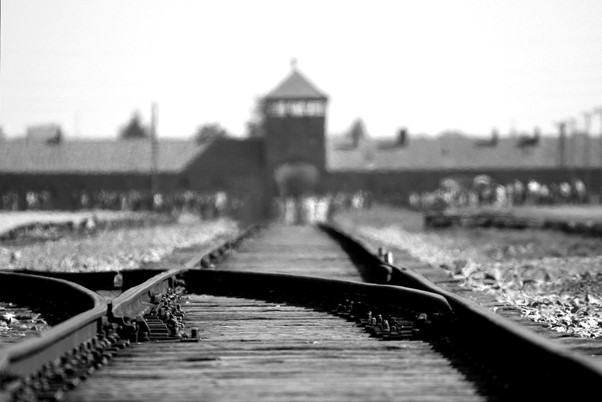
Indifference is not a beginning; it is an end. And, therefore, indifference is always a friend to the enemy, for it benefits the aggressor – never his victim
Elie Wiesel
I have been fortunate enough in my life to have been able to live and travel abroad, a luxury you should never take for granted. Having traveled in every continent there are plenty of things I will never forget, mostly good but one thing that will stay with me will be Auschwitz. It is hard to get excited about visiting Auschwitz, but it is also hard to not get excited about visiting Auschwitz. The day I visited Auschwitz, on the journey there a flurry of strange thoughts went through my head, perhaps ones you would only have when attending a funeral where you are supposed to be in grief. What do you wear, should I smile, what do you talk about, essentially you are creating a rule book inside your head of how not to be offensive. It’s a strange thought process and perhaps completely irrational, one of which I will probably never go through again. If I had to describe Auschwitz in one word, that word would be haunting and I could write for hours about Auschwitz without ever being able to get across the feeling of visiting it, but instead, I am going to share with you a poem I wrote on the journey back from Auschwitz, this poem has never seen the light of day and has been in my diary for over a decade, until now, but it feels like a perfect time to finally share, it’s called secrets of the ground.
Dark skies and tearful eyes,
only God knows the secrets this ground hides.
The flowers mask the crimes of old,
the walls are chipped by bullet holes.
Haunting sounds drowned out by hymns,
the shoes of children too scared to blink.
A cold wind howls in these Polish fields,
one million people how can this be real.
A train stands alone on the blackened track,
barb wire fences to hold them back.
The secrets out, the grounds have spoken,
we must never forget the lives that were taken.
Share this:


Holocaust Memorial Day: 27th January
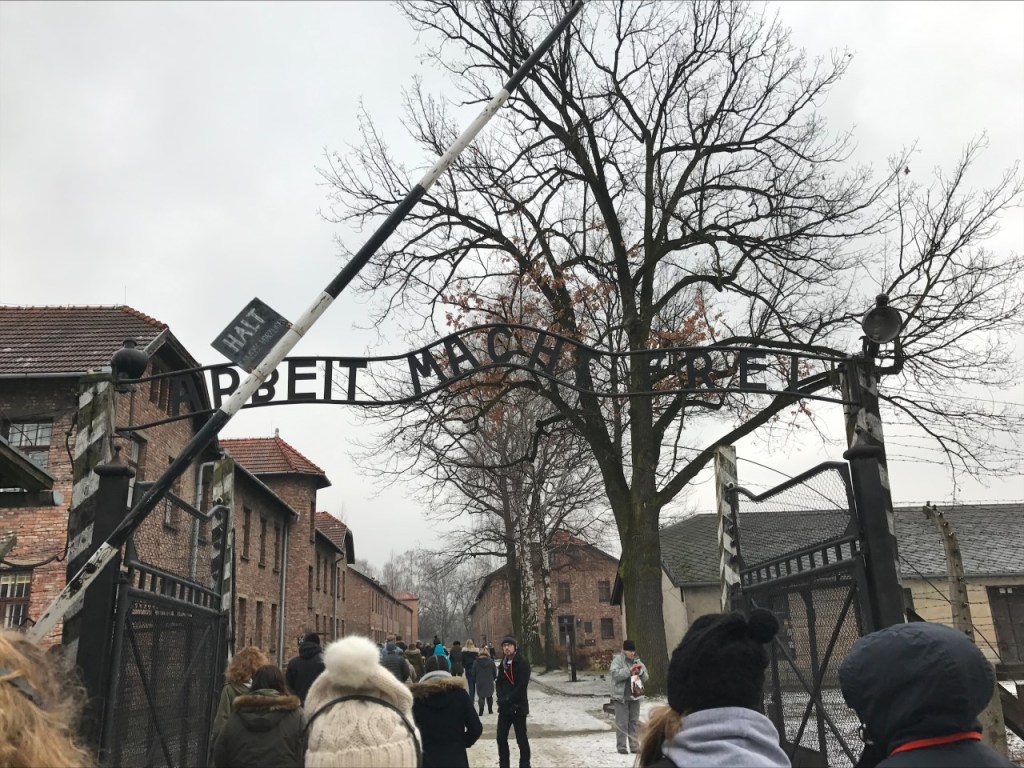
The 27th January marks an important event, Holocaust Memorial Day. This is a day to remember those who were murdered by the cruel Nazi regime, including 6 million Jews. These people were subject to the worst treatment that the modern world has ever seen. The Holocaust reminds us of how dangerous humankind can be to one another. These Nazi men went to work each morning knowing what they were doing and going home to their family at the end of their day of murders. This is something that I cannot comprehend, people that were so truly evil to degrade a whole group of people just because of who they are.
As someone who has had the opportunity to visit Auschwitz on an education trip while at school, I can say that the place is like nothing I could have ever imagined. The vast size and scale of both camps was inconceivable. To be in a place where so many people suffered their worst pains and lost their lives, it was a harrowing experience. From the hair to the scratch marks on the gas chamber walls, the place felt like no other. There was an uncomfortable feeling when you enter the gates of Arbeit macht frei, meaning, work will set you free. To know that so many walked under these gates not knowing what their fate held. And all of this for the Jews was because of their religion and the threat Hitler perceived them to have on Germany.
This is a topic that has always interested me, questioning why the Jewish community? My dissertation research so far has shown how the Jews were scapegoated by the Nazis for their successful businesses in and around Germany. Many Jewish families owned banks, jewellers and local businesses. The Nazis used this peaceful group of people and turned them into the enemy of the Nazi regime. The Jewish community was seen as a financial threat to the Nazis and needed to be eradicated for Nazi German to be successful. The hatred of the Jews developed, bringing in more dated views of the Jewish community. Within Nazi Germany, they were treated like filth and seen as subhuman because of their ‘impure’ genetics. Anyone seen to be from Jewish decent was seen as dirty and an unwanted member of society.
The stereotypes that the Jews are rich continued even after the war and still to this day, along with the stereotypes that Jews are the evil of society. Since March 2020, there have been conspiracy theories circulating on social media that the Jewish community was behind the COVID 19 pandemic. Many are suggesting that the Jewish people are trying to gain financially from the pandemic and destroy the economy. This is not something that is new, the Jewish community has faced these prejudices for as long as time.
My dissertation incorporates a study on social media and archival research. This project has taken me to the Searchlight Archives, located at the University of Northampton. The information held here shows how Britain’s far right movements carried on their anti-Semitic hate after the end of WWII. It’s very interesting to find that antisemitism never went away and still has not. Recently, the Texas Synagogue hostage crisis has show how much anti-Semitic hate is still in society. Three days after the Texas crisis, there was no longer headline news about it and those tweeting about it were part of the Jewish community.
Does this suggest that social media is anti-Semitic? Or is anti-Semitic hate not shared on social media because it is not of interest to people? Either way, Jews are still treated horribly in society and seen as a subhuman by many. This is the sad truth of antisemitism today, and this needs to change.
Share this:


Rule makers, rule breakers and the rest of us
There are plenty of theories about why rules are broken, arguments about who make the rules and about how we deal with rule breakers. We can discuss victimology and penology, navigating our way around these, decrying how victims and offenders are poorly treated within our criminal justice systems. We think about social justice, but it seems ignore the injustice perpetrated by some because we can somehow find an excuse for their rule breaking or point out some good deed somewhere along the line. And we lament at how some get away with rule breaking because of their status or power. But what is to be done about people that break the rules and in doing so cause or may cause considerable harm to others; to the rest of us?
Recently, Greece imposed a new penalty system upon those over 60 that are not vaccinated against Covid. Pensioners who have had real reductions in their pensions are now to be hit with a fine, a rolling fine at that, if they do not get vaccinated. This is against a backdrop of poor vaccination rates which seem to have improved significantly since the announcement of what many see as draconian measures by a right-wing government. There are those that argue that vaccination ought to be a choice, and this has been brought into focus by the requirements for health workers and those in the care profession to be vaccinated in this country. And we’ve heard arguments from industry against vaccination passports which would allow people to get into large venues and a consistent drip-drip effect of how damaging the covid rules are to the leisure industry and aviation, as well as the young people in society.
So, would it have been far more acceptable to have no rules at all around Covid? Should we have simply carried on and hoped that eventually herd immunity would kick in? Let’s not forget of course that the health service would have been so overwhelmed that many people will have died from illnesses other than Covid (they undoubtedly have to some extent anyway). The fittest will have survived and of course, the richest or most resourceful. Businesses will have been on their knees as workers failed to turn up for work, either because they were too ill or have moved on from this life and few customers will have thought about quaffing pints, clubbing, or venturing off to some faraway sunny place (not that they’d be particularly welcome there coming from plague island). It would have felt more like some Darwinian evolutionary experiment than civilised society.
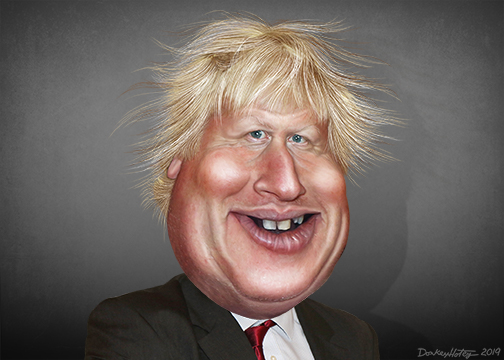
It seems that making some rules for the good of society is necessary. Of course, there will be those that break the rules and as a society, we struggle to determine what is to be done with them. Fines are too harsh, inappropriate, draconian. Being caring, educating, works for some but let’s be honest, there are those that will break the rules regardless. Whilst we can argue about what should be done with those that break the rules, about the impact they have on society, about victims and crimes, perhaps the most pressing argument is about equality of justice. The rest of us, those that didn’t break the rules, might question how draconian the rules were (are) and we might question the punishments meted out to those that broke the rules. But what really hurts, where we really feel hard done by, let down, angry is to see that those that made the rules, broke the rules and for them we don’t get to consider whether the punishment is draconian or too soft. There are no consequences for the rule makers even when they are rule breakers. It seems a lamentable fact that we have a system of governance, be that situated in politics or business, that advocates a ‘do as I say’ rather than ‘do as I do’ mentality. The moral compass of those in power seems to be seriously misaligned. As the MP David Davis calls for the resignation of Boris Johnson and says that he has to go, he should look around and he might realise, they all need to go. This is not a case of one rotten apple, the whole crop is off, and it stinks to high heaven.
Share this:

And still the message is the same…
Following on from last week’s blog entry from @5teveh, @jesjames50 explores further dimensions of Sarah Everard’s murder.
Recently we saw the sentencing of Sarah Everard’s kidnapper, rapist and murderer. He has received a whole life sentence. As a woman within society I welcome this sentence. As a criminologist I am at a loss. There is a lot to unpick here in terms of ‘justice’ and whether this has been served. It is pertinent to question the use of a whole life order on a violent, misogynistic, kidnapper, rapist and murderer; who cooperated after arrest, who pleaded guilty and expected the full force of the law. But I shall leave that to another day, as the media’s portrayal of the sentencing and aftermath is what is currently fuelling my anger. The message remains the same, women can and should do more to prevent their victimisation.
The sentence given is at odds with the coverage which has followed. Handing down the most severe sentence available in England and Wales represents the seriousness of the offence, and the damage it has caused to those directly involved and those further afield. The possibility that the offender was in a position of trust, has violated this trust and committed abhorrent acts appears to justify the whole life order. The comparison to terrorism, something which violence against women has been linked to before within academia, is also very telling. But what is the focus? The focus is on how women can go about feeling safe in society and make lines of inquiry if they have doubts about a police officer’s conduct! Here the onus is on women acting in a manner of keeping themselves safe. The message remains the same: women should prevent their victimisation. Excellent I’ll add this nugget of information to my bag of ‘top tips for walking alone at night’.
Why aren’t the media building on this platform to challenge misogynist attitudes? Why are they not raising awareness of violence against women? Sarah’s kidnapping, rape and murder is horrific: but what about the women who undergo daily violence at the hands of their partners, family, friends? These individuals are also in a position of trust and abuse this position to cause harm to women! Here the media could raise awareness about how deep-rooted the issue of violence against women is, but instead they reinforce the idea that women can prevent their victimisation, and that violence occurs at night, by a stranger, and will have the offender brought to justice. This is not the reality for the vast majority of women. It is an extreme and exceptional case (no doubt something True Crime will encapsulate in years to come) and this is further reinforced by the sentence given. Yet violence against women is not exceptional, or rare: it is an everyday reality! Something the media has failed to draw attention to. And by failing to cement Sarah’s kidnapping, rape and murder in the wider context of violence against women, it raises the potential to set a standard of violence against women. Those everyday cases which do not fit the same circumstances are not considered an issue.
My intentions are in no way to take away from the abhorrent crimes committed against Sarah. The crimes sit in the context of violence against women which is still a fundament issue overlooked within society, and has been overlooked once again. And the rhetoric which has followed, yet again, is around how women can protect themselves in the future. The message remains the same…