
Home » Research (Page 4)
Category Archives: Research

The number’s up for quantitative research! Or is it?

As my colleagues will no doubt confirm, I’m not a fan of numbers. Although, I always enjoyed maths, particularly algebra, my distaste for numbers comes when they are applied to people. Whilst I appreciate there are a lot of us, somewhere around 7.6 billion on the planet, the reduction of a human to a number doesn’t sit comfortably. This aversion to numbering people partly stems from academic study of the Holocaust, which was facilitated by the Nazi’s determination to reduce individual human lives first to digits and then to ashes. It also comes from my own lived experience, particularly in education, of knowing that individuals can and do change.
Criminologists such as Stanley Cohen (1988), Nils Christie (1997) and Jock Young (2011) have long recognised the fundamental flaws inherent in much quantitative criminology. They recognise that numbers are often used to obfuscate and confuse, taking readers down a route whereby they are presented as having their own intrinsic meaning, entirely distinct from the people whose data is being manipulated. Furthermore, those numbers are deemed scientific and authoritative, having far more sway than qualitative research predicated on finding meaning in individual lives.
Despite my antipathy to numbers, I have spent the last few months studying attempts to quantify a particular prison population; ex-servicemen. Much of this research is flawed in the same way as recognised by the eminent criminologists above. Instead, of answering what appears on the surface to be a straightforward question, many of these reports struggle to even define what they are trying to measure, let alone make sense of the measurements.
All this has made me think about the way we measure “engagement”. Last week, as you may have noticed from Manos’ entry, was the blog’s first birthday. Underneath, the professional front page lies, what WordPress rather hopefully describes, as ‘Stats’. From here, it is possible to identify the number of visitors per day, month and year, as well as the number of views. There is also a detailed map of the world, displaying all the countries from which these visitors are drawn. In essence, I have enough data to tell you that in our first year we have had 3,748 visitors and 5,124 views from 65 countries.
All of this sounds very encouraging and the team can make statements about how views are up on the period before, or make claims that we have attracted visitors from countries for the first time. If, so inclined, we could even have a leader board of the most popular contributor or entry; thankfully that doesn’t seem appeal to the team. If I wanted to write a report, I could include some lovely, bar or pie charts, even some infographics; certainly if you look below you will see a rather splendid Wordle which displays 233 different categories, used a total of 781 times.
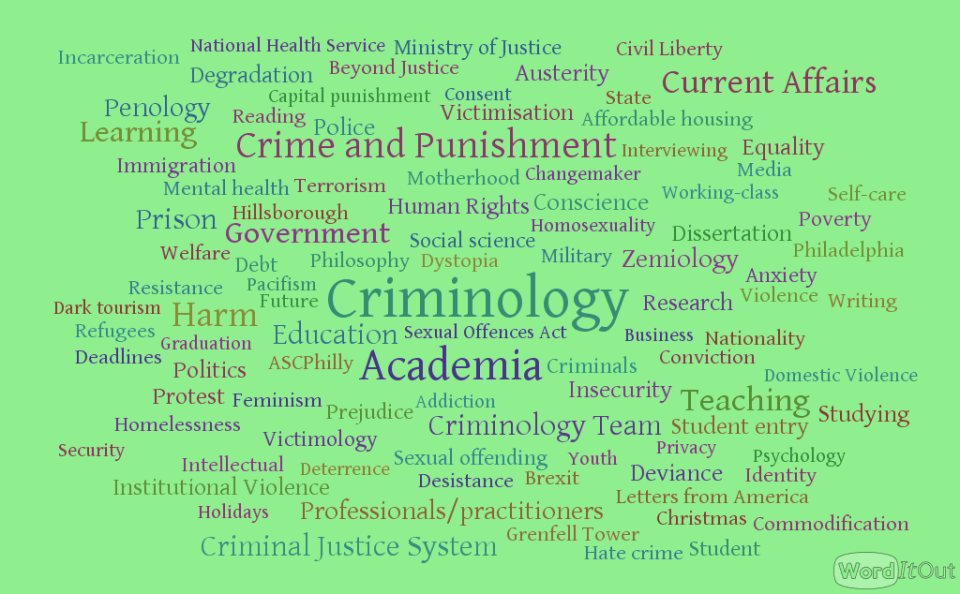
However, what exactly do we know? I would argue, not a lot. We have some evidence that some people have visited the blog at least once, but as to how many are regular readers; we have no clue. Do they read the entries and do they enjoy them? Again, no idea. Maybe they’re just attracted by particular pictures (the evidence would suggest that the Yellow Submarine, Kermit, the Pink Panther and tattoos do exceedingly well).[i] There is some evidence that many of the visitors come via Facebook and Twitter and these offer their own illusion of measurable activity. Certainly, Twitter offers its own ‘Analytics’ which advises me that my tweet containing Manos’ latest blog entry earned an impressive 907 ‘Impressions’, and 45 ‘Engagements’ which equals an ‘Engagement Rate’ of 5%! What any of that means; your guess is good as mine! Does scrolling mindlessly on your newsfeed whilst waiting for the kettle to boil count as an impression or an engagement? Should I be impressed or embarrassed by a 5% engagement rate – who knows? If I add it to my imaginary report, at least I’ll be able to add some more colourful charts to accompany my authoritative narrative. Of course, it will still be largely meaningless but it should look splendid!
More concerning are the repercussions to any such report, which would seem to imply that I had total control over improving such metrics and if they didn’t improve, that would ultimately be down to my inertia, inability or incompetence. Of course, the blog is a voluntary labour of love, created and curated by a group of like-minded individuals… However, if we consider this in relation to criminology and criminal justice, things take a more sinister turn….the numbers may indicate something, but at the end of the day those numbers represent people with their own ideas, concerns and behaviours. Discussions around payment by results seem to miss this vital point, but of course it means that failure to achieve these results can be blamed on individuals and companies. Of course, none of the above denies quantitative data a place within Criminology, but it has to be meaningful and not just a series of statements and charts.
Now, I’ve got my anti-quantitative rant of my chest, I’ll leave the final words to Nils Christie (1997) and his command to make criminology exciting and passionate as befits its subject matter. In his words, avoid ‘[l]ong reports of the obvious. Repetitions. Elaborate calculations leading to what we all know’ (Christie, 1997: 13).
Instead we should always consider:
[h]ow can it be like this? How come that so much criminology is that dull, tedious and intensely empty as to new insights? It ought to be just the opposite, in a science based on material from the core areas of drama. Our theories are based on situations of conflict and heroism, danger and catastrophe, abuses and sacrifices – just those areas where most of our literary heroes find their material. And still so trivial! (Christie, 1997: 13).
Rather than mindlessly churning out quantitative data that looks and is perceived as sophisticated, as criminologists we need to be far more critical. If you don’t believe Christie, what about taking heed of Green Day’s command to ‘question everything? Or shut up and be a victim of authority’ (Armstrong et al., 2000).
References:
Armstrong, Billie Joe, Dirnt, Mike and Cool, Tre, (2000), Warning [LP]. Recorded by Green Day in Warning, Reprise: Studio 880
Christie, Nils, (1997), ‘Four Blocks Against Insight: Notes on the Oversocialization of Criminologists,’ Theoretical Criminology, 1, 1: 13-23
Cohen, Stanley, (1988), Against Criminology, (Oxford: Transaction Books)
Young, Jock, (2011), The Criminological Imagination, (London: Polity Press)
A revised and reworked submission of this entry was published on the British Society of Criminology blog on 1 June 2018.
[i] This point will be “tested under experimental conditions” by the gratuitous inclusion of a picture showing teddy bears “reading”.
Share this:


Why you should trust your work

Bethany Davies is an Associate Lecturer teaching modules in the first year.
It is only human to doubt yourself in certain situations; however, academia can be a problematic situation to doubt your ideas and abilities. It can lead you to change your standpoint unnecessarily and also create so much stress that you give up on an idea or project entirely.
I deal with this less so now since my university experience but still regularly and I felt it may provide comfort to those currently studying or recently graduated, these examples are personal and are only two of many. In particular I want to address doubting your own ideas and work and how important it is to keep challenging those thoughts.
Upon starting university, my first ‘big essay’ (I describe this with humour as it was 3000 words, but as a first year that can seem like quite the ask) was a biographical assignment. This assignment required an interview with a family member or anyone who would be willing to talk to you and to apply that to research by highlighting some key events/accomplishments. I feared writing that essay as I had many friends with parents who were lawyers or grandparents who had been in the war or immigrants. These stories surely would be so interesting and my essay on my dad who worked in a warehouse would be seen as boring, perhaps. This was my first experience with fear and doubt over my work, but then I did the interview, wrote the essay, took a deep breath and submitted. Turns out it was one of my favourite pieces of work and the programme leaders liked it. It was an honest essay and while not glamorous, it was personal to me and that made the approval and grade that more rewarding.
In my second year, I conducted my placement at a probation office and based my research around a case study of one male who was doing an English class and aimed to discuss the success of that class. After around 8 weeks of observations and an interview with the male. I went to my seminar leader at the time (@paulaabowles) in a complete panic and almost teary-eyed. I told her how I felt my research was not good enough because the male was lying to me, in fact he was almost lying to the whole probation experience as he was more or less just turning up to tick the boxes he needed but then conducting his behaviour differently to me in certain situations and the interview. I felt I had failed as a researcher and also as a teacher almost, as I was assisting in the teaching of the class he was in. I was then told some of the great truths of research and also why I had not failed and actually I had done very well. My research was good research and I just had not realised it. The research didn’t find what I wanted it to, in fact it found the opposite, which was still good research. My research which I had titled ‘Playing the system’ had actually proved to not be a failure and my doubts were unnecessary but not anything to be ashamed of. As in my quest at the time to find answers of why was I such a ‘bad researcher’ and interviewer, I found a plethora of other people online and among peers with the same doubts over some great work they had produced.
Whether it be doubts or fear of speaking up in fear of failure or sounding stupid, I hope others may be able to see not only are they not alone, but actually you are normal because of these doubts. We should just maybe work on believing in our work more and not waiting to get the approval of others for those ideas. With this I feel it is fitting to use one of my favourite quotes from Bertrand Russell:
“The whole problem with the world is that fools and fanatics are always so certain of themselves, and wiser people so full of doubts.”
Share this:


Is education more fun than building a Lego Yellow Submarine? Discuss

This week some students, independently and across the years, introduced me to the novel idea that education should be “enjoyable” and “fun”. Furthermore, if it wasn’t enjoyable, it wasn’t being done right. Given Criminology’s subject matter is often grim, dark, focusing on the worst aspects of humankind, enjoyable and fun are not descriptions that often appear in relation to the discipline. Certainly, such a perspective is not one that I personally recognise; a day at an art gallery, playing Hungry Hippos with two little people, a nice bottle of wine, lunch with friends, building a Lego Yellow Submarine etc are things that I would say are enjoyable, perhaps even fun. But education……I’m not convinced! What follows are my vague ramblings around a subject which is very close to my heart (you are warned!).
All of the enjoyable activities I have described above are ones that I spend very little of my time doing and that to me, is part of their enjoyability (if such a word exists). They are attractive because they are rare and unusual, in my life at least. But education, learning, knowledge are part and parcel of my everyday existence, and dare I say fundamental to who am I. However, does any of this preclude education from being fun? Maybe, I just take for granted my thirst for knowledge in the same way as my thirst for water, just everyday appetites that need to be fed to maintain equilibrium and optimal performance.
I love considering new ideas and new perspectives, particularly if they challenge my thinking and jolt me out of complacency, so I want to consider this concept of enjoyable education. I’ve always been a curious person, there’s lots of questions that I want to know the answer to and they generally begin with “why”? Like all children, I expect I drove my parents mad with the constant questions; never fully satisfied with the answer. I can trace my first early, tentative steps into criminological thinking to when I was a child and regularly had to pass HMP Holloway[1] on the way to various hospital appointments. I used to wonder who lived in this huge, forbidding building, why they were there, what had they done, when would they get out and where would they go? Some decades on, I have answers to some of those questions but I’m still actively searching for the others. This, of course, is experiential learning and children’s books (at that time) offered little by way of answers to such profound criminological questions.

At school, the type of learning I liked best was when I could explore for myself. An experienced and knowledgeable teacher or lecturer explaining complex ideas could open the door so far, but I wanted to find out for myself as much as possible. For me, the best educationalists are those that gently guide and enable, not those who deliver information on demand. They also engender self-confidence and self-discipline encouraging the scholar to take control of their own intellectual journey. All of this leads me to the conclusion that learning is intrinsically neither enjoyable nor fun, although both may be by-products. Education, knowledge, learning, all of these are painful, challenging, at times they appear almost impossible. But! The level of personal satisfaction, achievement and growth means that ‘some kind of happiness is’, not as the Beatles suggest ‘measured out in miles’, but through intellectual endeavour (Lennon and McCartney, 1969). And to answer the essay question I set in the title, Lego has many charms but independent, self-direction is not one of them. Provided you follow the step-by-step illustrated instructions you will have your very own Yellow Submarine, but there are no surprises, whether positive or negative, which means I have no intellectual investment in the process. Furthermore, take the instructions away and I would not be able to recreate this “masterpiece”. Having said that, it does look rather lovely on my book case 🙂
Lennon, John and McCartney, Paul, (1969), Hey Bulldog, [LP]. Recorded by The Beatles in Yellow Submarine, Northern Songs: Apple
[1] HMP Holloway closed its doors for the final time in July 2016.
Share this:


Thank f**k it’s Christmas!

Jessica is an Associate Lecturer teaching modules in the first year.
We have arrived at that time of the year once again: CHRISTMAS! ‘Tis’ the season to celebrate, party, give and receive gifts, catch up with friends and family, and most importantly… catch up on some much needed sleep. We have arrived at the end of the first term of the academic year, and all I can think is: Thank f**k it’s Christmas. The first term always feels the longest: whether you are first years beginning your academic journey, second and third years re-gathering yourselves after the long summer, or staff getting back into the swing of things and trying to locate and remember all the new and old names. But now is the time to kick back, relax and enjoy the festive season: ready to return to academic life fresh faced and eager come the New Year, ready to start it all over again. Well not quite…
According to Haar et al., (2014) work-life balance is something which is essential to all individuals, in order to ensure job satisfaction, life satisfaction and positive mental health. If Christmas is as needed as it feels; perhaps we are not managing a good work-life balance, and perhaps this is something we can use the Christmas break to re-consider. Work-life balance is subjective and relies on individual acceptance of the ‘balance’ between the commitments in our lives (Kossek et al., 2014). Therefore, over the Christmas break, perhaps it would be appropriate to re-address our time management skills, in order to ensure that Easter Break doesn’t feel as desperately needed as Christmas currently does.
Alongside an attempt to re-organise our time and work load, it is important that we remember to put ourselves first; whether this be through furthering our knowledge and understanding with our academic endeavours, or whether it is spending an extra 15 minutes a day with a novel in order to unwind. Work-life balance is something we are (potentially) all guilty of undermining, at the risk of our mental health (Carlson, et al., 2009). I am not suggesting that we all ignore our academic responsibilities and say ‘yes’ to every movie night, or night out that is offered our way. What I am suggesting, and the Christmas break seems like a good place to start, is that we put the effort in with ourselves to unwind, in order to ensure that we do not burn out.
Marking, reading, writing and planning all need to be done over the Christmas break; therefore it is illogical to suggest taking our feet off the pedals and leaving academia aside in order to have the well needed break we are craving. What I am suggesting, is that we put ourselves in neutral and coast through Christmas, without burning out: engaging with our assignments, marking and reading, therefore still moving forward. BUT, and it is a big but, we remember to breathe, have a lie in, go out and socialise with friends and family, and celebrate completing the first term of this academic year. And with this in mind, try to consider ways, come the new term, where you can maintain a satisfying work-life balance, so that when Easter comes, it doesn’t feel so desperately needed.
However, it is highly likely that this will still be the case: welcome to the joys and stresses of academia.
Merry Christmas everyone!
References:
Carlson, D.S., Grzywacz, J.G. and Zivnuska, S. (2009) ‘Is work family balance more than conflict and enrichment?’ Human Relations. 62(10): 1459-1486.
Haar, J.M., Russo, M., Sune, A. and Ollier- Malaterre, A. (2014) ‘Outcomes of work-life balance on job satisfaction, life satisfaction and mental health: A study across seven cultures’. Journal of Vocational Behaviour. 85: 361-373.
Kossek, E.E., Valcour, M. and Kirio, P. (2014) ‘The sustainable workforce: Organizational strategies for promoting work-life balance and well-being’. In: Cooper, C. and Chen, P. (Eds) Work and Well-being. Oxford: Wiley-Blackwell. Pp:295-318.
Bibliography:
Ashurst, A. (2014) ‘How to… Manage time and resources effectively’. Nursing and Residential Care. 16(5): 296-297.
Kuhnel, J., Zacher, H., De Bloom, J and Bledow, R. (2017) ‘Take a Break! Benefits of sleep and short breaks for daily work engagement’. European Journal of Work and Organization Psychology. 26(4): 481-491.
Logan, J., Hughes, T. and Logan, B. (2016) ‘Overworked? An Observation of the relationship Between Student Employment and Academic Performance’. Journal of College Student Retention: Research, Theory and Practice. 18(3): 250-262.
Lyness, K.S. and Judiesch, M.K. (2014) ‘Gender egalitarianism and work-life balance for managers: Multisource perspectives in 36 countries’. Applied Psychology. 63(1): 96-129.
Mona, S. (2017) ‘Work-life Balance: Slow down, move and think’. Journal of Psychological Nursing and Mental Health Services. 55(3):13-14.
Share this:


Tackling Firearms Trafficking: Follow the Gun!

Dr Helen Poole is Deputy Dean in the Faculty of Health and Society and Lead for University of Northampton’s Research Centre for the Reduction of Gun Crime, Trafficking and Terrorism
Last week I attended the 4th Interpol Firearms Forensics Symposium in Dubrovnik, Croatia. This was the second I have attended, having presented the interim findings of the EU Project EFFECT in Singapore in 2015. EFFECT, which I co-lead with Professor Erica Bowen, looked at many aspects of gun crime, but the focus on trafficking became the predominant area of interest from our findings and recommendations following the Paris attacks, and was a strong focus of this year’s event. In particular, the links between organised firearms trafficking and terrorism were a key focus.
The UK is landlocked and has some of the most rigorous firearms licensing regulations and criminal legislation in the World which helps to keep us relatively safe from this threat, but still we are seeing rising rates of gun related crime in the UK, and some of the guns in use are moving from post-conflict areas such as the Balkan region. In 2015 The Shilling Gang were intercepted smuggling a large haul of military grade firearms into the UK via boat, a number of which emanated from Eastern Europe, and we know that firearms, their parts and accessories, are being imported from the US and Africa via both the dark web and the open net. The threat from junk, antique, converted and 3D printed weapons also present a threat.
Approximately 200 law enforcement officers, forensics experts and academics were present at the event, which highlighted two issues above all else: the importance of investigating officers to ‘follow the gun’; and the need for international cooperation to reduce the threat posed by small arms and light weapons. All too often officers will seize a firearm and identify the suspect, and close the case as detected. However, such an approach risks losing valuable intelligence in terms of where the gun came from, where else it might have been used, and the identification of trafficking routes. By using ballistics comparison technology, such as the International Ballistics Intelligence Network (IBIN), it is possible to compare ballistics intelligence to match crime scenes and, when combined with other forms of evidence and intelligence, identify the individuals or organised groups behind the supply of weapons. This may also lead to the detection of more crimes. However, this requires cooperation between nations to share information in a timely way, facilitated in many cases by Interpol, as well as a change in the mindset of detectives. Following the gun may be regarded as merely creating more work for the individual officer or department, and the detection of the individual crime may be required as the only positive outcome required. However, in terms of harm reduction, following the gun is more likely to reduce the number of future victims, and the serious harm caused to families and communities as a result of the number of crime guns in circulation.
Share this:


Reading is dead, long live the book

The first week of teaching is always a bit of a culture shock. The transition at the end of term from teaching to other activities and vice versa marks a change of tempo and a change of focus. For me, the summer is a time of immersion in reading, thinking and writing. All of these activities continue throughout the year but far less intensively. It’s is perhaps ironic then, that this week’s blog post has left me struggling for ideas…
Previously, I have blogged about the stresses and strains of writing, so this week I thought I might turn my attention to reading; a far more pleasurable personal experience. The first questions is why read? The simple answer is to accumulate knowledge, to find the answer to a question and to educate and entertain. Arguably, all of these purposes can be achieved far more easily by looking on the internet, getting a quick (if not always correct) answer. Why bother learning things when the internet can provide information 24 hours a day? Furthermore, who can fail to find something to entertain and amuse on the television, in the cinema or on the internet? Perhaps the death knell for the old-fashioned art of reading books is sounding with increasing urgency and volume? I disagree!
I learnt to read at around the age of 5 and very quickly I was hooked. Throughout my childhood I was teased for my seeming inability to put a book down even with eating or walking. This never dissuaded me away from the book and even when that one was finished, there would always be another one to take its place. This reading “addiction” has never left me and has meant that I have been able to explore mythical places such as Eastasia, Erewhon, Gilead, Lilliput, Manderley, Narnia and Utopia and without even leaving my armchair. I have explored America, Australia, Botswana, Germany, India, the Netherlands and South Africa to a name a few, not to mention my home city, both over ground and underground. In my reading life, I have travelled on the Orient Express, fought in the American Civil War, WWI and WWII, hidden from Nazis, as well as served prison sentences in Reading Gaol and Robben Island. I have solved crimes with Mikael Blomkvist, Scout Finch, the Famous Five and Hercule Poirot. I have felt the pains of Lady MacBeth, Jane Eyre and the second Mrs de Winter, been left unmoved by Flora Poste and Jay Gatsby and felt terrorised with Joanna Eberhart, Offred and Gregor Samsa.
Whilst the above may illustrate my love of reading, it does not really explain why it is so important to me and my career. For one, it is the only activity that really holds my concentration, particularly for extended periods of time. In the twenty-first century, where life seems so fast-paced and we jump from screen to screen, triggered by notifications as if we are one of Pavlov’s dogs, such a skill requires protection and cultivation. Second, it is intensely independent and personal; I can share stories with others, I can even discuss books in detail, but my reading is my own. Thirdly, and probably the most important for criminology is the opportunity to try someone else’s life for size. The famous line from Harper Lee; that ; ‘[y]ou never really understand a person until you consider things from his point of view – until you climb into his skin and walk around in it’ sums this up beautifully (1960/2006: 30). By reading accounts of crime, criminality, victimisation and criminal justice; even if fictionalised, we have an opportunity to test out ideas, to find out how comfortable we are with responses, actions and penalties. In particular, dystopic novels offer the unique potential to imagine the world differently. Whilst on the surface such texts, as with criminology, are presented as negative; dealing with uncomfortable, frightening and disturbing behaviours and responses, they are ultimately full of hope. The potential for change is both explicit and implicit in dystopic fiction and criminology; all is never lost, hope remains no matter what.
If you still need to be persuaded by my argument for reading everything and anything that can get your hands on, perhaps Beccaria’s words of wisdom will help ‘I should have everything to fear, if tyrants were to read my book, but tyrants never read’ (1872: 18).
And after all, who wants to be a tyrant? Not me!
Beccaria, Cesare, (1872), An Essay on Crimes and Punishments, (Albany: W. C. Little Co.), [online]. Available from: http://oll.libertyfund.org/index.php?option=com_staticxt&staticfile=show.php%3Ftitle=2193&Itemid=27 [Last accessed 24 March 2012]
Lee, Harper, (1960/2006), To Kill A Mockingbird, (London: Arrow Books)
Share this:


Life in the UK: Nigerians migrating from the other side
Damilola is a 2017 graduate having read BA Criminology with Sociology. Her blog entry reflects on the way in which personal experience can inform and be informed by research. Her dissertation is entitled Life in the UK: The individual narratives of Nigerians living in the United Kingdom and the different problems they faced during their integration into the UK
During my research on the topic of migration and integration, it was important to me, to make the individuals the focal point. This is because the majority of research in this area, depicts a holistic perspective. Therefore, understanding each individual story was vital during my research. It enabled an insight into the different coping mechanisms the Nigerian migrants used, to compensate for the sense of othering they often felt.
One of the most eye opening stories was that of a woman who had bleached her skin to become lighter. She felt this would encourage others to accept her and also, make her more appealing to prospective employers in the UK. Nigerian women bleaching their skin is not a new phenomena. According to the World Health Organisation, Nigerian women are the largest consumers of bleaching creams. This was a very important aspect because it highlighted that, Nigerian women both home and abroad often feel inferior because of the colour of their skin. These bleaching creams can cause serious damages to the skin, however these women and others alike are still willing to compromise their health because, they believe it will increase their likelihood of success.
Here is a blog post that goes into further details about the side effects of bleaching:
When migration is spoken about, it is almost always portrayed as an ‘issue’, something negative that needs to be dealt with. This is particularly evident with the campaigns during BREXIT of 2016. A lot of times, this encourages a negative stigma of migrants, both internationally and those from neighbouring European countries. This is not only damaging to the potential relationship between countries, it also creates a divide, a sense of ‘us against them’. Amidst of it all, are the most sensitive victims, the children of these migrants. A Participant during my research mentioned her children learning slangs such as “init” to fit in with the other kids at school. She also made mention of shortening the names of her children to accommodate the English tongue of their peers and teachers. For her the mental wellbeing of her children was more important, than a proper vocabulary or the right pronunciation of their names.
Moreover this also leads to another misconception about migrants. The common viewpoint proposed by earlier research is that the lack of understanding of the English language is the barrier that most migrants face. However the results from my research propose a different argument. I found that, it was the foreign African accent that most participants felt others had an issue with. For most participants their accent was the most difficult thing to loose. This often proved to be a problem. This is because it made them stand out and, was a universal stamp that highlighted “I AM NOT FROM HERE” in a country that encourages everyone to blend in.
Once again, this illustrates the real issue with migration, for many migrants the sense of belonging is never present. As a participant pointed out “even after getting my British passport, I am still not like them. I will always be Nigerian, I know that now”.
In relation to the interviewing of the participants, this proved to be the most difficult part of my research. This is because the women often drifted away from questions being asked and told tales of people who had similar experiences to them. Nonetheless it was also the most rewarding experience because these different tales were embedded with deeper meanings. The meanings that would later encourage a better understanding, of the way the women coped with integrating into a new country. Moreover, as a migrant myself it was interesting to see the changes that had occurred over time and, also a lot of what has remained the same. This is because despite coming to the country at a young age, I was able to relate to some of the coping mechanisms, such as the shortening of my name to accommodate the English tongue.
As a recent criminology graduate, my dissertation on migration and integration was one of the most eyeopening experiences of my life. I have learnt so much through this process, not only about the topic but also about myself. I am grateful for this experience because it has prepared me for what to expect for my postgraduate degree. A friendly advice from me, to anyone writing their dissertation would be to START EARLY!! It may seem impossible to start with but it will all be worth it in the end.
GOOD LUCK !!
Share this:


Back to school (again)!

Over the last couple of weeks I’ve revisited my life as a student. That’s not to say I haven’t been studying on a regular basis, but the last fortnight or so has seen a return to more “intensive” times. Having c. 20,000 words to prepare for Ph.D transfer, plus a rationale to tie it all together has led to some very late nights, not to mention days in the library. With the presentation still to prepare, not to mention the thesis, this looks likely to continue for some time. As an undergraduate student I was fortunate enough to study full-time and work part-time; this time the roles are reversed.
As an undergraduate, you get into the flow gradually; at the beginning the dissertation appears impossible; how can anyone write 10-12,000 words on just one subject when you’re struggling to write 1,000? By the time you get to that point, the question changes; how can I be expected to get everything I want to say into just 10-12,000 words? The process and progress is gradual and at times, haphazard; when you are in the throes of studying, success can be almost imperceptible. It is only at the end when you can really begin to consider how far you have come, from that early timorous foray into academic life. By the time you get to graduation you have forgotten the anxieties which often go hand-in-hand with academia.
Although I have studied more or less constantly, since taking my first hesitant steps back into education via an Access course, it’s been some time since I have been confronted by word counts and deadlines. For almost a decade, I’ve been setting them for other people rather than be subject to them myself. It’s come as quite a shock!
I’d forgotten how painful writing can be, especially to deadlines, reliving all the old anxieties and noticing the feelings of inadequacy flooding back. Not only trying to satisfy curiosity, develop understanding and construct arguments, there is also the knowledge that this is not private, your output is designed for an audience, albeit small. When I start writing, it is if I am back in primary school, trying to make sentences which not only make sense, but say what you want them to say. Trying to ensure that the words you choose are not going to bore your audience into submission and yet still get your message across. The perpetual internal competition, between wanting to give up and wanting to succeed, seems to grow ever more insistent the more you write.
So why do it? Why not just walk away, do something less painful, less challenging, less meaningful? Why bother with education when you don’t have to? The answer for me, as with all of us, is intensely personal and largely integral to my own sense of being. Even to put my rationale/motivation into words is extremely difficult; I’m not sure I have the words to do justice to the experience. Fortunately, some years ago my daughter did find the words; replace Philosophical/Philosophy with Criminological/Criminology and you’ll get the gist….
The Philosophical Orgasm
Philosophy is difficult. You can read the same piece over and over, making little progress each time, losing faith and on the verge of giving up and then… something happens. The fog clears, everything slots into place, the philosophy offers itself up to you, the tension subsides and your whole being is filled with warmth and understanding; new clarity dawns. This moment is something many of you will be familiar with. It comes on quickly, and strong. And it changes the way you understand forever. You’ve taken it, conquered it, made it yours. Borges sums it up perfectly; in that moment of clarity we become part of something larger than ourselves – we access that shared knowledge (shared, that is, by all those who have gone before, who have walked the same path) and can speak the words as our own. Some people call this the ‘Eureka!’ moment, but I am inclined to say there is even more to it than that. The Ancient Greek εὕρηκα translates roughly as ‘I have found it!’, hence its association with scientific discovery. We can all recall the story of Archimedes jumping out of his bath and running naked through the street exclaiming ‘eureka!’ upon his discovery that the volume of water displaced in his bath was equal to the volume of the part of his body that was submerged. In the case of philosophical understanding, something more personal is going on. It is not merely a case of seeing how concepts operate within arguments – the understanding goes deeper than that, is internalised, changes you. It’s like an orgasm in your mind, that permeates your whole being. The more difficult the philosophy you are trying to grasp, the more intense the orgasm. It isn’t about finding a solution to a problem, it’s about augmenting your ideas in preparation for the next exploration. On each subsequent journey, you’ll take those new ideas along with you. (Saffron Garside).

 Thoughts from the criminology team