
Home » Reflection
Category Archives: Reflection

To be a keeper of these stories. A collector of trust.

I think this will be somewhat of a poem; I guess.

About all the tears I’ve held space for lately.

There has been quite a lot. Is it any surprise?

Big ones, small ones. Happy and sad ones. Not really sure why ones.

‘cept it’s the happy ones I want to share today.

They’ve got me thinking. Reflecting.

A proper headshake, actually.
It’s not the best space for sensitive conversations but it’s what we’ve got.

I wait and I wait. Sometimes a flurry. Sometimes not.

The enthusiasm is sometimes hard to muster.

If I’m really being honest.

But wait I do. And wait I shall.

Oftentimes it’s a woman, who needs another.

It’s a gift I’ve got, I suppose.

“I’ve never seen her sit and talk with someone like this”

An aura, someone once said.

Lures people in and their story they are compelled to tell.

I’ve tried to teach it. We give and we take from every interaction.

You just have to be aware enough to see it.

There’s been some big ones just lately.

And what a pleasure it’s been.
She’s a ‘do it all’ Black mother.

A woman of incredible resilience.

We’ve been speaking for months now. Bit of this. Bit of that.

A call from the school one day, her son has self-harmed.

What do I say, she asks.

Everything is money. Money I don’t have.

She checks her sugars. Low again.

I can’t afford this canteen food.

Have to make a poster. Sustainable practice or something like that.

All this technology she says, I’m too slow.

I do what I can. Build her up. See her again.

I do what I can. Build her up. See her again.

There’s a little bit more brightness every time I do.

It’s Friday before last, how was your session I ask.

I was in a room with women doctors she says.

Little old me. I could never. Right at the start…and I don’t think I’m going to make it.

Can you believe it? she says. Women…with PhDs. Not me.

“Back home women get no such thing.” No no. Daren’t even dream.

Days roll on until a week's gone by.

She prances across the library. Beaming.

She’s come to share her joy with me.

A 60 she says. A 60!

My boys are so proud of me. Maybe I’ll make it after all.
Another. Working, studying, working, studying.

Mum needs the money. Physio for the cancer in her bones, she says.

She’s avoiding my questions about rest and nourishment.

Surviving on Mum’s joy receiving another ‘Look what I’ve done.’

This is just a flying visit though. Easy fix, I thought.

We’ve been here a while. Lingering.

I think I’ve said something wrong. She’s welling up again.

No. I’m so grateful to be here she says...with all you kind people.

I ask what she needs. Its courage, she says.

I write it out. A post-it note. Just the trick.

What would my most courageous self do?

Stick it to the fridge I say.

Mine is bravery. I share.

An inspiration! she cries. An inspiration? I cry.

I’m going to make it across that stage one day, she says. Yes, I am.
Her story. Quite overwhelming actually.

Though not easily shaken. I’m taken aback.

Intimate partner violence a divorce did not remedy.

A home of her own, apparently not to be.

In the hospital every other week.

The victim of a scam I realise as we speak.

Held up at every angle.

Yet she shows up. She shows up. She shows up.

It’s what we do, isn’t it?

It’s too much. Quitting. she says. Though I can’t say I believe it.

We’re here for 90 minutes. It’s all out on the table.

I hardly say a word really. I’m all ears, kind eyes and the occasional shoulder pat.

A breakthrough.

Look at me here laughing with you now.

What a relief. To be heard.  Maybe I’ll be able to sleep tonight.
Its all stuck with me, a sort of niggle.

I thought I knew what I was doing. I thought I was grateful for it all.

But to be a keeper of these stories. A collector of trust. I realise I was nothing of the sort.

So, on my own journey, I start anew, and that’s thanks to all of you.
This healing thing. Tricky business, really.
Reader, if you find yourself saying I HAVE TO this week.

That meeting, That essay. That commute.

Consider I GET TO

Because not everyone does and some that do give more than we can imagine, even just to be in the room with us.
Share this:


Is it time to unleash your criminological imagination?
In this blog entry, I am going to introduce a seemingly disconnected set of ideas. I say seemingly, because at the end, all will hopefully make sense. I suspect the following also demonstrates the often chaotic and convoluted process of my thought processes.
I’ve written many times before about Criminology, at times questioning whether I have any claim to the title criminologist and more recently, what those with the title should talk about. These come on top of hundreds of hours of study, contemplation and reflection which provides the backdrop for why I keep questioning the discipline and my place within it. I know one of the biggest issues for me is social sciences, like Criminology and many others, love to categorise people in lots of different ways: class, race, gender, offender, survivor, victim and so on. But people, including me, don’t like to be put in boxes, we’re complex animals and as I always tell students, people are bloody awkward, including ourselves! There is also a far more challenging issue of being part of a discipline which has the potential to cause, rather than reduce or remove harm, another topic I’ve blogged on before.
It’s no secret that universities across the UK and further afield are facing many serious, seemingly intractable challenges. In the UK these range from financial pressures (both institutional and individual), austerity measures, the seemingly unstoppable rise of technology and the implicit (or explicit, depending on standpoint) message of Brexit, that the country is closed to outsiders. Each of the challenges mentioned above seem to me to be anti-education, rather than designed to expand and share knowledge, they close down essential dialogue. Many years ago, a student studying in the UK from mainland Europe on the Erasmus scheme, said to me that our facilities were wonderful, and they were amazed by the readily available access to IT, both far superior to what was available to them in their own country. Gratifying to hear, but what came next was far more profound, they said that all a serious student really need is books, a enthusiastic and knowledgeable teacher and a tree to sit under. Whilst the tree to sit under might not work in the UK with our unpredictable weather, the rest struck a chord.
The world seems in chaos and war-mongers everywhere are clamouring for violence. Recent events in Darfur, Palestine, Sudan, Ukraine, Venezuela and many other parts of the world, demonstrate the frailty, or even, fallacy of international law, something Drs @manosdaskalou, @paulsquaredd and @aysheaobrien1ca0bcf715 have all eloquently blogged about. But while these discussions are important and pertinent, they cannot address the immediate harm caused to individuals and populations facing these many, varied forms of violence. Furthermore, whilst it’s been over 80 years since Raphäel Lemkin first coined the term ‘genocide’, it seems world leaders are content to debate whether this situation or that situation fits the definition. But, surely these discussions should be secondary, a humanitarian response is far more urgent. After all, (one would hope) that the police would not standby watching as one person killed another, all whilst having a discussion around the definition of murder and whether it applied in this context.
The rise of technology, in particular Generative Artificial Intelligence, has been the focus of blogs from Drs @sallekmusa, @5teveh and myself, each with their own perspective and standpoint. Efforts to combat the harmful effects of Grok enabling the creation of non-consensual pornographic images demonstrate both new forms of Violence Against Women and Girls [VAWG] and the limitations of control and enforcement. Whilst countries are rushing to ban Grok and control the access of social media for children under 16, it is clear that Grok and X are just one form of GAI and social media, there is seemingly nothing to stop others taking their place. And as everyone is well aware, laws are broken on a daily basis (just look at the court backlog and the overflowing prisons) and with no apparent way of controlling children’s access to technology (something which is actively encouraged in schools, colleges and universities) these attempts seem doomed to fail. Maybe more regulation. more legislation isn’t the answer to this problem.
Above I have briefly discussed four seemingly intractable problems. In each arena, we have many thousands of people across the globe trying to solve the issues, but the problems still remain. Perhaps we should ask ourselves the following questions:
- Maybe we are asking the wrong people to come up with the answers?
- Maybe we are constraining discussions and closing down debate?
- Maybe by allowing the established and the powerful to control the narrative we just continue to recycle the same problems and the same hackneyed solutions?
What if there’s another way?
And here we come to the crux of this blog, in Criminology we are challenged to explore any problem from all perspectives, we are continually encouraged to imagine a different world, what ought or could be a better place for all. I have the privilege of running two modules, one at level 4 Imagining Crime and one at Level 6 Violence. In both of these students work together to see the world differently, to imagine a world without violence, a world in which justice is a constant and reflection a continual practice. Walking into one of these classrooms you may well be surprised to see how thoughtful and passionate people can be when faced with a seemingly unsolvable problem when everything on the table is up for discussion. Although often misattributed to Einstein, the statement ‘Insanity is doing the same thing over and over again and expecting different results’ seems apposite. If we want the world to be different, we have to allow people to think about things differently, in free and safe spaces, so they can consider all perspectives, and that is where Criminology comes in.
Be fearless and unleash your criminological imagination, who knows where it might take you!
Share this:


Grief through art and privilege

Recently, I find myself constantly listening to Cat Burns’ (2025) new album ‘How to be Human’. An incredibly catchy, moving and soulful album. Lyrically, it navigates two types of grief; the death of a loved one (father and grandfather) and the end of a relationship. The lyrics are poignant and the melodies peaceful yet emotional. For somebody who has had this album hit too close too home, it is very much a ‘box of tissues at the ready’ type of album with some ‘get up and dance’ tracks included too.
Engaging with art (music, literature, print) which embodies and navigates grief can assist some in the healing process. Different people frame different emotions which hit in a whole new way. Music, art, literature are a necessity for human kind: but they are also a privilege. A privilege for those who can create, access and afford. Space, money, creativity are needed to create but also arguably to consume art as well. Is this fair given the unfortunate reality that we all will/have been bed fellows with grief, and these resources could help people process/address/feel?
This got me thinking about the broader collective which is grief: grieving for a previous version of yourself, grieving people, grieving a home, grieving something you want but cannot have, the ending of a relationship, loss of income. When I think about it, we grieve all sorts, yet these types of grief are not ‘mainstream’, or at least I hadn’t perceived them as such. And as I thought about grief, it made me think of those within the Secure Estate (children and adults), grieving the loss of loved ones, of relationships, of possibilities and of their liberties. Are they afforded the space to grieve? They are viewed as criminally responsible, and therefore deserving of punishment, and part of this punishment is loss but how do they process this? Do they view this loss of liberty in terms of grief? Are they afforded this privilege? I highly doubt it, and I wonder if this framing of grief and loss is something which needs deeper consideration when looking at rehabilitation. How can you rebuild and move forward if you haven’t processed, or at least begun to process, the loss. The loss of who you were, the loss of time, the loss of relationships, skills, knowledge etc.
In my humble opinion the album is beautiful and has made me deal with a new wave of feelings: but I think this is a good thing. As Burns (2025) identifies in ‘All this love’: it’s just part of the process. A process, given my positionality, I am privileged to be navigating with music, literature, family and friends. A privilege not afforded to all, or for all forms of grief. I think this should change. Grief can be all consuming, even on days when you think you’re on your feet, suddenly the rug is pulled from beneath you. And the tools you have, the space to be and to feel, are essential. So why then do we only afford them to some?
Bibliography:
Burns, C. (2025) ‘How to Be Human’. Available at Amazon Music (Accessed 31st October 2025)
Rosen, M. (2004) Sad Book. Somerville, MA: Candlewick Press
Savage, M. (2025) ‘Cat Burns’ new album shows a softer side to the Traitors star’, BBC, 31st October. Available at: https://www.bbc.co.uk/news/articles/cx2pxz14ypro (Accessed 11th November 2025)
Share this:

A reflective continuous journey

Over the last few weeks I have been in deep thought and contemplation. This has stemmed from a number of activities I have been involved in. The first of those was the Centre for the Advancement of Racial Equality (CARE) Conference, held on the 1st July. The theme this year was “Illustrating Futures – Reclaiming Race and Identity Through Creative Expressions.” It was a topic I have become both passionate and interested in over the last few years. It was really important to be part of an event that placed racial equality at the heart of its message. There were a number of speakers there, all with important messages. Assoc. Prof. Dr Sheine Peart and Dr Richard Race talked about the experiences of racialised women in higher education. They focused on the micro-aggressions they face, alongside the obstacles they encounter trying to gain promotions, or even to be taken seriously in their roles. Another key speaker during the conference was Dr Martin Glynn, unapologetically himself in his approach to teaching and his journey to getting his professor status. It was a reminder to be authentically yourself and not attempt to fit in an academic box that has been prescribed by others. As I write my first academic book, his authenticity reminded me to write my contribution to criminology in the way I see fit, with less worry and comparison to others. It was also another reminder not to doubt yourself and your abilities because of your background or your academic journey being different to others. Dr Glynn has and continues to break down barriers in and outside of the classroom and reminds us to think outside the box a little when we engage with our young students.
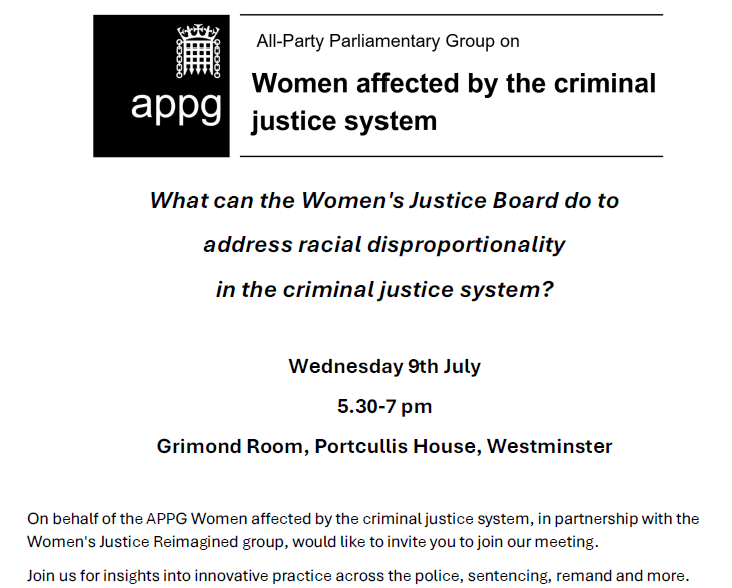
Another key event was the All-Party Parliamentary Group meeting on women in the criminal justice system. The question being addressed at the meeting was ‘What can the Women’s Justice Board do to address racial disproportionality in the criminal justice system?’. It was an opportunity for important organisations and stakeholders to stress what they believed were the key areas that needed to be addressed. Some of the charities and Non-governmental organisations were Hibiscus, Traveller Movement, The Zahid Mubarek Trust. There were also individuals from Head of Anti-slavery and Human Trafficking at HMPPS and the Deputy Mayor for Policing and Crime in London. Each representative had a unique standpoint and different calls for recommendations, ranging from:
• Hearing the voices of women affected in the CJS;
• Having culturally competent and trauma informed CJS staff;
• Ringfenced funding for specialist services and organisations like the ones that were in attendance;
• Knowing who you are serving and their needs;
• Making it a requirement to capture data on race and gender at all stages of the CJS.
It was truly great to be in a room full of individuals so ready to put the hard work in to advocate and push for change. I hope it will be one of many discussions I attend in the future.
Lastly, as I enter the final throes of writing my book on the experiences of Black women in prison I have been reflecting on what I want my book to get across, and who will be able to access it. The book represents the final outcomes of my PhD so to speak:
• To be able to disseminate the words and voices of the women that shared their stories;
• To be able to provide a visual into their lives and highlight the importance of visual research methods;
• To highlight some recommendations for change to reduce some of the pains of imprisonment faced by Black women;
• To call for more research on this group that has been rendered invisible.
Share this:


25 Years of Criminology at UON: Looking Back
This year Criminology at UON is celebrating its 25th Anniversary! Exciting times! In line with the celebrations, the Criminology Team have organised a number of events as part of these celebrations. Ranging from the ‘Changing the Narrative’ VAWG event, organised by Dr @paulaabowles and the Deputy Police, Fire and Crime Commissioner (PFCC), to a school’s event in June offering out miniature taster sessions to interested, local year12 students (more details T.B.C). As well all the exciting events, we have also had reflections from the Team around what it means to them and their journey with Criminology at UON. It is my journey which I would like to share with you now.
My journey begins in 2012 as a bright eyed and bushy tailed first year student moving away from home to Northampton to study Criminology. Having never done any Criminology, Psychology, Sociology, or Law before I was feeling very much out of my depth. However, little did I realise that my A-levels in Philosophy, Ethics and English Language would hold me steady. The first year was quite overwhelming: there were lots of tears and uncertainties. I remember it taking the entire summer between year 1 and year 2 to get my head around Harvard Referencing. But I survived! It was not until the end of year 2 and beginning of year 3 where I would say I began to ‘thrive’ in the discipline. As a student, one of my highlights was doing a research placement in year 2. Academically, I gained skills which prepared me for the dissertation in the final year, but it also brought me out of my shell much more. Pretty sure there were tears here as well- this has been a common feature of my journey with Criminology (as student and staff)!
In 2015 I graduated from UON with a BA in Criminology and in the September of that year began in the role as an Associate Lecturer in Criminology. This was incredibly scary but also incredibly rewarding. It was very interesting to be on ‘the other side’ of academia having so recently graduated and it took a fair amount of time to transition from student to staff (as academics we are also students so the transition is never fully complete)! I was involved on modules I had not had the privilege of studying and was able to work closely with esteemed colleagues I’d looked up to for so long and who had had a large impact in moulding the criminologist I was (and am today). In the September of 2020, after achieving my MSc in Criminology, I became a full-time lecturer and remain so five years later. The course and University has changed a lot in those 5 years, with some fabulous new modules in the BA and BA Criminology with Psychology courses, new colleagues offering a range of expertise and passion for areas within the discipline and some epic trips with a number of the student cohorts we have been blessed to have.
There have been challenges too, and lots of tears (especially from me), but the progress and evolution of Criminology at UON in the 13 years I have been a part of it have been monumental! Hopefully there will be even more positivity to come in the future. I feel incredibly grateful and blessed to have been involved with Criminology at UON for so long, and always look back on my student days with fondness. I’ve enjoyed my role as a member of staff and enjoyed being a part of the events the Team have organised and the new course which we have designed. A huge ‘Thank you’ must be written to the ‘founding father of Criminology at UON’ @manosdaskalou, without whom my, and many others, journey with Criminology at UON might be non-existent! So cheers to 25 years of Criminology at UON, the ‘founding father’, and to many more wonderful years (and hopefully less tears)!
Share this:


A Love Letter to Criminology at UON


In 2002, I realised I was bored, I was a full-time wife and parent with a long-standing part-time job in a supermarket. I first started the job at 15, left at 18 to take up a job at the Magistrates’ court and rejoined the supermarket shortly after my daughter was born. My world was comfortable, stable and dependable. I loved my family but it was definitely lacking challenge. My daughter was becoming increasingly more independent, I was increasing my hours and moving into retail management and I asked myself, is this it? Once my daughter had flown the nest, could I see myself working in a supermarket for the rest of my life? None of this is to knock those those that work in retail, it is probably the best training for criminology and indeed life, that anyone could ask for! I got to meet so many people, from all backgrounds, ethnicities, ages, religions and classes. It taught me that human beings are bloody awkward, including myself. But was it enough for me and if it wasn’t, what did I want?
At school, the careers adviser suggested I could work in Woolworths, or if I tried really hard at my studies and went to college, I might be able to work for the Midland Bank (neither organisation exists today, so probably good I didn’t take the advice!). In the 1980s, nobody was advocating the benefits of university education, at least not to working-class children like me. The Equal Pay Act might have been passed in 1970 but even today we’re a long way from equality in the workplace for women. In the 1980s there was still the unwritten expectation (particularly for working class children from low socio economic backgrounds) that women would get married, have children and perhaps have a part-time job but not really a career….I was a textbook example! I had no idea about universities, knew nobody that had been and assumed they were for other people, people very different from me.
That changed in 2002, I had read something in a newspaper about a Criminology course and I was fascinated. I did not know you could study something like that and I had so many questions that I wanted to answer. As regular readers of the blog will know I’m a long-standing fan of Agatha Christie whose fiction regularly touches upon criminological ideas. Having been born and raised in North London, I was very familiar with HMP Holloway’s buildings, both old and new, which raised lots of questions for a curious child, around who lived there, how did they get in and out and what did they do to the women held inside. Reading suffragette narratives had presented some very graphic images which further fed the imagination. Let’s just say I had been thinking about criminology, without even knowing such a discipline existed.
Once I was aware of the discipline, I needed to find a way to get over my prejudices around who university was for and find a way of getting in! To cut a long story short, I went to an Open Day and was told, go and get yourself an access course. At the time, it felt very blunt and reinforced my view that universities weren’t for the likes of me! Looking back it was excellent advice, without the access course, I would never have coped, let alone thrived, after years out of education.
In 2004 I started reading BA Criminology, with reading being the operant word. I had been an avid reader since early childhood (the subject of an earlier blog) and suddenly I was presented with a license to read whatever and whenever I wanted and as much as I could devour! For the first time in my life, people could no longer insist that I was wasting time with my head always in a book, I had “official” permission to read and read, I did! I got the chance to read, discuss, write and present throughout the degree. I wrote essays and reports, presented posters and talked about my criminological passions. I got the chance to undertake research, both empirical and theoretical, and lawks did I revel in all this opportunity. Of course, by looking back and reflecting, I forget all the stresses and strains, the anxieties around meeting so many new people, the terror of standing up in front of people, of submitting my first assessment, of waiting for grades….but these all pale into insignificance at the end and three years goes so very quickly….
In the summer of 2007, I had a lovely shiny degree in Criminology from the University of Northampton, but what next? By this point, I had the studying bug, and despite my anticipation that university would provide all the answers, I had a whole new set of questions! These were perhaps more nuanced and sophisticated than before but still driving me to seek answers. As I said earlier, human beings are awkward and at this point I decided, despite my earlier passion, I didn’t want to be put in a box labelled “Criminology“. I felt that I had finally cracked my fear of universities and decided to embark on a MA History of Medicine at Oxford Brookes. I wanted to know why Criminology textbooks and courses still included the racist, sexist, disablist (and plenty more) “theories” of Cesare Lombroso, a man whose ideas of the “born criminal” had been discredited soon after they were published.
But again the old fears returned….what did I know about history or medicine? What if the Criminology degree at Northampton hadn’t been very good, what if they just passed everyone, what if I was kidding myself? Everything at Brookes felt very different to Northampton, everyone on the course had studied BA History there. Their research interests were firmly centred on the past and on medicine, nursing, doctoring, hospitals and clinics and there was me, with my ideas around 20th century eugenics, a quasi-scientific attempt to rationalise prejudice and injustice. Along with studying the discipline, I learnt a lot about how different institutions work, I compared both universities on a regular basis. What did I like about each, what did I dislike. i thought about how academics operate and started to think about how I would be in that profession.
I successfully completed the MA and began to think maybe Northampton hadn’t given me good grades out of our pity or some other misplaced emotion, but that I had actually earnt them. I was very fortunate, I had maintained connection with Criminology at UON, and had the opportunity to tip my toe in the water of academia. I was appointed as an Associate Lecturer (for those not familiar with the title, it is somebody who is hourly paid and contribute as little or as much as the department requires) and had my first foray into university teaching. To put it bluntly, I was scared shitless! But, I loved every second in the classroom, I began to find my feet, slowly but surely, and university which had been so daunting began to seep into my very being.
Fast forward to 2025, I have been involved with UON for almost 22 years, first as a student, then as an academic, achieving my PhD in the process It is worth saying that the transition is not easy, but then nothing worth having ever is. I have gained so much from my studies, my relationship with two universities and the experiences I have had along the way. It is fair to say that I have shed many tears when studying, but also had some of my very highest highs, learning is painful, just watch a small child learning to read or write.
Hopefully, over the past decades I have repaid some of the debt I owe to the academics that have taught me, coached me, mentored me and supported me (special mention must go to @manosdaskalou who has been part of my journey since day 1). My life looks very different to 2002 and it is thanks to so many people, so many opportunities, the two universities that have provided me with a home from home and all of the students I have had the privilege to engage with.
I am so delighted to have been part of Criminology at UON’s 25 years of learning and teaching. To my colleagues, old and new, students, graduates and everyone I have met along the way, I raise my glass. Together we have built something very special, a community of people committed to exploring criminological ideas and making the world an equitable place.
Share this:


Book blurbs: a necessity or frill?

I have always been, and imagine I will always be, a lover of books. Until the summer of last year, it has always been physical books. The feel, the smell, the shock when you drop it as you’re drifting off to sleep, the dampness of pages when you’ve picked it up too quickly after getting out of a pool or the sea on holiday and that beautiful crinkle crisp after the page dries. Physical books are beautiful (even the ugly ones). And this holds for academic sources, non-fiction books and novels! One of the joys of selecting a book (new or often second-hand charity gems), is reading the blurb. It might give you a brief introduction to characters you are following, or if an academic source it might provide you with a brief list of topics the book navigates. The blurb might also contain some quotations and reviews expressing the ‘excellence’ or ‘gripping’ nature of the book. And whilst this is generally a positive feature, since reading e-books (where I do not read the blurb or even access the blurb), I have started to wonder if the blurb is actually a hinderance to the potential reader…
Now, this entry is not to debate the great debate of the 21st century: e-book versus book. But rather the format of an e-book not having a blurb per se versus the blurb on the back of a book. I am fortunate enough to have a Kindle: one of my most prized possessions. It’s beautiful, it can be read in all environments (warmth setting and light setting is incredible), it’s lightweight and fits in almost all of my bags and many of my pockets #notsponsored, but I have never read a blurb of a book on the Kindle, and I can’t work out if I’m missing out or if this is actually an improvement of the ‘book selection’ process.
Some positives of not accessing the blurb on the e-readers is it has opened up my reading list astronomically. I have read and loved books I am certain I would never have picked up or purchased had I read what they were about. Some have been heavy, taxing reads but so worth it in the end, others have been bizarre and wonderful but not something I would have ever recommended to myself. Had these been physical books, having read the blurb, these would have been left by me on the shelf and therefore I would have lost out on the joy, wonder and sadness that these books had to offer.
There are of course issues with not reading the blurbs and these issues reinforce the importance of the feature as a necessity and not just a frill. I have also read a number of books I quite simply wish I hadn’t. And had I read the blurb I would have known not to start these monstrosities (once I’ve started, unfortunately my brain makes me finish – commitment [even to books] is important to my brain). I have also read some incredible books but at the wrong time: again had I read the blurb I would have known that this book is not a sensible choice given my headspace.
The issue is most likely me, rather than whether blurbs are actually necessary or just frill. And I’d imagine it’s better to have them and not use them, them not have them and miss them. But if they aren’t being used, they have no purpose and become redundant. Is this a wider symptom of the rise of the e-book or just a side-effect that no one else is concerned about but me? I do not know. But I find it strange how heavily I rely on blurbs with physical books and how void they are with e-books. Are e-books the beginning of the end for blurbs or am I over think this? Penny for your thoughts?

Share this:


Highlights and Hindsight: Reflections from a Final Year Student

Whilst I hope to continue writing beyond graduation, for my last blog post as a UON student, I’d like to share, for those at the beginning or early stages of their degree, some of the things I’m glad I did, and the things I wish I had done, maybe something will resonate with you.
I’m glad I…
Found opportunities to prove myself: Although I worked before doing my degree, being course representative, student voice as well as a research assistant have helped me build confidence and skills and given me so much more to talk about when I’m selling myself in both professional and academic applications.
Maintained my routine: I’ve never pulled an all-nighter or found myself regularly submitting at 11:58pm (just one exception!) I knew I couldn’t give my best when stressfully counting down the minutes to midnight and being sleep deprived. I tried different ways and routines of studying and found something that was sustainable. As far as possible I maintained boundaries so as not to put myself in a position where sacrificing sleep was a necessity.
Didn’t compare myself (often!): It’s easy to see other people getting higher grades, doing more things, doing ‘harder’ topics, and to feel inferior. We’re all on our own journeys, have our own interests, our own barriers and limitations and that’s ok. I never have been and probably never will be a ‘straight A’ student, but I’ve worked incredibly hard for the grades I have got. And truly, in all the interviews I’ve done in the last 4 months (lots), they’ve been more interested my grit and compassion than everything else!
I wish I had…
Connected more: I wish I’d pushed a little harder to make some friends or some more familiar faces. University can be really lonely, for so many reasons, and I think lots of students feel this way! Perhaps pushing through that fear of the unknown, and the social anxiety to talk to people on my course, having joined a society or attended more events might have alleviated some of this.
Taken what I needed: I spent years one and two determined not to use extensions, mitigating circumstances or office hours, anything that I perceived to be a setback or a silly question. This resulted in me running out of an exam before finishing, and completing a timed assignment the day after discharge from psychiatric hospital. I turned this around in year three and used what I needed, used extensions, booked in to office hours even if it was just for reassurance and actually felt like I had given my work my best (and this reflected in higher grades!)
Last Nuggets of Advice
Pay attention to what you enjoy: It’s easy to see it all as just hard work, rush to get it done and then feel lost in the end. I’ve now started on a masters degree towards a career path I never thought I’d pursue, focussing on something that isn’t even my strongest skill, but I’ve decided its worth the challenge for something I’m going to enjoy.
Reflect, reflect, reflect: I’ve learned so much by taking the time to reflect on what I’m experiencing or learning, how it makes me feel and why, why I do or don’t want to do it, where my thoughts are coming from. I wholeheartedly recommend regularly thinking about these things (or writing about them!) The ability to be reflective is assessed more than you might think, and you never know what it might reveal to you.
You are more than this: No matter what grades you get, how you handle uni life, if you make friends or not, do ‘extra’ stuff or not, do a masters, or not. You’re still… you, with so many good qualities, values and goals that are not tied to your achievements, it may or may not always be the life changing experience you hoped it would be. This is an important time, sure, but it’s not more important than your health, your values, your sense of self.
Remember, you can only do what you can, with what you have at the time. Take care.
Share this:


HE and the curse of generative AI

A good part of the last academic year was spent debating the use of AI in Higher Education. Well, that’s what it felt like in our department. It became clear early on that some of our students had taken to using AI to generate their essays. Whilst we, as academics, debated its use, a number of issues became apparent. First and foremost was that of detecting its use in summative work. Despite the university guidelines about using AI and the need to reference its use, indicating where and how it had been used, students were producing work and passing it off as their own. Some of my colleagues were bothered about how its use could be detected, whereas others promoted its use and advocated teaching students how to use it. The arguments abound about how it might be used, not just to generate ideas but also to help improve grammar, for example. There are arguments about how it can help provide a literature review, saving time and effort. There are arguments about how it can help with essay structure and can help with that writer’s block, so many of us suffer from.
Whilst I understand its uses and understand my own limitations in knowledge and understanding about its many uses, I cannot but help thinking that somehow those that advocate its use have been blinded by the allure of something shiny and new. They will say they are just keeping up with technology, in the meantime, the tech giants are making a fortune and leading us further and further into a toxic dependency on technology which they in turn generate to quench our insatiable appetite. For those of you that remember, what was wrong with ‘Word 6’?
My stance seems to be somewhat simplistic on the matter, that is my stance on using generative AI in Higher Education to produce summative work in our field. It seems to me that the use of generative AI to produce summative work, bypasses all that Higher Education seeks to achieve. The British Society of Criminology provides a comprehensive menu of knowledge and skills that a student studying criminology should be able to boast at the end of their degree programme. We do our best to provide the building blocks for that achievement and test, using a variety of methods, whether the students have that knowledge and skills to the requisite standard. At the end of their studies, the students receive a certificate and a classification which indicate the level of skills and knowledge.
How then can we say that a student has the requisite knowledge and skills if they are allowed to use generative AI to produce their work? If a key skill is the ability to analyse and synthesise, how does an AI generated literature review assist with that skill? How will an AI generated essay format help the student navigate the vagaries of report writing and formatting in the workplace (different formats according to audience and needs)? How does a grammar check help the student learn if the words produced by the AI tool are not understood by the student; they won’t even know if it’s the correct word or tense or grammar that has been used. Often the mistake made by those advocating the use of AI is that they forget about how we learn. Having something produced for you is not learning, nowhere near it.
Even if a student acknowledges the use of AI in their work, what does that bit of work demonstrate about the student? Would we credit a student that had simply copied a large chunk from a book, or would we say that they needed to demonstrate how they can summarise that work and combine it with other pieces of work? In other words, would we want the student to produce something that is theirs?
There are tools for detecting the use of AI, just as there are tools for detecting plagiarism, the problem is that the former are not that reliable and are likely to produce a significant number of false positives. The consequence of the worries around the use of AI by students is that some of my colleagues, both at the university and the wider community are advocating that we return to exams and the like. I think that would be a retrograde step. We need students to be able to read, explore, and write so that they can demonstrate some quite critical skills. Skills that employers want.
Whilst it seems right that we show students how to use AI, we need to be clear about its limitations. More importantly we need to be clear that its use can be debilitating as much as it is useful. Not everything that is shiny and new is what it purports to be, good honest graft has far more value. There are no shortcuts to learning. If graduates are unable to demonstrate the requisite skills for a job, then their degree holds little value. I fear that many will be cursing the day they ever discovered generative AI.
Share this:


Headlines and Happiness: Balancing News Consumption and Wellbeing

As part of my reflective diary assessment for my third-year module ‘Critiquing Criminalistics’, I reflected on the importance of being up to date with world events to be able to apply criminological knowledge to them. I also reflected on the fact that I have avoided much of the news and media to manage my despair at the current state of the world. However, in order to further my academic knowledge and its application, I decided I just needed a safe way to keep on top of these things, so I compiled some tips and reminders for myself, and I’d like to share them with you.
Choose wisely: Choose reputable news sources, academic reports or reviews from trusted organisations, some will be better balanced, and much less sensationalised than others.
Practice media literacy: Be critical of the information you find; don’t believe everything you see and hear. Verify news stories from multiple sources before accepting them and remember what the media is designed to do. Plus, social media is full of misinformation and sensationalism and largely speaking, not a good resource!
Need to know basis: Consider which topics are most important for you to stay informed about, and limit exposure to news that is not relevant to your wellbeing or interests. It’s very easy to fall down the rabbit hole!
Limit your consumption: Put some boundaries in place that work for you, whether that’s setting an allotted time frame to catch up like to only listen to the radio on your drive into campus, taking a break from social media, or making sure those notifications are turned off so you’re not ambushed by breaking news.
Managing Traumatic Topics: If you are avoiding any particular topic, it might be helpful to have a trusted person read/watch for you first. Additionally, for any recommended films or series, try finding them on ‘Does the Dog Die?’ https://www.doesthedogdie.com/ to check for triggering content.
Find the happy stuff too: There is so much good happening in the world as well as all the bad, make sure you feed your brain some of that too, whether that’s in the news, or on social media.
Here are some other sources:
Look after yourself: Further to those things, take a break every once in a while, prioritise whatever it is that makes you see your world positively and seek support if you need it, that might be support from a professional, or talk to a trusted person, colleague, or staff member to air out those thoughts – go and ‘talk to a criminologist!’ If you’re particularly prone or you are a chronic catastrophiser (guilty!) – a perspective from someone else can be a useful tool.
Lastly, there is a quote I heard years ago, and while over time, there are some thoughts and applications of it that are less than favourable, I occasionally find it comforting; Fred Rogers passed along a message from his mother who said ‘Look for the helpers. You will always find people who are helping.’
If you are able to manage the discomfort, sometimes it is good to find what makes you feel, and listen to it, let it fire you up! Perhaps you’ll become the helper.

 Thoughts from the criminology team

