
Home » Learning (Page 9)
Category Archives: Learning

And time waits for no one, and it won’t wait for me*

Last week in my blog I mentioned that time is finite, and certainly where mere mortals are concerned. I want to extend that notion of finite time a little further by considering the concepts of constraints placed upon our time by what might at times be arbitrary processes and other times the natural order of things.
There are only 24 hours in a day, such an obvious statement, but one which provides me with a good starting point. Within that twenty fours we need to sleep and eat and perform other necessary functions such as washing etc. This leaves us only a certain amount of time in which we can perform other functions such as work or study. If we examine this closer, it becomes clear that the time available to us is further reduced by other ‘stuff’ we do. I like the term ‘stuff’ because everyone has a sense of what it is, but it doesn’t need to be specific. ‘Stuff’ in this instance might be, travelling to and from work or places of study, it might be setting up a laptop ready to work, making a cup of coffee, popping to the toilet, having a conversation with a colleague or someone else, either about work or something far more interesting, or taking a five-minute break from the endless staring at a computer screen. The point is that ‘stuff’ is necessary but it eats into our time and consequently the time to work or study is limited. My previous research around police patrol staffing included ‘stuff’, managerialists would turn in their graves, and therefore it became rapidly apparent that availability to do patrol work was only just over half the shift. So, thinking about time and how finite it is, we only have a small window in a 24-hour period to do work or study. Reduced even further if we try to do both.
I mentioned in my previous blog that I’m renovating a house and have carried out most of the work myself. We have a moving in date, a bit arbitrary but there are financial implications of not moving in on that date, so the date is fixed. One of the skills that I have yet to master is plastering. I can patch plaster but whole walls are currently just not feasible. I know this, having had to scrape plaster from several walls in the past and the fact that there was more plaster on the floor and me than there was on the wall. I also know that with some coaching and practice, over time, I could become quite accomplished, but I do not have time as the moving in date is fixed. And so, I employ plasterers to do the work. But what if I could not employ plasterers, what if, I had to do the work myself and I had to learn to do it whilst the deadline is fast approaching? Time is finite, I can try to extend it a little by spending more time learning in each 24-hour segment but ‘stuff’, my proper job and necessary functions such as sleeping will limit what I can do. Inevitably the walls will not be plastered when we move in or the walls will be plastered but so will the floor and me. I will probably be plastered in a different sense from sheer exacerbation. The knock-on effect is that I cannot move on to learn about, let alone carry out, decorating or carpet fitting or floor laying or any part of renovating a house.
As the work on the house progresses, I have become increasingly tired, but the biggest impact has been that my knees have really started to give me trouble to the extent that some days walking up and down stairs is a slow and painful process. I am therefore limited as to how quickly I can do things by my temporary disability. Where it took me a few minutes to carry something up the stairs, it now takes two to three times the amount of time. So, more time is required to do the work and there is still the need to sleep and do ‘stuff’ in a finite time that is rapidly running out.
You might think well so what? Let me ask you now to think about students in higher education. Using my plastering skills as an analogy, what if students embarking on higher education do not have the basic skills to the standard that higher education requires? What if they can read (patch plaster) but are not able to read to the standard that is needed (plastering whole walls)? How might we start to take them onto bigger concepts, how might they understand how to carry out a literature review for example? Time is not waiting for them to learn the basics, time moves on, there is a set time in which to complete a degree. Just as I cannot decorate until the walls are plastered so too can the students not embark on higher education studies until they have the ability to read to a requisite standard. So, what would the result be? Probably no assignments completed, or completed very poorly or perhaps, just as I have paid for plastering to be done….
Now think about my temporary disability, what if, like me, it takes students twice as long to complete a task, such as reading an article, because they have a disability? There is only so much time in a day and if they, like everyone else, have ‘stuff’ to do then is it not possible that they are likely to run out of time? We give students with learning difficulties and disabilities extra time in exams, but where is the extra time in the course of weekly learning? We accept that those with disabilities have to work harder, but if working harder means spending more time on something then what are they not spending time on? Why should students with disabilities have less time to do ‘stuff’?
The structure and processes within HE fails to take cognisance of time. Surely a rethink is needed if HE is not to be condemned as institutionally failing those with disabilities and learning difficulties. Widening participation has widening implications that seem to have been neglected. I’ll leave you with those thoughts, a quick glance at my watch and I had best go because in the words of the white rabbit, ‘Oh dear! Oh dear! I shall be late’ (Carroll, 1998: 10).
Carroll, L. (1998) Alice’s Adventures in Wonderland and Through the Looking-Glass: The centenary edition, London: Penguin books.
*Richards, K. and Jagger, M (1974) Time waits for no one. Warner/Chappell Music, Inc.
Share this:


The Lure of Anxiety

Helen is an Associate Lecturer teaching on modules in years 1 and 3.
I wear several hats in life, but I write this blog in the role of a lecturer and a psychologist, with experience in the theory and practice of working with people with psychological disorders.
In recent years, there has been an increase in awareness of mental health problems. This is very welcome. Celebrities have talked openly about their own difficulties and high profile campaigns encourage us to bring mental health problems out of the shadows. This is hugely beneficial. When people with mental health problems suffer in silence their suffering is invariably increased, and simply talking and being listened to is often the most important part of the solution.
But with such increased awareness, there can also be well-intentioned but misguided responses which make things worse. I want to talk particularly about anxiety (which is sometimes lumped together with depression to give a diagnosis of “anxiety and depression” – they can and do often occur together but they are different emotions which require different responses). Anxiety is a normal emotion which we all experience. It is essential for survival. It keeps us safe. If children did not experience anxiety, they would wander away from their parents, put their hands in fires, fall off high surfaces or get run over by cars. Low levels of anxiety are associated with dangerous behaviour and psychopathy. High levels of anxiety can, of course, be extremely distressing and debilitating. People with anxiety disorders avoid the things they fear to the point where their lives become smaller and smaller and their experience severely restricted.
Of course we should show compassion and understanding to people who suffer from anxiety disorders and some campaigners have suggested that mental health problems should receive the same sort of response as physical health problems. However, psychological disorders, including anxiety disorders, do not behave like physical illnesses. It is not a case of diagnosing a particular “bug” and then prescribing the appropriate medication or therapy to make it go away (in reality, many physical conditions do not behave like this either). Anxiety thrives when you feed it. The temptation when you suffer high levels of anxiety is to avoid the thing that makes you anxious. But anyone who has sat through my lecture on learning theory should remember that doing something that relieves or avoids a negative consequence leads to negative reinforcement. If you avoid something that makes you highly anxious (or do something that temporarily relieves the anxiety, such as repeatedly washing your hands, or engaging in a ritual) the avoidance behaviour will be strongly reinforced. And you never experience the target of your fears, so you never learn that nothing catastrophic is actually going to happen – in other words you prevent the “extinction” that would otherwise occur. So the anxiety just gets worse and worse and worse. And your life becomes more and more restricted.
So, while we should, of course be compassionate and supportive towards people with anxiety disorders, we should be careful not to feed their fears. I remember once becoming frustrated with a member of prison staff who proudly told me how she was supporting a prisoner with obsessive-compulsive disorder by allowing him to have extra cleaning materials. No! In doing so, she was facilitating his disorder. What he needed was support to tolerate a less than spotless cell, so that he could learn through experience that a small amount of dirt does not lead to disaster. Increasingly, we find ourselves teaching students with anxiety difficulties. We need to support and encourage them, to allow them to talk about their problems, and to ensure that their university experience is positive. But we do them no favours by removing challenges or allowing them to avoid the aspects of university life that they fear (such as giving presentations or working in groups). In doing so, we make life easier in the short-term, but in the long-term we feed their disorders and make things worse. As I said earlier, we all experience anxiety and the best way to prevent it from controlling us is to stare it in the face and get on with whatever life throws at us.
Share this:


Findings on the ‘traditional lecture’ format – perfect timing!

I seem to be reading more and more reports on the need to retain lectures as a form of teaching, as it is claimed to ensure students are more engaged and committed to their studies when this method is used. Well, these findings have come to my attention just as I am testing online technologies to replace the ‘traditional’ lecture, via Collaborate on the new Waterside campus. Collaborate is a tool in Blackboard which opens an online classroom for students to join, listen to the lecture and see slides or other media, while also being able to pose questions via a chat function.
On the face of it, not so different, just the physical world replicated in the real world, right? Well, I will reserve judgement as I am still coming to grips with what this technology can do, I am aware younger generations of students may embrace this, and the reality is, it is the only forum I have to offer teaching to large numbers of students. I suspect student experiences are mixed, I know some really like it, some are not so keen, so again, not so different to lectures? The article in the times suggests that students are less likely to drop out if they are taught via lectures and have perceptions of good one-to-one contact with staff. Some more interesting issues were raised from replies in the tweet about the story, raising questions about the need to focus on quality, not method, that many universities are playing catch up with new teaching technologies and that this needs to be better understood from social and cultural perspectives. I think it is also worth picking up on perceptions of students, along with their expectations of higher education and remember, they must develop as independent learners. The setting in this respect would not seem to matter, it is the delivery, the level of effort put in to engage students and reinforcing the message that their learning is as much their responsibility as ours.
There is certainly a lot to grapple with, and for me, just starting out with this new technology, I myself feel there is much to learn and I am keeping an open mind. I do feel there are aspects of traditional teaching which must be retained and this can be done via group seminars, with smaller numbers and an opportunity for discussion, debate and student-led learning. If we see the lecture as the foundation for learning, then perhaps its method of delivery is less important. Given the online provision I must use for lectures, during seminars, I step away from the powerpoint and use the time I have with students in a more interactive way. For those modules where I don’t use online lectures, not much has changed on the new campus, but I am always keen to see how online teaching methods could be adopted – and I am prepared to use them if I genuinely can see their value.
It would be easy to offer only critique of this technology, and I think it is also important not to see it as an answer to the perennial problems with lack of engagement and focus many lecturers experience from mid term onwards. Perhaps online provision can at least overcome barriers to attendance for commuting students, those who feel intimidated in large lecture halls, and those who simply find they don’t engage with the material in this setting. At a time when some courses attract high numbers of students, and the reality of having lectures with 150+ students in a room means potential for noise disruption, lack of focus and interaction then maybe online provision can offer a meaningful alternative. There is provision for some interaction, time can be set aside for this, students can join in without worrying about disruption or not being able to hear the lecturer and it removes the need for lecturers to discipline disruptive behaviour. It does require some level of ‘policing’ and monitoring, but the settings can enable this. Having done lectures with 100 plus students, it is not something I miss – I’ve always preferred smaller seminar group teaching and so I can see how online provision can be a better support for this.
Currently, I use the online session as a form of recap and review, with some additional content for students. This is in part due the timing of the session and I am sure it can work equally as well as preparation for seminars. Students can then use the time to clarify anything they don’t understand and it reinforces themes and issues covered in seminars as well as introducing news ways to examine various topics. As with any innovation, this needs more research from across the board of disciplines and research approaches. In order to move such innovation on from ‘trial and error’ and simply hoping for the best, as with any policy we need to know what works, when it works and why. Therefore, along with my colleagues, I will persist and keep a watchful eye on the work of pedagogic experts out there who are examining this. There have been the inevitable issues with wifi not supporting connectivity – I can’t believe I just used this sentence about my teaching, but there it is. I am optimistic these issues will be overcome, and in the meantime, I always have a plan B – relying on technology is never a good plan (hence the featured image for this blog), but this is perhaps something to reflect on for another day.
Share this:

What are Universities for?

As we go through another welcome week it becomes quite apparent in conversations with new students that their motivation for coming to University and joining a course is not singular. Of course there are some very clear objectives that are shared across like the interest for the subject and the employability afterwards for underlying those there are so many different personal motivations and aspirations attached.
In the eyes of our new cohort, I can see a variety of responses, the eagerness to learn the joy of studying, the expectation of belonging and the anticipation of ordering their lives across the University life, just to name but a few.
In conversation, I see these attributes in a different light. “I want to belong but I am shy”, “I wish to learn but I am worried about learning” “I want to engage but I am concern with my writing”. This is the soft underbelly of becoming a student; because in education our own insecurities are playing up. These little devils, who rest on the back of the head of many people who doubt themselves and worry them.
One of the greatest fears I hear and see been rehearsed before me is that of intellectual ability. This is one of those issues that becomes a significant barrier to many people’s fear when joining a University course. Of course the intellectual level of study is high. There are expectations of the degree of knowledge a student will build on and the way they will be able to utilise that level of knowledge. After all a University is an institution of High Learning. The place where disciplines are explored in totality and subjects are taught holistically. Nevertheless the University is not the end of one’s education but rather the door to a new dimension of learning.
For myself and many of my colleagues what makes this process incredibly exciting is to see those eyes of the new students across the years brighten up, as they “get it” as the penny drops and they connect different parts of knowledge together. Once people reach that part of their educational journey realise that coming to University was not simply an means to an end but something beyond that; the joy of lifelong learning.
As this is a early session, I shall address the intellectual fear. The greatest skills that any student need to bring with them in class is patience and passion. Passion for the subject; this is so important because it will sustain during the long cold winter days when not feeling 100%. Patience is equally important; to complete the course, needs plenty of hours out of class and a level of concentration that allows the mind to focus. Any successful student can testify to the long hours required to be in the library or at home going over the material and making sense of some challenging material. This ultimately unravels the last of the requirements, that of perseverance. It is through trial and error, rising up to a challenge that each student thrives.
So for those who joined us this year, welcome. The door to an exciting new world is here, to those returning, we shall pick up from where we left off and those who completed, hopefully University has now opened your eyes to a new world.
Share this:


Which mindset are you? This may depend on the sort of week you are having…..

This blog is inspired by an article posted on our Facebook group by my colleague @paulaabowles, from the work of Dweck (2016), suggesting mindsets can be categorised as either growth or fixed. It is interesting to consider how such a mindset can shape the way your life goes, but for me, any psychological analysis is always just part of the picture. That said, Dweck’s work is interesting and made me reflect on my life up until this week. This is a week where I seem to be waiting patiently (mostly) for acceptance of PhD corrections and to exchange contracts on my new house. Both of these processes are out of my control, require continued patience and a need to accept there is nothing I can do but wait.
For a lot of reasons, I immediately identified with the ‘growth’ mindset, being open to challenges, seeing intelligence as something to be nurtured and developed, worth the effort, understanding the need to learn from mistakes and being inspired by others. The other seems to me a life of stagnation, dismissal of anything new and creating a world which may be low risk, but ultimately unfulfilling. The fixed mindset also presents intelligence and success as something you are born with and therefore little effort is required to fulfil potential – almost as if life is mapped out for you, but it also belies a sense of entitlement, and inability to deal with failure as a challenge to move on from. However, if you are not somehow ‘blessed’ with the tools necessary for success, you must accept your fate. There are obvious social and cultural influences which can reinforce these messages, so perhaps, a fixed mindset leading to a life of success aligns with a life of privilege, but a life without this success identifies someone who cannot see a way to improve, blames others for their misfortune and doesn’t value their own ability to change. My parents always taught me the value of education (well, a lecturer and a teacher – of course they would!), and I never felt any limits were placed on me. But a big part of this must be attributed to me not facing the limits placed on individuals facing poverty, loss, psychological trauma or physical disabilities – my life, so far has largely been the outcomes of my decisions, and I count myself lucky to be able to say that.
That’s not to say I haven’t doubted my abilities, suffered ‘impostor syndrome’ and come up against challenges which have tested my resolve. It seems having a ‘growth’ mindset perhaps enables individuals to strive despite what life throws at you, and also despite how others may perceive you.
So, back to my week of waiting patiently and trying not to let anxieties come to the fore. Being able to call myself Dr Atherton and having my own house in the town I also work in is something I am really looking forward to, for obvious reasons. Years of work on the thesis and years of commuting from Birmingham to various parts of the Midlands (I know the M6 far too well) are about to lead to significant rewards. However, it also occurred to me none of this would be happening if I had given up on the PhD, stayed in a job which was not right for me, decided to carry on commuting and not made this decision to buy a house. It also occurred to me perhaps having a fixed mindset would be less stressful – you have to admit, my timing is spot on – but I don’t think that is the case. I chose the PhD and new job path because I was not happy, I chose to buy a house as M6 commuting is just not something I want to do anymore, and I want to feel more settled in my new post. As for the PhD, I knew I needed time away from a full-time job to complete it, and while it was risky to leave a permanent post, it seems my mindset pushed me to strive for something which was a better fit for me. My mindset helped me believe this was all possible, crucially it was down to me to do this and also, support from friends, family, ex and current colleagues have helped get me here. But, my social and economic circumstances also enabled all of this – we cannot just assume that psychological tools can overcome disadvantage, discrimination and a lack of opportunity.
Dweck suggests that these mindsets are a ‘view you adopt for yourself’. Fixed mindsets can impede development and the belief in change, and they also seem to create people whose concerns about others’ perceptions of them can be all-consuming, and no doubt lead to them avoiding situations where they will be judged. Those with the growth mindset see their traits as a starting point, from which anything can happen and they value the unknowable – the opportunities ahead, the hurdles and rewards. The fixed mindset creates a different kind of stress, a constant need for affirmation of beliefs, disregard of the need to adapt to changing circumstances, and god forbid, simply go with the flow. As much as I identify with the growth mindset, I can empathise with those who simply are unable to take risks, accept failure and manage the unknowable – there are times I have wanted to give up, take the easy path and feel more in control.
A day after starting this blog, the clouds parted and the sun shone down as the much-awaited email from the De Montfort University Doctoral College came to confirm my PhD corrections were accepted and I was to be awarded my doctorate. Suddenly after weeks of anxiety, the reward was certainly worth the wait. There will be plenty of days ahead to bask in the glory and enjoy this moment, and just for now, it is making me worry less about the house exchange, it will happen, I will be settled in my new home soon and enjoy a short drive to work for the first time in years. So, I will continue to strive, develop and take risks – not doing this may have meant a less anxious time this week, but they also lead to great rewards, and hopefully, even better things to come.
Dr. Susie Atherton
Senior Lecturer in Criminology
Share this:


Reflection: From student to professional

I graduated in July 2017 with a Criminology BA from the University of Northampton with a 2:2. In university I did two research placements at youth offending services and from there realised that this is what I wanted a career in.
I applied for a job in the Youth Offending Service with little belief that I could get the job. However I was offered the job and started working from September. As it nears to my first year being completed I have reflected on the transition from student to professional.
The past year has been a rollercoaster and I have a steep learning curve through this. University life especially all the deadlines and time management required only scratched the surface for what awaited me in the world of work.
One thing I wasn’t fully prepared for was the difficulties faced as a young professional. particularly when you’re the youngest member of staff by around 8 years. Many people do not take you seriously when you first start and it takes a while to ‘prove yourself’ as a professional to colleagues, other agencies and to the service users. I have even been mistaken for a young person when out on reparation (like community service) so it has been hard overcoming these barriers.
A positive is working with young people and I am enjoying this immensely. My job role means I work with low level offenders and prevention work with young people and this seems to be successful for most young people to avoid the criminal justice system. However I support those on higher orders as well as assisting on Reparation; so doing things like gardening, painting and decorating, to indirectly repair the harm caused. It’s great fun!
Restorative justice, something I learnt about at university, is something that as a youth offending service we try to incorporate with every young person we work with. Restorative justice is not at the forefront of all professionals however I’ve seen the benefits it can bring to both offender, victim and those indirectly affected by this.
I think the main points I’ve learnt over this past year is even after university you are constantly learning and that education doesn’t finish once you graduate. Alongside this is to go for it… no matter whether you think you will achieve it or not, we all have to start somewhere.
Share this:


“Στον πατέρα μου χρωστώ το ζην, στον δάσκαλό μου το ευ ζειν” To my father I owe living, to my teacher I owe my wellbeing (Alexander the Great)

I remember this phrase from school, among with other ones about the importance of education in life. Since then there have been several years but education is something that we carry with us and as such we take little memories of knowledge like pieces of a gigantic jigsaw that is our lives and put them together. Experience is that glue that makes each piece of knowledge to stick at the right time whenever you want to find the words or feelings to express the world around us. Education plays such an immense part in this process because it give us these words that explain our world a little more clearly, precisely, deeply
This phrase had great resonance with me as I have never known my father and therefore I had no obvious person to relate this to or to have a way to express gratitude for living to anyone (obviously from my paternal family branch). So for a very long time, I immerse myself in education. Teachers in and out of the classroom, living or dead, have left a trail of knowledge with me that defined me, shaped my thoughts and forge some intense memories that is now is my turn to share with my students.
Education has been my refuge, my friend and a place of great discovery. Knowledge has that power to subvert injustice and challenge ignorance. Arguably education comes in different guises and a formal school curriculum sometimes restricts the student into normatives of performance that relegates knowledge into bitesize information, easily digestible and reproduced. The question, of a fellow student of mine who asked, “sir, why do I need algebra?” could have only be met from the bemused teacher’s response…”for your education”! Maybe I am romanticizing my own education and potentially forget that formal compulsory education is always challenging and challenged because of the purpose it is called to play.
Maybe this is why, what I consider of value in education, I have always attributed to my own journey, things that I read without being in any curriculum, or discussions I had with my teachers that took us away from the strict requirements of a lesson plan. The greatest journey in education can start with one of the most basic of observations, situations, words that lead to an entire discussion on many complex ideas, theories and perspectives. These journeys were and are the most rewarding because you realise that behind a question is the accumulated human curiosity spanning the entire history of life.
One of the greatest places for anyone to quench this thirst for learning is the University. In and out of the classroom knowledge is there, ready to become part of a learners’ experience. It is not bestowed in the latest gadget or the most recent software and other gimmicky apparatus but in the willingness to dwell into knowledge, whether it is reading late in the library or having a conversation with fellow students or a tutor (under a tree as one of my students, once professed). Perhaps my trust in education is hyperbolic even obstinate but as I see it, those of us who have the choice, can choose to live or to live well. For the first, we can carry on existing, but for the latter the journey of knowledge is neither a short one nor one that comes easy but at least it will be rewarding.
Share this:


The Ever Rolling Stream Rolls On
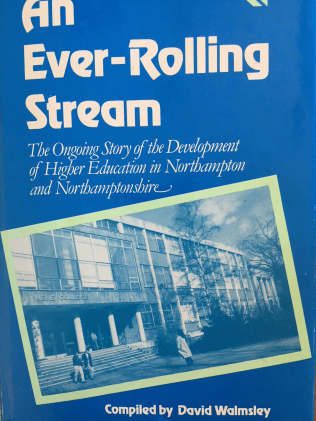
Professor Nick Petford is the Vice Chancellor of the University of Northampton.
As we gear up to leave Park Campus for Waterside it is only natural to feel a sense of loss. Park has been a great place to work and play and will hold a special place in many hearts, as summarised nicely by Bethany Davies from the Criminology team in a recent Blog.
When I took up post as VC in September 2010 I inherited a draft master plan for the University Estate. It was clear that the split campus was a concern to the previous management team and that both estates were starting to look tired. There were several options on the table. One was to move Avenue to Park. The other was expansion of Avenue and closer physical integration with Newton. The showcase element was a huge glass dome, bigger than the one at the British Museum, enclosing most of the courtyard space at Avenue under one roof. Both were impractical. Building Avenue on Park would have consumed most of the sports fields and greenery that makes it what it is. And the disruption of turning Park into a building site for 36 months would do little to improve the student or staff experience. But it would have achieved a single university site, unlike the Avenue plan that would have entrenched the status quo (with a big window cleaning bill to boot!). Not long after my arrival, and with a change in the way government wanted to drive the regional growth agenda, the newly established SEMLEP created in Northampton a 16 mile stretch of brownfield land bordering the River Nene as an Enterprise Zone. The rest, as they say, is history.
An enduring aspect of higher educational institutions is change. Depending on timing, from a personal viewpoint it can be a slow, almost glacial process. For others, caught up in periods of rapid transition, as we are now, the hurly burley can feel almost overwhelming. But change is always there. And Northampton is no exception. For those suspicious this is more spin than substance I can recommend The Ever Rolling Stream, a book compiled and printed in 1989 by the 567th Mayor of Northampton, David Walmsley, that charts the history of Higher Education in Northampton. In short, the key events culminating in the present University are:
1260: Ancient University
1867: Mechanics Institute
1932: Northampton Technical College (St George’s Avenue)
1967: University of Leicester University Centre, Northampton
1972: Northampton College of Education (Park Campus)
1975: Nene College of Higher Education
1978: The National Leathersellers Centre
1982: Sunley Management Centre
1989: Release from local authority control
1999: University College Northampton
2005: The University of Northampton
2018: Waterside.
The picture is one of periods of relative stability (including a c. 700 year sabbatical!), punctuated by mergers and consolidation. Our most rapid phase of change took place in the six years between 1972 and 1978 and involved the relocation, merger and subsequent closure of four separate educational establishments that ultimately comprise Park Campus as we know it today. Each of these phases would have been a unique cause of excitement, stress, resignations, hope and probable despair! But together they have two things in common – they happened mostly outside our working experience, and (ancient university excepted), ended in success. In our history of relocations and mergers, the inevitable conversations between doubters and advocates are lost in time, one exception being the amalgamation in 1937 of the School of Art in Abington Street, with the Technical College, which seems particularly vexed. Against this backdrop we see Waterside simply as the next stage in our evolution.
The title for Ever Rolling Stream comes from the hymn ‘O God our Help in Ages Past’. It sums up brilliantly the feeling of loss and the inevitability of change:
Time, like an ever-rolling stream,
Bears all its sons away;
They fly forgotten as a dream
Dies at the opening day.
Yes, think kindly of Park, and Avenue, mourn even as others will have done over those antecedents that culminated in our present estate. But don’t think you are the first to do so. Who knows, at some time in the future, staff and students not yet born will be contemplating a move from Waterside to a new horizon, as the ever rolling stream rolls on.
Share this:

A mature student’s reflections on the first year

At the age of 51, when I first applied to study Criminology at the University of Northampton, I was a VERY mature student. I had previously been a Registered Nurse for 12 years, then after having a family, re-joined the workforce in various jobs from bar work to office work. I even worked at the local Crematorium for a few years, followed by a short stint at a Funeral Directors! But now my children are grown up and I wanted to do something for me for a change. I happened to see an article in my local newspaper about a 55 year old gentleman who had just graduated from university and that got me thinking….then my daughter told me that there was a man in his 70s at her uni, whose wife made him go so he’d be out from under her feet! That settled it….if they could do it then so could I.
To be honest I was actually amazed to be accepted after writing a 500 word essay on why Criminology is important today. Now that I actually know how to write an essay, the thought of what I wrote then makes me cringe, but onwards and upwards!
Then came the fear. What the hell was I doing? I must be mad! I’d never fit in. These youngsters would never accept me. I’d be useless cos it’s so long since I studied. Even the lecturers would be younger than me. I’d be a joke!
But, what the hell, I thought, ….you only live once! So I swallowed my panic, girded my loins and set forth……I could always run away if I didn’t like it and I’d never have to see any of these people again!
Then out of the blue, on the first day of welcome week, someone started talking to me! She was a mature student too, though much younger than me! The next day I met someone else and the three of us stuck together like glue (and still do now)! As each day went by I started talking to more and more people and before I knew it, I was part of a large group of students ranging from 18 years old right up to me (yes I’m still the oldest person I know!) with every decade in between! I’m just amazed that these people have accepted me and I wish I’d done it years ago! We’ve even had a few drunken nights out (but we won’t go into too much detail about that!).
I have totally surprised myself by how quickly I’ve got back into study mode. The Associate Lecturers have been a lifeline and I can’t praise them enough for all the help and support they’ve given me. Not sure if I’m allowed to mention names, but @jesjames50 and @bethanyrdavies….you know who I mean!!!
All in all, I have absolutely loved my first year. I’ve really enjoyed the studying and it has opened my eyes to so many things. I feel I have a totally different perspective on life now and I’m really excited for Year 2. I have met some amazing people and I feel so thankful and proud to be part of the community of the University of Northampton.
My advice to anyone, especially older people thinking of embarking on a degree is, to coin a phrase from Nike, “just do it!” Education is the greatest gift and you are never too old to learn.
Share this:


Painting by numbers: The problem with HE.

Tillovision, http://www.Tillovision.com
I read a report the other week about concern over the number of 1st degrees that are being achieved within higher education in the UK (Richmond, 2018) and the fact that the volume of such achievements is devaluing university degrees. I juxtapose this with another report that states that 32% of students do not think they get value for money (Neves and Hillman, 2018) and the result is some soul searching about what it is I’m trying to achieve as a lecturer, aside from survival, and what higher education (HE) is about. A conversation with a friend who works in Information Technology muddies the water even more. He’s a high flyer, jetting backwards and forwards to the USA, solving problems, advising on, and implementing major change projects within large corporations and generally making a lot of money along the way. For him a degree is not as important as the ability to ‘think outside the box’, find solutions to problems and show leadership that enables change or fixes. If you have a degree then you ought to be able to do all these things to some extent, experience will then build on it. He lets on that his company will not touch graduates from certain universities, simply because they do not have the requisite skills or abilities, their degrees are effectively meaningless. A sad generalisation but one that is becoming increasingly prominent amongst employers. One other thing that he was quick to point out is that the ‘real world’ is highly competitive and his company are looking for the best potential.
So, what is higher education all about, higher than what? What is the benchmark and what is the end goal? I have always believed that higher education is about taking students beyond what can be read in books or can be followed in manuals. It is about enhancing the understanding of the world in which we operate, either professionally or socially and being able to redesign or reimagine that world. It is about leadership in its many guises, problem solving and the ability to use initiative and autonomy. It is about moving a student from being able to paint by numbers under supervision to a student that can paint free hand, understanding light and colours, understanding how to capture moods or how to be evocative, a student who uses materials that they want to use, and they are not frightened to do so. It stands to reason that not every student can achieve excellence. If the starting point is the ability to paint by numbers, then some will move only slightly beyond this and some will excel, but only a few will warrant a 1st degree. What is clear though is that the students really ought to be able to paint by numbers before they enter HE otherwise they will need to be taught that skill before they can move on. That then is no longer higher education but further education (FE) and more importantly, it sets students up to fail, if they are being measured against HE standards. An alternative to avoid this potential failure requires HE standards to be lowered to those of FE. In which case what is the point of HE?
So why would I be confused about HE? Well, when students are seen as cash cows, each being worth £9250 a year to an institution, being able to paint by numbers becomes a barrier to recruitment in a highly competitive market. Institutions can help students that do not have the requisite skills, but this requires either extra time before joining the HE course, this has funding implications, or a lot of extra work by the student during the HE course, and this means that students with limited academic ability struggle. A need to retain students over the three-year period of a degree, to ensure institutional financial stability or even viability, becomes problematic. Struggling students have a double whammy, they have to catch up to the starting point for each year, whilst also progressing through the year. The choices are stark for HE institutions, progress students by lowering standards or lose them.
HE institutions are measured on the number of good degrees and it makes for good advertising. There is enough literature around to suggest that such unsophisticated quantitative measures are never a good thing. The complexity of higher education, where there is a heavy reliance on students engaging in their studies (there is something to be said about reading for a degree), puts much of the achievement of grades beyond the control of lecturers or even institutions. The resultant solution appears to be the lowering of assessment standards and teaching to assessments. In effect, HE is falling in line with FE and teaching students to paint by numbers. It is easy to see why there is disquiet then about an increase in 1st degrees and more importantly, in a competitive world, why employers are becoming increasingly concerned about the value of a degree. As for value for money for students, for many, it’s a bit like being charged a fortune to race a Maserati round a track for a day but not being able to drive.
Neves, J. and Hillman, N. (2018) Student Academic Experience Survey report 2018 [online] available at https://www.heacademy.ac.uk/knowledge-hub/student-academic-experience-survey-report-2018 [accessed 20 June 2018]
Richmond, T. (2018) A degree of uncertainty: An investigation into grade inflation in universities. [online] available at, http://www.reform.uk/publication/a-degree-of-uncertainty-an-investigation-into-grade-inflation-in-universities/ [accessed 20 June 2018].

 Thoughts from the criminology team