
Home » Learning Theory
Category Archives: Learning Theory
Crime I: Nature or Nurture?
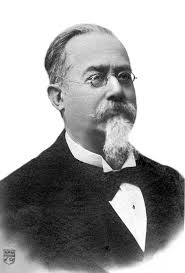
This is a two-part blog on embracing some of the criminological theory origin stories in the Western hemisphere. Is crime the product of bad genes or bad society? Are we born or made criminal?
In this week we shall be exploring our understanding of biological theories originating back in the 19th century with the “born criminal”. The following week we will look at the role of the environment.
The born criminal.
In 1871 Cesare Lombroso became the director at the Pesaro Mental Health Hospital (asylum) that housed the clinically insane. In that environment he examined the anatomical anomalies of residents in laboratory conditions. The era of the scientific exploration of deviance had begun. These meticulous explorations of bodily features and skulls formed the basis for his later thesis on The Born Criminal. The basis of his criminal population were residents of the asylum. His control group (i.e. those deemed non-criminal) were soldiers. Later, these were combined with the population of inmate prison population Lombroso and his associates visited. As he assumed an academic role in one of the finest Italian universities the world read his seminal publication of L’uomo delinquente {The Born Criminal] .Which in 1876 became one of the publications that influence the work of its contemporaries. In later years studied in exactly the same way. criminality in women using sex workers and prisoners as his research population cumulating into the 1893 publication of La Donna Delinquente: La prostituta e la donna normale [The Criminal Woman: The Prostitute and the Normal Woman.
His theoretical reach transcended borders and became widely read in the English-speaking world. This is an origin story according to numerous textbooks about the biological understanding of criminality. When embellished with some of the original quotes this becomes a theory of crime that explains different criminalities and makes the most significant leap that combines scientific rationale with crime. The methodology of anthropometry is a careful measuring of human features, prominently skulls! The main theoretical “innovation” was the recognition of a state of atavism; a regression onto a prior evolutionary stage for those engaged in crime.
A theory of crime on the born criminal seemed as a logical step at a time hailed as an era of discovery and exploration. A time that social and political movements in Europe asked profound questions about self and society. This narrative of course largely overlooks that whilst West European and US philosophers are posing these questions their elites and establishment are preoccupied with colonialism and dominance. In fact, it is the time European conflict around the world for dominance intensified. By the late 19th century, the European powers will try to manage their dominance in other continents by carving the world according to their own interests. The Berlin conference of 1884-85 is the culmination of such European competition and led to the split of Africa into zones of colonial influence.
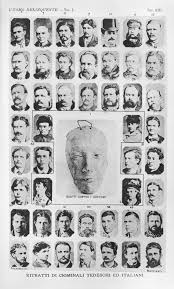
In what way is The Born Criminal related with colonialism?
The theory of the “born criminal” breaks down humanity into two; the “normals” and the “atavists” which conveniently separates us from them. The criminal becomes the outcome of a lack of civilisation that can be seen in their physical features. There is history in separating people for the sake of exploitation, subjugation and even genocide. In this context of using civilisation (solely European) as the feature of separation is something previously seen in the colonisation of the Americas. When the European explorers landed in a new (for their map’s) continent the question of whom it belongs to was answered using religious decree. Several popes described the native population of these “discovered lands” as uncivilised and unworthy of human rights. It was the papal “Doctrine of Discovery” that denied the indigenous people rights to their land because uncivilised, faithless people (calling it terra nullus or empty land) do not count. Therefore, this separation for discrimination is not new, but Lombroso brought some scientific veneer to it.
It is important to remind all that “the born criminal” theory was widely discredited already in the early 20th century, when data analysis found no support for atavism and the biological features seemingly associated with criminality. Yet still this approach seems to capture even today some interest in the collective criminological imagination. Can you tell the prospective criminality reflected in someone’s gaze? It is a question that people still wonder, despite any lack of empirical or scientific data. The line of separating criminals from non-criminal provides an arbitrary differentiation that offers some clarity of how criminals should look, in a similar fashion to separating the “civilised” from the “savages”. In this overreaching correlation crime becomes the act of the uncivilised. It can also be flipped over and the uncivilised are the criminals contributing to the continuous fear of those who see the foreigner with suspicion.
A theory about the biological origins on crime that has offered us an explanation of the born criminal that has no scientific evidence but carries populist imagination because we take comfort in differentiating people. Next week we shall be exploring a theory that explores of the environmental factors of crime.
Share this:


A Love Letter to Criminology at UON


In 2002, I realised I was bored, I was a full-time wife and parent with a long-standing part-time job in a supermarket. I first started the job at 15, left at 18 to take up a job at the Magistrates’ court and rejoined the supermarket shortly after my daughter was born. My world was comfortable, stable and dependable. I loved my family but it was definitely lacking challenge. My daughter was becoming increasingly more independent, I was increasing my hours and moving into retail management and I asked myself, is this it? Once my daughter had flown the nest, could I see myself working in a supermarket for the rest of my life? None of this is to knock those those that work in retail, it is probably the best training for criminology and indeed life, that anyone could ask for! I got to meet so many people, from all backgrounds, ethnicities, ages, religions and classes. It taught me that human beings are bloody awkward, including myself. But was it enough for me and if it wasn’t, what did I want?
At school, the careers adviser suggested I could work in Woolworths, or if I tried really hard at my studies and went to college, I might be able to work for the Midland Bank (neither organisation exists today, so probably good I didn’t take the advice!). In the 1980s, nobody was advocating the benefits of university education, at least not to working-class children like me. The Equal Pay Act might have been passed in 1970 but even today we’re a long way from equality in the workplace for women. In the 1980s there was still the unwritten expectation (particularly for working class children from low socio economic backgrounds) that women would get married, have children and perhaps have a part-time job but not really a career….I was a textbook example! I had no idea about universities, knew nobody that had been and assumed they were for other people, people very different from me.
That changed in 2002, I had read something in a newspaper about a Criminology course and I was fascinated. I did not know you could study something like that and I had so many questions that I wanted to answer. As regular readers of the blog will know I’m a long-standing fan of Agatha Christie whose fiction regularly touches upon criminological ideas. Having been born and raised in North London, I was very familiar with HMP Holloway’s buildings, both old and new, which raised lots of questions for a curious child, around who lived there, how did they get in and out and what did they do to the women held inside. Reading suffragette narratives had presented some very graphic images which further fed the imagination. Let’s just say I had been thinking about criminology, without even knowing such a discipline existed.
Once I was aware of the discipline, I needed to find a way to get over my prejudices around who university was for and find a way of getting in! To cut a long story short, I went to an Open Day and was told, go and get yourself an access course. At the time, it felt very blunt and reinforced my view that universities weren’t for the likes of me! Looking back it was excellent advice, without the access course, I would never have coped, let alone thrived, after years out of education.
In 2004 I started reading BA Criminology, with reading being the operant word. I had been an avid reader since early childhood (the subject of an earlier blog) and suddenly I was presented with a license to read whatever and whenever I wanted and as much as I could devour! For the first time in my life, people could no longer insist that I was wasting time with my head always in a book, I had “official” permission to read and read, I did! I got the chance to read, discuss, write and present throughout the degree. I wrote essays and reports, presented posters and talked about my criminological passions. I got the chance to undertake research, both empirical and theoretical, and lawks did I revel in all this opportunity. Of course, by looking back and reflecting, I forget all the stresses and strains, the anxieties around meeting so many new people, the terror of standing up in front of people, of submitting my first assessment, of waiting for grades….but these all pale into insignificance at the end and three years goes so very quickly….
In the summer of 2007, I had a lovely shiny degree in Criminology from the University of Northampton, but what next? By this point, I had the studying bug, and despite my anticipation that university would provide all the answers, I had a whole new set of questions! These were perhaps more nuanced and sophisticated than before but still driving me to seek answers. As I said earlier, human beings are awkward and at this point I decided, despite my earlier passion, I didn’t want to be put in a box labelled “Criminology“. I felt that I had finally cracked my fear of universities and decided to embark on a MA History of Medicine at Oxford Brookes. I wanted to know why Criminology textbooks and courses still included the racist, sexist, disablist (and plenty more) “theories” of Cesare Lombroso, a man whose ideas of the “born criminal” had been discredited soon after they were published.
But again the old fears returned….what did I know about history or medicine? What if the Criminology degree at Northampton hadn’t been very good, what if they just passed everyone, what if I was kidding myself? Everything at Brookes felt very different to Northampton, everyone on the course had studied BA History there. Their research interests were firmly centred on the past and on medicine, nursing, doctoring, hospitals and clinics and there was me, with my ideas around 20th century eugenics, a quasi-scientific attempt to rationalise prejudice and injustice. Along with studying the discipline, I learnt a lot about how different institutions work, I compared both universities on a regular basis. What did I like about each, what did I dislike. i thought about how academics operate and started to think about how I would be in that profession.
I successfully completed the MA and began to think maybe Northampton hadn’t given me good grades out of our pity or some other misplaced emotion, but that I had actually earnt them. I was very fortunate, I had maintained connection with Criminology at UON, and had the opportunity to tip my toe in the water of academia. I was appointed as an Associate Lecturer (for those not familiar with the title, it is somebody who is hourly paid and contribute as little or as much as the department requires) and had my first foray into university teaching. To put it bluntly, I was scared shitless! But, I loved every second in the classroom, I began to find my feet, slowly but surely, and university which had been so daunting began to seep into my very being.
Fast forward to 2025, I have been involved with UON for almost 22 years, first as a student, then as an academic, achieving my PhD in the process It is worth saying that the transition is not easy, but then nothing worth having ever is. I have gained so much from my studies, my relationship with two universities and the experiences I have had along the way. It is fair to say that I have shed many tears when studying, but also had some of my very highest highs, learning is painful, just watch a small child learning to read or write.
Hopefully, over the past decades I have repaid some of the debt I owe to the academics that have taught me, coached me, mentored me and supported me (special mention must go to @manosdaskalou who has been part of my journey since day 1). My life looks very different to 2002 and it is thanks to so many people, so many opportunities, the two universities that have provided me with a home from home and all of the students I have had the privilege to engage with.
I am so delighted to have been part of Criminology at UON’s 25 years of learning and teaching. To my colleagues, old and new, students, graduates and everyone I have met along the way, I raise my glass. Together we have built something very special, a community of people committed to exploring criminological ideas and making the world an equitable place.
Share this:


Terrorised into compliance

Learning and teaching is a complex business, difficult to describe even by those in the process of either/or both. Pedagogy, as defined by Lexico is ‘[t]he method and practice of teaching, especially as an academic subject or theoretical concept’. It underpins all teaching activity and despite the seemingly straightforward definition, is a complex business. At university, there are a variety of pedagogies both across and within disciplines. How to teach, is as much of a hot topic, as what to teach and the methods and practices are varied.
So how would you feel if I said I wanted Criminology students to quake in their boots at the prospect of missing classes? Or “literally feel terror” at the thought of failing to do their reading or not submitting an assessment? Would you see this as a positive attempt to motivate an eager learner? A reaction to getting the best out of lazy or recalcitrant students? A way of instilling discipline, keeping them on the straight and narrow on the road to achieving success? After all, if the grades are good then everything must be okay? Furthermore, given many Criminology graduate go on to careers within Foucault’s ‘disciplinary society’ maybe it would be useful to give them a taste of what’s to come for the people they deal with (1977: 209).
Hopefully, you are aghast that I would even consider such an approach (I promise, I’m definitely not) and you’ve already thought of strong, considered arguments as to why this would be a very bad idea Yet, last week the new Home Secretary, Pritti Patel stated that she wanted people to “literally feel terror” at the prospect of becoming involved in crime. Although presented as a novel policy, many will recognise this approach as firmly rooted in ideas from the Classical School of Criminology. Based on the concepts of certainty, celerity and severity, these ideas sought to move away from barbaric notions and practices to a more sophisticated understanding of crime and punishment.
Deterrence (at the heart of Classical School thought) can be general or specific; focused on society or individuals. Patel appears to be directing her focus on the latter, suggesting that feelings of “terror” will deter individuals from committing crime. Certainly, one of the classical school’s primary texts, On Crime and Punishment addresses this issue:
‘What is the political intention of punishments? To terrify, and to be an example to others. Is this intention answered, by thus privately torturing the guilty and the innocent?’
(Beccaria, 1778: 64)
So, let’s think through this idea of terrorising people away from crime, could it work? As I’ve argued before if your crime is a matter of conscience it is highly unlikely to work (think Conscientious Objectors, Suffragettes, some terrorists). If it is a crime of necessity, stealing to feed yourself or your family, it is also unlikely to succeed, certainly the choice between starvation and crime is terrifying already. What about children testing boundaries with peers, can they really think through all the consequences of actions, research suggests that may not be case (Rutherford, 1986/2002). Other scenarios could include those under the influence of alcohol/drugs and mental health illnesses, both of which may have an impact on individual ability to think through problems and solutions. All in all, it seems not everyone can be deterred and furthermore, not all crimes are deterrable (Jacobs, 2010). So much for the Home Secretary’s grand solution to crime.
As Drillminister demonstrates to powerful effect, violent language is contextual (see @sineqd‘s discussion here). Whilst threats to kill are perceived as violence when uttered by young, black men in hoods, in the mouths of politicians they apparently lose their viciousness. What should we then make of Pritti Patel’s threats to make citizens “literally feel terror”?
Selected bibliography
Beccaria, Cesare, (1778), An Essay on Crimes and Punishments, (Edinburgh: Alexander Donaldson), [online]. Available from: https://archive.org/details/essayoncrimespu00Becc/page/n3
Foucault, Michel, (1977), Discipline and Punish: The Birth of the Prison, tr. from the French by Alan Sheridan, (London: Penguin Books)
Jacobs, Bruce A., (2010), ‘Deterrence and Deterrability’, Criminology, 48, 2: 417-441
Rutherford, Andrew, (1986/2002), Growing Out of Crime: The New Era, (Winchester: Waterside Press)
Share this:


The Lure of Anxiety

Helen is an Associate Lecturer teaching on modules in years 1 and 3.
I wear several hats in life, but I write this blog in the role of a lecturer and a psychologist, with experience in the theory and practice of working with people with psychological disorders.
In recent years, there has been an increase in awareness of mental health problems. This is very welcome. Celebrities have talked openly about their own difficulties and high profile campaigns encourage us to bring mental health problems out of the shadows. This is hugely beneficial. When people with mental health problems suffer in silence their suffering is invariably increased, and simply talking and being listened to is often the most important part of the solution.
But with such increased awareness, there can also be well-intentioned but misguided responses which make things worse. I want to talk particularly about anxiety (which is sometimes lumped together with depression to give a diagnosis of “anxiety and depression” – they can and do often occur together but they are different emotions which require different responses). Anxiety is a normal emotion which we all experience. It is essential for survival. It keeps us safe. If children did not experience anxiety, they would wander away from their parents, put their hands in fires, fall off high surfaces or get run over by cars. Low levels of anxiety are associated with dangerous behaviour and psychopathy. High levels of anxiety can, of course, be extremely distressing and debilitating. People with anxiety disorders avoid the things they fear to the point where their lives become smaller and smaller and their experience severely restricted.
Of course we should show compassion and understanding to people who suffer from anxiety disorders and some campaigners have suggested that mental health problems should receive the same sort of response as physical health problems. However, psychological disorders, including anxiety disorders, do not behave like physical illnesses. It is not a case of diagnosing a particular “bug” and then prescribing the appropriate medication or therapy to make it go away (in reality, many physical conditions do not behave like this either). Anxiety thrives when you feed it. The temptation when you suffer high levels of anxiety is to avoid the thing that makes you anxious. But anyone who has sat through my lecture on learning theory should remember that doing something that relieves or avoids a negative consequence leads to negative reinforcement. If you avoid something that makes you highly anxious (or do something that temporarily relieves the anxiety, such as repeatedly washing your hands, or engaging in a ritual) the avoidance behaviour will be strongly reinforced. And you never experience the target of your fears, so you never learn that nothing catastrophic is actually going to happen – in other words you prevent the “extinction” that would otherwise occur. So the anxiety just gets worse and worse and worse. And your life becomes more and more restricted.
So, while we should, of course be compassionate and supportive towards people with anxiety disorders, we should be careful not to feed their fears. I remember once becoming frustrated with a member of prison staff who proudly told me how she was supporting a prisoner with obsessive-compulsive disorder by allowing him to have extra cleaning materials. No! In doing so, she was facilitating his disorder. What he needed was support to tolerate a less than spotless cell, so that he could learn through experience that a small amount of dirt does not lead to disaster. Increasingly, we find ourselves teaching students with anxiety difficulties. We need to support and encourage them, to allow them to talk about their problems, and to ensure that their university experience is positive. But we do them no favours by removing challenges or allowing them to avoid the aspects of university life that they fear (such as giving presentations or working in groups). In doing so, we make life easier in the short-term, but in the long-term we feed their disorders and make things worse. As I said earlier, we all experience anxiety and the best way to prevent it from controlling us is to stare it in the face and get on with whatever life throws at us.

 Thoughts from the criminology team

