
Home » Identity (Page 3)
Category Archives: Identity

The Ever Rolling Stream Rolls On
Professor Nick Petford is the Vice Chancellor of the University of Northampton.
As we gear up to leave Park Campus for Waterside it is only natural to feel a sense of loss. Park has been a great place to work and play and will hold a special place in many hearts, as summarised nicely by Bethany Davies from the Criminology team in a recent Blog.
When I took up post as VC in September 2010 I inherited a draft master plan for the University Estate. It was clear that the split campus was a concern to the previous management team and that both estates were starting to look tired. There were several options on the table. One was to move Avenue to Park. The other was expansion of Avenue and closer physical integration with Newton. The showcase element was a huge glass dome, bigger than the one at the British Museum, enclosing most of the courtyard space at Avenue under one roof. Both were impractical. Building Avenue on Park would have consumed most of the sports fields and greenery that makes it what it is. And the disruption of turning Park into a building site for 36 months would do little to improve the student or staff experience. But it would have achieved a single university site, unlike the Avenue plan that would have entrenched the status quo (with a big window cleaning bill to boot!). Not long after my arrival, and with a change in the way government wanted to drive the regional growth agenda, the newly established SEMLEP created in Northampton a 16 mile stretch of brownfield land bordering the River Nene as an Enterprise Zone. The rest, as they say, is history.
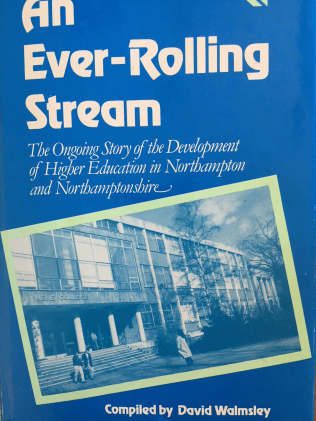
An enduring aspect of higher educational institutions is change. Depending on timing, from a personal viewpoint it can be a slow, almost glacial process. For others, caught up in periods of rapid transition, as we are now, the hurly burley can feel almost overwhelming. But change is always there. And Northampton is no exception. For those suspicious this is more spin than substance I can recommend The Ever Rolling Stream, a book compiled and printed in 1989 by the 567th Mayor of Northampton, David Walmsley, that charts the history of Higher Education in Northampton. In short, the key events culminating in the present University are:
1260: Ancient University
1867: Mechanics Institute
1932: Northampton Technical College (St George’s Avenue)
1967: University of Leicester University Centre, Northampton
1972: Northampton College of Education (Park Campus)
1975: Nene College of Higher Education
1978: The National Leathersellers Centre
1982: Sunley Management Centre
1989: Release from local authority control
1999: University College Northampton
2005: The University of Northampton
2018: Waterside.
The picture is one of periods of relative stability (including a c. 700 year sabbatical!), punctuated by mergers and consolidation. Our most rapid phase of change took place in the six years between 1972 and 1978 and involved the relocation, merger and subsequent closure of four separate educational establishments that ultimately comprise Park Campus as we know it today. Each of these phases would have been a unique cause of excitement, stress, resignations, hope and probable despair! But together they have two things in common – they happened mostly outside our working experience, and (ancient university excepted), ended in success. In our history of relocations and mergers, the inevitable conversations between doubters and advocates are lost in time, one exception being the amalgamation in 1937 of the School of Art in Abington Street, with the Technical College, which seems particularly vexed. Against this backdrop we see Waterside simply as the next stage in our evolution.
The title for Ever Rolling Stream comes from the hymn ‘O God our Help in Ages Past’. It sums up brilliantly the feeling of loss and the inevitability of change:
Time, like an ever-rolling stream,
Bears all its sons away;
They fly forgotten as a dream
Dies at the opening day.
Yes, think kindly of Park, and Avenue, mourn even as others will have done over those antecedents that culminated in our present estate. But don’t think you are the first to do so. Who knows, at some time in the future, staff and students not yet born will be contemplating a move from Waterside to a new horizon, as the ever rolling stream rolls on.
Share this:


The changing face of criminology

We can profess that those of us in academia get to own a small nugget of knowledge on their chosen subject. This is how specialism is developed and cultivated. We start our long journey into knowledge first by learning the discipline as a whole, going through the different theories and issues, becoming aware of the critical debates, before we embrace the next step of in depth understanding. Little by little knowledge becomes a road full of junctions, intersections and byroads, constantly fueled by one of the most basic but profound parts of human experience, curiosity. Academia, was originally developed by a person looking up in the wider cosmos and wondering; surely there is more to life than this. When the recorded experience aligned with imagination it produced results; civilization emerged as a collective testament of being. Arguably the first ever question, whenever it was posed and however it was phrased, philosophy was born; any attempt to answer it generated reason and logic.
The process of learning is painstaking because education is a process and as such it requires us to grow as we absorb it. This process is never ending because “The eye never has enough of seeing, nor the ear its fill of hearing” to quote Ecclesiastes and therefore learning is lifelong. In academia, in particular, this thirst for knowledge is unquenchable and because of it we progress our respective disciplines further, constantly expanding the boundaries. Anyone of us who had a discussion in or out of a classroom will testify that even on the same topic, with the same material, a seminar is never the same. The main reason for this is, education is active and as a learner I gain from whatever I can relate to and comprehend. Time and time again, I go back to my own learning as I adapt my pedagogy, because to teach is a dialectic; we impart an idea and we let it flourish to those who shall be taking it further.
There is a reason why I am so reflecting of education on this entry; recently we had a reunion of our alumni and in preparation of the event, I was looking back at the way we taught criminology, what changed and how things have progressed. Colleagues, moved on as expected and the student demographics may have changed but the subject is still taught. It is this ongoing process that fascinated me in that reflection. The curriculum and the ideas behind it. As an institution we offer a number of subject areas, criminology included, that other institutions around the world do, but no other institution will have the unique blend of what we offer. This part is quite astounding that in the reproduction of ideas and across the continuity of disciplinary knowledge, there is always a place for originality.
On the day, I could hear the stories from some of our alumni with a latent sense of pride as they spoke with some confidence about their life plans, work commitments and ideas. These were the same people who some years ago, blushed in a seminar from shyness, were anxious about their exam results and worried about their degree classification. Now with confidence, they embrace their education with the realisation that they have just made the first step into a terra incognita… their journey into learning continues. During the next weeks (and hopefully, months), a number of our alumni (and current students) will put pen to paper of their thoughts, on our blog and talk about their experiences and their criminology. We thank them in advance and are looking forward to read their thoughts.
Share this:

Anniversaries and Festivities
 About a year ago, as a team we started this blog in order to relate criminological ideas into everyday life. News, events and markers on our social calendar became sources of inspiration and inquiry. Within a year, we have managed somehow to reflect on the academic cycle, some pretty heavy social issues that evoked our passions and interests. Those of you who read our entries, thank you for taking the time, especially those who left comments with your own experiences and ideas.
For us as a contributing team, the opportunity to talk outside the usual spaces about things that we regard as interesting is a real pleasure. A colleague of mine, tends to say that criminology is a subject made for discussions. These discussions usually grow in classrooms but they are restricted of time. In some way, our blog is an extension of that environment but we are also cognisant that we want to talk beyond the parochial “ivory towers” of academia.
The first blog entry was about running a pilot then, for a new module delivered entirely in prison with students from the university and the prison. This week, we celebrated the first cohort who completed the module. I have been an observer of social conventions all my life and to see the way people in the celebration connected with each other was great. For all of us in the module, it makes perfect sense because we have done that journey together but for anyone coming for the first time in prison this must have been an astounding experience.
This is what we commemorate in a celebration. Not necessarily the end result whatever that is, but the journey. As people consumed with speed in a modern society, we very rarely take the time to look back and reflect. It can be argued that we can do so when we reach our ever expanding retiring age; reflect on our life’s work. Nonetheless, it is important now and then to look back and see how we get here. For example, I am proud that I serve a university that offers opportunities to students from the wider society without barriers or obstacles. Some of our students are first in their family to go to University. This is an amazing opportunity that leaves the doors of social mobility open. A number of our graduates are now my colleagues or work in the wider criminal justice system.
So what is a celebration? A moment in time to look back and say, “hey I have a journey ahead but look how far I have come”. This is why these little moments are so watershed to all; whether we celebrate a year in the blog, a year on a module or a year in a job, marriage etc. Some celebrations are small reminders of time, other of events and some other of accomplishments. In a world where the news should be accompanied with health warnings, as people feel insignificant as individuals to bring about change, a celebration is a mark that things can happen. A person who decides to be an agent of change, whether it is a message against racism (#blacklivesmatter) sexual abuse (#metoo), or gun violence (#enoughisenough), they can do so without realising that one day when they will look back things will be very different for all; a possible cause for another celebration then. It matters to look back when you want to change the future. Life is experiential journey and marking these experiences is our way of leaving a trace on a large social wall.
In a couple of months (May 14) we shall be celebrating 18 years of Criminology at the University of Northampton. Another moment in time to reflect of the impact and the effects this programme has had on the students and the community.
Cheers
Share this:


Why you should trust your work

Bethany Davies is an Associate Lecturer teaching modules in the first year.
It is only human to doubt yourself in certain situations; however, academia can be a problematic situation to doubt your ideas and abilities. It can lead you to change your standpoint unnecessarily and also create so much stress that you give up on an idea or project entirely.
I deal with this less so now since my university experience but still regularly and I felt it may provide comfort to those currently studying or recently graduated, these examples are personal and are only two of many. In particular I want to address doubting your own ideas and work and how important it is to keep challenging those thoughts.
Upon starting university, my first ‘big essay’ (I describe this with humour as it was 3000 words, but as a first year that can seem like quite the ask) was a biographical assignment. This assignment required an interview with a family member or anyone who would be willing to talk to you and to apply that to research by highlighting some key events/accomplishments. I feared writing that essay as I had many friends with parents who were lawyers or grandparents who had been in the war or immigrants. These stories surely would be so interesting and my essay on my dad who worked in a warehouse would be seen as boring, perhaps. This was my first experience with fear and doubt over my work, but then I did the interview, wrote the essay, took a deep breath and submitted. Turns out it was one of my favourite pieces of work and the programme leaders liked it. It was an honest essay and while not glamorous, it was personal to me and that made the approval and grade that more rewarding.
In my second year, I conducted my placement at a probation office and based my research around a case study of one male who was doing an English class and aimed to discuss the success of that class. After around 8 weeks of observations and an interview with the male. I went to my seminar leader at the time (@paulaabowles) in a complete panic and almost teary-eyed. I told her how I felt my research was not good enough because the male was lying to me, in fact he was almost lying to the whole probation experience as he was more or less just turning up to tick the boxes he needed but then conducting his behaviour differently to me in certain situations and the interview. I felt I had failed as a researcher and also as a teacher almost, as I was assisting in the teaching of the class he was in. I was then told some of the great truths of research and also why I had not failed and actually I had done very well. My research was good research and I just had not realised it. The research didn’t find what I wanted it to, in fact it found the opposite, which was still good research. My research which I had titled ‘Playing the system’ had actually proved to not be a failure and my doubts were unnecessary but not anything to be ashamed of. As in my quest at the time to find answers of why was I such a ‘bad researcher’ and interviewer, I found a plethora of other people online and among peers with the same doubts over some great work they had produced.
Whether it be doubts or fear of speaking up in fear of failure or sounding stupid, I hope others may be able to see not only are they not alone, but actually you are normal because of these doubts. We should just maybe work on believing in our work more and not waiting to get the approval of others for those ideas. With this I feel it is fitting to use one of my favourite quotes from Bertrand Russell:
“The whole problem with the world is that fools and fanatics are always so certain of themselves, and wiser people so full of doubts.”
Share this:


Tattoos: deviance or individualism?
For my blog this week I thought I’d follow up on @charlottejdann’s blog on tattoos and add some personal experiences to the discussion. The media certainly have had their part to play in the negative connotations surrounding tattoos and the types of people with them, however I question the extent to which the media influence those perceptions today. Based purely on my own experience and opinion I believe that tattoos have become relatively common and as we saw in Charlotte’s blog the rise in tattoo studios would certainly seem to support this assumption. In fact, I think a process of normalisation has occurred whereby it is more surprising when someone hasn’t got a tattoo than when they have. Furthermore, the negative connotations and ‘expressed shock’ at the increase in tattooing is, in my humble opinion, typically associated to those of the older, more traditional generation for whom tattooing was a symbol of deviance, rebellion and/or disrepute.
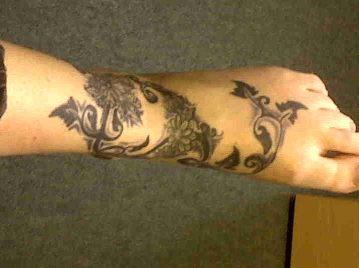
I got my first tattoo when I was just 14; a small black panther discreetly placed on my thigh. My choice of phrase here is not accidental, being just 14 and below the age of legal consent the placement of this tattoo had to be discrete to hide it from my mother. The intentional law breaking and deception of this act would certainly look like deviance to an outside observer. Since then I added two more tattoos to my collection and have another one planned for the near future. Reflecting on this notion of deviance and my own motivation I arrive at a number of conclusions. My first tattoo was, without doubt, an act of rebellion against the expectations placed upon me by family and peers to be a ‘good girl’ and a ‘high achiever’. I don’t in any way regret that tattoo but I can recognise the reason for getting it. My second tattoo was more daringly placed on my upper arm and in hindsight was not thought through or carefully picked but at the same time it was not an act of rebellion. Those of you with tattoos may understand when I say that getting tattoos is like an addiction, you either love them or hate them but once you’ve got one, you want more. It was this ‘addiction’ so to speak that led to my second tattoo. My third tattoo which covers my foot and spreads up my ankle, symbolises the changing direction of my life after the birth of my first child and is by far my favourite to date. In short, the meaning or motivation for each tattoo has shifted over time reflecting my growth as a person and my life experiences.
At the point of my third tattoo I’d entered the world of academia and was establishing my professional identity; an identity that was in some ways at odds with my tattooed body. Wearing a professional suit and heels with a tattoo on my foot and ankle certainly led to some raised eyebrows and disapproving looks from older colleagues. This reaction was nothing compared to the openly disapproving judgements I later encountered from fellow magistrates; not only was I young to be a magistrate but I was also tattooed and had the audacity to display them in court! Linking this reaction back to my earlier statement about deviance, rebellion and disrepute, the simplest thing would be for me to wear a trouser suit in court and hide my tattoos, in essence, conforming to societies expectations of that position. However, my reasons for not doing so are twofold, firstly I am a bit of rebel at heart and secondly, I do not see my tattoos as an act of deviance but one of self-expression. In all other areas of life, I conform to the norms and values of society, I have a career and present myself as a professional, I’m trying to raise my children to be good law-abiding citizens, I pay my bills on time, I put out my rubbish when asked and I try to treat others with compassion and respect. In short, I’ve joined the collective, blended into society and accepted the expectations of me as a woman, a mother, a daughter and so forth. My tattoos therefore are a reflection of self-expression, my little rebellious side that says, “I’m more than one of the collective, I’m an individual”. Each tattoo reflects my journey, where I have come from, what I have experienced, who I am and where I am going. They tell the reader that I am more than just a number, I am an individual embracing self-expression through body art because to me tattoos are not just ink, they are pieces of art symbolising your life journey. For this reason, I agree with Charlotte’s argument that tattooed people cannot be stereotyped as a homogeneous group because tattoos by their very nature make us unique individuals.
Share this:


Perceptions of tattooed bodies

Charlotte Dann is a psychology lecturer in the Faculty of Health and Society, researching women’s tattooed bodies. You can find out more and get in touch via Twitter – @CharlotteJD
Whenever I discuss my tattoo research, I always frame it historically, because I think it’s important to consider how we have come to the point we are at with how tattoos are perceived and understood. And you know, it’s good for a laugh.
In the late 1800s, Lombroso researched deviancy and criminality, and as part of this, came to the conclusion that people who had tattoos were criminals and prostitutes. However, this research was conducted on – you guessed it – criminals and prostitutes. Despite the poor correlation that was presented, his research was influential in how we perceive deviancy and deviant bodies, to the point that those negative connotations towards tattooed bodies still ring true today. Tattoos may be ever rising in popularity (figures indicated one in five has a tattoo, and the number of studios rose by around 170% in the last decade in the UK), but tattooed bodies can still be found to be associated with deviancy.
Let’s consider the influence of the media in this. Over the past few years, there has been a flurry of articles that express shock for the fact that ‘normal’ people are getting tattoos, and why tattoos are becoming more popular for women. It only takes a quick gander at the comments left on these articles to see that public opinion hasn’t changed that much, and that these articles perpetuate negative perceptions about tattoos (i.e. they’re not meant for ‘normal’ people). Newspaper articles such as this often make reference to the ‘normal’ people who are now adorning their bodies – normal being white, middle-class, ‘respectable’ people. The narrative of such newspaper articles often seems to rely on a discourse that positions tattooing as the proper domain of ‘the other’, associated with deviant, problematised, and generally male bodies. Newspaper articles often reflect a certain moral panic about the rise of tattoos among so called ‘normal’ people, whilst at the same time, normalise the practice of tattooing itself.
The media does not do a good job in quelling negative connotations regarding tattooed people, as they tend to focus more on the extremes – the eye-catching headlines, the things that make you wince and tut, not the everyday person who is tattooed. In recent years, newspapers have reported on tattooed teachers as being ‘inappropriate’ for children, on young adults who get cheap ‘joke’ tattoos on holidays in Magaluf, and present morality tales such as those who regret their tattoo choices. In addition, they also frame our understandings of ‘who’ this ‘normal’ tattooed person is (look – even Samantha Cameron and David Dimbleby have them!)
I think what we need to do is question the idea of what a ‘normal’ body is, and really think about the assumptions we make about that body based on frankly outdated perceptions. There is no longer one particular type of person who is tattooed – the availability and accessibility of tattoo studios, designs, and techniques, has meant that you cannot stereotype all tattooed people as one homogenous group.
Share this:


Life in the UK: Nigerians migrating from the other side
Damilola is a 2017 graduate having read BA Criminology with Sociology. Her blog entry reflects on the way in which personal experience can inform and be informed by research. Her dissertation is entitled Life in the UK: The individual narratives of Nigerians living in the United Kingdom and the different problems they faced during their integration into the UK
During my research on the topic of migration and integration, it was important to me, to make the individuals the focal point. This is because the majority of research in this area, depicts a holistic perspective. Therefore, understanding each individual story was vital during my research. It enabled an insight into the different coping mechanisms the Nigerian migrants used, to compensate for the sense of othering they often felt.
One of the most eye opening stories was that of a woman who had bleached her skin to become lighter. She felt this would encourage others to accept her and also, make her more appealing to prospective employers in the UK. Nigerian women bleaching their skin is not a new phenomena. According to the World Health Organisation, Nigerian women are the largest consumers of bleaching creams. This was a very important aspect because it highlighted that, Nigerian women both home and abroad often feel inferior because of the colour of their skin. These bleaching creams can cause serious damages to the skin, however these women and others alike are still willing to compromise their health because, they believe it will increase their likelihood of success.
Here is a blog post that goes into further details about the side effects of bleaching:
When migration is spoken about, it is almost always portrayed as an ‘issue’, something negative that needs to be dealt with. This is particularly evident with the campaigns during BREXIT of 2016. A lot of times, this encourages a negative stigma of migrants, both internationally and those from neighbouring European countries. This is not only damaging to the potential relationship between countries, it also creates a divide, a sense of ‘us against them’. Amidst of it all, are the most sensitive victims, the children of these migrants. A Participant during my research mentioned her children learning slangs such as “init” to fit in with the other kids at school. She also made mention of shortening the names of her children to accommodate the English tongue of their peers and teachers. For her the mental wellbeing of her children was more important, than a proper vocabulary or the right pronunciation of their names.
Moreover this also leads to another misconception about migrants. The common viewpoint proposed by earlier research is that the lack of understanding of the English language is the barrier that most migrants face. However the results from my research propose a different argument. I found that, it was the foreign African accent that most participants felt others had an issue with. For most participants their accent was the most difficult thing to loose. This often proved to be a problem. This is because it made them stand out and, was a universal stamp that highlighted “I AM NOT FROM HERE” in a country that encourages everyone to blend in.
Once again, this illustrates the real issue with migration, for many migrants the sense of belonging is never present. As a participant pointed out “even after getting my British passport, I am still not like them. I will always be Nigerian, I know that now”.
In relation to the interviewing of the participants, this proved to be the most difficult part of my research. This is because the women often drifted away from questions being asked and told tales of people who had similar experiences to them. Nonetheless it was also the most rewarding experience because these different tales were embedded with deeper meanings. The meanings that would later encourage a better understanding, of the way the women coped with integrating into a new country. Moreover, as a migrant myself it was interesting to see the changes that had occurred over time and, also a lot of what has remained the same. This is because despite coming to the country at a young age, I was able to relate to some of the coping mechanisms, such as the shortening of my name to accommodate the English tongue.
As a recent criminology graduate, my dissertation on migration and integration was one of the most eyeopening experiences of my life. I have learnt so much through this process, not only about the topic but also about myself. I am grateful for this experience because it has prepared me for what to expect for my postgraduate degree. A friendly advice from me, to anyone writing their dissertation would be to START EARLY!! It may seem impossible to start with but it will all be worth it in the end.
GOOD LUCK !!

 Thoughts from the criminology team