
Home » Honour Based Violence
Category Archives: Honour Based Violence

Changing the Narrative around Violence Against Women and Girls

For Criminology at UON’s 25th Birthday, in partnership with the Northampton Fire, Police and Crime Commissioner, the event “Changing the Narrative: Violence Against Women and Girls” convened on the 2nd April. Bringing together a professional panel, individuals with lived experience and practitioners from charity and other sectors, to create a dialogue and champion new ways of thinking. The first in a series, this event focused on language.
All of the discussions, notes and presentations were incredibly insightful, and I hope this thematic collation does it all justice.
“A convenient but not useful term.”
Firstly an overwhelming reflection on the term itself; ‘Violence Against Women and Girls’ – does it do justice to all of the behaviour under it’s umbrella? We considered this as reductionist, dehumanising, and often only prompts thinking and action to physical acts of violence, but perhaps neglects many other harms such as emotional abuse, coercion and financial abuse which may not be seen as, or felt as ‘severe enough’ to report. It may also predominantly suggest intimate partner or domestic abuse which may too exclude other harms towards women and girls such as (grand)parent/child abuse or that which happens outside of the home. All of which are too often undetected or minimised, potentially due to this use of language. Another poignant reflection is that we may not currently be able to consider ‘women and girls’ as one group, given that girls under 16 may not be able to seek help for domestic abuse, in the same way that women may be able to. We also must consider the impact of this term on those whose gender identity is not what they were assigned at birth, or those that identify outside of the gender binary. Where do they fit into this?
To change the narrative, we must first identify what we are talking about. Explicitly. Changing the narrative starts here.
“I do not think I have survived.”
We considered the importance of lived experience in our narratives and reflected on the way we use it, and what that means for individuals, and our response.
Firstly, the terms ‘victim’ and ‘survivor’ – which we may use without thought, use as fact, particularly as descriptors within our professions, but actually these are incredibly personal labels that only individuals with such experience can give to themselves. This may be reflective of where they are in their journey surrounding their experiences and have a huge impact on their experience of being supported. It was courageously expressed that we also must recognise that individuals may not identify with either of those terms, and that much more of that person still exists outside of that experience or label. We also took a moment to remember that some victims, will never be survivors.
Lived experience is making its way into our narratives more and more, but there is still much room for improvement. We champion that if we are to create a more supportive, inclusive, practical and effective narrative, we must reflect the language of individuals with lived experience and we must use it to create a narrative free from tick boxes, from the lens of organisational goals and societal pressure.
Lived experience must be valued for what it is, not in spite of what it is.
“In some cases, we allow content – which would otherwise go against our standards – if its newsworthy.”
A further theme was a reflection on language which appears to be causing an erosion of moral boundaries. For example, the term ‘misogyny’ – was considered to be used flippantly, as an excuse, and as a scapegoat for behaviour which is not just ‘misogynistic’ but unacceptable, abhorrent, inexcusable behaviour – meaning the extent of the harms caused by this behaviour are swept away under a ‘normalised’ state of prejudice.
This is one of many terms that along with things like ‘trauma bond’ and ‘narcissist’ which have become popular on social media without any rigour as to the correct use of the term – further normalises harmful behaviour, and prevents women and girls from seeking support for these very not normal experiences. In the same vein it was expressed that sexual violence is often seen as part of ‘the university experience.’
This use of language and its presence on social media endangers and miseducates, particularly young people, especially with new posting policies around the freedom of expression. Firstly, in that many restrictions can be bypassed by the use of different text, characters and emoji so that posts are not flagged for certain words or language. Additionally, guidelines from Meta were shared and highlighted as problematic as certain content which would, and should, normally be restricted – can be shared – as long as is deemed ‘newsworthy.’
Within the media as a whole, we pressed the importance of using language which accurately describes the actions and experience that has happened, showing the impact on the individual and showing the extent of the societal problem we face… not just what makes the best headline.
“We took action overnight for the pandemic.”
Language within our response to these crimes was reflected upon, in particular around the term ‘non-emergency’ which rape, as a crime, has become catalogued as. We considered the profound impact of this language for those experiencing/have experienced this crime and the effect it has on the resources made available to respond to it.
Simultaneously, in other arenas, violence toward women and girls is considered to be a crisis… an emergency. This not only does not align with the views of law enforcement but suggests that this is a new, emerging crisis, when in fact it is long standing societal problem, and has faced significant barriers in getting a sufficient response. As reflected by one attendee – “we took action overnight for the pandemic.”
“I’ve worked with women who didn’t report rape because they were aroused – they thought they must have wanted it.”
Education was another widely considered theme, with most talk tables initially considering the need for early education and coming to the conclusion that everyone needs more education; young and old – everything in between; male, female and everything in between and outside of the gender binary. No-one is exempt.
We need all people to have the education and language to pass on to their children, friends, colleagues, to make educated choices. If we as adults don’t have the education to pass on to children, how will they get it? The phrase ‘sex education’ was reflected upon, within the context of schools, and was suggested to require change due to how it triggers an uproar from parents, often believing their children will only be taught about intercourse and that they’re too young to know. It was expressed that age appropriate education, giving children the language to identify harms, know their own body, speak up and speak out is only beneficial and this must happen to help break the cycle of generational violence. We cannot protect young people if we teach them ignorance.
Education for all was pressed particularly around education of our bodies, and our bodily experiences. In particular of female bodies, which have for so long been seen as an extension of male bodies. No-one knows enough about female bodies. This perpetuates issues around consent, uneducated choices and creates misplaced and unnecessary guilt, shame and confusion for females when subjected to these harms.
“Just because you are not part of the problem, does not mean you are part of the solution.“
Finally, though we have no intention or illusion of resolution with just one talk, or even a series of them – we moved to consider some ways forward. A very clear message was that this requires action – and this action should not fall on women and girls to protect themselves, but for perpetrators for be stopped. We need allies, of all backgrounds, but in particular, we need male allies. We need male allies who have the education, and the words necessary to identify and call out the behaviour of their peers, their friends, their colleagues, of strangers on the bus. We asked – would being challenged by a ‘peer’ have more impact? Simply not being a perpetrator, is not enough.
Share this:


Victims of Domestic Violence Repeatedly Failed by UK Police Forces

On the last day of August 2024 I was invited to an event focused on “Victims of Domestic Violence Repeatedly Failed by UK Police Forces” held at Fenny Compton Village Hall. The choice of venue was deliberate, it was the same venue where Alan Bates brought together for the first time, just some of the many post-masters/mistresses impacted by, what we now recognise as, Britain’s largest miscarriage of justice. This meeting demonstrated that rather than one or two isolated incidents, this was widespread impacting 100s of people. Additionally, the bringing of people together led to the creation of the Justice for Sub-Postmasters Alliance [JFSA], a collective able to campaign more effectively, showing clearly that there is both strength and purpose in numbers.
Thus the choice of venue implicitly encouraged attendees to take strength in collectivity. Organised by three women who had lost daughters and a niece who instinctively knew that they weren’t the only ones. Furthermore, each had faced barrier after barrier when trying to find out what had happened to their loved ones leading up to and during their deaths. What they experienced individually in different areas of the country, shared far more commonality than difference. By comparing their experiences, it became clear that their losses were not unique, that across the country and indeed, the world, women were being subjected to violence, dying, grieving and being subjected to organisational indifference, apathy, if not downright institutional violence.
At the event, woman after woman, spoke of different women, very much loved, some had died, some had fled their violent partners (permanently, one hopes) and others who were still trapped in a living hell. Some spoke with confidence, others with trepidation or nerves, all filled with anguish, passion and each determined to raise their voices. Again and again they detailed their heartbreaking testimony, which again showed far more commonality than difference:
- Women being told that their reporting of domestic abuse incidents may make things much worse for them
- Evidence lost or disposed of by police officers
- Corrupted or deleted body worn camera footage
- Inability or unwillingness to recognise that domestic abuse, particularly coercive behaviour escalates, these are not separate incidents and cannot be viewed in isolation
- Police often dismissing women’s reports as examples of “minor” or “borderline” domestic abuse, when as detailed above, individual incidents in isolation do not reflect the lived experience
- History of domestic abuse ignored/disregarded whether or not recorded by the police
- Victims of domestic abuse being asked for forensic levels of detail when trying to report
- Victims of domestic abuse being incorrectly refused access by the police to access to information covered by Clare’s Law (Domestic Violence Disclosure Scheme)
- The Domestic Abuse, Stalking and Honour Based Violence [DASH} forms treated as tick box exercise, often done over harried phone calls
- Victims of domestic violence, criminalised when trying to protect themselves and their children from violent partners
- When escaping from violent relationships women are placed in refuges, often far from their support networks, children move schools losing their friendship circles and breaking trusted relationships with teachers
- Suicide not investigated according to College of Policing own guidance: Assume Nothing, Believe nobody, Challenge everything!
- Police failing to inform the parents of women who have died
- Dead women’s phones and laptops handed over to the men who have subjected them to violence (under the guise of next-of-kin)
- The police overreliance on testimony of men (who have subjected them to violence previously) in relation to their deaths
- Challenges in accessing Legal Aid, particularly when the woman and children remain in the family home
- The lack of joined up support, lots of people and charities trying to help on limited resources but reacting on an ad hoc basis
- The police would rather use valuable resources to fight victims, survivors and their families’ complaints against them
The above is by no means an exhaustive list, but these issues came up again and again, showing clearly, that none of the women’s experiences are unique but are instead repeated again and again over time and place. It doesn’t matter what year, what police force, what area the victim lived in, their education, their profession, their class, marital status, or whether or not they were mothers. It is evident from the day’s testimony that women are being failed not only by the police, but also the wider Criminal Justice System.
Whilst the women have been failed, the criminologist in me, says we should consider whether the police are actually “failing” or whether they are simply doing what they were set up to do, and women are simply collateral damage. Don’t forget the police as an institution are not yet 200 years. They were set up to protect the rich and powerful and maintain control of the streets. Historically, we have seen the police used against the population, for example policing the Miners’ Strikes, particularly at Orgreave. More recently the response to those involved in violent protest/riots demonstrates explicitly that the police and the criminal justice system can act swiftly, when it suits. But consider what it is trying to protect, individuals or businesses or institutions or the State?
The police have long been faced by accusations of institutional racism, homophobia and misogyny. It predominantly remains a institution comprised of white, straight, (nominally) Christian, working class, men, despite frequent promises to encourage those who do not fit into these five classifications to enlist in the force. Until the police (and the wider CJS) are prepared to create a less hostile environment, any attempt at diversifying the workforce will fail. If it continues with its current policies and practices without input from those subjected to them, both inside and outside the institution, any attempt at diversifying the institution will fail. But again we come back to that word ‘failure’, is it failing if the institution continues to maintain the status quo, to protect the rich and powerful and maintain control of the streets?
But does the problem lie solely with the police and the wider criminal justice system, or are we continually failing as a society to support, nurture and protect women? Take for example Hearn’s astute recognition that ‘[f]or much too long men have been considered the taken-for-granted norm against which women have been judged to be different’ offers an alternative rationale (1998: 3).Many scholars have explored language in relation to women and race, identifying that in many cases the default is understood to be a white male (cf. de Beauvoir, 1949/2010, Lakoff, 1973, Spender, 1980, Eichler, 1988/1991, Penelope, 1990, Homans, 1997). As de Beauvoir evocatively writes, ‘humanity is male and man defines woman not in herself, she is not regarded as an autonomous being […] He is the Subject; he is the Absolute. She is the Other’ (de Beauvoir, 1949/2010: 26). Lakoff (1973) also notes that the way in which language is used both about them and by them, disguises and enables marginalisation and disempowerment. Furthermore, it enables the erasure of women’s experience. The image below illustrates this well, with its headline figure relating to men. Whilst not meaning to dismiss any violence, when women’s victimisation far outweighs that faced by men, this makes no logical sense.

Nevertheless, we should not forget men as Whitehead dolefully concludes:
‘to recognize the extent and range of men’s violences is to face the depressing and disturbing realization that men’s propensity for cruelty and violence is probably the biggest cause of misery in the world (2002: 36).’
Certainly numerous authors have identified the centrality of men (and by default masculinity) to any discussion of violence. These range from Hearn’s powerful assertion that it is ‘men [who] dominate the business of violence, and who specialize in violence’ (1998: 36) to Mullins (2006) suggestion that women act as both stimulation for men’s violence (e.g. protection) and as a limiter. Certainly, Solnit perceptively argues that armed with the knowledge that men are responsible for far more violence, it should be possible to ‘theorise where violence comes from and what we can do about it a lot more profoundly’ (2014: 25).
All of the challenges and barriers identified on the day and above make it incredibly difficult, even for educated well-connected women to deal with, this is compounded when English is not your first language, or you have a visa dependant on your violent partner/husband, or hold refugee status. As various speakers, including the spokeswoman for Sikh Women’s Aid made clear, heritage and culture can add further layers of complexity when it comes to domestic abuse.
Ultimately, the event showed the resilience and determination of those involved. It identified some of the main challenges, paid tribute to both victims and survivors and opened a new space for dialogue and collective action. If you would like to keep up with their campaign, they use the hashtag #policefailingsuk and can be contacted via email: policefailings.uk@yahoo.com
References
de Beauvoir, Simone, (1949/2010), The Second Sex, tr. from the French by Constance Borde and Sheila Malovany Chevalier, (New York: Vintage Books)
Eicler, Margrit, (1988/1991), Nonsexist Research Methods, (London: Routledge) (Kindle Version)
Hearn, Jeff, (1998), The Violences of Men, (London, Sage Publications Ltd)
Homans, Margaret, (1997), ‘“Racial Composition”: Metaphor and the Body in the Writing of Race’ in Elizabeth Abel, Barbara Christian and Helene Moglen, (Eds), Female Subjects in Black and White, (London: University of California Press): 77-101
Lakoff, Robin, (1973), ‘Language and Woman’s Place,’ Language in Society, 2, 1: 45-80
Mullins, Christopher W., (2006), Holding Your Square: Masculinities, Streetlife and Violence, (Cullompton: Willan Publishing)
National Centre for Domestic Violence, (2023), ‘Domestic Abuse Statistics UK,’ National Centre for Domestic Violence, [online]. Available from: https://www.ncdv.org.uk/domestic-abuse-statistics-uk/ [Last accessed 31 August 2024]
Penelope, Julia, (1990), Speaking Freely: Unlearning the Lies of the Fathers’ Tongues, (New York: Pergamon Press)
Solnit, Rebecca, (2014), Men Explain Things to Me, (London: Granta Publications)
Spender, Dale, (1980), Man Made Language, (London: Routledge and Kegan Paul)
Whitehead, Stephen M., (2002), Men and Masculinities, (Cambridge: Polity Press)
Share this:


For Tyre’s last Five badges. (spoken word)
The badges you wear were betrayed the very instant you flashed your sights on me.
You had nothing good in mind from the start.
I was doomed from the beginning.
By the time the brutality started,
The senselessness of it all kept my body numb to the assault.
“What did I do,” I keep asking, as
Your brutal blows, strongholds and punches bend my body into painful pretzels.
While y’all’ve got me firmly pressed against the pavement, y’all yell:
“Get on the ground.”
Pressed on the ground, I say disarmingly:
“You guys are really doing a lot right now.”
My calmness stands out against all your unwavering aggressions.
Yet, you continue to play the same game: “Get on the ground.”
Beneath the ground there is only hell, and yet
My face pressed against the gravel by your hooves feels like hell, right here, right now.
‘Watching the world wake up from history.’
As if wielding your fists and batons, tasers and bullets don’t threaten me enough,
There are five of you, and
Each of you is massive.
Each of you …highly trained, experienced, and tremendously pumped up.
I am a little weasel sized up against any one of you, and
You are a mob of five.
Too weak to lift my own self, two officers hoisted me up by my limp arms, blood streaming from my head and outta ev’ry orifice, voice too weak to shout. I’m beaten badly, and yet you continue to brutalise me.
Manhandled.
I stumble up, firmly in your grasp, and all I do is plead, which gave enough time for another officer to grab a baton.
He quickly came back with the baton, screaming “give us your hands,” while the two officers still restrained me by these very same hands.
You continually scream “Stop resisting,” while
At least two if not three of you all strangling some part of my body.
The agony is immense.
You’re a pack on the hunt.
You chase me down, and
Torture and kick me more feverishly for running away.
I am in a battle for my life, you…
You are in a battle for your manhood.
“Bruh, you say, and words like these are the same words used to connect us to one another.
The words you use to abuse me could be endearing in another context.
Yet you have the nerve to call me “bruh,” and beat your brother to death.
‘I was alive and I waited, waited’
Waited for your humanity to show up,
Waited for justice to be served to me equally.
‘I was alive and I waited, waited,’ waited three days in the hospital…and
Neither justice nor your humanity ever showed up.

Share this:


Can Barbie ever be Feminist?
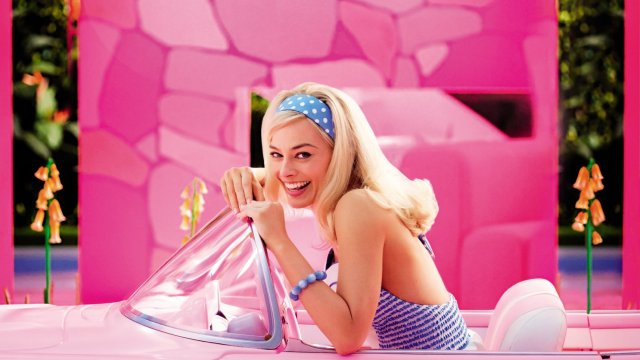
Barbie certainly has people talking, the commentary surrounding the film takes a variety of angles. A quick google search shows that Barbie’s ironic take on the patriarchy appears to have ruffled the fragility feathers with some viewers describing it as ‘man-hating’. I could not help but chuckle at a YouTube video titled; Barbie Bombs Innocent Families with Feminist Propaganda…because apparently, equality is such a bad idea.
There have been some superficial and tokenistic attempts to ‘diversify’ the brand. Yet, at its core the imagery of Barbie still appears to be an obvious symbol of oppressive white feminism. The Barbie doll could be seen to project the white feminine beauty ideal, and the main character within the film, Margot Robbie, appears to embody this ideal. I.e., the appearance of a white, cis-gender, heterosexual women with the wealth to be able to afford all sorts of powdery pink capitalist goods and a body type which is impossible to achieve.
In the contemporary era this ideal continues to be damaging. Even for the most privileged of women, it promotes the spending of much more of women’s income than men on items such as beauty, food and lifestyles, and encourages restrictive dieting practices, which can be damaging to physical and mental health (Naomi Wolf, 1990). For marginalised women there is damage caused due to living in a world which promotes the white privileged as normative. Some examples include, the advertising and selling of skin bleaching products to achieve this white or ‘light’ beauty ideal, to schools excluding Black and Brown school children for having afro textured hair (Emma Dabiri, 2019 and Ibram X. Kendi, 2019).
Whilst the Barbie film apparently has a dig at capitalism, the film and the merchandise sold will produce huge profits by selling this particular brand of feminism. So those interested can buy into feminism and make the capitalists happy rather than being political or radical.
Apparently, the film depicts a comedic take on the patriarchy, with Ken’s toxicity and Barbie having to deal with microaggressions when entering the ‘real world’. How far does the film go with illustrating patriarchal oppression? Is the intersectional oppression experienced by the most marginalised of women present? Does Barbie and Co have issues with femicide, police brutality, poverty, mental ill health, rape, incarceration, immigration detention, homelessness or drowning whilst in a boat whilst trying to seek refuge? Or is the patriarchy in film only palatable and profitable if it presents itself in the form of privileged women experiencing comedic microagressions?
Maybe Barbie will lead to some (probably white and privileged) people thinking more critically or feeling empowered but it doesn’t seem to be a type of feminism ‘for all people’, so perhaps it’s not feminism at all (bell hooks, 1982).
I wonder what will happen to the profits made from the film…
Note* I have not watched the Barbie film so apologies for the vague analysis and sketchy details*
References:
Dabiri, Emma. (2020) Don’t touch my hair. United Kingdom: Penguin Books.
hooks, bell. (1982) Ain’t I a Woman : Black women and feminism. London: Pluto.
Kendi, Ibram. X. (2019) How to be an antiracist. London: The Bodley Head.
Wolf, Naomi. (1991) The Beauty Myth : How images of beauty are used against women. New York: William Morrow and Company.
Share this:


Tyre Nichols’ last bird’s eye view.
[Spoken Word/Read aloud]

After my death, the New York Times reported that you all gave me “at least 71 commands.”
“Many were contradictory or impossible,” the Times tweeted.
In a mob frenzy throughout the whole ordeal, y’all kept shouting at me over each other.
When I couldn’t comply – and even when I did manage to obey– you…(SMH)
“Responded with escalating force.”
Hmph!
NYT’s tweet is cleverly crafted, with a photo – a bird’s eye view of us from the street camera.
There we see 4 of you hunched down on me, pressing my whole body against the ground.
The 5th thug is lunging toward me with a weapon.
After my death, I wonder how y’all will explain this footage –
Knowing the nature of these viral tweets?
I’ve personally reposted too many posts of Black bodies in my exact position to count.
I know I didn’t have to do anything to get here,
Knowing this brings me no comfort in this moment.
All of your commands ignore my humanity.
I am powerless and yet you persist.
In the many video angles of your fatal attack, we all see that…
Each of you had so many chances to just stop!
I’ve always tried to make sense of such lethal violence.
I try to understand the who, what and why of your attack that led to my death.
You had me pinned and pressed to the ground when you kept barking:
“Get on the ground.”
When you kept yelling, one after the other, “Give me your hands,”
Two or three of you were already bending my arms backward and forward with force.
I contort myself and try to comply, yet
You keep screaming “Stop resisting,” meanwhile,
At the same time, two or three of you are manhandling some part of me, at all times.
At the end when you leaned my beaten-up, bleeding, limp body against your car,
One of you snaps-n-shares pictures of me with colleagues and friends.
He’s proud and reaching out to folks who’ll pat him on the back for his latest accomplishment.
During the whole attack, I notice this is the only time he’s cool. He smiles.
He’s clearly used to this exact same rush, this exact same thrill.
I’m more disappointed than angered by his grin.
Mine is an all-American honor killing –
Most just get shot, but many have been tortured just like me.
We see this is how too many of his brethren defend their shield.
Where was I to go?
Appeal to the other officers on the scene whose negligence is pristine?
I tried to run, you captured me, which provoked more torture; nowhere feels safe.
Why was I being terrorized?
And by you, who’ve pledged to protect us from (this) terrorism and (this) thug behavior.
What was I to do?
Flight, freeze or fight.
I am tiny compared to any one of you, y’alls combat training and y’alls five big bodies built-up for battle.
I am a fly; you act like lords.
“Bruh,” you call me, but there is no evidence of brotherliness here.
Or, does your fraternity honor and practice such sadomasochistic rituals?
I like skateboarding and photography, another magazine writes, trying to digest my senseless murder.
Yet the videos of me captured for the world to see are
“…absent all beauty and sterilized of hope.”
When would this end?
Would I have to die for you to stop.
How had I possibly provoked this attack?
Who was I to obey?
You? You’re no good, like Linda Ronstadt said:
You’re no good. You’re no good. Baby, you’re no gooooooood…..
You’re no good.
Or perhaps good in your god’s eyes?
Or, are you God?
No.
You’re not anybody’s God, but…
You play one out here on these streets.
Now, you’re playing my God… my life is keenly in your fists.
Yes! These unceasing murders that I’ve seen – not just mine now–
Is what makes this place hell on Earth in the here and now.
So perhaps y’all’re just agents of the devil,
A force unleashed from the depths upon these streets.
“Momma,” I cry out as loud as I can, and you continue to holler obscenities at me.
Momma used to say all people are fundamentally good,
But lately, I’ve felt fundamentally unsure, and now I’m convinced.
“I didn’t do anything,” I plea, rolling on the ground with my hands behind my back.
Y’all kick me.
“Mom,” I cry out again.
I will die here alone.
No mother should lose her child like this.
The agony inside now, as I call out to my momma, is not for her help,
But because I can already feel her pain once she hears how I’m dying.
Since momma fought for the public release of the videos of my attack,
My name is a hashtag and we have been written about a plenty.
“Every Black mother knows she is a split second,” one newspaper writes,
“… a quirk of chance, from joining a lineage of suffering that stretches back through Mamie Elizabeth Till-Mobley…”
When she saw y’all in court for my kidnapping, assault, oppression, and murder,
Momma said you didn’t even have the courage to look her in the face.
Cowards.
Momma said you’re gonna see her each time you are called to see the judge.
-END-
Photo:
NPR OBITUARIES: “Tyre Nichols loved skateboarding. That’s how his friends say they’ll remember him.”
Share this:


The Problem is Bigger than Tate
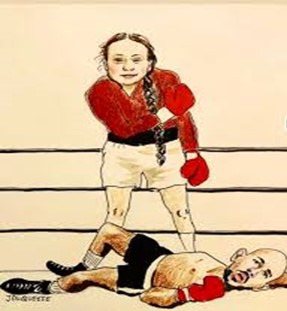
While there are many things that have got under my skin lately, it seems that every time I go on social media, turn on the television, or happen to have a conversation, the name Andrew Tate is uttered. His mere existence is like a virus, attacking not only my brain and soul but it seems a large population of the world. His popularity stems from his platform followed by thousands of men and young boys (it’s known as the ‘Real World’).
His platform ‘educating’ men on working smarter not harder has created a ‘brotherhood’ within the manosphere that celebrates success and wealth. Tate is framed as a man’s man, physically strong, rich and he even has a cigar attached to his hand (I wonder if he puts it down when he goes to the bathroom). It seems many of his aspiring followers want to mimic his fast rich lifestyle.
This seems to be welcomed, especially now when the price of bread has significantly risen (many of his followers would sell the closest women in their life for a whiff of his cigar, and of course to be deemed to have an Insta-desirable lifestyle). While this ideology has gained hype and mass traction in recent years (under the Tate trademark) it seems that his narcissistic, problematic image and what he stands for has only just been deemed a problem … due to his recent indiscretions.
There is now outrage in UK schools over the number of young boys following Tate and his misogynistic ideology. But I cannot help but ask … why was this not an issue before? I am aware of rape culture, victim blaming, sexual harassment, and systems of silence at every level of the UK education establishment. The launch of ‘Everyone’s Invited’ shone a light on the problematic discourse, so why are we only seeing that there is a problem now?
There are many reasons why there’s a delayed outrage, and I would be here all day highlighting all the problems. So, I will give you a couple of reasons. The first is the Guyland ideology: many Tate supporters who fall into the cultural assumption of masculinity expect to be rewarded for their support, in ways of power and material possession (this includes power over women and others deemed less powerful). If one does not receive what they believe they are owed or expected, they will take what they believe they are owed (by all means necessary).
There is also a system of silence within their peer group which is reinforced by parents, female friends, the media, and those that are in administrative power. The protection of toxic behavior has been continuously put under the umbrella of ‘boys will be boys’ or the idea that the toxic behavior is outside the character of the individual or not reflective of who they truly are.
I will go one step further and apply this to the internalised patriarchy/misogyny of the many women that came out and supported Jeremy Clarkson when he callously attacked Meghan. While many of the women have their individual blight with Meghan for reasons I do not really care to explore, by supporting the rhetoric spewed by Clarkson, they are upholding systemic violence against women.
The third point is that capitalism overthrows humanity and empathy in many ways. All you need to do is to look at a history books, it seems that lessons will never be learned. The temptation of material possessions has overthrown morality. The media gives Tate a platform and in turn Tate utters damaging ideology. This brings more traffic to the platforms that he is on and thus more money and influence….after all he is one of the most googled people in the world.
The awareness of the problematic behaviour and the total disregard for protecting women and girls from monsters like Tate shows, how the outrage displayed by the media about harms against victims such as Sabina Nessa and Sarah Everard is performative. The news coverage and the discussion that centred on the victimisation of these two women have easily been forgotten. If the outrage is real then why are we still at a point where we are accepting excuses and championing misogyny under the guise of freedom of speech, without challenging the harm it really does.
It seems that society is at a point of total desensitization where there is more interest in Tate losing an argument with Greta Thunberg, posing with a cigar on an exotic beach for likes, than really acknowledging the bigger picture. Andrew Tate has been accused of rape and human trafficking. The worst thing is, this is not the first time that he has been accused of horrific crimes – and with the audio evidence that was released to the press recently, he should be in prison. But with the issues that permeate the Met police there is no surprise as to why he has been given the green light to continue his violent behaviour. But this is not just a UK issue. There has been a large amount of support overseas with young men and boys marching in masses in support of Tate, so I cannot be surprised that he was able to and continues to build a platform that celebrates and promotes horrendous treatment of women.
For many the progression of a fair and equal society is an aspiration, but for the supporters of the Tate’s in the world they tend to lean on the notion that they are entitled to more, and to acquire what they think they are owed, and will behave to the extreme of toxicity. While it is easy to fixate on a pantomimic villain like Tate to discuss his problematic use of language and how this translates in schools, the bigger picture of institutionalised patriarchy is always being missed.
It is important to unpick the toxic nature of our society, to understand the contributing factors that have allowed Andrew Tate and others like him to be such influential figures.
Share this:

And still the message is the same…
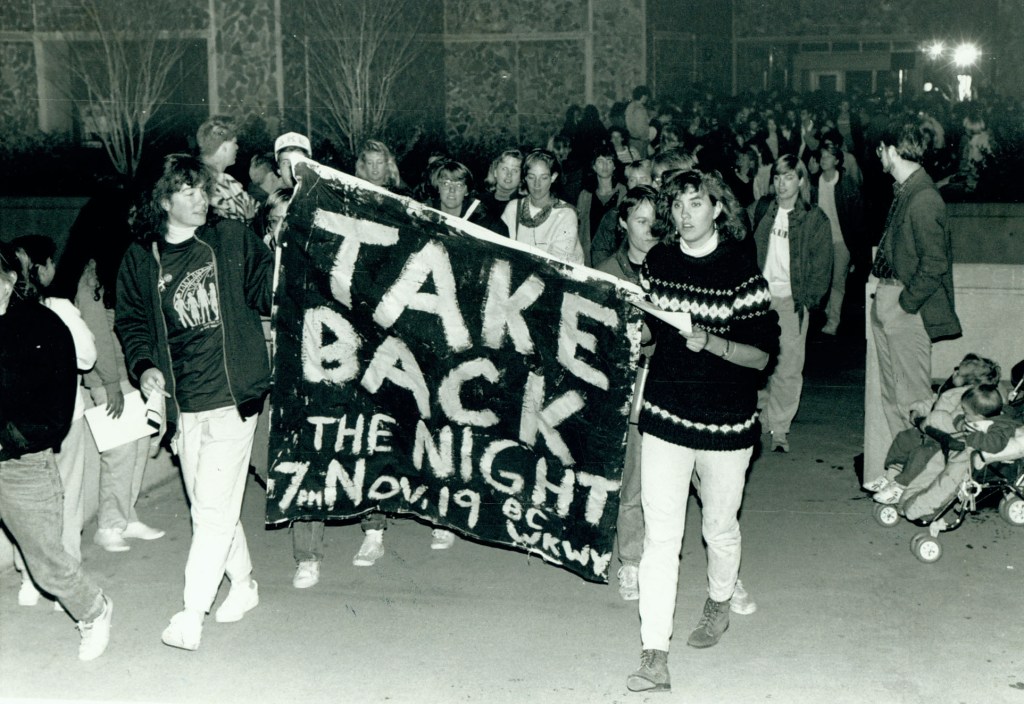
Following on from last week’s blog entry from @5teveh, @jesjames50 explores further dimensions of Sarah Everard’s murder.
Recently we saw the sentencing of Sarah Everard’s kidnapper, rapist and murderer. He has received a whole life sentence. As a woman within society I welcome this sentence. As a criminologist I am at a loss. There is a lot to unpick here in terms of ‘justice’ and whether this has been served. It is pertinent to question the use of a whole life order on a violent, misogynistic, kidnapper, rapist and murderer; who cooperated after arrest, who pleaded guilty and expected the full force of the law. But I shall leave that to another day, as the media’s portrayal of the sentencing and aftermath is what is currently fuelling my anger. The message remains the same, women can and should do more to prevent their victimisation.
The sentence given is at odds with the coverage which has followed. Handing down the most severe sentence available in England and Wales represents the seriousness of the offence, and the damage it has caused to those directly involved and those further afield. The possibility that the offender was in a position of trust, has violated this trust and committed abhorrent acts appears to justify the whole life order. The comparison to terrorism, something which violence against women has been linked to before within academia, is also very telling. But what is the focus? The focus is on how women can go about feeling safe in society and make lines of inquiry if they have doubts about a police officer’s conduct! Here the onus is on women acting in a manner of keeping themselves safe. The message remains the same: women should prevent their victimisation. Excellent I’ll add this nugget of information to my bag of ‘top tips for walking alone at night’.
Why aren’t the media building on this platform to challenge misogynist attitudes? Why are they not raising awareness of violence against women? Sarah’s kidnapping, rape and murder is horrific: but what about the women who undergo daily violence at the hands of their partners, family, friends? These individuals are also in a position of trust and abuse this position to cause harm to women! Here the media could raise awareness about how deep-rooted the issue of violence against women is, but instead they reinforce the idea that women can prevent their victimisation, and that violence occurs at night, by a stranger, and will have the offender brought to justice. This is not the reality for the vast majority of women. It is an extreme and exceptional case (no doubt something True Crime will encapsulate in years to come) and this is further reinforced by the sentence given. Yet violence against women is not exceptional, or rare: it is an everyday reality! Something the media has failed to draw attention to. And by failing to cement Sarah’s kidnapping, rape and murder in the wider context of violence against women, it raises the potential to set a standard of violence against women. Those everyday cases which do not fit the same circumstances are not considered an issue.
My intentions are in no way to take away from the abhorrent crimes committed against Sarah. The crimes sit in the context of violence against women which is still a fundament issue overlooked within society, and has been overlooked once again. And the rhetoric which has followed, yet again, is around how women can protect themselves in the future. The message remains the same…
Share this:


Looking in all the wrong places and finding no answers
Recently we saw the killer of Sarah Everard receive a whole life sentence for her murder and with the sentence came the usual rhetoric from the politicians and media alike. I could tell you how I feel as a former police officer, but I just don’t think that really matters, others have said it but what they say, undoubtedly with conviction, seems rather hollow. What matters is that another life has been taken as a result of male violence, not just violence, male violence. I don’t disagree with those that want to make the streets safe for women, reclaim the streets, I don’t disagree with the ‘me too movement’, but somehow, I feel that the fundamental issue is being missed. Somehow, I think that all the rhetoric and calls for action concentrate too much on women as victims and looking for someone or some organisation to blame. There seems to be a sense created that this is a problem for women and in doing so concentrates on the symptoms rather than the cause. This is a problem for men and our society. Let’s not dress it up, pretend it could be something else, use terms like ‘not all men’, it is a fact nearly all violence, whether that be against women or men is perpetrated by … you guessed it, men.
I was watching a tv programme the other day about migraines and as it transpires there are millions of migraine sufferers around the world, most are women. It seems as a man I’m in the minority. One of the interviewees, a professor was asked why so little had been done in terms of research and finding a cure. He was frank, if it had been a male problem then there would have been more done. I’m not sure I totally subscribe to that because there are lots of other factors, after all prostate cancer a major cause of male deaths seems to have received comparatively little coverage until recently. But he made me think, if men, particularly those of influence accepted there was a problem would they be inclined to act? We call for more females in policing, we call for more females in the boardroom, predominately because we want to make things look a little fairer, a bit more even. We still have a massive gender pay gap in so many businesses and the public sector, we still have accusations and proven cases of sexual harassment. We still have archaic attitudes to women in so many walks of life, including religion. Words are great, useless but great. If you own the problem, you find solutions, men don’t own the problem and that is a problem.
So, it seems to me, that we are looking in the wrong place. Removing Cressida Dick as the head of the Metropolitan Police service isn’t going to change things. Blaming the police as an organisation isn’t going to change things. Look around you, look at all the scandals, all the sexual offences against women, against children. Look at where the perpetrators are placed in society, in positions of trust, as members of a variety of organisations, organisations that traditionally we thought we could turn to in our need. And look at the gender of those that commit those crimes, almost always men.
The solution to all of this is beyond me. As a criminologist I know of so many theories about why people commit crime or are victims of crime. Some are a little ridiculous but are a product of their time, others fit quite nicely into different circumstances, but none fully explain why. There are no real certainties and predicting who and where is almost impossible. Somehow, we need our leaders, predominately men, to grasp the mettle, to accept this a problem for men. If we owned the problem, we might start to tackle the causes of male violence, whatever they might be. Maybe then we might start to address the symptoms, society will be a safer place, and nobody will need to reclaim the streets.
https://www.theloquitur.com/get-educated-and-be-aware-sexual-assault-will-affect-your-life/
Share this:

What about women?
This month marks Women’s History Month. It’s a time where I reflect on how privileged I am to be surrounded by a group of women who have added so much to my life just by being in it.
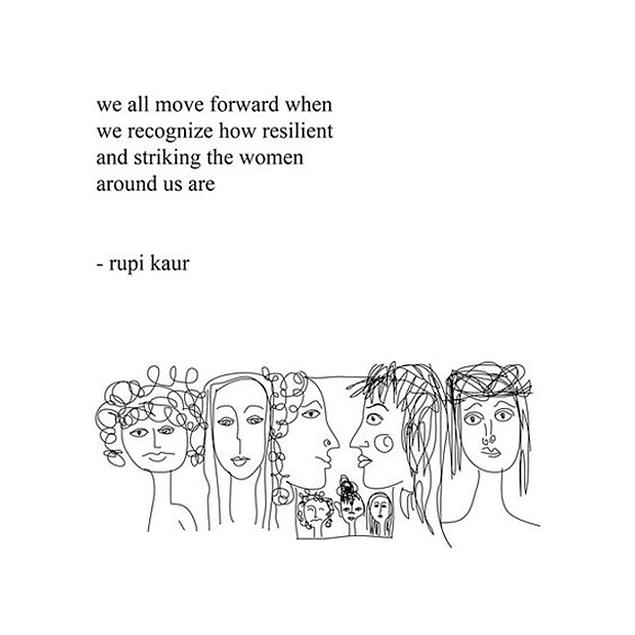
I am also reminded of writers and poets (both past and present) like Woolf, De Beauvoir, Lorde, Walker, Kaur, Attwood and Evaristo whose words have not only added so much to my outlook on life but they also continue to remind me that as a woman I need to continue to listen, provide support and uplift other women. It is incredibly sad but necessary that we need to be reminded of the need to support one another.
Women’s History Month has coincided with the murder of Sarah Everard, another of the many women who have been murdered by men whilst walking home alone. The policing and arresting of women at Sarah’s vigil, the justifications for such arrests and the events themselves are now being reported as false. Followed by the government’s predictable draconian response to silence and restrict protesting rights is maddening. And more importantly, the solidarity illustrated with women gathering to pay their respects to Sarah has now been spoilt due to these damaging enforcement responses.
I find it so sad that commentary by some women surrounding the murder of Sarah had taken the stance of defending men. There are so many very good men in this world, and it is true that not all men are bad, but the reality is that men tend to be the perpetrators when other men, women and children are murdered.
We live in a society which reinforces gender inequality, oppression and stereotypes about women to the point that women internalise misogyny. As a result, some women are quick to defend men to the point that, in some cases, men who are the perpetrators are presented as the victims. And the women who are actual victims are blamed for their own victimisation.
This attitude towards women comes at the detriment of not allowing the space for people to begin to consider that femicide and gendered violence are the damaging consequences of living in an unequal society. The pain caused to the victims also becomes either diluted or made invisible. This is especially the case with Asian or Black women’s victim experiences, as these are rarely found within the news, and if shown, are rarely believed.
There are many obstacles faced by women who attempt to flee routine gendered violence. Attempts to seek support can result in many women losing their homes, jobs and contact with their friends and families. As well as this, women who intend to report being victims of gender-based violence may battle to overcome the stigma that is attached to being a victim. For women with visas that state that there is ‘no recourse to public funds’ escaping violence becomes even more difficult, post Brexit, this now also applies to women from the EU.
Whilst online debates occur surrounding Sarah Everard’s case, the reality is that many women are scared to walk alone. Many are also scared to live within their own homes due to the fear of violence. If we are quick to defend men in light of such tragic events how will we ever be able to support these women? How will they ever feel empowered to report being victims of crime? Yes, not all men are bad, but when a case like Sarah’s is publicised perhaps our first response should be empathising with other women.
Share this:


Reflecting on International Women’s Day
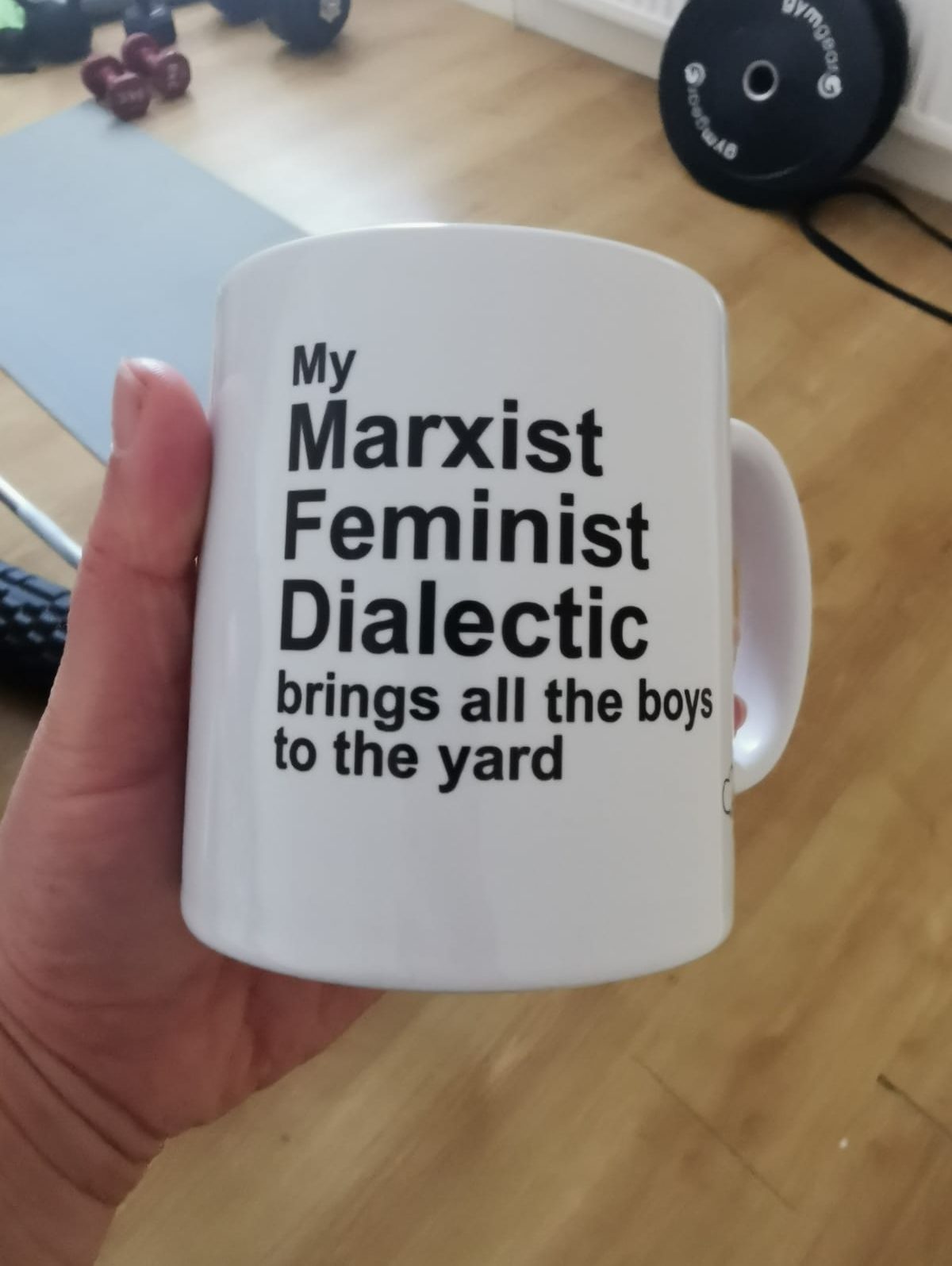
On International Women’s Day I wanted to write a blog to celebrate the incredible women who have inspired me, supported me, fought for the rights of women all over the world both past and present. Perhaps that post will come but I felt sadness and anger, rage that made me want to shout and swear from the rooftops that feminism is not done. Gender equality has not been completed. We may have advanced a few levels, but patriarchy is still alive and free right here in England as well as throughout the world. The reality is that gender equality is a myth. Ordinarily I’m more hopeful and positive and maybe the pandemic combined with finishing my PhD is pushing me over the edge. But as well as celebrating International Women’s Day I wanted to identify some of the areas in which there is work to do, both in the UK and worldwide.
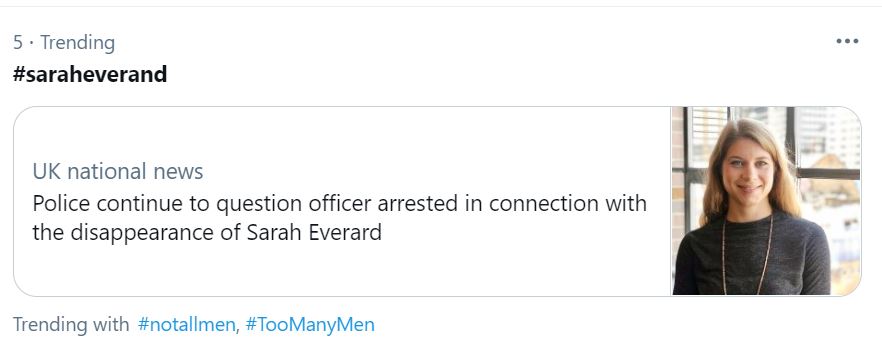
On the week of International Women’s Day, the media has been filled with women, but not for the right reasons. Let us start with the interview broadcasted on International Women’s Day with Megan Markle and Prince Harry which highlighted not only her position as a woman but also the intersectionality of being a woman of colour in the royal family and the implications of this. The interview was responded in an appalling manner by Piers Morgan who questioned her experience of feeling suicidal which was then reflected on social media (never read the comments!!!). A woman’s experiences with mental health were questioned and ridiculed. Not long after the tragic death of Caroline Flack, people – including many other women – have forgotten to #bekind. The investigation over the disappearance of Sarah Everard was responded to by the Met police advising women in the local area not to go out at night, perpetuating a culture of victim blaming. A woman’s actions were being questioned. So here we are in 2021 with our internal thoughts and emotions and our external actions being judged by others. When women have spoken out about our right to feel safe walking home at night, about how we walk the long way home and hold a key between our fingers for protection, #notallmen resurfaces on Twitter, in a similar tone to #alllivesmatter last year. When one group renews a call for equality, the patriarchs and supremacists oppress harder. These are just a couple of examples in the media, the public domain, this week but there is also clear inequality in domestic life.
Throughout the pandemic there have been numerous reports suggesting that women have disproportionately undertaken childcare which has had a devastating impact, particularly for single mothers. While data from the Office for National Statistics shows that home schooling is distributed equally in mixed sex couples, women have undertaken substantially more of non-developmental childcare – the bathing, bedtime routine, feeding etc. I recall the days of being a working single parent with a small child. With no after school club and no family available to chip in, I relied on childcare swaps, a childminder (who I couldn’t afford to pay more than a couple of days per week). It was a case of beg, borrow or steal whatever childcare I could get to get to work and would often miss lectures because I didn’t have any childcare (note to students – if you have childcare responsibilities and are struggling please do not hesitate to drop me an email. I have almost a decade of experience juggling kids with studies and I am always happy to share tips or just have a mutual rant about how hard it is!). I cannot imagine how I would have managed with the pandemic if my children were younger. I am lucky enough to work in a team where my colleagues don’t bat an eyelid when my teenager pops her head in asking for food or help with schoolwork but I do have friends telling me how their male counterparts have given them advice on how to juggle virtual meetings with parenting small children. Men (not all men – some men are excellent allies) having no clue how hard women have to fight as women to do it all – the career, the childcare, the housework, all while earning less than our male counterparts (currently 15.5% less). Of course the data on equal pay is complex but the bottom line is we get paid less, it’s harder to advance our careers because as we live in the bodies that produce babies and we have career breaks when we take maternity leave or go part time while the children are young – the only way that can change is if we choose not to have kids and we are criticised for that too!
I have so far established that the UK is hostile in the media and not equal in the home and employment but where do we sit globally? It was placed 21st on the Global Gender Gap Index 2020. Do you think you could guess which countries are higher than the UK? Go on, spend a minute and write down who you would expect to be in the top 20. Of course, there are the countries one might expect – Iceland is top of the list, Norway, Finland and New Zealand too. But let’s throw a curveball in there. Albania. Having worked with and interviewed many female Albanian asylum seekers and refugees who have usually fled Albania due to at least one but often many forms of gendered violence this comes as quite a surprise to me. Of course, I have a biased experience and have only come into contact with those who have had devastating experiences of patriarchy in the country. Rwanda is up there too within the top 10. Not long after the devastating genocide in Rwanda where women were brutally raped as a weapon of war (see here for a cheeky plug and an analysis of sexual violence in conflict in a different geographical context). Today, women make up half of the politicians in the country. Women have risen up and have taken power. In the UK I look at the female politicians in power today and in recent years and I recoil in horror. Priti Patel is probably (barring the Queen) the most powerful female politician in England. I witness first hand in my work with asylum seekers the harm she causes every day. Intentional harm, following in Theresa May’s footsteps to create a hostile environment for migrants. These women are not the people I want to look up to, or want my children to look up to. In fact, one of the few shared interests my daughter and I have is our disdain for these women.
The women I do look up to are those asylum seekers Patel and her band of merry men at the Home Office are trying to repel. Those who have fled situations that I, as a middle class white woman cannot even begin to comprehend. All the women who I have interviewed in my doctoral research had either fled gendered violence including forced and child marriage, domestic abuse, sex trafficking and honour violence; or their gender had intersected with other forms of persecution making their living situation untenable because they were women. They fled life or death situations to the point of leaving their homes, families and countries because their governments could not, or would not, protect them. They arrive in the UK and are faced with the hostile environment conjured by May and continued by Patel and both the Home Secretaries in between. They face structural violence in the forms of forced poverty, illegal detention, substandard and sometimes dangerous accommodation perpetrated under the mandate of women. All the while being vilified by the tabloids and swathes of the public. Some of my participants arrived here as children and were bullied in school because they were asylum seekers, being told that they were taking jobs and money. The bullies could not comprehend that they were prohibited by law from working and were given £5 per day to live on. They then hid their identities, never telling anyone that they were an asylum seeker, lying to their friends about why they couldn’t go on college trips abroad, why they couldn’t have a bank account, why they couldn’t get a job or go to university.
I want to celebrate Amira* who defied the odds. She came here when she was in her early teens, knowing just a few words of English. She worked hard to learn the language and passed her GCSEs and A-levels, gaining a competitive Sanctuary scholarship which funded her university education. I want to celebrate Drita, an Eastern European woman who was physically abused by her father as a child, forced to marry an abusive man who eventually left her destitute with three children. She then left her children with her parents while she sought work, got a boyfriend who sold her into sex slavery, set her room on fire to kill herself but managed to escape, picked up her children and fled a lifetime of gendered violence from every man she had ever met. She spent 2 days in a lorry with her children to get to the UK. Not really the UK, she would have gone anywhere, just out of her country to safety. These women are survivors. These women fought to stay alive. They fought to escape. They didn’t escape. They arrived here to face May’s legacy of a hostile environment. These women are terrified every time they have to report to the Home Office, every letter they get threatens them with detention and deportation and reminds them that they or on bail, literally equating them with a process usually found in the criminal justice system. These women are heroes and should be celebrated for surviving. On International Women’s Day yes, let us celebrate all that all we have achieved so far but it cannot end here. Each year we need a renewed call for action for women.
*All names are pseudonyms to protect the anonymity of participants

 Thoughts from the criminology team