
Home » Engagement (Page 2)
Category Archives: Engagement

Findings on the ‘traditional lecture’ format – perfect timing!

I seem to be reading more and more reports on the need to retain lectures as a form of teaching, as it is claimed to ensure students are more engaged and committed to their studies when this method is used. Well, these findings have come to my attention just as I am testing online technologies to replace the ‘traditional’ lecture, via Collaborate on the new Waterside campus. Collaborate is a tool in Blackboard which opens an online classroom for students to join, listen to the lecture and see slides or other media, while also being able to pose questions via a chat function.
On the face of it, not so different, just the physical world replicated in the real world, right? Well, I will reserve judgement as I am still coming to grips with what this technology can do, I am aware younger generations of students may embrace this, and the reality is, it is the only forum I have to offer teaching to large numbers of students. I suspect student experiences are mixed, I know some really like it, some are not so keen, so again, not so different to lectures? The article in the times suggests that students are less likely to drop out if they are taught via lectures and have perceptions of good one-to-one contact with staff. Some more interesting issues were raised from replies in the tweet about the story, raising questions about the need to focus on quality, not method, that many universities are playing catch up with new teaching technologies and that this needs to be better understood from social and cultural perspectives. I think it is also worth picking up on perceptions of students, along with their expectations of higher education and remember, they must develop as independent learners. The setting in this respect would not seem to matter, it is the delivery, the level of effort put in to engage students and reinforcing the message that their learning is as much their responsibility as ours.
There is certainly a lot to grapple with, and for me, just starting out with this new technology, I myself feel there is much to learn and I am keeping an open mind. I do feel there are aspects of traditional teaching which must be retained and this can be done via group seminars, with smaller numbers and an opportunity for discussion, debate and student-led learning. If we see the lecture as the foundation for learning, then perhaps its method of delivery is less important. Given the online provision I must use for lectures, during seminars, I step away from the powerpoint and use the time I have with students in a more interactive way. For those modules where I don’t use online lectures, not much has changed on the new campus, but I am always keen to see how online teaching methods could be adopted – and I am prepared to use them if I genuinely can see their value.
It would be easy to offer only critique of this technology, and I think it is also important not to see it as an answer to the perennial problems with lack of engagement and focus many lecturers experience from mid term onwards. Perhaps online provision can at least overcome barriers to attendance for commuting students, those who feel intimidated in large lecture halls, and those who simply find they don’t engage with the material in this setting. At a time when some courses attract high numbers of students, and the reality of having lectures with 150+ students in a room means potential for noise disruption, lack of focus and interaction then maybe online provision can offer a meaningful alternative. There is provision for some interaction, time can be set aside for this, students can join in without worrying about disruption or not being able to hear the lecturer and it removes the need for lecturers to discipline disruptive behaviour. It does require some level of ‘policing’ and monitoring, but the settings can enable this. Having done lectures with 100 plus students, it is not something I miss – I’ve always preferred smaller seminar group teaching and so I can see how online provision can be a better support for this.
Currently, I use the online session as a form of recap and review, with some additional content for students. This is in part due the timing of the session and I am sure it can work equally as well as preparation for seminars. Students can then use the time to clarify anything they don’t understand and it reinforces themes and issues covered in seminars as well as introducing news ways to examine various topics. As with any innovation, this needs more research from across the board of disciplines and research approaches. In order to move such innovation on from ‘trial and error’ and simply hoping for the best, as with any policy we need to know what works, when it works and why. Therefore, along with my colleagues, I will persist and keep a watchful eye on the work of pedagogic experts out there who are examining this. There have been the inevitable issues with wifi not supporting connectivity – I can’t believe I just used this sentence about my teaching, but there it is. I am optimistic these issues will be overcome, and in the meantime, I always have a plan B – relying on technology is never a good plan (hence the featured image for this blog), but this is perhaps something to reflect on for another day.
Share this:

What are Universities for?

As we go through another welcome week it becomes quite apparent in conversations with new students that their motivation for coming to University and joining a course is not singular. Of course there are some very clear objectives that are shared across like the interest for the subject and the employability afterwards for underlying those there are so many different personal motivations and aspirations attached.
In the eyes of our new cohort, I can see a variety of responses, the eagerness to learn the joy of studying, the expectation of belonging and the anticipation of ordering their lives across the University life, just to name but a few.
In conversation, I see these attributes in a different light. “I want to belong but I am shy”, “I wish to learn but I am worried about learning” “I want to engage but I am concern with my writing”. This is the soft underbelly of becoming a student; because in education our own insecurities are playing up. These little devils, who rest on the back of the head of many people who doubt themselves and worry them.
One of the greatest fears I hear and see been rehearsed before me is that of intellectual ability. This is one of those issues that becomes a significant barrier to many people’s fear when joining a University course. Of course the intellectual level of study is high. There are expectations of the degree of knowledge a student will build on and the way they will be able to utilise that level of knowledge. After all a University is an institution of High Learning. The place where disciplines are explored in totality and subjects are taught holistically. Nevertheless the University is not the end of one’s education but rather the door to a new dimension of learning.
For myself and many of my colleagues what makes this process incredibly exciting is to see those eyes of the new students across the years brighten up, as they “get it” as the penny drops and they connect different parts of knowledge together. Once people reach that part of their educational journey realise that coming to University was not simply an means to an end but something beyond that; the joy of lifelong learning.
As this is a early session, I shall address the intellectual fear. The greatest skills that any student need to bring with them in class is patience and passion. Passion for the subject; this is so important because it will sustain during the long cold winter days when not feeling 100%. Patience is equally important; to complete the course, needs plenty of hours out of class and a level of concentration that allows the mind to focus. Any successful student can testify to the long hours required to be in the library or at home going over the material and making sense of some challenging material. This ultimately unravels the last of the requirements, that of perseverance. It is through trial and error, rising up to a challenge that each student thrives.
So for those who joined us this year, welcome. The door to an exciting new world is here, to those returning, we shall pick up from where we left off and those who completed, hopefully University has now opened your eyes to a new world.
Share this:


A mature student’s reflections on the first year

At the age of 51, when I first applied to study Criminology at the University of Northampton, I was a VERY mature student. I had previously been a Registered Nurse for 12 years, then after having a family, re-joined the workforce in various jobs from bar work to office work. I even worked at the local Crematorium for a few years, followed by a short stint at a Funeral Directors! But now my children are grown up and I wanted to do something for me for a change. I happened to see an article in my local newspaper about a 55 year old gentleman who had just graduated from university and that got me thinking….then my daughter told me that there was a man in his 70s at her uni, whose wife made him go so he’d be out from under her feet! That settled it….if they could do it then so could I.
To be honest I was actually amazed to be accepted after writing a 500 word essay on why Criminology is important today. Now that I actually know how to write an essay, the thought of what I wrote then makes me cringe, but onwards and upwards!
Then came the fear. What the hell was I doing? I must be mad! I’d never fit in. These youngsters would never accept me. I’d be useless cos it’s so long since I studied. Even the lecturers would be younger than me. I’d be a joke!
But, what the hell, I thought, ….you only live once! So I swallowed my panic, girded my loins and set forth……I could always run away if I didn’t like it and I’d never have to see any of these people again!
Then out of the blue, on the first day of welcome week, someone started talking to me! She was a mature student too, though much younger than me! The next day I met someone else and the three of us stuck together like glue (and still do now)! As each day went by I started talking to more and more people and before I knew it, I was part of a large group of students ranging from 18 years old right up to me (yes I’m still the oldest person I know!) with every decade in between! I’m just amazed that these people have accepted me and I wish I’d done it years ago! We’ve even had a few drunken nights out (but we won’t go into too much detail about that!).
I have totally surprised myself by how quickly I’ve got back into study mode. The Associate Lecturers have been a lifeline and I can’t praise them enough for all the help and support they’ve given me. Not sure if I’m allowed to mention names, but @jesjames50 and @bethanyrdavies….you know who I mean!!!
All in all, I have absolutely loved my first year. I’ve really enjoyed the studying and it has opened my eyes to so many things. I feel I have a totally different perspective on life now and I’m really excited for Year 2. I have met some amazing people and I feel so thankful and proud to be part of the community of the University of Northampton.
My advice to anyone, especially older people thinking of embarking on a degree is, to coin a phrase from Nike, “just do it!” Education is the greatest gift and you are never too old to learn.
Share this:


Painting by numbers: The problem with HE.

Tillovision, http://www.Tillovision.com
I read a report the other week about concern over the number of 1st degrees that are being achieved within higher education in the UK (Richmond, 2018) and the fact that the volume of such achievements is devaluing university degrees. I juxtapose this with another report that states that 32% of students do not think they get value for money (Neves and Hillman, 2018) and the result is some soul searching about what it is I’m trying to achieve as a lecturer, aside from survival, and what higher education (HE) is about. A conversation with a friend who works in Information Technology muddies the water even more. He’s a high flyer, jetting backwards and forwards to the USA, solving problems, advising on, and implementing major change projects within large corporations and generally making a lot of money along the way. For him a degree is not as important as the ability to ‘think outside the box’, find solutions to problems and show leadership that enables change or fixes. If you have a degree then you ought to be able to do all these things to some extent, experience will then build on it. He lets on that his company will not touch graduates from certain universities, simply because they do not have the requisite skills or abilities, their degrees are effectively meaningless. A sad generalisation but one that is becoming increasingly prominent amongst employers. One other thing that he was quick to point out is that the ‘real world’ is highly competitive and his company are looking for the best potential.
So, what is higher education all about, higher than what? What is the benchmark and what is the end goal? I have always believed that higher education is about taking students beyond what can be read in books or can be followed in manuals. It is about enhancing the understanding of the world in which we operate, either professionally or socially and being able to redesign or reimagine that world. It is about leadership in its many guises, problem solving and the ability to use initiative and autonomy. It is about moving a student from being able to paint by numbers under supervision to a student that can paint free hand, understanding light and colours, understanding how to capture moods or how to be evocative, a student who uses materials that they want to use, and they are not frightened to do so. It stands to reason that not every student can achieve excellence. If the starting point is the ability to paint by numbers, then some will move only slightly beyond this and some will excel, but only a few will warrant a 1st degree. What is clear though is that the students really ought to be able to paint by numbers before they enter HE otherwise they will need to be taught that skill before they can move on. That then is no longer higher education but further education (FE) and more importantly, it sets students up to fail, if they are being measured against HE standards. An alternative to avoid this potential failure requires HE standards to be lowered to those of FE. In which case what is the point of HE?
So why would I be confused about HE? Well, when students are seen as cash cows, each being worth £9250 a year to an institution, being able to paint by numbers becomes a barrier to recruitment in a highly competitive market. Institutions can help students that do not have the requisite skills, but this requires either extra time before joining the HE course, this has funding implications, or a lot of extra work by the student during the HE course, and this means that students with limited academic ability struggle. A need to retain students over the three-year period of a degree, to ensure institutional financial stability or even viability, becomes problematic. Struggling students have a double whammy, they have to catch up to the starting point for each year, whilst also progressing through the year. The choices are stark for HE institutions, progress students by lowering standards or lose them.
HE institutions are measured on the number of good degrees and it makes for good advertising. There is enough literature around to suggest that such unsophisticated quantitative measures are never a good thing. The complexity of higher education, where there is a heavy reliance on students engaging in their studies (there is something to be said about reading for a degree), puts much of the achievement of grades beyond the control of lecturers or even institutions. The resultant solution appears to be the lowering of assessment standards and teaching to assessments. In effect, HE is falling in line with FE and teaching students to paint by numbers. It is easy to see why there is disquiet then about an increase in 1st degrees and more importantly, in a competitive world, why employers are becoming increasingly concerned about the value of a degree. As for value for money for students, for many, it’s a bit like being charged a fortune to race a Maserati round a track for a day but not being able to drive.
Neves, J. and Hillman, N. (2018) Student Academic Experience Survey report 2018 [online] available at https://www.heacademy.ac.uk/knowledge-hub/student-academic-experience-survey-report-2018 [accessed 20 June 2018]
Richmond, T. (2018) A degree of uncertainty: An investigation into grade inflation in universities. [online] available at, http://www.reform.uk/publication/a-degree-of-uncertainty-an-investigation-into-grade-inflation-in-universities/ [accessed 20 June 2018].
Share this:

The Power of Education

“Education is the most powerful weapon which we can use to change the world” (Nelson Mandela)
My name is Stephanie, and I was a Criminology (with Education Studies) student at Northampton from 2012-2015. After graduating, I proceeded with my masters in International Criminal Law and Security at Northampton still. I graduated with my Masters in February 2018. This blog post is a dedication to how one lecture and one seminar, from 2 different modules at different points in my university ignited a fire in me, which is still in me today.
Education opens our minds to new things; we see things differently and can use it as a force to make the world a better place and we can better understand the world around us. It can empower us to make change, teach and impart our knowledge to others.
During the 1st year of my undergrad, in a lecture in Crime and Society focussing on sexual crime, my heart sank. I thought back to when I was 13 years old, I was sexually assaulted at school. I didn’t realise it at that time, until that session on sexual crime.
I reminisced of the horrible occasion, telling the boy who assaulted me to stop and pushed his hands away. Despite any efforts to stop him, he still invaded my personal space and touched me without my consent, leaving deep emotional scars, my body feeling utterly violated, physically sick and was uncomfortable in my own skin (of which hung with me for a number of years after).
In the session on sexual crime, anger and distress bubbled in my stomach, as I tried to ignore the memories that were resurfacing. It was not until my final year in a Crime and Punishment seminar, where a role play of a rape victim reporting to the police demonstrated in class was done that a fire of inspiration was ignited. A fierce passion burned inside me, and I deeply felt that I had to do something.
This was inspiration behind my petition on making it compulsory to teach consent in schools: https://www.change.org/p/rt-hon-justine-greening-mp-to-make-it-compulsory-to-teach-consent-within-secondary-school-pshe-sex-education-classes
That seminar left me feeling a mixture of things; firstly, I was (and still am) appalled by the rape myths that are riddled in our society and justice system, and the lack of compassion shown to rape victims. I felt angry and somewhat distressed, because of my own experience of sexual assault.
It most importantly, started a fire of wanting to make change to better inform people in society of these rape myths, and to understand consent. To all who have read this, please sign, share and encourage others to do the same for this petition.
On another note, you are also more than welcome to follow my personal blog here at: https://wordpress.com/stats/day/flowervioletblog.wordpress.com
Share this:


Remembering Stephen Hawking: A legacy for us all

On March 14th 2018, Professor Stephen Hawking died at the age of 76. For many people, his life was as much about his long battle with motor neurone disease as it was about his achievements as a theoretical physicist. The first thing I saw when clicking on news sites was this quote:
‘Remember to look up at the stars and not down at your feet. Try to make sense of what you see and about what makes the universe exist. Be curious. And however difficult life may seem, there is always something you can do, and succeed at. It matters that you don’t just give up’.
To me, this reflects the value he placed on the pursuit of knowledge, to see this as an opportunity, not a burden and to strive to make sense of it all. For him, it was the universe, the vast expanse of stars and galaxies to be understood in ways I could not even being to fathom. For those studying social sciences, our world is not out there beyond the Earth’s atmosphere, but it is a world we must also seek to understand and, as lecturers and students to communicate this understanding to others. There is a lot of concern in HE as to how to engage students, to consider what we can do to keep them attending and studying their chosen subject outside the classroom. I am beginning to think this is not just to do with our efforts in lectures and seminars, but also perhaps we don’t emphasise enough the opportunity students have, and the value of being in HE is so much more than the qualification itself.
One thing is clear – we should not be in the business of spoon feeding information, to be repeated in assessments, in order for students to be awarded a degree based on their strategy to work towards assessments, and little else. It may sometimes feel like this, so we do have to consider whether this is to do with the way we teach, or the way students respond to this. I think the latter needs as much attention, in that it needs to be clear that students must take responsibility for their learning, and one obvious way to do this is to make the most of opportunities provided by their university. There are students I have taught in my 14 years in HEIs who have clearly appreciated the opportunity they have been given – they make it all worthwhile. There are those who never seem to engage on any level, not even to pass assessments, and who realise HE is not for them. I have more respect for someone coming to that conclusion and seeking a different type of opportunity than those who muddle through and hope it just gets easier.
By the way, if the tone of this seems judgemental, it is not meant that way. My reflections are based on my experiences as a lecturer, but crucially, also as a student. Here is where I have to confess something. In my BSc I was one of those students who muddled through. Then half way through year 2, I realised I was wasting the opportunity I had been given, got a grip and graduated with a 2:2. I know I could have done so much better. The next stage of my academic journey was a combination of being in the right place at the right time and working in a university as a course administrator where one of the staff benefits was to subsidise the cost of degree programmes. The university was the London School of Economics and Political Science, the degree was an MSc in Criminal Justice Policy, and it was very heavily subsidised. My attitude to this opportunity was so different. I was amazed to be accepted onto the programme and found myself being taught by Professor Janet Foster, Professor Robert Reiner, Professor Andrew Ashworth, Professor Maurice Punch, and Professor Ben Bowling. Sorry for the name dropping, but this was the last thing I expected to happen to me. I came away with a Merit award and it set me on this path to be a criminologist. I engaged with the degree by attending everything, working during evenings and weekends, following advice and making the most of it. Then to find myself undertaking a PhD, well it has been a long and arduous journey at times, but I knew my experiences before had set me up well to take on the challenge. It can feel isolating and lonely sometimes, and it can take over your life, but once again, I value the opportunity not just as the pursuit of knowledge, but also the way it has made me overcome challenges and not give up.
The experience of studying for a degree when I was engaged, interested and committed was so much better, with less anxiety, a sense of achievement and I knew I had done my best. As I said earlier, as academics we can do our bit, and many of us do – we consider how best to communicate theories, concepts, policies, debates, and to empower students to have their say. We offer opportunities for interaction, discussion, challenging ideas and enabling students to think more critically. We do this so that students enjoy their studies, make the most of the opportunity and value this as a pursuit of knowledge, as well as the qualification. However, we can only do this successfully when students engage with this process and understand and then accept their role. My role as a lecturer in criminology is about to change significantly, as the move to a new campus changes teaching methods and provision. I have my anxieties about adapting my modules over summer to fit with this model, IT fails, and the usual issues about going through big changes. I know our students share the same anxieties, it’s natural. But, the one thing we can do is ensure that we, as staff and students alike recognise the important role we have, to embrace this change and make the best of it.
So, my plea to students is this. If we don’t keep seeking to expand our understanding and valuing this process of learning, if we stop being curious, then we don’t advance. That is the legacy of Professor Hawking, to remember to keep asking questions, to value learning and to strive to better understand the world around us. Sometimes it will feel like there are barriers put in your way and you cannot overcome them. At this point, it is worth remembering what Professor Hawking had to deal with on a daily basis and ask yourself what you can do to solve these problems. Not only will you do better in your studies, you will learn important skills for the future and will look back knowing you have done your best and overcame whatever life threw at you. That is a legacy to be proud of.
Susie Atherton, Humanoid, Planet Earth.
Share this:


Anxious about being anxious

The fact that the digital readout on my car tells me that it is a due a service and that it needs to be looked at because something is very wrong does not provide comfort, just a nagging concern that it might break down soon, but how soon? On my way to work I left a message on my wife’s mobile phone, ‘it’s only me, just calling to say on my way to work’. She didn’t answer the phone, she’s out riding the horse, has something happened? Mid conversation with a work colleague, my phone’s just pinged, I must check it, it’s only my mate asking me out for a drink… ‘Nice one, next Thursday?’… What was that you were saying Susie? It’s not that the conversation is unimportant it’s just that I might miss something important on the phone. Checking emails, that email I sent an hour ago still hasn’t been responded to… back to Susie.
An hour later… must check my emails. What’s on Facebook, another notification has come through… must respond … ‘like’, there done. Better check I haven’t missed anything. Ebay… I’m still the highest bidder… should I increase my bid… just in case, Ebay says it would be a good idea. Google the item… what’s it worth… back to Ebay… Increase bid. Must check it again soon. Text from wife, all is good. Check emails… check phone … check Ebay… Check Facebook… all quiet, are they working..? Is it a network problem? Thank goodness I haven’t got a Twitter account to worry about. Now I have to write a blog entry… what to write about, will anyone read it let alone like it? Off to my seminar, I wonder if the laptop will work, will it connect to that new screen and stay connected, last week it kept disconnecting… will the technology work… busy, worry…
Before the days of connectivity and the great digital advancement, I didn’t worry about such things. But then I wouldn’t have phoned my wife on the way to work, in fact I wouldn’t have spoken to or heard from her for the whole day until I got home. I wouldn’t be worrying about the car because it would either be working or have broken down. Any correspondence I received would be in my in tray on a desk and would be dealt with and put into an out tray, the pending tray, or the bin. The pending tray was usually just waiting for the bin. Nothing to ping and rudely distract me from my conversation with a colleague. No need to worry about whether I was the highest bidder, I would be at the auction bidding, it would be happening there and then. I wouldn’t have been connected to a world of ‘friends’ producing meaningless drivel about where they were having their cup of coffee or the fact they liked some article in a paper about mass rape or murder. As for the laptop and the screen, paper never let me down.
We live in a digital age and everything is at your fingertips and it’s available right now. But what does that do? It may give you an edge in some respects but it also makes you edgy. I look around and see and hear about so many people suffering from anxiety, old and young alike. Perhaps the cause is not technology alone but it certainly doesn’t help. Maybe I worry too much, maybe I’m just becoming anxious about being anxious.
Share this:


The number’s up for quantitative research! Or is it?

As my colleagues will no doubt confirm, I’m not a fan of numbers. Although, I always enjoyed maths, particularly algebra, my distaste for numbers comes when they are applied to people. Whilst I appreciate there are a lot of us, somewhere around 7.6 billion on the planet, the reduction of a human to a number doesn’t sit comfortably. This aversion to numbering people partly stems from academic study of the Holocaust, which was facilitated by the Nazi’s determination to reduce individual human lives first to digits and then to ashes. It also comes from my own lived experience, particularly in education, of knowing that individuals can and do change.
Criminologists such as Stanley Cohen (1988), Nils Christie (1997) and Jock Young (2011) have long recognised the fundamental flaws inherent in much quantitative criminology. They recognise that numbers are often used to obfuscate and confuse, taking readers down a route whereby they are presented as having their own intrinsic meaning, entirely distinct from the people whose data is being manipulated. Furthermore, those numbers are deemed scientific and authoritative, having far more sway than qualitative research predicated on finding meaning in individual lives.
Despite my antipathy to numbers, I have spent the last few months studying attempts to quantify a particular prison population; ex-servicemen. Much of this research is flawed in the same way as recognised by the eminent criminologists above. Instead, of answering what appears on the surface to be a straightforward question, many of these reports struggle to even define what they are trying to measure, let alone make sense of the measurements.
All this has made me think about the way we measure “engagement”. Last week, as you may have noticed from Manos’ entry, was the blog’s first birthday. Underneath, the professional front page lies, what WordPress rather hopefully describes, as ‘Stats’. From here, it is possible to identify the number of visitors per day, month and year, as well as the number of views. There is also a detailed map of the world, displaying all the countries from which these visitors are drawn. In essence, I have enough data to tell you that in our first year we have had 3,748 visitors and 5,124 views from 65 countries.
All of this sounds very encouraging and the team can make statements about how views are up on the period before, or make claims that we have attracted visitors from countries for the first time. If, so inclined, we could even have a leader board of the most popular contributor or entry; thankfully that doesn’t seem appeal to the team. If I wanted to write a report, I could include some lovely, bar or pie charts, even some infographics; certainly if you look below you will see a rather splendid Wordle which displays 233 different categories, used a total of 781 times.
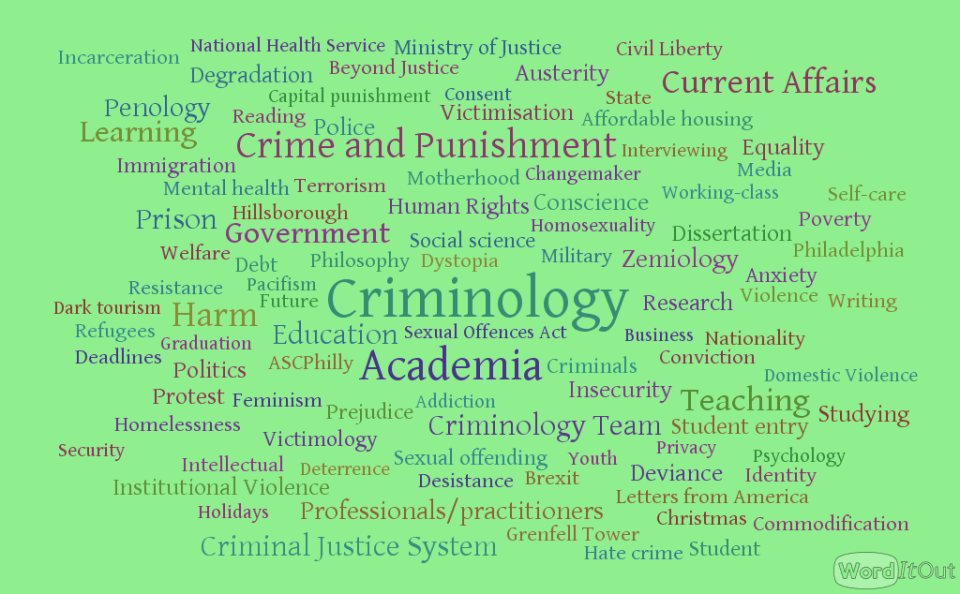
However, what exactly do we know? I would argue, not a lot. We have some evidence that some people have visited the blog at least once, but as to how many are regular readers; we have no clue. Do they read the entries and do they enjoy them? Again, no idea. Maybe they’re just attracted by particular pictures (the evidence would suggest that the Yellow Submarine, Kermit, the Pink Panther and tattoos do exceedingly well).[i] There is some evidence that many of the visitors come via Facebook and Twitter and these offer their own illusion of measurable activity. Certainly, Twitter offers its own ‘Analytics’ which advises me that my tweet containing Manos’ latest blog entry earned an impressive 907 ‘Impressions’, and 45 ‘Engagements’ which equals an ‘Engagement Rate’ of 5%! What any of that means; your guess is good as mine! Does scrolling mindlessly on your newsfeed whilst waiting for the kettle to boil count as an impression or an engagement? Should I be impressed or embarrassed by a 5% engagement rate – who knows? If I add it to my imaginary report, at least I’ll be able to add some more colourful charts to accompany my authoritative narrative. Of course, it will still be largely meaningless but it should look splendid!
More concerning are the repercussions to any such report, which would seem to imply that I had total control over improving such metrics and if they didn’t improve, that would ultimately be down to my inertia, inability or incompetence. Of course, the blog is a voluntary labour of love, created and curated by a group of like-minded individuals… However, if we consider this in relation to criminology and criminal justice, things take a more sinister turn….the numbers may indicate something, but at the end of the day those numbers represent people with their own ideas, concerns and behaviours. Discussions around payment by results seem to miss this vital point, but of course it means that failure to achieve these results can be blamed on individuals and companies. Of course, none of the above denies quantitative data a place within Criminology, but it has to be meaningful and not just a series of statements and charts.
Now, I’ve got my anti-quantitative rant of my chest, I’ll leave the final words to Nils Christie (1997) and his command to make criminology exciting and passionate as befits its subject matter. In his words, avoid ‘[l]ong reports of the obvious. Repetitions. Elaborate calculations leading to what we all know’ (Christie, 1997: 13).
Instead we should always consider:
[h]ow can it be like this? How come that so much criminology is that dull, tedious and intensely empty as to new insights? It ought to be just the opposite, in a science based on material from the core areas of drama. Our theories are based on situations of conflict and heroism, danger and catastrophe, abuses and sacrifices – just those areas where most of our literary heroes find their material. And still so trivial! (Christie, 1997: 13).
Rather than mindlessly churning out quantitative data that looks and is perceived as sophisticated, as criminologists we need to be far more critical. If you don’t believe Christie, what about taking heed of Green Day’s command to ‘question everything? Or shut up and be a victim of authority’ (Armstrong et al., 2000).
References:
Armstrong, Billie Joe, Dirnt, Mike and Cool, Tre, (2000), Warning [LP]. Recorded by Green Day in Warning, Reprise: Studio 880
Christie, Nils, (1997), ‘Four Blocks Against Insight: Notes on the Oversocialization of Criminologists,’ Theoretical Criminology, 1, 1: 13-23
Cohen, Stanley, (1988), Against Criminology, (Oxford: Transaction Books)
Young, Jock, (2011), The Criminological Imagination, (London: Polity Press)
A revised and reworked submission of this entry was published on the British Society of Criminology blog on 1 June 2018.
[i] This point will be “tested under experimental conditions” by the gratuitous inclusion of a picture showing teddy bears “reading”.

 Thoughts from the criminology team