
Home » Criminological imagination (Page 3)
Category Archives: Criminological imagination

25 years of Criminology

When the world was bracing for a technological winter thanks to the “millennium bug” the University of Northampton was setting up a degree in Criminology. Twenty-five years later and we are reflecting on a quarter of a century. Since then, there have been changes in the discipline, socio-economic changes and wider changes in education and academia.
The world at the beginning of the 21st century in the Western hemisphere was a hopeful one. There were financial targets that indicated a raising level of income at the time and a general feeling of a new golden age. This, of course, was just before a new international chapter with the “war on terror”. Whilst the US and its allies declared the “war on terror” decreeing the “axis of evil”, in Criminology we offered the module “Transnational Crime” talking about the challenges of international justice and victor’s law.
Early in the 21st century it became apparent that individual rights would take centre stage. The political establishment in the UK was leaving behind discussions on class and class struggles and instead focusing on the way people self-identify. This ideological process meant that more Western hemisphere countries started to introduce legal and social mechanisms of equality. In 2004 the UK voted for civil partnerships and in Criminology we were discussing group rights and the criminalisation of otherness in “Outsiders”.
During that time there was a burgeoning of academic and disciplinary reflection on the way people relate to different identities. This started out as a wider debate on uniqueness and social identities. Criminology’s first cousin Sociology has long focused on matters of race and gender in social discourse and of course, Criminology has long explored these social constructions in relation to crime, victimisation and social precipitation. As a way of exploring race and gender and age we offered modules such as “Crime: Perspectives of Race and Gender” and “Youth, Crime and the Media”. Since then we have embraced Kimberlé Crenshaw’s concept of intersectionality and embarked on a long journey for Criminology to adopt the term and explore crime trends through an increasingly intersectional lens. Increasingly our modules have included an intersectional perspective, allowing students to consider identities more widely.
The world’s confidence fell apart when in 2008 in the US and the UK financial institutions like banks and other financial companies started collapsing. The boom years were replaced by the bust of the international markets, bringing upheaval, instability and a lot of uncertainty. Austerity became an issue that concerned the world of Criminology. In previous times of financial uncertainty crime spiked and there was an expectation that this will be the same once again. Colleagues like Stephen Box in the past explored the correlation of unemployment to crime. A view that has been contested since. Despite the statistical information about declining crime trends, colleagues like Justin Kotzé question the validity of such decline. Such debates demonstrate the importance of research methods, data and critical analysis as keys to formulating and contextualising a discipline like Criminology. The development of “Applied Criminological Research” and “Doing Research in Criminology” became modular vehicles for those studying Criminology to make the most of it.
During the recession, the reduction of social services and social support, including financial aid to economically vulnerable groups began “to bite”! Criminological discourse started conceptualising the lack of social support as a mechanism for understanding institutional and structural violence. In Criminology modules we started exploring this and other forms of violence. Increasingly we turned our focus to understanding institutional violence and our students began to explore very different forms of criminality which previously they may not have considered. Violence as a mechanism of oppression became part of our curriculum adding to the way Criminology explores social conditions as a driver for criminality and victimisation.
While the world was watching the unfolding of the “Arab Spring” in 2011, people started questioning the way we see and read and interpret news stories. Round about that time in Criminology we wanted to break the “myths on crime” and explore the way we tell crime stories. This is when we introduced “True Crimes and Other Fictions”, as a way of allowing students and staff to explore current affairs through a criminological lens.
Obviously, the way that the uprising in the Arab world took charge made the entire planet participants, whether active or passive, with everyone experiencing a global “bystander effect”. From the comfort of our homes, we observed regimes coming to an end, communities being torn apart and waves of refugees fleeing. These issues made our team to reflect further on the need to address these social conditions. Increasingly, modules became aware of the social commentary which provides up-to-date examples as mechanism for exploring Criminology.
In 2019 announcements began to filter, originally from China, about a new virus that forced people to stay home. A few months later and the entire planet went into lockdown. As the world went into isolation the Criminology team was making plans of virtual delivery and trying to find ways to allow students to conduct research online. The pandemic rendered visible the substantial inequalities present in our everyday lives, in a way that had not been seen before. It also made staff and students reflect upon their own vulnerabilities and the need to create online communities. The dissertation and placement modules also forced us to think about research outside the classroom and more importantly outside the box!
More recently, wars in Europe, the Middle East, Africa and Asia have brought to the forefront many long posed questions about peace and the state of international community. The divides between different geopolitical camps brought back memories of conflicts from the 20th century. Noting that the language used is so old, but continues to evoke familiar divisions of the past, bringing them into the future. In Criminology we continue to explore the skills required to re-imagine the world and to consider how the discipline is going to shape our understanding about crime.
It is interesting to reflect that 25 years ago the world was terrified about technology. A quarter of a century later, the world, whilst embracing the internet, is worriedly debating the emergence of AI, the ethics of using information and the difference between knowledge and communication exchanges. Social media have shifted the focus on traditional news outlets, and increasingly “fake news” is becoming a concern. Criminology as a discipline, has also changed and matured. More focus on intersectional criminological perspectives, race, gender, sexuality mean that cultural differences and social transitions are still significant perspectives in the discipline. Criminology is also exploring new challenges and social concerns that are currently emerging around people’s movements, the future of institutions and the nature of society in a global world.
Whatever the direction taken, Criminology still shines a light on complex social issues and helps to promote very important discussions that are really needed. I can be simply celebratory and raise a glass in celebration of the 25 years and in anticipation of the next 25, but I am going to be more creative and say…
To our students, you are part of a discipline that has a lot to say about the world; to our alumni you are an integral part of the history of this journey. To those who will be joining us in the future, be prepared to explore some interesting content and go on an academic journey that will challenge your perceptions and perspectives. Radical Criminology as a concept emerged post-civil rights movements at the second part of the 20th century. People in the Western hemisphere were embracing social movements trying to challenge the established views and change the world. This is when Criminology went through its adolescence and entered adulthood, setting a tone that is both clear and distinct in the Social Sciences. The embrace of being a critical friend to these institutions sitting on crime and justice, law and order has increasingly become fractious with established institutions of oppression (think of appeals to defund the police and prison abolition, both staples within criminological discourse. The rigour of the discipline has not ceased since, and these radical thoughts have led the way to new forms of critical Criminology which still permeate the disciplinary appeal. In recent discourse we have been talking about radicalisation (which despite what the media may have you believe, can often be a positive impetus for change), so here’s to 25 more years of radical criminological thinking! As a discipline, Criminology is becoming incredibly important in setting the ethical and professional boundaries of the future. And don’t forget in Criminology everyone is welcome!

Share this:


What makes a good or bad society?: IX

As part of preparing for University, new students were encouraged to engage in a number of different activities. For CRI1009 Imagining Crime, students were invited to contribute a blog on the above topic. These blog entries mark the first piece of degree level writing that students engaged with as they started reading for their BA (Hons) Criminology. With the students’ agreement these thought provoking blogs have been brought together in a series which we will release over the next few weeks.
By definition, a society is a crowd of people living together in a community. So when it comes to discussing a ‘good’ or ‘bad’ society we must consider if everybody in the community follows the standard of social norms that are expected and what each community demands as the list of standardised norms may differ. In modern day British societies, it can sometimes be difficult to decide whether we live in a good or bad society. This can be difficult for reasons such as politics, law and crime. Some may decide our society is good because they believe our government is fair and they reap the benefits of those higher up whereas others may deem our society as bad because the government is unfair, and they are at a disadvantage. I would say there are 5 main qualities to a good society: Equality, freedom, empowerment, opportunity and education. Equality is an important factor for a good society as it makes sure people are treated with the same levels of respect and dignity as everyone else and that the differences they may have are celebrated and not shunned. As well as this, freedom is important as it allows people to create lives full of purpose, meaning and success and gives people the ability to flourish and thrive. Similarly, empowerment is important because it promotes both equality and freedom while reducing inequality by enabling the individuals who have been discriminated against to take charge and participate as a member of society. In addition to this, opportunity is equally as important because it enables individuals to have a fair chance to achieve their potential, whether this be achieving their dream job/career or being successful in education. Finally, education is an important characteristic to a good society because it promotes economic growth within our society, provides young people with career paths and ensures a great deal of personal development. Without these key fundamentals in a society, it can lead to high crime rates in certain categories such as antisocial behaviour, hate crime, violent crime and theft. To avoid a spike in crime rates it is essential a society works on these values. While its easy to talk about what makes a good society it is just as important to be aware of what makes a bad society. Each individual will believe it takes different characteristics to make a society bad, but in my opinion, I believe there are 5 specific qualities to a bad society. If a society contains any of the following, it can arguably be classified as a bad society: inequality, lack of justice, discrimination, poor education and cultural oppression. Not only will a society with these values be ‘bad’ but it creates an altered view on what the socially normative way of life is.
Unfortunately, in today’s society each of the crucial qualities to have a ‘good’ society can never be guaranteed. Even in modern-day society we still see each of these qualities shut down by racism, sexism and ableism. So with all of this information considered I believe there can never be a definitive answer to the question of “Do we live in a good or bad society”.
Share this:


SUPREME COURT VISIT WITH MY CRIMINOLOGY SQUAD!

Author: Dr Paul Famosaya
This week, I’m excited to share my recent visit to the Supreme Court in London – a place that never fails to inspire me with its magnificent architecture and rich legal heritage. On Wednesday, I accompanied our final year criminology students along with my colleagues Jes, Liam, and our department head, Manos, on what proved to be a fascinating educational visit. For those unfamiliar with its role, the Supreme Court of the United Kingdom stands at the apex of our legal system. It was established in 2009, and serves as the final court for all civil cases in the UK and criminal cases from England, Wales, and Northern Ireland. From a criminological perspective, this institution is particularly significant as it shapes the interpretation and application of criminal law through precedent-setting judgments that influence every level of our criminal justice system

7:45 AM: Made it to campus just in the nick of time to join the team. Nothing starts a Supreme Court visit quite like a dash through Abington’s morning traffic!

8:00 AM: Our coach is set to whisk us away to London!
Okay, real talk – whoever designed these coach air conditioning systems clearly has a vendetta against warm-blooded academics like me! 🥶 Here I am, all excited about the visit, and the temperature is giving me an impromptu lesson in ‘cry’ogenics. But hey, nothing can hold us down!.

Picture: Inside the coach where you can spot the perfect mix of university life – some students chatting about the visit, while others are already practising their courtroom napping skills 😴
There’s our department Head of Departmen Manos, diligently doing probably his fifth headcount 😂. Big boss is channelling his inner primary school teacher right now, armed with his attendance sheet and pen and all. And yes, there’s someone there in row 5 I think, who’s already dozed off 🤦🏽♀️ Honestly, can’t blame them, it’s criminally early!
9:05 AM The dreaded M1 traffic
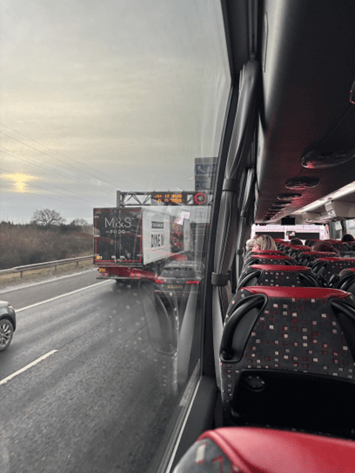
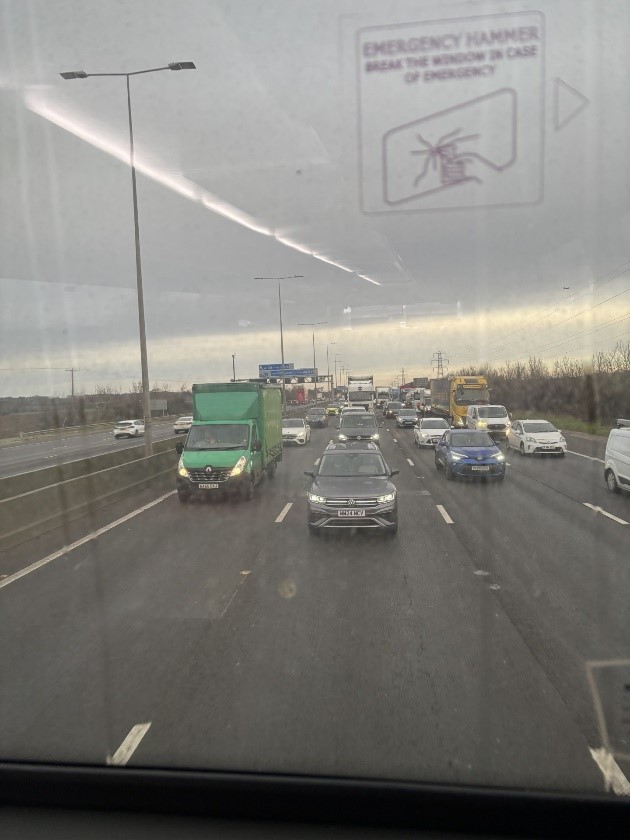
Sometimes these slow moments give us the best opportunities to reflect. While we’re crawling through, my mind wanders to some of the landmark cases we’ll be discussing today. The Supreme Court’s role in shaping our most complex moral and legal debates is fascinating – take the assisted dying cases for instance. These aren’t just legal arguments; they’re profound questions about human dignity, autonomy, and the limits of state intervention in deeply personal decisions. It’s also interesting to think about how the evolution of our highest court reflects (or sometimes doesn’t reflect) the society it serves. When we discuss access to justice in our criminology lectures, we often talk about how diverse perspectives and lived experiences shape legal interpretation and decision-making. These thoughts feel particularly relevant as we approach the very institution where these crucial decisions are made.

The traffic might be testing our patience, but at least it’s giving us time to really think about these issues.
10:07 AM – Arriving London – The stark reality of London’s inequality hits you right here, just steps from Hyde Park.
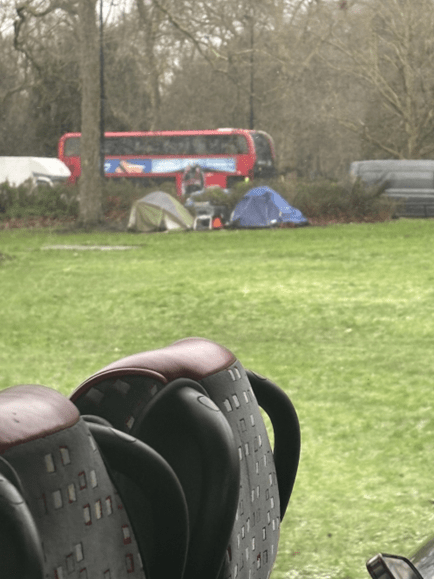
Honestly, this is a scene that perfectly summarises the deep social divisions in our society – luxury cars pulling up to the Dorchester where rooms cost more per night than many people earn in a month, while just meters away, our fellow citizens are forced to make their beds on cold pavements. As a criminologist, these scenes raise critical questions about structural violence and social harms. When we discuss crime and justice in our lectures, we often talk about root causes. Here they are, laid bare on London’s streets – the direct consequences of austerity policies, inadequate mental health support, and a housing crisis that continues to push more people into precarity. But as we say in the Nigerian dictionary of life lessons – WE MOVE!! 🚀
10:31 AM Supreme Court security check time
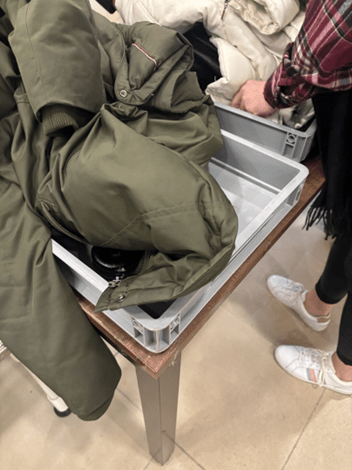
Security check time, and LISTEN to how they’re checking our students’ water bottles! The way they’re examining those drinks is giving: Nah this looks suspicious 🤔

So there I am, breezing through security like a pro (years of academic conferences finally paying off!). Our students follow suit, all very professional and courtroom-ready. But wait for it… who’s that getting the extra-special security attention? None other than our beloved department head Manos! 😂

The security guard’s face is priceless as he looks through his bags back and forth. Jes whispers to me ‘is Manos trying to sneak in something into the supreme court?’ 😂 Maybe they mistook his collection of snacks for contraband? Or perhaps his stack of risk assessment forms looked suspicious? 😂 There he is, explaining himself, while the rest of us try (and fail) to suppress our giggles. He is a free man after all.
10: 44AM Right so first stop, – Court Room 1.


Our tour guide provided an overview of this institution, established in 2009 when it took over from the House of Lords as the UK’s highest court. The transformation from being part of the legislature to becoming a physically separate supreme court marked a crucial step in the separation of powers in the country’s legislation. There’s something powerful about standing in this room where the Justices (though they usually sit in panels of 5 or 7) make decisions. Each case mentioned had our criminology students leaning in closer, seeing how theoretical concepts from their modules materialise in this very room.
10:59 AM Moving into Court 2, the more modern one!


After exploring Courtroom 1, we moved into Court Room 2, and yep, I also saw the contrast! And apparently, our guide revealed, this is the judges’ favourite spot to dispense justice – can’t blame them, the leather chairs felt lush tbh!
Speaking of judges, give it up for our very own Joseph Buswell who absolutely nailed it when the guide asked about Supreme Court proceedings! 👏🏾 As he correctly pointed out, while we have 12 Supreme Court Justices in total, they don’t all pile in for every case. Instead, they work in panels of 3 or 5 (always keeping it odd to avoid those awkward tie situations). 👏🏾 And what makes Court Room 2 particularly significant for public access to justice the cameras and modern AV equipment which allow for those constitutional and legal debates to be broadcast to the nation. Spot that sneaky camera right at the top? Transparency level: 100% I guess!

The exhibition area

The exhibition space was packed with rich historical moments from the Supreme Court’s journey. Among the displays, I found myself pausing at the wall of Justice portraits. Let’s just say it offered quite the visual commentary on our judiciary’s journey towards representation…

Beyond the portraits, the exhibition showcased crucial stories of landmark judgments that have shaped our legal landscape. Each case display reminded us how crucial diverse perspectives are in the interpretation and application of law in our multicultural society.

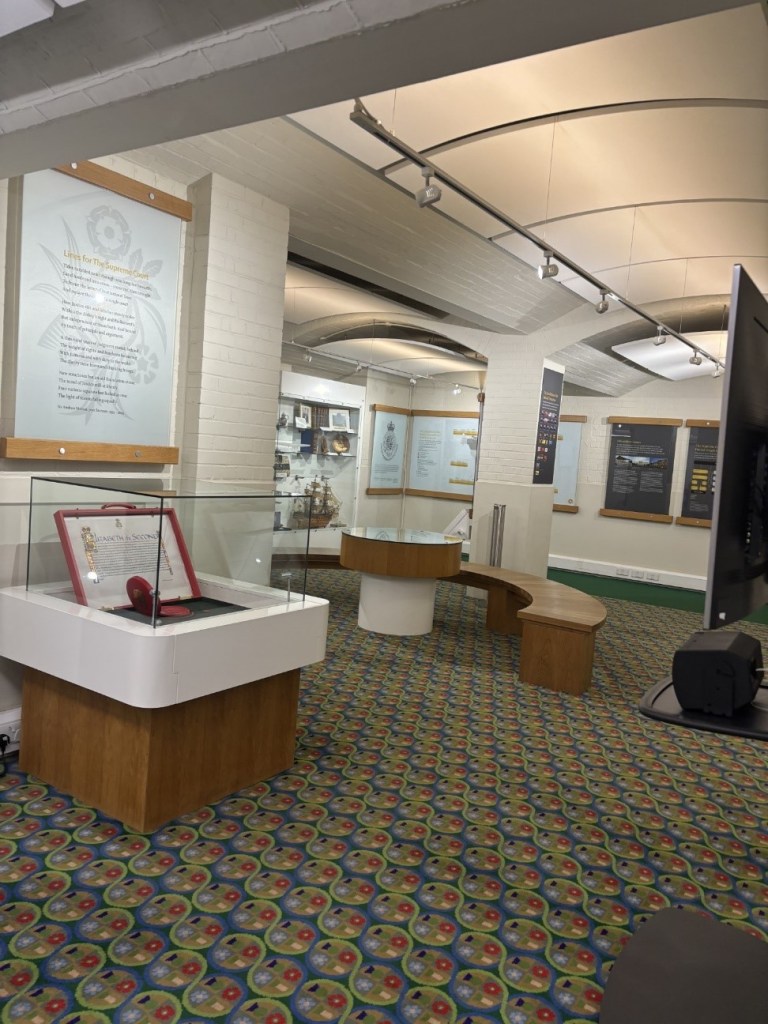

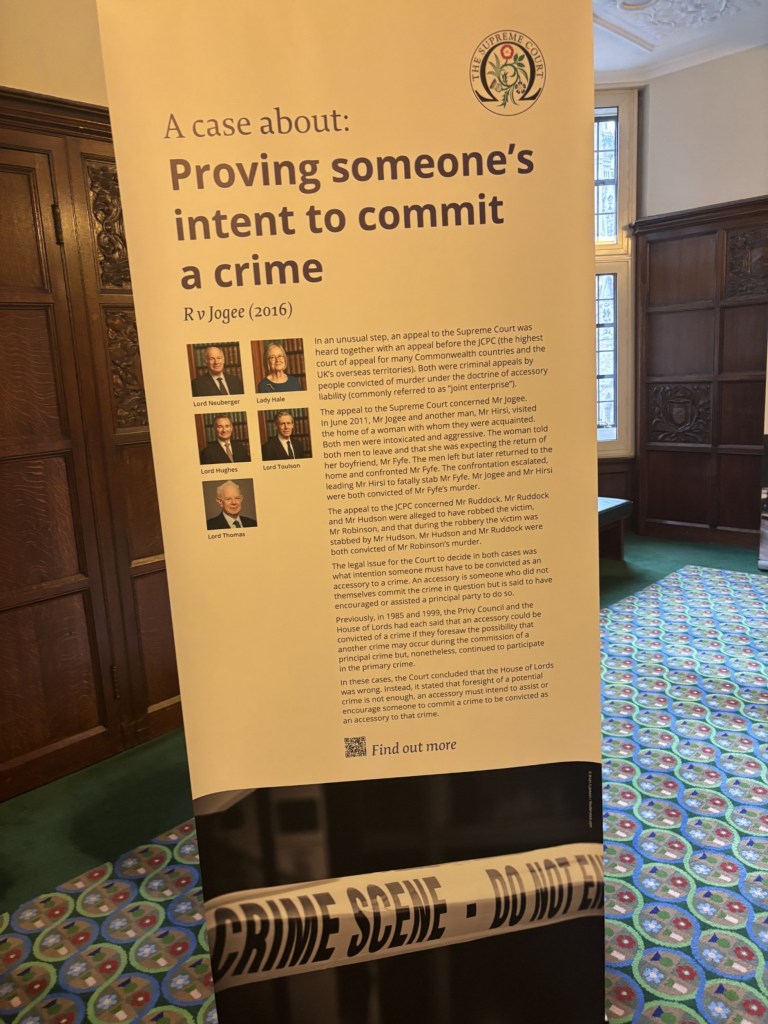
11: 21AM Moving into Court 3, home of the Judicial Committee of the Privy Council (JCPC)

The sight of those Commonwealth flags tells a powerful story about the evolution of colonial legal systems and modern voluntary jurisdiction. Our guide explained how the JCPC continues to serve as the highest court of appeal for various independent Commonwealth countries. The relationship between local courts in these jurisdictions and the JCPC raises critical questions about legal sovereignty and judicial independence and the students were particularly intrigued by how different legal systems interact within this framework – with each country maintaining its own laws and legal traditions, yet looks to London for final decisions.

Breaktime!!!!
While the group headed out in search of food, Jes and I were bringing up the rear, catching up after the holiday and literally SCREAMING about last year’s Winter Wonderland burger and hot dog prices (“£7.50 for entry too? In this Keir Starmer economy?!😱”). Anyway, half our students had scattered – some in search of sustenance, others answering the siren call of Zara (because obviously, a Supreme Court visit requires a side of retail therapy 😉).


But here’s the moment that had us STUNNED – right there on the street, who should come power-walking past but Sir Chris Whitty himself! 😱 England’s Chief Medical Officer was on a mission, absolutely zooming past us like he had an urgent SAGE meeting to get to 🏃♂️. That man moves with PURPOSE! I barely had time to nudge Jes before he’d disappeared. One second he was there, the next – gone! Clearly, those years of walking to press briefings during the pandemic have given him some serious speed-walking skills! 👀
3:30 PM – Group Photo!
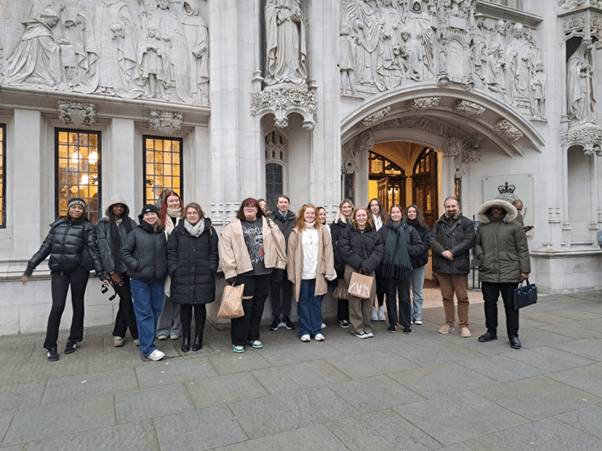
Looking at these final year criminology students in our group photo though! Even with that criminal early morning start (pun intended 😅), they made it through the whole Supreme Court experience! Big shout out to all of them 👏🏾👏🏾👏🏾👏🏾👏🏾👏🏾 Can you spot me? I’m the one on the far right looking like I’m ready for Arctic exploration (as Paula mentioned yesterday), not London weather! 🥶 Listen, my ancestral thermometer was not calibrated for this kind cold today o! Had to wrap up in my hoodie like I was jollof rice in banana leaves – and you know we don’t play with our jollof! 😤
4:55 PM Heading Back To NN

On the journey back to NN, while some students dozed off (can’t blame them – legal learning is exhausting!), I found myself reflecting on everything we’d learned. From the workings of the highest court in our land to the stark realities of social inequality we witnessed near Hyde Park, today brought our theoretical classroom discussions into sharp focus. Sitting here, watching London fade into the distance, I’m reminded of why these field trips are so crucial for our students’ understanding of justice, law, and society.
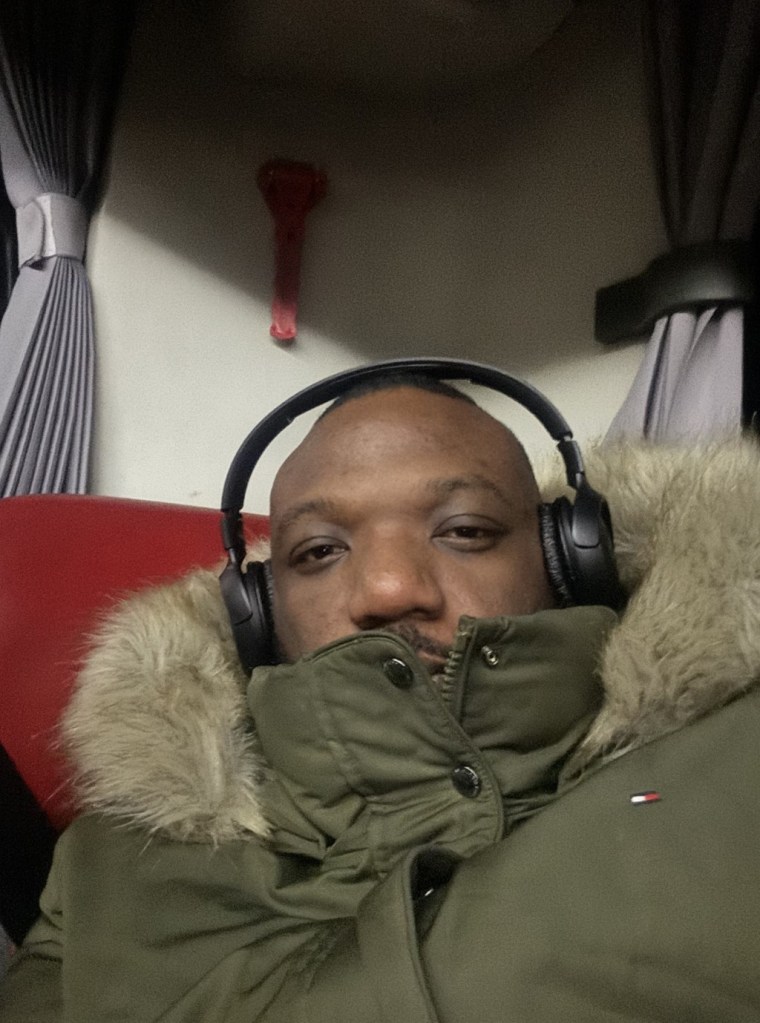

Listen, can we take a moment to appreciate our driver though?! Navigating that M1 traffic like a BOSS, and getting us back safe and sound! The real MVP of the day! 👏🏾👏🏾👏🏾👏🏾👏🏾👏🏾
And just like that, our Supreme Court trip comes to an end. From early morning rush to security check shenanigans, from spotting Chief Medical Officer on the streets to freezing our way through legal history – what a DAY!
To my amazing final years who made this trip extra special – y’all really showed why you’re the future of criminology! 👏🏾 Special shoutout to Manos (who can finally put down his attendance sheet 😂), Jes, and Liam for being the dream team! And to London… boyyyy, next time PLEASE turn up the heat! 🥶
As we all head our separate ways, some students were still chatting about the cases we learned about (while others were already dreaming about their beds 😴), In all, I can’t help but smile – because days like these? This is what university life is all about!
Until our next adventure… your frozen but fulfilled criminology lecturer, signing off! 🙌
Share this:

What makes a good or bad society?: VIII
As part of preparing for University, new students were encouraged to engage in a number of different activities. For CRI1009 Imagining Crime, students were invited to contribute a blog on the above topic. These blog entries mark the first piece of degree level writing that students engaged with as they started reading for their BA (Hons) Criminology. With the students’ agreement these thought provoking blogs have been brought together in a series which we will release over the next few weeks.
Fundamentally, the requirements for a ‘good’ society should consist of several characteristics that contribute to a positive quality of life for all members of the community. There should be a basis in equality, fair judgment, and the ability for all people who are a part of that society to live without undue struggle or unnecessary discomfort, be it financial, emotional or physical. There are a lot of reasons why a society might be good, or bad, and fixing any one problem will not automatically allow us to call ourselves good, but any progress can be positive and may take us closer.
There are large steps towards equality that we as a society have taken in the last century, however this progress is not sustainable when there are many in positions of power who have no interest in changing the status quo. According to the European Commission, less than one in ten CEOs of major companies are women, and women are over represented in particular types of career, which is known as sectoral segregation. This leads to many viewing these sectors as overly feminine, and while this isn’t necessarily true, and shouldn’t affect how valued those careers are, careers viewed as feminine are systemically undervalued, and consistently lead to judgment for those choosing to follow those paths, leaving them underpaid and overworked. In 2021 there was still a gender pay gap of 12.7% in the European Union, with women on average earning almost 13% less than men hourly. Can a society that undervalues over half of its members truly be a good society?
In addition to this, there is a cycle of racial discrimination within this society’s judgment system. With systemic racism ingrained in society for years before legislation was introduced to prevent discrimination in terms of housing and hiring, the UK’s police force contained rampant racial bias for years, which perpetuates even today. Black people in the UK are stopped on the street up to seven times more frequently than white people. There is an undue fear within the public that black people are more dangerous, that they are more likely to commit crime, and statistics that seem to prove this correct are often taken out of context, or supplied without consideration for social factors which may cause this. There is often an aspect of moral panic, whereby the media and other agents of social control use isolated events to incite fear of a particular community, and this causes a dangerous cycle of self fulfilling prophecy, where that community appears to act as expected. After all, if an entire group of people are going to be treated badly, regardless of their actions, does it make any difference if they fulfil our expectations or not?
True equality within any society is impossible, as humans we have natural differences which prevent us from being exactly the same. If men and women participated equally in all sports, there would likely be more injuries simply from biological advantages. If everyone earned the same, and class differences did not exist, there would be no motivation or reward for going above and beyond in the search for success and improvement, and society would remain stagnant. However, we are failing in our most basic duty to protect people from unfair discrimination, and at least offer the opportunity to try for success. Many careers considered ‘too feminine’ to hold true value in society include those in education or healthcare, which are vital in ensuring the next generation can be better than we are, and in maintaining the wellbeing of current members of the community. We should be using the media to dismantle these prejudices, rather than using it to target other groups and spread fear and misinformation. These issues may persist due to a lack of awareness in the wider community, or maybe they exist due to higher powers encouraging that society remain as it is, with them benefiting at the cost of others suffering. I would prefer to assume ignorance over malice, but neither is an excuse. Until we can claim to be as equal a society as it is possible to be, respecting the contributions women offer to society and treating them with the respect they deserve, and not treating a different skin colours as a marker for antisocial behaviour, just to name a few, I cannot claim to live in a truly good society.
Share this:

What makes a good or bad society?: VII
As part of preparing for University, new students were encouraged to engage in a number of different activities. For CRI1009 Imagining Crime, students were invited to contribute a blog on the above topic. These blog entries mark the first piece of degree level writing that students engaged with as they started reading for their BA (Hons) Criminology. With the students’ agreement these thought provoking blogs have been brought together in a series which we will release over the next few weeks.
What are some requirements to a good society? A good society makes us, as a community, feel secure. This is so incredibly important in making a society be considered good as it lowers the rates of criminality, thus improving the appearance of the area and reassurance of being a safe place. This will lead to a better world, given that it will promote positive behaviour, similar to the idea of positive reinforcement, if people were to act accordingly, they would be rewarded with a positive environment. Another requirement is the higher employment rates, the more success will be found within a society. Meaning, there will be less cases of homelessness, and considerably more wealth compared to if there were lower employment rates within a place. Higher employment rates also link into my next point of a fair education. A fair education is arguably one of the most important requirements of a good society, as it firstly links into high employment rates, if someone were to be in a position of having a better education, their IQ is likely to be higher which in most chances will lead to a very succeeding job. A fair education is very important as it allows everyone involved a fair chance and involves no bias, if this were the case it would lead to a bad society as the community are not promoting wealth for everyone involved, only for those they favour. Another requirement that makes up a good society is human rights. Similar to a fair education, human rights provide a chance for people and includes no favouritism. Human rights provide freedom which impact factors such as food and healthcare. These thrive to better societies given that people are not held back and can be free to do however they please in positive and safe ways. A final requirement I would suggest that makes a good society are basic human needs. It is crucial that humans are provided with our biological needs such as water, food, housing/shelter etc. This is due to the fact that we simply cannot live without it.
However, I do believe that we live in a bad society, for many reasons, including the reasons previously mentioned. To begin, there has been a lack of safety net from the police to the public, which leads to repeated cases of rape, police brutality etc. While it can be argued the police are trying to keep the public safe, they are simply causing more harm than good, and considering the police are meant to be role models to the public, the public have increased the rate of criminality with riots and protests against the police, not making our society a safe place. Our society has become let down in regard to basic human needs, although employments rates are high at 74.8% for those ages 16-64, in 2019 the homelessness statistic in the UK is significantly high at 219,000. Meaning the need for food, shelter and water has become at a higher demand.
It has been very clear in recent years that we do not live in a good society, due to the reasons of security within the police, employment rates, a fair education, human rights and basic human needs, all of which could easily make up a good society if it were taken seriously by the appropriate people.
Share this:

What makes a good or bad society?: VI
As part of preparing for University, new students were encouraged to engage in a number of different activities. For CRI1009 Imagining Crime, students were invited to contribute a blog on the above topic. These blog entries mark the first piece of degree level writing that students engaged with as they started reading for their BA (Hons) Criminology. With the students’ agreement these thought provoking blogs have been brought together in a series which we will release over the next few weeks.
I believe that the society we live in is good but has areas that need to be improved. One of the requirements that I think will make a good society is sympathy. I believe that if more people show sympathy towards the homeless, then it can help lower the homeless population and, therefore, lower the percentage of unemployment. This can also reduce the strain on charities, which in turn allows them to focus more help on the people who really need it.
Another requirement to make a good society is self-control. If the population practices self-control, then our society will start to have fewer incidents involving alcohol, such as drink driving and fewer aggressive assaults. One of the other outcomes of practising self-control is a decrease in the volume of visits to the NHS. This can be anything from A&E visits after a night out to health visits due to obesity, this decrease could majorly help the NHS and allow them to give more appointments to people with life-threatening conditions.
Another requirement to help make a good society is more successful and higher rehabilitation rates. If we as a society start to give more support to the members that have wronged then they will have a higher chance of being reformed, which will allow us to live in a society with a lower crime rate, therefore, giving us the opportunity to feel safer in our lives.
One of the other areas of our society that needs improvement is education. If the level of education and extra educational support is improved in areas of higher deprivation then it will help young people to move away from crime and bad role models, they may be able to get higher paying jobs, which will allow them to take care of their families and improve the areas that they have come from. This can give them security in their lives, which again will help them to turn away from criminal acts. If the extra educational support is increased then the young people who need extra support can improve on their studies and gain more confidence in themselves, which will help them to gain better grades.
Another requirement of a good society is lower unemployment levels. If we start to improve support for the unemployed, such as classes to help them improve on existing skills and to learn new skills. This can start to lower the unemployment rates and relieve some of the pressure on the government and the county and district councils.
One of the other areas that we could improve in our society to make it better is extra curricular activities for young people to get involved with. If there are more weekend and after school activities and workshops for our younger people to get involved with then it can help to stop them committing crimes. These activities can also help them to learn new skills to take forward in their lives, it can also help those who maybe aren’t as academic as others.
Share this:

What makes a good or bad society?: V
As part of preparing for University, new students were encouraged to engage in a number of different activities. For CRI1009 Imagining Crime, students were invited to contribute a blog on the above topic. These blog entries mark the first piece of degree level writing that students engaged with as they started reading for their BA (Hons) Criminology. With the students’ agreement these thought provoking blogs have been brought together in a series which we will release over the next few weeks.
Our society is created up by a system that fails it from the beginning it is supposed to make our society better, but in fact creates conflict and frustration and this would be the justice system. The justice system is put in place to allow people to live in a world that has rules and control to create this good society, however, is overwhelmed by the amount of crime.
A good society in my eyes would be one where people took accountability for their wrong doings, because as humans its unrealistic to ask there to be no mistakes we all are living life for the first time and therefor are bound to get things wrong, but being able to take accountability for our actions would be the first step to being able to have a good society. I don’t think it’s possible to ever have no crime or this pitch perfect world, but I believe that there’s things that can be put into place to make society better.
In my eyes change requires there to be understanding and accountability, we as people find it very easy to judge and come to assumptions instead of taking time to understand the issues at hand, and if we would just take a step back and try and see the bigger picture we may be able to come to a mutual ground of seeing why issues occur instead of simply judging. Helping us to understanding why things happen and reduce the resent that occurs is certain situations.
For a society to flourish and grow it needs to be nurtured in the right way this would include, having a fair justice system, things put into place to help guide those who have lost their way a bit and to provide a constant support system. I strongly think a society depends on the nurture around it and that widely impact the impact those are going to have on others.
An ideal good society would involve everyone coming together to support one and another being each other’s community instead of creating big segregations between races and cultures if we as human could learn to live and work together as one, we would solve a lot of issues across the world. War would not exist as our system would result in aiding everyone.
I still believe a good society needs a hierarchy system in terms of rules in place to ensure everyone’s safe as without a foundation of what’s right and wrong it allows people to think they can do as they please. Rules help put into perspective what’s not allowed as a collective thing that are unacceptable by knowledge and provide a punishment to fall upon if those rules are broken.
Overall, a good society needs to be built up of basic foundations of nature, understanding and accountability in my opinion to reduce the conflict that occurs in some cases. A good society needs to be open minded.
Share this:

What makes a good or bad society?: IV
As part of preparing for University, new students were encouraged to engage in a number of different activities. For CRI1009 Imagining Crime, students were invited to contribute a blog on the above topic. These blog entries mark the first piece of degree level writing that students engaged with as they started reading for their BA (Hons) Criminology. With the students’ agreement these thought provoking blogs have been brought together in a series which we will release over the next few weeks.
A good society can be defined as one with social cohesion with a safe, secure environment and a bad society as one lacking these qualities, when using this definition, we can look at if society is good or bad.
In the media there has been an increase in crimes reported, including individuals being caught and charged for their actions, which would have previously escaped the public eye. With an increase in media use from youths, it puts them at a risk to exploitation due to their vulnerability as young people. Social influencers have been able to exploit their own children through sexualising their actions to attract paedophiles and earn profit from these views. In this situation, parents fail to protect their children from the harmful environment the media can attract. Thus, social media is growing in its dangerous nature making it unsafe.
There has been an increase in violence in all aspects of society, such as shootings and wars. America holds the highest rate of school shootings and has failed to make schools a safe place for children. America suffers from violence due to the legalisation of guns which can be seen with many attempted assassinations of presidents, some of which have been successful. The latest attempt being Donald Trump in 2024, which shows how America has failed to provide people with security no matter their status in society.
Even outside of America there has been a failure to make society safe as seen in East Europe. The Russo Ukrainian war gained attention in 2022 over Russia’s failure to capture Ukraine. This caused anxiety as other countries could not fight due to being part of NATO, instead they provided aid for Ukraine. Despite this the war has continued, making Ukraine unsafe to live in, forcing many to immigrate. The Israel-Hamas war started in 2023 and as a result of this war, businesses who supported Israel were boycotted, which demonstrates the interests between businesses and the public not aligning, resulting in protests over powerful figures’ failure to speak up against the violence, thus there is a lack of social solidarity.
Human rights are not consistent within the world. This can be seen in Islamic countries making homosexuality forbidden, whereas in the West homosexuality can be acted upon in public without punishment. With women’s rights there has been recent debates about abortion and its legalisation within America. 17 states have banned abortion, which shows a lack of consensus between the states as the laws are not consistent throughout America. There has been widespread protests to bring back the right to an abortion to women. Additionally, in some countries women have fewer rights due the ideology of men as being superior. The exclusion to rights means women cannot work or get an education predominantly in the Middle East and Africa, whereas the West aim for equal opportunities, showing how politics between countries are not in agreement as to what is a human right.
Therefore, when looking at these events, there is a lack of social cohesion and safety between countries, and even within the same country there is little agreement, this results in a bad society.
Share this:

What makes a good or bad society?: III
As part of preparing for University, new students were encouraged to engage in a number of different activities. For CRI1009 Imagining Crime, students were invited to contribute a blog on the above topic. These blog entries mark the first piece of degree level writing that students engaged with as they started reading for their BA (Hons) Criminology. With the students’ agreement these thought provoking blogs have been brought together in a series which we will release over the next few weeks.
Introduction
Everyone has a different view on whether our society is good or bad or what they perceive a good society to be. Especially individuals who come from different backgrounds and diverse cultures, people experience different societies, cultures and childhoods which can affect everyone’s versions of what a good society is.
Requirements of a good society
My perception of a good society would be a multicultural and diverse civilisation where crime, racism, misogyny, sexism, ableism and so on is at an all time low or doesn’t exist. I only say an all time low because where people are concerned some kind of deviant behaviour will always exist. I believe a society where men could be able to walk the street without the fear of being assaulted or women could walk the streets without the fear of being sexually assaulted is ideal. Also I believe a good society would have no hierarchy, not to the extreme of communism but in the sense that no one should look down on a job individuals have. No job, car or house is valued more because everyone is trying to improve their quality of life. Everyone no matter what race, ethnicity and gender should have the same amount of respect and in the same sense if someone commits a crime no matter who they are they should be held with the same accountability. Women should be paid the same as men, when they are completing the same tasks and doing the same job there should be no reason for them to have different pay. Another requirement I believe in is easy access to education for everyone. Growing up in a deprived area I understand the struggles with getting an education and I personally believe that helping with funds for students, creating more schools or helping support parents who would rather homeschool their children should be more accessible. Absence of corruption is also another, for a society to work and be the best it can be there should be no corruption. No one should be able to use their power, money or any form of blackmail to get out of situations they have caused. Society would be so much smoother if corruption never existed, leading to there should be no attentiveness to power. People who do have power should not be able to use it to their advantage, I do not believe in removing power however, there should never be a situation where an individual who values themselves to have more ‘power’ then another should feel they can control another.
Good Society?
It’s extremely hard to define and work out all requirements of a good society as it could be never ending to work out everyone’s belief of what a good society is as well as my own. I believe we can all have our own opinion of what a good society would require or how it would function. But I will leave you with this, I always say a good society would be one where my younger siblings and the next generations can walk the street and I will not have to worry about their safety. When we reach that point I believe that’s what a good society would be.
Share this:


A Love Letter: in praise of board games
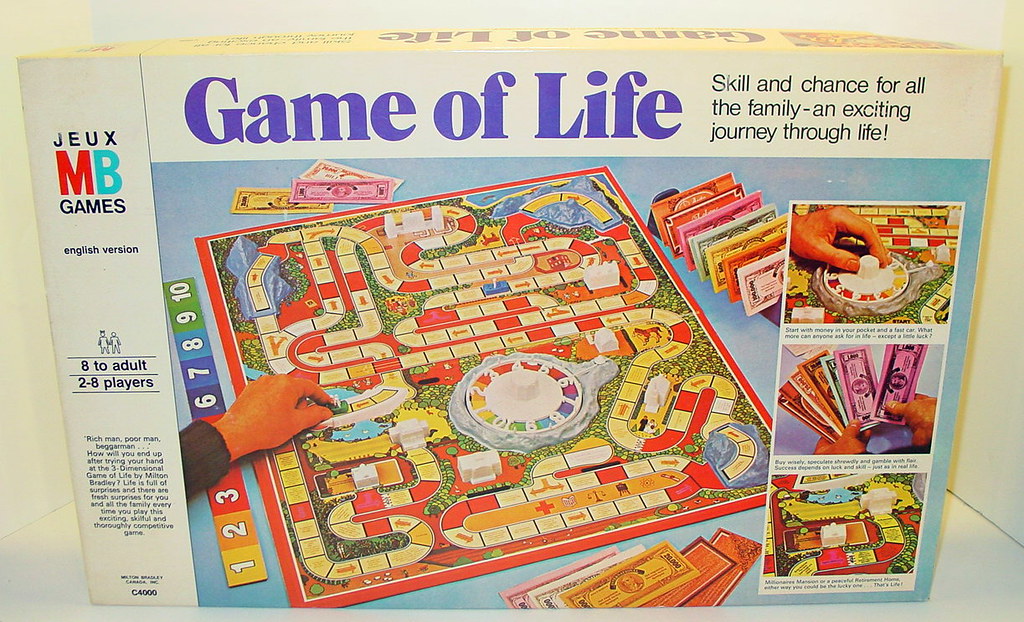
This my fifth love letter, previously I have written in praise of poetry, art, Agatha Christie and the Thoughts from the Criminology Team blog. Since early childhood, I have loved playing games and today’s entry is dedicated to this form of media. In the early years, the focus on fun is paramount, after all who wants to play a dull game? Equally important, the educational aim of games is sometimes explicit, other times less so. Nevertheless, they help us learn to match and sort colours and shapes, to develop our counting skills in an applied setting and improve our memory recall, as well as spelling. Games likes Snap, Happy Families, Hungry Hippos, Snakes and Ladders, Guess Who, Junior Scrabble offer a variety of different ways for children to learn important skills whilst playing. These games enable even very small children to share space, develop important interpersonal skills like taking turns and learn to deal with winning, and of course, losing. Often the latter is a very slow and painful lesson to learn….and one that isn’t always remembered into adulthood!
Of course, one of the most explicit part of playing games is learning the rules of the game, and of course, what happens when we deviate from those rules. It might lead to the loss of a turn or even forfeiture of the entire game. People interpret rules in different ways and families often develop their own “house” rules, but nevertheless there is always an agreed upon set of rules and a way of policing and punishing those who break them.
But once these lessons have been learned, what do games have to teach us as adults? I would say plenty! On a surface level, they offer an opportunity to relax and do something outside of our humdrum lives. Once the games have been purchased, they generally cost nothing to play unlike other forms of leisure time.1 Some can be played alone, others require competitors or even teams. They can aid our thinking, concentration and develop skills of strategy and tactics. They also have the general benefit of not being all consuming (unless at competition level), allowing for conversation to flow. The latter, conversing whilst doing something else, can often be useful for difficult emotional conversations, allowing people to open up without pressure (known colloquially as “health by stealth”).
But do board games have anything to offer to Criminology? Again, I would argue yes! Most games involve chance or luck, will you get the numbers you need, will you have the right pieces/cards in your hand, will the other person play their game in a way that benefits you? It is easy to recognise the role that luck or chance plays in games, but are we equally aware of their role in our lives. More importantly, as criminologists do we fully understand and acknowledge the role played by both in relation to criminality and victimisation?
We have no choice about whether we are born or not, when and where we arrive on the earth, who our parents are. These are all down to forces outside our individual and collective control. Our upbringing, our education, our employment opportunities are largely constrained by geography, money and influence. Compare the opportunities available to a baby born today in Sudan, with one born in the UK, another born in Palestine, and another born in Finland. Compare again, thinking about race, sex, class, disability, sexuality and so on. Very quickly you begin to understand the role played by chance and luck.
So if all of the above are imponderables, how much of a role does luck play in relation to criminality and victimisation? The regular publication of data relating to crime in postcodes, towns/cities and globally show huge diversity in the chance of victimisation. Lucky you, if you were born and live in the ‘Nordic countries of Europe (Norway, Sweden, Denmark, Iceland, and Finland) who rank among the 25 safest globally, most of them also being among the top 10 happiest nations worldwide’. Less fortunate, if you were born in Haiti, Ukraine, Palestine, Sudan or Iraq identified as some of the most dangerous places on earth currently. It is not very difficult to imagine the difference in opportunities in fundamental human rights; food, shelter, healthcare, education and so on. In war ridden nations it is incredibly difficult to separate different typologies of victimisation and for the individuals living under these conditions, it makes no meaningful difference who is/are the perpetrators.
Even if you are living in a “peaceful” state2 such as the UK, there are vast differences in the opportunities available. If you have money you can buy a car to get to work in your evening/night job, if you don’t, maybe you can take a bus, failing that you can walk. Each of those journeys carries its own risks. Your sex, your race, your ethnicity, your sexuality, your abilities/disabilities, your age add the aggravating/mitigating factors and see your risk increase/decrease. All a matter of chance and luck
What about criminality, is this, as the Classical School of Criminology would have us accept, a matter of free will, weighing up the pros and cons and making a deliberate and calculating choice to commit crime? Or can we also identify the same issues of luck and chance as shown above? If your family is loving, everyone has good health, housing is secure, food is plentiful and there are plenty of educational and employment opportunities in your area, would you still choose a life of crime? If there is violence at home, poverty impacts health, housing and regular meals, making it challenging to study or work, would you perceive crime to be a choice?
And what of those board game rules and consequences, real life has its own rules, some written in the forms of laws, others engrained via family, friends, institutions; the norms of our society. In the board game, these rules apply equally (aside from luck and chance) but in real life, not so much. Consider racial and ethnic disproportionality and the treatment of vulnerable women in the CJS, as just two examples. We may all be playing in the same “Game of Life”, but luck, chance and the rules we are subjected to are very different when it comes to criminality and victimisation.
- I appreciate that there are some very expensive board games out there, as well as expansion packs to enhance play. ↩︎
- There are lots of academic arguments around what constitutes a peaceful state, most agree that it more than just the absence of war. Whilst the UK has not seen active warfare on its shores for decades, its military has been involved in conflict throughout the world for more than a century. ↩︎

 Thoughts from the criminology team