
Home » Criminological imagination (Page 2)
Category Archives: Criminological imagination

Technology: one step forward and two steps back
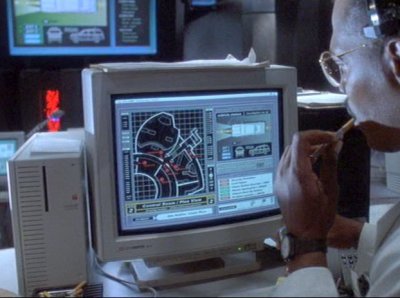
I read my colleague @paulaabowles’s blog last week with amusement. Whilst the blog focussed on AI and notions of human efficiency, it resonated with me on so many different levels. Nightmarish memories of the three E’s (economy, effectiveness and efficiency) under the banner of New Public Management (NPM) from the latter end of the last century came flooding back, juxtaposed with the introduction of so-called time saving technology from around the same time. It seems we are destined to relive the same problems and issues time and time again both in our private and personal lives, although the two seem to increasingly morph into one, as technology companies come up with new ways of integration and seamless working and organisations continuously strive to become more efficient with little regard to the human cost.
Paula’s point though was about being human and what that means in a learning environment and elsewhere when technology encroaches on how we do things and more importantly why we do them. I, like a number of like-minded people are frustrated by the need to rush into using the new shiny technology with little consideration of the consequences. Let me share a few examples, drawn from observation and experience, to illustrate what I mean.
I went into a well-known coffee shop the other day; in fact, I go into the coffee shop quite often. I ordered my usual coffee and my wife’s coffee, a black Americano, three quarters full. Perhaps a little pedantic or odd but the three quarters full makes the Americano a little stronger and has the added advantage of avoiding spillage (usually by me as I carry the tray). Served by one of the staff, I listened in bemusement as she had a conversation with a colleague and spoke to a customer in the drive through on her headset, all whilst taking my order. Three conversations at once. One full, not three quarters full, black Americano later coupled with ‘a what else was it you ordered’, tended to suggest that my order was not given the full concentration it deserved. So, whilst speaking to three people at once might seem efficient, it turns out not to be. It might save on staff, and it might save money, but it makes for poor service. I’m not blaming the young lady that served me, after all, she has no choice in how technology is used. I do feel sorry for her as she must have a very jumbled head at the end of the day.
On the same day, I got on a bus and attempted to pay the fare with my phone. It is supposed to be easy, but no, I held up the queue for some minutes getting increasingly frustrated with a phone that kept freezing. The bus driver said lots of people were having trouble, something to do with the heat. But to be honest, my experience of tap and go, is tap and tap and tap again as various bits of technology fail to work. The phone won’t open, it won’t recognise my fingerprint, it won’t talk to the reader, the reader won’t talk to it. The only talking is me cursing the damn thing. The return journey was a lot easier, the bus driver let everyone on without payment because his machine had stopped working. Wasn’t cash so much easier?
I remember the introduction of computers (PCs) into the office environment. It was supposed to make everything easier, make everyone more efficient. All it seemed to do was tie everyone to the desk and result in redundancies as the professionals, took over the administrative tasks. After all, why have a typing pool when everyone can type their own reports and letters (letters were replaced by endless, meaningless far from efficient, emails). Efficient, well not really when you consider how much money a professional person is being paid to spend a significant part of their time doing administrative tasks. Effective, no, I’m not spending the time I should be on the role I was employed to do. Economic, well on paper, fewer wages and a balance sheet provided by external consultants that show savings. New technology, different era, different organisations but the same experiences are repeated everywhere. In my old job, they set up a bureaucracy task force to solve the problem of too much time spent on administrative tasks, but rather than look at technology, the task force suggested more technology. Technology to solve a technologically induced problem, bonkers.
But most concerning is not how technology fails us quite often, nor how it is less efficient than it was promised to be, but how it is shaping our ability to recall things, to do the mundane but important things and how it stunts our ability to learn, how it impacts on us being human. We should be concerned that technology provides the answers to many questions, not always the right answers mind you, but in doing so it takes away our ability to enquire, critique and reason as we simply take the easy route to a ready-made solution. I can ask AI to provide me with a story, and it will make one up for me, but where is the human element? Where is my imagination, where do I draw on my experiences and my emotions? In fact, why do I exist? I wonder whether in human endeavour, as we allow technology to encroach into our lives more and more, we are not actually progressing at all as humans, but rather going backwards both emotionally and intellectually. Won’t be long now before some android somewhere asks the question, why do humans exist?
Share this:


The future of criminology

If you have an alert on your phone then a new story may come with a bing! the headline news a combination of arid politics and crime stories. Sometimes some spicy celebrity news and maybe why not a scandal or two. We are alerted to stories that bing in our phone to keep ourselves informed. Only these are not stories, they are just headlines! We read a series of headlines and form a quick opinion of anything from foreign affairs, transnational crime, war, financial affairs to death. We are informed and move on.
There is a distinction, that we tend not to make whenever we are getting our headline alerts; we get fragments of information, in a sea of constant news, that lose their significance once the new headline appears. We get some information, but never the knowledge of what really happened. We hear of war but we hardly know the reasons for the war. We read on financial crisis but never capture the reason for the crisis. We hear about death, usually in crime stories, and take notice of the headcount as if that matters. If life matters then a single loss of life should have an impact that it deserves irrespective of origin.
After a year that forced me to reflect deeply about the past and the future, I often questioned if the way we consume information will alter the way we register social phenomena and more importantly we understand society and ourselves in it. After all crime stories tend to be featured heavily in the headlines. Last time I was imagining the “criminology of the future” it was terrorism and the use of any object to cause harm. That was then and now some years later we still see cars being used as weapons, fear of crime is growing according to the headlines that even the official stats have paused surveying since 2017! Maybe because in the other side of the Atlantic the measurement of fear was revealed to be so great that 70% of those surveyed admitted being afraid of crime, some of whom to the extent that changes their everyday life.
We are afraid of crime, because we read the headlines. If knowledge is power, then the fragmented information is the source of ambiguity. The emergence of information, the reproduction of news, in some cases aided by AI have not provided any great insight or understanding of what is happening around us. A difference between information and knowledge is the way we establish them but more importantly how we support them. In a world of 24/7 news updates, we have no ideological appreciation of what is happening. Violence is presented as a phenomenon that emerges under the layers of the dark human nature. That makes is unpredictable and scary. Understandably so…
This a representation of violence devoid of ideology and theory. What is violence in our society does not simply happens but it is produced and managed through the way it is consumed and promoted. We sell violence, package it for patriotic fervour. We make defence contracts, selling weapons, promoting war. In society different social groups are separated and pitted against each other. Territory becomes important and it can be protected only through violence. These mechanisms that support and manage violence in our society are usually omitted. A dear colleague quite recently reminded me that the role of criminology is to remind people that the origins of crime are well rooted in our society in the volume of harm it inflicts.
There is no singular way that criminology can develop. So far it appears like this resilient discipline that manages to incorporates into its own body areas of work that fiercely criticised it. It is quite ironic for the typical criminology student to read Foucault, when he considered criminology “a utilitarian discipline”! Criminology had the last laugh as his work on discipline and punishment became an essential read. The discipline seems to have staying power but will it survive the era of information? Most likely; crime data originally criticised by most, if not all criminologists are now becoming a staple of criminological research methods. Maybe criminology manages to achieve what sociology was doing in the late 20th century or maybe not! Whatever direction the future of criminology takes it will be because we have taken it there! We are those who ought to take the discipline further so it would be relevant in years to come. After all when people in the future asked you what did you do…you better have a good answer!
Share this:


#UONCriminologyClub: Introduction to Criminology with Dr Manos Daskalou

In celebration of the 25 years of Criminology at UON, we have been hosting a number of events that demonstrate the diversity and reach criminology has as a discipline in different communities. In a spirit of opening a wider dialogue we have created a series of online classes for young home educated learners (10-15) to provide some taster sessions about criminology. This is a reflection of the very first one.
Setting up a session for young learners is not an easy feat! The introduction session was about to set the tone with the newly formed “Criminology Club” like the old Micky Mouse Club, only with more crime and less mice! The audience of our new crime-busters was ready to engage. The pre-session activity was set and the tone for what was to follow was clear. For an hour I would be conversing on crime. To get through the initial introductions with the group, we went over the activity. Top crimes and reasons for arranging them in that order. Our learners went into a whole range of criminalities and provided their own rationale for what they thought made them serious. There is a complex simplicity in this activity; regardless of age or experience, our understanding and most importantly justification of crime, tells us more about us, than the person committing it. Once we were done with the “pleasantries” we moved into the main part of the class.
Being an introductory session, it was important to set it right; telling a story and framing it into a conversation is important. What’s the best way to start the story of crime, but to tell a story we all know about when growing up; a fairy-tale. Going for a classic fairy-tale seemed to be the best way to go!
For this session the fairy tale chosen was Cinderella.
“I really enjoyed today’s session! I feel enlightened – Dr @manosdaskalou was great and I really loved the activities. I didn’t know the original story of Cinderella – it’s so horrifying. I didn’t think of crime in fairy-tales before but now I will be on the look out.” (Quinn age 12).
The original tale, like most fairy-tales has a fairly brutal twist that reinforces strongly the cautionary tale within the story. This was an audience participation narration and the help of the “crime-busters” was necessary every step of the way. Understanding the types of crimes being committed at every turn of the tale, while wondering if this was to be regarded appropriate behaviour now. Suddenly the fairy tale becomes an archive of social trends, beliefs and actions, captioned into the spin of the story. The hour was far too little time covering a simple fairy tale!
“I would like to thank Dr @manosdaskalou for today. I had an amazing time. The only thing I didn’t like was when it ended. I like stories so I enjoyed when we talked about Cinderella, I didn’t realise how gruesome the original one was!” (Paisley age 10).
There is something interesting running over a familiar tale and looking at it from a different perspective. The process of decoding messages and reviewing narratives. For a younger audience the terms may sound incomprehensible but it is amazing how much narrative analysis the new “crime-busters” did! Our social conventions are so complex yet despite that a child at the age of 10 can pick them up and put them in the right order. Seeing them confronting the different dilemmas, the story took them on so many different levels, was an interesting process. It is always a challenge to pitch any material at the right level but on this occasion, for this group, about this story in this instance, the “crime-busters” were introduced to Criminology!
“We had so much fun today in our first criminology lesson with Dr @manosdaskalou from UON. Time flew by so quickly, I was so interested in everything we were discussing and wanted to know more and more. In today’s session we pulled apart the fairytale Cinderella discussing what crimes the characters in it had committed and why. I thought this was a really great idea. I was having so much fun in the lesson that I didn’t realise how much I was actually learning but now that we have finished I realise I know much more about criminology and how to study a classic text with Criminology in mind. A big thank you to @manosdaskalou who made it an incredibly fun and engaging session. I’m sure I speak for most of us when I say I can’t wait to come back next time and learn more.” (Atty aged 14).
The end of the session left the group of “crime-busters” wanting more. Other colleagues will continue offering more sessions to an early generation of learners getting to know the basics about “Criminology” a discipline that many people think they know from true crime, little realising we spend so much time dispelling the myths! Who would imagine that the best way to do so, was to tell them a fairy tale.
Share this:


25 Years of Criminology at UON: Looking Back

This year Criminology at UON is celebrating its 25th Anniversary! Exciting times! In line with the celebrations, the Criminology Team have organised a number of events as part of these celebrations. Ranging from the ‘Changing the Narrative’ VAWG event, organised by Dr @paulaabowles and the Deputy Police, Fire and Crime Commissioner (PFCC), to a school’s event in June offering out miniature taster sessions to interested, local year12 students (more details T.B.C). As well all the exciting events, we have also had reflections from the Team around what it means to them and their journey with Criminology at UON. It is my journey which I would like to share with you now.
My journey begins in 2012 as a bright eyed and bushy tailed first year student moving away from home to Northampton to study Criminology. Having never done any Criminology, Psychology, Sociology, or Law before I was feeling very much out of my depth. However, little did I realise that my A-levels in Philosophy, Ethics and English Language would hold me steady. The first year was quite overwhelming: there were lots of tears and uncertainties. I remember it taking the entire summer between year 1 and year 2 to get my head around Harvard Referencing. But I survived! It was not until the end of year 2 and beginning of year 3 where I would say I began to ‘thrive’ in the discipline. As a student, one of my highlights was doing a research placement in year 2. Academically, I gained skills which prepared me for the dissertation in the final year, but it also brought me out of my shell much more. Pretty sure there were tears here as well- this has been a common feature of my journey with Criminology (as student and staff)!
In 2015 I graduated from UON with a BA in Criminology and in the September of that year began in the role as an Associate Lecturer in Criminology. This was incredibly scary but also incredibly rewarding. It was very interesting to be on ‘the other side’ of academia having so recently graduated and it took a fair amount of time to transition from student to staff (as academics we are also students so the transition is never fully complete)! I was involved on modules I had not had the privilege of studying and was able to work closely with esteemed colleagues I’d looked up to for so long and who had had a large impact in moulding the criminologist I was (and am today). In the September of 2020, after achieving my MSc in Criminology, I became a full-time lecturer and remain so five years later. The course and University has changed a lot in those 5 years, with some fabulous new modules in the BA and BA Criminology with Psychology courses, new colleagues offering a range of expertise and passion for areas within the discipline and some epic trips with a number of the student cohorts we have been blessed to have.
There have been challenges too, and lots of tears (especially from me), but the progress and evolution of Criminology at UON in the 13 years I have been a part of it have been monumental! Hopefully there will be even more positivity to come in the future. I feel incredibly grateful and blessed to have been involved with Criminology at UON for so long, and always look back on my student days with fondness. I’ve enjoyed my role as a member of staff and enjoyed being a part of the events the Team have organised and the new course which we have designed. A huge ‘Thank you’ must be written to the ‘founding father of Criminology at UON’ @manosdaskalou, without whom my, and many others, journey with Criminology at UON might be non-existent! So cheers to 25 years of Criminology at UON, the ‘founding father’, and to many more wonderful years (and hopefully less tears)!
Share this:

25th Year Reflection
I have been part of Criminology at UON as BA Criminology student, then Associate Lecturer then Lecturer in Criminology for about 13 years in total. My last reflection on my Criminology journey was in 2020 as I had just embarked on my new role as a Lecturer in Criminology. Every now and then I reflect on how lucky I am to be able to have a job role which has the potential to encourage a passion for learning, reading, writing, critical thinking as well as other life skills.
When reflecting on the 25th year Criminology anniversary I think mostly of the old Park Campus that I used to frequent and study at as a student. It had quite a nice feel to it and there was also enough surrounding nature for a famous badger to make this place part of its habitat! There were less books available online when I was an undergraduate compared to today so I have fond memories of going to the library often to have a browse and coming away with as many criminology related books that I could fit in my bag at once. Finding places where I could study for hours that were less frequented than the main library also gave me a bit of a buzz. There also used to be a Pavilion bar near to where the majority of exams would take place, one of my favorite past time memories is sipping on a beer in the Pavilion just after the end of my final third year Criminology exam season, (whilst secretly thinking of how I thought the exams went much better than expected).
When reflecting I am also reminded of how lecturers like Dr @manosdaskalou and Dr @paulaabowles can be incredibly inspirational and influential at guiding academic paths (such as my own!). The re-occurring ideas that ‘criminology is everywhere’ and that we should ‘question everything’ has boded well for helping me to make difficult decisions and in thinking about how I interacted with people when I was working within crime related industries.
In more recent years staff and students have moved to a new campus, have worked and studied through the challenges that come with Covid-19 and contextual uncertainties. This year has had some highlights for me, such as working on a new module Imagining Crime. Whereby we used inspiration from the novel 1984 by George Orwell to task students with committing weekly ‘thought crimes’ by seeing/hearing/reading about something criminological and questioning this by using critical thinking. Listening to the development of critical thinking via the ‘thought crime’ method has been a delight. The flexible, creative and multidisciplinary nature of criminology is also quite fabulous for maintaining interest in criminology over a long period of time but also for venturing into new and less explored areas. For instance, staff and students in Imagining Crime had the pleasure of attending a guest speaker session with @saffrongarside about children’s literature and the environment this academic year – at a time when Northampton itself seemed to be struggling to cope with flooding. Of course, this did highlight the importance of seeing environmental issues as criminological issues, but also the importance of considering children’s books as criminologically cultural artifacts, was something completely new and intriguing for me. I also gained a lot from hearing what our students (who are predominantly) young people think about environmental issues outside of the mainstream media angles that I have seen.
To round up, I loved my student life whilst studying BA Criminology and I am sure many others will say ‘ditto to that’. Long may the love for Criminology at UON continue!
Share this:


Exploring the National Museum of Justice: A Journey Through History and Justice

As Programme Leader for BA Law with Criminology, I was excited to be offered the opportunity to attend the National Museum of Justice trip with the Criminology Team which took place at the back end of last year. I imagine, that when most of us think about justice, the first thing that springs to mind are courthouses filled with judges, lawyers, and juries deliberating the fates of those before them. However, the fact is that the concept of justice stretches far beyond the courtroom, encompassing a rich tapestry of history, culture, and education. One such embodiment of this multifaceted theme is the National Museum of Justice, a unique and thought-provoking attraction located in Nottingham. This blog takes you on a journey through its historical significance, exhibits, and the essential lessons it imparts and reinforces about justice and society.
A Historical Overview
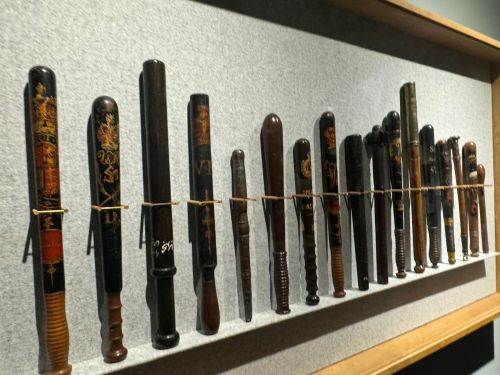
The National Museum of Justice is housed in the Old Crown Court and the former Nottinghamshire County Gaol, which date back to the 18th century. This venue has witnessed a myriad of legal proceedings, from the trials of infamous criminals to the day-to-day workings of the justice system. For instance, it has seen trials of notable criminals, including the infamous Nottinghamshire smuggler, and it played a role during the turbulent times of the 19th century when debates around prison reform gained momentum. You can read about Richard Thomas Parker, the last man to be publicly executed and who was hanged outside the building here. The building itself is steeped in decade upon decade of history, with its architecture reflecting the evolution of legal practices over the centuries. For example, High Pavement and the spot where the gallows once stood.
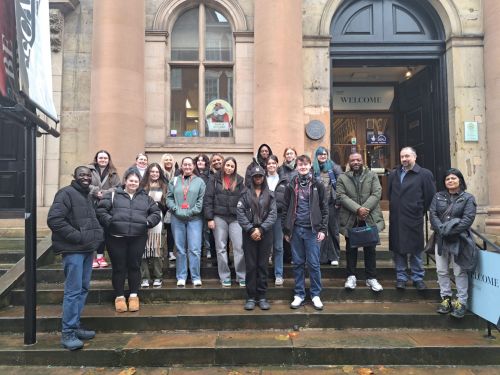
By visiting the museum, it is possible to trace the origins of the British legal system, exploring how societal values and norms have shaped the laws we live by today. The National Museum of Justice serves as a reminder that justice is not a static concept; it evolves as society changes, adapting to new challenges and perspectives. For example, one of my favourite exhibits was the bench from Bow Street Magistrates Court. The same bench where defendants like Oscar Wilde, Mick Jagger and the Suffragettes would have sat on during each of their famous trials. This bench has witnessed everything from defendants being accused of hacking into USA Government computers (Gary McKinnon), Gross Indecency (Oscar Wilde), Libel (Jeffrey Archer), Inciting a Riot (Emmeline Pankhurst) as well as Assaulting a Police Officer (Miss Dynamite).
Understanding this rich history invites visitors to contextualize the legal system and appreciate the ongoing struggle for a just society.
Engaging Exhibits
The National Museum of Justice is more than just a museum; it is an interactive experience that invites visitors to engage with the past. The exhibits are thoughtfully curated to provide a comprehensive understanding of the legal system and its historical context. Among the highlights are:
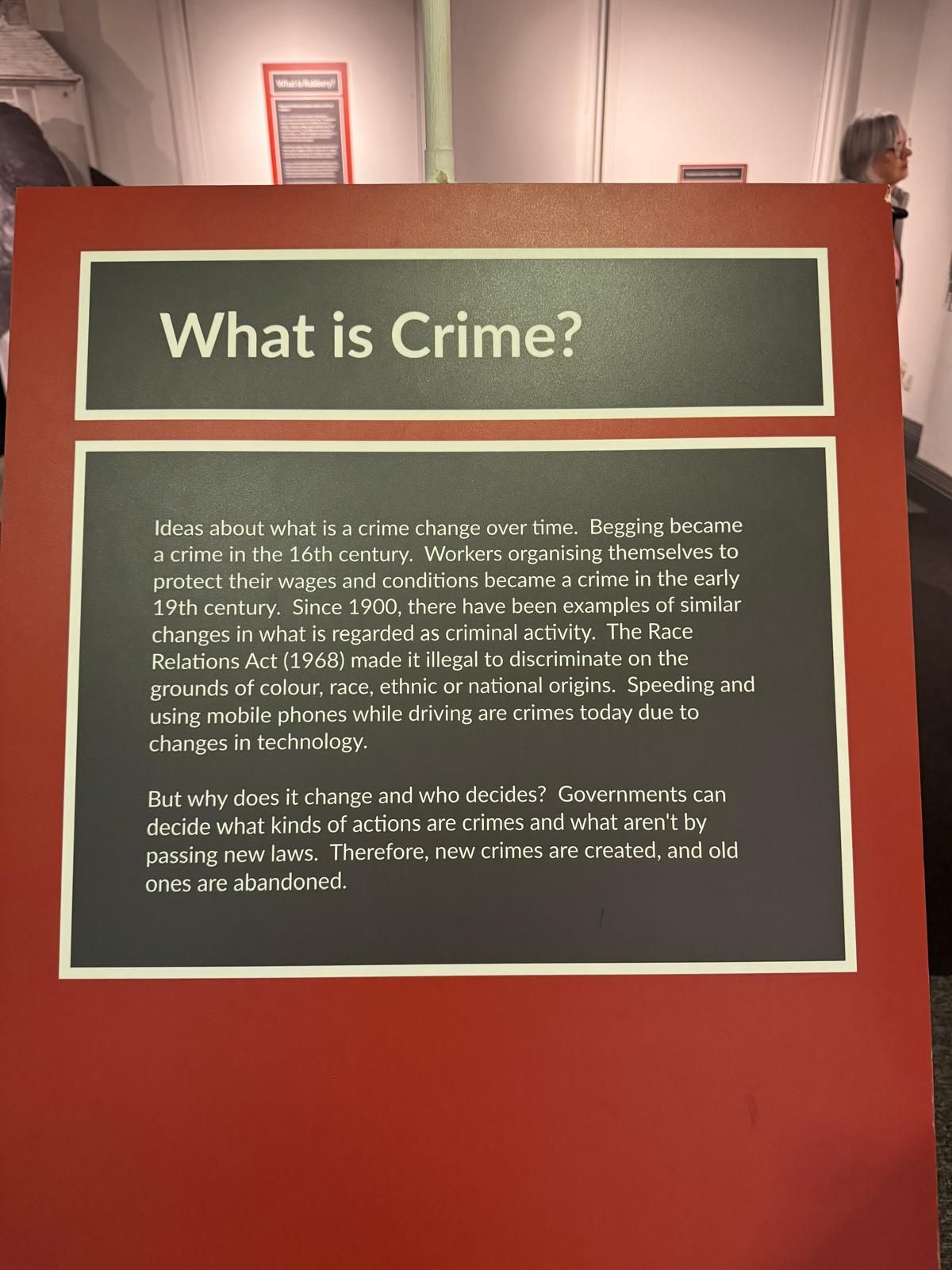



1. The Criminal Courtroom: Step into the courtroom where real trials were once held. Here, visitors can learn about the roles of various courtroom participants, such as the judge, jury, and barristers. This is the same room that the Criminology staff and students gathered in at the end of the day to share our reflections on what we had learned from our trip. Most students admitted that it had reinforced their belief that our system of justice had not really changed over the centuries in that marginalised communities still were not dealt with fairly.
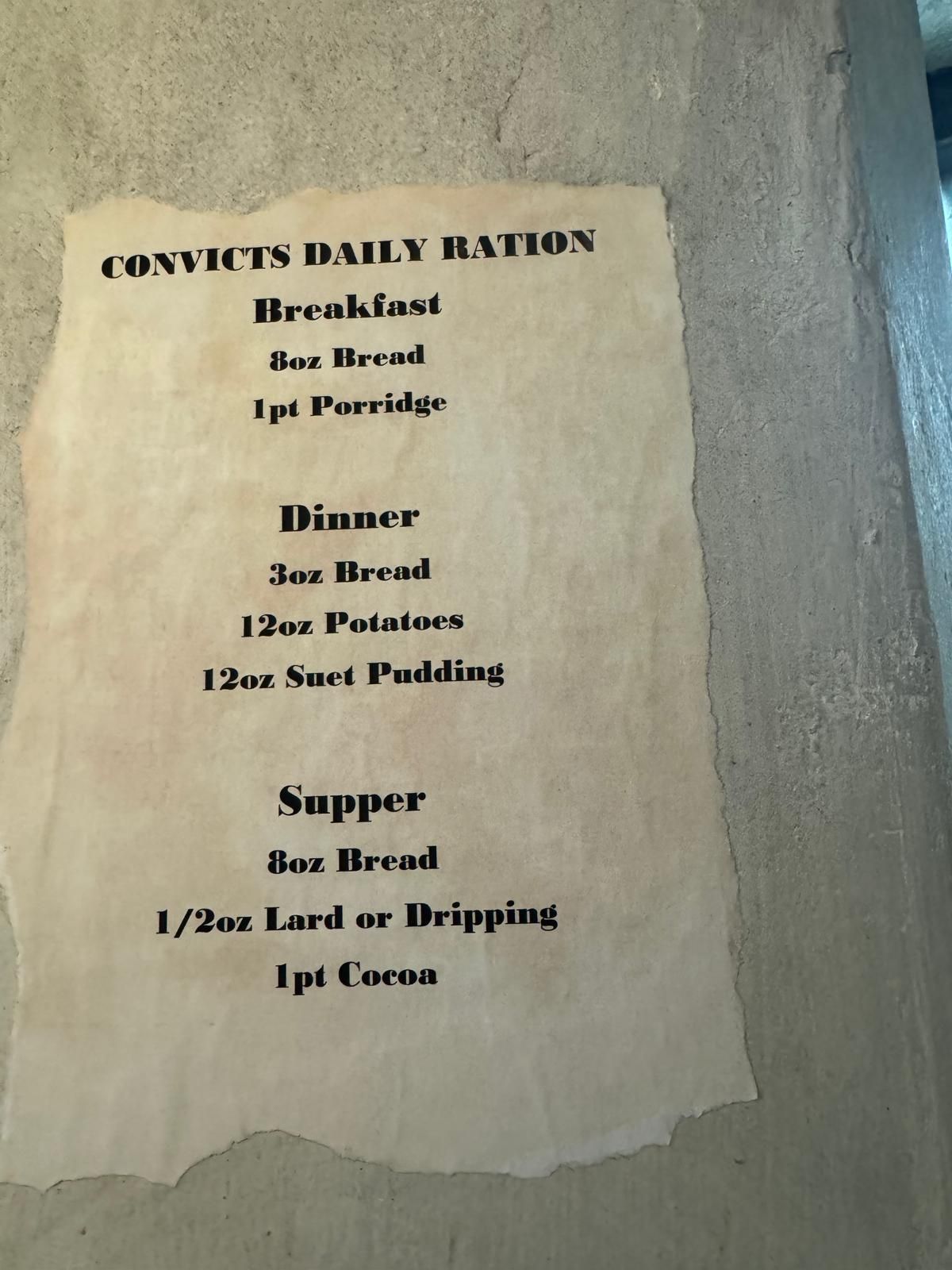
2. The Gaol: We delved into the grim reality of life in prison during the Georgian and Victorian eras. The gaol section of the gallery offers a sobering look at the conditions inmates faced, emphasizing the societal implications of punishment and rehabilitation. For example, every prisoner had to pay for his/ her own food and once their sentence was up, they would not be allowed to leave the prison unless all payments were up to date. The stark conditions depicted in this exhibit encourage reflections on the evolution of prison systems and the ongoing debates surrounding rehabilitation versus punishment. Eventually, in prisons, women were taught skills such as sewing and reading which it was hoped may better their chances of a successful life in society post release. This was an evolution within the prison system and a step towards rehabilitation of offenders rather than punishment.
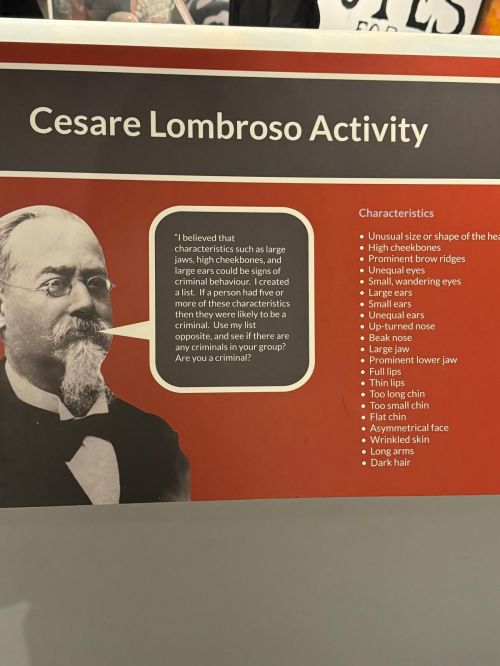
3. The Crime and Punishment Exhibit: This exhibit examines the relationship between crime and society, showcasing the changing perceptions of criminal behaviour over time. For example, one famous Criminologist of the day Cesare Lombroso, once believed that it was possible to spot a criminal based on their physical appearance such as high cheekbones, small ears, big ears or indeed even unequal ears. Since I was not familiar with Lombroso or his work, I enquired with the Criminology department as to studies that he used to reach the above conclusions. Although I believe he did carry out some ‘chaotic’ studies, it really reminded me that it is possible to make statistics say whatever it is you want them to say. This is the same point in relation to the law generally. As a lawyer I can make the law essentially say whatever I want it to say in the way I construct my arguments and the sources I include. Overall, The Inclusions of such exhibits raises and attempts to tackle difficult questions about personal and societal morality, justice, and the impact of societal norms on individual actions. By examining such leading theories of the time and their societal reactions, the exhibit encourages visitors to consider the broader implications of crime and the necessity of reform within the justice system. Do you think that today, deciding whether someone is a criminal based on their physical appearance would be acceptable? Do we in fact still do this? If we do, then we have not learned the lessons from history or really moved on from Cesare Lombroso.
Lessons on Justice and Society
The National Museum of Justice is not merely a historical site; it also serves as a platform for discussions about contemporary issues related to justice. Through its exhibits and programs, our group was invited to reflect on essentially- The Evolution of Justice: Understanding how laws have changed (or not!) over time helps us appreciate the progress (or not!) made in human rights and justice and with particular reference to women. It also encourages us to consider what changes may still be needed. For example, we were incredibly privileged to be able to access the archives at the museum and handle real primary source materials. We, through official records followed the journey of some women and girls who had been sent to reform schools and prisons. Some were given extremely long sentences for perhaps stealing a loaf of bread or reel of cotton. It seemed to me that just like today, there it was- the huge link between poverty and crime. Yet, what have we done about this in over two or three hundred years? This focus on historical cases illustrates the importance of learning from the past to inform present and future legal practices.
– The Importance of Fair Trials: The gallery emphasizes the significance of due process and the presumption of innocence, reminding us that justice must be impartial and equitable. In a world where public opinion can often sway perceptions of guilt or innocence, this reminder is particularly pertinent. The National Museum of Justice underscores the critical role that fair trials play in maintaining the integrity of the legal system. For example, if you were identified as a potential criminal by Cesare Lombroso (who I referred to above) then you were probably not going to get a fair trial versus an individual who had none of the characteristics referred to by his studies.
– Societal Responsibility: The exhibits prompt discussions about the role of society in shaping laws and the collective responsibility we all share in creating a just environment. The National Museum of Justice encourages visitors to think about their own roles in advocating for justice, equality, and reform. It highlights that justice is not solely the responsibility of legal professionals but also of the community at large.
– Ethics and Morality: The museum offers a platform to explore ethical dilemmas and moral questions surrounding justice. Engaging with historical cases can lead to discussions about right and wrong, prompting visitors to consider their own beliefs and biases regarding justice.
Conclusion
The National Museum of Justice in Nottingham is a remarkable destination that beautifully intertwines history, education, and advocacy for justice. By exploring its rich exhibits and engaging with its thought-provoking themes, visitors gain a deeper understanding of the complexities surrounding justice and its vital role in society. Whether you are a history buff, a legal enthusiast, a Criminologist or simply curious about the workings of justice, the National Museum of Justice offers a captivating journey that will leave you enlightened and inspired.
As we navigate the complexities of the modern world, it is essential to remember the lessons of the past and continue striving for a fair and just society for all. The National Museum of Justice stands as a powerful testament to the ongoing quest for justice, inviting us all to be active participants in that journey. In doing so, we honour the legacy of those who have fought for justice throughout history and commit ourselves to ensuring that the principles of fairness and equity remain at the forefront of our society. Sitting on that same bench that Emmeline Pankhurst once sat really reminded me of why I initially studied law.
The main thought that I was left with as I left the museum was that justice is not just a concept; it is a lived experience that we all contribute to shaping.

Share this:


Criminology in the neo-liberal milieu

I do not know whether the title is right nor whether it fits what I want to say, but it is sort of catchy, well I think so anyway even if you don’t. I could never have imagined being capable of thinking up such a title let alone using words such as ‘milieu’ before higher education. I entered higher education halfway through a policing career. I say entered; it was more of a stumble into. A career advisor had suggested I might want to do a management diploma to advance my career, but I was offered a different opportunity, a taster module at a ‘new’ university. I was fortunate, I was to renew an acquaintance with Alan Marlow previously a high-ranking officer in the police and now a senior lecturer at the university. Alan, later to become an associate professor and Professor John Pitts became my mentors and I never looked back, managing to obtain a first-class degree and later a PhD. I will be forever grateful to them for their guidance and friendship. I had found my feet in the vast criminology ocean. However, what at first was delight in my achievements was soon to be my Achilles heel.
Whilst policing likes people with knowledge and skills, some of the knowledge and skills butt up against the requirements of the role. Policing is functional, it serves the criminal justice system, such as it, and above all else it serves its political masters. Criminology however serves no master. As criminologists we are allowed to shine our spotlight on what we want, when we want. Being a police officer tends to put a bit of a dampener on that and required some difficult negotiating of choppy waters. It felt like I was free in a vast sea but restrained with a life ring stuck around my arms and torso with a line attached so as to never stray too far from the policing ideology and agenda. But when retirement came, so too came freedom.
By design or good luck, I landed myself a job at another university, the University of Northampton. I was interviewed for the job by Dr @manosdaskalou., along with Dr @paulaabowles (she wasn’t Dr then but still had a lot to say, as criminologists do), became my mentors and good friends. I had gone from one organisation to another. If I thought I knew a lot about criminology when I started, then I was wrong. I was now in the vast sea without a life ring, freedom was great but quite daunting. All the certainties I had were gone, nothing is certain. Theories are just that, theories to be proved, disproved, discarded and resurrected. As my knowledge widened and I began to explore the depths of criminology, I realised there was no discernible bottom to knowledge. There was only one certainty, I would never know enough and discussions with my colleagues in criminology kept reminding me that was the case.
Why the ‘neo-liberal milieu’ you might ask, after all this seems to be a romanticised story about a seemingly successful transition from one career to another. Well, here’s the rub of it, universities are no different to policing, both are driven, at an arm’s length, by neo liberal ideologies. The business is different but subjugation of professional ideals to managerialist ideology is the same. Budgets are the bottom line; the core business is conducted within considerable financial constraints. The front-line staff take the brunt of the work; where cuts are made and processes realigned, it is the front-line staff that soak up the overflow. Neo-Taylorism abounds, as spreadsheets to measure human endeavour spring up to aide managers both in convincing themselves, and their staff, that more work is possible in and even outside, the permitted hours. And to maintain control, there is always, the age-old trick of re-organisation. Keep staff on their toes and in their place, particularly professionals.
The beauty of being an academic, unlike a police officer, is that I can have an opinion and at least for now I’m able to voice it. But such freedoms are under constant threat in a neo-liberal setting that seems to be seeping into every walk of life. And to be frank and not very academic, it sucks!
Share this:


Concrete Jungle

The 6th February 2025 marked what would have been the 80th birthday of Bob Marley. Despite his passing at the age of 36, his iconic legacy remains through various means; from his music being played and passed down from generation to generation, to the work of his wife, children and grandchildren that work to keep his message and music alive.
I myself was introduced to the music of Bob Marley at a young age by my father. My father played bass guitar in a band and music in our household was very important and a way in which we bonded. My father also had the pleasure to watch Bob Marley play live in the 1970s.
Whilst Bob Marley and Bob Marley and the Wailers have a massive catalogue in which I have many favourites, I wanted to share a personal favourite that may be slightly less known.
I’ve been getting first year students to choose songs and then getting them to try to apply criminological theories that link to the song. I think this would be a good way of getting them thinking and applying their knowledge.
Concrete Jungle by Bob Marley and the Wailers
I love this song for many reasons which I will mention briefly.
Firstly, the lyrics are emotive and powerful. The introductory lyrics state:
No sun will shine in my day today.
The high yellow moon won’t come out to play.
Darkness has covered my light
and has changed my day into night!
These initial lyrics highlight the plight of many individuals living in Kingston, Jamaica at the time. It alludes to the lack of resources, opportunities and hope.
The song continues in this vein
Must be somewhere (sweet life) to be found (out there somewhere for me)
Instead of a concrete jungle
Where the living is harder
Oh man, you’ve got to do your best, yeah (concrete jungle)
No chains around my feet but I’m not free.
I know I am bound here in captivity.
And I’ve never known happiness.
The lyrics are deep and meaningful and Bob Marley sings them with such unrivalled conviction, pain and emotion.
Another poignant lyric in the song is:
I’ve got to pick myself from off the ground, yeah
In this yah concrete jungle
These lyrics highlight two things to me, the bitter feeling of knowing no one is there to help but themselves and second, the sheer resilience of individuals in such situations that pick themselves up from the disadvantage, poverty, and discrimination they face.
Whilst Bob Marley’s voice is unmatched, a moment must be spared to discuss the background vocals, the bass guitar and the guitar solos. Peter Tosh and Bunny Wailer’s background vocals are just as important and the higher key provides a great contrast.
Additionally, the bass guitar in this song is an important constant throughout the song, there in the background but still a key element. The guitar solo also adds an extra element to the song and arguably moves this song beyond the genre of reggae to the realm of rock and perhaps a new audience. It’s no wonder rock bands at the time were influenced by reggae music and vice versa. A good example being The Clash’s version of ‘Police and Thieves’, originally sung by Junior Murvin.
So if you have time, listen to the song, maybe a few tunes as each time you may hear and appreciate different elements of the song. I particularly encourage you to watch the performance of Concrete Jungle on The Old Grey Whistle Test, which can be found on YouTube. The live performance shows the emotion in a new way!
Share this:


Family life in Tenerife versus the UK
I have recently been on a family holiday with our toddler to Tenerife. We began the journey by getting to an airport in the UK. Whilst there the security checks were done for families alongside everyone else. Toddlers were required to get out of their prams, to have their shoes taken off and could not hold onto their toys. The security seemed relatively tight as my hands were swabbed, my toddler was searched with a security stick and the small volume of water that he was allowed was also swabbed.
Whilst arriving and departing via the airport in Tenerife the security allocated a separate quieter section of space for families, this seemed far more relaxed, staff were smiling and dared to say ‘hola’ and ‘hello’. There were no additional checks and a toddler cup of water was allowed. Some staff were also making a deliberate attempt to identify the names of babies, toddlers and children from boarding passes or passports to be able to greet them by their names with waves and smiles.
Whilst on holiday I could be forgiven for thinking that we were royalty whilst pushing a pram and toddler around the streets. As pedestrians always had the right of way, whenever there is a road to cross, the cars must stop due to zebra-like crossings marking on the ground. There are also plenty of playgrounds and toilets and plenty of opportunity for play outdoors in sea and sand.
Whilst at home in Birmingham (UK) there are far less zebra crossings and on quite a few occasions cars have failed to stop at zebra crossings whilst I have been waiting with a pram and toddler. Baby and toddler swimming pools also seem to be difficult to access due to locations and restrictions on pool opening time frames. There are parks but I have never seen a park within a shopping centre like I did in Tenerife. Despite the UK becoming quite cold in the winter, the ability to access free indoor play during winter time also seems to be a privilege, rather than a given. Whilst there are some fabulous playgroups and library sessions for babies and toddlers, sometimes establishments promoting themselves as ‘family friendly’ places do not always feel friendly to toddlers at all. This is especially the case if toddlers are required to adhere to adult informal rules, such as not touching things or making loud noise. As some how toddlers trying to explore their world are labelled by some as ‘terrible’ at ‘two’ (see below poem by Holly McNish).

Whilst I have no idea about the education system in Tenerife, these experiences did leave me reflecting on the provision of mainstream education for babies, toddlers and children in the UK. In comparison to countries such as Finland, some mainstream UK education settings are often critiqued for limiting play, time spent in the outdoors, creativity and freedom to think (Dorling and Koljonen, 2020). The popularity of European influenced Montessori nurseries and Forest Schools in the UK seem to indicate that some parents do want something different for children. Whilst on mention of difference, UK mainstream educational approaches to difference seem to be about an assimilation type of inclusivity and diversity, rather than celebrating and learning from the variety of UK cultures. For instance, it seems “marvelous” that if attending mainstream schools in the UK some Romany gypsies are required to fit the restrictive and disciplinarian like school mould, i.e., of shutting up and sitting down (see Good English by Tawona Sithole) or sitting straight and not talking (see Julia Donaldson’s children’s book: The Snail and the Whale). Yet there is little (if any) acknowledgment of how some Romany have an educating culture of fostering independence, voice, freedom and creativity through plenty of outdoor play, roaming around and human interaction is a huge positive. Dorling and Koljonen (2020) state that investment in children and family support is incredibly beneficial for society, as well as families. The reflection above left me thinking that more or something different could be done.
Reference:
Dorling, D and Koljonen, A. (2020) Finntopia : What We Can Learn from the World’s Happiest Country. Newcastle upon Tyne: Agenda Publishing.
Share this:


What makes a good or bad society?: X

As part of preparing for University, new students were encouraged to engage in a number of different activities. For CRI1009 Imagining Crime, students were invited to contribute a blog on the above topic. These blog entries mark the first piece of degree level writing that students engaged with as they started reading for their BA (Hons) Criminology. With the students’ agreement these thought provoking blogs have been brought together in a series which we will release over the next few weeks.
A society can be defined as a certain number of people living together within a community, of which, all of humanity contribute toward in various ways. Therefore, to accurately determine whether the very society we live in is plainly good or bad is practically impossible. This is due to the sheer number of factors that intertwine to breed what we know as a society, such as beliefs, language, social norms and various other elements. Having said this, it is possible to determine what makes a society better, for example equality for all that present equal chance and opportunity for every human, regardless of age, gender or race of which can be evidenced in the world we live in today. Examples of this include the Equality Act of 2010, that required public bodies to prove how their chosen policies have affected people with protected characteristics. This provides evidence that suggests the society we live within is indeed good, as this alludes to the idea that all who contain protected characteristics are catered for as their needs may require, ideally removing any feeling of prejudice or hardship for those with protected characteristics.
However, there are components that make a society worse, such as prejudices, these can be based on people’s race, gender, age, etc. Prejudice can be described as someone obtaining a preconceived opinion that is not based on reason, reality or even from an opinion that is often harmful and negative. This can derive from harmful stereotypes or even family upbringing, meaning natural tensions and aggression appear within society, of which, appear within our very own. Despite actions taken to combat such, it is indisputable to argue that racism and sexism still very much plague humanity and therefore society, potentially causing the conclusion that our society is in fact bad.
Overall, the idea that our society can be plainly labelled as good or bad is vastly naïve. However, this is not to suggest that elements within our society are good, such as equality being more and more evident within our society, meaning equal opportunity and chance for humanity that is unarguably positive. On the contrary, the very fact that prejudices still plague society to this very day, highlights the worst parts of society, concluding that our society is neither good nor bad, but rather a combination of the two thus creating a complex system we know today as, our society.

 Thoughts from the criminology team