
Home » Criminals (Page 6)
Category Archives: Criminals

Why Criminology terrifies me

Cards on the table; I love my discipline with a passion, but I also fear it. As with other social sciences, criminology has a rather dark past. As Wetzell (2000) makes clear in his book Inventing the Criminal: A History of German Criminology 1880-1945 the discipline has (perhaps inadvertently) provided the foundations for brutality and violence. In particular, the work of Cesare Lombroso was utilised by the Nazi regime because of his attempts to differentiate between the criminal and the non-criminal. Of course, Lombroso was not responsible (he died in 1909) and could not reasonably be expected to envisage the way in which his work would be used. Nevertheless, when taken in tandem with many of the criticisms thrown at Lombroso’s work over the past century or so, this experience sounds a cautionary note for all those who want to classify along the lines of good/evil. Of course, Criminology is inherently interested in criminals which makes this rather problematic on many grounds. Although, one of the earliest ideas students of Criminology are introduced to, is that crime is a social construction, which varies across time and place, this can often be forgotten in the excitement of empirical research.
My biggest fear as an academic involved in teaching has been graphically shown by events in the USA. The separation of children from their parents by border guards is heart-breaking to observe and read about. Furthermore, it reverberates uncomfortably with the historical narratives from the Nazi Holocaust. Some years ago, I visited Amsterdam’s Verzetsmuseum (The Resistance Museum), much of which has stayed with me. In particular, an observer had written of a child whose wheeled toy had upturned on the cobbled stones, an everyday occurrence for parents of young children. What was different and abhorrent in this case was a Nazi soldier shot that child dead. Of course, this is but one event, in Europe’s bloodbath from 1939-1945, but it, like many other accounts have stayed with me. Throughout my studies I have questioned what kind of person could do these things? Furthermore, this is what keeps me awake at night when it comes to teaching “apprentice” criminologists.
This fear can perhaps best be illustrated by a BBC video released this week. Entitled ‘We’re not bad guys’ this video shows American teenagers undertaking work experience with border control. The participants are articulate and enthusiastic; keen to get involved in the everyday practice of protecting what they see as theirs. It is clear that they see value in the work; not only in terms of monetary and individual success, but with a desire to provide a service to their government and fellow citizens. However, where is the individual thought? Which one of them is asking; “is this the right thing to do”? Furthermore; “is there another way of resolving these issues”? After all, many within the Hitler Youth could say the same.
For this reason alone, social justice, human rights and empathy are essential for any criminologist whether academic or practice based. Without considering these three values, all of us run the risk of doing harm. Criminology must be critical, it should never accept the status quo and should always question everything. We must bear in mind Lee’s insistence that ‘You never really understand a person until you consider things from his point of view. Until you climb inside of his skin and walk around in it’ (1960/2006: 36). Until we place ourselves in the shoes of those separated from their families, the Grenfell survivors , the Windrush generation and everyone else suffering untold distress we cannot even begin to understand Criminology.
Furthermore, criminologists can do no worse than to revist their childhood and Kipling’s Just So Stories:
I keep six honest serving-men
(They taught me all I knew);
Their names are What and Why and When
And How and Where and Who (1912: 83)
Bibliography
Browning, Christopher, (1992), Ordinary Men: Reserve Police Battalion 101 and the Final Solution in Poland, (London: Penguin Books)
Kipling, Rudyard, (1912), Just So Stories, (New York: Doubleday Page and Company)
Lee, Harper, (1960/2006), To Kill a Mockingbird, (London: Arrow Books)
Lombroso, Cesare, (1911a), Crime, Its Causes and Remedies, tr. from the Italian by Henry P. Horton, (Boston: Little Brown and Co.)
-, (1911b), Criminal Man: According to the Classification of Cesare Lombroso, Briefly Summarised by His Daughter Gina Lombroso Ferrero, (London: G. P. Putnam’s Sons)
-, (1876/1878/1884/1889/1896-7/ 2006), Criminal Man, tr. from the Italian by Mary Gibson and Nicole Hahn Rafter, (London: Duke University Press)
Solway, Richard A., (1982), ‘Counting the Degenerates: The Statistics of Race Deterioration in Edwardian England,’ Journal of Contemporary History, 17, 1: 137-64
Wetzell, Richard F., (2000), Inventing the Criminal: A History of German Criminology 1880-1945, (Chapel Hill: The University of North Carolina Press)
Share this:


Netflix and Study?

Bethany Davies is an Associate Lecturer teaching modules in the first year.
As each year and each term goes by, it brings to light how much more we are all connected through media and also how we use media to socialise and also learn.
Now, watching television, movies and using music to learn is not a new concept, I understand this, but on a personal level, I have found more individuals using television and more specifically, crime documentaries to fuel their interest in criminology and their understanding of elements of the criminal justice system.
I believe firstly, the idea of enjoying, what is termed ‘binge watching’, crime documentaries, an interesting concept. As previously explored on the blog regarding ‘enjoyment’ and ‘fun’ of criminology, the themes in these documentaries are very dark and in most cases, the gorier it is, the more it seems to be enjoyed by some viewers. Each September that rolls around we have the (sometimes dreaded) ‘ice breaker’ session, where we get to know our students and what has made them want to pursue a criminology degree at this University. Within that you will always have some who choose to voice their love of a certain crime TV show. This does not always end at first introductions either, there is often a continuation of comparisons made between that of a serious historical event and that of Netflix documentary (for example) which can often contain more dramatic music and pictures than it does criminological discussion.
The question I would like to present is, do we nourish the idea of using documentaries and crime dramas to keep the interest of those who wish to pursue criminology as a field of learning, or would doing so be disingenuous to what criminology is and neglect the love for reading and debates in criminology? I do not necessarily feel this is a question we have to worry about tremendously as I feel those who seek to study criminology purely based on their love for crime documentaries will either soon realise that there is so much of criminology that does not fit those ideas and either love it or abandon it at that point.
But in years to come these questions may be more significant than they are currently. Especially if used as a tool in universities to attract more students into a certain discipline. There are such large elements of criminology that I feel have to be explored with literature or within a seminar setting with questions and debates, and it can be easy for institutions to say that these elements will always be fundamental to a criminology degree for years to come. However, if other institutions start to use more and more media and visual aids to demonstrate a theory or issue of crime in the future, or what I suspect more as a marketing campaign to attract students, will we conform? There are some articles (from questionable sources) that some institutions are using Snapchat and social media takeovers to help attract students to certain courses, most of which I have read about have been media based, granted. But let’s hope all this drivelling nonsense is just my brain after a long bank holiday weekend and not a possibly looming prospect of the future of criminology, right?
Share this:


Criminology for Children

Helen is an Associate Lecturer teaching on modules in years 1 and 3.
Last term, my 9-year-old son’s class topic was “Crime and Punishment”. They took a historical perspective, comparing punishments across different periods of time and they began their topic with a “creative kickstart”: a visit to the National Museum of Justice in Nottingham (albeit two weeks later than planned because the bus failed to turn up!). They had a whale of a time! They were photographed with a range of gruesome artefacts and they took part in a mock trial (a re-enactment of a genuine historical case). My son’s group acquitted the defendant, Isabella, who was accused of stealing clothes, on the basis of insufficient evidence, but the other group from his school found her guilty.
Part of the class’s enthusiasm for this topic undoubtedly stems from the fascination of 9-year-old children with blood and guts. The teacher reported that they were particularly excited to learn about criminals who had been hung, drawn and quartered (although she refrained from playing them the clips from Gunpowder which depicted what this actually looked and sounded like!!). My son drew great pleasure from thinking about what it would be like if he was actually allowed to impose mediaeval punishments on his arch enemy. However, exploration of issues of crime and punishment has value far beyond satisfying a fascination for the gory.
Thinking about crime and punishment requires critical reasoning skills. What is fair? What is reasonable? How much evidence do I need? How good is this evidence? Why do we do things differently now? And critical reasoning skills are essential for navigating a world of social media, peer pressure, advertising and fake (or at least dubious) news that these children will soon be entering. My son’s class had a debate on the death penalty. When I asked him his views later, over tea, he thought carefully and told me that the death penalty was a good thing because if someone had done something really bad, they deserved a really serious punishment. It was a very good example of level two moral reasoning (Kohlberg, 1964): what you would expect from a reasonably well-adjusted 9-year-old. But the class vote at the end of the debate was split equally for and against, demonstrating a range of views. As we ate our tea, I explained my own position on the death penalty (formulated much later, when I was a post-graduate student), that there are some things that a good society just should not do and killing its own citizens, for whatever reason, is one of those things. That argument might have been a bit abstract for my son to take on board, but it is exactly through discussion and debate and exposure to different views that we develop and improve our critical and moral reasoning skills. It’s never too early to start!
Reference
Kohlberg, L. (1964) Development of moral character and moral ideology. In M. Hoffman and L. Hoffman (Eds.) Review of Child Development Research, Vol. 1. (pp. 381-343). New York: Russell Sage Foundation.
Share this:


Tattoos: deviance or individualism?
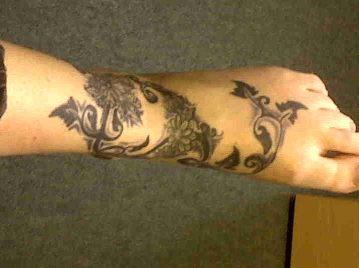
For my blog this week I thought I’d follow up on @charlottejdann’s blog on tattoos and add some personal experiences to the discussion. The media certainly have had their part to play in the negative connotations surrounding tattoos and the types of people with them, however I question the extent to which the media influence those perceptions today. Based purely on my own experience and opinion I believe that tattoos have become relatively common and as we saw in Charlotte’s blog the rise in tattoo studios would certainly seem to support this assumption. In fact, I think a process of normalisation has occurred whereby it is more surprising when someone hasn’t got a tattoo than when they have. Furthermore, the negative connotations and ‘expressed shock’ at the increase in tattooing is, in my humble opinion, typically associated to those of the older, more traditional generation for whom tattooing was a symbol of deviance, rebellion and/or disrepute.
I got my first tattoo when I was just 14; a small black panther discreetly placed on my thigh. My choice of phrase here is not accidental, being just 14 and below the age of legal consent the placement of this tattoo had to be discrete to hide it from my mother. The intentional law breaking and deception of this act would certainly look like deviance to an outside observer. Since then I added two more tattoos to my collection and have another one planned for the near future. Reflecting on this notion of deviance and my own motivation I arrive at a number of conclusions. My first tattoo was, without doubt, an act of rebellion against the expectations placed upon me by family and peers to be a ‘good girl’ and a ‘high achiever’. I don’t in any way regret that tattoo but I can recognise the reason for getting it. My second tattoo was more daringly placed on my upper arm and in hindsight was not thought through or carefully picked but at the same time it was not an act of rebellion. Those of you with tattoos may understand when I say that getting tattoos is like an addiction, you either love them or hate them but once you’ve got one, you want more. It was this ‘addiction’ so to speak that led to my second tattoo. My third tattoo which covers my foot and spreads up my ankle, symbolises the changing direction of my life after the birth of my first child and is by far my favourite to date. In short, the meaning or motivation for each tattoo has shifted over time reflecting my growth as a person and my life experiences.
At the point of my third tattoo I’d entered the world of academia and was establishing my professional identity; an identity that was in some ways at odds with my tattooed body. Wearing a professional suit and heels with a tattoo on my foot and ankle certainly led to some raised eyebrows and disapproving looks from older colleagues. This reaction was nothing compared to the openly disapproving judgements I later encountered from fellow magistrates; not only was I young to be a magistrate but I was also tattooed and had the audacity to display them in court! Linking this reaction back to my earlier statement about deviance, rebellion and disrepute, the simplest thing would be for me to wear a trouser suit in court and hide my tattoos, in essence, conforming to societies expectations of that position. However, my reasons for not doing so are twofold, firstly I am a bit of rebel at heart and secondly, I do not see my tattoos as an act of deviance but one of self-expression. In all other areas of life, I conform to the norms and values of society, I have a career and present myself as a professional, I’m trying to raise my children to be good law-abiding citizens, I pay my bills on time, I put out my rubbish when asked and I try to treat others with compassion and respect. In short, I’ve joined the collective, blended into society and accepted the expectations of me as a woman, a mother, a daughter and so forth. My tattoos therefore are a reflection of self-expression, my little rebellious side that says, “I’m more than one of the collective, I’m an individual”. Each tattoo reflects my journey, where I have come from, what I have experienced, who I am and where I am going. They tell the reader that I am more than just a number, I am an individual embracing self-expression through body art because to me tattoos are not just ink, they are pieces of art symbolising your life journey. For this reason, I agree with Charlotte’s argument that tattooed people cannot be stereotyped as a homogeneous group because tattoos by their very nature make us unique individuals.
Share this:


Perceptions of tattooed bodies

Charlotte Dann is a psychology lecturer in the Faculty of Health and Society, researching women’s tattooed bodies. You can find out more and get in touch via Twitter – @CharlotteJD
Whenever I discuss my tattoo research, I always frame it historically, because I think it’s important to consider how we have come to the point we are at with how tattoos are perceived and understood. And you know, it’s good for a laugh.
In the late 1800s, Lombroso researched deviancy and criminality, and as part of this, came to the conclusion that people who had tattoos were criminals and prostitutes. However, this research was conducted on – you guessed it – criminals and prostitutes. Despite the poor correlation that was presented, his research was influential in how we perceive deviancy and deviant bodies, to the point that those negative connotations towards tattooed bodies still ring true today. Tattoos may be ever rising in popularity (figures indicated one in five has a tattoo, and the number of studios rose by around 170% in the last decade in the UK), but tattooed bodies can still be found to be associated with deviancy.
Let’s consider the influence of the media in this. Over the past few years, there has been a flurry of articles that express shock for the fact that ‘normal’ people are getting tattoos, and why tattoos are becoming more popular for women. It only takes a quick gander at the comments left on these articles to see that public opinion hasn’t changed that much, and that these articles perpetuate negative perceptions about tattoos (i.e. they’re not meant for ‘normal’ people). Newspaper articles such as this often make reference to the ‘normal’ people who are now adorning their bodies – normal being white, middle-class, ‘respectable’ people. The narrative of such newspaper articles often seems to rely on a discourse that positions tattooing as the proper domain of ‘the other’, associated with deviant, problematised, and generally male bodies. Newspaper articles often reflect a certain moral panic about the rise of tattoos among so called ‘normal’ people, whilst at the same time, normalise the practice of tattooing itself.
The media does not do a good job in quelling negative connotations regarding tattooed people, as they tend to focus more on the extremes – the eye-catching headlines, the things that make you wince and tut, not the everyday person who is tattooed. In recent years, newspapers have reported on tattooed teachers as being ‘inappropriate’ for children, on young adults who get cheap ‘joke’ tattoos on holidays in Magaluf, and present morality tales such as those who regret their tattoo choices. In addition, they also frame our understandings of ‘who’ this ‘normal’ tattooed person is (look – even Samantha Cameron and David Dimbleby have them!)
I think what we need to do is question the idea of what a ‘normal’ body is, and really think about the assumptions we make about that body based on frankly outdated perceptions. There is no longer one particular type of person who is tattooed – the availability and accessibility of tattoo studios, designs, and techniques, has meant that you cannot stereotype all tattooed people as one homogenous group.
Share this:


Just good business or theft?

In October the Citizens Advice Bureau published a report about overcharging by mobile phone companies for mobile phones (CAB 2017). In short, a mobile phone contract usually includes the price of the mobile phone as well as the service. ‘Many people take out a mobile phone contract with the cost of the new handset included in the overall price of the fixed term deal – the majority of which are paid off on a monthly basis for a period of 2 years’ (CAB 2017). The companies often notify the consumer that the contract is coming to an end and offer an upgrade and new contract. If you are too busy or forgetful or naïve and leave the contract running, you will continue to pay for the phone even though it is paid up. According to CAB this can be as much as £38 a month.
Now consider this scenario, you enter a shop and hand over £10 for goods purchased and receive change for £20. Realising the mistake, you pocket the money despite having knowledge of the mistake.
Sections 1-7 of the Theft Act 1968 are very clear and Section 1 states:
“(1) A person is guilty of theft if he dishonestly appropriates property belonging to another with the intention of permanently depriving the other of it; and “thief” and “steal” shall be construed accordingly.
(2) It is immaterial whether the appropriation is made with a view to gain, or is made for the thief’s own benefit.
Section 5 is also very clear in defining whether property belongs to another and subsection 4 states:
Where a person gets property by another’s mistake, and is under an obligation to make restoration (in whole or in part) of the property or its proceeds or of the value thereof, then to the extent of that obligation the property or proceeds shall be regarded (as against him) as belonging to the person entitled to restoration, and an intention not to make restoration shall be regarded accordingly as an intention to deprive that person of the property or proceeds.”
In the case of the wrong change being provided at the shop, it is very clear that theft has occurred. So why not so for mobile phone overcharging? It is clear that you have handed over more money than you should through your bank account and this is an error, unless of course you wanted to pay more for your phone than it’s worth. The company keeps the money, knowing that they have overcharged you. Does that not sound like theft too? I don’t think a contract is worded in such a way that you give permission to be overcharged, nor can the company rely on the fact that the contract represents the whole package, otherwise how else would they maintain a pricing differentiation between different models? Maybe they can argue that all transactions are automated and therefore nobody forms any intent. To the latter I would suggest to those that are overcharged, ask for your money back from a person in the company and when they refuse…. Is it good business or theft?
Citizens Advice Bureau (2017) Mobile phone networks overcharging loyal customers by up to £38 a month, [online] available at www.citizensadvice.org.uk/about-us/how-citizens-advice-works/media/press-releases/ [accessed 24 November 2017].

 Thoughts from the criminology team