
Home » Criminal Justice System (Page 6)
Category Archives: Criminal Justice System

Within Grey Walls

“Waking up to gray walls and black bars…in the silence of ones own thoughts, leaves one to a feeling of somberness…as those around begin to stir and began their individual day, hope creeps into ones mind….as the discussions regarding legal strategies began, hope then becomes more than just a shadow…as guys began to discuss their potential future beyond prison and being locked in a cell for days at a time, hope becomes more than just a fleeting moment! Silence can sometimes be ones own enemy on death row:-…So I condition myself to discover the “why” I fight through the fits of depression and despair, instead of focusing on the “how’s”….because pursuit of the “why’s” bring about methods of finding a solution….encouragement to remain hopeful!”
Everyone has the right to life, liberty and security of person (1).
Without the right to life, we cannot enjoy the freedoms set forth in the Universal Declaration of Human Rights.
However, what if one’s life was imprisoned and waiting to be ended for crime? In addition, what if a person was to be put to death for associating with a particular demographic?
The death penalty is the authorization of the state to kill a citizen for a crime, whether it’s murder, rape, treason, or more severe crimes, such as crimes against humanity and genocide (2).
Whilst the death penalty can be a deterrent, provide justice, and be the ultimate punishment for a crime and justice for victims, it is also used in some countries to persecute minority groups, such as the LGBT community (3) (4). (In references, there is a link to an interactive map of countries that utilize the death penalty for LGBT groups).
According to the Death Penalty Information Centre (DPIC), around 82% of cases involving capital punishment, race was a determining factor of giving this punishment, in comparison to white counterparts (5). However, the justice system is far from perfect, and miscarriages of justice occur. Due to issues of racism and racial bias (particularly within the American Justice System), this has seen members of minority groups and innocent people put on death row whilst a criminal still walks free. A damning example of a miscarriage of justice, and a clear demonstration of racism, is the case of George Stinney, whom, at the age of 14, was wrongly accused of murdering 2 girls. He was taken to court, tried by an all white jury, and was given the electric chair (6).
This, ultimately, is the state failing to protect its citizens, and causing irreparable damage to others. The George Stinney case is a condemnatory example of this. On top of that, it is hard to measure deterrence, and whether capital punishment actually deters people from committing crime.
However, what is it actually like being on death row?
June 2017 saw the start of a new friendship – a unique friendship. What simply started out with me wanting to reach out and be a ray of light to someone on death row, turned into a wonderful experience of sharing, support and immeasurable beauty. In June 2017, I began writing to a man on death row, and simply wanted to be a ray of light to someone in a dark place.
He has shared some of his thoughts of what it is like to be on death row:
“Perseverance. This is key when facing a day in prison (physically and mentally) because is never “where” you are physically, but your ability and willingness took push through those times of adversity and overcome the very things that have the power to bring you down….such as evil”. BUT- when we examine the word “evil” look closely…. Do you see it yet? ….. It’s “LIVE” backwards and to me its when we lose our patience to “LIVE” that we have brushes with “evil”…no???? So within these walls I do my best to find the “silver lining” and develop the better aspects of me”.
Now, it may seem effortlessly -but- in all honestly….its very difficult to face each day with the uncertainty of knowing whether the presence I have is one that has significance….in here I have to prepare myself on a constant basis in order to be the best version of myself no matter what lays ahead.
Thankfully….I have met an incredible person, who guides me by way of her words…offers me comforts by way of her thoughts and prayer and encourages me through her never ending presence! She is beautiful in every aspect of the word…She has helped me to discover that EVERYTHING and NOTHING awaits beyond forever!
References
(1) Universal Declaration of Human Rights (UNDH) Article 1 Available online at: https://www.un.org/en/universal-declaration-human-rights/ Accessed on 21/01/2020
(2) Louise Gaille ’15 Biggest Capitol Pros and Cons’ Available online at: https://vittana.org/15-biggest-capital-punishment-pros-and-cons Accessed on 24/03/2020
(3) The Human Dignity Trust ‘Saudi Arabia: Types of Criminalisation’ Available online at: https://www.humandignitytrust.org/country-profile/saudi-arabia/ Accessed on 24/03/2020
(4) Death Penalty Information Centre ‘Executions By Race and Race of Victim’ Available online at: https://deathpenaltyinfo.org/executions/executions-overview/executions-by-race-and-race-of-victim
(5) Ibid
(6) Snopes Fact Check ‘Did South Carolina Execute 14-year-old George Stinney, then declare him innocent 70 years later?’ Available online at: https://www.snopes.com/fact-check/george-stinney-execution-exoneration/ Accessed on 24/03/2020
Other
Interactive map of countries where the death penalty is used against the LGBT community: https://www.humandignitytrust.org/lgbt-the-law/map-of-criminalisation/?type_filter=crim_gender_exp
Human Writes: https://www.humanwrites.org
Share this:


Hypocrites or just human?

At a time of a significant religious festival in the Christian calendar and at a time of global anxiety, sacrifice and distress, it seems apt to reflect on where we stand in it all.
Like most, I watch the television, listen to the radio, tap into social media (albeit only on limited occasions), receive emails and listen to family, friends and colleagues.
I am amazed by the sacrifice that some people make to protect or look after others and yet dismayed by the actions and comments of some. And yet as I ponder on the current situation I realise that it only brings into focus behaviours, actions and comments that were already there. Perhaps, the circumstances have allowed some to shine or provided more of a focus on those that already do outstanding things, and this is a good thing but human nature as it is, doesn’t really change. Here are a few examples, I’m sure if you reflect on these you will think of more.
- We lament at the inequality in the world, but we do little about it. Instead, we fight to buy up all the toilet rolls that we can, lest we run out.
- We complain the government haven’t done enough in the current crisis and then flout the guidelines they gave us on social gatherings and movement or cause others to do so (did you really need that Amazon order?)
- We complain about our work conditions, but we are content for the company or organisation to continue paying us, often saying they don’t pay us enough
- We are upset by colleagues who do us a disservice and then denigrate others because of their so-called ineptitude
- We complain about being bullied but go on to display the same bullying behaviours that we complained about
- We call people misogynistic but then in the same breath suggest that the world would be better without men or that women do a better job
- We accuse people of being racist but then use derogatory and stereotypical language to describe those that we accuse
- We condemn those that we see as privileged and suggest they should give up their wealth and status. And yet we fail to consider our own privilege and are not prepared to give up what we have (see the first comment re inequality)
- We see the criminal justice system as unfair but would be the first to complain if we were a victim of crime and the offender wasn’t brought to justice. What we see as justice is dependent on the impact the wrongful act has on us
- We commit crimes, albeit perhaps minor ones or committed crimes when we were younger and didn’t know better, yet we castigate others for being criminal. Welfare cheats are awful, but tax payments are to be avoided
I could go on, but I think by now you get the general idea. I’ll return to religion if I may, not that I’m religious, but I did start off the blog with an acknowledgement of the timing in line with the Christian calendar: “He that is without sin among you, let him cast the first stone at her”, (John, 8:7). Maybe we should be a little more honest with ourselves and think about what we say or do before we judge and condemn others. I do wonder though, are we all hypocrites, or is it part of the pathology of just being human?
Share this:

The Ho Stro’ (A quick peek at a little sex work) #BlackAsiaWithLove

The original, unofficial Ho Stro’ theme song. Play this while reading (see below).
Sitting on the curb of a busy road along the railroad track.
Wearing a mini skirt with your legs spread, bent over
Scratching your wig with one of your long fire-engine red fingernails, while
Reaching in your purse for the matching lipstick.
It’s half past midnight, the night is young.
4 women on the Ho Stro’ between the railroad track, a busy road, and a giant city park.
Hoes stroll day and night.
I’ve been on my way to work, or
Watching the sunrise on my way home from clubbing,
Rain or shine,
These hoes are inline
On time.
Scattered along the railroad track facing the park,
Sometimes 1 by 1, sometimes in twos;
And an elderly woman within eyeshot.
I’ve seen a crack head or two, too,
Trying to push herself up to any mens passing by.
Crack or smack,
I’m not sure what these hoes do,
But I know it’s whack.
Frail, emaciated, veins popping and tattered.
They rarely cross the road and venture along the train track.
Over here it’s wide open,
The hoes along the track roam in packs…
Whereas the park side of the stroll provides the crack heads some cover.
For a while, I resisted knowing that these women were hoes.
But one evening,
A couple of hoes showed up at my favorite Beef Noodle joint as I sat for dinner.
All cheery and bubbly,
Dressed for a night out.
Greeting everyone that comes in as you do in your neighborhood joint*
One of the ladies came over towards me, all bubbly and cheery,
Stretched out and unfolded her hands as if she were about to offer me something,
Then jabbed her index finger in-and-out of… you get it.
Yes, THAT universal gesture,
Though it didn’t seem lude coming from her, over a bowl of Pho.
I politely declined, they placed their orders and sat down.
Hoes gotta eat, too.
In my after-dinner walks around the lake,
I have to watch out when I reach the long, straight, tree-lined stretch along the track.
There, there’s nothing but cars parked,
And tea stalls at both ends.
Hoes tend to congregate right in the middle.
Pulling tricks.
No man gets by unsolicited.
It’s as if the bright fire-red were their signal.
Fire-engine red lipstick and false nails to match.
Sometimes a matching skirt, purse and shoes, too.
It’s loitering, but
Soliciting men, too.
The men know where to find them, these hoes are always there.
Street crawlers know where to find them.
Rush hour or late-night,
Early morning, and absolutely at high noon…
Women can’t loiter.
Just look at how we treat women who are not even in the trade.
Meanwhile, men and boys in most parts of the world can hang out anywhere, anytime.
Men are much freer at this level of corporeal control and bodily integrity –
In public and private space.
Although I’d argue that we teach boys to disintegrate into the night.
This is exactly the breach that’s reached here.
These hoes stroll.
There is a Ho Stro’ in every city I know!
Pimps, hookers, hoes, tricks, johns and everybody in between can see.
Who do the law-keepers claim are the criminals?
Hey mister, have you got a dime?
Mister: Voulez-vous coucher avec moi ce soir?
—
*I’ve only lived here a half a year, so I’m sure this is their hood; I’m new to the party.
NB: Ho Stro’ or whore stroll is an American southern vernacular term – the first term I learned as a kid – for a red-light district. PLEASE, do not look up Ho Stroll on YouTube but if you must this one from LA is HILARIOUS And please, seriously, don’t bother looking up words for the clients of female sex workers.
Share this:


“TW3” in Criminology

In the 1960s, or so I am told, there was a very popular weekly television programme called That Was The Week That Was, informally known as TW3. This satirical programme reflected on events of the week that had just gone, through commentary, comedy and music. Although the programme ended before I was born, it’s always struck me as a nice way to end the week and I plan to (very loosely) follow that idea here.
This week was particularly hectic in Criminology, here are just some of the highlights. On Monday, I was interviewed by a college student for their journalism project, a rather surreal experience, after all, ‘Who cares what I think?’
On Tuesday, @manosdaskalou and I, together with a group of enthusiastic third years, visited the Supreme Court in London. This trip enabled a discussion which sought to unpack the issue of diversity (or rather the lack of) within justice. Students and staff discussed a variety of ideas to work out why so many white men are at the heart of justice decisions. A difficult challenge at the best of times but given a new and urgent impetus when sat in a courtroom. It is difficult, if not impossible, to remain objective and impartial when confronted with the evidence of 12 Supreme Judges, only two of which are women, and all are white. Arguments around the supposed representativeness of justice, falter when the evidence is so very stark. Furthermore, with the educational information provided by our tour guide, it becomes obvious that there are many barriers for those who are neither white nor male to make their way through the legal ranks.

Wednesday saw the culmination of Beyond Justice, a module focused on social justice and taught entirely in prison. As in previous years, we have a small ceremony with certificate presentation for all students. This involves quite a cast, including various dignitaries, as well as all the students and their friends and family. This is always a bittersweet event, part celebration, part goodbye. Over the months, the prison classroom leaves its oppressive carceral environment behind, instead providing an intense and profound tight-knit learning community. No doubt @manosdaskalou and I will return to the prison, but that tight-knit community has now dissipated in time and space.

On Thursday, a similarly bitter-sweet experience was my last focused session this year on CRI3003 Violence: From Domestic to Institutional. Since October, the class has discussed many different topics relating to institutional violence focused on different cases including the deaths of Victoria Climbié, Blair Peach, Jean Charles de Menezes, as well as the horror of Grenfell. We have welcomed guest speakers from social work, policing and the fire service. Discussions have been mature, informed and extremely sensitive and again a real sense of a learning community has ensued. It’s also been my first experience of teaching an all-female cohort which has informed the discussion in a variety of meaningful ways. Although I haven’t abandoned the class, colleagues @manosdaskalou and @jesjames50 will take the reins for a while and focus on exploring interpersonal violence. I’ll be back before the end of the academic year so we can reflect together on our understanding of the complexity of violence.
Finally, Friday saw the second ever #BigCriminologyQuiz and the first of the new decade. At the end of the first one, the participants requested that the next one be based on criminology and music. Challenge completed with help from @manosdaskalou, @treventoursu, @svr2727, @5teveh and @jesjames50. This week’s teams have requested a film/tv theme for the next quiz so we’ll definitely have our work cut out! But it’s amazing to see how much criminological knowledge can be shared, even when you’re eating snacks and laughing. [i]

So, what can I take from my criminological week:
- Some of the best criminological discussions happen when people are relaxed
- Getting out of the classroom enables and empowers different voices to be heard
- Getting out of the classroom allows people to focus on each and share their knowledge, recognising that
- A classroom is not four walls within a university, but can be anywhere (a coach, a courtroom a prison, or even the pub!)
- A new environment and a new experience opens the way for discord and dissent, always a necessity for profound discussion within Criminology
- When you open your eyes and your mind you start to see the world very differently
- It is possible (if you try very hard) to ignore the reality of Friday 31 January 23:00 ☹
- It is possible to be an academic, tour guide, mistress of ceremonies and quiz mistress, all in the same week!
Here’s looking forward to next week….not least Thursday’s Changemaker Awards where I seem to have scored a nomination with my #PartnerinCriminology @manosdaskalou.
[i] The first quiz was won by a team made up of 1st and 2nd years. This week’s quiz was won by a group of third years. The next promises to be a battle royale 😊 These quizzes have exposed, just how competitive criminologists can be….
Share this:


20 years of Criminology

It was at the start of a new millennium that people worried about what the so-called millennium will do to our lives. The fear was that the bug will usher a new dark age where technology will be lost. Whilst the impending Armageddon never happened, the University College Northampton, as the University of Northampton was called then, was preparing to welcome the first cohort of Criminology students.
The first cohort of students joined us in September 2000 and since then 20 years of cohorts have joined since. During these years we have seen the rise of University fees, the expansion of the internet and google search and of course the emergence of social media. The original award was focused on sociolegal aspects, predominantly the sociology of deviance, whilst in the years since the changes demonstrate the departmental and the disciplinary changes that have happened.
Early on, as criminology was beginning to find its voice institutionally, the team developed two rules that have since defined the focus of the discipline. The first is that the subject will be taught in a multi-disciplinary approach, widely inclusive of all the main disciplines involved in the study of crime; so alongside sociology, you will find psychology, law, history, philosophy to name but a few. The impetus was to present these disciplines on an equal footing and providing opportunity to those joining the course, to discover their own voice in criminology. The second rule was to give the students the opportunity to explore contentious topics and draw their own perspective. Since the first year of running it, these rules have become the bedrock of UoN Criminology.
The course since the early years has grown and gone through all those developmental stages, childhood, adolescence and now eventually we have reached adulthood. During these stages, we managed to forge a distinctiveness of what criminology looks like; introducing for example a research placement to allow the students to explore the theory in practice. In later years we created courses that reflect Criminology in the 21st Century always relating to the big questions and forever arming learners with the skills to ask the impossible questions.
Through all these years students join with an interest in studying crime and by the time they leave us, to move onto the next chapter of their lives, they have become hard core criminologists. This is always something that we consider one of the course’s greatest contribution to the local community.
In an ordinary day, like any other day in the local court one may see an usher, next to a probation officer, next to a police officer, next to a drugs rehabilitation officer, all of them our graduates making up the local criminal justice system. A demonstration of the reach and the importance of the university as an institution and the services it provides to the local community. More recently we developed a module that we teach in prison comprised by university and prison students. This is a clear sign of the maturity and the journey we have done so far…
As the 21st century entered, twin towers fell, bus and tube trains exploded, consequent wars were made, riots in the capital, the banking crisis, the austerity, bridge attacks, Brexit, extinction rebellion, buildings burning, planes coming down, forest fires and #metoo, and we just barely cover 20 years. These and many more events keep criminological discourse relevant, increase the profile of the subject and most importantly further the conversation we are having in our society as to where we are heading.
As I raise my glass to salute the first 20 years of Criminology at the University of Northampton, I am confident that the next 20 years will be even more exciting. For those who have been with us so far a massive thank you, for those to come we are looking forward to discussing some of the many issues with you. We are passionate about criminology and we want you to infect you with our passion.
As they say in prison, the first 20 years are difficult the rest you just glide through…
Share this:


Stop Protecting the #PervertPrince

In the past six months, I have been reflecting on recent stories that have hit media headlines. Although these topics are extremely important, in my opinion not enough “meaningful” discussion has been had. I’m referring to the sexual exploitation of children – the power imbalance, that powerful men within society have abused and have seeming got away with. I start with Jeffrey Epstein.
Although he was convicted of sexual crimes against children, his conviction is one of deceit. The American justice system let down his victims, disguising the severity of his crimes, allowing him to continue his abuse of power on vulnerable children. He was not charged with paedophilia or rape, the US legal system thought it would be fitting to charge him with solicitation of minors for prostitution.

There are various things that are problematic with this, but one of the biggest problems for me is using minors and prostitution in the same sentence. It annoys me that we tend to view our society as progressive and yet we still label children as prostitutes, forgetting that there is a legal age of consent and no child can be a prostitute as they cannot give consent, as much as the law would suggest. This is reminiscent of the Rotherham sex ring, where police labelled minors as prostitutes, forgetting that they are victims of coercion, exploitation and rape. This ideology quickly moves the emphasis away from the perpetrators of crime while negatively impacting the victim. It is time that we have compassion for the victims of such awful crimes and move away from labelling and blaming.
It makes my blood boil that people have the audacity to argue that the US legal systems failings can be used as an outlet of blame for the relationship that Epstein, Prince Andrew and President Clinton had. Lady Colin Campbell stated that if the US legal system had been more transparent Clinton and the shamed Prince would have made better judgements on their friendship with him. She and others have come to this defence of the ‘upper crust,’ using the American justice system failings as a crutch for their wrongdoings.
Although some may agree with her, I must highlight some glaring points that should be raised, before she states such ludicrous statements – such as: Prince Andrew and Bill Clinton’s advisors would have done thorough background checks on Epstein. This would have identified his crimes and his monstrous ways. They would have disclosed the information that was flagged to them and then warned them against forming relationships with the known predator. If these men had any shred of decency, then they would have kept a distance.
My conclusion as to why they did not, is because they feel they are above the law and do not have to conform to the norms that the rest of society subscribes too. It is all about money and status to them, if you are not one of them, you are not human. This notion was visible when Prince Andrew had his very uncomfortable interview with Emily Maitlis. During the interview he never displayed any kind of remorse for the victims. He didn’t even mention them or their harm. He used phrases like Epstein engaged in activity that is unbecoming rather than condemning his actions and showing any kind of emotion. This reaction, or lack of, has only stretched his credibility. He blazingly lied throughout the interview and his actions have made him look like a bumbling pervert.

Even though Prince Andrew has demonstrated a lack of morality, the biggest discussion that surrounds this entity is whether he should step down from his royal duties. It seems everyone forgets that he has shown a lack of compassion, he has been pictured with young girls who have accused him and Epstein of violating them. But being a prince trumps all these facts, as he is let off lightly.
He is rich and powerful, and like Epstein, their status has sheltered them from real-world consequences. Epstein is now deceased, but it was all on his terms and once again the victimisation of children has been overshadowed by the circumstances of how he died. The salacious topic of how he managed to commit suicide and whether he was murdered is now big news. As for Prince Andrew, I cannot imagine he will be found guilty and he will not speak publicly about this topic again. Some may demand answers, but he will be protected from any real justice.
It is time that we start opening our eyes and acknowledging the victims of these crime. It is time to make it known that just because you are royalty, a billionaire or a socialite you are not above the law. We need to fight for the voiceless in our society, against the people who abuse their power and stop making excuses for them.
Share this:


Friday the 13th

Odd thing superstition, it makes reasonable and seemingly rational people think and behave in the most irrational and inexplicable manner. Always we notice these behaviours and thoughts in other people, but so many of us carry in the back of our minds equally irrational ideas and beliefs. We hear of football club managers who always wear the same clothes at a game, athletes that engage in the same pre-game routine and of course, politicians who act in certain ways during their election campaign. For the rest of us there are ladders in the street, black cats, that we may avoid or there are dates in the calendar that we take notice. Friday the 13th is one of those Anglo-Saxon dates that people take notice of.
I am sure that some of my historian friends will be able to give a good account of the origin of the unfortunate date, but I can only go with the “official tradition” of Jesus, the 13th student, (Judas) and his subsequent arrest on the Friday before the Crucifixion. The day, somehow, became one of those that we notice, even when we are not superstitious. There is even a psychologically recognised fear of the date Triskaidekaphobia; which in Greek means the fear of 13! Of course social fears are blended with wider social anxieties, whether that is the fear of the unknown or the realisation that in life, there are things that we have little control of.
In the days leading up to this Friday the 13th we engaged with political discussions about what direction the country shall take. The health service, the justice system, the state’s responsibility, all the way to welfare and the state of the union, were all eclipsed by one topic that has dominated discourses, that of the execution of leave from the European Union commonly known as Brexit. Ironically the “exit” preface was used before for Greece (Grexit), and Italy (Italexit) but seems that Brexit has won the battle of the modern lexicon. The previous “exits” where used as a cautionary tale for the countries being forced out of the union, whilst Brexit is about leaving the Union.
Having considered all the issues, this one issue became the impetus for people to give politicians a mandate. Complete this issue before and above all the rest. It is an issue likened to a divorce, given a texture, (soft/hard) and has even been seen as the reason for generational conflicts. Therefore the expectation is clear now . Leave the European Union, and then let’s see what we can do next. The message is fairly clear and the expectation is palpable. Beliefs and hopes of the people narrowed down to one political move that shall terminate membership to the European Union. Of course there are subsequent questions and issues that this act of national defiance may come with. As for the state of the Union, that may have to be the next thing we discuss. This follow up conversation may not be as welcome, but it is definitely interesting. If joining the EU back in 1975, warranted a discussion, then the 1536 Act of Union may become the next topic for conversation. As for healthcare, justice, education and welfare, we may have to wait a little bit more longer. Whether this will mark Friday 13th December 2019 as a date of fortune or misfortune, that is yet to be decided, but that is the same for every day of the week.
Just for your records and for the Triskaidekaphobians out there, the next Friday the 13 is in March 2020 followed by the one in November 2020. Just saying…
Share this:


Empathy Amid the “Fake Tales of San Francisco”*

This time last week, @manosdaskalou and I were in San Francisco at the American Society of Criminology’s conference. This four-day meeting takes place once a year and encompasses a huge range of talkers and subjects, demonstrating the diversity of the discipline. Each day there are multiple sessions scheduled, making it incredibly difficult to choose which ones you want to attend.
Fortunately, this year both of our two papers were presented on the first day of the conference, which took some of the pressure off. We were then able to concentrate on other presenters’ work. Throughout discussions around teaching in prison, gun violence and many other matters of criminological importance, there was a sense of camaraderie, a shared passion to understand and in turn, change the world for the better. All of these discussions took place in a grand hotel, with cafes, bars and restaurants, to enable the conversation to continue long after the scheduled sessions had finished.
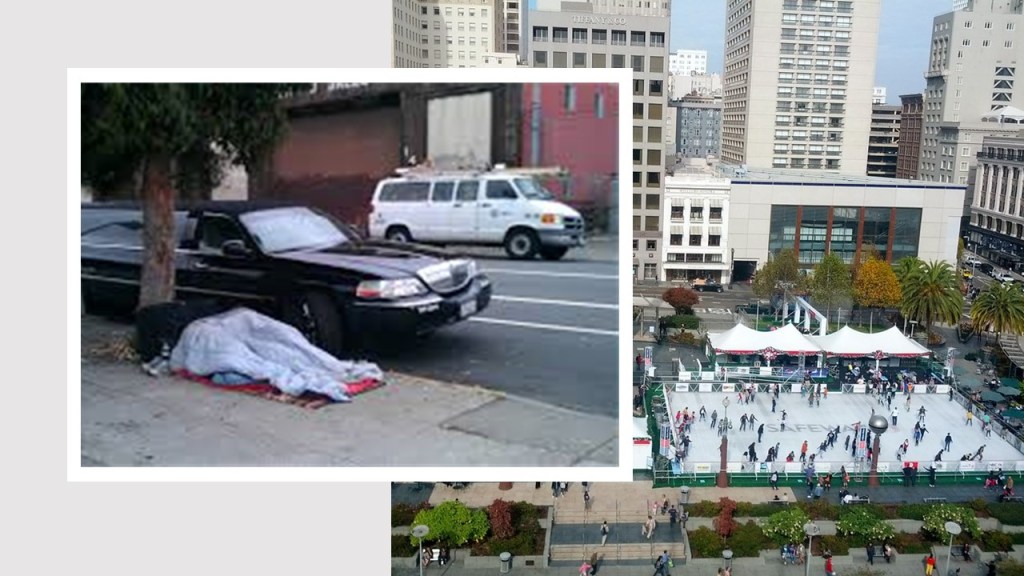
Outside of the hotel, there is plenty to see. San Francisco is an interesting city, famous for its Golden Gate Bridge, the cable cars which run up and down extraordinarily steep roads and of course, criminologically speaking, Alcatraz prison. In addition, it is renowned for its expensive designer shops, restaurants, bars and hotels. But as @haleysread has noted before, this is a city where you do not have to look far to find real deprivation.
I was last in San Francisco in 2014. At that point cannabis had been declassified from a misdemeanour to an infraction, making the use of the drug similar to a traffic offence. In 2016, cannabis was completely decriminalised for recreational use. For many criminologists, such decriminalisation is a positive step, marking a change from viewing drug use as a criminal justice problem, to one of public health. Certainly, it’s a position that I would generally subscribe to, not least as part of a process necessary to prison abolition. However, what do we really know about the effects of cannabis? I am sure my colleague @michellejolleynorthamptonacuk could offer some insight into the latest research around cannabis use.
When a substance is illegal, it is exceedingly challenging to research either its harms or its benefits. What we know, in the main, is based upon problematic drug use, those individuals who come to the attention of either the CJS or the NHS. Those with the means to sustain a drug habit need not buy their supplies openly on the street, where the risk of being caught is far higher. Thus our research population are selected by bad luck, either they are caught or they suffer ill-effects either with their physical or mental health.
The smell of cannabis in San Francisco is a constant, but there is also another aroma, which wasn’t present five years ago. That smell is urine. Furthermore, it has been well documented, that not only are the streets and highways of San Francisco becoming public urinals, there are also many reports that public defecation is an increasing issue for the city. Now I don’t want to be so bold as to say that the decriminalisation of cannabis is the cause of this public effluence, however, San Francisco does raise some questions.
- Does cannabis cause or exacerbate mental health problems?
- Does cannabis lead to a loss of inhibition, so much so that the social conventions around urination and defecation are abandoned?
- Does cannabis lead to an increase in homelessness?
- Does cannabis increase the likelihood of social problems?
- Does the decriminalisation of cannabis, lead to less tolerance of social problems?
I don’t have any of the answers, but it is extremely difficult to ignore these problems. The juxtaposition of expensive shops such as Rolex and Tiffany just round the corner from large groups of confused, homeless people, make it impossible to avoid seeing the social problems confronted by this city. Of course, poor mental health and homelessness are not unique to San Francisco or even the USA, we have similar issues in our own town, regardless of the legal status of cannabis. Certainly the issue of access to bathroom facilities is pressing; should access to public toilets be a right or a privilege? This, also appears to be a public health, rather than CJS problem, although those observing or policing such behaviour, may argue differently.
Ultimately, as @haleysread found, San Francisco remains a City of Contrast, where the very rich and the very poor rub shoulders. Unless, society begins to think a little more about people and a little less about business, it seems inevitable that individuals will continue to live, eat, urinate and defection and ultimately, die upon the streets. It is not enough to discuss empathy in a conference, no matter how important that might be, if we don’t also empathise with people whose lives are in tatters.
*Turner, Alex, (2006), Fake Tales of San Francisco, [CD]. Recorded by Arctic Monkeys in Whatever People Say I Am, That’s What I’m Not, The Chapel: Domino Records
Share this:


Care Leavers, Criminal Justice and Higher Education

“These children are in our care; we, the state, are their parents- and what are we setting them up for…the dole, the streets, an early grave? I tell you: this shames our country and we will put it right.”
David Cameron MP, Prime Minister October 2015 at the Conservative Party Conference.
Well, I think it would be fair to say that politicians’ minds have not been exercised unduly over the fate of care leavers since David Cameron made the above promise in 2015. I worked with children in care and care leavers involved in the youth justice system for over thirty years and although his analysis of the outcomes for care leavers was simplistic and crude, tragically Cameron’s statement rings true for many of those leaving care.
With regard to the criminal justice system, Lord Laming’s independent review “In Care, Out of Trouble” http://www.prisonreformtrust.org.uk/Portals/0/Documents/In%20care%20out%20of%20trouble%20summary.pdf, notes that there is no reliable data on the numbers of looked after children in custody. However, based on data from a number of sources, the review came to the conclusion that around 400 looked after children are in custody at any one time. The total number of children in custody for July 2019 is 817. So, slightly less than half of those children in custody are looked after children according to the best estimates available, drawn from different sources. http://youthjusticeboard.newsweaver.co.uk/yots2/1g2x6m3h9q315chudc9elc?email=trueYJBulletin
Moving the spotlight, a huge 40% of care leavers are not engaged in Education, Training or Employment and only 6% of care leavers gain entry to university https://assets.publishing.service.gov.uk/government/uploads/system/uploads/attachment_data/file/464756/SFR34_2015_Text.pdf . This at a time when around 50% of children now have access to Higher Education and the opportunities that this can provide. Also, 20% of young people who are homeless have previously been in care.
Naturally, we have to be careful to provide a level of balance to the above rather desperate and shocking figures. Lord Laming’s review found that 94% of children in care did not get in trouble with the law. However, children in care are six times more likely to be cautioned, or convicted of an offence than children in the wider population. Furthermore, children in care who come to police attention are more likely to be prosecuted and convicted than cautioned when compared to the wider child population.
So, what has happened since 2015 when David Cameron declared his intention to “put it right”? In truth, there have been some steps forward and these need to be celebrated and built upon. The Care Leaver Covenant, a promise made by private, public or voluntary organisations to provide support for care leavers aged 16-25 has meant the availability of employment opportunities for young care leavers in the Civil Service, local authorities and a range of private sector organisations. Closer to home, here at the University of Northampton, we have launched a new package of support for care leavers who want to study with us. The package offers the possibility, from 2020, of a fully funded place in our Halls of Residence for the first academic year, a contract which extends their accommodation lease to include the summer vacation. A block for many care leavers entering Higher Education is the very real issue of where to live at the end of the academic year, so this tries to address this issue. Another block experienced is financial hardship; the offer provides a non-means tested financial award of up to £1,500 per year to help with course and living costs, and this alongside the local authority’s statutory responsibility to support access to higher education may also help. We also have a designated member of support staff to provide advice and guidance. All these demonstrate our commitment to widening participation and encouraging ambition.
Of course, this is only part of the picture. Arguably, our engagement with young people in care needs to start shortly after their transition to secondary school. The wider social structures which perpetuate disadvantage and poverty will continue to challenge those who are children in care and leaving care. The “adverse childhood experiences” – a rather unedifying term for physical, sexual, and emotional abuse perpetrated by carers or parents-will still have an impact for this group and potentially impair their ability or commitment to study.
If however, I learnt anything from my years working with children in care and children leaving care, it is that you should not underestimate their ability to overcome the obstacles placed in their way. With the right support and a child centred approach, education can provide the right framework for opportunities. Victor Hugo famously said that if you open a school door, you close a prison. Let’s kick open the door of Higher Education a little wider and increase the life chances of these children in OUR care.
As a footnote, I should say that my mum was in care from the age of four until she was fifteen when she was adopted. I would therefore be happy to acknowledge that this has some influence on my perspective and my interest in this group of young people.
Dave Palmer Lecturer in Criminal Justice Services
Share this:


You can’t tell me what to do….

It seems that much criminological discussion centres on motivation. This ranges from focusing on the motivation to commit crime, the motivation to report victimisation, the motivation to work within the criminal justice system, all the way though to the motivation for punishment. In each of these circumstances, much is taken for granted, assumed and reacted to as if there were a consensus.
However, how much do we really know about motivation? To be sure, there are plenty of criminological theories focusing on individual explanations for criminality and deviance, particularly around psychopathy, personality and biology. Others, such as Classical theory assume that we are all the same, rational creatures motivated by the same factors. But take a moment and consider what motivates you? Are those factors positive or negative?
Let’s take the prison for example. According to some politicians, the media and other commentators, incarceration can punish and rehabilitate, frighten people out of crime whilst also empowering them to move away from crime. It offers an opportunity to desist from drug taking, whilst simultaneously enabling prisoners to develop a drug habit. Prison can offer a haven from social problems on the outside, whilst also creating a dangerous environment on the inside and these are just a few of the many pronouncements on the prison. Although oppositional, these differing narratives all indicate the prison as a place of change; transformation, the only difference is whether this is positive or negative, in essence does prison make people better or worse?
Considering much of the blog’s readership is focused on education, it might be useful to apply the prison experience to our own personal motivations. Would it be helpful to have someone constantly telling you what to do? Escorting you to and from the toilet, the classroom, the workplace? Controlling your every move? Deciding when and what you eat? Determining if you can access a shower, the library, the gym and so on? Passing judgement on who can visit you and when they can come? Would these “motivational” factors inspire you to study more? What if you were locked in a very small room (think student accommodation) for hour upon end, would your essays be any better?
For me personally, all of the above, would not motivate; they might frighten or even terrify me. They would allow me to feel resentful, bitter, alienated, perhaps even aggressive. Maybe I would become depressed, self-harm, or turn to drugs for consolation. Maybe, I could retreat into studying as release from an oppressive regime, but is that motivation? or escapism? or even institutionalisation?
I wonder, surely there must be far better, less harmful ways of tapping into motivation? By looking at our own experiences and considering what has motivated us in a positive way previously, we can begin to consider how we might motivate ourselves and others. Some of the motivational factors I can identify from my own life include, people who are prepared to listen to my ideas (good and bad) without interrupting, to guide (but not tell, never tell!) me to finding solutions to problems and to treat me with dignity and respect. Other examples, include introducing me to important literature, but not batting an eyelid when I excitedly tell them all about the content. Being there for me as a fellow human regardless of status (perceived or otherwise), when everything is a challenge, and I just want to vent and celebrating all successes (however tiny). These are just a few, personal reflections, but what they have in common, is the focus on another human who matters to you, who is cheering you on from the side-lines and is able to empathise and encourage. The other commonality, of course, is that these factors are not entrenched within the prison or the wider criminal justice system.[1]
Have a think for yourself and see if you can find anything currently within the prison or CJS that would motivate you! If it doesn’t, you need to question what it is the prison is actually trying to achieve.
[1] This does not preclude individual positive interpersonal relationships within the prison or CJS, but it is not a primary function of either.

 Thoughts from the criminology team