
Home » Conviction
Category Archives: Conviction

UK Justice v The Demonic and Others

The sanctity of a civilised court room demands rationality, but the laws of the distant and not so distant past in this jurisdiction are entrenched in the uncanny. Rules safeguarding the impartiality of the jury are grim “wards” against the spiritual chaos that once dictated verdicts. The infamous case of the Ouija Board jurors, aka R v Young[i] only thirty years ago is not merely a legal curiosity: it is a modern chilling echo of a centuries old struggle defining the judiciary’s absolute commitment to a secular process that refuses to share its authority with the spectral world. The ancient rule, now applied to Google and the smartphone, has always been simple: the court cannot tolerate a decision derived from an unvetted external source.
When Law Bowed To The Supernatural-Ancient Past?
For millennia, the outcome of a criminal trial in Britain was terrifyingly dependent on the supernatural, viewing the legal process as a mechanism for Divine Judgement[ii]. The state feared the power of the otherworldly more than it trusted human evidence.
Prior to the 13th century, the determination of guilt was not based on evidence but on the Judicium Dei [iii](Judgement of God). The accused’s fate lay not with the court but with the elements of the earth itself.
The Ordeal of Hot Iron: The accused would carry a piece of red-hot iron. If their subsequent wound was judged “unclean” after three days-a sign of God withholding his grace-the accused was condemned to death. The burden of proof was literally placed upon a miracle.
The Ordeal of Cold Water: This was an essential test in early witch-finding. If the bound accused floated, the pure water was thought to reject them as impure agents of the Devil, condemning them as guilty. The collapse of these ordeals after the Fourth Lateran Council in 1215 was the first, forced act of separation between the secular law and the spiritual realm, necessitating the creation of a human, rational jury[iv]
Legislating against the Demonic: The Witchcraft Acts
Even after the rise of the jury, the judiciary was consumed by the fear of the demonic. The Act against Conjuration, Witchcraft and dealing with evil and wicked Spirits 1604 (1 Jas.4 1. c. 12)[v] made contacting the demonic a capital felony, ensuring that the courtroom remained a battleground against perceived occult evil.
The Pendle Witch Trials (1612): This event is a spectral stain on UK legal history. Ten people were executed based on testimony that included spectral evidence, dreams, and confessions extracted under duress. The judges and juries legally accepted that the Devil and his agents had caused tangible harm. The failure to apply any rational evidential standards resulted in judicial murder.[vi]
Even the “rational” repeal in the Witchcraft Act 1735 (9 Geo. 2. c. 5),[vii] which only criminalised pretending to use magic (fraud), haunted the system. The prosecution of medium Helen Duncan in 1944 under this very Act, for deceiving the public with her spiritualist services, demonstrated that the legal system was still actively policing the boundaries of the occult well into the modern era, fearful of supernatural deceit if not genuine power.
The Modern Séance: R v Young and the Unholy Verdict
The 1994 murder trial of Stephen Young[viii], accused of the double murder of Harry and Nicola Fuller, brought the full weight of this historical conflict back into the spotlight. The jury, isolated and burdened with the grim facts of the case, succumbed to an uncanny primal urge for absolute certainty.
The jury had retired to a sequestered hotel to deliberate the grim facts of the double murder.During a break in deliberations on the Friday night, four jurors initiated a makeshift séance in their hotel room. They used paper and a glass to fashion a crude Ouija board, placing their life-altering question to the “spirits” of the deceased victims, Harry and Nicola Fuller.
The glass, according to the jurors’ later testimony, moved and chillingly spelled out the words “STEPHEN YOUNG DONE IT.”
The Court of Appeal, led by Lord Taylor CJ, ruled that the séance was a “material irregularity” because it took place outside the official deliberation room (in the hotel). This activity amounted to the reception of extrinsic, prejudicial, and wholly inadmissible evidence after the jury had been sworn. The verdict was quashed because a system based on proof cannot tolerate a decision derived from ‘the other side’
The core rule remains absolute: the verdict must be based only on the facts presented in court. The modern threat to this principle is not possession by a demon, but digital contamination, a risk the law now treats as functionally identical to the occult inquiry of 1994.
The Digital Contamination: R v Karakaya[ix]
The Criminal Justice and Courts Act 2015 (CJCA 2015) was the formal legislative “ward” against the digital equivalent of the séance.
The New Medium: In the 2018 trial of Huseyin Karakaya, a juror used a mobile phone to research the defendant’s previous conviction. The smartphone became the unauthorised medium. The Legal Equivalence: The Juries Act 1974, s 20A (inserted by CJCA 2015)[x] makes it a criminal offence for a juror to intentionally research the case. In the eyes of the law, consulting Google for “defendant’s past” is legally equivalent to consulting a ghost for “who done it.” Both are dangerous acts of unauthorized external inquiry.
The Court of Appeal, in R v Karakaya quashed the conviction because introducing external, inadmissible evidence (like a prior conviction) created a real risk of prejudice, fundamentally undermining the fair trial principle raised in Young.
The lesson of the Ouija Board Jurors and the digital contamination in R v Karakaya is a chilling warning from the past: the moment the courtroom accepts an external, unverified source—be it a spirit or a search engine—the entire structure of rational justice collapses, bringing back the judicial catastrophe of the Pendle Trials. In 2025, the UK criminal justice system continues to fight the ghosts of superstition, ensuring the verdict is determined by the cold, impartial scrutiny of the facts.
[i] R v Young [1995] QB 324
[ii]R Bartlett, Trial by Fire and Water: The Medieval Judicial Ordeal (Oxford University Press 1986). (https://amesfoundation.law.harvard.edu/lhsemelh/materials/BartlettTrialByFireAndWater.pdf)
[iii] J G Bellamy, The Criminal Law of England 1066–1307: An Outline (Blackwell 1984) p42
[iv] Margaret H. Kerr, Richard D. Forsyth, Michael J. Plyley
The Journal of Interdisciplinary History, Vol. 22, No. 4 (Spring, 1992), pp. 573-595
[v] https://archives.blog.parliament.uk/2020/10/28/which-witchcraft-act-is-which/
[vi] https://www.historic-uk.com/CultureUK/The-Pendle-Witches/
[vii] Witchcraft Act 1735 (9 Geo. 2. c. 5) https://statutes.org.uk/site/the-statutes/eighteenth-century/1735-9-george-2-c-5-the-witchcraft-act/
[viii] R v Young [1995] QB 324
[ix] R v Karakaya[ 2020] EWCA Crim 204
[x]The Juries Act 1974, s 20A https://www.legislation.gov.uk/ukpga/1974/23/section/20A
Share this:


Leading with Integrity: Standing Firm Against the Echo Chamber

Sallek Yaks Musa
Truth hurts. Few appreciate it, and even fewer defend it when it threatens comfort or convention. My understanding of this reality came through personal experience, an early lesson in leadership that continues to shape how I view authority and the dangerous allure of sycophancy.
Two decades ago, my journey into education began in an unusual way. For five years, my father had spoken passionately about his dream to establish a nursery, primary, and secondary school that would help transform the state of education in our city. In 2004, we finally decided to bring that dream to life. What followed was both the beginning of my passion for education and my first encounter with the complexity of leading people and institutions.
The process of establishing the school was neither smooth nor simple. I remember every detail – the struggle to develop infrastructure that met required standards and equip it, the endless paperwork, the defence of proposals before career bureaucrats, and the scrutiny of regulatory inspections. Each stage tested our patience and resolve, yet the experience became invaluable. It offered me lessons no textbook could teach and laid the solid foundation of my leadership philosophy.
By the time we received approval to open in September 2005, I led over a hundred interviews to staff the school. That period sharpened my ability to read people and situations intuitively, a skill I have trusted ever since. The school went on to succeed beyond expectation: self-sustaining, thriving, and impacting tens of thousands of young lives. Yet, behind this success lay one central principle – truth.
My commitment to truth shaped the school’s ethos. Every decision, from recruitment to remuneration, from board meetings to relationships with parents and staff, was guided by sincerity. My academic training would later frame this conviction in philosophical terms. With leadership, I align with Auguste Comte’s positivist epistemology, rooted in the belief that truth is objective, concrete, and independent of social interpretation. This, I discovered, is easier preached than practised.
In practice, truth is disruptive. It offends vanity, challenges comfort, and exposes deception. My insistence on it often placed me in direct opposition to others on the Board, including my father. He later confided that while my defiance was difficult to bear, it forced him to confront realities he had overlooked. I further learned that the defender of truth often stands alone. My father eventually recognised what I had resisted all along: the quiet but corrosive power of flattery.
Sycophancy, though rarely discussed openly, remains one of the greatest dangers to leadership. It thrives where authority is unquestioned, and dissent discouraged. Flattery seduces leaders into believing they are infallible. It builds an echo chamber that filters information, reinforcing biases and creating an illusion of competence. Over time, this isolation from reality becomes costly as decisions are made on false premises, honest critics are sidelined, and mediocrity is rewarded over merit. But this is not a modern affliction.
The 16th-century political theorist Niccolò Machiavelli, in The Prince, warned rulers of this very danger. He cautioned that the wise Prince must deliberately surround himself with people courageous enough to speak the truth, for flatterers ‘take away the liberty of judgment.’ Centuries later, the philosopher Hannah Arendt would echo this concern, arguing that the loss of truth in public life leads to moral decay and political collapse. The persistence of these warnings shows how deeply entrenched sycophancy remains in systems of power.
The psychology behind flattery is deceptively simple. It feeds the ego, providing comfort that masquerades as respect and support. Leaders, craving affirmation, often mistake it for loyalty. But as Daniel Kahneman and other cognitive theorists have shown, human judgment is easily distorted by bias and praise. Flattery, therefore, becomes not merely a social nicety but a psychological trap, one that blinds decision-makers to inconvenient truths.
For those newly stepping into student’s course representative roles, these lessons carry special relevance. Academic leadership is often less about authority and more about stewardship, the quiet work of creating conditions where ideas can flourish, student’s voices are heard, and students can contribute honestly. Resist the temptation to surround yourself with agreeable voices. Encourage critique, invite dissent, and create a culture where questioning is not perceived as confrontation but as commitment to excellence. The strength of representation lies not in the leader’s popularity but in their willingness to confront complexity, admit limits, and make decisions grounded in truth rather than convenience.
As the once “baby school” turned twenty this year, its anniversary passed in my absence. My father’s message of appreciation reached me nonetheless, and his words reminded me why truth, though often costly, remains indispensable to authentic leadership. He wrote:
Remember, son, true leadership lies in listening attentively, sieving facts from noise, embracing unpopular voices, acting on truth, and valuing others above yourself.
That reflection closed a circle that began two decades ago. It reminded me that leadership rooted in truth is not about being right but about being realistic. It is about creating space where honesty thrives, even when it unsettles.
Flattery may offer short-term peace, but truth builds long-term strength and relationships. The leader who welcomes honesty, however uncomfortable, not only guards against failure but also nurtures a culture of integrity that outlives their term.
Twenty years after that first bold step into education, leading teams and managing academic programmes in education, I remain convinced that truth is not a luxury in leadership – it is its lifeline. Legacies are not defined by applause or position, but by the integrity to lead with sincerity, listen without fear, and act with unwavering commitment to what is right. People are ultimately remembered not for simply opposing flattery, but for the truth they championed and the courage they demonstrated to stand firm in their convictions when it mattered most.
Share this:


#UONCriminologyClub: What should we do with an Offender? with Dr Paula Bowles

You will have seen from recent blog entries (including those from @manosdaskalou and @kayleighwillis21 that as part of Criminology 25th year at UON celebrations, the Criminology Team have been engaging with lots of different audiences. The most surprising of these is the creation of the #UONCriminologyClub for a group of home educated children aged between 10-15. The idea was first mooted by @saffrongarside (who students of CRI1009 Imagining Crime will remember as a guest speaker this year) who is a home educator. From that, #UONCriminologyClub was born.
As you know from last week’s entry @manosdaskalou provided the introductions and started our “crime busters” journey into Criminology. I picked up the next session where we started to explore offender motivations and society’s response to their criminal behaviour. To do so, we needed someone with lived experience of both crime and punishment to help focus our attention. Enter Feathers McGraw!!!
At first the “crime busters” came out with all the myths: “master criminal” and “evil mastermind” were just two of the epithets applied to our offender. Both of which fit well into populist discourse around crime, but neither is particularly helpful for criminological study, But slowly and surely, they began to consider what he had done (or rather attempted to do) and why he might be motivated to do such things (attempted theft of a precious jewel). Discussion was fast flowing, lots of ideas, lots of questions, lots of respectful disagreement, as well as some consensus. If you don’t believe me, have a look at what Atticus and had to say!
We had another excellent criminology session this week, this time with Dr Paula Bowles. I think we all had a lot of fun, I personally could have enjoyed double or triple the session time. Dr Bowles was engaging, fun and unpretentious, making Criminology accessible to us whilst still covering a lot of interesting and complex subjects. We discussed so many different aspects of serious crime and moral and ethical questions about punishment and the treatment of criminals. During the session, we went into some very deep topics and managed to cover many big ideas. It was great that everyone was involved and had a lot to say. You might not necessarily guess from what I’ve said so far, how we got talking about Criminology in this way. It was all through the new Aardman animations film Wallace and Gromit: Vengeance Most Fowl and the cheeky little penguin or is it just a chicken? Feathers McGraw. Whether he is a chicken or a penguin, he gave us a lot to discuss such as whether his trial was fair or not since he can’t talk, if the zoo could really be counted as a prison and, if so was he allowed to be sent there without a trial? Deep ethical questions around an animation. Just like last time it was a fun and engaging lesson that made me want to learn more and more and I can’t wait for next time. (Atticus, 14)
What emerged was a nuanced and empathetic understanding of some key criminological debates and questions, albeit without the jargon so beloved of social scientists: nature vs. nurture, coercion and manipulation of the vulnerable, the importance of human rights, the role of the criminal justice system, the part played by the media, the impetus to punish to name but a few. Additionally, a deep philosophical question arose as to whether or not Aardman’s portrayal of Feathers’ confinement in a zoo, meant that as a society we treat animals as though they are criminals, or criminals as though they are animals. We are all still pondering this particular question…. After deciding as group that the most important thing was for Feathers to stop his deviant behaviour, discussions inevitably moved on to deciding how this could be achieved. At this point, I will hand over to our “crime busters”!
What to do with Feathers McGraw?
At first, I thought that maybe we should make prison a better place so that he would feel the need to escape less. It wouldn’t have to be something massive but just maybe some better furniture or more entertainment. Also maybe make the security better so that it would be harder to break out. If we imagine the zoo as the prison, animals usually stay in the zoo for their life so they must have done some very bad stuff to deserve a life sentence! Is it safe to have dangerous animals so close to humans? Feathers McGraw might get influenced by the other prisoners and instead of getting better he might get more criminal ideas. I believe there should be a purpose-built prison for the more dangerous criminals, so they are kept away from the humans and the non-violent criminals. in this case is Feathers considered a violent or non-violent criminal? Even though he hasn’t killed anyone, he has abused them, tried to harm them, hacked into Wallace’s computer, vandalised gardens through the Norbots, and stole the jewel. So, I think we should get a restraining order against Feathers McGraw to stop him from seeing Wallace and Gromit. I also think we should invest in therapy for Feathers to help him realise that he doesn’t need to own the jewel to enjoy it, what would he even do with it?! Maybe socializing could also help to maybe take his mind of doing criminal things. He always seems alone and sad. I’m not sure whether he will be able to change his ways or not but I think we should do the best we can to. (Paisley, 10)
I think in order to stop Feathers McGraw’s criminal behaviour, he should go to prison but while he is there, he should have some lessons on how to be good, how to make friends, how to become a successful businessman (or penguin!), how to travel around on public transport, what the law includes and what the punishments there are for breaking it etc. I also think it’s important to make the prisons hospitable so that he feels like they do care about him because otherwise it might fuel anger and make him want to steal more diamonds. At the same time though, it should not be too nice so that he’ll think that stealing is great, because if you don’t get caught, then you keep whatever you stole and if you do get caught then it doesn’t matter because you will end up staying in a luxury cell with silky soft blankets.
After he is released from prison, I would suggest he would be held under house arrest for 2-3 months. He will live with Wallace and Gromit and he will receive a weekly allowance of £200. With this money, he will spend:
£100 – Feathers will pay Wallace and Gromit rent each week,
£15-he will pay for his own clothes,
£5-phone calls,
£10-public transport,
£35-food,
£5-education,
£15-hygiene,
£15- socialising and misc.
During this time, Feathers could also be home educated in the subjects of Maths, English etc. He should have a schedule so he will learn how to manage his time effectively and eventually should be able to manage his timewithouta schedule. The reason for this is because when Feathers was in prison, he was told what to do every day and at what time he would do it. He now needs to learn how to make those decisions by himself. This would mean when his house arrest is finished, he can go out into the real world and live happy life without breaking the law or stealing. (Linus, 13)
I think that once Feathers McGraw has been captured any money that he has on him will be taken away as well as any disguises that he has and if he still has any belongings left they will be checked to see whether he can have them. After that he should go to a proper prison and not a Zoo, then stay there for 3 months. Once a week, while he is in prison a group of ten penguins will be brought in so that he can be socialised and learn manners and good behaviour from them. However they will be supervised to make sure that they don’t come up with plans to escape. After that he will live with a police officer for 3 years and not leave the house unless a responsible and trustworthy adult accompanies him until he becomes trustworthy himself. He will be taught at the police officers house by a tutor because if he went to school he might run away. Feathers McGraw will have a weekly allowance of £460 that is funded by the government as he won’t have any money. Any money that was taken away from him will be given back in this time. Any money left over will be put into his savings account or used for something else if the money couldn’t quite cover it.
In one week he will give
£60 for fish and food
£10 for travel
£50 for clothing but it will be checked to make sure that it isn’t a disguise.
£80 for the police officer that looking after him
£15 for necessities (tooth brush, tooth paste, face cloth etc…)
£70 for his tutor
£55 for education supplies
£20 will be put in a savings account for when he lives by himself again.
And £100 for some therapy
After 1 year if the police officer looking after him thinks that he’s trustworthy enough then he can get a job and use £40 pounds a week (if he earns manages to earn that much.) as he likes and the rest of it will be put into his savings account. Feathers McGraw will only be allowed to do certain jobs for example, He couldn’t be a police officer in case he steals something that he’s guarding, He also couldn’t be a prison guard in case he helped someone escape etc… If at any point he commits another crime he will lose his freedom and his job and will be confined to the house and garden. When he lives by himself again he will have to do community service for 1 month. (Liv, 11).
Feathers McGraw has committed many crimes, some of which include attempted theft, abuse towards Wallace and Gromit, and prison break.
Here are some ideas of things that we can do to stop him from reoffending:
Immediate action:
A restraining order is to be put in place so he can’t come within 50m of Wallace and Gromit, for their protection both physical and mental. Penguins live for up to 20 years so seeing as he is portrayed as being an adult, my guess is he is around 10 years old. His sentence should be limited to 2 years in prison. Whilst serving his sentence he should be given a laptop (with settings so that he can’t use it to hack) so he can write, watch videos, play games and learn stuff.
Longer term solutions:
When Feathers gets out he will be banned from seeing the gem in museums so there will be less chance of him stelling it. He also will be given some job options to help him get started in his career. His first job won’t be front facing so Wallace and Gromit won’t have to be worried and they will get to say no to any job Feathers tries to get. If he reoffends, he will be taken to court where his sentence will be a minimum of 5 years in prison.
Rehabilitation:
I think Feathers should be given rehabilitation in several different forms, some sneakier than others! One of these forms is probation: penguins which are trained probation officers who will speak to him and try to say that crime is not cool. To him they will look like normal penguins, he won’t know that they have had training. He also should be offered job experience so he can earn a prison currency which he can use to buy upgrades for his cell (for example a better bed, bigger tv, headphones, an mp3 player and songs for said mp3 player) to give him a chance to get a job in the future. (Quinn, 12)
The “crime busters” comments above came after reflecting on our session, their input demonstrates their serious and earnest attempt to resolve an extremely complex issue, which many of the greatest minds in Criminology have battled with for the last two centuries. They may seem very young to deal with a discipline often perceived as dark, but they show us an essential truth about Criminology, it is always hopeful, always focused on what could be, instead of tolerating what we have.
Share this:


Is Easter relevant?

What if I was to ask you what images will you conjure regarding Easter? For many pictures of yellow chicks, ducklings, bunnies, and colourful eggs! This sounds like a celebration of the rebirth of nature, nothing too religious. As for the hot cross buns, these come to our local stores across the year. The calendar marks it as a spring break without any significant reference to the religion that underpins the origin of the holiday. Easter is a moving celebration that observers the lunar calendar like other religious festivals dictated by the equinox of spring and the first full moon. It replaces previous Greco-Roman holidays, and it takes its influence for the Hebrew Passover. For those who regard themselves as Christians, the message Easter encapsulates is part of their pillars of faith. The main message is that Jesus, the son of God, was arrested for sedition and blasphemy, went through two types of trials representing two different forms of justice; a secular and a religious court which found him guilty. He was convicted of all charges, sentenced to death, and executed the day after sentencing. This was exceptional speed for a justice system that many countries will envy. By all accounts, this man who claimed to be king and divine became a convicted felon put to death for his crimes. The Christian message focuses primarily on what happened next. Allegedly the body of the dead man is placed in a sealed grave only to be resurrected (return from the death, body and spirit) roamed the earth for about 40 days until he ascended into heavens with the promise to be back in the second coming. Christian scholars have been spending time and hours discussing the representation of this miracle. The central core of Christianity is the victory of life over death. The official line is quite remarkable and provided Christians with an opportunity to admire their head of their church.
What if this was not really the most important message in the story? What if the focus was not on the resurrection but on human suffering. The night before his arrest Jesus, according to the New Testament will ask “Father, if thou be willing, remove this cup from me” in a last attempt to avoid the humiliation and torture that was to come. In Criminology, we recognise in people’s actions free will, and as such, in a momentary lapse of judgment, this man will seek to avoid what is to come. The forthcoming arrest after being identified with a kiss (most unique line-up in history) will be followed by torture. This form of judicial torture is described in grim detail in the scriptures and provides a contrast to the triumph of the end with the resurrection. Theologically, this makes good sense, but it does not relate to the collective human experience. Legal systems across time have been used to judge and to punish people according to their deeds. Human suffering in punishment seems to be centred on bringing back balance to the harm incurred by the crime committed. Then there are those who serve as an example of those who take the punishment, not because they accept their actions are wrong, but because their convictions are those that rise above the legal frameworks of their time. When Socrates was condemned to death, his students came to rescue him, but he insisted on ingesting the poison. His action was not of the crime but of the nature of the society he envisaged. When Jesus is met with the guard in the garden of Gethsemane, he could have left in the dark of the night, but he stays on. These criminals challenge the orthodoxy of legal rights and, most importantly, our perception that all crimes are bad, and criminals deserve punishment.
Bunnies are nice and for some even cuddly creatures, eggs can be colourful and delicious, especially if made of chocolate, but they do not contain that most important criminological message of the day. Convictions and principles for those who have them, may bring them to clash with authorities, they may even be regarded as criminals but every now and then they set some new standards of where we wish to travel in our human journey. So, to answer my own question, religiosity and different faiths come and go, but values remain to remind us that we have more in common than in opposition.
Share this:


It’s different now… it happened to me
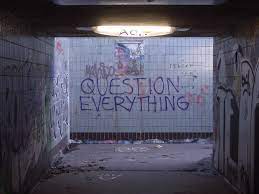
A few weeks ago, @paulaabowles shared an article on the Criminology Facebook page which posed the question of whether graffiti is art or crime. My response was art. And like all art, not all variations, interpretations or styles are for everyone. I know I can look at some graffiti and be quite taken aback at the brightness, boldness and creativity which shines through. I can also look at some and go ‘eugh’. However I have the same reactions to various classical and well-known pieces. My unrefined self does not get all the hype about a number of Picasso’s works (possibly all the ones I have seen). Nevertheless this is the beauty of art: it is down to individual taste.
So for me, I was fairly certain on my opinions and convictions towards graffiti as an art form, and as an example of the CJS further stigmatising and criminalisation young people’s behaviours: something I am certain we are all quite familiar with at this stage in our criminological journey. However those beliefs and informed views were put to the test over the Bank Holiday (BH) Weekend, and in all honesty I think I am still trying to get to grips with them. It is different now…. It happened to me.
Some context: as those of you who have read various blog posts from myself will no doubt remember, my partner runs a small kiosk near one of the Royal Parks in London. Often during the weekends and summer months, I provide an extra pair of hands to help clean and serve during the busier periods. And as a result of the pandemic, my partner finds themselves going from a team of 4 down to just them, and me when I am able to support: this was the case for the BH Weekend. Off we popped, down to London for a day of serving hotdogs, drinks and ice creams. However our day was thrown off course by some ‘ugly’ graffiti all over the front of the kiosk.
My partner was angry, and felt personally attacked (not really sure by who- but guess that’s besides the point). It is not the first time the kiosk has had graffiti on it, but it is the first time I have seen it in person and witnessed my partner’s response. Rather than starting our working day and opening up, we had to clean the graffiti off. My partner set to this: just over 3 hours later some of it has been removed, but so has some of the kiosk’s paint. It looks a mess. We are now at midday and we cannot afford to remain closed and keep cleaning. We have lost 3 hours of trading time to try and remove it, only to remove some of it and some of the kiosk’s paint. I am informed that we shall need to go to B&Q to try and find some graffiti remover: Capitalism wins again! But seeing my partner cleaning for 3 hours, losing the trading hours and for this end result: I can’t help but feel angry, frustrated and in want of some kind of justice. It’s different now… it happened to me.
But what realistically would justice be in the scenario? What do I actually want as a result? I have no idea. I asked my partner who said they just wanted them ‘not to do it’. It is private property, will my partner call the police? Nope: just nuisance annoying behaviour, but not much anyone can do about it. I feel less inclined to call it art. I like my partner’s use of ‘nuisance’ behaviour: it feels very accurate. I do not think my partner was targeted, I think it was available as a surface to be used for that individual or individuals to express themselves. But I am shaken in my previously held convictions. Shouldn’t something be done. We lost 3 hours of trading, the kiosk now needs to be repainted and we shall need to purchase some graffiti remover. All for some expression of ‘art’? Shouldn’t there be some kind of repercussion?
I am not too sure. I also know when this has happened before, and I have not been present to witness the impact it has on my partner and the kiosk I have been very nonchalant about it. ‘Oh dear, that’s frustrating’, ‘ah well, never mind’. But being there and seeing it: I view it differently. And this is something many of us come to grips with when considering hypothetical moral situations and larger ethical questions. We think we will act one way, but if it happened to us: it is quite possible our opinions, informed views and beliefs would change. I still think graffiti is art, but I am not so convinced in my previous assertation that it is not a crime…

Share this:


Betty Broderick

I’m sure many of you are aware of the Dirty John series two, Betty Broderick. Although it has not had as much coverage as I’d have hoped. Now true crime documentaries are not always the best way to find out the truth, after delving deep into the history of this case, I found it does represent it well. If you haven’t given it a watch, I would definitely recommend it and would love to know your thoughts on the case.
Betty was married to Daniel Broderick, having 4 children and helping him become a doctor and then through law school. Of course, it all ended in 1989 when Betty had finally had enough of the torturous years with her husband’s affair with Linda Kolkena, killing them both. Not that I am condoning what she did at all, it was wrong for her to end his and Linda’s life. Although I do understand why she did do it and believe others in her situation could be led to this end too. After she kept them afloat with money while he went through law school, having his children and being the perfect housewife, he decided she was too old and needed a young wife to suit his new high class life-style.
This is not to say that Daniel was the sole person to blame, Betty was in the wrong too. However, taking a woman’s children away from her and brainwashing them tipped her over the edge, as it would do with many women. Betty brought the children up alone, with Daniel always too busy with his company to care about them. It seems Daniel did love Betty to begin with, but to me, it seems it became easy and stayed with her to do everything for him.
Daniel began socialising with his new girlfriend, rubbing his success in Betty’s face. This really does make me sad for Betty, she had no money because all her time was invested in her husband’s career. When it came to the divorce, it became a game for Daniel, trying to leave her with next to nothing and only supervised visits with her own children. He really did drive her to the point of destruction.
This woman is now 72 and has been in prison since 1989. I may be too generous, but I believe that this woman should be let to live her final years as a free woman. Free from having to fight for her children, fight for money to live and fight for her sanity. Daniel took all these away from her. And, although he did not get to live, Betty merely existed in the years of their divorce. She lost her spark and became depressed.
What do you believe?
Share this:


A month of Black history through the eyes of a white, privileged man… an open letter

Dear friends,
Over the years, in my line of work, there was a conviction, that logic as the prevailing force allows us to see social situations around (im)passionately, impartially and fairly. Principles most important especially for anyone who dwells in social sciences. We were “raised” on the ideologies that promote inclusivity, justice and solidarity. As a kid, I remember when we marched as a family against nuclear proliferation, and later as an adult I marched and protested for civil rights on the basis of sexuality, nationality and class. I took part in anti-war marches and protested and took part in strikes when fees were introduced in higher education.
All of these were based on one very strongly, deeply ingrained, view that whilst the world may be unfair, we can change it, rebel against injustices and make it better. A romantic view/vision of the world that rests on a very basic principle “we are all human” and our humanity is the home of our unity and strength. Take the environment for example, it is becoming obvious to most of us that this is a global issue that requires all of us to get involved. The opt-out option may not be feasible if the environment becomes too hostile and decreases the habitable parts of the planet to an ever-growing population.
As constant learners, according to Solon (Γηράσκω αεί διδασκόμενος)[1] it is important to introspect views such as those presented earlier and consider how successfully they are represented. Recently I was fortunate to meet one of my former students (@wadzanain7) who came to visit and talk about their current job. It is always welcome to see former students coming back, even more so when they come in a reflective mood at the same time as Black history month. Every year, this is becoming a staple in my professional diary, as it is an opportunity to be educated in the history that was not spoken or taught at school.
This year’s discussions and the former student’s reflections made it very clear to me that my idealism, however well intended, is part of an experience that is deeply steeped in white men’s privilege. It made me question what an appropriate response to a continuous injustice is. I was aware of the quote “all that is required for evil to triumph is for good men to do nothing” growing up, part of my family’s narrative of getting involved in the resistance, but am I true to its spirit? To understand there is a problem but do nothing about it, means that ultimately you become part of the same problem you identify. Perhaps in some regards a considered person is even worse because they see the problem, read the situation and can offer words of solace, but not discernible actions. A light touch liberalism, that is nice and inclusive, but sits quietly observing history written in the way as before, follow the same social discourses, but does nothing to change the problems. Suddenly it became clear how wrong I am. A great need to offer a profound apology for my inaction and implicit collaboration to the harm caused.
I was recently challenged in a discussion about whether people who do not have direct experience are entitled to a view. Do those who experience racism voice it? Of course, the answer is no; we can read it, stand against it, but if we have not experienced it, maybe, just maybe, we need to shut up and let other voices be heard and tell their stories. Black history month is the time to walk a mile in another person’s shoes.
Sincerely yours
M
[1] A very rough translation: I learn, whilst I grow, life-long learning.
Share this:


A Love Letter: in praise of art

Some time ago, I wrote ‘A Love Letter: in praise of poetry‘, making the case as to why this literary form is important to understanding the lived experience. This time, I intend to do similar in relation to visual art.
Tomorrow, I’m plan to make my annual visit to the Koestler Arts’ Exhibition on show at London’s Southbank Centre. This year’s exhibition is entitled Another Me and is curated by the musician, Soweto Kinch. Previous exhibitions have been curated by Benjamin Zephaniah, Antony Gormley and prisoners’ families. Each of the exhibitions contain a diverse range of unique pieces, displaying the sheer range of artistic endeavours from sculpture, to pastels and from music to embroidery. This annual exhibition has an obvious link to criminology, all submissions are from incarcerated people. However, art, regardless of medium, has lots of interest to criminologists and many other scholars.
I have never formally studied art, my reactions and interpretations are entirely personal. I reason that the skills inherent in criminological critique and analysis are applicable, whatever the context or medium. The picture above shows 4 of my favourite pieces of art (there are many others). Each of these, in their own unique way, allow me to explore the world in which we all live. For me, each illustrate aspects of social (in)justice, social harms, institutional violence and the fight for human rights. You may dislike my choices. arguing that graffiti (Banksy) and photography (Mona Hatoum) have no place within art proper. You may disagree with my interpretation of these pieces, dismissing them as pure ephemera, forgotten as quickly as they are seen and that is the beauty of discourse.
Nonetheless, for me they capture the quintessential essence of criminology. It is a positive discipline, focused on what “ought” to be, rather than what is. To stand small, in front of Picasso’s (1937) enormous canvas Guernica allows for consideration of the sheer scale of destruction, inherent in mechanised warfare. Likewise, Banksy’s (2005) The Kissing Coppers provides an interesting juxtaposition of the upholders of the law behaving in such a way that their predecessors would have persecuted them. Each of the art pieces I have selected show that over time and space, the behaviours remain the same, the only change, the level of approbation applied from without.
Art galleries and museums can appear terrifying places, open only to a select few. Those that understand the rules of art, those who make the right noises, those that have the language to describe what they see. This is a fallacy, art belongs to all of us. If you don’t believe me, take a trip to the Southbank Centre very soon. It’s not scary, nobody will ask you questions, everyone is just there to see the art. Who knows you might just find something that calls out to you and helps to spark your criminological imagination. You’ll have to hurry though…closes 3 November, don’t miss out!
Share this:


Corrosive substances – A knee-jerk reaction or a sensible solution?

Following the apparent growth in acid attacks the suggestion from Amber Rudd on a potential means of tackling the problem has all the markings of another knee-jerk policy that lacks careful planning and application. The proposal is to restrict the sales of corrosive substances and introduce new, specific legislation for possession and use of such substances against another person. The justification for these suggestions is based on the doubling of attacks between 2012 and 2016-17. Furthermore a 6 month review by National Police Chiefs Council (NPCC) report 400 acid or corrosive substance attacks between October 2016 and April 2017. The impact of such attacks is long lasting and without question, a horrific life changing experience, however is this reaction the right one for all concerned?
The plan to ban the sale of corrosive substances to under 18s in itself may be a sensible idea, if there is careful consultation on what substances are to be included in this blanket approach. A similar approach already exists with the sale of knives, tobacco and alcohol yet the extent to which these policies are a success is a moot point. Policing such an approach will also be considerably challenging because there is currently no clear outline of what the government intends to class as a corrosive substance. If the suggestions that bleach will be on the list then this may prove very difficult, if not impossible to police. Many of the corrosive substances being used today are household names readily available in most local shops and supermarkets, not to mention the internet. When purchasing items subject to restriction on the internet, the only check of age is you clicking a button to confirm it and maybe adding a date of birth, neither of which are particularly secure.
Taking this a step further the other suggestion is the creation of a new offence; possession of a corrosive substance in a public place. Such legislation is modelled on legislation already used to tackle knife offences and offensive weapons whereby a prison sentence of upto 4 years can be issues for possession, with intent to carry out an attack. However, why is such an approach necessary when perpetrators of acid attacks can already receive a life sentence under existing legislation. Is it because of the tremendous success of the approach taken to knife crime? Unlikely, if you consider the resistance by the judiciary to use such an approach which would inevitably lead to much higher prison numbers than we already have. In short, the ‘do it again…threat’ is highly unlikely to act as a deterrence when deterrence as a reason for punishment has long been questionable.
Is this another knee-jerk reaction to media hype? Evidence of another poorly considered policy response driven by political self-interest and the desire to be ‘seen to be doing something’. Many of these attacks have been linked to societies folk devils; youth or personal vendetta’s therefore rather than creating new policy, why not focus on existing measures using them to their full force and improving the services offered to the victims of these heinous crimes. Under existing legislations those convicted of an acid attack can receive a life sentences so why new legislation. Survivors also get a life sentence so surely the more appropriate response is to focus on victim’s needs (physical and psychological) rather than the creation of unnecessary legislation
Share this:


Farewell

After much deliberation and careful consideration I have decided to leave the University. I have, for the most part, enjoyed my time here and have learned a great deal from my colleagues who are never short of advice and a willingness to share it. Their patience, enthusiasm, understanding and commitment have been greatly appreciated and are something I shall strive to emulate. Much is often made of the importance of the ‘student experience’ without commensurate attention afforded to the staff experience. Whilst I do not wish to enter into discussion about the institutional factors that prompted my decision to leave, I would like to acknowledge some positive elements of my ‘staff experience’.
I taught across all three years of the criminology degree programme and have met some very interesting students. Of course not all shared my passion for the discipline or enthusiasm for studying but a number of students made the lecturing experience incredibly thought provoking and enjoyable. Those to which I refer were never short of challenging questions, views, opinions and the drive to seek out answers to complex questions if only to be in a position to ponder more searching questions; in short every lecturer’s dream. What I found most remarkable was their willingness to listen, to consider and perhaps even accept new ideas that not only challenged their existing world view but elements of the very discipline they were studying. This receptiveness allowed me to pitch ideas and content, at what was considered a high level, which was not only understood and owned but utilised in seminar discussions, social media commentary and assessments. If I could take you with me I most certainly would.
As I move to another university, and since I cannot take you with me, I would like to offer some last bits of advice which you may take or leave as you like.
- Maintain your intellectual curiosity and continue to develop your critical faculties. Remember success in your studies is built from perseverance rather than some innate intellectualism you think you may or may not have. Persevere with what may appear as ‘long and boring’ readings, do not become disheartened if you do not understand; more sticks than you might think and besides seminars are the ideal place to explore what you understood and what you did not.
- Resist the temptation to view yourself as a customer, granted the issues around fees make this difficult, but ultimately it does more harm than good. As a customer you expect the commodity (a degree) for which you are in the process of paying to be given to you. Yet as a student you earn through determined perseverance a qualification that is infinitely more valuable.
- Lastly, make the most of the opportunity. Work hard and attain the best degree that you are capable of achieving. Remember that, whilst there are people around to support you throughout your studies, it is ultimately up to you.
It has been a pleasure, good luck for the future.
Justin Kotzé, August 2017

 Thoughts from the criminology team
