
Home » Academia (Page 2)
Category Archives: Academia

A Love Letter to Criminology at UON


In 2002, I realised I was bored, I was a full-time wife and parent with a long-standing part-time job in a supermarket. I first started the job at 15, left at 18 to take up a job at the Magistrates’ court and rejoined the supermarket shortly after my daughter was born. My world was comfortable, stable and dependable. I loved my family but it was definitely lacking challenge. My daughter was becoming increasingly more independent, I was increasing my hours and moving into retail management and I asked myself, is this it? Once my daughter had flown the nest, could I see myself working in a supermarket for the rest of my life? None of this is to knock those those that work in retail, it is probably the best training for criminology and indeed life, that anyone could ask for! I got to meet so many people, from all backgrounds, ethnicities, ages, religions and classes. It taught me that human beings are bloody awkward, including myself. But was it enough for me and if it wasn’t, what did I want?
At school, the careers adviser suggested I could work in Woolworths, or if I tried really hard at my studies and went to college, I might be able to work for the Midland Bank (neither organisation exists today, so probably good I didn’t take the advice!). In the 1980s, nobody was advocating the benefits of university education, at least not to working-class children like me. The Equal Pay Act might have been passed in 1970 but even today we’re a long way from equality in the workplace for women. In the 1980s there was still the unwritten expectation (particularly for working class children from low socio economic backgrounds) that women would get married, have children and perhaps have a part-time job but not really a career….I was a textbook example! I had no idea about universities, knew nobody that had been and assumed they were for other people, people very different from me.
That changed in 2002, I had read something in a newspaper about a Criminology course and I was fascinated. I did not know you could study something like that and I had so many questions that I wanted to answer. As regular readers of the blog will know I’m a long-standing fan of Agatha Christie whose fiction regularly touches upon criminological ideas. Having been born and raised in North London, I was very familiar with HMP Holloway’s buildings, both old and new, which raised lots of questions for a curious child, around who lived there, how did they get in and out and what did they do to the women held inside. Reading suffragette narratives had presented some very graphic images which further fed the imagination. Let’s just say I had been thinking about criminology, without even knowing such a discipline existed.
Once I was aware of the discipline, I needed to find a way to get over my prejudices around who university was for and find a way of getting in! To cut a long story short, I went to an Open Day and was told, go and get yourself an access course. At the time, it felt very blunt and reinforced my view that universities weren’t for the likes of me! Looking back it was excellent advice, without the access course, I would never have coped, let alone thrived, after years out of education.
In 2004 I started reading BA Criminology, with reading being the operant word. I had been an avid reader since early childhood (the subject of an earlier blog) and suddenly I was presented with a license to read whatever and whenever I wanted and as much as I could devour! For the first time in my life, people could no longer insist that I was wasting time with my head always in a book, I had “official” permission to read and read, I did! I got the chance to read, discuss, write and present throughout the degree. I wrote essays and reports, presented posters and talked about my criminological passions. I got the chance to undertake research, both empirical and theoretical, and lawks did I revel in all this opportunity. Of course, by looking back and reflecting, I forget all the stresses and strains, the anxieties around meeting so many new people, the terror of standing up in front of people, of submitting my first assessment, of waiting for grades….but these all pale into insignificance at the end and three years goes so very quickly….
In the summer of 2007, I had a lovely shiny degree in Criminology from the University of Northampton, but what next? By this point, I had the studying bug, and despite my anticipation that university would provide all the answers, I had a whole new set of questions! These were perhaps more nuanced and sophisticated than before but still driving me to seek answers. As I said earlier, human beings are awkward and at this point I decided, despite my earlier passion, I didn’t want to be put in a box labelled “Criminology“. I felt that I had finally cracked my fear of universities and decided to embark on a MA History of Medicine at Oxford Brookes. I wanted to know why Criminology textbooks and courses still included the racist, sexist, disablist (and plenty more) “theories” of Cesare Lombroso, a man whose ideas of the “born criminal” had been discredited soon after they were published.
But again the old fears returned….what did I know about history or medicine? What if the Criminology degree at Northampton hadn’t been very good, what if they just passed everyone, what if I was kidding myself? Everything at Brookes felt very different to Northampton, everyone on the course had studied BA History there. Their research interests were firmly centred on the past and on medicine, nursing, doctoring, hospitals and clinics and there was me, with my ideas around 20th century eugenics, a quasi-scientific attempt to rationalise prejudice and injustice. Along with studying the discipline, I learnt a lot about how different institutions work, I compared both universities on a regular basis. What did I like about each, what did I dislike. i thought about how academics operate and started to think about how I would be in that profession.
I successfully completed the MA and began to think maybe Northampton hadn’t given me good grades out of our pity or some other misplaced emotion, but that I had actually earnt them. I was very fortunate, I had maintained connection with Criminology at UON, and had the opportunity to tip my toe in the water of academia. I was appointed as an Associate Lecturer (for those not familiar with the title, it is somebody who is hourly paid and contribute as little or as much as the department requires) and had my first foray into university teaching. To put it bluntly, I was scared shitless! But, I loved every second in the classroom, I began to find my feet, slowly but surely, and university which had been so daunting began to seep into my very being.
Fast forward to 2025, I have been involved with UON for almost 22 years, first as a student, then as an academic, achieving my PhD in the process It is worth saying that the transition is not easy, but then nothing worth having ever is. I have gained so much from my studies, my relationship with two universities and the experiences I have had along the way. It is fair to say that I have shed many tears when studying, but also had some of my very highest highs, learning is painful, just watch a small child learning to read or write.
Hopefully, over the past decades I have repaid some of the debt I owe to the academics that have taught me, coached me, mentored me and supported me (special mention must go to @manosdaskalou who has been part of my journey since day 1). My life looks very different to 2002 and it is thanks to so many people, so many opportunities, the two universities that have provided me with a home from home and all of the students I have had the privilege to engage with.
I am so delighted to have been part of Criminology at UON’s 25 years of learning and teaching. To my colleagues, old and new, students, graduates and everyone I have met along the way, I raise my glass. Together we have built something very special, a community of people committed to exploring criminological ideas and making the world an equitable place.
Share this:


25 years of Criminology

When the world was bracing for a technological winter thanks to the “millennium bug” the University of Northampton was setting up a degree in Criminology. Twenty-five years later and we are reflecting on a quarter of a century. Since then, there have been changes in the discipline, socio-economic changes and wider changes in education and academia.
The world at the beginning of the 21st century in the Western hemisphere was a hopeful one. There were financial targets that indicated a raising level of income at the time and a general feeling of a new golden age. This, of course, was just before a new international chapter with the “war on terror”. Whilst the US and its allies declared the “war on terror” decreeing the “axis of evil”, in Criminology we offered the module “Transnational Crime” talking about the challenges of international justice and victor’s law.
Early in the 21st century it became apparent that individual rights would take centre stage. The political establishment in the UK was leaving behind discussions on class and class struggles and instead focusing on the way people self-identify. This ideological process meant that more Western hemisphere countries started to introduce legal and social mechanisms of equality. In 2004 the UK voted for civil partnerships and in Criminology we were discussing group rights and the criminalisation of otherness in “Outsiders”.
During that time there was a burgeoning of academic and disciplinary reflection on the way people relate to different identities. This started out as a wider debate on uniqueness and social identities. Criminology’s first cousin Sociology has long focused on matters of race and gender in social discourse and of course, Criminology has long explored these social constructions in relation to crime, victimisation and social precipitation. As a way of exploring race and gender and age we offered modules such as “Crime: Perspectives of Race and Gender” and “Youth, Crime and the Media”. Since then we have embraced Kimberlé Crenshaw’s concept of intersectionality and embarked on a long journey for Criminology to adopt the term and explore crime trends through an increasingly intersectional lens. Increasingly our modules have included an intersectional perspective, allowing students to consider identities more widely.
The world’s confidence fell apart when in 2008 in the US and the UK financial institutions like banks and other financial companies started collapsing. The boom years were replaced by the bust of the international markets, bringing upheaval, instability and a lot of uncertainty. Austerity became an issue that concerned the world of Criminology. In previous times of financial uncertainty crime spiked and there was an expectation that this will be the same once again. Colleagues like Stephen Box in the past explored the correlation of unemployment to crime. A view that has been contested since. Despite the statistical information about declining crime trends, colleagues like Justin Kotzé question the validity of such decline. Such debates demonstrate the importance of research methods, data and critical analysis as keys to formulating and contextualising a discipline like Criminology. The development of “Applied Criminological Research” and “Doing Research in Criminology” became modular vehicles for those studying Criminology to make the most of it.
During the recession, the reduction of social services and social support, including financial aid to economically vulnerable groups began “to bite”! Criminological discourse started conceptualising the lack of social support as a mechanism for understanding institutional and structural violence. In Criminology modules we started exploring this and other forms of violence. Increasingly we turned our focus to understanding institutional violence and our students began to explore very different forms of criminality which previously they may not have considered. Violence as a mechanism of oppression became part of our curriculum adding to the way Criminology explores social conditions as a driver for criminality and victimisation.
While the world was watching the unfolding of the “Arab Spring” in 2011, people started questioning the way we see and read and interpret news stories. Round about that time in Criminology we wanted to break the “myths on crime” and explore the way we tell crime stories. This is when we introduced “True Crimes and Other Fictions”, as a way of allowing students and staff to explore current affairs through a criminological lens.
Obviously, the way that the uprising in the Arab world took charge made the entire planet participants, whether active or passive, with everyone experiencing a global “bystander effect”. From the comfort of our homes, we observed regimes coming to an end, communities being torn apart and waves of refugees fleeing. These issues made our team to reflect further on the need to address these social conditions. Increasingly, modules became aware of the social commentary which provides up-to-date examples as mechanism for exploring Criminology.
In 2019 announcements began to filter, originally from China, about a new virus that forced people to stay home. A few months later and the entire planet went into lockdown. As the world went into isolation the Criminology team was making plans of virtual delivery and trying to find ways to allow students to conduct research online. The pandemic rendered visible the substantial inequalities present in our everyday lives, in a way that had not been seen before. It also made staff and students reflect upon their own vulnerabilities and the need to create online communities. The dissertation and placement modules also forced us to think about research outside the classroom and more importantly outside the box!
More recently, wars in Europe, the Middle East, Africa and Asia have brought to the forefront many long posed questions about peace and the state of international community. The divides between different geopolitical camps brought back memories of conflicts from the 20th century. Noting that the language used is so old, but continues to evoke familiar divisions of the past, bringing them into the future. In Criminology we continue to explore the skills required to re-imagine the world and to consider how the discipline is going to shape our understanding about crime.
It is interesting to reflect that 25 years ago the world was terrified about technology. A quarter of a century later, the world, whilst embracing the internet, is worriedly debating the emergence of AI, the ethics of using information and the difference between knowledge and communication exchanges. Social media have shifted the focus on traditional news outlets, and increasingly “fake news” is becoming a concern. Criminology as a discipline, has also changed and matured. More focus on intersectional criminological perspectives, race, gender, sexuality mean that cultural differences and social transitions are still significant perspectives in the discipline. Criminology is also exploring new challenges and social concerns that are currently emerging around people’s movements, the future of institutions and the nature of society in a global world.
Whatever the direction taken, Criminology still shines a light on complex social issues and helps to promote very important discussions that are really needed. I can be simply celebratory and raise a glass in celebration of the 25 years and in anticipation of the next 25, but I am going to be more creative and say…
To our students, you are part of a discipline that has a lot to say about the world; to our alumni you are an integral part of the history of this journey. To those who will be joining us in the future, be prepared to explore some interesting content and go on an academic journey that will challenge your perceptions and perspectives. Radical Criminology as a concept emerged post-civil rights movements at the second part of the 20th century. People in the Western hemisphere were embracing social movements trying to challenge the established views and change the world. This is when Criminology went through its adolescence and entered adulthood, setting a tone that is both clear and distinct in the Social Sciences. The embrace of being a critical friend to these institutions sitting on crime and justice, law and order has increasingly become fractious with established institutions of oppression (think of appeals to defund the police and prison abolition, both staples within criminological discourse. The rigour of the discipline has not ceased since, and these radical thoughts have led the way to new forms of critical Criminology which still permeate the disciplinary appeal. In recent discourse we have been talking about radicalisation (which despite what the media may have you believe, can often be a positive impetus for change), so here’s to 25 more years of radical criminological thinking! As a discipline, Criminology is becoming incredibly important in setting the ethical and professional boundaries of the future. And don’t forget in Criminology everyone is welcome!

Share this:


An annual reflection and a glance to the year ahead!

As we complete the last day before the Christmas break, I encourage you to sit back and reflect on what you have achieved this academic term. Some of you will have started university for the first time and will be getting to grips with the processes, the assessments, the staff and the learning styles of the university. Some of you will be navigating second year and the new expectations of you at this level, learning to move beyond discussion to instead evaluation and being critical, honing your research skills in preparation for your dissertations in the next academic year. For some of you this may have been a hard journey and one that will progress into the second semester, but please know that this will build up your skills and your confidence, turning you into the academic you need to be in order to succeed.
For some of you, you will have moved into your third and final year. With this comes more independence, and some of this may feel uncertain, confusing, and a bit unknown. Please know that again this does not last and you will find your feet. Whether that is a lightbulb moment with your dissertation, or finally finding the right article that helps you to write your essay. For those of you that have exams coming up in January, make sure you can enjoy the festivities and take a well earned break. But when you find those moments where you’re bored and have nothing to do, and you start to think about your criminology course, I think that will be a good indication to pick up a book, to read through your notes, or to practice some exam questions.
On a personal note as I reflect on this year there are things I am definitely proud to have achieved, and things I would like to work on in the future. One of my biggest achievements this year was completing my PhD. It has been a long, difficult journey, spanning over eight years, but the feeling of successfully completing my viva, making those final changes, and the recognition I feel when discussing my research to various people reminds me of its importance. The special moment of my graduation. At my graduation my research title was read aloud, I was applauded, and then welcomed into the academic community onstage to be seated with fellow academics such as my supervisors. This was a special moment I will cherish and having family there was all the more memorable and precious. Whilst the PhD journey has come to an end, new opportunities arise, so keep an eye out in 2025 for further publications!
In addition, this year, I navigated my new job at the University of Northampton. In the 12 months I’ve been here I have learnt a lot from colleagues, from the faculty, and from other departments. Looking ahead, the road is one of change and adjustment, but I am optimistic and ready for whatever changes may come.
I wish everyone a wonderful and restful Christmas. Like myself, I hope you return in the New Year with renewed energy ready to tackle any new adventures with poise and determination. Remember to push yourselves to get to the best version of you!
Share this:


Meet the FBL Student Experience Assistant Team – Kayleigh

My name is Kayleigh, and I am one of the Student Experience Assistants (SEAs) for the Faculty of Business and Law at UON.
I graduated from UON in 2024 with a BA in Psychology with Criminology, and alongside this role I have just started a Master of Research degree. I also work in mental health for the NHS at the weekends. My academic and professional interests are largely around peer support, diversity and inclusion; particularly around the value of lived and living experience, forensic mental health, and neuroscience.
I came to UON in 2021 as a mature student having worked and volunteered within various forensic mental health settings, and I assumed this would be the area I went back into when I finished my degree, but now I’m not so sure… Despite a lot of adversity, university was overall a hugely positive and pivotal experience for me and so I am currently exploring a more academic path. I have a lot of experience to call upon and to share and I’m hopeful that I can support you so that your time at university is positive too.
I am here to support both students and staff in the Faculty of Business and Law by meeting with teams to identify their needs and ensuring students get the right help. As a recent UON graduate, I understand the challenges you might be facing and can offer guidance, connect you with the right people, or just have an informal chat. I have been assigned to support Criminal Justice Studies and Strategy & International Business teams, but support to students is not necessarily limited to these subjects. You can reach out to any of the SEAs for help.
Contact the team at fblseat@northampton.ac.uk, or me directly at kayleigh.willis@northampton.ac.uk. We also hold a drop-in outside LH201, Monday to Friday, 10am-4pm, no booking needed.
Share this:


Meet the FBL Student Experience Assistant Team – Kezia

Hello everyone! My name is Kezia Asante, and I’m part of the Student Experience Assistance Team [SEAT]. I’ll be working with the Criminology and Law departments and am looking forward to meeting you all and providing necessary support wherever it’s needed.
My primary objective in this role is to enhance your overall student experience, and as a recent graduate of the university myself, I understand how overwhelming student life can be. Challenges like balancing coursework, managing deadlines, and navigating university resources can feel daunting, but I’m here to help guide and support you through all of it. Feel free to reach out whenever you need assistance or just a friendly chat!
Choosing criminology to study was a great decision, and if you allow yourself to, you can gain a wealth of knowledge and a fresh perspective on the world. I’ve developed a genuine passion for the subject, particularly because I believe it encourages us to examine the complexities in grey areas that others might view as simply black and white. Criminology has so many different aspects that stem from various fields such as sociology, psychology, law, policing, and forensics. It delves into the root causes of crime, the workings of the criminal justice system, and the societal impacts of crime and punishment and much much more! Moreover, pursuing a degree in criminology can lead you down numerous career paths. For instance, I will be starting my MSc in Cyber Security and Forensics in January, inspired by my interest in the digital realm initiated by my criminology studies.
Overall, what I’m trying to say is to make the most of your criminology studies. Immerse yourself in the subject, engage with your peers and professors, and take advantage of all the resources available to you. Attend workshops, research, and read up on areas of the subject you enjoy and participate in relevant events to deepen your understanding and broaden your perspective. The more actively you engage, the more you’ll get out of it.
Please don’t navigate the university experience on your own. There are many people like me and various support systems available to help you and make your journey easier.
Look forward to meeting you all!
Kezia Asante
kezia.asante-nkansa@northampton.ac.uk
Share this:


Welcome to the University: How can I help you?

In recent years, and to be more specific, ever since universities were forced to introduce fees, a wider discussion emerged regarding what the Universities are for. The fees changed the nature of education and from a right, it became a privilege. The choice of going to Higher Education [HE] to improve oneself was combined with what the universities can offer to make their education “value for money”! This of course had to be done in line with consumer policy and practice. That led to a shift from educational principles to commercial concerns. Changing the process from what universities do, to what they can offer for their prospective students. Talking consumer law and setting thing up to align with what we can offer, not what students can achieve. This led to a fierce competition in the sector about which university offers the greatest value for money.
“Come to our university, we have nice buildings”, “come to us we have nicer laptops”, “no, come to us we have fabulous sports facilities” “no please come to us we will take you away on great trips”. Although telling students what to expect and how this is offered is great, it does miss the fundamental principle of what a university is! Universities evolved from philosophical academies that posed questions about the world. The participants engaged in dialogue that challenged their perspectives and viewpoints. Out of their works our collective understanding on nature and the world, was and is still, being shaped.
A university is an annex of learning. It covers a wide variety of disciplines and provides opportunities for advancing education locally, nationally and internationally. Academics who teach are experts in their field, having undergone a long educational process themselves. The people who come to the university to learn, are adults, the majority still young adults, who wish to develop their skills and advance their education to the highest level. The last point is the most poignant when it comes to Higher Education. It builds up learning experience together with hard and soft skills on academic writing and articulation, advancing disciplinary knowledge and a profound understanding of self; “a know thyself” moment.
The services offered pale into comparison with what students can really acquire from a university education. No amount of consumer products can replace the insight and of course the transformative nature of Higher Education. A number of helpful services are a great addition to the educational experience, and I am forever grateful to the hard work to all of our colleagues in students’ services and other administrative services that makes our lives, and the lives of the students so much better, but they are not the main reason why so many come through the doors of HE. The university has its place in education and what it does is already clear. It gives people the opportunity for employment and personal advancement, and that is great, but what it really does is to be transformative. People get time to consider things they may have never thought before and discuss them with people who have spent a considerable time in studying them.
As this week marks the start of the academic year and we are all happy welcoming our students, I would like to remind everyone that Higher Education is not a passive process but an active one that allows each participant to interact with and to interrogate the materials and ideas they are presented with. Whilst some students influenced by a consumer mentality may be asking what I am getting, this may not be a satisfactory question because each person wants different things, but we all aspire to improve ourselves in the process. So to paraphrase a US president: “Ask not what your University can do for you – ask what you can do for your University studies”.
Share this:


The power of collaboration in Higher Education

In today’s rapidly evolving landscape of higher education, interdepartmental collaboration and knowledge sharing are becoming increasingly vital. By rapid evolution, I mean the pressing challenges we face, including rising costs and finances, issues in student engagement and attendance, digital transformation and rise of new technologies, growing concerns about student wellbeing, and most importantly, the critical need to ensure a strong, positive student experience in the face of these challenges. While the idea of interdepartmental collaboration and knowledge sharing isn’t entirely new, its importance in addressing these complex issues cannot be overemphasised.
At my university, our faculty, the Faculty of Business and Law recently celebrated its ‘Faculty Best Practice Day’ on Wednesday, September 4th. This event, led by our deanery, was an opportunity for departments within the faculty to showcase their hard work, innovations, and fresh ideas across various areas – from teaching and research to employability and beyond. Personally, I view this day as an opportunity to connect with colleagues from different departments – not just ‘catch-up’ but to gain insight into their current activities, exchange updates and share ideas on developments within our sector and disciplines.
This event is particularly intriguing to me for three distinct reasons. Firstly, the ability for department representatives to present their activities to faculty members is invaluable. Departmental reps showcase their growth strategies, techniques for strengthening student engagement, and the support they provide for students after graduating. Some present their research and future directions for the faculty. Others present their external partnership growth, evidence-based teaching pedagogy, and other innovative approaches for enhancing student experiences. Also, these presentations often highlight advancements in technology integration and initiatives aimed at encouraging diversity and inclusion within the HE. All these presentations are not just impressive – they’re incredibly informative and inspiring. Secondly, the event regularly reinforces the need for collaboration between departments – a cornerstone of academia. After all, no single person or department is an island of knowledge. So the ability to collaborate with other faculty members is crucial as it provides opportunities for synergy and innovation, showcases our strengths. Thirdly, and on a personal level, the event fosters the need to learn best practices from others, and this is an aspect that has been tremendously helpful for my career. Such interactions provide opportunity for stronger collegiality, including insights into different approaches and methods that I can adapt and apply in my own work in ways that I can contribute to my professional growth and effectiveness.
In the most recent event, I attended a session on cultural literacy and awareness. Despite my years in higher education, I was particularly surprised to learn new things about cultural awareness that pertain not only to international students but to home students as well. This was an excellent session that also offered the opportunity to connect with colleagues from other departments whom you only know through email exchanges, but rarely see in person.
In sum, I strongly encourage everyone in academia to attend such events or create one if you can. Contribute to and engage with these events – for they equip us to break down traditional barriers between disciplines and provides us with an opportunity to learn from each other with an open mind. This is something I will continue to advocate for because fostering interdepartmental collaboration isn’t just beneficial – it’s essential. It is through these collaborative efforts that we can truly innovate, improve, and excel in our mission to educate and inspire the next generation.
Share this:


HE and the curse of generative AI

A good part of the last academic year was spent debating the use of AI in Higher Education. Well, that’s what it felt like in our department. It became clear early on that some of our students had taken to using AI to generate their essays. Whilst we, as academics, debated its use, a number of issues became apparent. First and foremost was that of detecting its use in summative work. Despite the university guidelines about using AI and the need to reference its use, indicating where and how it had been used, students were producing work and passing it off as their own. Some of my colleagues were bothered about how its use could be detected, whereas others promoted its use and advocated teaching students how to use it. The arguments abound about how it might be used, not just to generate ideas but also to help improve grammar, for example. There are arguments about how it can help provide a literature review, saving time and effort. There are arguments about how it can help with essay structure and can help with that writer’s block, so many of us suffer from.
Whilst I understand its uses and understand my own limitations in knowledge and understanding about its many uses, I cannot but help thinking that somehow those that advocate its use have been blinded by the allure of something shiny and new. They will say they are just keeping up with technology, in the meantime, the tech giants are making a fortune and leading us further and further into a toxic dependency on technology which they in turn generate to quench our insatiable appetite. For those of you that remember, what was wrong with ‘Word 6’?
My stance seems to be somewhat simplistic on the matter, that is my stance on using generative AI in Higher Education to produce summative work in our field. It seems to me that the use of generative AI to produce summative work, bypasses all that Higher Education seeks to achieve. The British Society of Criminology provides a comprehensive menu of knowledge and skills that a student studying criminology should be able to boast at the end of their degree programme. We do our best to provide the building blocks for that achievement and test, using a variety of methods, whether the students have that knowledge and skills to the requisite standard. At the end of their studies, the students receive a certificate and a classification which indicate the level of skills and knowledge.
How then can we say that a student has the requisite knowledge and skills if they are allowed to use generative AI to produce their work? If a key skill is the ability to analyse and synthesise, how does an AI generated literature review assist with that skill? How will an AI generated essay format help the student navigate the vagaries of report writing and formatting in the workplace (different formats according to audience and needs)? How does a grammar check help the student learn if the words produced by the AI tool are not understood by the student; they won’t even know if it’s the correct word or tense or grammar that has been used. Often the mistake made by those advocating the use of AI is that they forget about how we learn. Having something produced for you is not learning, nowhere near it.
Even if a student acknowledges the use of AI in their work, what does that bit of work demonstrate about the student? Would we credit a student that had simply copied a large chunk from a book, or would we say that they needed to demonstrate how they can summarise that work and combine it with other pieces of work? In other words, would we want the student to produce something that is theirs?
There are tools for detecting the use of AI, just as there are tools for detecting plagiarism, the problem is that the former are not that reliable and are likely to produce a significant number of false positives. The consequence of the worries around the use of AI by students is that some of my colleagues, both at the university and the wider community are advocating that we return to exams and the like. I think that would be a retrograde step. We need students to be able to read, explore, and write so that they can demonstrate some quite critical skills. Skills that employers want.
Whilst it seems right that we show students how to use AI, we need to be clear about its limitations. More importantly we need to be clear that its use can be debilitating as much as it is useful. Not everything that is shiny and new is what it purports to be, good honest graft has far more value. There are no shortcuts to learning. If graduates are unable to demonstrate the requisite skills for a job, then their degree holds little value. I fear that many will be cursing the day they ever discovered generative AI.
Share this:


Embracing Technology in Education: Prof. Ejikeme’s Enduring Influence
Sallek Yaks Musa, PhD, FHEA

When I heard about the sudden demise of one of my professors, I was once again reminded of the briefness and vanity of life —a topic the professor would often highlight during his lectures. Last Saturday, Prof. Gray Goziem Ejikeme was laid to rest amidst tributes, sadness, and gratitude for his life and impact. He was not only an academic and scholar but also a father and leader whose work profoundly influenced many.
I have read numerous tributes to Prof. Ejikeme, each recognizing his passion, dedication, and relentless pursuit of excellence, exemplified by his progression in academia. From lecturer to numerous administrative roles, including Head of Department, Faculty Dean, Deputy Vice Chancellor, and Acting Vice Chancellor, his career was marked by significant achievements. This blog is a personal reflection on Prof. Ejikeme’s life and my encounters with him, first as his student and later as an academic colleague when I joined the University of Jos as a lecturer.
Across social media, in our graduating class group, and on other platforms, I have seen many tributes recognizing Prof. Ejikeme as a professional lecturer who motivated and encouraged students. During my undergraduate studies, in a context where students had limited voice compared to the ‘West,’ I once received a ‘D’ grade in a social psychology module led by Prof. Dissatisfied, I mustered the courage to meet him and discuss my case. The complaint was treated fairly, and the error rectified, reflecting his willingness to support students even when it wasn’t the norm. Although the grade didn’t change to what I initially hoped for, it improved significantly, teaching me the importance of listening to and supporting learners.
Prof. Ejikeme’s classes were always engaging and encouraging. His feedback and responses to students were exemplary, a sentiment echoed in numerous tributes from his students. One tribute by Salamat Abu stood out to me: “Rest well, Sir. My supervisor extraordinaire. His comment on my first draft of chapter one boosts my morale whenever I feel inadequate.”
My interaction with Prof. Ejikeme significantly shaped my teaching philosophy to be student-centered and supportive. Reflecting on his demise, I reaffirmed my commitment to being the kind of lecturer and supervisor who is approachable and supportive, both within and beyond the classroom and university environment.
Prof. Ejikeme made teaching enjoyable and was never shy about embracing technology in learning. At a time when smartphones were becoming more prevalent, he encouraged students to invest in laptops and the internet for educational purposes. Unlike other lecturers who found laptop use during lectures distracting, he actively promoted it, believing in its potential to enhance learning. His forward-thinking approach greatly benefited me and many others.
Building on Prof. Ejikeme’s vision, today’s educators can leverage advancements in technology, particularly Artificial Intelligence (AI), to further enhance educational experiences. AI can personalize learning by adapting to each student’s pace and style, providing tailored feedback and resources. It can also automate administrative tasks, allowing educators to focus more on teaching and student interaction. For instance, AI-driven tools can analyse student performance data to identify learning gaps, recommend personalized learning paths, and predict future performance, helping educators intervene proactively.
Moreover, AI can support academics in research by automating data analysis, generating insights from large datasets, and even assisting in literature reviews by quickly identifying relevant papers. By embracing AI, academics can not only improve their teaching practices but also enhance their research capabilities, ultimately contributing to a more efficient and effective educational environment.
Prof. Ejikeme’s willingness to embrace new technologies was ahead of his time, and it set a precedent for leveraging innovative tools to support and improve learning outcomes. His legacy continues as we incorporate AI and other advanced technologies into education, following his example of using technology to create a more engaging and supportive learning experience.
Over the past six months, I have dedicated significant time to reflecting on my teaching practices, positionality, and the influence of my role as an academic on learners. Prof. Ejikeme introduced me to several behavioural theories in social psychology, including role theory. I find role theory particularly crucial in developing into a supportive academic. To succeed, one must balance and ensure compatible role performance. For me, the golden rule is to ensure that our personal skills, privileges, dispositions, experiences from previous roles, motivations, and external factors do not undermine or negatively impact our role or overshadow our decisions.
So long, Professor GG Ejikeme. Your legacy lives on in the countless lives you touched.
Disclaimer: AI may have been used in this blog.
Share this:


Reflecting on my viva experience
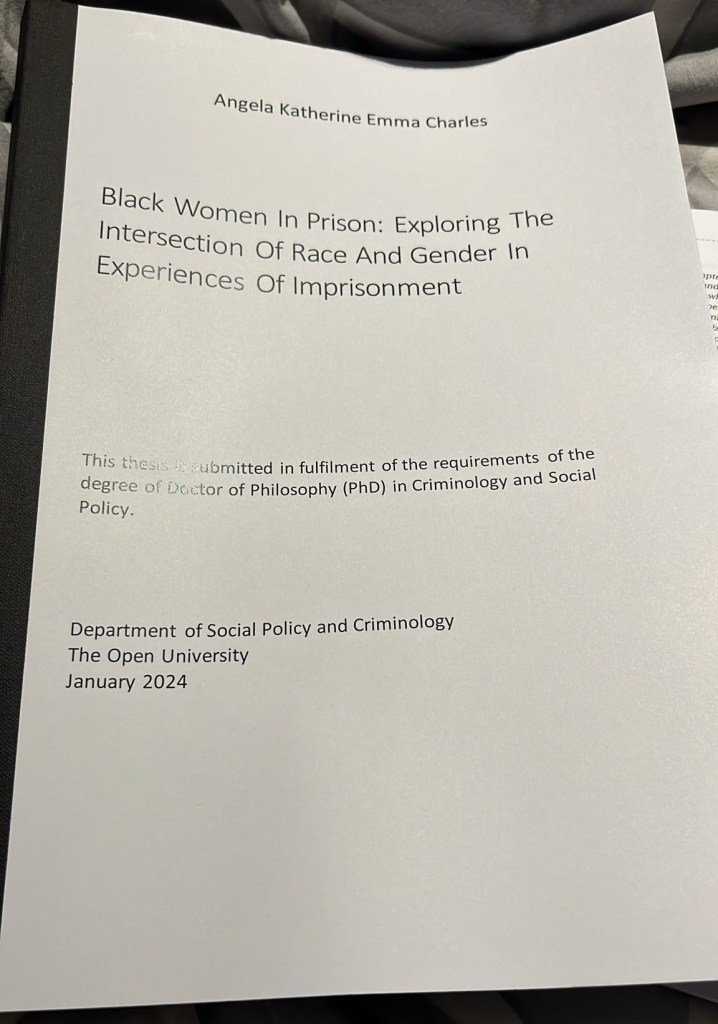
I reflect one week after one of the most important examinations in academia, the viva. Like any examination you never know what is going to come up and therefore you have to be prepared for anything. This makes preparation tricky, uncertain and at times perplexing. There were areas I thought might come up, and in those cases I had a response ready.
On the day, despite all the preparation there were questions that required pause, thought, navigation and discussion. Upon reflection, there were times where I would have liked to provide a more polished and articulate answer, but I am not a robot and therefore my answers are human, with stutters and pauses, passion and dedication; they are unpolished and there is a beauty to that.
What made the difference was having two very supportive examiners that were approachable, interested in my research and wanting me to fulfil my potential. Their additional years in the field/academia over mine were not used to demonstrate their superiority, but instead to guide me in the final process of completing my thesis.
The process acted as a reminder to me that how you approach a situation is so important. In academia, whilst we may be trying to highlight the flaws in a potential project or correcting errors or misconceptions in student’s writing so they can improve, we also ought to put the effort into seeing the good in someone’s work where possible. Think about whether your approach is constructive, how can that individual be supported to the finish line. It pays to maybe think back to the time when your work was being dissected, analysed, with the outcome affecting your academic career in front of you, what type of examiner would you have wanted, maybe that is the one you need to strive to be to others.
I passed with minor corrections that they stressed would only take a few days work. I hope this is acts a testament to what is possible. As a first-generation Black woman that tentatively stepped into academia, achieved a first-class honours degree, navigated a masters at Oxford University, was successful in achieving a funded PhD to then pass with minor corrections, challenge yourself and dare to dream!


