
Home » Articles posted by jesjames50 (Page 2)
Author Archives: jesjames50

Proud to be kind
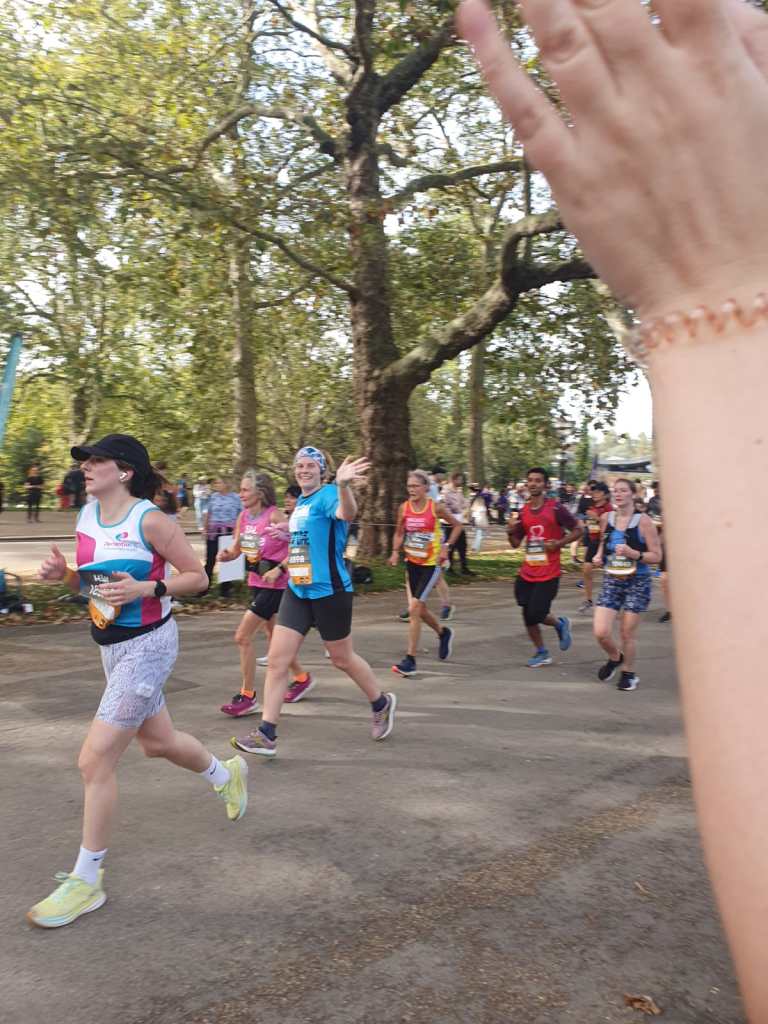
On Sunday 8th October 2023, I ran the Royal Parks Half Marathon to raise money for Freedom From Torture. It took 2hrs 11mins and 56 secs in 24 degree heat; 27 supporters who donated to Freedom From Torture to sponsor me; 5 friends who were with me on the day and kept my dehydrated spirits up; 30+ individual messages of support and encouragement on and before race day; countless well wishes and congratulations after the race; and £705 raised to rehabilitate and treat torture survivors.
The humanity and kindness shown by those who donated, checked in on me, wished me well and trained with me was overwhelming. £705 is an extraordinary amount of money and is going to make a huge difference to people’s lives who have run from torture, harm and unlawful persecution. Freedom From Torture offers, people who have experienced torture, safety and provides them with skills to be able to manage and overcome their trauma. Rooted in the foundations of this charity, and individuals that support it, is the notion of kindness, caring and wanting to live in a better world were our identities as humans are what transcends all conflict, hostility and harm in the world.
Sunday 8th October was an emotional day. Because of the focus on training (actually reaching 13.1miles/21.097km), my reasons for running and raising money for Freedom From Torture became, sort of, an afterthought- something that snuck up on me now and then rather than the focal fuel powering my legs! Even the steady influx of donations didn’t quite have the gravatas to let the reality sink in. That my silly (albeit very long) run is going to be positively impacting people’s lives! People who have experienced grave harms, displacement and social injustice. It wasn’t until the race began, where other charities and organisations were visible, being surrounded by other runners in their tops signifying who they were running for, where the enormity of the event, distance and possible impact this could have, hit home! Tears as the race begins.
Tears also followed after the race. Not to be too boastful but: I ran a half marathon! On a week where my chronic illness had seriously kicked my butt! Flash back to Thursday that week and I was concerned I wouldn’t make it to the race, let alone finish it! Once that wave of overwhelmingness passed, the next wave was not far behind. People I know and care for, and people I do not know, have banded together to support survivors of torture. Their donations will provide therapy, counselling, support for survivors of torture to manage their trauma and to be able to rebuild lives which had been destroyed. The people who donated and supported in all capacities have demonstrated incredible kindness, and the reality of what this money is going towards reduced me to yet another round of tears. But this time, tears of joy. Look what we can achieve! Look what we can do with kindness! Look what we can do when we lean on those around us!
Sunday 8th October 2023 will be a day I shall not forget. It is a day which I am immensely proud of. Not just of my running achievement, but the achievement of all those committed to making a change and providing support to those that need it. Thank you to everyone who has been with me on this journey to raise money to support survivors of torture: it couldn’t have been done without you!
Share this:


Reproductive Healthcare Ramblings

Reproductive health in England and Wales is a shambles: particularly for women and people who menstruate. The failings start early, where, as with most things, stereotypes and ‘norms’ are enforced upon children from GPs, schools, from parents/guardians who have experienced worse, or who do not know any different, which keep children from speaking up. These standards and stereotypes come from a male dominated health care system especially in relation to gynaecology, and our patriarchal society silences children without the children even realising they are being silenced. As a child, you are expected to go about your daily routine, sit your exams, look after your siblings, represent the school at the tournament of the week, and do all this while, for some, bleeding, cramping, being fatigued but not be expected to talk about it. After all, you are told time and time again: it’s normal.
Moving through life, women and people who menstruate face similar stigma, standards, assumptions during adulthood as they faced during childhood. There is more awareness now of endometriosis, adenomyosis, uterine fibroids, Polycystic Ovary Syndrome Condition (PCOS) to name but a few. But women and people who menstruate report feelings of being gaslighted by [male] gynaecologists, encouraged to have children in order to regulate their hormones (pregnancy and childbirth comes with a whole new set of healthcare problems and conditions), to take the contraceptive pill and deal with the migraines, mood swings, weight gain and depression which many women and girls report. Some of the above chronic illnesses impact fertility, so ‘try for a baby’ is not an easy, or even a wanted path. Diagnosis is also complex: for example a diagnosis for endometriosis takes on average 8 years (Endometriosisuk, 2023), and can only be confirmed with surgery. That relies on women and people who menstruate going to their GP, reporting their symptoms, listening to the ‘have you tried the pill’ or ‘having a baby will help manage your symptoms’: which relies on trust. Not everyone trusts the NHS, not everyone feels comfortable being dismissed by a nurse, or GP or then their gynaecologist. Especially when a number of these illnesses are framed and seen as a white-woman illness. Communities of women and people who menstruate remain hidden, dealing with the stigma and isolation that our reproductive health system carries in England and Wales. And this is not a new issue.
The reproductive healthcare for women and people who menstruate is dire. Just ask anyone who has experienced it. What then is it like for women in prison? The pains of imprisonment are well documented: deprivation of goods, loss of liberty, institutionalisation, no security, depreciation of mental health (Sykes, 1958; Carlen, 1983). The gendered pains, fears and harms less so, but we know women in prison are fearful about the deterioration of relationships (especially with children), lack of facilities to support new mothers, physical and sexual abuse, and poor mental and physical health support including reproductive health. The poor reproductive healthcare available to women and people who menstruate within society, is a grade above what is available in prisons. These women are quite literally isolated, alone and withdrawn from society (through the process of imprisonment), and for some, they will become further isolated and withdrawn via the pains of their chronic illness.
There isn’t really a point to this blog: more like a rambling of frustrations towards all the children who will journey through our subpar reproductive healthcare system, who will navigate the stigma and assumptions littered within society. To all the women and people who menstruate who are currently wading through this sh*t show, educating themselves, their family, their friends and in some cases their GPs, those people unable to speak out, not knowing how or simply not wanting to. And to those in the Secure Estate, grappling with the pains of imprisonment and having their reproductive healthcare needs ignored, overlooked or missed.
I haven’t even mentioned menopause…
References:
Carlen, P. (1983) Women’s Imprisonment, Abingdon: Routledge.
Corston, Baroness J. (2007) The Corston Report: A Review on Women with Particular Vulnerabilities in the Criminal Justice System, London: Home office.
Endometriosis UK (2023) Endometriosis Facts and Figures [online] Available at: https://www.endometriosis-uk.org/endometriosis-facts-and-figures#:~:text=Endometriosis%20affects%201.5%20million%20women,of%20those%20affected%20by%20diabetes.&text=On%20average%20it%20takes%208,symptoms%20to%20get%20a%20diagnosis. [Accessed 24th August 2023]
Sykes, G. (1958/2007) The Society of Captives: A Study of a Maximum Security Prison, Princeton: Princeton University Press.

Share this:


Freedom From Torture

Two weeks ago, we marked Refugee Week. The Freedom From Torture Northampton local group put on a showing of Matar, and a short documentary about making the film. Whilst the attendance was small, the showings were powerful and there was some heartful discussion around the importance of raising awareness, compassion and understanding around refugees and asylum seekers. And the importance of giving space to those voices who have lived these realities rather than being spoken for, and often over. The importance of space and empowerment is something all Criminologists and Criminology students will be familiar with.
One week ago we were witness to the Court of Appeal ruling that it was not safe to send asylum seekers to Rwanda, despite Suella Braverman’s ‘dream’ for the Conservative Party to ‘stop the boats’ via this unethical and inhumane migration bill. And whilst a huge sigh of relief leaves my body, I can’t help but feel anxious and angry at what is to come next. These people (the Government) have come from positions of power, comfort, security, wealth, and education- all their lives. They have no lived experience regarding why people flee from their home countries, the desperate need to run from unlawful prosecution, to want a safer life for themselves and their loved ones. So how are they best placed to decide on what response, (if there should be one), the country takes to immigration? There is also a racial element in relation to this: refugees from Ukraine were not met with the hostility and hate from this country, unlike asylum seekers and refugees from Syria or Afghanistan. Why is that? Well, for one thing the structural inequalities around ‘Whiteness’ is a place to start. The Government seems to have forgotten that people are running from harm, torture, and death. Running for their lives for the hope of a kinder, safer life.
Three weeks ago I signed up to run the Royal Parks’ Half Marathon on 8th October 2023. I am fundraising for Freedom From Torture which, whilst specific to fundraising, supporting and providing treatment for torture survivors, also work to campaign against the hatred and harmful policies being spouted by the Government against refugees and asylum seekers. I usually run 2-3 times a week, providing my body is playing ball which frustratingly appears to be less and less the case, but never more than 10km. A half marathon is just over 21km! So I’ve got a long way to go. But this distance is nothing compared to the miles and miles people fleeing harm, unlawful prosecution and/or torture have to endure. All support, be it financial or sharing blog posts and raising awareness on social media is highly appreciated. The link to my JustGiving Page can be found at the bottom of the blog alongside a very pink picture of me after a 5.58km ‘recovery run’.
Fair warning: my social media and blog posts will be dedicated to how I’m getting on in relation to the training, distance, blisters and will be accompanied by unflattering pictures of myself after various runs! But it’s important to remember WHY I’m running and WHO I’m running for.
Thanks for the support: I’ll keep you posted! JustGiving Link.

Share this:


Rise of the machines: fall of humankind

May is a pretty important month for me: Birthdays, graduations, what feels like a thousand Bank Holidays, marking deadlines, end of Semester 2 and potentially some annual leave (if I haven’t crashed and crumbled beforehand). And all of the above is impacted by, or reliant on the use of machines. Their programming, technology, assistance, and even hindrance will all have a large impact on my month of May and what I am finding, increasingly so, is that the reliance on the machines for pretty much everything in relation to my list above is making my quite anxious for the days to come…
Employment, education, shopping, leisure activities are all reliant on trusty ol’ machines and technology (which fuels the machines). The CRI1003 cohort can vouch, when I claim that machines and technology, in relation to higher education, can be quite frustrating. Systems not working, or going slow, connecting and disconnecting, machines which need updates to process the technology. They are also fabulous: online submissions, lecture slides shown across the entirety of the room not just one teeny tiny screen, remote working, access to hundreds of online sources, videos, typing, all sorts! I think the convoluted point I am trying to get too is that the rise of the reliance on machines and technology has taken humankind by storm, and it has come with some frustrations and some moments of bliss and appreciation. But unfortunately the moments of frustration have become somewhat etched onto the souls of humankind… will my laptop connect? Will my phone connect to the internet? Will my e-tickets download properly? Will my banking app load?
Why am I pondering about this now?
I am quite ‘old school’ in relation to somethings. I am holding on strong to paper books (despite the glowing recommendations from friends on Kindles and E-readers), I use cash pretty much all the time (unless it is not accepted in which case it is a VERY RARE occasion that the business will receive my custom), and I refuse to purchase a new phone or update the current coal fuelled device I use (not literally but trying to be creative). Why am I so committed to refusing to be swept along in the rise of the machines? Simple: I don’t trust them.
I have raised views about using card/contactless to purchase goods elsewhere and I fully appreciate I am in a minority when it comes to the reliance on cash. However, what happens when the card reader fails? What happens when the machine needs an update which will take 40mins and the back up machine also requires an update? Do traders and businesses just stop? What happens when the connection is weak, or the connection fails? What happens when my e-tickets don’t load or my reservation which went through on my end, didn’t actually go through on their end? See, if I had spoken to someone and got their name and confirmed the reservation, or had the physical tickets, or the cash: then I would be ok. The reliance on machines removes the human touch. And often adds an element of confusion when things go wrong: human error we can explain, but machine error? Harder to explain unless you’re in the know.
May should be a month of celebrations and joy: Birthdays, graduations, end of the Semester, for some students the end of their studies. But all of this hinders of machines. Yes, it requires humans to organise and use the technology but very little of it is actually reliant on humans themselves. I am oversimplifying. But I am also anxious. Anxious that a number of things we enjoy, rely on and require for daily life is becoming more and more machine-like by the day. I have an issue, can I talk to a human- nope! Talk to a bot first then see if a human is needed. So much of our lives are becoming reliant on machines and I’m concerned it means more will go wrong…
Share this:


“Over-policed and under-protected”- School children and policing: some criminological discussions

During the first week of Semester 2, the Criminology team put on a number of small sessions designed around topic areas to encourage some ‘radical’ discussion. Topic areas were designed to deliberately encourage debate and critical consideration. Due to the increasing use of police in schools, and relatively recent (within the past few years) issues around police stop and search in schools, disproportionately being used in schools with a majority Black and Brown cohort, often framed as ‘urban’ schools: it is an area of great interest for both Stephanie and myself. We were expecting some lively discussions around whether the Police should be in schools, and if so, in what capacity: and whilst the students did not disappoint in relation to this matter, they also raised some excellent points around the policing of school children and the control the school forces upon them. It is this area of the discussions that I would like to share with you.
Policing as a form of social control, exerted by schools, not necessarily the Police force, is rife within schools: something the students were quick to draw attention to. This was raised in relation to the policing of Black children’s hair. They are told to alter their appearances based on white standards, have been sent home for not conforming to the school dress code, sent to the back of classrooms for having distracting hair: in both primary and secondary school settings. This power over Black children’s hair, stands in contrast to the idea that children have no say over their hair, and are held to white westernised standards, yet can be held criminally responsible and subject to the force of the law as they are recognised as mature enough to understand crime and its consequences.
This baffling, controlling narrative is also evident in the use of school uniforms. Students raised the inappropriateness of some of the school uniforms in relation to the length of skirts, banning trainers, and piercings, which was a method of control which removed all sense of individuality and identity. It was recognised that children are encouraged to ‘grow up’ and ‘mature’ and ‘figure out’ what they want to do, but they had the methods of exploring this, especially in relation to their identity, restricted and policed. The limited autonomy over hair, clothes, piercings and children’s bodies stands in stark contrast to the legal discourse of children being criminally responsible at the age of 10years old in England and Wales. This was baffling to us!
A further way of policing students in school was through the surveillance the schools exerted over children. The use of CCTV, fingerprints as a method of purchasing lunch was originally considered as a form of security: the all seeing eye of big brother, oops sorry the school, and the attempt to reduce bullying by removing the carrying of cash was originally framed as a way of protecting children. However, the students were very critical of whether this surveillance was intended as protection, or rather as control. The idea of being deterred from delinquency through the use of CCTV, and preventing bullying by removing the possibility of money was considered, but again this refers back to the controlling of children’s behaviour.
There isn’t enough space to include all areas of the 2 hour discussion, and the time flew by quickly as the students and staff lost themselves in considering the role police play in schools, and the role schools play in policing children. The session concluded with us considering the school as an institution and whether its primary role was that of education, or of the creation of obedient bodies. I won’t tell you where we settled, but it is worth a ponder…
With thanks to all those who attended and stimulated the critical discussions around over-policed and under-protected: school children and policing: Gloria, Lucy, Kayode, Uche, Christivie, Joseph, Rosemary, Katya, Kayleigh, Chrissy, Diamante, Shola-Renee, Ellie, Sarah, Zoe, Stephanie and Jessica.
Share this:


Public confidence in the CJS: ending on a high?

2022 has been a turbulent and challenging year for many. Social inequalities and disadvantage are rife, with those in power repeatedly making bad, inhumane decisions and with very little, to no, accountability or consequences (insert your favourite example from the sh** storm that is the Conservative Party here). Union after Union, across sectors, engage in industrial action in response to poor working conditions and pay, amidst a cost-of-living crisis. And although seemingly unconnected, as the year comes to a close, the Sentencing Guidelines (2022) report on Public Confidence in the Criminal Justice System (CJS) has got me feeling frustrated. My previous blog entries have often been ‘moans’. And whilst January is often dubbed the month of new beginnings and change for the year ahead: we’re not quite there yet so true to form here is my latest moan!
The report exists as one of many conducted by Savanta to collate data on public confidence, in terms of effectiveness and fairness, in the CJS and public awareness of the sentencing guidelines. The data collected in March 2022, was via online surveys given to a “nationally representative sample of 2,165 adults in England and Wales” (Archer et al., 2022, p.9). Some of their highlighted ‘Key Findings’ include that confidence levels in CJS remains relatively stable in comparison to 2018, on the whole, respondents viewed sentences as ‘too lenient’ however this varied based on offence, the existence of the sentencing guidelines improves respondent’s confidence in the fairness of sentencing, and that engagement with broadcast news sources was high across respondents (Archer et al., 2022). It is not the findings, per se, that I take umbrage with, but rather the claim it is a “nationally representative sample of adults in England and Wales” (Archer et al., 2022, p.9).
I take issue on two fronts. The first being that the sample size of 2,165 adult respondents is representative when the demographic factors included are: gender (male and female), age (18-34yo, 35-54yo and 55+), region, ethnicity (White, Mixed, Asian, Black and Other) and socio-economic grade. Now considering we are, thankfully, at the end of 2022 we should all be able to recognise that a sample which only includes cis-gendered options, narrows ethnicity down to 4 categories and the charming ‘other’, and does not include disabilities is problematic. There has been a large body of research done on people with disabilities and their experiences within the CJS, the lack of representation, the lack of accessibility to space and decisions, potentially impacting a defendant’s right to a fair trial, and a victim’s right to justice (Equality and Human Rights Commission, 2021; Hyun et al., 2013 ). So I ask, is this not something which needs considering when looking at public confidence in the CJS of a “nationally representative” sample?
In addition to this, I take issue with the requirement that the sample be “nationally representative”. We have research piece upon research piece about how Black men and Black boys experience the CJS and its various agencies disproportionately to their white counterparts (Lammy, 2017; Monteith et al., 2022; Parmar, 2012). Their experiences of stop and search, sentencing, bail, access to programmes within the Secure and Youth estate. There is nothing representative about our CJS in terms of who it processes, how this is done, and by whom. According to Monteith et al., (2022) 1% of Judges in the CJS are Black, and there are NO Black judges on the High Court, Court of Appeal of Supreme Court: this is not representative! Why then, are we concerned with a representative sample when looking at public confidence in CJS and the sentencing guidelines, when it is not experienced in a proportionate manner?
Maybe I’ve missed the point?
The report is clear, accessible, visible to the public: crucial concepts when thinking about justice, and measuring public confidence in the CJS is fraught with difficulties (Bradford and Myhill, 2015; Kautt and Tankebe, 2011). But this just feels like another nail being thumped into the coffin that is 2022. Might be the eagerness I possess to leave 2022 behind, or the impeding dread for the year to follow but the report has angered me rather than reassured me. As a criminologist, I am hopeful for a more inclusive, representative, fair and accountable CJS, but I am not sure how this will be achieved if we do not accept that the system disproportionately impacts (but not exclusively) Black men, women and children. Think it might be time for another mince pie…
Happy New Year to you all!
References:
Archer, N., Butler, M., Avukatu, G. and Williams, E. (2022) Public Knowledge of Confidence in the Criminal Justice System and Sentencing: 2022 Research. London: Sentencing Council.
Bradford, B. and Myhill, A. (2015) Triggers of change to public confidence in the police and criminal justice system: Findings from the crime survey for England and Wales panel experiment, Criminology and Criminal Justice, 15(1), pp.23-43.
Equality and Human Rights Commission (2021) Does the criminal justice system treat disabled people fairly? [Online] Available at: https://www.equalityhumanrights.com/en/inquiries-and-investigations/does-criminal-justice-system-treat-disabled-people-fairly [ Accessed 4th November 2021].
Hyun, E., Hahn, L. and McConnell, D. (2013) Experiences of people with learning disabilities in the criminal justice system, British Journal of Learning Disabilities, 42: 308-314.
Kautt, P. and Tankebe, J. (2011) Confidence in the Criminal Justice System in England and Wales: A Test of Ethnic Effects, International Criminal Justice Review, 21(2),pp. 93-117.
The Lammy Review (2017) The Lammy Review: An independent review into the treatment of, and outcomes for, Black Asian and Minority Ethnic Individuals in the Criminal Justice System, [online] Available at: https://assets.publishing.service.gov.uk/goverment/uploads/system/uploads/attachment_data/file/643001/lammy-review-final-report-pdf [Last Accessed 14th February 2021].
Monteith, K., Quinn, E., Dennis, A., Joseph-Sailsbury, R., Kane, E., Addo, F. and McGourlay, C. (2022) Racial Bias and the Bench: A Response to the Judicial Diversity and Inclusion Strategy (2020-2025), [online] Available at: https://documents.manchester.ac.uk/display.aspax?DOCID=64125 [Accessed 4th November 2022].
Parmar, A. (2012) Racism and ethnicity in the criminal justice process, in: Hucklesby, A. and Wahidin, A. (eds.) Criminal Justice, 2nd ed, Oxford: Oxford University Press, pp.267-296.
Share this:


The ‘Chocolate Cost-of-Living Crisis’

Despite the turmoil and mess the country is currently in, this week’s blog post is dedicated to chocolate, and how to maintain a very much needed chocolate fix during the cost-of-living crisis and the sh** storm which British Politics currently is. Do not even get me started on the Casey Review (2022) which has been overshadowed by that sh** storm I previously mentioned. So, in an attempt to address a serious concern plaguing us all, but disproportionately those most vulnerable, I would like to share some of my findings on the ‘chocolate cost-of-living crisis’.
Before the ‘official’ cost-of-living crisis hit, chocolate was seriously upping its price tag. What used to be 99p or £1 for branded ‘share’ bag (I mean who actually has the self-control to share a share bag?!), has now risen to a huge £1.25 per bag! Now this is for Cadbury’s ‘share’ bags (buttons, wispa bites, twirl pieces to name a few), you are looking at £1.35 for Mars products (Magic stars, Minstrels, Maltesers, MnMs)! Those of us that eat Vegan, lactose-free chocolate are looking at an even higher price tag for an even smaller product. Supermarket chocolate has also gone up in price, and remains nowhere near as scrumptious as the likes of Cadbury, Mars and even Nestle (although I myself am not a Nestle loving due to their questionable ethical practices*). But given the sh** storm the Country is currently in, and the impact of the cost-of-living crisis is having, we need chocolate more than ever! But do not fear: I have some handy tips when it comes to selecting the most reasonably priced and therefore affordable chocolate to help get us through these sh***y times.
The key when looking at the cost of chocolate, and all products, is to look at the price per g/kg. This is usually in teeny tiny writing at the bottom of the price tag on the shelves. Most chocolate (and because I am a self-proclaimed chocolate snob, I am discussing branded chocolate) is coming in around the 85p+ per 100g mark. But there are some sneaky little joys which are undercutting this, and I highly recommend stocking up!
Terry’s Milk Chocolate Orange: £1, (63p/100g): a clear winner! They have various types, dark chocolate, white chocolate and popping candy, and these vary in weights but come in between 63p/100g to 69p/100g!
Cadbury Dairy Milk (360g bar): £3, (83p/100g): the key to Cadburys is the bigger the cheaper! Do not be fooled by the smaller bars and their ‘cheaper’ price. They are not cheaper: and lets be honest who wouldn’t want 360g of chocolate over 150g?!
HOWEVER
Galaxy Caramel (135g bar): 99p (73p/100g): good news for caramel lovers! The smaller caramel bar is cheaper than the 360g Galaxy smooth milk bar (97p/100g), so in this case less is actually more!
Galaxy Minstrels ‘More to Share’ Bag: £1.99 (83p/100g): best value share bag out there at the moment. Again, do not be tricked by the smaller and what may seem like cheaper bags, because they are not!
Growing up with a single-parent father who worked the ‘mum’ shift in a warehouse meant we were very stringent and careful with money: mainly because we didn’t have much. This skill of checking value for money and the price per g/kg is something engrained within me, and something I am extremely grateful for! Check those £’s per g/kg people! It may mean you can have a treat at the end of the week, which doesn’t burn through your pockets, to help off-set the sh** we are currently dealing with.
*it has recently been brought to my attention, the unethical historical practices of Cadbury’s in relation to the Slave Trade, and their racist advertisements in the early 2000’s (not sure how I missed this)! Morally, as I try to avoid Nestle products due to their unethical practices, I will also attempt the same with Cadbury’s: but I fear this will not be an easy transition.
Share this:


The Good Doctor has me thinking…

Recently I have begun watching ABC’s The Good Doctor, which is a medical drama based in the fictional, yet prestigious, San Jose St Bonaventure Hospital and follows the professional and personal journeys of a number of characters. The show is based on a South Korean tv medical drama called Good Doctor and is produced by Daniel Dae Kim and developed by David Shore (creator of House). The main character is Dr Shaun Murphy who has Autism. He is a surgical resident in the early seasons and the show focuses on how Dr Murphy navigates his professional and personal life, as well as how the hospital and other doctors, surgeons, nurses and patients navigate Dr Murphy’s style of communication and respond to him. As a medical drama, in my humble opinion, it is highly entertaining with the usual mix of interesting medical cases and personal drama required. The characters are also relatable in a number of different areas. As a springboard for a platform to talk about equality, equity and fairness, it is accessible and thought-provoking.
A key focus of the programme is the difficulty Dr Murphy has with communication. Well, I say difficulty in communicating, but in actuality I would say he communicates differently to what is recognised as an ‘accepted’ or ‘normal’ form of communication. Dr Murphy struggles to express emotions and becomes overwhelmed when things change and are not within his controlled environment. A number of his colleagues adapt their responses and ways of interacting with him in order to support and include him, whereas others do not and argue that despite his medical brilliance, and first-rate surgical skills, he should not be treated differently to the other surgical residents, as this is deemed unfair.
Whilst watching, the claims of treating all surgical residents equally, and ensuring the hospital higher-ups are being fair; notions of John Rawls’ writing scream out at me. Students who have studied Crime and Justice should be familiar with Rawls’ veil of ignorance, liberty principles and difference principle, in particular with its reference to ‘justice’. But the difference principle weighs heavily when looking at how Dr Murphy functions within the hospital institution with its rules, procedures and power dynamics which clearly benefit and align with some people more so than others. Under the veil of ignorance, maybe an empathetic doctor or surgeon is not required, but a competent and successful one is? Maybe being empathetic is a personal circumstance rather than an objective trait? For Rawls, it is important that the opportunity to prosper is equal for all: and this might mean the way this opportunity is presented is different for different individuals. Rawls asks us to consider a parallel universe and what could be (a popular stance to take within the philosophical realm): why can’t people with autism be given the chance to save lives and perform surgeries just because they cannot communicate in a way deemed ‘the norm’ when dealing with patients.
It is possible that I am over-thinking this. And when I ask my partner about it, they raise questions about why Dr Murphy should be given different opportunities to the other residents and the harm Dr Murphy’s communication barriers could and do cause within the series. But I feel they are missing the point: it is not about different opportunities, its about different methods to ensure they all have the same opportunity to succeed as surgeons. It is not about treating everyone the same, which might on the surface appear to be fair, it is about recognising that equal treatment involves taking account for the differences. Why should Dr Murphy be measured against norms and values from an institution which is historically white, non-disabled, male, and cis-gendered? This might appear to be a lot of thought for a fictional medical drama, but to reiterate it’s an excellent programme with plenty to think about…
Bibliography:
Rawls, J. (1971) A Theory of Justice. Oxford: Oxford University Press.
Ryan, A. (1993) Justice. Oxford: Oxford University Press.
Share this:


‘Gentleminions’: the rise of…media demonisation?


Recently one of the main ‘stories’ which appear to be filling up my newsfeeds on social media, is around the latest TikTok trend: ‘Gentleminions’ and the havoc this appears to be causing Cinemas. I am yet to see the film Minions 2: The Rise of Gru but have no doubt I will as a fan of the little, yellow and mischievous title characters, and their ‘villainous’ boss. However, what has become apparent from reading the news articles which have come about from the TikTok trend and the “terrible menace” these ‘gentleminions’ pose (Heritage, 2022), is that yet again, the media appear to be demonising young people and their pastimes, something which has been fairly consistent since the emergence of the independent press back in Victorian England.
The trend involves, “teenagers”, “young people”, “youngsters” and/or “kids” watching Minions 2 dressed in formalwear as an imitation of some ‘famous’ TikTok users (Gill, 2022; Heritage, 2022; Hirwani, 2022). Seems pretty harmless, however there have been reports of “shouting and mimicking the minions” (Hirwani, 2022), “honk full volume gibberish” (Heritage, 2022), “rowdy behaviour from groups of teens” (Gill, 2022). Again, all seems fairly harmless, albeit possibly annoying. Yet, there have also been reports of “vandalism, throwing objects and abusing staff” (Gill, 2022). What I can’t help but utter is a sense of: here we go again, in relation to young people and the next wave of nuisance or harm they pose to society. It verges on the notion of demonising young people for being young people… something the British media is all to well versed in.
My thoughts wonder back to the infamous media portrayal of events which occurred on the Bank Holiday weekend back in 1964 with those violent and dangerous young people affiliated with the Mods and Rockers… oh wait a minute! That was a misrepresentation and portrayal of events which lead to what we know recognise as a moral panic (excuse the oversimplification). I wonder if this ‘gentleminion’ trend will follow suit? The media has consistently reported on the nuisance these young people are causing and the refunds given by cinemas to unhappy customers who have been unable to enjoy the film. Focusing on the damage caused by these youngsters in vague terms and without any real evidence. It is interesting that the media flocks to the negative portrayal of these youth, mirroring Hendrick’s (2015) point that children and their pastimes represent a moral threat to society, hence the continual interest in them.
The Guardian’s portrayal is slightly more positive, whilst including the narrative of the “terrible menace” these ‘Gentleminions’ pose, Heritage (2022) also presents the idea that this trend could be a positive trend for cinema and film considering the struggles they faced with the pandemic and the uprising of streaming services. Who knows: maybe cinema will take Heritage’s (2022) idea about having select screenings to allow and encourage young people to attend the film and practice their ‘gibberish’, whilst allowing other film goers the chance to view the film without the distraction? More than likely, true to form, this will all blow over in a week or so, but it does make you wonder why the media haven’t learned from previous experience and doesn’t just “leave them kids alone” (Pink Floyd, 1972).
References:
Cohen, S. (2002) Folk Devils and Moral Panics, 3rd edn. London: Routledge.
Gill, E. (2022) Cinemas banning teens in suits from watching Minions amid TikTok #gentleminions trend, Manchester Evening News, 6th July [online], Available at: https://www.manchestereveningnews.co.uk/news/greater-manchester-news/minions-movie-wearing-suits-banned-24411350 [Accessed 6th July 2022].
Hendrick, H. (2015) Histories of youth crime and youth justice. In: Goldson, B. and Muncie, J. (eds.) Youth Crime and Justice. 2nd ed. London: Sage Publications, pp.1-16.
Heritage, S. (2022) The teens disrupting Minions screenings might actually be the saviours of cinema, The Guardian, 5th July [online], Available at: https://www.theguardian.com/film/2022/jul/05/teens-disrupting-minions-screenings-gentleminions-despicable-me-rise-of-gru [Accessed 6th July 2022].
Hirwani, P. (2022) Minions: Cinemas ban teens in suits following the ‘gentleminions’ TikTok trend, The Independent, 5th July [online], Available at: https://www.independent.co.uk/arts-entertainment/films/news/minions-theatres-ban-gentleminions-teens-b2115800.html [Accessed 6th July 2022].
Pink Floyd (1972) Another Brick in the Wall, Pt 2 (2011 Remastered), Available from: Amazon Music [Accessed 6th July 2022].
Share this:


Youth or Adult: can you tell?

This week’s blog begins with a game: youth or adult, secure estate in England and Wales. Below are some statements, and you simply need to guess (educated guesses please), whether the statement is about the youth, or adult secure estate. So, are the statements about children in custody (those under the age of 18 years old) or adults in custody (18+). When you’re ready…
- 70% decrease in custody in comparison to 10 years ago
- Segregation, A.K.A Solitary Confinement, used as a way of managing the most difficult individuals and those who pose a risk to themselves or others
- Racial disproportionality in relation to experiencing custody and being remanded to custody
- Self-harm is alarmingly high
- 1/3 have a known mental health disability
- Homelessness after release is a reality for a high proportion of individuals
- Over half of individuals released from custody reoffend, this number increases when looking at those sentenced to 6months of less
How many did you answer youth secure estate, and how many adult secure estate? Tally up! Did you find a 50/50 split? Did you find it difficult to answer? Should it be difficult to spot the differences between how children and adults are treated/experience custody?
All of the above relate specifically to children in custody. The House of Commons Committee (2021) have argued that the secure estate for children in England and Wales is STILL a violent, dangerous set of environments which do little to address the needs of children sentenced to custody or on remand. Across the academic literature, there is agreement that the youth estate houses some of the most vulnerable children within our society, yet very little is done to address these vulnerabilities. Ultimately we are failing children in custody! The Government said they would create Secure Schools as a custody option, where education and support would be the focus for the children sent here. These were supposed to be ready for 2020, and in all fairness, we have had a global pandemic to contend with, so the date was pushed to 2022: and yet where are they? Where is the press coverage on the positive impact a Secure School will make to the Youth estate? Does anyone really care? A number of Secure Training Centres (STCs) have closed down across the past 10 years, with an alarmingly high number of the institutions which house children in custody failing Ofsted inspections and HM Inspectorate of Prisons (2021) found violence and safety within these institutions STILL a major concern. Children experience bullying from staff, could not shower daily, experience physical restraint, 66% of children in custody experienced segregation which was an increase from the year prior (HM Inspectorate of Prisons, 2021). These experiences are not new, they are re-occurring, year-on-year, inspection after inspection: when will we learn?
The sad, angry, disgusting truth is you could have answered ‘adult secure estate’ to most of the statements above and still have been accurate. And this rings further alarm bells. In England and Wales, we are supposed to treat children as ‘children first, offenders second’. Yet if we look to the similarities between the youth and adult secure estate, what evidence is there that children are treated as children first? We treat all offenders the same, and we treat them appallingly. This is not a new argument, many have raised the same points and concerns for years, but we appear to be doing very little about it.
We are kidding ourselves if we think we have a separate system for dealing with children who commit crime, especially in relation to custody! It pains me to continue seeing, year on year, report after report, the same failings within the secure estate, and the same points made in relation to children being seen as children first in England and Wales: I just can’t see it in relation to custody- feel free to show me otherwise!
References:
House of Commons Committees (2021) Does the secure estate meet the needs of young people in custody? High levels of violence, use of force and self-harm suggest the youth secure estate is not fit for purpose [Online]. Available at: https://houseofcommons.shorthandstories.com/justice-youth-secure-estate/index.html. [Last accessed 4th April 2022].
HM Inspectorate of Prisons (2021) Children in Custody 2019-2020: An analysis of 12-18-year-old’s perceptions of their experiences in secure training centres and young offender institutions. London: Her Majesty’s Inspectorate of Prisons.

 Thoughts from the criminology team