
Home » 2023 (Page 4)
Yearly Archives: 2023

Is Criminology Up to Speed with AI Yet?
On Tuesday, 20th June 2023, the Black Criminology Network (BCN) together with some Criminology colleagues were awarded the Culture, Heritage, and Environment Changemaker of the Year Award 2023. The University of Northampton Changemaker Awards is an event showcasing, recognising, and celebrating some of the key success and achievements of staff, students, graduates, and community initiatives.
For this award, the BCN, and the team held webinars with a diverse audience from across the UK and beyond to mark the Black History Month. The webinars focused on issues around the ‘criminalisation of young Black males, the adultification of Black girls, and the role of the British Empire in the marking of Queen Elizabeth’s Jubilee.’. BCN was commended for ‘creating a rare and much needed learning community that allows people to engage in conversations, share perspectives, and contextualise experiences.’ I congratulate the team!
The award of the BCN and Criminology colleagues reflects the effort and endeavour of Criminologists to better society. Although Criminology is considered a young discipline, the field and the criminal justice system has always demonstrated the capacity to make sense of criminogenic issues in society and theorise about the future of crime and its administration/management. Radical changes in crime administration and control have not only altered the pattern of some crime, but criminality and human behaviour under different situations and conditions. Little strides such as the installation and use of fingerprints, DNA banks, and CCTV cameras has significantly transformed the discussion about crime and crime control and administration.
Criminologist have never been shy of reviewing, critiquing, recommending changes, and adapting to the ever changing and dynamic nature of crime and society. One of such changes has been the now widely available artificial intelligence (AI) tools. In my last blog, I highlighted the morality of using AI by both academics and students in the education sector. This is no longer a topic of debate, as both academics and students now use AI in more ways than not, be it in reading, writing, and formatting, referencing, research, or data analysis. Advance use of various types of AI has been ongoing, and academics are only waking up to the reality of language models such as Bing AI, Chat GPT, Google Bard. For me, the debate should now be on tailoring artificial intelligence into the curriculum, examining current uses, and advancing knowledge and understanding of usage trends.
For CriminologistS, teaching, research, and scholarship on the current advances and application of AI in criminal justice administration should be prioritised. Key introductory criminological texts including some in press are yet to dedicate a chapter or more to emerging technologies, particularly, AI led policing and justice administration. Nonetheless, the use of AI powered tools, particularly algorithms to aid decision making by the police, parole, and in the courts is rather soaring, even if biased and not fool-proof. Research also seeks to achieve real-world application for AI supported ‘facial analysis for real-time profiling’ and usage such as for interviews at Airport entry points as an advanced polygraph. In 2022, AI led advances in the University of Chicago predicted with 90% accuracy, the occurrence of crime in eight cities in the US. Interestingly, the scholars involved noted a systemic bias in crime enforcement, an issue quite common in the UK.
The use of AI and algorithms in criminal justice is a complex and controversial issue. There are many potential benefits to using AI, such as the ability to better predict crime, identify potential offenders, and make more informed decisions about sentencing. However, there are also concerns about the potential for AI to be biased or unfair, and to perpetuate systemic racism in the criminal justice system. It is important to carefully consider the ethical implications of using AI in criminal justice. Any AI-powered system must be transparent and accountable, and it must be designed to avoid bias. It is also important to ensure that AI is used in a way that does not disproportionately harm marginalized communities. The use of AI in criminal justice is still in its early stages, but it has the potential to revolutionize the way we think about crime and justice. With careful planning and implementation, AI can be used to make the criminal justice system fairer and more effective.
AI has the potential to revolutionize the field of criminology, and criminologists need to be at the forefront of this revolution. Criminologists need to be prepared to use AI to better understand crime, to develop new crime prevention strategies, and to make more informed decisions about criminal justice. Efforts should be made to examine the current uses of AI in the field, address biases and limitations, and advance knowledge and understanding of usage trends. By integrating AI into the curriculum and fostering a critical understanding of its implications, Criminologists can better equip themselves and future generations with the necessary tools to navigate the complex landscape of crime and justice. This, in turn, will enable them to contribute to the development of ethical and effective AI-powered solutions for crime control and administration.
Share this:

Refugee Week 2023

Monday 19th June commences the 2023 Refugee Week and this year’s theme is compassion, a quality we have seen little of in Fortress Europe policy and practice this year. As many of you will know, Jessica James and I founded the Northampton Freedom From Torture local supporter’s group earlier this year. Part of the reason for setting up the group was to help foster compassion towards people seeking safety in our local area. Admittedly, we’ve been pretty quiet so far (workloads, life etc. – we welcome volunteers to help organise events) but for Refugee Week we have organised a film screening of MATAR and The First Drop of Rain: Making MATAR.
MATAR is a WaterBear Original following the story of an asylum seeker in England who, when confronted with the hostile immigration system in the UK, is forced to live on the fringes of society and rely on his bike to survive.
A powerful and poignant story of resilience and perseverance, based on the lived experience of co-writer Ayman Alhussein. MATAR stars actor Ahmed Malek (The Swimmers) in the titular role, with BAFTA-nominated actor Youssef Kerkour (Home) and Elmi Rashid Elmi (The Swimmers). This docu-fiction short film is directed by BAFTA-winning Hassan Akkad and produced by Deadbeat Studios in association with Choose Love.
The event will be hosted on Wednesday 21st June 2023 from 5.30pm in the Morley Room at the University of Northampton. Tickets are free and can be booked here but we welcome donations and sponsorship for @jesjames50’s forthcoming half marathon.
In October, Jes will be running the Royal Parks Half Marathon to fundraise for Freedom From Torture. Running is one of Jes’ favourite hobbies and is enjoyed by millions across the globe as a popular pastime and fitness activity. However, running in this capacity is a privilege. For some it is forced upon them to flee harm, torture and unlawful prosecution. Freedom For Torture is a charity which is dedicated to helping, healing and protecting people who have survived torture. The half marathon is 13.1miles and has raised nearly £60million for over 1000 charity partners since 2008, and in 2023 we are aiming to contribute to this! Watch this space for more details about the upcoming fundraising activities and sponsoring Jes take on her longest run ever for survivors of torture. You can find Jes’ Just Giving page here.

Now we have the promotion out of the way, let’s talk about why compassion matters. The UK government is intent on ‘stopping the boats’, yet the policies they propose to achieve this do not include opening safe and legal routes to those seeking safety here. Instead, governments throughout much of Europe opt for deterrent measures, the results of which mean border deaths as we have seen in the tragedy off the coast of Greece this week. The omission of opening safe routes contributes to the structural violence of immigration policy and practice in Europe and means that deaths at the border are, as Shahram Khosravi argues, an acceptable consequence of border practices. There exists a gaping chasm where the compassion should be.
Meanwhile, those who do show compassion such as those volunteering to help refugees, protesters and even refugees themselves risk criminal prosecution. Sara Mardini is among a group of volunteers who faced prosecution in Greece earlier this year for a number of charges relating to their voluntary work with refugees. Although acquitted of a number of charges, some of the volunteers still face investigation for people smuggling and other offences. Meanwhile in the UK protesters are routinely arrested for protesting inhumane deportation and the Nationality and Borders Act 2022 allows maximum sentences of life imprisonment for those piloting small boats to smuggle migrants into the UK, not considering that many of these people will be refugees themselves who have paid smugglers and been forced to pilot boats, or who have agreed to pilot a boat in return for their passage. The stakes are high for acts of compassion.
As a border criminologist and activist, the refugee ‘crisis’, political, media and public responses to people seeking safety can feel overwhelming at times. It is difficult to comprehend what one person can do, yet there is power where lots of individuals stand up against injustice. Just over a year ago, I was at a protest outside an immigration removal centre on the day the first flight to Rwanda was due to take place. There were others there and at various locations around the country, and even more mobilised on social media. Campaign groups, charities and lawyers worked together to bring a court case against the UK government. While the war is ongoing, we won the battle that day and the plane was not allowed to leave.
We can all do something to spread compassion towards people seeking safety. Actions could be as simple as learning about refugees by watching a film or reading a book. It could mean sharing your thoughts in conversations and viA social media platforms. You could write to your MP and ask them to show some compassion or volunteer with a group like our Freedom From Torture local group or participate in a protest.
Share this:


Violence on the Frontline: Guest speakers and CRI3003

Before starting the CRI3003 module, if you asked me what violence was, I was pretty confident that I could answer. Violence, of course, is a “behaviour involving physical force intended to hurt, damage, or kill someone or something” (Oxford Dictionary). Alike to the Oxford Dictionary, this was also my understanding. It wasn’t until I started the module that I was bombarded by a whole different understanding: violence as institutional.
At first, this concept confused me. I think anybody who believes they fully understand the complexities of violence is not yet finished in their journey to understanding. This module, unlike other modules on the course, allowed students to listen to guest speakers from the frontline of the many institutions in which we learnt about. This, for me, proved invaluable. It helped me understand institutional violence, and why it is so complex. The speakers, albeit brilliant and informing, sometimes themselves didn’t completely understand the concept of institutional violence, and for me this highlighted the exact reason why it flourishes: lack of understanding within the institution. As violence is not understood as institutional, its insidious nature will never be understood, and neither will its impact. Instead, institutions desperately want to point the finger, and struggle to understand violence which has no actor.
In my opinion, not only did I learn as a student from the guest speakers, I believe the guest speakers also learnt from us. The interaction and questioning as a result of these sessions is where the crucial learning took place, as it allowed me as a student to understand an institutionalised perspective, and it allowed the guest speaker to understand an outsider perspective; a view they may not be encouraged to adopt within the institution in which they operate. This cross examination of ideas allowed for a more informed, deeper understanding. I think it is very easy to think you understand a concept, but applying it in your evaluation of the guest speaker’s experiences accelerates your understanding.
It is fair to say I learnt a lot from all the guest speakers on the module, and I believe it is a great opportunity and privilege to have had as an undergraduate student. Just when you think you understand a case in class, the guest speaker will make you re-evaluate everything you had learnt previously. This is a skill which is not only useful for a criminology degree, but also for everyday life when you enter the social world in which is made up by such institutions.
It is for the reasons stated above that I believe CRI3003: Violence from Domestic to Institutional is a brilliant module. Personally, it was my favourite. It consolidated my learning perfectly and allowed me to demonstrate all of the knowledge I had previously learnt. As I said before, the guest speakers allowed students to question their own understanding, and perhaps view a case in an alternative lens. This multifaceted understanding of such complex concepts is crucial in criminology, and life as a whole.
From my experience, the guest speaker sessions are only as good as the questions asked, so come prepared! In asking the right questions, invisible violence becomes visible, and all of the content learnt before finally falls into place.
Share this:


Maybe HE Needs Damaging: The EDI-fication of Institutional Violence

The business case for diversity initiatives, unconscious bias training, cultural sensitivity workshops, and more are some of the things that come under institutional focuses on Equality, Diversity and Inclusion, known more commonly as EDI. These are then applied to numbers of protected characteristics named in the Equality Act 2010. In addition to EDI being difficult to measure, insurgents have spoken out against it, as it seems to have taken many for fools as a phantom limb of the Anti-Racism Industrial Complex. As white people co-opt and profit from concepts and traditions of thought that Black and Brown people created and developed. For example, “identity politics” was coined in the 1970s by the Combahee River Collective to talk about their experiences of classism, lesbophobia and misogynoir. Meanwhile, the term has been co-opted by the political right in their war against equality.
As a freelancer invited into organisations to “raise awareness” on issues pertaining to racial inequality and more, I am asked to do one-time events … but never long-term interventions that shifts the scales of power and privilege. On a basic level, institutions like schools and universities can say look how much we are doing while actually not doing anything at all. Those who lose are the students and employees from historically excluded backgrounds including Black, Asian, LGBTQ+, disabled and other violently exploited groups. So, EDI then claims to want to end inequality while actually upholding it.
***
During the COVID-19 lockdowns, I read a poetry collection called Postcolonial Banter by Bradford-based spoken word poet and educator Suhaiymah Manzoor-Khan. Her poem “Decentring Diversity” illustrates the issues with more Black/Brown faces in high places as somewhat being interchangable with anti-racism: “Just because they give you a seat at the table doesn’t mean they want you to speak at the table” (p81). As expected, this reaffirmed my own suspicions about the EDI agenda: simply having more Black and Brown people as managers will not solve our problems. Encouraging more Black and Brown people to inhabit these institutions to be part of the labour force, while well-intentioned, will not solve our problems when there is little want to change working conditions (i.e racism at universities).
As universities continue to exploit international students (i.e through extortionate tuition fees and precarious visas … in partnership with the Home Office), these same institutions employ EDI “initiatives” to protect these power structures. Meanwhile, Black and Brown asylum seekers drown at sea.
Having more Black and Brown faces in high places continues be a harmful tactic in EDI discourse, as we saw with their deployment in The Sewell Report. Here the UK Government – a white instituton – curated a panel of Black and Brown “experts” in their fields (but not in racism) to conduct an inquiry that told us institutional racism doesn’t exist. As the same government continues with its “anti-woke” nonchalance in its attacks on Critical Race Theory. I want to see more people that look like me in spaces I inhabit. But at what cost? As political commentator Ash Sarkar states, “I mean, this idea that all you need is brown faces in high places is just absolutely for the birds. […] That just because somebody shares some of your identity attributes, it doesn’t mean that they are going to be organising in your interests” (DDN, 2021).
Increasingly, organisations illustrate their “commitment” to Equality & Diversity by creating a diversity role within senior leadership for a Black or Brown person, only to leave this person unsupported. These staff members become tokenised and end up speaking through whiteness (as per #FloellaGate during The Coronation, and The Sewell Report). This is what happens when you project Black and Brown people into jobs within organisations, unsupported, in places that were not designed for us in the first place. Black and Brown people should certainly consider these roles if offered (and if in an emotionally healthy position to do so), but organisations need to support them. Otherwise, we are being set up to fail.
“The concept of diversity only exists if there is an assumed neutral point from which ‘others’ are ‘diverse.’ Putting aside for now the straight, male, middle-classness of that ‘neutral’ space, its dominant aspect is whiteness. Constructed by a white establishment, the idea of ‘diversity’ is neo-liberal speak. It is the new corporatized version of multiculturalism. It is about management, efficiency, box-ticking.”
Kavita Bhanot (2015)
When “diversity” is called for in organisations, it is useful to remember “diversity” is often just euphemistic language for marked difference, often Blackness and Brownness. In saying “diversity”, organisations are also telling us who institutions are designed by and who they work for. As scholar-activist Muna Abdi stated, “Diversity work is about manging the racial optics of a space. It is about bringing together people who are marked as ‘different’ into spaces that remain designed for those with power.”
In doing so, thus, some “differences” are then seen as neutral differences (i.e white; man; cisgender; ; heterosexual; neurotypical), and some are seen as Other (i.e Black; Asian; Muslim; woman; gay; neurodivergent; transgender). In giving specific groups power in a world that thrives on hierarchy and social order, historically excluded groups always lose … including racialised wo/men and people that reject all gender binaries. These groups are also some of the worse impacted by state-manufactured violence i.e how police departments treat some humans like objects to moved out of the way.
Under the “protected characteristics” named in the Equality Act 2010, in concept being victim of racism should be threaded through all of them. i.e Black women who are more likely to die in childbirth than their white counterparts. This is a very specific experience situated under “misogynoir” (Bailey, 2010), where anti-Blackness and misogyny join hands – exclusive to Black women in their position as Black women. Since 2010, the Equality Duty has largely been understood by organisations as somewhat positive:
“The general equality duty therefore requires organisations to consider how they could positively contribute to the advancement of equality and good relations. It requires equality considerations to be reflected into the design of policies and the delivery of services, including internal policies, and for these issues to be kept under review.”
Public Sector Equality Duty
Within higher education, gender equality frameworks like Athena Swann continue to privilege gender over race (Bhopal and Henderson, 2021). One must ask why? In short, some academics would say that with white experiences as the default setting (even in women’s experiences of misogyny), there is no priority for Black and Brown women to be included. So, for Black and Brown people, “progress” only tends to happen within a white supremacist system when those interests are conjoined with the goals of whiteness. In Critical Race Theory, we call this “interest convergence” (Bell, 1980). With the logic of diversity as a euphemism for Black / Brown (Bhanot, 2015), these initiatives also continue to omit the role of colour-conscious racism. This recentres white people as the “common sense” or universal worldview.
***
Often, I recieve emails from schools and others asking for EDI training; I don’t do EDI work, I do disruption work – with much of it challenging dominant power structures! EDI work in my experience has been about reform, not reparations: it has been about firefighting within institutions and managing acceptable levels of violence (i.e through resilience / “cultural sensitivity” workshops, and unconscious bias training … ugh).
In her thread about ‘unconscious bias training’, Muna Abdi also reminds us that this not something to ignore as a “tick-box exercise, it is a deliberate organisational decision and originally implemented to limit corporate risk. Furthermore, Muna tells us how it diverts attention from a needed focus on institutional and structural violence into a focus on individual violence between people.
The Equality, Diversity and Inclusion agenda has been one of the biggest traps to hit education in decades. In March, I got into a discussion with a teacher on Twitter about this. Her tweet suggested that anybody against the EDI agenda’s concepts were probematic, when in truth there is a lot wrong with EDI because it doesn’t do what it says. And in fact, in being designed around giving institutions plausible deniability and limiting corporate risk it keeps the violence going.
In late 2022, I made a complaint about a university conference. The event was situated around anti-racism in education (or so it claimed), but the event reproduced racism and whiteness in different ways. I was horrified. What struck me is how “good white people” (Sullivan, 2014) had psyologically distanced themselves from “bad supremacists.” In my complaint, it reasserted how power works and that white “anti-racists” can be some of the most racist people to challenge. As Sara Ahmed writes, “To compain at the university is to be treated as ungrateful for the benefits you have recieved from the university: the freedom to make your own interpretation, the freedom to be critical, academic freedom” (p135).
For me, EDI has been about boxticking and efficiency, using the “racial optics” of Black and Brown people for university brochures, working groups, “race equality centres” and so forth, while campus police and security continue to harrass Black students. Universities draw on the language of EDI to encourage students and staff to study/work there: “non-performativity” (Ahmed, 2018: 333). But language does not translate to transforming hostile spaces into safe ones (better yet, less hostile … in academia, safe spaces do not exist for Black and Brown staff unless we make them ourselves). Thus the brochures, and other forms of marketing are used to create the appearance without action (Ahmed and Swann, 2006).
Or as Nirmal Puwar (2004) writes,
“In policy terms, diversity has overwhelmingly come to mean the inclusion of different bodies. It is assumed that, once we have more women and racialised minorities, or other groups, represented in the hierarchies of organisations (government, civil service, judiciary, police, universities and the arts sector), especially in the élite positions of those hierarchies, then we shall have diversity. Structures and policies will become much more open when these groups enter and make a difference to organisations.”
Nirmal Puwar
Too much and often, I see organisations framing their equality ‘commitments’ as diversity strategies sidestepping the violence of patriarchy, white supremacy, ableism, and cis-heteronormativity culture. In their bums on seats approach (also centring capitalism), they fail to recognise the violence of Equality and Diversity on the people they “intend” to help. We then see term like “decolonisation” used interchangably with EDI, when in fact they are more likely opposites; EDI keeps the violence going, decolonisation roots it out – literally attacks it at the stem! Intersectionality has also been used to give EDI more credibility or kudos, of course co-opted by white institutions trying to remain relevant.
“The easy adoption of decolonizing discourse by educational advocacy and scholarship, evidenced by the increasing number of calls to “decolonize our schools,” or use “decolonizing methods,” or, “decolonize student thinking”, turns decolonization into a metaphor” (p1).
Eve Tuck and K. Wayne Yang
As useful as EDI may be to some, its ethos in large, conflicts with both anti-racist work and decolonisation as a practice. Frequently, EDI work within institutions avoids looking at racialisation, thus centring whiteness as sameness and avoiding systemic oppression altogether. It does the work of the corporate agenda, hence “nonperformativity” (Ahmed, 2006). In this lack of intentional work (also supported by universities), racial literacy is sidelined. The late Lani Guinier (2004) defines racial literarcy as “the capacity to decipher the durable racial grammar that structures racialized hierarchies” (p100).
The power of white supremacy illustrates that those not racialised as white are not able to bring their full authentic selves into a space. For example, in my experience at work – I am either Black or disabled – but simultaneously policed from being both. This is how whiteness maintains its power in diversity work because EDI only allows us to look at one identity position at a time. Whiteness, thus reproduces itself in spaces where it is also being interrogated (Ahmed, 2021: 158). When you question the questioning, and the thinking behind the questions, you are then placed under surveillance:
“… the [w]hite eye only, an eye that constantly has the [Black] … academic body – individual, collective, epistemological – under surveillance for any sign of trouble, any possibility of claim of racism to break the uneasy [w]hite [friendliness] of academia” (p59).
Shirley Anne Tate
Whiteness by care is still whiteness. Neoliberals would say relationships between humans are now transactional and purely economic in hope of monetary exchange. Violence by EDI is still violence. EDI keeps the violence going and is the neoliberal’s equality. It’s an empty gesture that gives institutions (like universities) plausible deniability and limits corporate risk. It is not the job of HR departments to look after employee welfare, but to limit corporate risk (i.e complaints about racism, sexual harrasssment etc etc). It just so happens the former informs the latter, and HR exists to protect reputational damage.
Indeed, EDI is full of empty promises that lumps the experiences of people whose daily lives are encompassed with being on the recieving end of extreme violence … with the same people who talk about this “journey of learning” we are all on … from a vantage point of privilege. The institutional equality agenda make me feel unsafe at work. Institutions enjoy talking up policy, but not the culture of terror that exists in the workplace. Not because of the dangerous potential of bad policymaking (though that also exists), but the dangerous potential of employees who fail upwards into unaccountable power.
“Things might appear fluid if you are going the way things are flowing. When you are not going that way, you experience the flow … [a]s a wall” – Sara Ahmed
Share this:


Mental Health Awareness Week…Should Be Every Week

When I began my A-Levels, I was an overly confident, happy female, looking forward to studying my chosen topics. By the end, I was holding on by a thread after many chats of dropping out, praying to pass, and wanted to stay inside and never go out again. I went from loving my friends, to finding it a chore to be with them. I would come home, lock myself in my room, and not come out unless I had to. Why was I feeling like this? I always felt I had been fortunate with a privileged upbringing, my family are financially stable, we live in a nice area, I have great friends, so what reason did I have to feel so bad about life?
This is mental health. It does not matter who you are or where you come from; it can affect anyone. After months of brushing it off, it was a shock to the system when I was told that I suffered from Depression and a GAD. But once you acknowledge that there is a problem, you are already one step ahead of the game. However, it is also important to talk to those around you too. Not one of my friends or family knew what I was going through, how could the confident happy girl, be anxious and depressed? It did not match. I could not tell them I was struggling; I would look like a failure. Why did I think like this?
Mental health, although getting better, has become a taboo subject, due to stereotypes being attached to those who suffer. You become dangerous, socially unacceptable, shameful, embarrassing. However, mental health does not come with a label attached; it does not look the same. Your favourite lecturer who is always happy may have PTSD, that chatty boy in class who you envy may be depressed, and that quiet ‘weird’ girl may suffer from social anxiety; we are all too quick to conclude these assumptions about people.
What is not spoken about, is how much studying in university can affect your mental health. The stress about assessments and exams, the anxiety about being behind or waiting for a grade to be released, or the worry about speaking up in class in case someone disagrees with your point. It can all get too much. This is something which is hidden from potential university students.
After coming off of anti-depressants, gaining a love for exercise, and meeting the most supportive friends, I can finally say, I am good. I have my wobbles, like we all do, but I am so proud of the progress I have made. If you are suffering from mental health, you are not alone. The World Health Organization recognises that 1 in every 8 people in the world live with a mental disorder. Let’s start talking about our experiences, normalise mental health chats and empower those who feel hesitant to speak out. From experience, I can promise you it will be worth it.
Share this:


Here to serve but not your slave

My wife and I were fortunate enough to go on holiday this year to a beautiful island in the Caribbean. Palm Island, a stone’s throw, well 10-minute boat ride (I’m not prone to exaggeration you understand) from Union Island, and some 45 minutes by plane to Barbados is a unique paradise described as the Maldives in the Caribbean.
The circumstances of the people that work on Palm Island (and history) are perhaps not too dissimilar to those that work in Cape Verde, a subject of a previous blog. Wages are poor, the staff are not exactly affluent, and work is hard to come by. Many have gravitated to Palm Island from nearby islands to find work and have subsequently stayed on Union Island, commuting every day after a long shift. Others stay on Palm Island in staff accommodation, returning home to their families every few months in St. Vincent and elsewhere. Whilst guests enjoy luxurious accommodation, great food and plentiful drinks, the workers receiving low wages, relying on a percentage of the service charge and tips, do not even have the luxury of a constant water supply on Union Island. Palm Island has its own water processing plant, Union Island does not. Hence the gardener telling me he had to pay $250 dollars to have water delivered to his home; £100 for the water and $150 for the delivery. The dry season is hard going and financially precarious.
The Island shut down during Covid and many of the workers returned home with no wages for the duration. Poverty is not an alien concept to them. Their lives and that of the visitors couldn’t be further apart and yet are intertwined by capitalism in the form of tourism. They need the tourists to sustain the jobs, the more tourists, the more in service charges and tips. Of course, the owners of the island want more tourists because it brings in more revenue. A moral dilemma for some perhaps, well for me anyway. I won’t be pretentious and state that I go to the island to support the local economy, vis-a-vie the poor people, I go there for a really good holiday. But here is the crux of the matter, and hence the title, I try my utmost to treat the staff with respect. I recognise that they are paid to serve me and other guests, and they do a brilliant job, but they are not my servants or slaves (the historical significance should be obvious). And yet I have witnessed people demanding drinks without a please or thank you, “give me a vodka”, “she wants a rum and coke”. I have seen people coming off yachts with day passes for the island, they came, they saw, they made a complete mess and they left…. You can clear up our mess! Glasses left all over the beach, beach towels left wherever, they last used them. “What did your last servant die of”, I ask, as they slope off into the rum filled sunset? “It certainly wasn’t old age” I shout after them. But it just seems lost on them.
I ask myself would they have treated me like that had I been the one behind the bar? I think not, perhaps the lighter colour of my skin may have persuaded them that I am worthy of some courtesy. But then who knows, it seems that some people that have money have a certain arrogance and disregard for anyone else.
Not all of the customers were like that, most were polite and some very friendly with the staff. But we shouldn’t forget the power dynamics, and above all else the privilege that some of us enjoy. Above all else it is a useful reminder that when people are there to serve, they are not your servant nor your slave and they and the job they do deserves respect.
Share this:

For years I’ve participated in my own oppression
I’d shout out against hate in public, but in private spaces I sat silent as homophobic slights and slurs came at me from people who said they cared for me.
I grinned and accepted the kindness of colleagues when they have said that their faith does not condone my “lifestyle,” telling myself kindness was a lifestyle as much as hypocrisy.
I tolerated students who sat in my office accepting my extra time and unpaid assistance,
Even when they’ve said, “hate the sin, love the sinner,” to my face.
I’ve been patient and listened deeply to my own students – beyond the call of duty –
Even when the very same folks used anti-gay slurs in my presence because their faith said so.
I remained silent even when I’ve seen those folks sin like nobody’s business.
I’ve waltzed quietly past openly anti-gay church groups passing out fliers of their flock, when I know plenty-o-gay folks who’ve barely survived growing up inside those hate cults.
I’ve walked by entire groups of people who look like me, holding my head high and pretending not to hear their snide comments about my lack of gender conformity.
I’ve been the only openly queer person in crowds of Black people, and
One of few Black people in entire crowds of queer folks, and
Accepted mere tolerance in place of respect, and
Refused to speak up against stereotypes about people like me in all these spaces, and
Acted like it didn’t matter.
It mattered.
It mattered each and every time, but
I covered my wounds, and
I learned to heal quickly, and
I kept moving so quickly that
Folks couldn’t see my feet shifting, and
I kept telling myself “It’ll be ok,” just because it gets better.
Life has gotten better, and
Allyship is real, and
Folks have stood by me in dark and in light, and
Friends have held my hand in my times of despair, so
Still I rise.
But even then, I’ve starred in my very own version of imitation of life.
I pretended that words didn’t hurt because I’m an adult, and
A role model to the youth I serve.
I’ve acted like I didn’t hear youth laugh and snicker as soon as I entered the room.
I heard.
I’ve acted like I didn’t see their parents side-eye me as I walked by.
I saw.
I acted like I didn’t care as some kid called me a sissy as I walked into the mall.
I cared.
When a 12-year-old kid called me a homophobic slur in class,
I facilitated an age-appropriate discussion about bullying, and
Pushed the shame he caused to the back of my mind.
I didn’t want to embarrass my colleagues by bringing it up.
Words from 12-year-old kids aren’t supposed to penetrate adults’ souls.
When the latest daily news repeatedly targets people like me for exclusion,
I’ve pretended like our lives didn’t matter.
We matter.
Words aren’t supposed to hurt, and
Stares aren’t supposed to mean much, and
I’m supposed to have it all together.
Let hate “roll off of you like water off a duck’s back” would roll off my tongue as easily as I could bump-n-grind to Cardi B.
But there comes a point when silence suffocates.
One reaches a point when staying quiet is untenable.
My inaudible screams of terror only turned inwards and tore my own heart out.
Silence equals death.
For years, I’ve participated in my own oppression.
Share this:


The decline of social interaction

I am writing about the decline of social interaction today – not because of my interest in sociological interactionist perspectives but because of the declining state of social interactions and the general lack of engagement in societies lately. Additionally, as we come to the end of Mental Health Awareness Week, it is important to reflect on the relationship between social interaction and mental health.
Previously, I have written about the students’ lack of engagement in classrooms and their unwillingness to participate and commit to their studies. In that blog, I tried to understand why students are becoming increasingly disinterested in their studies and why attendance has plummeted. I identified some interconnected issues that might be causing these problems, including anxiety, financial difficulties, lack of sense of belonging and the difficulties of readjusting to life after the pandemic. Furthermore, I have also tried to proffer some solutions for how I think students can resolve these challenges and detailed the importance of being part of a community. However, upon reflection, I realised that I might have underestimated the impact of social interactions in societies today.
First, I’d like to define social interactions as a meaning-making process. It is a process through which individuals exchange ideas, relate, manage information, and react to each other’s dealings. Of course, social interaction encompasses communication but constitutes characteristics like mannerisms, gesticulations, eye contact, smiling, slang, etc. Blumer (1969) lays bare the fundamental premise of this approach (and for the sociologists reading, I recognise the work of Mead, so don’t worry) by exploring some basic premises through which interactions form human character. While these characteristics are more appreciated physically, even though they may be passive sometimes, they create a different feel and richness for socialisation, relationships, and interaction. Not only that, they all constitute the genetic makeup of our social behaviour which invariably translates to our social character. However, in recent times, the nuances that we enjoy being physically engaged with one another seem to be slowly disappearing. Our digital presence, emoticons, Gifs, stickers and memes have replaced many of these characteristics and nuances.



It is important to note, though, that being among people, participating in discussions physically and forming peer relationships all provide us with a good recipe through which we can use to improve our psychological well-being, social interactions and skills. Take a ride on the underground trains in London during peak periods, for example, and you will hear how loud the silence is despite the crowded setting.
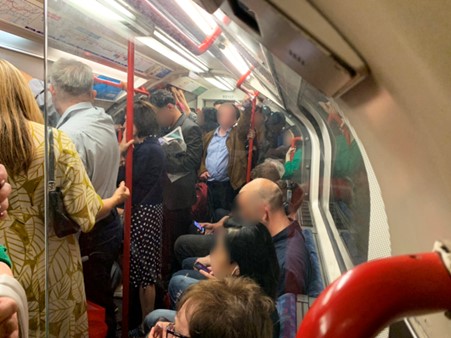
I believe that we are living in a time when people are becoming more and more disconnected from one another, and part of the problem also has to do with the consequences of the pandemic social distancing/quarantine rules – which was a necessary evil.

While the social distancing guidance may have been withdrawn, I think there seems to be a continuous trend where people keep each other’s distance even after the pandemic. Loneliness is becoming more perverse; people are becoming removed from social life, and procrastination seems to have taken centre stage.
Again, the rise and usage of multiple social media platforms have also put us where we are slowly replacing our physical presence with our digital presence. We can easily sit behind our WhatsApp, Twitter or TikTok for hours without speaking – but submerged in this digital world. While I am not in any way condemning the use of social media, I think we risk our physical interactions being replaced with digital interactions, which I also consider a contributing factor to the decline of social interactions we face today.

I agree that we all must move with time; we have to adjust ourselves to this new world, or else we will be left behind. However, I suggest not letting our physical engagement dissipate, nor should we allow our digital presence to become more important than our in-person presence. As indicated earlier, we are witnessing a decline in social interactions, but the task ahead of us as a society is to begin to consider ways to ameliorate this problem. There is value in social interaction, even if some might not see the benefits of it. Some studies in the past have found that ensuring good social interactions can improve psychological well-being. Thus, my assignment for everyone reading this blog today is to pick up your phone and check up on a loved one! The sun is out (well, for now); take a break and go out with your friends, have some food and drinks over the weekend, exchange some jokes, and smile!
Life, indeed, is a beautiful thing to have.

Reference
Blumer, H. (1969). Symbolic interactionism: Perspective and methods. Englewood Cliffs, NJ: Prentice Hall.
Share this:


If I had a time machine…which coronation would I see?
If I had a time machine…which coronation would I see?
If I had a time machine, I would most certainly travel back in time…to witness some great moments in history.
The birth of Jazz in Congo Square in New Orleans, or
Martin Luther King deliver that great speech in Memphis the eve of his assassination, or
The moment the first white man set shore upon the Niger Delta.
Would I go back and see
The crowing of King George, or
Queen Victoria’s coronation, or
Would I be wicked enough to sneak into the palace of the tiny Spanish queen Anne who gave permission and cash to ‘explorers’ who’d cast caste onto the dark skins of every ‘native’ they encountered.
Caste. And race.
Without imperialism, there’d be no black stain upon my skin against which my ancestors resisted.
Without the profit of human trafficking, there’d be no need for labels like Black or white, nor
Racism, nor patriarchy for that matter, a concept squarely meant to trace intergenerational wealth Black folks have been robbed in these United States and upon these British Isles.
See, my mother tongue is English –
The language my Black mother spoke to me came through colonialism.
We were enslaved and inherited names and customs that are easily recognizable to Brits today.
This language limits how I discuss these events, and
Unless I try really hard, and make concerted efforts,
This language limits how I think about these concepts.
You heard that? The English language limits places I take myself in my own mind!
These facts are maddening.
If I describe the Spanish explorers as conquerors, and
Tell you that virtually every pope was a sinner not a saint, and
If I could go back in time, I’d slit the throat of that young Spanish queen, and
If I admit that I have nothing but disdain for every English man, woman and child who’s held that orb Charlie held this past Saturday, then
Even by my own standards, I question if I’d be the hero of my own history.
If I were to go back in time and arm Nat Turner with weapons, or
Help Harriet Tubman guide folks along the underground railroad north to freedom, or
Go further back and try, try, try to stop the entire triangular slave trade altogether, then
I must accept that I’d be erasing myself.
I’d risk robbing Congo Square of its famed place in history, and
I might not be able to hear the pop, Rock, Hip-Hop and House music blasting out of this tawdry bar’s speakers right now.
I’d risk not even being me.
This does not make me grateful for the crown, nor
Does it reduce me to resentment and rage.
It’s complicated.
I’m proud of the New World cultures Africa and her Diaspora have made from our mangled past.
My identity?
It’s layered.
As layered and, again, as complicated as all the fates of all the peoples of the Commonwealth to whom I am now tied due to, dare I say, the golden and bejeweled crown
Carefully placed upon your king’s head.
Long may he reign.
Not.
We all want our histories repaired.
And an end to monarchy.
The End.
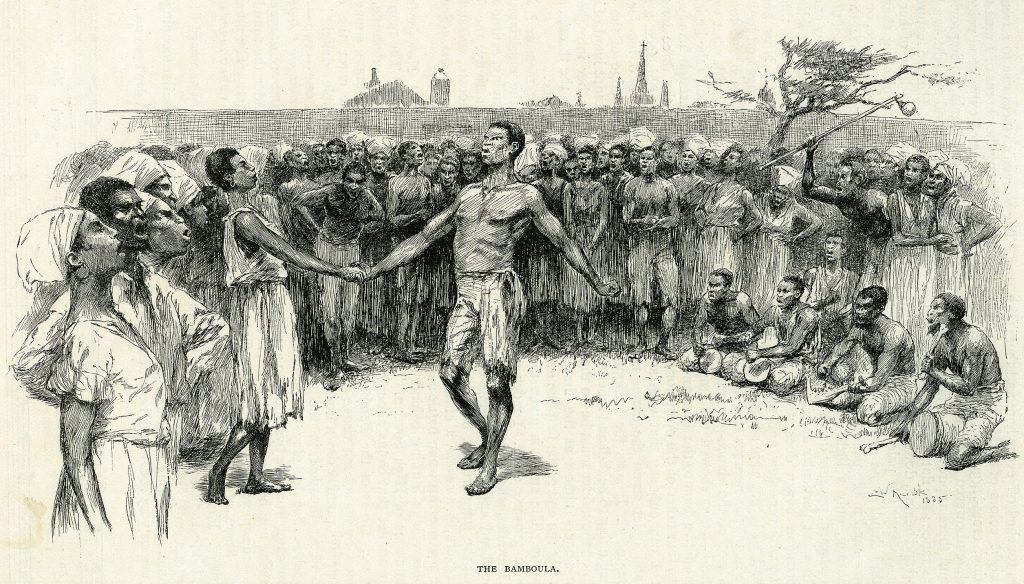
Dancing in Congo Square, AKA The Queens and Kings of Jazz
Share this:


Brought to You by Tampax
Whilst social media platform Twitter is routinely criticised for being a toxic cesspit of trolls, racism and discrimination, there is an opposing story: commentators like Kelechi have used their platforms to mock power. To the untrained eye, her tweet appears random but it is actually referencing #TamponGate – a scandal that was picked up by the British press in 1993 when Charles confessed to Camilla he wanted to “live inside” her trousers, joking that he might be reincarnated in the life after death as tampon.
Discourses to tampons aside, potential of solidarity and coalition in our shared trauma under the British Crown will be manifestly apparant this bank holiday weekend – just as it was during the scenes on social media during the Commonwealth Games, Jubilee and Queen’s Funeral. Black Twitter, Irish Twitter, and Indian Twitter alongside Scouser Twitter and Celtic Fans Twitter will probably be linking up. Edutainment and memes aplenty. With the long bank holiday weekend, I know other political commentators will take to Twitter, Instagram, TikTok and Tumblr to vent their frustrations.
Potential for coalition and solidarity presents itself in the deep space of the interweb. Under the thinking of the social media posts, there sits an exhaustion from groups that have long been exploited by the monarchy. Audre Lorde (1984) once termed racism and sexism as “grown up words” (p152) revisiting how victims often acquire the language to articulate their experience after the experience. In her blog post ‘Feminism and Fragility’, sociologist Sara Ahmed (2016) further states “Once we have the words, you are putting a sponge to the past: mopping things up, all that spillage.” So, this experience revisits the bit bitting at institutional violence and how actions become institutionalised by repeated behaviours.
As Bob Marley said
“So if you are the big tree
Small Axe, (Burnin’, 1973)
We are the small axe
Ready to cut you down (well sharp)
To cut you down”
Meanwhile, I must ask ‘did Tesco actually call [redacted] a [redacted]?
Whilst the pomp of the coronation is absorbed into the brains of millions of people around the world, this is happening during a Cost of Capitalism crisis, paid for at the taxpayers’ expense. Sounds of abolish the monarchy can be heard around the world. I do wonder what Britain would like without this mafia institution. When you do start looking at these systems more closely, you begin to see how entangled the monarchy is with other institutions – police, prisons, and many more – including entities like Honours committees, the privy council and House of Lords too. To abolish the monarchy is also linked with other abolitionist narratives.
Like every other criminology blog entry, now let’s discuss Guy DeBord’s theory of ‘the spectacle’. ‘The spectacle’, said French Marxist Guy DeBord, is a system of domination that claims your attention and then your attention faciliates your subjugation. So, the irony is that even with my dislike of the monarchy – I’m doomed if I do, and doomed if I don’t talk about it – because within the advertised life of the spectacle, there’s nothing I can say that doesn’t make the spectacle stronger.
Meanwhile, the appeal of Harry & Meghan in this case act as a violent juxtaposition to a British public who in many ways still see “good” and “bad” royalty, not The Crown as a wholly imperialistic violent construct. To me things like coronations, jubilees keep us distracted. Even when trying to avoid such nonsense, our world has become so saturated by media. As Guy DeBord writes “There is no place left where people can discuss the realities which concern them, because they can never lastingly free themselves from the crushing presence of media discourse and the various forces organised to relay it” (DeBord, 1998: 19).
Anyhow, now as all of us are immersed in the spectacle, we may as well stay implicated. In the 1960s, it was possible to think critically. Now, being a philisopher just means you have watched Inception!

 Thoughts from the criminology team