
Home » 2021 (Page 8)
Yearly Archives: 2021

Reflecting on International Women’s Day
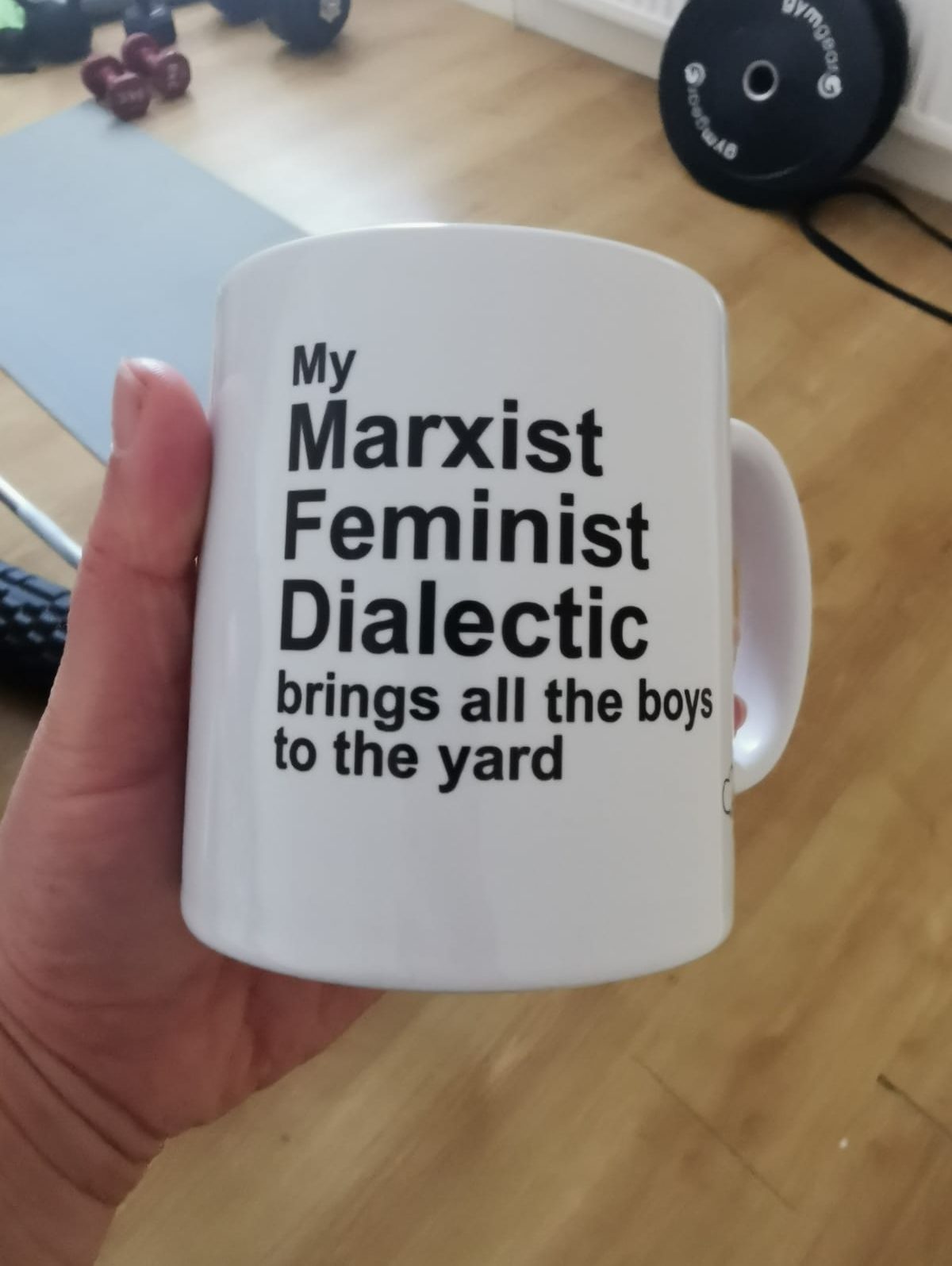
On International Women’s Day I wanted to write a blog to celebrate the incredible women who have inspired me, supported me, fought for the rights of women all over the world both past and present. Perhaps that post will come but I felt sadness and anger, rage that made me want to shout and swear from the rooftops that feminism is not done. Gender equality has not been completed. We may have advanced a few levels, but patriarchy is still alive and free right here in England as well as throughout the world. The reality is that gender equality is a myth. Ordinarily I’m more hopeful and positive and maybe the pandemic combined with finishing my PhD is pushing me over the edge. But as well as celebrating International Women’s Day I wanted to identify some of the areas in which there is work to do, both in the UK and worldwide.
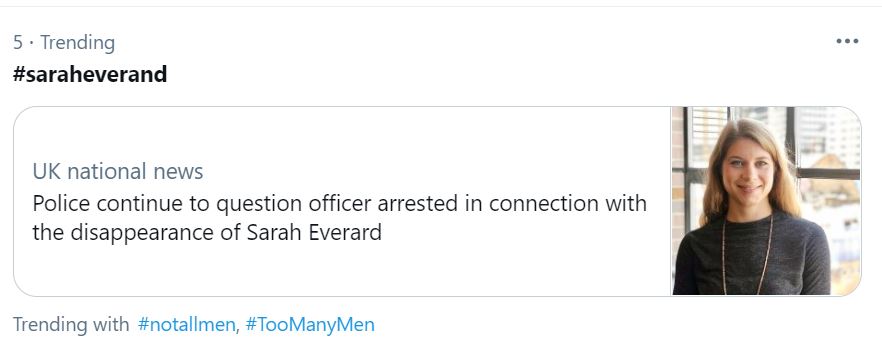
On the week of International Women’s Day, the media has been filled with women, but not for the right reasons. Let us start with the interview broadcasted on International Women’s Day with Megan Markle and Prince Harry which highlighted not only her position as a woman but also the intersectionality of being a woman of colour in the royal family and the implications of this. The interview was responded in an appalling manner by Piers Morgan who questioned her experience of feeling suicidal which was then reflected on social media (never read the comments!!!). A woman’s experiences with mental health were questioned and ridiculed. Not long after the tragic death of Caroline Flack, people – including many other women – have forgotten to #bekind. The investigation over the disappearance of Sarah Everard was responded to by the Met police advising women in the local area not to go out at night, perpetuating a culture of victim blaming. A woman’s actions were being questioned. So here we are in 2021 with our internal thoughts and emotions and our external actions being judged by others. When women have spoken out about our right to feel safe walking home at night, about how we walk the long way home and hold a key between our fingers for protection, #notallmen resurfaces on Twitter, in a similar tone to #alllivesmatter last year. When one group renews a call for equality, the patriarchs and supremacists oppress harder. These are just a couple of examples in the media, the public domain, this week but there is also clear inequality in domestic life.
Throughout the pandemic there have been numerous reports suggesting that women have disproportionately undertaken childcare which has had a devastating impact, particularly for single mothers. While data from the Office for National Statistics shows that home schooling is distributed equally in mixed sex couples, women have undertaken substantially more of non-developmental childcare – the bathing, bedtime routine, feeding etc. I recall the days of being a working single parent with a small child. With no after school club and no family available to chip in, I relied on childcare swaps, a childminder (who I couldn’t afford to pay more than a couple of days per week). It was a case of beg, borrow or steal whatever childcare I could get to get to work and would often miss lectures because I didn’t have any childcare (note to students – if you have childcare responsibilities and are struggling please do not hesitate to drop me an email. I have almost a decade of experience juggling kids with studies and I am always happy to share tips or just have a mutual rant about how hard it is!). I cannot imagine how I would have managed with the pandemic if my children were younger. I am lucky enough to work in a team where my colleagues don’t bat an eyelid when my teenager pops her head in asking for food or help with schoolwork but I do have friends telling me how their male counterparts have given them advice on how to juggle virtual meetings with parenting small children. Men (not all men – some men are excellent allies) having no clue how hard women have to fight as women to do it all – the career, the childcare, the housework, all while earning less than our male counterparts (currently 15.5% less). Of course the data on equal pay is complex but the bottom line is we get paid less, it’s harder to advance our careers because as we live in the bodies that produce babies and we have career breaks when we take maternity leave or go part time while the children are young – the only way that can change is if we choose not to have kids and we are criticised for that too!
I have so far established that the UK is hostile in the media and not equal in the home and employment but where do we sit globally? It was placed 21st on the Global Gender Gap Index 2020. Do you think you could guess which countries are higher than the UK? Go on, spend a minute and write down who you would expect to be in the top 20. Of course, there are the countries one might expect – Iceland is top of the list, Norway, Finland and New Zealand too. But let’s throw a curveball in there. Albania. Having worked with and interviewed many female Albanian asylum seekers and refugees who have usually fled Albania due to at least one but often many forms of gendered violence this comes as quite a surprise to me. Of course, I have a biased experience and have only come into contact with those who have had devastating experiences of patriarchy in the country. Rwanda is up there too within the top 10. Not long after the devastating genocide in Rwanda where women were brutally raped as a weapon of war (see here for a cheeky plug and an analysis of sexual violence in conflict in a different geographical context). Today, women make up half of the politicians in the country. Women have risen up and have taken power. In the UK I look at the female politicians in power today and in recent years and I recoil in horror. Priti Patel is probably (barring the Queen) the most powerful female politician in England. I witness first hand in my work with asylum seekers the harm she causes every day. Intentional harm, following in Theresa May’s footsteps to create a hostile environment for migrants. These women are not the people I want to look up to, or want my children to look up to. In fact, one of the few shared interests my daughter and I have is our disdain for these women.
The women I do look up to are those asylum seekers Patel and her band of merry men at the Home Office are trying to repel. Those who have fled situations that I, as a middle class white woman cannot even begin to comprehend. All the women who I have interviewed in my doctoral research had either fled gendered violence including forced and child marriage, domestic abuse, sex trafficking and honour violence; or their gender had intersected with other forms of persecution making their living situation untenable because they were women. They fled life or death situations to the point of leaving their homes, families and countries because their governments could not, or would not, protect them. They arrive in the UK and are faced with the hostile environment conjured by May and continued by Patel and both the Home Secretaries in between. They face structural violence in the forms of forced poverty, illegal detention, substandard and sometimes dangerous accommodation perpetrated under the mandate of women. All the while being vilified by the tabloids and swathes of the public. Some of my participants arrived here as children and were bullied in school because they were asylum seekers, being told that they were taking jobs and money. The bullies could not comprehend that they were prohibited by law from working and were given £5 per day to live on. They then hid their identities, never telling anyone that they were an asylum seeker, lying to their friends about why they couldn’t go on college trips abroad, why they couldn’t have a bank account, why they couldn’t get a job or go to university.
I want to celebrate Amira* who defied the odds. She came here when she was in her early teens, knowing just a few words of English. She worked hard to learn the language and passed her GCSEs and A-levels, gaining a competitive Sanctuary scholarship which funded her university education. I want to celebrate Drita, an Eastern European woman who was physically abused by her father as a child, forced to marry an abusive man who eventually left her destitute with three children. She then left her children with her parents while she sought work, got a boyfriend who sold her into sex slavery, set her room on fire to kill herself but managed to escape, picked up her children and fled a lifetime of gendered violence from every man she had ever met. She spent 2 days in a lorry with her children to get to the UK. Not really the UK, she would have gone anywhere, just out of her country to safety. These women are survivors. These women fought to stay alive. They fought to escape. They didn’t escape. They arrived here to face May’s legacy of a hostile environment. These women are terrified every time they have to report to the Home Office, every letter they get threatens them with detention and deportation and reminds them that they or on bail, literally equating them with a process usually found in the criminal justice system. These women are heroes and should be celebrated for surviving. On International Women’s Day yes, let us celebrate all that all we have achieved so far but it cannot end here. Each year we need a renewed call for action for women.
*All names are pseudonyms to protect the anonymity of participants
Share this:


Sundays on the plantation. (Soundtrack: Sunday in Savannah by Nina Simone)
On Sundays, the slaves played music, sang, and folks danced.
Ev’rybody could see their spirits were lifted.
Human spirits need to be lifted in order for folks to live.
HUMAN ENSLAVERS must constantly stamp out the spirits in order to maintain slavery.
All spirits.
The masters’ arsenal included weapons for splitting their hearts from their righteous minds.
Slavery is a godless institution, so
They made a holy art from preaching and practicing duplicity – like Capoeira, only deadly.
So, slaves dancing and singing was restricted to Sundays.
All other days were reserved for the masters to sharpen their hooves.
White pastors reserved Sundays to forgive white sins.
Such sweet Sundays on plantations was all depicted in the 2016 remake of Roots.
The Sunday after the birth of Kunta Kinte’s first child,
The Fiddler and Kunta were out at night to perform the naming ceremony –
A tradition repeated across every generation in the series,
Which opened with Kunta’s own ceremony in Africa, presumably near modern-day Banjul.
3 slave catchers caught them out in a storm.
Fiddler gave his life so that the 3 slave catchers wouldn’t take Kunta’s “tar baby” as
“Nigger tax” for being caught out at night, without papers,
Not as if they’d asked. An escape was quickly plotted.
Fiddler caused a distraction,
Kunta started running, cuddling his newborn,
His gait hindered by the limp he got when catchers cut off his foot the 2nd time he’d escaped.
During this altercation,
Fiddler knocked one of the catchers off his horse, then
Wrangled the sword away from another, and
Stabbed him to death, only to be killed moments later by the 3rd catcher’s blade.
Meanwhile, Kunta had stashed the baby beneath a tree.
He waited for the third catcher to chase him down on his horse.
Kunta knocked him down, grabbed the catcher’s axe and swiftly cut his throat wide open.
He picked up his first-born child, and
Stumbled back to check on Fiddler’s corpse before making his way safely home.
That Sunday, Kunta resolved to train his daughter to resist slavery.
He did.
She did.
As did their descendants – resist.

Share this:


Lockdown and Locked In

The COVID-19 pandemic has caused a whole range of issues for so many people. Everything from job losses, businesses closing down, people being unable to leave the house, people panic buying and stock piling. There has also been a sharp increase in mental health issues, loneliness, isolation, and fears about what the future holds.
However, one thing that has been reported on, is the increase in domestic violence that has occurred across the country. In April 2020, phone calls to the charity Refuge were up by 49%, (1) and people accessing their website seeking help had increased by 417% (2). As more people are working from home, abusers are at home too, making it harder for survivors of domestic abuse to get away from their partners.
In an effort to combat domestic abuse, and to provide confidential help to survivors, the government launched the ‘Ask for ANI‘ codeword scheme (Action Needed Immediately) whereby a survivor of abuse can go to their local pharmacy and get private and confidential help. Survivors can ask if they want to get help from a domestic violence refuge, or to get the police involved. Everything will be led by the survivor who will be in the private consultation room with the pharmacist helping the survivor (3)
References
(1) Home Office (2021) ‘Domestic Abuse and Risks of Harm Within the Home’ Available online at: https://publications.parliament.uk/pa/cm5801/cmselect/cmhaff/321/32105.htm#_idTextAnchor000 Accessed on 19/02/2021
(2) House of Commons (2020) ‘Home Affairs Committee’ Available online at: https://publications.parliament.uk/pa/cm5801/cmselect/cmhaff/correspondence/HASC-transcript-15-April.pdf – page 24. Accessed on 19/02/2021
(3) HM Government (2020) ‘Guidance for Pharmacies Implementing the Ask for ANI Domestic Abuse Codeword Scheme’ Available online at: https://assets.publishing.service.gov.uk/government/uploads/system/uploads/attachment_data/file/940379/Training_information_-_Ask_for_ANI.pdf Accessed on 19/02/2021
Other Sources
Unlisted (2020) ‘Domestic Abuse Codeword Pharmacy Training Video’ Available online at: https://www.youtube.com/watch?v=OOs3awxx5YU&feature=youtu.be Accessed on 19/02/2021
Share this:


Happy birthday and reflection on the (painful) art of writing

In November 2016, I had an idea that the Criminology team should create and maintain a blog. To that end I set up this account, put out a welcome message and then life (and Christmas, 2016) got in the way…. To cut a long story short, @manosdaskalou, @5teveh and I decided we’d give it a go, and on the 3 March 2017, @manosdaskalou broke our duck with the first post. This, of course, means we are celebrating the blog’s 4th birthday and it seems timely to reflect both on the blog and the (painful) art of writing.
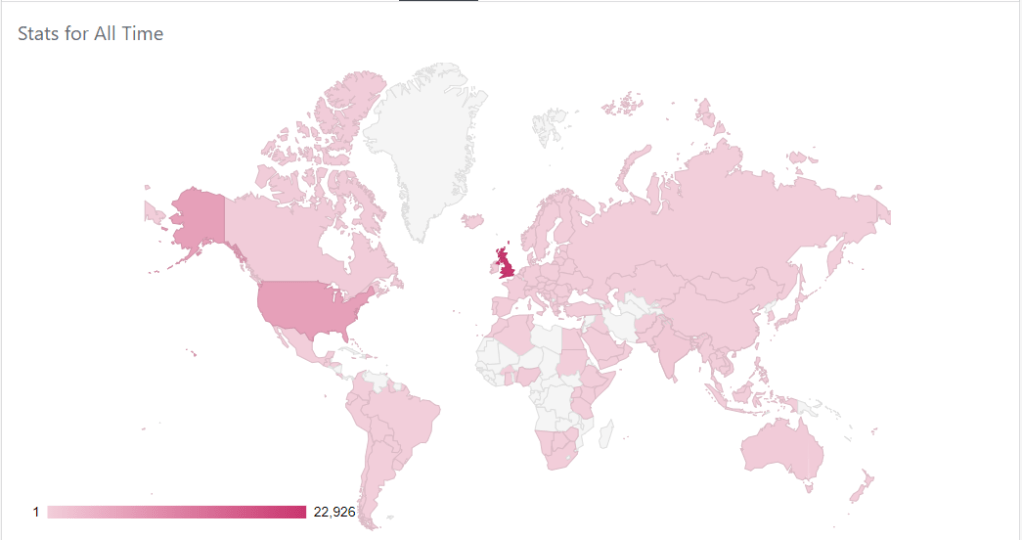
Since that early foray the blog has published almost 500 times and has been read by almost 23,000 people from across the globe. As you can see from the map below, we still have a few areas of the globe to reach, so if you have contacts, be sure to let them know about us 🙂
To date, our most read individual entry comes from a current student @zeechee, followed closely behind by one of @manosdaskalou‘s contributions and then one from @treventoursu. But of course, the most popular page of all is the front page where the most current entries are. That’s not to say that some entries don’t crop up again and again, for instance @manosdaskalou‘s most popular entry went live in May 2017, @zeechee‘s in January 2020 and @treventoursu‘s in February 2020. Sometimes these things take time to find their audience, but it shows you can’t hide excellent writing and content finds a way through.
Over the past 4 years we have had contributions from a wide range of people, some have contributed just one or two, others more frequently and the three founding members (once started) have never stopped blogging. During this time, bloggers have covered an enormous range of different topics, some with more frequency than others. Of course, this year much of the content, whether intended or not, has had connections to the ongoing global pandemic. The blog for both writers and readers has offered some distraction, even if only 5 minutes escape whilst waiting for the kettle to boil, from the devastation wrought by Covid-19.
All of the above gives us much to celebrate, not least our stamina and perseverance, but says nothing about the art of writing which I’d like to reflect on now. By the time it’s live on the blog, the process is forgotten, until the next entry becomes due. For some people writing comes easily, for me, it doesn’t. I find all kinds of writing painful and often like pulling teeth. I know what I want to say, I have a reasonable vocabulary, knowledge of my discipline and a keen eye on current affairs. All of this is true until I start the writing process….
Some of my reluctance relates to my individual personality, some to my social class and some to my gender. It is probably the latter two which create the highest barriers and I find myself in a spiral or internalised argument around who would want to read this, why should they, everyone knows this and on and on ad nauseum until I either write the sodding thing or very rarely, give up in disgust at my own ineptitude. I know this is irrational and I know that I have written many thousands of words in my lifetime, most largely forgotten in the fog of time, but still, every time the barriers shoot up. What makes it worse is that I can generally fulfil what ever writing brief I am confronted with, but only after a gargantuan battle of wills with myself.
Despite this a couple of things have helped considerably. The first is a talk originally give by Virginia Woolf in 1931. In this very short piece, entitled ‘Professions for Women’, Woolf details similar struggles, much more eruditely than I have, in relation to writing as a women.
The obstacles against her are still immensely powerful—and yet they are very difficult to define. Outwardly, what is simpler than to write books? Outwardly, what obstacles are there for a woman rather than for a man? Inwardly, I think, the case is very different; she has still many ghosts to fight, many prejudices to overcome. Indeed it will be a long time still, I think, before a woman can sit down to write a book without finding a phantom to be slain, a rock to be dashed against.
Woolf, 1931
She also names the internal conflict the ‘Angel in the House’. For Woolf, this creature has to be murdered in order for the female writer to make progress. For someone, like me committed to non-violence/pacifism, killing, even of an imaginary creature, is challenging, so instead I get in a few nudges, make my ‘angel’ agree to be quiet, even if only for a short time. As Woolf alludes, some days this works well, other times not so much, acknowledging that even when dead, the angel continues to undermine. Nevertheless this short essay helped me to understand that my so-called foibles were actually shared by other women and were formed during our socialisation. Because of this, I have regularly recommended to female students that they have a read and see if it helps them too.
The other thing that has really helped is the blog. The commitment to write regularly, to a deadline, has helped considerably. Although I know that I’m part of a team equally committed to the success of the blog, makes a difference. It ensures accountability. Of course, I could call on anyone of my colleagues to cover my slot, but I would be doing that knowing that I am adding to another person’s workload. Alternatively, I could opt not to write and leave a gapping hole on the blog that day/week, but again that would be letting down everyone on the blogging team, we all have a part to play. So sometimes reluctantly, other times with anger, still more times with passion, the words eventually come. I cannot speak for my fellow bloggers but I can say with some certainty blogging has done wonders for me in terms of accountability, not to mention the pleasure of working with a group of interesting and exciting writers on a regular basis.
Why not join us?
Share this:


Praise for Miss Saundra. #EssentialWorkers @ School
In the second grade, I started in a new school that was designed as a progressive environment where students, teachers and administrators were all on a first-name basis. Radical, even in ’82, our school was forward about gender, race and class diversity. Despite this, I only had one Black teacher in my elementary school years – the amazing music teacher. As kids, we could see few other Black adults: the assistant librarian, a handful of the lunchroom ladies, as well as the Black middle- and high-school teachers we saw in the same building. This meant that the Black adult we most consistently interacted with was Miss Saundra, the janitor.
Miss Saundra appeared around corners, could surprise you out of a closet you hadn’t even noticed was there. She was always on hand should there be any major mess or spill. Best of all, our school gleamed from top to bottom, every classroom, every hallway, every bookshelf, every restroom – every desk! It felt lovely to go to school every day, the floors shined, the windows sparkled, and even the banisters were pristine. I am certain this level of hygiene must have taken a team, but I remember Miss Saundra, probably because she was friendly to me. I can still see her, unbending her back to look at us, and speak face to face.
If I ever had to come to school early to play in the gym or have breakfast, or stay late for an after-school activity, Miss Saundra would likely be there, tidying up. She always took time to greet us. She was even there for school dances, and asked nothing in return, and we knew nothing of her outside the labor she devoted to us in the background. She was our school’s magic negro.
Other than the school guard who was not armed with anything but charm, Miss Saundra, might have been the first at school, followed by the ladies making breakfast. These were our essential workers – like the air we breathed in the heart of our city. I like to think because of their personalities we felt at home in our environment and therefore enjoyed school more fully.
Kids carry on.
When I was in the third grade, our teacher – a tall, grey-haired white man of grand stature who taught me I could master math even though it wasn’t easy for me – sent all the girls ahead to music class. He held the boys back for a chat. Apparently, someone had urinated in the second-floor boys’ bathroom, and they’d worked out that only our class had taken a break between cleanings. Since teachers had separate restrooms, I thought it must have been Miss Saundra who’d discovered the mess, and so I wondered what that conversation was like with our teacher, who was now accusing us! Though he didn’t demand we rat out the culprit, he called it “nasty,” and said we could get electrocuted, because “electricity travels through water,” wagging his index finger like it was on fire. With that, he sent us off to music!
This was probably the first time that I’d been explicitly asked to identify as a gender, and it was over THIS! I knew that whoever had done it would have needed an audience. So not only did some fool piss on the wall, some other fool(s) stood around and watched! I thought, what bastard did this! Didn’t they know Miss Saundra would have to clean it? Didn’t she greet them, and ask them how they’re doing like she does me? Did they ‘see’ Miss Saundra everyday like she saw us? Why would they piss on her parade? Why give Miss Saundra the blues for your pissing contest!
I stopped by the bathroom on the way back from music class. Sure enough, Miss Saundra had been done had it squeaky, bleachy clean! I could never have imagined girls’ doing something like that.
I knew that like me, Miss Saundra was an outsider in a space where I belonged. I knew people like Miss Saundra, so she was not a stranger to me. I had no ambitions of becoming a janitor, but I certainly knew women, in my family and in my community, who did this sort of work. And those women I knew who did that sort of work encouraged people like me to do well in school, so I could take advantage of the kinds of choices they didn’t have. I had no reason to think Ms. Saundra less of me. What’s more, even though I felt strange in my own body, she treated me as human, especially. The gratitude I feel for her sounds like a tambourine in my own theme song.
#EssentialWorkers, #SanitationWorkers
Share this:


The Peace of ‘the Lamb with the Lion’ (Oh say, can you see?). Happy not Leap Day #BlackenAsiaWithLove
The peace of the Lamb with the Lion (Oh say, can you see?)
There is no peace between the lamb and the lion.
The lion will always feel hunger, and feast, nurture cubs, and prosper on lamb.
This becomes the lion’s nature.
The lion may grow greedy on the ease of his feed.
Wallowing on his back in the sun, him belly full o’ greed.
For the lion, none of this is the slaughter of the lambs.
🎵Them belly full but we HUNgry.
Black people were born into the American caste system hangry!
White people, on the flip side, were granted freedom to feed themselves, and
Gain capital if they agreed to cooperate – actively or passively -with the system of hate.
Many men did, many were coerced with the promises and benefits and power of whiteness.
Hunger and anger easily fester into animality, hell and hate – none of which leads to liberation. If we were determined to be free, merely mastering the masters’ tools could not be our fate. We have had to craft a culture of resistance… based on love. This is the antithesis of the Greed, Anger and Stupidity that fuels hate. In our resistance, we have forged the ‘strength to love’ ourselves, in spite of the ‘birth of the nation’. Humanists of all hues always find a way.
Early that winter after Emmett Till was executed and his Mississippi killers acquitted, the radical Mrs. Rosa Parks refused to continue to go along with riding Jim Crow in Alabama, and in so doing gave Dr. King his final cue. Down one summer from up north, apparently young Till had made some form of pass at a white woman in a shop in town. He crossed Jim Crow, for which he had to be promptly sacrificed.
Apparently, Mamie Till had sent out a powerful signal that summer by leaving the casket open for all to view her son’s dehumanized corpse – an honor killing, quite scripted and business as usual by that point in our nation’s still hopeful nascent democracy. Ms. Till resisted. She’d crossed a line by balling her fist, then pointing her accusing finger squarely at Jim Crow – that’s who’d snatched, brutally tortured, mutilated and murdered her boy. The lions had fed. “Dar he,” Till’s uncle, Moses Wright, said standing in court, pointing to the men who’d dragged the boy from his house, never to be seen alive again. They could no longer cooperate with a corrupt and deadly system.
Reading Rosa Parks’ cue, King rallied his congregation, and
Agitated the local community, and
Called for a boycott,
Not a storming of the state capital, which still sits just a stone’s throw from his church.
Teach-ins, sit-ins, rallies and marches followed.
They called them rioters-n-things just they do today.
Roaring, shouting, chanting, singing: We! Shall! Overcome (period).
They were met with guns and bayonets on bridges,
At schools, white parents mobbed Black children trying to make their way.
Now, Miss Betsy pays for her kids to go to private schools and ignores the public ones.
We were singing the blues for Mister Charlie.
This blues train was a just stop along long revolutionary tracks that have deep underground roots.
We’re talking ‘bout a revolution!
Bayard Rustin taught Martin Luther King the power and techniques of non-violent civil resistance. By 1959, MLK had assumed the rhetoric and role of Fredrick Douglas, and began
fellowshipping with Dalits while studying how Gandhi-ji had spearheaded a non-violent imperial defeat, which decolonized, yet ultimately, further splintered the sub-continent. Such solidarity still stands between oppressed and progressive peoples everywhere.
King’s call to conscience and action grew…the lambs bellowed out for solidarity.
King’s movement joined hands with people of all races, religions, all faiths, and
They marched arm-n-arm with the humanists among sinners, senators, students and sanitary workers, and
Gave the president the language of emancipation, and
Then Dr. King advocated against war,
Just as poor and Black soldiers were being disproportionately deployed to die on the front line.
They say that’s what got him shot-n-killed to death…
A casualty among many.
There are people around the world today singing “
GAS fuels hate!
This is why we can’t wait!
Progressives peacefully demonstrate to affirm our shared belief in humanism,
In spite our CONstitution’s original ill-fate.
Love is the true heart of patriotism.
Peace is what our actions illustrate.
So, get up and sing your blues today because #BLM:
🎵Get up! Stand-up!/Stand-up for your rights!/Get up! stand up!/Don’t give up the fight! [repeat infinitely]
Share this:


Keep Calm and Forget the Pandemic or What to do in a pandemic? Take advantage of the situation
Eleven months now and there is a new spectre haunting Europe; a plague that has taken hold of our lives and altered our lifestyles. Lockdowns, the r rate, viral transmission, mutations are new terms that common people use as if we are experienced epidemiologists. Masks, made of cloth or the surgical ones, gloves and little bottles of antiseptic have become new fashion accessories. Many people report mental fatigue and others a state of confinement inside their own homes. Some people have started complaining that there is no light in this long tunnel, in country after country face with overwhelmed medical staff and system.
The optimist in me is unequivocal. We can make it through. Life is far more powerful than a disease and it always finds a way to continue, even in the most hostile of conditions. In my view however this is not going to be a feat of a great person; this is not going to be resolved by one solution. The answer is in us as a collective. Humanity thrived when it gets together and the ability to form meaningful bonds that is the backbone of our success to survival.
Imagine our ancestors making their first communities; people that had no speed like the felines, no strength like the great apes and no defensive shell to protect them. Coming out of Africa thousands of years ago, this blood creature had no offensive nor defensive structures to prevail. Our ancestors’ survival must have been on the brink. Who could imagine that some thousands of years ago, we were the endangered species? Our endurance lies on the ability to form a group that worked together and understood each other, carried logic, used tools and communicated with each other.
The current situation is a great reminder of the importance of society and its true purpose. People form societies to protect each other and advance their opportunity for success. We may have forgotten that and understandably so, since we have had people who claimed that there is no such thing as a society, only the individual. The prevailing economic system focuses on individual success, values individual recognition and prioritises individual issues. In short, why worry about others, miles away, feet away, steps away from us if we are doing well.
It is interesting to try to imagine a society as a random collection of indifferent individuals, but more people begin to value the importance of the other. After years of austerity and the promotion of individualism, more people live alone, make relationships through social networking and mostly continue to live a solitary life even when they live with others. Communities, as an ex-prime minister claimed as broken and so people waste no time with them. We take from our communities, the things we need, and we discard the rest. Since the start of the pandemic, deliveries, and online companies have been thriving. Whilst physical shops are facing closure, online ones can hardly cope with the demand. As a system, capitalism is flexible enough to retune the way wealth is made. Of course, when you live alone, there are things you cannot have delivered; intimacy, closeness, intercourse. People can fulfil their basic needs apart from the one that makes them people; their socialisation. We will have to address it and perhaps talk about the need to be a community again.
In the meantime, what happens at the top? In the Bible there was the story of the pool of Siloam. This miraculous pond blessed by an angel offered the opportunity for clemency for those who swam in the waters. Wipe the slate clean and start again. So, what do governments do? Interestingly not as much. Right now, as people try to come to terms with loss, isolation and pain, different governments try to address other political issues. One country is rocked by the revelations that its head of state has created a palace to live in. Another one, has finished construction of his summer palace. In another country they are bringing legislation to end abortions, in another they propose the introduction of police on campuses. Others are restricting the right to protest, and in a country famed for its civil rights, legislation is being introduced not to take pictures of police officers in public, even if they may be regarded in violation of duties. It seems that it is open season for the curtail of civil liberties through the back door. In an island kingdom the system has ordered and moves forward with the construction of more and bigger prisons. A sign that they anticipate public upheaval. Maybe; whatever the reason this opportunity to supress the masses may be tantalising, but it is wrong. When ever we come out of this we need to reconnect as a community. If this becomes an opportunity for some, under the suppression of civic rights, things will become problematic. For starters, people will want to see their patience and perseverance rewarded. My advice to those who rule, listen to your base.
Share this:


The Case of Mr Frederick Park and Mr Ernest Boulton

As a twenty-first century cis woman, I cannot directly identify with the people detailed below. However, I feel it important to mark LGBT+ History Month, recognising that so much history has been lost. This is detrimental to society’s understanding and hides the contribution that so many individuals have made to British and indeed, world history. What follows was the basis of a lecture I first delivered in the module CRI1006 True Crimes and Other Fictions but its roots are little longer
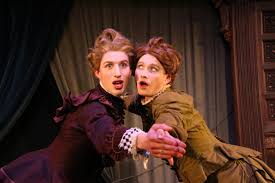
Some years ago I bought a very dear friend tickets for us to go and see a play in London (after almost a year of lockdowns, it seems very strange to write about the theatre).. I’d read a review of the play in The Guardian and both the production and the setting sounded very interesting. As a fan of Oscar Wilde’s writing, particularly The Ballad of Reading Gaol and De Profundis (both particularly suited to criminological tastes) and a long held fascination with Polari, the play sounded appealing. Nothing particularly unusual on the surface, but the experience, the play and the actors we watched that evening, were extraordinary. The play is entitled Fanny and Stella: The SHOCKING True Story and the theatre, Above the Stag in Vauxhall, London. Self-described as The UK’s LGBTQIA+ theatre, Above the Stag is often described as an intimate setting. Little did we know how intimate the setting would be. It’s a beautiful, tiny space, where the actors are close enough to just reach out and touch. All of the action (and the singing) happen right before your eyes. Believe me, with songs like Sodomy on the Strand and Where Has My Fanny Gone there is plenty to enjoy. If you ever get the opportunity to go to this theatre, for this play, or any other, grab the opportunity.

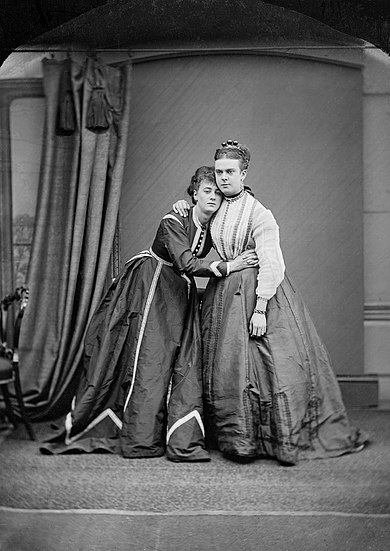
So who were Fanny and Stella? Christened Frederick Park (1848-1881) and Ernest Boulton (1848-1901), their early lives are largely undocumented beyond the very basics. Park’s father was a judge, Boulton, the son of a stockbroker. As perhaps was usual for the time, both sons followed their respective fathers into similar trades, Park training as an articled clerk, Boulton, working as a trainee bank clerk. In addition, both were employed to act within music halls and theatres. So far nothing extraordinary….
But on the 29 April 1870 as Fanny and Stella left the Strand Theatre they were accosted by undercover police officers;
‘“I’m a police officer from Bow Street […] and I have every reason to believe that you are men in female attire and you will have to come to Bow Street with me now”’
(no reference, cited in McKenna, 2013: 7)
Upon arrest, both Fanny and Stella told the police officers that they were men and at the police station they provided their full names and addresses. They were then stripped naked, making it obvious to the onlooking officers that both Fanny and Stella were (physically typical) males. By now, the police had all the evidence they needed to support the claims made at the point of arrest. However, they were not satisfied and proceeded to submit the men to a physically violent examination designed to identify if the men had engaged in anal sex. This was in order to charge both Fanny and Stella with the offence of buggery (also known as sodomy). The charges when they came, were as follows:
‘they did with each and one another feloniously commit the abominable crime of buggery’
‘they did unlawfully conspire together , and with divers other persons, feloniously, to commit the said crimes’
‘they did unlawfully conspire together , and with divers other persons, to induce and incite other persons, feloniously, to commit the said crimes’
‘they being men, did unlawfully conspire together, and with divers others, to disguise themselves as women and to frequent places of public resort, so disguised, and to thereby openly and scandalously outrage public decency and corrupt public morals’
Trial transcript cited in McKenna (2013: 35)
It is worth noting that until 1861 the penalty for being found guilty of buggery was death. After 1861 the penalty changed to penal servitude with hard labour for life.
You’ll be delighted to know, I am not going to give any spoilers, you need to read the book or even better, see the play. But I think it is important to consider the many complex facets of telling stories from the past, including public/private lives, the ethics of writing about the dead, the importance of doing justice to the narrative, whilst also shining a light on to hidden communities, social histories and “ordinary” people. Fanny and Stella’s lives were firmly set in the 19th century, a time when photography was a very expensive and stylised art, when social media was not even a twinkle in the eye. Thus their lives, like so many others throughout history, were primarily expected to be private, notwithstanding their theatrical performances. Furthermore, sexual activity, even today, is generally a private matter and there (thankfully) seems to be no evidence of a Victorian equivalent of the “dick pic”! Sexual activity, sexual thoughts, sexuality and so on are generally private and even when shared, kept between a select group of people.
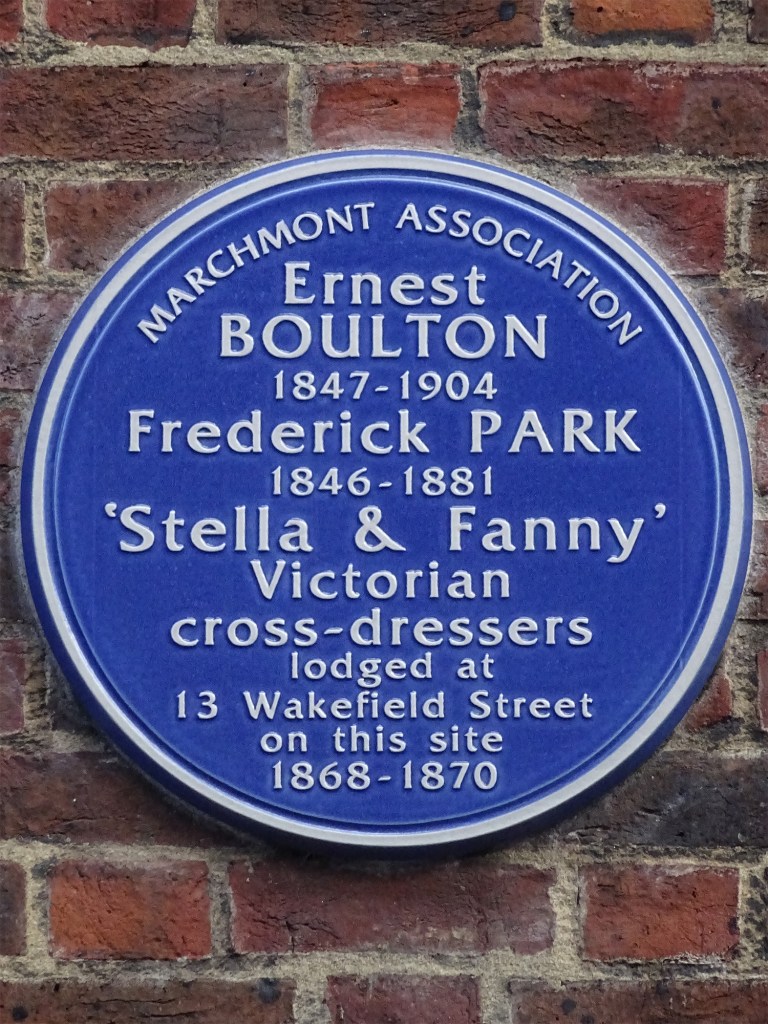
This means that authors working on historical sexual cases, such as that of Fanny and Stella, are left with very partial evidence. Furthermore, the evidence which exists is institutionally acquired, that is we only know their story through the ignominy of their criminal justice records. We know nothing of their private thoughts, we have no idea of their sexual preferences or fantasies. Certainly, the term ‘homosexual’ did not emerge until the late 1860s in Germany, so it is unlikely they would have used that language to describe themselves. Likewise, the terms transvestite, transsexual and transgender did not appear until 1910s, 1940s and 1960s respectively so Fanny and Stella could not use any of these as descriptors. Despite the blue plaque above, we have no evidence to suggest that they ever described themselves as ‘cross-dressers’ In short, we have no idea how either Fanny or Stella perceived of themselves or how they constructed their individual life stories. Instead, authors such as Neil McKenna, close the gaps in order to create a seamless narrative.
McKenna calls upon an excellent range of different archival material for his book (upon which the play is based). These include:
- National Archives in Kew
- British Library/British Newspaper Library, London
- Metropolitan Police Service Archive, London
- Wellcome Institute, London
- Parliamentary Archives, London
- Libraries of the Royal Colleges of Surgeons, London and Edinburgh
- National Archives of Scotland
Nevertheless, these archives do not contain the level of personal detail, required to tell a fascinating story. Instead the author draws upon his own knowledge and understanding to bring these characters to life. Of course, no author writes in a vacuum and we all have a standpoint which impacts on the way in which we understand the world. So whilst, we know the institutional version of some part of Fanny and Stella’s life, we can never know their inner most thoughts or how they thought of themselves and each other. Any decision to include content which is not supported by evidence is fraught with difficulty and runs the risk of exaggeration or misinterpretation. A constant reminder that the two at the centre of the case are dead and justice needs to be done to a narrative where there is no right of response.
It is clear that both the book and the play contain elements that we cannot be certain are reflective of Fanny and Stella’s lives or the world they moved in. The alternative is to allow their story to be left unknown or only told through police and court records. Both would be a huge shame. As long as we remember that their story is one of fragile human beings, with many strengths and frailties, narratives such as this allow us a brief glimpse into a hidden community and two, not so ordinary people. But we also need to bear in mind that in this case, as with Oscar Wilde, the focus is on the flamboyantly illicit and tells us little about the lived experience of some many others whose voices and experiences are lost in time..
References
McKenna, Neil, (2013), Fanny and Stella: The Young Men Who Shocked Victorian England, (London: Faber and Faber Ltd.) Norton, Rictor, (2005), ‘Recovering Gay History from the Old Bailey,’ The London Journal, 30, 1: 39-54 Old Bailey Online, (2003-2018), ‘The Proceedings of the Old Bailey,’ The Old Baily Online, [online]. Available from: https://www.oldbaileyonline.org/ [Last accessed 25 February 2021]
Share this:


Drag queens and space occupying scenes

In closing out LGBTQ+ history month, Luke Ward and I spoke at the UoN Psychology Society about our research on Ru Paul’s Drag Race. Given the popularity of the series (especially now it is available on streaming service Netflix), it is likely that even if you are not a part of the LGBT+ community, you may have seen the show (or at least shared a meme or two).
The series Ru Paul’s Drag Race first began on LGBTQ+ network Logo TV, and over the past decade, has made the move from a niche and community oriented market, to a mass market phenomenon. This echoes the roots of drag, from the underground ballroom scene in 1980s New York, to the accessible (but not always affordable) drag shows and conventions that are available today. We have moved away from the underground to taking up more space – cis, straight, previously unavailable space – which has made drag something more lucrative than its initial inception.
It is within this commercialised region of drag that we see a shift in focus within the community. It is not just a symbol of resistance against societal norms of gender and sexuality, but it is also something of a commodity – something that to our (patriarchal) society, has become useful, in being able to sell products (literally – make up, drag queen merch) to a wider (mostly young, white, and straight) audience. Whilst the majority of the Drag Race series have been based on the US, if we bring in the UK to this conversation, the evidence of wider accessibility of drag can be seen through its showing on the BBC, of all television networks.
Whether the commercialisation of drag is a positive for the community remains to be seen. However, what we can say on the back of the success and accessibility of Ru Paul’s Drag Race is the awareness that has been brought to a range of intersectional issues, from racism to religion, and gender identity to social class. Though some of these issues might not be news to the LGBT+ community, we can most certainly agree that it has brought about discussion of such issues to those who perhaps had not even thought about such positions, let alone experienced them. Especially with the perpetuation of social media, community discussion has never been so lively, both online and offline.
Regardless of your opinion of the series, it has opened up conversations in new spaces that brings visibility to the LGBT+ community. We discuss these issues, as well as the comparisons between US and UK drag, in our recent paper that you can find here.
Share this:


Criminology is everywhere!
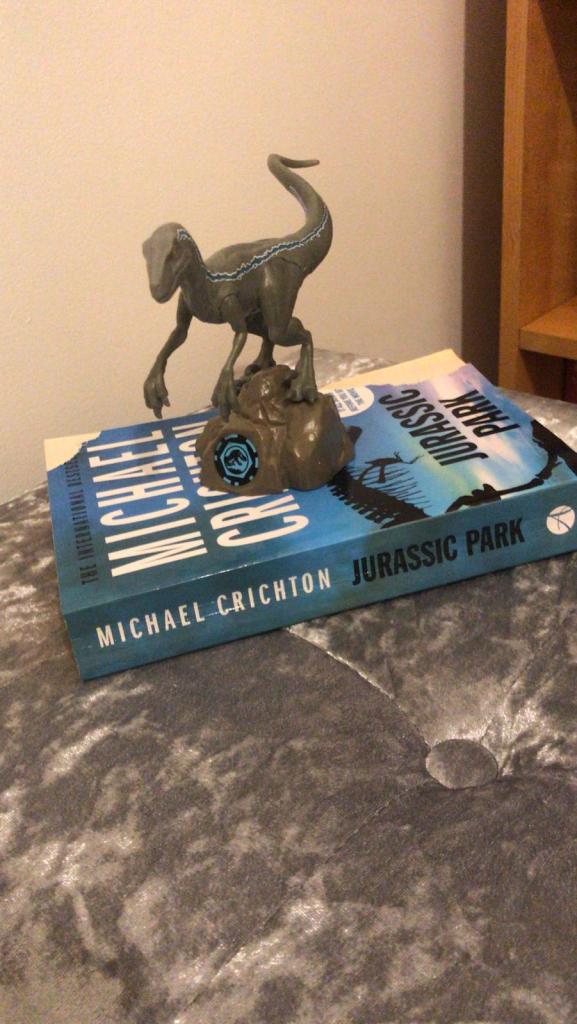
When I think back to thinking about choosing a degree, way back when, I remember thinking Criminology would be a good choice because it is specific in terms of a field: mainly the Criminal Justice System (CJS). I remember, naively, thinking once I achieved my degree I could go into the Police (a view I quickly abandoned after my first year of studies), then I thought I could be involved in the Youth Justice System in some capacity (again a position abandoned but this time after year 2). And in third year I remember talking to my partner about the possibility of working in prisons: Crime and Punishment, and Violence: from domestic to institutional (both year 3 modules) kicked that idea to the curb! I remember originally thinking Criminology was quite narrow and specific in terms of its focus and range: and oh my was I wrong!
Whilst the skills acquired through any degree transcend to a number of career paths, what I find most satisfying about Criminology, is how it infiltrates everything! A recent example to prove my point which on the outside may have nothing to do with Criminology, when in actual fact it could be argued it has criminological concepts and ideas at its heart is the 2015 film: Jurassic World. It is no secret that I am a huge lover of Crichton novels but also dinosaurs. But what I hope to illustrate is how this film is excellent, not just in relation to dinosaur content: but also in relation to one of my interests in Criminology.
Jurassic World, for those of you who have not had the pleasure of viewing, focuses on the re-creation of a Jurassic Park, sporting new attractions, rides and dinosaurs in line with the 21st century. The Indominus Rex is a genetically modified hybrid which is ‘cooked-up’ in the lab, and is the focus of this film. Long story short, she escapes, hunts dinosaurs and people for sport, and is finally killed by a joint effort from the Tyrannosaurus, Blue the Velociraptor and the Mosasaurus: YAY! But what is particularly Criminological, in my humble opinion, is the focus and issues associated with the Indominus Rex being raised in isolation with no companionship in a steeled cage. Realistically, she lives her whole life in solitary confinement, and the rangers, scientists and management are then shocked that she has 0 social skills, and goes on a hunting spree. She is portrayed in the film as a villain of sorts, but is she really?
Recently in Violence: from domestic to institutional, we looked at the dangers and harms of placing individuals in solitary confinement or segregation. Jurassic World demonstrates this: albeit with a hybrid dinosaur which is fictitious. The dangers, and behaviours associated with the Indominus Rex are symbolic to the harms caused when we place individuals in prison. The space is too small, there is no interaction, empathy or relationships formed with the dinosaur apart from with the machine that feeds it. The same issues exist when we look at the prison system and it raises questions around why society is shocked when individuals re-offend. The Indominus Rex is a product of her surroundings and lack of relationships: there are some problematic genes thrown in there too but we shall leave that to one side for now.
There are a number of criminological issues evident in Jurassic World, (have a watch and see) and all of the Jurassic Park movies. Criminology is everywhere: in obvious forms and not so obvious forms. The issues with the prison system, segregation specifically, transcend to schools and hospitals, society in general and to dinosaurs in a fictional movie. Criminology, and with it critical thinking, is everywhere: even in the Lego Movie where everything is awesome! Conformity and deviance wrapped up in colourful bricks and catchy tunes: have a watch and see…

 Thoughts from the criminology team