
Home » 2018 (Page 8)
Yearly Archives: 2018

Is Easter a criminological issue?

Spring is the time that many Christians relate with the celebration of Easter. For many the sacrament of Easter seals their faith; as in the end of torment and suffering, there is the resurrection of the head of the faith. All these are issues to consider in a religious studies blog and perhaps consider the existential implications in a philosophical discourse. How about criminology?
In criminology it provides great penological and criminological lessons. The nature of Jesus’s apprehension, by what is described as a mob, relates to ideas of vigilantism and the old non-professional watchmen who existed in many different countries around the world. The torture, suffered is not too dissimilar from the investigative interrogation unfortunately practiced even today around the world (overtly or covertly). His move from court to court, relates to the way we apply for judicial jurisdiction depending on the severity of the case and the nature of the crime. The subsequent trial; short and very purposefully focused to find Jesus guilty, is so reminiscent of what we now call a “kangaroo court” with a dose of penal appeasement and penal populism for good measure. The final part of this judicial drama, is played with the execution. The man on the cross. Thousands of men (it is not clear how many) were executed in this method.
For a historian the exploration of past is key, for a legal professional the study of black letter law principles and for a criminal justice practitioner the way methods of criminal processes altered in time. What about a reader in criminology? For a criminologist there are wider meanings to ascertain and to relate them to our fundamental understanding of justice in the depth of time. The events which unfolded two millennia back, relate to very current issues we read in the news and study in our curriculum. Consider arrest procedures including the very contested stop and search practice. The racial inequalities in court and the ongoing debates on jury nullification as a strategy to combat them. Our constant opposition as a discipline to the use of torture at any point of the justice system including the use of death penalty. In criminology we do not simply study criminal justice, but equally important, that of social justice. In a recent talk in response to a student’s question I said that that at heart of each criminologist is an abolitionist. So, despite our relationship and work with the prison service, we remain hopeful for a world where the prison does not become an inevitable sentence but an ultimate one, and one that we shall rarely use. Perhaps if we were to focus more on social justice and the inequalities we may have far less need for criminal justice
Evidently Easter has plenty to offer for a criminologist. As a social discipline, it allows us to take stock and notice the world around us, break down relationships and even evaluate complex relationships defying world belief systems. Apparently after the crucifixion there was also a resurrection; for more information about that, search a theological blog. Interestingly in his Urbi et Orbi this year the Pope spoke for the need for world leaders to focus on social justice.
Share this:


Netflix and Study?

Bethany Davies is an Associate Lecturer teaching modules in the first year.
As each year and each term goes by, it brings to light how much more we are all connected through media and also how we use media to socialise and also learn.
Now, watching television, movies and using music to learn is not a new concept, I understand this, but on a personal level, I have found more individuals using television and more specifically, crime documentaries to fuel their interest in criminology and their understanding of elements of the criminal justice system.
I believe firstly, the idea of enjoying, what is termed ‘binge watching’, crime documentaries, an interesting concept. As previously explored on the blog regarding ‘enjoyment’ and ‘fun’ of criminology, the themes in these documentaries are very dark and in most cases, the gorier it is, the more it seems to be enjoyed by some viewers. Each September that rolls around we have the (sometimes dreaded) ‘ice breaker’ session, where we get to know our students and what has made them want to pursue a criminology degree at this University. Within that you will always have some who choose to voice their love of a certain crime TV show. This does not always end at first introductions either, there is often a continuation of comparisons made between that of a serious historical event and that of Netflix documentary (for example) which can often contain more dramatic music and pictures than it does criminological discussion.
The question I would like to present is, do we nourish the idea of using documentaries and crime dramas to keep the interest of those who wish to pursue criminology as a field of learning, or would doing so be disingenuous to what criminology is and neglect the love for reading and debates in criminology? I do not necessarily feel this is a question we have to worry about tremendously as I feel those who seek to study criminology purely based on their love for crime documentaries will either soon realise that there is so much of criminology that does not fit those ideas and either love it or abandon it at that point.
But in years to come these questions may be more significant than they are currently. Especially if used as a tool in universities to attract more students into a certain discipline. There are such large elements of criminology that I feel have to be explored with literature or within a seminar setting with questions and debates, and it can be easy for institutions to say that these elements will always be fundamental to a criminology degree for years to come. However, if other institutions start to use more and more media and visual aids to demonstrate a theory or issue of crime in the future, or what I suspect more as a marketing campaign to attract students, will we conform? There are some articles (from questionable sources) that some institutions are using Snapchat and social media takeovers to help attract students to certain courses, most of which I have read about have been media based, granted. But let’s hope all this drivelling nonsense is just my brain after a long bank holiday weekend and not a possibly looming prospect of the future of criminology, right?
Share this:


Remembering Stephen Hawking: A legacy for us all

On March 14th 2018, Professor Stephen Hawking died at the age of 76. For many people, his life was as much about his long battle with motor neurone disease as it was about his achievements as a theoretical physicist. The first thing I saw when clicking on news sites was this quote:
‘Remember to look up at the stars and not down at your feet. Try to make sense of what you see and about what makes the universe exist. Be curious. And however difficult life may seem, there is always something you can do, and succeed at. It matters that you don’t just give up’.
To me, this reflects the value he placed on the pursuit of knowledge, to see this as an opportunity, not a burden and to strive to make sense of it all. For him, it was the universe, the vast expanse of stars and galaxies to be understood in ways I could not even being to fathom. For those studying social sciences, our world is not out there beyond the Earth’s atmosphere, but it is a world we must also seek to understand and, as lecturers and students to communicate this understanding to others. There is a lot of concern in HE as to how to engage students, to consider what we can do to keep them attending and studying their chosen subject outside the classroom. I am beginning to think this is not just to do with our efforts in lectures and seminars, but also perhaps we don’t emphasise enough the opportunity students have, and the value of being in HE is so much more than the qualification itself.
One thing is clear – we should not be in the business of spoon feeding information, to be repeated in assessments, in order for students to be awarded a degree based on their strategy to work towards assessments, and little else. It may sometimes feel like this, so we do have to consider whether this is to do with the way we teach, or the way students respond to this. I think the latter needs as much attention, in that it needs to be clear that students must take responsibility for their learning, and one obvious way to do this is to make the most of opportunities provided by their university. There are students I have taught in my 14 years in HEIs who have clearly appreciated the opportunity they have been given – they make it all worthwhile. There are those who never seem to engage on any level, not even to pass assessments, and who realise HE is not for them. I have more respect for someone coming to that conclusion and seeking a different type of opportunity than those who muddle through and hope it just gets easier.
By the way, if the tone of this seems judgemental, it is not meant that way. My reflections are based on my experiences as a lecturer, but crucially, also as a student. Here is where I have to confess something. In my BSc I was one of those students who muddled through. Then half way through year 2, I realised I was wasting the opportunity I had been given, got a grip and graduated with a 2:2. I know I could have done so much better. The next stage of my academic journey was a combination of being in the right place at the right time and working in a university as a course administrator where one of the staff benefits was to subsidise the cost of degree programmes. The university was the London School of Economics and Political Science, the degree was an MSc in Criminal Justice Policy, and it was very heavily subsidised. My attitude to this opportunity was so different. I was amazed to be accepted onto the programme and found myself being taught by Professor Janet Foster, Professor Robert Reiner, Professor Andrew Ashworth, Professor Maurice Punch, and Professor Ben Bowling. Sorry for the name dropping, but this was the last thing I expected to happen to me. I came away with a Merit award and it set me on this path to be a criminologist. I engaged with the degree by attending everything, working during evenings and weekends, following advice and making the most of it. Then to find myself undertaking a PhD, well it has been a long and arduous journey at times, but I knew my experiences before had set me up well to take on the challenge. It can feel isolating and lonely sometimes, and it can take over your life, but once again, I value the opportunity not just as the pursuit of knowledge, but also the way it has made me overcome challenges and not give up.
The experience of studying for a degree when I was engaged, interested and committed was so much better, with less anxiety, a sense of achievement and I knew I had done my best. As I said earlier, as academics we can do our bit, and many of us do – we consider how best to communicate theories, concepts, policies, debates, and to empower students to have their say. We offer opportunities for interaction, discussion, challenging ideas and enabling students to think more critically. We do this so that students enjoy their studies, make the most of the opportunity and value this as a pursuit of knowledge, as well as the qualification. However, we can only do this successfully when students engage with this process and understand and then accept their role. My role as a lecturer in criminology is about to change significantly, as the move to a new campus changes teaching methods and provision. I have my anxieties about adapting my modules over summer to fit with this model, IT fails, and the usual issues about going through big changes. I know our students share the same anxieties, it’s natural. But, the one thing we can do is ensure that we, as staff and students alike recognise the important role we have, to embrace this change and make the best of it.
So, my plea to students is this. If we don’t keep seeking to expand our understanding and valuing this process of learning, if we stop being curious, then we don’t advance. That is the legacy of Professor Hawking, to remember to keep asking questions, to value learning and to strive to better understand the world around us. Sometimes it will feel like there are barriers put in your way and you cannot overcome them. At this point, it is worth remembering what Professor Hawking had to deal with on a daily basis and ask yourself what you can do to solve these problems. Not only will you do better in your studies, you will learn important skills for the future and will look back knowing you have done your best and overcame whatever life threw at you. That is a legacy to be proud of.
Susie Atherton, Humanoid, Planet Earth.
Share this:


You know what really grinds my gears…

Jessica is an Associate Lecturer teaching modules in the first year.
Unlike the episode from Family Guy, which sees the main character Peter Griffin present a segment on the Quahog news regarding perhaps ‘trivial’ issues which really grind his gears, I would hope that what grinds my gears is also irritating and frustrating for others.
What really grinds my gears is the portrayal of women without children being pitied in the media. Take a recent example of Jennifer Aniston who has (relatively recently) split from her partner. The coverage appears to be (and this is just my interpretation) very pitiful around how Jennifer does not have any children; and this is a shame. Is it? Has anyone bothered to ask Jennifer if she feels this is a shame? Is this something Jennifer feels is missing from her life? Who knows: It might be the case. But the issue that I have, and ultimately what really grinds my gears, is this assumption that as a woman you are expected to want and to eventually have children.
There are lots of arguments around how society is making progress (I’ll leave it amongst yourselves to argue if this is accurate or not, and if so to what extent), however is it in this context? If women are still pressured by the media, family and friends to conform to the gendered stereotype of women as mothers, has society made progress? I am not for one minute saying that women shouldn’t be mothers, or that all women should be mothers; what I am annoyed about is this apparent assumption that all women want to be mothers and more harmful, the ignorant assumption that all women can be mothers.
It really grinds my gears that it still appears to be the case that women are not ‘doing gender’ correctly if they are not mothers, or if they do not want to be mothers. Families and friends seem to assume that having a family is what everyone wants and strives to achieve, therefore not doing this results in some form of failure. How is this fair? The human body is complex (not that I have any real knowledge in this area), imagine the impact you are having on women assuming they want and will have a family, if biologically, and potentially financially, having one is difficult for them to do? Is it not rude that you are assuming that women want children because their biology allows them the potential to have them?
In answer to the last question: Yes! I think it is rude, wrong and ultimately irritating that it is assumed that all women want children and them not having them somehow means their life has missed something. As with all lifestyle choices and decisions, not every lifestyle is for everyone. Therefore I would greatly appreciate it if society acknowledged that women not wanting or having children does not mean that they have accomplished less in life in comparison to those who have children, it just means they have made different choices and walked different paths.
For me, this just highlights how far we still have to go to eradicate gender stereotypes; that is, if we even can?
Share this:


How to stay motivated in a de-motivating environment

I’m afraid to say that this week’s entry lacks both criminological insight and positivity but in the absence of a more engaging and topical issue to debate I offer a reflective piece on staying motivated in a de-motivating environment.
Working in academia can be challenging, it’s certainly not a place to work if you have no passion for learning and engaging in healthy debate but of late I’ve found myself asking why I bother. We all know people who hate their jobs, who live for that Friday night escape and the freedom that a weekend affords and I’m thankful for the fact that I don’t feel that way…or I haven’t until recently. I’ve never hated Monday’s, possibly because academia doesn’t work on a 9 – 5, Monday to Friday basis but still, what I do has not felt like a chore until now. This term, as classroom engagement and attendance has dropped so too has my motivation and with each new pressure, training course, despondent student, stressed colleague and pointless meeting I’ve found myself wondering why I continue to hit my head against a brick wall. The future currently facing me and my colleagues is not one full of hope and prosperity but rather increased classroom time, even less hours in a day, increased pressure from those who have no understanding of what we actually do, more paperwork, more blame when things don’t work and even less time with those we love. This isn’t what any of us signed up for and it certainly isn’t enhancing our careers. So, what are my options and how do I stay motivated in this de-motivating environment?
I suppose the first thing to consider is whether or not I want to stay in this environment, I could simply walk away and do something else but deep down I know that my passion lies in this type of work so this isn’t a feasible option. I could change university but is the grass really greener on the other side? We are all acutely aware of the difficulties facing the sector and there is no shortage of stories in the news about campus closures and staff redundancies, not to mention the increasingly competitive nature of the job that demands more and more of us as researchers and income generators, so maybe the challenges we face pale in comparison to our colleagues’ experiences elsewhere. In eliminating these options I’m forced to look inward for organisational support mechanisms which take the form of courses such as ‘SMART working’, ‘Personal Effectiveness’ and ‘thriving in a changing environment’. However, while these options appear on the surface to be supportive they focus on us changing as individuals without any recognition of institutional pressures that we have no control over, such as staffing or resources. Don’t get me wrong, I’m not against self-help approaches but in reality, it doesn’t matter how SMART or effective I am as a worker, there are only so many hours in a day and only so much I, or my colleagues can do without the very real danger of burnout. As such I’m left with only one, rather sad option and that is to embrace my selfish side and withdraw from anything which is not a contractual necessity. In practice this means the students will no longer get the above and beyond support they have come to expect, the university will no longer get my enthusiasm for helping to shape future policy and practice, and my colleagues will lose an active member of the team. In theory, I shouldn’t care about the impact that this might have on others, but in reality it pains me to think that this might be the only way to survive in the de-motivating environment.
Share this:


Anxious about being anxious

The fact that the digital readout on my car tells me that it is a due a service and that it needs to be looked at because something is very wrong does not provide comfort, just a nagging concern that it might break down soon, but how soon? On my way to work I left a message on my wife’s mobile phone, ‘it’s only me, just calling to say on my way to work’. She didn’t answer the phone, she’s out riding the horse, has something happened? Mid conversation with a work colleague, my phone’s just pinged, I must check it, it’s only my mate asking me out for a drink… ‘Nice one, next Thursday?’… What was that you were saying Susie? It’s not that the conversation is unimportant it’s just that I might miss something important on the phone. Checking emails, that email I sent an hour ago still hasn’t been responded to… back to Susie.
An hour later… must check my emails. What’s on Facebook, another notification has come through… must respond … ‘like’, there done. Better check I haven’t missed anything. Ebay… I’m still the highest bidder… should I increase my bid… just in case, Ebay says it would be a good idea. Google the item… what’s it worth… back to Ebay… Increase bid. Must check it again soon. Text from wife, all is good. Check emails… check phone … check Ebay… Check Facebook… all quiet, are they working..? Is it a network problem? Thank goodness I haven’t got a Twitter account to worry about. Now I have to write a blog entry… what to write about, will anyone read it let alone like it? Off to my seminar, I wonder if the laptop will work, will it connect to that new screen and stay connected, last week it kept disconnecting… will the technology work… busy, worry…
Before the days of connectivity and the great digital advancement, I didn’t worry about such things. But then I wouldn’t have phoned my wife on the way to work, in fact I wouldn’t have spoken to or heard from her for the whole day until I got home. I wouldn’t be worrying about the car because it would either be working or have broken down. Any correspondence I received would be in my in tray on a desk and would be dealt with and put into an out tray, the pending tray, or the bin. The pending tray was usually just waiting for the bin. Nothing to ping and rudely distract me from my conversation with a colleague. No need to worry about whether I was the highest bidder, I would be at the auction bidding, it would be happening there and then. I wouldn’t have been connected to a world of ‘friends’ producing meaningless drivel about where they were having their cup of coffee or the fact they liked some article in a paper about mass rape or murder. As for the laptop and the screen, paper never let me down.
We live in a digital age and everything is at your fingertips and it’s available right now. But what does that do? It may give you an edge in some respects but it also makes you edgy. I look around and see and hear about so many people suffering from anxiety, old and young alike. Perhaps the cause is not technology alone but it certainly doesn’t help. Maybe I worry too much, maybe I’m just becoming anxious about being anxious.
Share this:


A Failing Cultural or Criminal Justice System?

Sallek is a graduate from the MSc Criminology. He is currently undertaking doctoral studies at Stellenbosch University, South Africa.
In this piece, I reflect on the criminal justice system in Nigeria showing how a cultural practice evoked a social problematique, one that has exposed the state of the criminal justice system of the country. While I dissociate myself from the sect, I assume the place of the first person in contextualizing this discourse.
In line with the norm, our mothers were married to them. Having paid the bride wealth, even though they have no means, no investment and had little for their upkeep, they married as many as they could satisfy. In our number, they birth as many as their strength could allow, but, little did we know the intention is to give us out to tutelage from religious teachers once we could speak. So, we grew with little or no parental care, had little or no contact, and the street was to become our home where we learnt to be tough and strong. There we learnt we are the Almajiri (homeless children), learning and following the way and teaching of a teacher while we survived on alms and the goodwill of the rich and the sympathetic public.
As we grew older, some learnt trades, others grew stronger in the streets that became our home, a place which toughened and strengthened us into becoming readily available handymen, although our speciality was undefined. We became a political tool servicing the needs of desperate politicians, but, when our greed and their greed became insatiable, they lost their grip on us. We became swayed by extremist teachings, the ideologies were appealing and to us, a worthy course, so, we joined the sect and began a movement that would later become globally infamous. We grew in strength and might, then they coerced us into violence when in cold blood, their police murdered our leader with impunity. No one was held responsible; the court did nothing, and no form of judicial remedy was provided. So, we promised full scale war and to achieve this, we withdrew, strategized, and trained to be surgical and deadly.
The havoc we created was unimaginable, so they labelled us terrorists and we lived the name, overwhelmed their police, seized control of their territories, and continued to execute full war of terror. We caused a great humanitarian crisis, displaced many, and forced a refugee crisis, but, their predicament is better than our childhood experience. So, when they sheltered these displaced people in camps promising them protection, we defiled this fortress and have continued to kill many before their eyes. The war they waged on us using their potent monster, the military continuous to be futile. They lied to their populace that they have overpowered us, but, not only did we dare them, we also gave the military a great blow that no one could have imagined we could. The politicians promised change, but we proved that it was a mere propaganda when they had to negotiate the release of their daughters for a ransom which included releasing our friends in their custody. After this, we abducted even more girls at Dapchi. Now I wonder, these monsters we have become, is it our making, the fault of our parents, a failure of the criminal justice system, or a product of society?
Share this:


The number’s up for quantitative research! Or is it?

As my colleagues will no doubt confirm, I’m not a fan of numbers. Although, I always enjoyed maths, particularly algebra, my distaste for numbers comes when they are applied to people. Whilst I appreciate there are a lot of us, somewhere around 7.6 billion on the planet, the reduction of a human to a number doesn’t sit comfortably. This aversion to numbering people partly stems from academic study of the Holocaust, which was facilitated by the Nazi’s determination to reduce individual human lives first to digits and then to ashes. It also comes from my own lived experience, particularly in education, of knowing that individuals can and do change.
Criminologists such as Stanley Cohen (1988), Nils Christie (1997) and Jock Young (2011) have long recognised the fundamental flaws inherent in much quantitative criminology. They recognise that numbers are often used to obfuscate and confuse, taking readers down a route whereby they are presented as having their own intrinsic meaning, entirely distinct from the people whose data is being manipulated. Furthermore, those numbers are deemed scientific and authoritative, having far more sway than qualitative research predicated on finding meaning in individual lives.
Despite my antipathy to numbers, I have spent the last few months studying attempts to quantify a particular prison population; ex-servicemen. Much of this research is flawed in the same way as recognised by the eminent criminologists above. Instead, of answering what appears on the surface to be a straightforward question, many of these reports struggle to even define what they are trying to measure, let alone make sense of the measurements.
All this has made me think about the way we measure “engagement”. Last week, as you may have noticed from Manos’ entry, was the blog’s first birthday. Underneath, the professional front page lies, what WordPress rather hopefully describes, as ‘Stats’. From here, it is possible to identify the number of visitors per day, month and year, as well as the number of views. There is also a detailed map of the world, displaying all the countries from which these visitors are drawn. In essence, I have enough data to tell you that in our first year we have had 3,748 visitors and 5,124 views from 65 countries.
All of this sounds very encouraging and the team can make statements about how views are up on the period before, or make claims that we have attracted visitors from countries for the first time. If, so inclined, we could even have a leader board of the most popular contributor or entry; thankfully that doesn’t seem appeal to the team. If I wanted to write a report, I could include some lovely, bar or pie charts, even some infographics; certainly if you look below you will see a rather splendid Wordle which displays 233 different categories, used a total of 781 times.
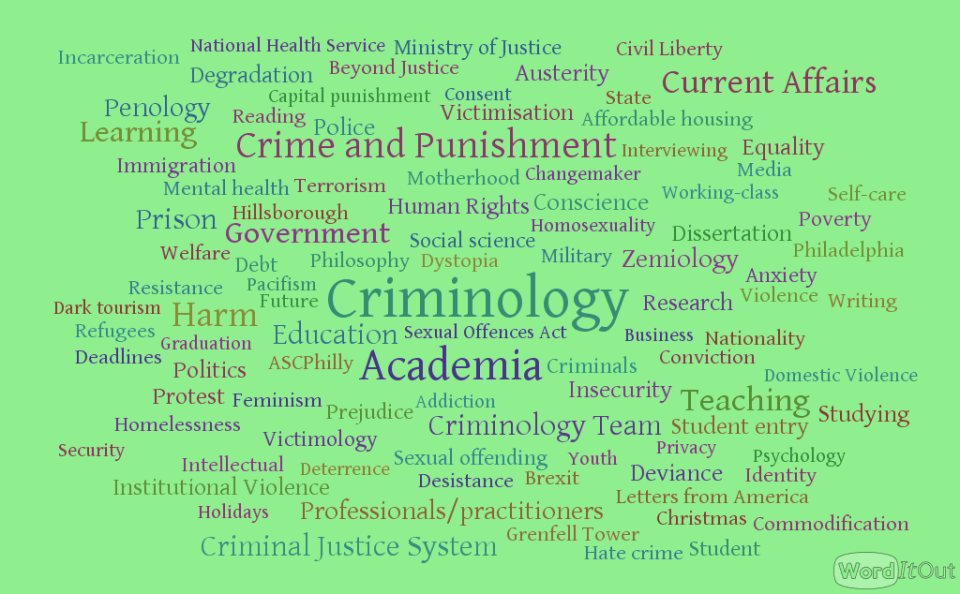
However, what exactly do we know? I would argue, not a lot. We have some evidence that some people have visited the blog at least once, but as to how many are regular readers; we have no clue. Do they read the entries and do they enjoy them? Again, no idea. Maybe they’re just attracted by particular pictures (the evidence would suggest that the Yellow Submarine, Kermit, the Pink Panther and tattoos do exceedingly well).[i] There is some evidence that many of the visitors come via Facebook and Twitter and these offer their own illusion of measurable activity. Certainly, Twitter offers its own ‘Analytics’ which advises me that my tweet containing Manos’ latest blog entry earned an impressive 907 ‘Impressions’, and 45 ‘Engagements’ which equals an ‘Engagement Rate’ of 5%! What any of that means; your guess is good as mine! Does scrolling mindlessly on your newsfeed whilst waiting for the kettle to boil count as an impression or an engagement? Should I be impressed or embarrassed by a 5% engagement rate – who knows? If I add it to my imaginary report, at least I’ll be able to add some more colourful charts to accompany my authoritative narrative. Of course, it will still be largely meaningless but it should look splendid!
More concerning are the repercussions to any such report, which would seem to imply that I had total control over improving such metrics and if they didn’t improve, that would ultimately be down to my inertia, inability or incompetence. Of course, the blog is a voluntary labour of love, created and curated by a group of like-minded individuals… However, if we consider this in relation to criminology and criminal justice, things take a more sinister turn….the numbers may indicate something, but at the end of the day those numbers represent people with their own ideas, concerns and behaviours. Discussions around payment by results seem to miss this vital point, but of course it means that failure to achieve these results can be blamed on individuals and companies. Of course, none of the above denies quantitative data a place within Criminology, but it has to be meaningful and not just a series of statements and charts.
Now, I’ve got my anti-quantitative rant of my chest, I’ll leave the final words to Nils Christie (1997) and his command to make criminology exciting and passionate as befits its subject matter. In his words, avoid ‘[l]ong reports of the obvious. Repetitions. Elaborate calculations leading to what we all know’ (Christie, 1997: 13).
Instead we should always consider:
[h]ow can it be like this? How come that so much criminology is that dull, tedious and intensely empty as to new insights? It ought to be just the opposite, in a science based on material from the core areas of drama. Our theories are based on situations of conflict and heroism, danger and catastrophe, abuses and sacrifices – just those areas where most of our literary heroes find their material. And still so trivial! (Christie, 1997: 13).
Rather than mindlessly churning out quantitative data that looks and is perceived as sophisticated, as criminologists we need to be far more critical. If you don’t believe Christie, what about taking heed of Green Day’s command to ‘question everything? Or shut up and be a victim of authority’ (Armstrong et al., 2000).
References:
Armstrong, Billie Joe, Dirnt, Mike and Cool, Tre, (2000), Warning [LP]. Recorded by Green Day in Warning, Reprise: Studio 880
Christie, Nils, (1997), ‘Four Blocks Against Insight: Notes on the Oversocialization of Criminologists,’ Theoretical Criminology, 1, 1: 13-23
Cohen, Stanley, (1988), Against Criminology, (Oxford: Transaction Books)
Young, Jock, (2011), The Criminological Imagination, (London: Polity Press)
A revised and reworked submission of this entry was published on the British Society of Criminology blog on 1 June 2018.
[i] This point will be “tested under experimental conditions” by the gratuitous inclusion of a picture showing teddy bears “reading”.
Share this:

Anniversaries and Festivities
 About a year ago, as a team we started this blog in order to relate criminological ideas into everyday life. News, events and markers on our social calendar became sources of inspiration and inquiry. Within a year, we have managed somehow to reflect on the academic cycle, some pretty heavy social issues that evoked our passions and interests. Those of you who read our entries, thank you for taking the time, especially those who left comments with your own experiences and ideas.
For us as a contributing team, the opportunity to talk outside the usual spaces about things that we regard as interesting is a real pleasure. A colleague of mine, tends to say that criminology is a subject made for discussions. These discussions usually grow in classrooms but they are restricted of time. In some way, our blog is an extension of that environment but we are also cognisant that we want to talk beyond the parochial “ivory towers” of academia.
The first blog entry was about running a pilot then, for a new module delivered entirely in prison with students from the university and the prison. This week, we celebrated the first cohort who completed the module. I have been an observer of social conventions all my life and to see the way people in the celebration connected with each other was great. For all of us in the module, it makes perfect sense because we have done that journey together but for anyone coming for the first time in prison this must have been an astounding experience.
This is what we commemorate in a celebration. Not necessarily the end result whatever that is, but the journey. As people consumed with speed in a modern society, we very rarely take the time to look back and reflect. It can be argued that we can do so when we reach our ever expanding retiring age; reflect on our life’s work. Nonetheless, it is important now and then to look back and see how we get here. For example, I am proud that I serve a university that offers opportunities to students from the wider society without barriers or obstacles. Some of our students are first in their family to go to University. This is an amazing opportunity that leaves the doors of social mobility open. A number of our graduates are now my colleagues or work in the wider criminal justice system.
So what is a celebration? A moment in time to look back and say, “hey I have a journey ahead but look how far I have come”. This is why these little moments are so watershed to all; whether we celebrate a year in the blog, a year on a module or a year in a job, marriage etc. Some celebrations are small reminders of time, other of events and some other of accomplishments. In a world where the news should be accompanied with health warnings, as people feel insignificant as individuals to bring about change, a celebration is a mark that things can happen. A person who decides to be an agent of change, whether it is a message against racism (#blacklivesmatter) sexual abuse (#metoo), or gun violence (#enoughisenough), they can do so without realising that one day when they will look back things will be very different for all; a possible cause for another celebration then. It matters to look back when you want to change the future. Life is experiential journey and marking these experiences is our way of leaving a trace on a large social wall.
In a couple of months (May 14) we shall be celebrating 18 years of Criminology at the University of Northampton. Another moment in time to reflect of the impact and the effects this programme has had on the students and the community.
Cheers
Share this:


A help or a hindrance: The Crime Survey of England and Wales

I recently took part in the Crime Survey for England and Wales and, in the absence of something more interesting to talk about, I thought I would share with you how exchanging my interviewer hat for an interviewee one gave me cause to consider the potential impact that I could have on the data and the validity of the data itself. My reflections start with the ‘incentive’ used to encourage participation, which took the shape of a book of 6 first class stamps accompanying the initial selection letter. This is not uncommon and on the surface, is a fair way of encouraging or saying thank you to participants. Let’s face it, who doesn’t like a freebie especially a useful one such as stamps which are now stupidly expensive. The problem comes when you consider the implications of the gesture and the extent to which this really is a ‘freebie’, for instance in accepting the stamps was I then morally obliged to participate? There was nothing in the letter to suggest that if you didn’t want to take part you needed to return the stamps, so in theory at least I was under no obligation to participate when the researcher knocked on the door but in practice refusing to take part while accepting the stamps, would have made me feel uncomfortable. While the question of whether a book of first class stamps costing £3.90 (Royal Mail, 2018) truly equates to 50 minutes of my time is a moot point, the practice of offering incentives to participate in research raises a moral and/or ethical question of whether or not participation remains uncoerced and voluntary.
My next reflection is slightly more complex because it relates to the interconnected issues associated with the nature and construction of the questions themselves. Take for example the multitude of questions relating to sexual offending and the way in which similar questions are asked with the alteration of just one or two words such as ‘in the last 12 months’ or ‘in your lifetime’. If you were to not read the questions carefully, or felt uncomfortable answering such questions in the presence of a stranger and thus rushed them, you could easily provide an inaccurate answer. Furthermore, asking individuals if they have ‘ever’ experiences sexual offending (all types) raises questions for me as a researcher regarding the socially constructed nature of the topic. While the law around sexual offending is black and white and thus you either have or haven’t experienced what is defined by law as a sexual offence, such questions fail to acknowledge the social aspect of this offence and the way in which our own understanding, or acceptance of certain behaviours has changed over time. For instance, as an 18 year old I may not have considered certain behaviours within a club environment to be sexual assault in the same way that I might do now. With maturity, education and life experience our perception of behaviour changes as do our acceptance levels of them. In a similar vein, society’s perception of such actions has changed over time, shifting from something that ‘just happens’ to something that is unacceptable and inappropriate. I’m not saying that the action itself was right back then and is now wrong, but that quantitative data collected hold little value without a greater understanding of the narrative surrounding it. Such questions are only ever going to demonstrate (quantitatively) that sexual offending is problematic, increasing, and widely experienced. If we are honest, we have always known this, so the publication of quantitative figures does little to further our understanding of the problem beyond being able to say ‘x number of people have experienced sexual offending in their lifetime’. Furthermore, the clumping together of all, or certain sexual offences muddies the water further and fails to acknowledge the varying degree of severity and impact of offences on individuals and groups within society.
Interconnected with this issue of question relevance, is the issue of question construction. A number of questions ask you to reflect upon issues in your ‘local area’, with local being defined as being within a 10-15 minute walk of your home, which for me raised some challenges. Firstly, as I live in a village it was relatively easy for me to know where I could walk to in 10/15 minutes and thus the boundary associated with my responses but could the same be said for someone who 1) doesn’t walk anywhere or 2) lives in an urban environment? This issue is made more complex when it comes to knowing what crimes are happening in the ‘local’ area, firstly because not everyone is an active community member (as I am) therefore making any response speculative unless they have themselves been a victim of crime – which is not what these questions are asking. Secondly, most people spend a considerable amount of time away from home because of work, so can we really provide useful information on crime happening in an area that we spend little time in? In short, while the number of responses to these questions may alleviate some of these issues the credibility, and in turn usefulness of this data is questionable.
I encountered similar problems when asked about the presence and effectiveness of the local police. While I occasionally see a PCSO I have no real experience or accurate knowledge of their ‘local’ efficiency or effectiveness, not because they are not doing a good job but because I work away from home during the day, austerity measures impact on police performance and thus police visibility, and I have no reason to be actively aware of them. Once again, these questions will rely on speculative responses or those based on experiences of victimisation which is not what the question is actually asking. All in all, it is highly unlikely that the police will come out favourable to such questions because they are not constructed to elicit a positive response and give no room for explanation of your answer.
In starting this discussion, I realise that there is so much more I could say, but as I’ve already exceeded my word limit I’ll leave it here and conclude by commenting that although I was initially pleased to be part of something that we as Criminologist use in our working lives, I was left questioning its true purpose and whether my knowledge of the field actually allowed me to be an impartial participant.

 Thoughts from the criminology team