
Home » Posts tagged 'life'
Tag Archives: life

Self-Care: A Criminologist’s Confession
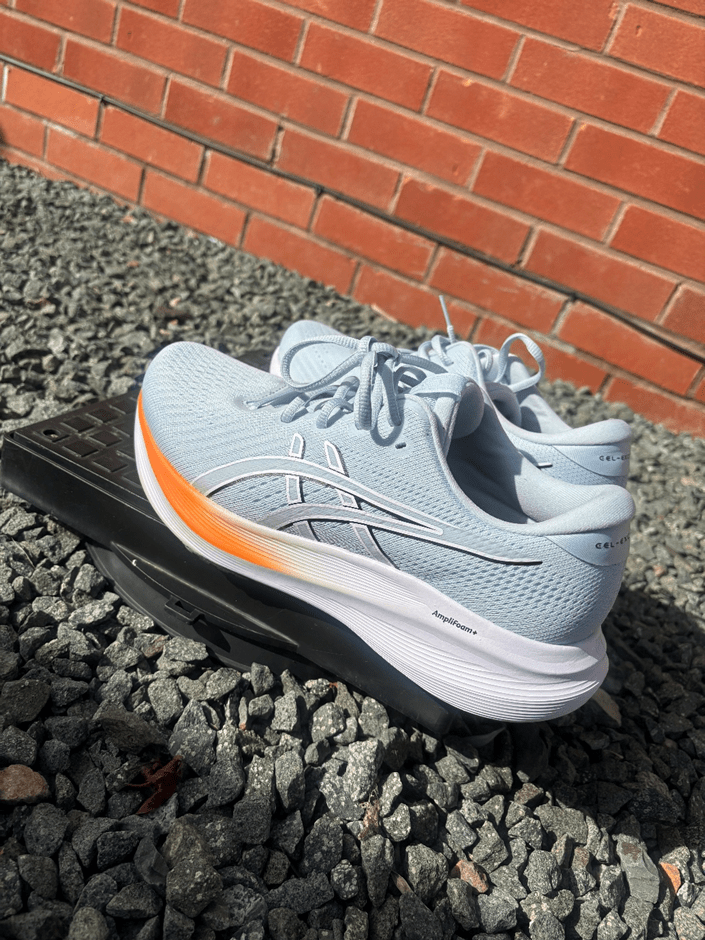
Let me be upfront, I study crime for a living. I am not a wellness guru. I do not own a journal with an inspirational quote on the cover and I have never once made a green smoothie by choice. So if you were expecting expert advice, I apologise. What I do have is a recently sustained injury, a pair of retired running shoes (not the picture above!), and something to say about all of it.
Back in November, I got injured during a light gym sesh. Nothing dramatic, no heroic story involving a marathon finish line or a training montage. My body simply decided it had opinions, and I had to stop running. For someone who uses running to decompress, that was not ideal. Turns out when you take away the one thing that clears your head, your head gets quite crowded.
Now, before I go any further, I need to take a moment to salute my old running shoes, ASICS Gel. It was fire! Two years of loyalty, two years of 6am starts, two years of rain, wind and whatever else the British weather threw at us, two years of bad days turned around, two years of grinding when the motivation was nowhere to be found. Never complained. Never let me down. Absolute workhorse!!. Round of applause for these guys. Rest well.
I did want to include a photo as a tribute. My wife looked at it this morning and said, “nah, that’s ugly, delete it.” So. No photo. The shoes deserved better and apparently so do you.
In their place, there is a new sheriff in town as you can see up there. Fresh out of the box, and performing very well so far. No complaints. High hopes. ASICS, run me my influencer cheque quick!!!!
Getting back into running after time off is humbling. Your lungs have apparently moved on with their lives. Your legs remember nothing. But we are getting there, slowly, steadily, without any illusions of grandeur. Some days are better than others. The weather has not always helped, although getting better.
But then, getting back to it, however slowly, has reminded me how much I had let self-care slide. It is easy to do. Life gets busy, work piles up, and suddenly taking care of yourself feels like one more thing on the to-do list.
So, from one person who is very much a work in progress: take care of yourselves. Whatever that looks like for you. It does not have to be running. It does not have to be anything impressive. It just has to be something.
I’ll be back with an update on how the new ones are getting on. Fingers crossed they have what it takes to fill those shoes. Literally.
Share this:


Happy Birthday: The Blog in Pictures, Numbers and Words

Tuesday marked the 8th “official” birthday of our blog. I say official because although the site was created in November of 2016, the writing did not start in earnest until 3 March. Since that early foray into blogging, we’ve managed collectively to clock up quite a few vital statistics
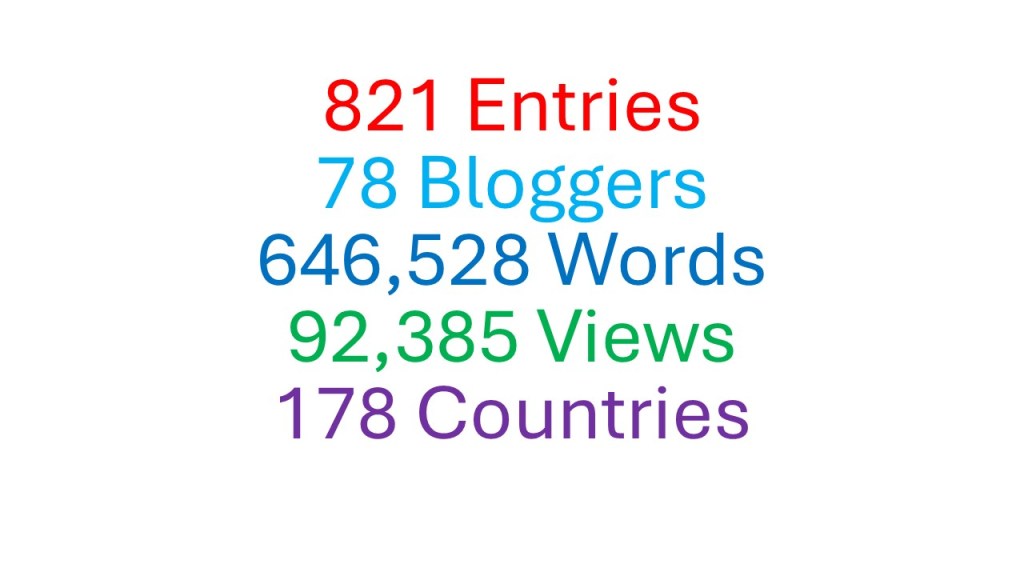
Our 78 bloggers are made of the Criminology Team (both past and present), students and graduates, as well as a number of honorary criminologists. Some have written only one entry, perhaps reflecting on their dissertation, while others have and continue to contribute on a regular or ad hoc basis. It has to be said that 9 of our top 20 most read entries come from students/graduates, another two come from non-criminologists. Certainly graduate and student entries are always very popular. Our most read, continues to be the front page which contains the latest entries, but many of our entries have shown remarkable longevity. For instance, then student, now graduate, Natalie’s (@criminologysocietyuon) thoughts around the “true crime” documentary Betty Broderick remains our most read individual entry, clocking up views ever since the day it was published. This demonstrates the enormous appetite for “true crime” that many people have. Likewise, Dr Stephen O’Brien’s (@anfieldbhoy) reflections on the 30th anniversary of the Hillsborough Disaster continues to be well-read, particularly around the anniversary on 15 April. In the words of the poet, Ella Wheeler Wilcox: ‘No question is ever settled, until it is settled right’ and there is certainly a long way to go to obtain justice for the 97.
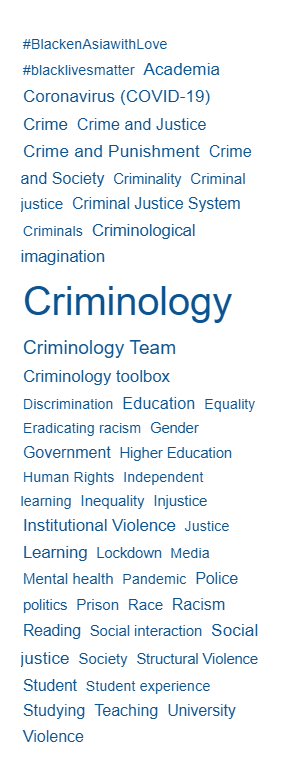
As can be seen from the word cloud, which appears on the front page of the blog and below, Criminology unsurprisingly occupies the attention of most of our bloggers and entries. However, it is also clear that social injustice, inequalities and various forms of violence appear regularly within our writing. There is also a strong focus on learning and teaching, as well as evidence of the lasting generational impact of the Covid-19 pandemic (our best year for readership to date).
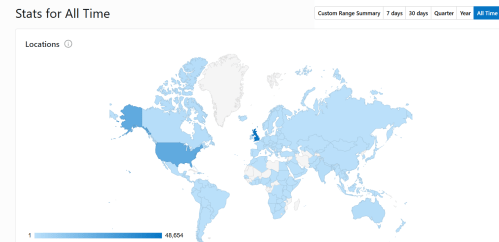
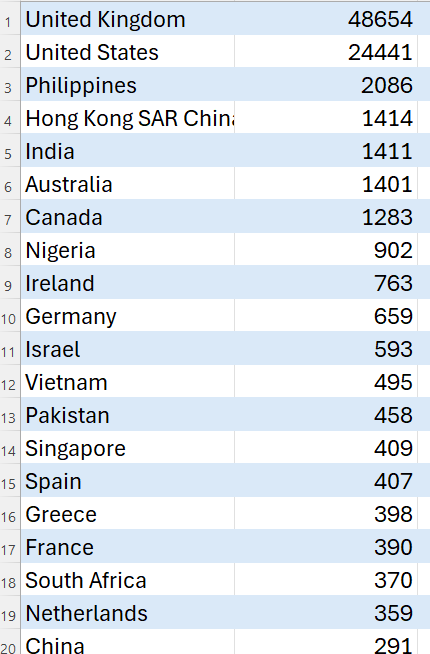
As you can see from the map the majority of our readers come from the UK and the USA, but we’ve also captured the criminological imagination of people from a diverse range of countries ranging from Albania to Zambia. Some of the countries can be explained through our bloggers’ diverse heritage, for instance, Greece, Nigeria, USA have obvious connections, others, we’ve no idea how our words have spread so far. Nevertheless, it is a very exciting to see the blog’s global reach.
As the saying goes, from small acorns to giant oaks, the germ of an idea has spread beyond any of our wildest dreams. The number of blog entries continues to grow on a weekly basis, it seems we never run out of criminological matters to write about. It has given all of us a space to ponder, to muse, to write through dark days and celebrations, and to continue to engage in Public Criminology. Similarly, the number of bloggers steadily rises, some are in their earliest foray into discovering Criminology, some have years of immersion in the discipline, but we are all learners. In the words of Nelson Mandela: ‘Education is the most powerful weapon which you can use to change the world’ so why would we ever want to stop learning?
When we started, we thought the blog would last for a year, maybe, either we’d run out of things to write about or we’d find other things to do with our time. Neither has happened and it seems there is still plenty of appetite from our bloggers and our readers. To both we raise a glass, without you, none of this would have been possible, so thank you! Now, let’s see how long we can keep this up!
Share this:


Tis very quiet on a Friday…

Fridays are an especially busy day for the BA Criminology and BA Criminology with Psychology students and staff: for some there are 6hours of classes today, finishing their Friday at 6pm! What a way to finish off the ‘working’ week: packed full of interesting discussions and learning. However, the vibe on the roads in via the morning commute and the silence rolling through the Library at 10am would suggest not everyone shares in a full-on Friday experience!
Friday evenings would mark the end of a long week for many, and the, hopefully, exciting possibilities the weekend might hold. But as I travelled into Northampton, on my usually very early and busy commute, I couldn’t help but notice the lighter quieter roads. It makes a nice change up- can leave a little later than usual and do not have to comprehend with the stresses of the morning rush hour: but why? Why have Fridays become quiet?
As many staff and students will know: car parking can be a smidge of a challenge when arriving for 9ams: but not on a Friday. Usually, to beat the rush, it is ideal to arrive at campus before 0830: but not on a Friday. 0845 and there remain many car parking spaces- again excellent to set up for a long day of studying but why the sudden quietness on a Friday? Is this a symptom of a wider issue?
There is a peaceful sense around campus today- despite the busy day for some courses. It feels very much like the week is over: should this be so overtly felt at 9am instead of 6pm? I have asked friends not in academia, and this Friday quietness appears to be across industries. Friday appears to be a favourite day to work from home: a gentle ease into the weekend. But should we be easing into the weekend or ending the ‘working’ week a little frazzled and desperate for the weekend ahead? Does it really matter? The grey weather we’ve been blessed with today I am sure does not help, and it is a nice change up from the mid-week hustle and bustle which exists on campus. But why have Fridays crept into this sort of ‘start of the weekend’ status? The Friday evening I can see being that representation: but the Friday morning? Maybe it’s a one-off and next week the roads and campus will be buzzing and hopefully the sun will be shining. But for today, the last Friday in February: its very much a gentle atmosphere on campus.
Share this:


The coffee shop that’s worth more than its profit margin

Every morning follows the same rhythm. Finish my gym session, towel off, and head straight to the M&S café for my coffee. It’s not just about the caffeine – though God knows I need it. It’s about the ladies behind the counter who greet me with genuine warmth, who remember my order, who take pride in their work. In a world that often feels rushed and impersonal, their kindness has become my daily reset button.

But this isn’t really a story about my coffee ritual. It’s about what I’ve witnessed in that café—something far more important than any morning black americano.

The tables are always dotted with elderly faces. At first, I didn’t think much of it. But over time, as I’ve chatted with them, “I come here every Tuesday and Thursday,” one gentleman told me in the queue, staring at his menu. “Meet up with whoever’s about. Talk football, moan about the weather.” He smiled. “Beats sitting at home staring at the four walls, doesn’t it?” It’s beautiful, really. Watching strangers become friends over scones, toasties and crosswords. Seeing lonely people find their people, even if just for an hour.

The gentle hum of conversation about politics, memories, grandchildren, postwar Britain, the price of everything these days. This is what community looks like – unscripted, unglamorous, essential. I’ve become friends with some of them myself. They’ve told me about children who live too far away, partners they’ve lost, days that feel too long and too empty. For many, this café visit is their main activity. Their reason to get dressed. Their connection to the outside world.

A couple of days ago, I was at the gym when I overheard a conversation that stopped me mid-rep. They’re closing the café. The M&S café. Our café. I asked one of the staff members – one of those lovely ladies who makes this place what it is. She confirmed it quietly, almost apologetically, but couldn’t (or wouldn’t) share the details. The rumour mill says it’s about profit margins. The official line from M&S is that they’re repurposing spaces to create room for more popular products. More popular products!. And I felt something crack inside me.
If this is truly about profits, then we need to have a serious conversation about what we value as a society. Yes, businesses need to be viable. Yes, companies have shareholders and bottom lines and quarterly targets. I understand economics, I used to work in the financial services – a Bank to be precise, so I understand numbers. But when did we collectively decide that every single square foot of commercial space must justify its existence purely through revenue? This café might not be their most profitable location. But what’s the cost of closing it? Where exactly do we expect these elderly people to go?
“Just go to another café,” someone might say. But you’re missing the point entirely. This isn’t about coffee. It’s about familiarity. It’s about the staff who know your name. It’s about the community that’s been built, brick by brick, conversation by conversation, over months and years. You can’t just transplant that somewhere else. Community doesn’t work like that.
My elderly friends at the café (many of them in their 80s) represent a growing crisis we’d rather not acknowledge. Let me give you some numbers. According to a recent report on Age and loneliness in the UK, nearly 940,000 older people in the UK are often lonely – that’s one in fourteen people over 65 (Age UK 2024). And here’s the truly heartbreaking bit: 270,000 older people go an entire week without speaking to a single friend or family member.
Do you know how crazy that sounds? Not speaking to a single friend or family member!! A whole week!!
And loneliness doesn’t just make people sad—it kills. It increases the risk of depression, heart disease, stroke, dementia etc. This isn’t just about comfort or quality of life. This is a public health crisis. And yet, we’re closing the very spaces where people find connection. Where will they go? Costa? Starbucks? Even if they could afford the higher prices, those chains don’t foster the same sense of belonging. They’re designed for laptop workers and quick takeaways, not for lingering conversation and community building.
Councils cut funding for community centers – libraries operate on skeleton hours, now commercial spaces that accidentally became social lifelines are vanishing too.
I’m not naive. I know M&S isn’t a charity. I’m also aware they do good work by partnering with food banks and donating surplus food to people who need it. They clearly have a social conscience. But they brand themselves on quality, trust, and British values. Well, here’s a British value: looking after our elderly. Not abandoning them.
M&S, you have an opportunity here. An opportunity to position yourselves as a company that doesn’t just talk about community values but actually lives them. You could be the retailer that says, “We’re keeping our cafés open because we recognise they’re tackling one of the biggest health crises facing our aging population.” Imagine the goodwill. Imagine the respect. Imagine being the company that genuinely helps combat loneliness alongside all the good work you’re already doing – that’s how you truly stand tall amongst your peers.
There’s such thing as enough profit. There’s such a thing as being a responsible corporate citizen. There’s such a thing as recognising that some things – like providing a warm, safe space for lonely pensioners to find friendship – might be worth preserving even if it means slightly less room for those “more popular products.”
Our very own café will probably close. The space will be repurposed – maybe more retail shelving, maybe nothing at all. The decision-makers will never meet the people affected. They’ll never know about the Tuesday regular who’ll now have nowhere to go, or the widow who found a reason to leave the house, or the gentleman who finally made friends after his kids relocated to another country. And my morning ritual? I’ll find another coffee shop. I’ll survive.
But what about the people for whom this was so much more than coffee? What about the 270,000 older people who might go another week without speaking to anyone? What about your chance to be part of the solution instead of part of the problem?#
This is what the world is turning into: a place where community is a nice-to-have but never a must-have. Have we forgotten that sometimes the most valuable things can’t be measured on a balance sheet. We can do better than this.
What do you think? Are there spaces in your community facing similar threats? I’d genuinely love to hear your thoughts.
Reference list
Age UK (2024) Age UK’s new report shows ‘you are not alone in feeling lonely’. Available at: https://www.ageuk.org.uk/latest-press/articles/age-uks-new-report-shows-you-are-not-alone-in-feeling-lonely/ (Accessed: 27 October 2025)
Share this:


Why I refuse to join the hate train

In a world drowning in outrage, where every headline screams division and every scroll brings fresh fury, it’s easy to forget something fundamental: there’s still beauty everywhere.
Turn on the news and you’re bombarded with it all—bans, blame, and bitter arguments about who’s ruining what. Immigrants, the wealthy, the homeless, the young, the benefits claimants—everyone’s apparently the problem. It’s a relentless tide of negativity and moaning that can sweep you under if you’re not careful.
But what if we chose differently?
Here are a few things I noticed in the last couple of weeks:
I came across a book that someone left on a park bench with a note: “Free to a good home.” On another late night, a man saw a mother struggling—baby in one arm, shopping bags in the other—and didn’t hesitate to help her to her car. And if you’re thinking “why didn’t she use a trolley?” then you’re part of the problem I’m talking about, because there were no trolleys in that shop.
In another moment, a homeless person was offering water to a runner who’d collapsed in the heat, providing comfort when it mattered most.
Elsewhere, a teacher stayed late for his “troubled” student preparing for exams. When I asked why, he said: “Everyone calls him destructive. I refuse to lose hope. He’s just a slower learner, and I’ll support him as long as it takes.”
In another event, teenagers on bikes formed a protective barrier around an elderly woman crossing the road.
Small acts. Quiet kindness. The stuff that never makes headlines, doesn't trend on social media, and doesn't fuel debates.
The truth is, these things happen everywhere, all the time. While we’re busy arguing about who’s destroying society, society is quietly rebuilding itself through a million small kindnesses. The coffee lady in the Learning Hub who remembers your order. The elderly doorman at Milton Keyens Costco who draws smiley faces on reciepts and hands them to children on their way out, just to see them smile. The neighbour who randomly helps pick up litter in the neighbourhood with her girls every Sunday afternoon. The friend who texts to check in with the simple words “how are you?”
The truth is simple: for every voice spreading hate, there are countless others spreading hope. For every person tearing down, there are builders, healers, and helpers working in the quiet spaces between the noise.
Yes, problems exist. Yes, challenges are real. But so is the grandfather teaching his grandson about dignity and respect. So is the aunty teaching her niece how to bake. So is the library volunteer reading to the shelter dogs. So is the community garden where strangers become neighbours.
Today, I’m choosing to notice the nice. Not because I’m naive, but because I refuse to let the moaning and the loudest voices drown out the most important ones. The ones that remind us we’re more alike than different. The ones that choose connection over division.
Your turn: What nice thing will you notice today? Free your mind, pay attention—you'll see one.
Because in a sea of anger, being gentle isn’t weak or naive—it’s revolutionary.
Share this:


Will Santa Visit?
For me Christmas always acts as a stark reminder of inequity, both past and present. I tend to remember television and music, stories of inequity between the haves and the have nots at Christmas time being told by the privileged few. Such as the Muppets Christmas Carol’s (1992) depiction of Tiny Tim, as being poor and disabled but ever so grateful for what he had. Quite recently I was doing some food shopping when I heard the Band Aid (1984) song, Do they know it’s Christmas playing on the tannoy. Despite the criticism relating to white privileged saviorism apparently still this song is popular enough to have a revival in 2024.
Christmas things cost money. So the differences between Christmas experiences of the haves and the have nots are drastic. Whilst many children are very aware that it is Christmas they might also be very aware of the financial constraints that their parents and/or guardians may be in. On the flip side there are other children who will have presents galore and are able to enjoy the festivities that Christmas bring.
This is also a time where goods are advertised and sold that are not needed and not recommended by healthcare professionals. Such as the sale of children’s toys that are dangerous for young children. For example, I was considering purchasing Water Beads as a fun crafting gift option for some children this year, until I was made aware that a children’s hospital and local playgroup are warning parents of the dangers of these as if swallowed can drastically expand in the body which could cause serious health complications.
It seems that social media also adds to the idea that parents and/or guardians should be providing more to enhance the Christmas experience. With posts about creating North Pole breakfasts, Christmas Eve boxes, matching Christmas family Christmas pajamas and expensive Santa visits. All of which come at a financial cost.

As well as this some toys that seem to be trending this year might be seen to misappropriate working class culture. For example, if your parents can afford to take you to Selfridges you can get a ‘fish and chip’ experience when buying Jelly Cat soft toys in the forms of items traditionally purchased from a fish and chip shop (see image above). This experience plus a bundle of these fish chips and peas soft toys cost £130 according to the Jelly Cat website. The profits gained for the Jelly Cat owners are currently being quoted in the news as being £58 million. Whilst at the same time some customers of these real life fish and shops will find it difficult to afford to buy a bag of chips. And some real life fish and chip businesses seem to be at risk of closure, in part due to high cost of living climate which impacts on cost of produce and bills.
Given the above issues it is not surprising that some children are worried that Santa won’t visit them this year.

 Thoughts from the criminology team