
Home » Posts tagged 'Gender'
Tag Archives: Gender

St Valentines Day! Love and other emotions

This blog today is all about love…. or maybe not! As criminologists, we tend to see things slightly different, and our perspective is influenced by functions other than undying declarations of love.
Saint Valentine is associated with love and people celebrate the day with their special romantic person, or by pursuing any person of interest, with romantic cards. Greeting cards, bottles of wine, boxes of chocolates, bunches of flowers, heart shaped jewellery, lovely sonnets, sexy underwear, kinky gifts and over the top romantic gestures! All of the above are anticipated actions on this day. Any of these will act as a demonstration of love. In some ways the more enormous the gesture the greater the demonstration of love and intimacy to the intended special person. Many times, we hear those in a relationship rut complaining that “they don’t even buy me chocolates anymore” a sign that love has fizzled out.
Love is a powerful emotion, and I dare not to challenge it. Artists have created their best work on love! Religion has created its strongest appeal on love. People, the world over, have based their entire lives of how they feel about a person they choose to be their partner and share their lives with. So clearly love is important! Enough for an Austrian psychotherapist to create an entire theory on love and sex. We feel ready to go to war for love and we are completely convinced that love is the force that keeps us going. Love is strong and we feel it every day.
Therefore, it is slightly surprising that the patron saint of romantic love is a rather fictional character! The saint is meant to be a priest who lived in the 3rd century AD and martyred by tortured for his faith. There was no romance involved and there were no love poems written of the time. In fact, the Roman Catholic church did not recognise or mentioned this martyrdom at the time. The first accounts on St Valentine appear in the 6th and later the 9th centuries, some centuries later. Since then, the story of the saint is embellished further, until the 19th century when it becomes connected with romantic love in some tenuous way. For example, the more recent narratives claim that before his execution he would convert and cure the daughter of his jailer. He was also officiating wedding ceremonies between Christians which may have given him the romantic connection. In the 19th century we have the first mass production of love tokens dedicated to the day and in the 20th, century especially post 1960s the celebration was growing in popularity and appeal. Currently the day is a celebration that has a significant capitalist value. It is usually a commercial success midway between Christmas and Easter.
Some religious historians noted that in the Roman calendar in February there have been rituals and celebrations on fertility and cleanliness (physical, spiritual). It was the time presumably when young Romans prepared for sexual relations. Therefore, an amalgamation of the old practices and the then new religion overlap with an obscure Saint to act as the glue to connect them and reaffirm the importance of love. Ironically the Roman citizens of the time, in particular the patricians, would not recognise such acts! They married out of interest, connecting the wealth and power of different factions. In those cycles love was more of a chimera rather than a reality.
Romantic love with knights, towers, dragons and gestures of devotion will appear as fanciful tales. Who hasn’t heard of Odysseus and his beloved wife Penelope who remained faithful to him for 20 years! Her fidelity was not reciprocated, and Odysseus had multiple affairs and fathered several children across the Mediterranean. Not quite the romantic story people would like to believe. Romantic love was always a tale, with vivid twists and turns. Love appears almost pure, undiluted that lifts those in its path. Shakespeare wrote fantastic sonnets on love. Some of the best things ever written in English. Still his contemporaries did not recognise this love. The majority of people at the time died young, malnourished and exhausted. Those who barely survive cannot afford to embrace love. As for those in power their relationship with love can be summed up in the old mnemonic rhyme “divorced, beheaded, died; divorced, beheaded, survived”!
We presume that romantic love is a representation of two people having feelings for one other. That is a nice sentiment but historically weak. Love for women does not exist. Not because women are devoid of emotions; quite the contrary! Because women have been used in social transactions between men who barter and use them as part of their household. A feminist today can recognise, despite all assurances for equality, how unequal life is. Especially in the household! If anyone wants to see why love is not equal only see how domestic and intimate violence is spread between gender lines. Because St Valentine brings flowers and chocolates, but it also brings beatings and abuse. Across the year it is during holidays and significant dates, including St Valentines that violence against women surges. One can unfortunately deduce that love is not for women. Oh…. The irony as romantic novels and movies are presented mostly for women as “chick flicks”!
Earlier in this post, it was said that the bigger the romantic move the better! Who will do this big romantic gesture? A man with chivalrous intent. Our household data reveal that men will spend more than double on what women will spend on the day, making their romantic intent more obvious. Perhaps men are more romantic and feel the need to satisfy that internal need. Or maybe there are other emotions at play. Love is very powerful, but so is possessiveness. In a history of transactions men used women for trading, so their gestures may be a latent act of dominance, a fresh reminder of possession. Instead of giving them chocolates, you may as well urinate all over them. That way your beloved will have your scent and keep other suitors away. So, this is not love but control, jealousy and dominance. Every drop of wine, every piece of chocolate, every flower petal, is yet another link in the chain of ownership. In case this gets misunderstood, the individual who buys flowers isn’t a villain, but the history of this kind of love is pointing in this direction. Your partner may have the best intentions and the greatest love and regard for you, but our society has never really acknowledged the transactional relationship between men and women. It is similar to those who speak of the evils of slavery, but with no recognition of reparations. This love is not pure and clean. It is the darkest form of patriarchy that controls people making them to believe in an adult fairytale once the other story of Santa Claus is not believed any more.
Romantic actions target all incomes and all ages, but of course there is a drive to get younger people, new generations of customers, on the love spending machine. At this stage I shall write…what not to do when you are planning a romantic day! Do not go overboard. Love is something felt in the heart not in the pocket. Heart-shaped products do not say “I love you” more than square or round ones! Red is no more appealing than any other colour and of course if emotions are high, they tend to last more than a day! Ideally do not spend any money! In the unfortunate event that you do, do not cook your romantic meal with a sharp knife. You may pierce the palm of your hand and end up with stitches. Do not spread chocolate on a partner before establishing if they are allergic to any of the ingredients, you may end up in A&E. Do not offer them wine, if they have an intolerance to alcohol, they may vomit all over your pristine bedspread. Do not write something funny or profound if they are thick and unable to comprehend deeper meanings (in that case what are you doing with them???). Love is not an idea, a moment, a day, an instant. It is a lifetime however long or short it is. You will live in love and you will die in love. Even when you are by yourself love is in you and it cannot be defined by the actions of people around you. Finally, love is selfless so do not try to control them, “love is a rebellious bird that nobody can tame”!

Share this:

Gen Z’s gender divide
How can we help bridge Gen Z’s global gender divide as they negotiate for their futures? Unique to Gen Z, according to a recent study, women and men aged 16 to 29 diverge greatly on how they perceive existing inequality as well as assess their futures. That’s according to a widely-reported King’s College study, ‘Emerging tensions? How younger generations are dividing on masculinity and gender equality’, which also found:
- Men are around twice as likely as women to say doing housework and caring for family members are things that apply to both genders equally, despite evidence showing that in reality women do more of both on average. (See also: the Mental Load)
- A higher proportion of men also think there is no gender difference in likelihood of being a senior manager or earning a high income, yet research suggests these characteristics apply to men more than women in the UK. (See also: the UK government’s Gender Pay Gap index, and the Economist)
Family and parental leave – is just one way home and work lives overlap in policy, practice and legislation, acknowledging the importance of unpaid (domestic) labour. BBC news reports on one study that found, “men who take paternity leave do more childcare later.” How might these ‘emerging tensions’ impact the gender inequality in parental leave laws, policies, and practices?
One trend is for companies to create equal and pro-social family policies far beyond laws, not least of which is hybrid working. Flexible/hybrid work has been a lobbying target long before Covid by the Fawcett Society, which champions the Equal Pay Day campaign, and consults the government on the Gender Pay Gap. In 2023 their data highlighted that: “77% of women agreed that they would be more likely to apply for a job that advertises flexible working options.”
Other parental leave policies are gender-neutral, include IVF, adoptive and LGBTQAI+ parents, incentivise paternity leave, and host gendered employee networks. How else will these ‘emerging tensions’ show up in the workplace? One wonders how are other policies and practices promoting a fairer workplace and a healthier work/life balance?
It’s hard out here for…
Notably, all sorts of business news outlets have been reporting about this issue, and more recently about King’s College study, including Forbes, which found it curious that: “for those aged between 16 and 29…some 68% of women said that it was harder to be a woman, while only 35% of men agreed with that statement.” This article shines light on a gap and leaves it at that.
The Guardian has produced a series of articles and podcasts about the growing number of studies and polls reflecting this same cross-gender cultural rift: Here are a few headlines from just this past February:
1/2/24: Gen Z boys and men more likely than baby boomers to believe feminism harmful, says poll.
2/2/24: Friday briefing: Why the politics of young men and women are drifting further and further apart.
7/2/24: Why is generation Z so divided on gender? [Podcast]
Reporting on the study, The Independent headlines: “Of course Gen Z boys believe feminism is harmful – they’ve learnt it from the internet.” Indeed, the author reminds us that social media is quite apt at seeding and feeding division. “Algorithms often operate on extremes: because people tend to click on and engage with the most sensational, hyperbolic content, this is what the algorithm serves up.” Subsequently, young men and women grew up in two very different virtual worlds.

Feminism, the new F-word
According to the King’s College study: 42% of the public say, “equal rights … have had a positive impact on today’s young men.” This is acknowledged in the 2019 Government Equalities Office report, Changing Gender Norms: Engaging with Men and Boys, regarding the Advertising Standards Authority’s guidance on toxic masculine images, stating: “stereotypes implying that men should be physically strong, unemotional and family breadwinners are limiting and potentially damaging.”
Ironically, my career began in international development, which has long since addressed the role of boys and men in gender equality and masculinities, especially through the lens of sexual and reproductive health. In parallel, the work to decriminalise LGBTQAI+ communities simultaneously made alternative masculinities more visible to the wider society which lead even more to question, well frankly, patriarchy.
Still, in America, the majority, “whether they identify as feminists or not – say it is very important for women to have equal rights with men.” Could this be cognitive dissonance?
As these changes grow in wider society, we see organisations responding externally, e.g. virtue-signalling, diversity training, and rainbow advertising. How will organizations shift internally, e.g. in recruitment, retention, leadership, and reward?
Share this:


Kisses from Granny Don’t Count! #BlackenAsiaWithLove #ShortStory
In America, and most certainly in the land of Dixie and cotillions, at the end of junior high school year we have a tradition of getting our senior class rings. By “getting,” I mean individually buying a ring from the same one or two companies in our city who cash in on this ritual annually. We knew that many of us had to foot the bill with our own after-school jobs, while others’ parents could virtually write a blank check! (Hopefully, at least, or perhaps most assuredly, somebody in the school system gets a kickback from all this cash flow.)
While class rings appeared personalized, the rings – and the ritual – were effectively mass manufactured, complete with standardized shapes and design features: school’s name and mascot – in our case a bear – class year (1993!), and maybe our initials inscribed inside. Oh, and a heteronormative adolescent sexualized ritual to which I shall return shortly.
Rings are generally presented at a school ceremony. Until graduation, class rings are worn facing the wearer as motivation towards the ultimate achievement, after which it is worn outward as a badge of pride and honor. A graduating class could all agree to the same design – usually the school colors – which I believe the majority of my class did. While I prefer the look of silver against my dark skin, our school colors were royal blue and gold, so classes at our school often got blue sapphire set in the lowest Karat gold available that didn’t look cheap. For such a notoriously liberal school (i.e., gender and racially/geographically* integrated by design), this was one of the few explicit acts of conformity.
‘You Wear it Well’ – DeBarge, 1985
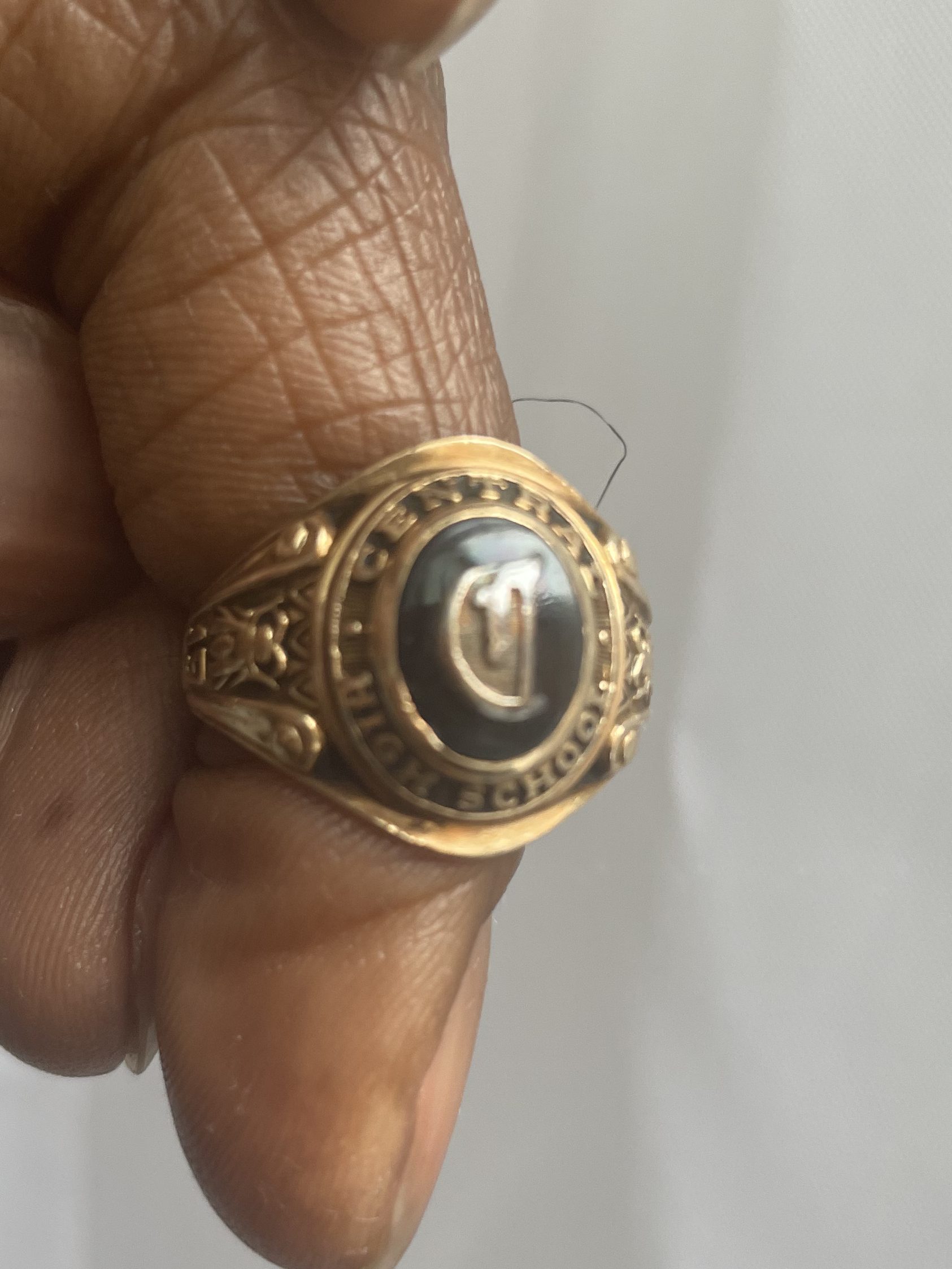
The next part of the tradition is having 100 different people turn the ring, as sort of an acknowledgement of becoming a senior. The first 99 turn it in one direction, while the final person reverses the order. This clockwise/counter-clockwise turn seals the deal. Yet get this, you’re supposed to kiss the hundredth person who turns the ring. You say the word “kiss” in front of most any group of adolescents and they’ll giggle. We knew what kind of kiss was meant. FRENCH like fries! Somehow becoming a senior in high school had been coopted by this hetero-ritual, a hetero-rite of passage (het-or-no-rites!).
I am troubled that this academic milestone is linked to gender. Worse, the ritual is predictably a performance act that fixes gender to normative sexual roles; yes, heteropatriarchy. Worse still, this binary gender performance is discrete, couched in achieving a basic education.
The ring dealer comes to school and makes a sales pitch to the class, and sets up a booth in the lobby after school. In his pitch, he promises a ‘free’ glossy little form to collect all the signatures. It was a bait and switch. These dealers sold us the rings but gave us the forms, the evidence we needed to prove we’d passed another stage towards adulthood. And what were we supposed to do with the blank glossy forms? Come back to school and boast?
The first 50 or so signatures were just us. Our own schoolmates turning each other’s rings, filling in each other’s forms on the very day the rings arrived. Family filled in a lot, too. I distinctly remember a teacher or two requesting to be excluded from the tradition, or take part in the ring ritual of becoming a senior, else we whittle their fingers away.
We all know everybody only wanted to see who signed the final line – a prompt to incite heteronormalizing speech-acts. Well, a few folks weren’t single and already had that 100th spot reserved and filled by sundown. Needless to say, kisses from granny don’t count! I’m pretty sure this wasn’t written on the dealer’s well-crafted sheet. Our market dominated, heteronormative introduction to adulthood for all to see.
I’d attended the same school since second grade so I’d seen people celebrate this class ring ritual for years, and even attended several graduations. I’d watched the “Senior run” year after year – a day at the end of school, when the graduating class runs through all the halls, cheering, banging on lockers as all the kids in all the classes rush out to line the hallways and egg them on. I loved school, adored our school, adored my classmates, and even looked forward to our turn, though parting so bittersweet.
At 16, I was only starting to be able to fully disidentify with the barrage of heterosexualized norms that engulfed me. I had to disentangle heterosexuality from virtually every facet of life – even finishing high school, a normal step we’re all expected to take. It’s as if to gain access to what bell hooks calls ‘the good life’ one had to signify alignment with compulsory heterosexuality.
I knew that I could not even turn my ring 100 times without kissing a girl. No way I’d risk putting a guy’s name at the end of that glossy list – someone I’d actually dreamt of French-kissing. Not like I knew any guy who’d be game. Damn. This was a lot of pressure. This junior prom was forcing me to make all kinds of adult decisions.
“The more I get of you, the stranger it feels…”
I was 16, and wasn’t out yet. Unlike at twelve when these feelings first bubbled over, by 16 I was on the cusp of self-acceptance, and preparing to face this possibility that I was gay. Perhaps it was pure timing. By the 11thgrade I knew for sure I’d be leaving home months after graduation, which was suddenly within reach. I could chart my own homo path. But still, at that age, I had doubts. I tried seriously dating a young woman as my last-ditch effort to see if I was straight or (at least) bisexual.
Kaye wasn’t a classmate, which wouldn’t have worked anyway because in retrospect all my classmates already knew, and had decided to accept me without question. Kaye attended an all-girls’ school, so we’d met through an extracurricular, Black youth empowerment program. Kaye was clearly college bound. She had her own dreams and ambitions, and pursued them – an ideal mate for me. She was the most attractive woman I knew, both inside and out, both to me and others. Yes, THAT sister who is not invulnerable, but has it all together. If she didn’t do, then dammit I was gay!
Fortunately, my girl was smart. And by smart, I mean that she was intelligent, real smart as in NOT clueless at all. We agreed to a kiss on the cheek, and she’d sign the last line on my glossy form. And by ‘agreed to’, I mean that this is what Kaye put on the table as her firm and final offer. She also had the good sense to let me turn her ring, too, but she reserved the 100th signature for someone special. I respected that. This clarified our plutonic status – no Facebook updates needed: I’m gay.
“Gotta find out what I meant to you…You were sweet as cheery pie/ Wild as Friday night”
Share this:


Dear Black People. #BlackAsianWithLove
Dear Black People:
Remember, whiteness has been largely invisible to MANY folks for MANY generations. While one Corona-filled year can make a dent in it, these changes will hurt and will take time. For example, imagine waking up one day, seeing another Black body drop on the streets at the hands of the police, and you see the American president making mockery of it. Stereotypical “rednecks” are breaking open cans of (cheap) beer to celebrate the deaths and you suddenly realize that this – none of this – would NEVER happen to you because of the color of your skin, because your skin is white. That’s got a be an earth-shattering realization.
Dear Black people, can you remember learning something that totally shattered your world view? That’s what’s happening to the wider, whiter world right now. Like any humans, some embrace change, others retreat in defeat and plot retaliation, for Mr. Backlash is NEVER EVER late.
Dear Black people, take a deep breath. Step back and look at the arch of history. It’s a sheer miracle that you’re even here, that your ancestors survived (I’ll spare you the litany of atrocities). History shows you that these flaring moments are fleeting, that in fact, it gets better. So, keep your head to the sky! Strap up your boots, march for justice, speak up, fight for peace, raise your voices in solidarity with peace-loving people everywhere of every shape, size and color. Do these things at your own pace, in your own way, and in your own space, for every contribution towards world peace is needed. Be the change.

 Thoughts from the criminology team