
Home » Posts tagged 'Crime'
Tag Archives: Crime

What should criminologists talk about?

Recently, Criminology with Psychology graduate, now PhD student @zo3conneely wrote an entry focused on the rise of the Reform Party in British politics, which you can find here. In response, we received a comment via social media, asking what this entry had to do with Criminology. As we always say in Criminology, all questions are welcome and valid, after all, for many of us our mantra is ‘question everything’! From a lay perspective, the question indicates a particular understanding of academic disciplines, it presupposes that Criminology has a very narrow focus. In this view, criminologists should stay in their own lane and focus purely and simply on what is commonly understood as crime, i.e. actions which are against the law.
But hang on, doesn’t that fall under the purview of those who study or practice criminal law, something neither I not Zoe have undertaken? Alternatively, is it the business of those who work in the field of criminal justice, investigating and processing those believed to have been involved in law-breaking? Again, not something either Zoe or I have experience of. If my colleagues in law and criminal justice are the experts in actions against the law, where does Criminology fit in and why include a discussion on political parties such as Reform in a blog dedicated to the discipline?
However, the answer is more complex than the original question would indicate. The answer is also much longer than the question. Criminology has been described as a rendezvous or umbrella discipline, a space where everyone can gather to discuss crime from all perspectives. This includes disciplines as diverse as Drama, History, Literature, Philosophy, Psychology as well as many others, including Politics. It is therefore, expected that those who write for a Criminology blog will be drawn from a diverse range of academic backgrounds, for instance, whilst I have a BA and a PhD in Criminology, my MA is in the History of Medicine. For my fellow bloggers, their academic journeys will also be reflective of their curiosity and their developing academic knowledge and skills. It is therefore anticipated that each academic brings their own unique academic knowledge and personal experiences to the discussion table. It is this which enables Criminology to take a holistic approach, we don’t and should not seek consensus, but incorporate as many diverse views as is possible. Only then can we gain a real understanding of the phenomena we call crime, criminality, victimisation, and of course, the responses to such.
But what of crime itself? Do we all have a shared understanding of what ‘crime’ is? After all, much of the time we don’t see crime, only potentially some evidence that is has occurred. Furthermore, it depends very much on time and space. If we were living in 1960’s Britain, suicide, abortion and homosexuality would all feature heavily in our list of crimes. However, suicide was decriminalised in 1961, and abortion and homosexuality were partially decriminalised in 1967, with the latter further decriminalised in 2003. Likewise, if we were to look further afield we would crimes listed in statute books that we do not have here, for example adultery is a crime in Iran, Pakistan, Saudi Arabia, Somalia and was only repealed in Taiwan in 2020. Thus it is quickly evident that crime is not static, it can change drastically through time and place. We also have to recognise that crime can be decriminalised and recriminalised, for example the overturning of Roe vs Wade in the USA, removes the constitutional right for those pregnant to access abortions. If it taught us nothing else, the Covid-19 pandemic showed us rights can be granted and rights can be taken away, which means that criminologists need to keep a very careful eye on both the past and the present.
Whilst my colleagues in law have as their focus current legislation and how it is practised, and my colleagues in criminal justice seek to ensure that the law is enacted and used to the letter of that law, criminology is much freer. After all, we need to know who is making those laws and why. Whilst we can answer quite simply parliamentarians, this does not tell us very much. We also need to know who, for example only 14% of the current parliament belong to the Global Ethnic Majority, a smaller percentage than the population proportionately. Of these 90, 66 are drawn from the Labour Party, 15 Conservative and 5 Liberal Democrats. Likewise, at the 2024 election 40% of MPs are women, despite women making up over 50% of the UK’s population. Let’s not even get started on the disproportionate number of privately educated MPs, or the lack of visibility of disability, sexuality and so on…. Needless to say, the UK parliament does not look like the vast majority of the British public. Yet these are the people make our laws, and if we don’t understand that as a criminological issue, we will soon come unstuck.
We all need to understand what is happening once those laws have been passed, who is delivering justice for the UK? Whether we look at Judges, Barristers, Solicitors, we find a predominance of white men, only when we look at the magistracy we begin to find some real diversity. But don’t forget magistrates are unpaid, lay members of the judiciary, so it is perhaps unsurprising that women make up 57% of this particular field. So what about criminal justice practitioners? If we look at the police for England and Wales, over 91% are white, 65% are men. In relation to His Majesty’s Prison and Probation Service [HMPPS], over 54% are female, yet these are predominantly based within probation, not the prison service. So we begin to see that the people making, enacting and facilitation legislation and criminal justice do not look very much like the country’s population. Criminologically, this matters, how can we hope to tackle serious social harms like Violence Against Women and Girls [VAWG], homelessness, poverty etc when people have neither knowledge nor experience? Can we really talk achieve just outcomes if the people responsible do not look, sound like us, have very different, often privileged backgrounds which mean we have little shared experience?
Hopefully, this entry has gone a little way towards explaining why the discipline of Criminology (and of course, this blog) maintains an careful eye on politics, among a huge range of other interests. Don’t forget, Criminology is a positive discipline, focused on what could be, what ought to be, a fairer society for all of us.
Share this:


A year on… semantics, semantics and semantics?

In October 2024, I wrote a blog on the recently opened Secure School- Oasis Restore. The shiny new edition to the Children and Young People Secure Estate (CYPSE) in England and Wales. In the introduction I pondered on whether this would bring about change within the CYPSE or if this was more of the same. There were lots of positives to consider with the resources, ethos and style of the new Secure School but I, and many others, had concerns that these changes were just words and would amount to little substance. Serious issues within the YJS such as the use of remand, the increasing number of Black and dual heritage children in the CYPSE (despite the overall downwards trend), the continued use of isolation and the high rates of self-harm all appeared to be forgotten with the unveiling of the new Secure School. However, a year on, and the CYPSE failing children appears to be continuing.
Oasis Restore had to ‘temporarily’ close in the summer of 2025 over safety concerns (BBC, 2025). Upon closer reading, and looking at the Ofsted report from April 2025, the main issue is around doors not being able to close properly due to how they were initially made and the damage they have sustained. The Ofsted report (2025) also highlights the use of physical restraint but is positive in how this is only used as a last resort and recorded effectively. The report claims there is a nurturing environment at Oasis Restore, and is overall relatively positive (Ofsted, 2025). The concern is the harm the displacement will have on the children. And why, a CYPSE institution which has cost approximately £40million, was not built fit for purpose?
The children who are placed in CYPSE, for welfare or justice grounds, are incredibly vulnerable. They have often experienced trauma, oppression and isolation at various stages in their childhood from various people and institutions (especially care and CJS). The reality is, these children have been failed multiple times before their arrival in the CYPSE and these failures continue whilst they are there. Oasis Restore was supposed to be different: it was supposed to help, support, nurture and protect. And whilst that appeared to be very much on the agenda, the closing and displacement of these vulnerable children is going to add to being failed by society. I ended my previous blog, reflecting on John Rawls’ when thinking about justice, if an institution cannot be reformed then it should be abolished. I asked, if it was finally time to abolish the CYPSE. I whole heartedly believe it is.
Bibliography:
Askew, J. (2025) Young Offenders School Closes After Safety Concerns, BBC. [online] Available at: https://www.bbc.co.uk/news/articles/cde3g28gxp4o [Accessed 14.10.25]
End Child Imprisonment (2024) Why child imprisonment is beyond reform: A review of the evidence August 2024. [online] Available at: https://article39.org.uk/wp-content/uploads/2024/08/Why-child-imprisonment-is-beyond-reform.-A-review-of-the-evidence-August-2024.pdf
Share this:


The future of criminology

If you have an alert on your phone then a new story may come with a bing! the headline news a combination of arid politics and crime stories. Sometimes some spicy celebrity news and maybe why not a scandal or two. We are alerted to stories that bing in our phone to keep ourselves informed. Only these are not stories, they are just headlines! We read a series of headlines and form a quick opinion of anything from foreign affairs, transnational crime, war, financial affairs to death. We are informed and move on.
There is a distinction, that we tend not to make whenever we are getting our headline alerts; we get fragments of information, in a sea of constant news, that lose their significance once the new headline appears. We get some information, but never the knowledge of what really happened. We hear of war but we hardly know the reasons for the war. We read on financial crisis but never capture the reason for the crisis. We hear about death, usually in crime stories, and take notice of the headcount as if that matters. If life matters then a single loss of life should have an impact that it deserves irrespective of origin.
After a year that forced me to reflect deeply about the past and the future, I often questioned if the way we consume information will alter the way we register social phenomena and more importantly we understand society and ourselves in it. After all crime stories tend to be featured heavily in the headlines. Last time I was imagining the “criminology of the future” it was terrorism and the use of any object to cause harm. That was then and now some years later we still see cars being used as weapons, fear of crime is growing according to the headlines that even the official stats have paused surveying since 2017! Maybe because in the other side of the Atlantic the measurement of fear was revealed to be so great that 70% of those surveyed admitted being afraid of crime, some of whom to the extent that changes their everyday life.
We are afraid of crime, because we read the headlines. If knowledge is power, then the fragmented information is the source of ambiguity. The emergence of information, the reproduction of news, in some cases aided by AI have not provided any great insight or understanding of what is happening around us. A difference between information and knowledge is the way we establish them but more importantly how we support them. In a world of 24/7 news updates, we have no ideological appreciation of what is happening. Violence is presented as a phenomenon that emerges under the layers of the dark human nature. That makes is unpredictable and scary. Understandably so…
This a representation of violence devoid of ideology and theory. What is violence in our society does not simply happens but it is produced and managed through the way it is consumed and promoted. We sell violence, package it for patriotic fervour. We make defence contracts, selling weapons, promoting war. In society different social groups are separated and pitted against each other. Territory becomes important and it can be protected only through violence. These mechanisms that support and manage violence in our society are usually omitted. A dear colleague quite recently reminded me that the role of criminology is to remind people that the origins of crime are well rooted in our society in the volume of harm it inflicts.
There is no singular way that criminology can develop. So far it appears like this resilient discipline that manages to incorporates into its own body areas of work that fiercely criticised it. It is quite ironic for the typical criminology student to read Foucault, when he considered criminology “a utilitarian discipline”! Criminology had the last laugh as his work on discipline and punishment became an essential read. The discipline seems to have staying power but will it survive the era of information? Most likely; crime data originally criticised by most, if not all criminologists are now becoming a staple of criminological research methods. Maybe criminology manages to achieve what sociology was doing in the late 20th century or maybe not! Whatever direction the future of criminology takes it will be because we have taken it there! We are those who ought to take the discipline further so it would be relevant in years to come. After all when people in the future asked you what did you do…you better have a good answer!
Share this:


Exploring the National Museum of Justice: A Journey Through History and Justice

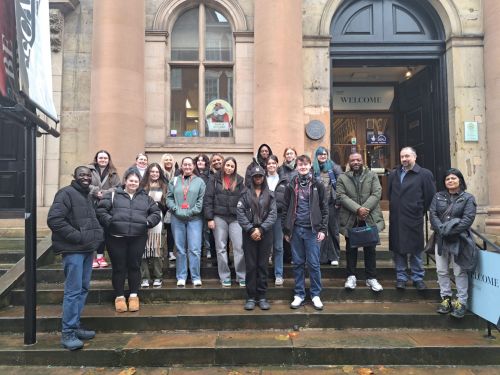
As Programme Leader for BA Law with Criminology, I was excited to be offered the opportunity to attend the National Museum of Justice trip with the Criminology Team which took place at the back end of last year. I imagine, that when most of us think about justice, the first thing that springs to mind are courthouses filled with judges, lawyers, and juries deliberating the fates of those before them. However, the fact is that the concept of justice stretches far beyond the courtroom, encompassing a rich tapestry of history, culture, and education. One such embodiment of this multifaceted theme is the National Museum of Justice, a unique and thought-provoking attraction located in Nottingham. This blog takes you on a journey through its historical significance, exhibits, and the essential lessons it imparts and reinforces about justice and society.
A Historical Overview
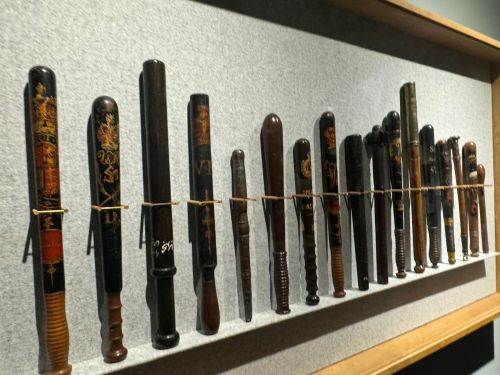
The National Museum of Justice is housed in the Old Crown Court and the former Nottinghamshire County Gaol, which date back to the 18th century. This venue has witnessed a myriad of legal proceedings, from the trials of infamous criminals to the day-to-day workings of the justice system. For instance, it has seen trials of notable criminals, including the infamous Nottinghamshire smuggler, and it played a role during the turbulent times of the 19th century when debates around prison reform gained momentum. You can read about Richard Thomas Parker, the last man to be publicly executed and who was hanged outside the building here. The building itself is steeped in decade upon decade of history, with its architecture reflecting the evolution of legal practices over the centuries. For example, High Pavement and the spot where the gallows once stood.
By visiting the museum, it is possible to trace the origins of the British legal system, exploring how societal values and norms have shaped the laws we live by today. The National Museum of Justice serves as a reminder that justice is not a static concept; it evolves as society changes, adapting to new challenges and perspectives. For example, one of my favourite exhibits was the bench from Bow Street Magistrates Court. The same bench where defendants like Oscar Wilde, Mick Jagger and the Suffragettes would have sat on during each of their famous trials. This bench has witnessed everything from defendants being accused of hacking into USA Government computers (Gary McKinnon), Gross Indecency (Oscar Wilde), Libel (Jeffrey Archer), Inciting a Riot (Emmeline Pankhurst) as well as Assaulting a Police Officer (Miss Dynamite).
Understanding this rich history invites visitors to contextualize the legal system and appreciate the ongoing struggle for a just society.
Engaging Exhibits
The National Museum of Justice is more than just a museum; it is an interactive experience that invites visitors to engage with the past. The exhibits are thoughtfully curated to provide a comprehensive understanding of the legal system and its historical context. Among the highlights are:




1. The Criminal Courtroom: Step into the courtroom where real trials were once held. Here, visitors can learn about the roles of various courtroom participants, such as the judge, jury, and barristers. This is the same room that the Criminology staff and students gathered in at the end of the day to share our reflections on what we had learned from our trip. Most students admitted that it had reinforced their belief that our system of justice had not really changed over the centuries in that marginalised communities still were not dealt with fairly.
2. The Gaol: We delved into the grim reality of life in prison during the Georgian and Victorian eras. The gaol section of the gallery offers a sobering look at the conditions inmates faced, emphasizing the societal implications of punishment and rehabilitation. For example, every prisoner had to pay for his/ her own food and once their sentence was up, they would not be allowed to leave the prison unless all payments were up to date. The stark conditions depicted in this exhibit encourage reflections on the evolution of prison systems and the ongoing debates surrounding rehabilitation versus punishment. Eventually, in prisons, women were taught skills such as sewing and reading which it was hoped may better their chances of a successful life in society post release. This was an evolution within the prison system and a step towards rehabilitation of offenders rather than punishment.
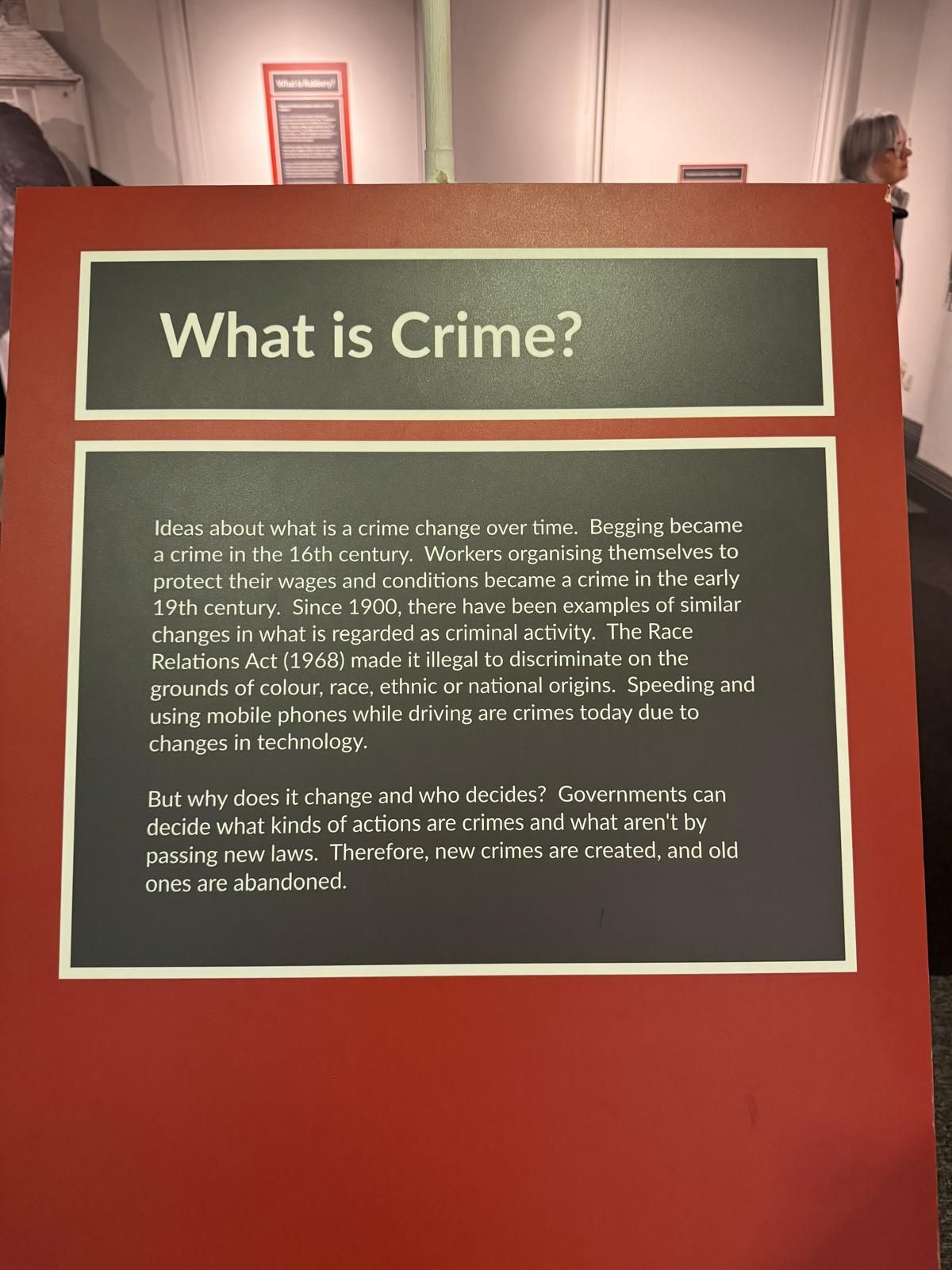
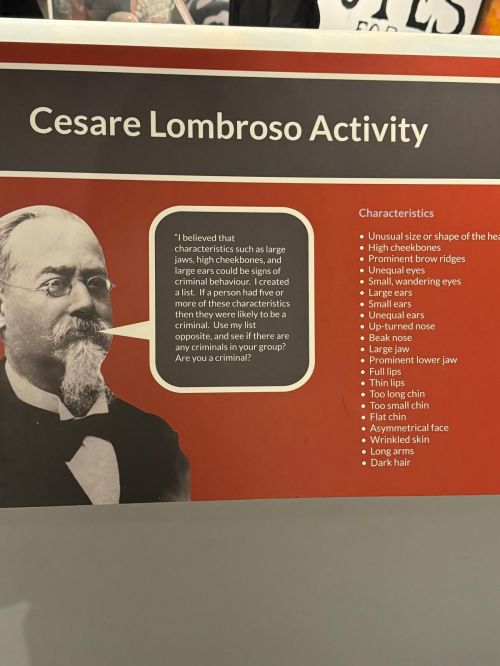
3. The Crime and Punishment Exhibit: This exhibit examines the relationship between crime and society, showcasing the changing perceptions of criminal behaviour over time. For example, one famous Criminologist of the day Cesare Lombroso, once believed that it was possible to spot a criminal based on their physical appearance such as high cheekbones, small ears, big ears or indeed even unequal ears. Since I was not familiar with Lombroso or his work, I enquired with the Criminology department as to studies that he used to reach the above conclusions. Although I believe he did carry out some ‘chaotic’ studies, it really reminded me that it is possible to make statistics say whatever it is you want them to say. This is the same point in relation to the law generally. As a lawyer I can make the law essentially say whatever I want it to say in the way I construct my arguments and the sources I include. Overall, The Inclusions of such exhibits raises and attempts to tackle difficult questions about personal and societal morality, justice, and the impact of societal norms on individual actions. By examining such leading theories of the time and their societal reactions, the exhibit encourages visitors to consider the broader implications of crime and the necessity of reform within the justice system. Do you think that today, deciding whether someone is a criminal based on their physical appearance would be acceptable? Do we in fact still do this? If we do, then we have not learned the lessons from history or really moved on from Cesare Lombroso.
Lessons on Justice and Society
The National Museum of Justice is not merely a historical site; it also serves as a platform for discussions about contemporary issues related to justice. Through its exhibits and programs, our group was invited to reflect on essentially- The Evolution of Justice: Understanding how laws have changed (or not!) over time helps us appreciate the progress (or not!) made in human rights and justice and with particular reference to women. It also encourages us to consider what changes may still be needed. For example, we were incredibly privileged to be able to access the archives at the museum and handle real primary source materials. We, through official records followed the journey of some women and girls who had been sent to reform schools and prisons. Some were given extremely long sentences for perhaps stealing a loaf of bread or reel of cotton. It seemed to me that just like today, there it was- the huge link between poverty and crime. Yet, what have we done about this in over two or three hundred years? This focus on historical cases illustrates the importance of learning from the past to inform present and future legal practices.
– The Importance of Fair Trials: The gallery emphasizes the significance of due process and the presumption of innocence, reminding us that justice must be impartial and equitable. In a world where public opinion can often sway perceptions of guilt or innocence, this reminder is particularly pertinent. The National Museum of Justice underscores the critical role that fair trials play in maintaining the integrity of the legal system. For example, if you were identified as a potential criminal by Cesare Lombroso (who I referred to above) then you were probably not going to get a fair trial versus an individual who had none of the characteristics referred to by his studies.
– Societal Responsibility: The exhibits prompt discussions about the role of society in shaping laws and the collective responsibility we all share in creating a just environment. The National Museum of Justice encourages visitors to think about their own roles in advocating for justice, equality, and reform. It highlights that justice is not solely the responsibility of legal professionals but also of the community at large.
– Ethics and Morality: The museum offers a platform to explore ethical dilemmas and moral questions surrounding justice. Engaging with historical cases can lead to discussions about right and wrong, prompting visitors to consider their own beliefs and biases regarding justice.
Conclusion
The National Museum of Justice in Nottingham is a remarkable destination that beautifully intertwines history, education, and advocacy for justice. By exploring its rich exhibits and engaging with its thought-provoking themes, visitors gain a deeper understanding of the complexities surrounding justice and its vital role in society. Whether you are a history buff, a legal enthusiast, a Criminologist or simply curious about the workings of justice, the National Museum of Justice offers a captivating journey that will leave you enlightened and inspired.
As we navigate the complexities of the modern world, it is essential to remember the lessons of the past and continue striving for a fair and just society for all. The National Museum of Justice stands as a powerful testament to the ongoing quest for justice, inviting us all to be active participants in that journey. In doing so, we honour the legacy of those who have fought for justice throughout history and commit ourselves to ensuring that the principles of fairness and equity remain at the forefront of our society. Sitting on that same bench that Emmeline Pankhurst once sat really reminded me of why I initially studied law.
The main thought that I was left with as I left the museum was that justice is not just a concept; it is a lived experience that we all contribute to shaping.

Share this:


St Valentines Day! Love and other emotions

This blog today is all about love…. or maybe not! As criminologists, we tend to see things slightly different, and our perspective is influenced by functions other than undying declarations of love.
Saint Valentine is associated with love and people celebrate the day with their special romantic person, or by pursuing any person of interest, with romantic cards. Greeting cards, bottles of wine, boxes of chocolates, bunches of flowers, heart shaped jewellery, lovely sonnets, sexy underwear, kinky gifts and over the top romantic gestures! All of the above are anticipated actions on this day. Any of these will act as a demonstration of love. In some ways the more enormous the gesture the greater the demonstration of love and intimacy to the intended special person. Many times, we hear those in a relationship rut complaining that “they don’t even buy me chocolates anymore” a sign that love has fizzled out.
Love is a powerful emotion, and I dare not to challenge it. Artists have created their best work on love! Religion has created its strongest appeal on love. People, the world over, have based their entire lives of how they feel about a person they choose to be their partner and share their lives with. So clearly love is important! Enough for an Austrian psychotherapist to create an entire theory on love and sex. We feel ready to go to war for love and we are completely convinced that love is the force that keeps us going. Love is strong and we feel it every day.
Therefore, it is slightly surprising that the patron saint of romantic love is a rather fictional character! The saint is meant to be a priest who lived in the 3rd century AD and martyred by tortured for his faith. There was no romance involved and there were no love poems written of the time. In fact, the Roman Catholic church did not recognise or mentioned this martyrdom at the time. The first accounts on St Valentine appear in the 6th and later the 9th centuries, some centuries later. Since then, the story of the saint is embellished further, until the 19th century when it becomes connected with romantic love in some tenuous way. For example, the more recent narratives claim that before his execution he would convert and cure the daughter of his jailer. He was also officiating wedding ceremonies between Christians which may have given him the romantic connection. In the 19th century we have the first mass production of love tokens dedicated to the day and in the 20th, century especially post 1960s the celebration was growing in popularity and appeal. Currently the day is a celebration that has a significant capitalist value. It is usually a commercial success midway between Christmas and Easter.
Some religious historians noted that in the Roman calendar in February there have been rituals and celebrations on fertility and cleanliness (physical, spiritual). It was the time presumably when young Romans prepared for sexual relations. Therefore, an amalgamation of the old practices and the then new religion overlap with an obscure Saint to act as the glue to connect them and reaffirm the importance of love. Ironically the Roman citizens of the time, in particular the patricians, would not recognise such acts! They married out of interest, connecting the wealth and power of different factions. In those cycles love was more of a chimera rather than a reality.
Romantic love with knights, towers, dragons and gestures of devotion will appear as fanciful tales. Who hasn’t heard of Odysseus and his beloved wife Penelope who remained faithful to him for 20 years! Her fidelity was not reciprocated, and Odysseus had multiple affairs and fathered several children across the Mediterranean. Not quite the romantic story people would like to believe. Romantic love was always a tale, with vivid twists and turns. Love appears almost pure, undiluted that lifts those in its path. Shakespeare wrote fantastic sonnets on love. Some of the best things ever written in English. Still his contemporaries did not recognise this love. The majority of people at the time died young, malnourished and exhausted. Those who barely survive cannot afford to embrace love. As for those in power their relationship with love can be summed up in the old mnemonic rhyme “divorced, beheaded, died; divorced, beheaded, survived”!
We presume that romantic love is a representation of two people having feelings for one other. That is a nice sentiment but historically weak. Love for women does not exist. Not because women are devoid of emotions; quite the contrary! Because women have been used in social transactions between men who barter and use them as part of their household. A feminist today can recognise, despite all assurances for equality, how unequal life is. Especially in the household! If anyone wants to see why love is not equal only see how domestic and intimate violence is spread between gender lines. Because St Valentine brings flowers and chocolates, but it also brings beatings and abuse. Across the year it is during holidays and significant dates, including St Valentines that violence against women surges. One can unfortunately deduce that love is not for women. Oh…. The irony as romantic novels and movies are presented mostly for women as “chick flicks”!
Earlier in this post, it was said that the bigger the romantic move the better! Who will do this big romantic gesture? A man with chivalrous intent. Our household data reveal that men will spend more than double on what women will spend on the day, making their romantic intent more obvious. Perhaps men are more romantic and feel the need to satisfy that internal need. Or maybe there are other emotions at play. Love is very powerful, but so is possessiveness. In a history of transactions men used women for trading, so their gestures may be a latent act of dominance, a fresh reminder of possession. Instead of giving them chocolates, you may as well urinate all over them. That way your beloved will have your scent and keep other suitors away. So, this is not love but control, jealousy and dominance. Every drop of wine, every piece of chocolate, every flower petal, is yet another link in the chain of ownership. In case this gets misunderstood, the individual who buys flowers isn’t a villain, but the history of this kind of love is pointing in this direction. Your partner may have the best intentions and the greatest love and regard for you, but our society has never really acknowledged the transactional relationship between men and women. It is similar to those who speak of the evils of slavery, but with no recognition of reparations. This love is not pure and clean. It is the darkest form of patriarchy that controls people making them to believe in an adult fairytale once the other story of Santa Claus is not believed any more.
Romantic actions target all incomes and all ages, but of course there is a drive to get younger people, new generations of customers, on the love spending machine. At this stage I shall write…what not to do when you are planning a romantic day! Do not go overboard. Love is something felt in the heart not in the pocket. Heart-shaped products do not say “I love you” more than square or round ones! Red is no more appealing than any other colour and of course if emotions are high, they tend to last more than a day! Ideally do not spend any money! In the unfortunate event that you do, do not cook your romantic meal with a sharp knife. You may pierce the palm of your hand and end up with stitches. Do not spread chocolate on a partner before establishing if they are allergic to any of the ingredients, you may end up in A&E. Do not offer them wine, if they have an intolerance to alcohol, they may vomit all over your pristine bedspread. Do not write something funny or profound if they are thick and unable to comprehend deeper meanings (in that case what are you doing with them???). Love is not an idea, a moment, a day, an instant. It is a lifetime however long or short it is. You will live in love and you will die in love. Even when you are by yourself love is in you and it cannot be defined by the actions of people around you. Finally, love is selfless so do not try to control them, “love is a rebellious bird that nobody can tame”!


 Thoughts from the criminology team