
Home » Posts tagged 'Books'
Tag Archives: Books

Not reading criminology? That’s criminal!
There are two kinds of criminology conversations I get embroiled in these days! Those with people who read criminology where we discuss many social/cultural phenomena under a specific lens or those with people who find criminology interesting, but consume popular crime instead. The first group with varying level of engagement is beginning to decode some tell-tell signs in current events, using their knowledge of the discipline, as a deciphering mechanism. The second group is quite different. Their understanding of crime is based on dramatisations and literary conventions around plots and characters. Even real crime is harbouring under the guise of some “exclusive” journalistic exposé…far from any basic criminological understanding.
Years ago, a colleague from Sociology told me a story regarding a family event. They were completing their PhD in the discipline, and they were questioned by an elderly person, as to what they would do when they finished their thesis. They responded in the usual way many graduate students tend to, about hoping to get into academia or get some funding for some further research. The elderly person didn’t seem satisfied…. they prompted further. What will be your specialism? What will you be able to tell people that you are proficient in? Society and people, the colleague replied! That’s hardly a skill, the old relative replied; we all live in society! The colleague was equally intrigued and offended. They thought that by offering a succinct response it would have helped their relative to understand without being confounded with notions on symbolic interactionism and ethnomethodology. This was a little anecdote that resonates with many social scientists, criminologists included, that whilst they try to explore people and culture around them, they are becoming distant to the actual people around them.
The degree of challenge in recent years seems to increase for disciplines where people in general have a vague idea of what it is. Many try to use psychological terms to explain other people’s behaviours, without realty appreciating, the clinical and scientific conditions of the term. That is relevant to criminology too. The representation of crime for public consumption has introduced some of the discipline’s terms into everyday parlance. From forensic terms on profiling, to the origins of criminality, expectations on crime are forged. A criminologist’s reaction to popular criminology pundits tends to be, well not quite, only to be met with disbelief of the criminology they know!
One of the ways to appeal to those interested in popular criminology and take them to the discipline will be to add some facts and figures that promote reality. Perhaps but that has been done before but only to give a gloss of “legitimacy” in fiction. It makes it more compelling, but it doesn’t really offer the depth of knowledge. To understand criminology, one must read criminology. The history is filled with colleagues who brought their imagination to the discipline. From Bonger’s Criminality and Economic Conditions to Jock Young and The Criminological Imagination there are books and papers that are waiting to be read by a new audience to try to figure out these ideas.
Maybe we all live in society and heard about crime and even experienced it, but to understand it we need some criminology. The discipline, as with all social sciences, is a dialogue between people ready to carry forward the next constructs that shall appear as crimes. If we read them and take part in these conversations maybe the area of harsh punishments, exclusion and persecution may not be as appealing. We are an academic discipline but at the same time we open the discussion to our community. So if you are neither a student, graduate, nor fellow academic and you are interested in criminology, why don’t you come to visit? https://www.northampton.ac.uk/about-us/contact-us/open-days/
Share this:


Happy Birthday: The Blog in Pictures, Numbers and Words

Tuesday marked the 8th “official” birthday of our blog. I say official because although the site was created in November of 2016, the writing did not start in earnest until 3 March. Since that early foray into blogging, we’ve managed collectively to clock up quite a few vital statistics
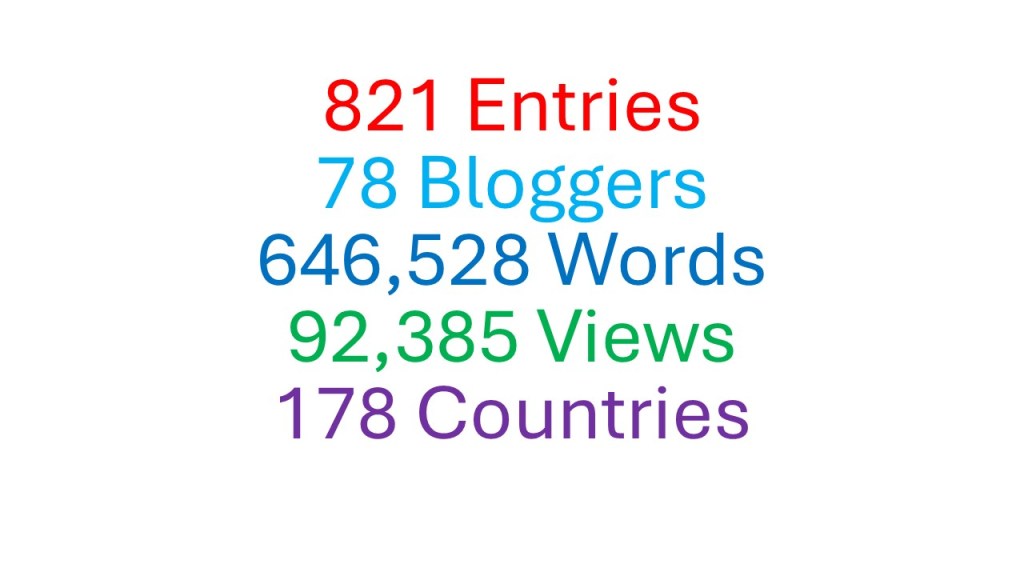
Our 78 bloggers are made of the Criminology Team (both past and present), students and graduates, as well as a number of honorary criminologists. Some have written only one entry, perhaps reflecting on their dissertation, while others have and continue to contribute on a regular or ad hoc basis. It has to be said that 9 of our top 20 most read entries come from students/graduates, another two come from non-criminologists. Certainly graduate and student entries are always very popular. Our most read, continues to be the front page which contains the latest entries, but many of our entries have shown remarkable longevity. For instance, then student, now graduate, Natalie’s (@criminologysocietyuon) thoughts around the “true crime” documentary Betty Broderick remains our most read individual entry, clocking up views ever since the day it was published. This demonstrates the enormous appetite for “true crime” that many people have. Likewise, Dr Stephen O’Brien’s (@anfieldbhoy) reflections on the 30th anniversary of the Hillsborough Disaster continues to be well-read, particularly around the anniversary on 15 April. In the words of the poet, Ella Wheeler Wilcox: ‘No question is ever settled, until it is settled right’ and there is certainly a long way to go to obtain justice for the 97.
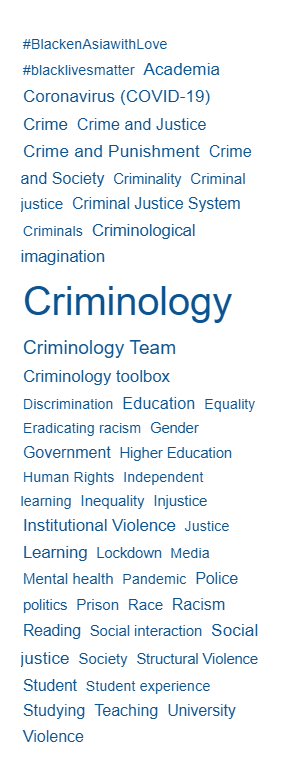
As can be seen from the word cloud, which appears on the front page of the blog and below, Criminology unsurprisingly occupies the attention of most of our bloggers and entries. However, it is also clear that social injustice, inequalities and various forms of violence appear regularly within our writing. There is also a strong focus on learning and teaching, as well as evidence of the lasting generational impact of the Covid-19 pandemic (our best year for readership to date).
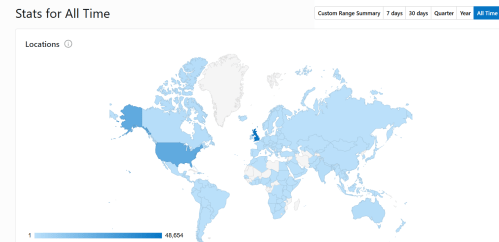
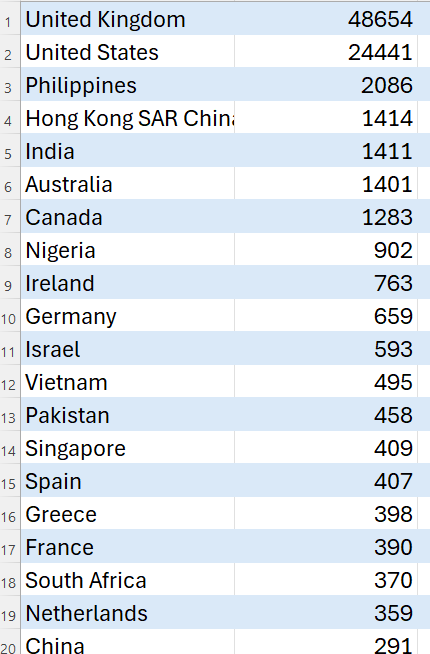
As you can see from the map the majority of our readers come from the UK and the USA, but we’ve also captured the criminological imagination of people from a diverse range of countries ranging from Albania to Zambia. Some of the countries can be explained through our bloggers’ diverse heritage, for instance, Greece, Nigeria, USA have obvious connections, others, we’ve no idea how our words have spread so far. Nevertheless, it is a very exciting to see the blog’s global reach.
As the saying goes, from small acorns to giant oaks, the germ of an idea has spread beyond any of our wildest dreams. The number of blog entries continues to grow on a weekly basis, it seems we never run out of criminological matters to write about. It has given all of us a space to ponder, to muse, to write through dark days and celebrations, and to continue to engage in Public Criminology. Similarly, the number of bloggers steadily rises, some are in their earliest foray into discovering Criminology, some have years of immersion in the discipline, but we are all learners. In the words of Nelson Mandela: ‘Education is the most powerful weapon which you can use to change the world’ so why would we ever want to stop learning?
When we started, we thought the blog would last for a year, maybe, either we’d run out of things to write about or we’d find other things to do with our time. Neither has happened and it seems there is still plenty of appetite from our bloggers and our readers. To both we raise a glass, without you, none of this would have been possible, so thank you! Now, let’s see how long we can keep this up!
Share this:


Tis very quiet on a Friday…

Fridays are an especially busy day for the BA Criminology and BA Criminology with Psychology students and staff: for some there are 6hours of classes today, finishing their Friday at 6pm! What a way to finish off the ‘working’ week: packed full of interesting discussions and learning. However, the vibe on the roads in via the morning commute and the silence rolling through the Library at 10am would suggest not everyone shares in a full-on Friday experience!
Friday evenings would mark the end of a long week for many, and the, hopefully, exciting possibilities the weekend might hold. But as I travelled into Northampton, on my usually very early and busy commute, I couldn’t help but notice the lighter quieter roads. It makes a nice change up- can leave a little later than usual and do not have to comprehend with the stresses of the morning rush hour: but why? Why have Fridays become quiet?
As many staff and students will know: car parking can be a smidge of a challenge when arriving for 9ams: but not on a Friday. Usually, to beat the rush, it is ideal to arrive at campus before 0830: but not on a Friday. 0845 and there remain many car parking spaces- again excellent to set up for a long day of studying but why the sudden quietness on a Friday? Is this a symptom of a wider issue?
There is a peaceful sense around campus today- despite the busy day for some courses. It feels very much like the week is over: should this be so overtly felt at 9am instead of 6pm? I have asked friends not in academia, and this Friday quietness appears to be across industries. Friday appears to be a favourite day to work from home: a gentle ease into the weekend. But should we be easing into the weekend or ending the ‘working’ week a little frazzled and desperate for the weekend ahead? Does it really matter? The grey weather we’ve been blessed with today I am sure does not help, and it is a nice change up from the mid-week hustle and bustle which exists on campus. But why have Fridays crept into this sort of ‘start of the weekend’ status? The Friday evening I can see being that representation: but the Friday morning? Maybe it’s a one-off and next week the roads and campus will be buzzing and hopefully the sun will be shining. But for today, the last Friday in February: its very much a gentle atmosphere on campus.
Share this:


Is it time to unleash your criminological imagination?

In this blog entry, I am going to introduce a seemingly disconnected set of ideas. I say seemingly, because at the end, all will hopefully make sense. I suspect the following also demonstrates the often chaotic and convoluted process of my thought processes.
I’ve written many times before about Criminology, at times questioning whether I have any claim to the title criminologist and more recently, what those with the title should talk about. These come on top of hundreds of hours of study, contemplation and reflection which provides the backdrop for why I keep questioning the discipline and my place within it. I know one of the biggest issues for me is social sciences, like Criminology and many others, love to categorise people in lots of different ways: class, race, gender, offender, survivor, victim and so on. But people, including me, don’t like to be put in boxes, we’re complex animals and as I always tell students, people are bloody awkward, including ourselves! There is also a far more challenging issue of being part of a discipline which has the potential to cause, rather than reduce or remove harm, another topic I’ve blogged on before.
It’s no secret that universities across the UK and further afield are facing many serious, seemingly intractable challenges. In the UK these range from financial pressures (both institutional and individual), austerity measures, the seemingly unstoppable rise of technology and the implicit (or explicit, depending on standpoint) message of Brexit, that the country is closed to outsiders. Each of the challenges mentioned above seem to me to be anti-education, rather than designed to expand and share knowledge, they close down essential dialogue. Many years ago, a student studying in the UK from mainland Europe on the Erasmus scheme, said to me that our facilities were wonderful, and they were amazed by the readily available access to IT, both far superior to what was available to them in their own country. Gratifying to hear, but what came next was far more profound, they said that all a serious student really need is books, a enthusiastic and knowledgeable teacher and a tree to sit under. Whilst the tree to sit under might not work in the UK with our unpredictable weather, the rest struck a chord.
The world seems in chaos and war-mongers everywhere are clamouring for violence. Recent events in Darfur, Palestine, Sudan, Ukraine, Venezuela and many other parts of the world, demonstrate the frailty, or even, fallacy of international law, something Drs @manosdaskalou, @paulsquaredd and @aysheaobrien1ca0bcf715 have all eloquently blogged about. But while these discussions are important and pertinent, they cannot address the immediate harm caused to individuals and populations facing these many, varied forms of violence. Furthermore, whilst it’s been over 80 years since Raphäel Lemkin first coined the term ‘genocide’, it seems world leaders are content to debate whether this situation or that situation fits the definition. But, surely these discussions should be secondary, a humanitarian response is far more urgent. After all, (one would hope) that the police would not standby watching as one person killed another, all whilst having a discussion around the definition of murder and whether it applied in this context.
The rise of technology, in particular Generative Artificial Intelligence, has been the focus of blogs from Drs @sallekmusa, @5teveh and myself, each with their own perspective and standpoint. Efforts to combat the harmful effects of Grok enabling the creation of non-consensual pornographic images demonstrate both new forms of Violence Against Women and Girls [VAWG] and the limitations of control and enforcement. Whilst countries are rushing to ban Grok and control the access of social media for children under 16, it is clear that Grok and X are just one form of GAI and social media, there is seemingly nothing to stop others taking their place. And as everyone is well aware, laws are broken on a daily basis (just look at the court backlog and the overflowing prisons) and with no apparent way of controlling children’s access to technology (something which is actively encouraged in schools, colleges and universities) these attempts seem doomed to fail. Maybe more regulation. more legislation isn’t the answer to this problem.
Above I have briefly discussed four seemingly intractable problems. In each arena, we have many thousands of people across the globe trying to solve the issues, but the problems still remain. Perhaps we should ask ourselves the following questions:
- Maybe we are asking the wrong people to come up with the answers?
- Maybe we are constraining discussions and closing down debate?
- Maybe by allowing the established and the powerful to control the narrative we just continue to recycle the same problems and the same hackneyed solutions?
What if there’s another way?
And here we come to the crux of this blog, in Criminology we are challenged to explore any problem from all perspectives, we are continually encouraged to imagine a different world, what ought or could be a better place for all. I have the privilege of running two modules, one at level 4 Imagining Crime and one at Level 6 Violence. In both of these students work together to see the world differently, to imagine a world without violence, a world in which justice is a constant and reflection a continual practice. Walking into one of these classrooms you may well be surprised to see how thoughtful and passionate people can be when faced with a seemingly unsolvable problem when everything on the table is up for discussion. Although often misattributed to Einstein, the statement ‘Insanity is doing the same thing over and over again and expecting different results’ seems apposite. If we want the world to be different, we have to allow people to think about things differently, in free and safe spaces, so they can consider all perspectives, and that is where Criminology comes in.
Be fearless and unleash your criminological imagination, who knows where it might take you!
Share this:


25 years is but a drop in time!

If I was a Roman, I would be sitting in my comfortable triclinium eating sweet grapes and dictating my thoughts to a scribe. It was the Roman custom of celebrating a double-faced god that started European celebrations for a new year. It was meant to be a time of reflection, contemplation and future resolutions. It is under these sentiments that I shall be looking back over the year to make my final calculations. Luckily, I am not Roman, but I am mindful that over 2025 years have passed and many people, have tried to look back. Since I am not any of these people, I am going to look into the future instead.
In 25 years from now we shall be heading to the middle of the 21st century. A century that comes with great challenges. Since the start of the century there has been talk of economic bust. The banking crisis slowed down the economy and decreased real income for people. Then the expectation was that crime will rise as it did before; whilst the juries may still be out. the consensus is that this crime spree did not come…at least not as expected. People became angry and their anger was translated in changes on the political map, as many countries moved to the right.
Prediction 1: This political shift to the right in the next 25 years will intensify and increase the polarisation. As politics thrives in opposition, a new left will emerge to challenge the populist right. Their perspective will bring another focus on previous divisions such as class. Only on this occasion class could take a different perspective. The importance of this clash will define the second half of the 21st century when people will try to recalibrate human rights across the planet. Globalisation has brought unspeakable wealth to few people. The globalisation of citizenship will challenge this wealth and make demands on future gains.
As I write these notes my laptop is trying to predict what I will say and put a couple of words ahead of me. Unfortunately, most times I do not go with its suggestions. As I humanise my device, I feel sorry for its inability to offer me the right words and sometimes I use the word as to acknowledge its help but afterwards I delete it. My relationship with technology is arguably limited but I do wonder what will happen in 25 years from now. We have been talking about using AI for medical research, vaccines, space industry and even the environment. However currently the biggest concern is not AI research, but AI generated indecent images!
Prediction 2: Ai is becoming a platform that we hope will expand human knowledge at levels that we could have not previously anticipated. One of its limitations comes from us. Our biology cannot receive the volume of information created and there is no current interface that can sustain it. This ultimately will lead to a divide between people. Those who will be in favour of incorporating more technology into their lives and those who will ultimately reject it. The polarisation of politics could contribute to this divide as well. As AI will become more personal and intrusive the more the calls will be made to regulate. Under the current framework to fully regulate it seems rather impossible so it will lead to an outright rejection or a complete embrace. We have seen similar divides in the past during modernity; so, this is not a novel divide. What will make it more challenging now is the control it can hold into everyday life. It is difficult to predict what will be the long-term effects of this.
During the late 20th and early 21st centuries drug abuse and trafficking seemed to continue to scandalise the public and maintain attention as much as it did back in the 1970s and 80s. Drugs have been demonised and became the topic of media representation of countless moral panics. Its reach in the public is wide and its emotional effect rivals only that of child abuse. Is drugs abuse an issue we shall be considering in 25 years from now?
Prediction 3: People used substances as far back as we can record history. Therefore, there will be drugs in the future to the joy of all these people who like to get high! It is most likely that the focus will be on synthetic drugs that will be more focused on their effects and how they impact people. The production is likely to change with printers being able to develop new substances on a massive scale. These will create a new supply line among those who own technology to develop new synthetic forms and those who own the networks of supply. In previous times a takeover did happen so it is likely to happen again, unless these new drugs emerge under formal monopolies, like drug companies who will legalise their recreative use.
One of the biggest tensions in recent years is the possibility of another war. Several European politicians have already raised it pretending to be making predictions. Their statements however are clear signs of war preparation. The language is reminiscent of previous eras and the way society is responding to these seems that there is some fertile ground. Nationalism is the shelter of every failed politician who promises the world and delivers nothing. Whether a citizen in Europe (EU/UK) the US or elsewhere, they have likely to have been subjected to promises of gaining things, better days coming, making things great…. only to discover all these were empty vacant words. Nothing has been offered and, in most cases, working people have found that their real incomes have shrunk. This is when a charlatan will use nationalism to push people into hating other people as the solution to their problems.
Prediction 4: Unfortunately, wars seem to happen regularly in human history despite their destructive nature. We also forget that war has never stopped and elusive peace happens only in parts of the world when different interests converge. There is a combination of patriotism, national pride and rhetoric that makes people overlook how damaging war is. It is awfully blindsided not to recognise the harm war can do to them and to their own families. War is awful and destroys working people the most. In the 20th century nuclear armament led to peace hanging by a thread. This fear stupidly is being played down by fraudsters pretending to be politicians. Currently the talk about hybrid war or proxy war are used to sanitise current conflicts. The use of drones seems to have altered the methodology of war, and the big question for the next 25 years is, will there be someone who will press THAT button? I am not sure if that will be necessary because irrespective of the method, war leaves deep wounds behind.
In recent years the discussion about the weather have brought a more prevailing question. What about the environment? There is a recognised crisis that globally we seem unable to tackle, and many make already quite bleak predictions about it. Decades ago, Habermas was exploring the idea of “colonization of the lifeworld” purporting that systemic industrial agriculture will lead to environmental degradation. Now it seems that this form of farming, the greenhouse gasses and deforestation are becoming the contributing factors of global warming. The inaction or the lack of international coordination has led calls for immediate action. Groups that have been formed to pressure political indecision have been met with resistance and suspicion, but ultimately the problem remains.
Prediction 5: The world acts when confronted with something eminent. In the future some catastrophic events are likely to shape views and change attitudes. Unfortunately, the planet runs on celestial and not human time. When a prospective major event happens, no one can predict its extent or its impact. The approach by some super-rich to travel to another planet or develop something in space is merely laughable but it is also a clear demonstration why wealth cannot be in the hands of few oligarchs. Life existed before them and hopefully it will continue well beyond them. On the environment I am hopeful that people’s views will change so by the end of this century we will look at the practices of people like me and despair.
These are mere predictions of someone who sits in a chair having read the news of the day. They carry no weight and hold no substantive strength. There is a recognition that things will change at some level and we shall be asked to adapt to whatever new conditions we are faced with. In 25 years from now we will still be asking similar questions people asked 100 years ago. Whatever happens, however it happens, life always finds a way to continue.
Share this:


A reflective continuous journey

Over the last few weeks I have been in deep thought and contemplation. This has stemmed from a number of activities I have been involved in. The first of those was the Centre for the Advancement of Racial Equality (CARE) Conference, held on the 1st July. The theme this year was “Illustrating Futures – Reclaiming Race and Identity Through Creative Expressions.” It was a topic I have become both passionate and interested in over the last few years. It was really important to be part of an event that placed racial equality at the heart of its message. There were a number of speakers there, all with important messages. Assoc. Prof. Dr Sheine Peart and Dr Richard Race talked about the experiences of racialised women in higher education. They focused on the micro-aggressions they face, alongside the obstacles they encounter trying to gain promotions, or even to be taken seriously in their roles. Another key speaker during the conference was Dr Martin Glynn, unapologetically himself in his approach to teaching and his journey to getting his professor status. It was a reminder to be authentically yourself and not attempt to fit in an academic box that has been prescribed by others. As I write my first academic book, his authenticity reminded me to write my contribution to criminology in the way I see fit, with less worry and comparison to others. It was also another reminder not to doubt yourself and your abilities because of your background or your academic journey being different to others. Dr Glynn has and continues to break down barriers in and outside of the classroom and reminds us to think outside the box a little when we engage with our young students.
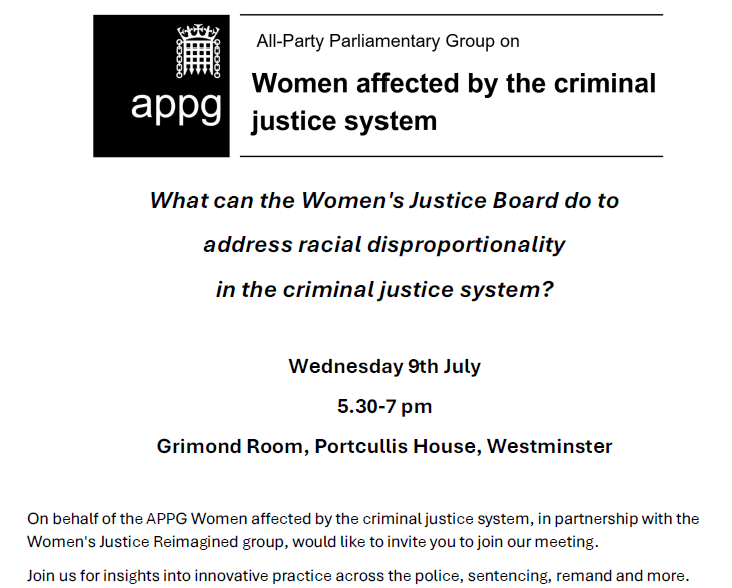
Another key event was the All-Party Parliamentary Group meeting on women in the criminal justice system. The question being addressed at the meeting was ‘What can the Women’s Justice Board do to address racial disproportionality in the criminal justice system?’. It was an opportunity for important organisations and stakeholders to stress what they believed were the key areas that needed to be addressed. Some of the charities and Non-governmental organisations were Hibiscus, Traveller Movement, The Zahid Mubarek Trust. There were also individuals from Head of Anti-slavery and Human Trafficking at HMPPS and the Deputy Mayor for Policing and Crime in London. Each representative had a unique standpoint and different calls for recommendations, ranging from:
• Hearing the voices of women affected in the CJS;
• Having culturally competent and trauma informed CJS staff;
• Ringfenced funding for specialist services and organisations like the ones that were in attendance;
• Knowing who you are serving and their needs;
• Making it a requirement to capture data on race and gender at all stages of the CJS.
It was truly great to be in a room full of individuals so ready to put the hard work in to advocate and push for change. I hope it will be one of many discussions I attend in the future.
Lastly, as I enter the final throes of writing my book on the experiences of Black women in prison I have been reflecting on what I want my book to get across, and who will be able to access it. The book represents the final outcomes of my PhD so to speak:
• To be able to disseminate the words and voices of the women that shared their stories;
• To be able to provide a visual into their lives and highlight the importance of visual research methods;
• To highlight some recommendations for change to reduce some of the pains of imprisonment faced by Black women;
• To call for more research on this group that has been rendered invisible.
Share this:


The future of criminology

If you have an alert on your phone then a new story may come with a bing! the headline news a combination of arid politics and crime stories. Sometimes some spicy celebrity news and maybe why not a scandal or two. We are alerted to stories that bing in our phone to keep ourselves informed. Only these are not stories, they are just headlines! We read a series of headlines and form a quick opinion of anything from foreign affairs, transnational crime, war, financial affairs to death. We are informed and move on.
There is a distinction, that we tend not to make whenever we are getting our headline alerts; we get fragments of information, in a sea of constant news, that lose their significance once the new headline appears. We get some information, but never the knowledge of what really happened. We hear of war but we hardly know the reasons for the war. We read on financial crisis but never capture the reason for the crisis. We hear about death, usually in crime stories, and take notice of the headcount as if that matters. If life matters then a single loss of life should have an impact that it deserves irrespective of origin.
After a year that forced me to reflect deeply about the past and the future, I often questioned if the way we consume information will alter the way we register social phenomena and more importantly we understand society and ourselves in it. After all crime stories tend to be featured heavily in the headlines. Last time I was imagining the “criminology of the future” it was terrorism and the use of any object to cause harm. That was then and now some years later we still see cars being used as weapons, fear of crime is growing according to the headlines that even the official stats have paused surveying since 2017! Maybe because in the other side of the Atlantic the measurement of fear was revealed to be so great that 70% of those surveyed admitted being afraid of crime, some of whom to the extent that changes their everyday life.
We are afraid of crime, because we read the headlines. If knowledge is power, then the fragmented information is the source of ambiguity. The emergence of information, the reproduction of news, in some cases aided by AI have not provided any great insight or understanding of what is happening around us. A difference between information and knowledge is the way we establish them but more importantly how we support them. In a world of 24/7 news updates, we have no ideological appreciation of what is happening. Violence is presented as a phenomenon that emerges under the layers of the dark human nature. That makes is unpredictable and scary. Understandably so…
This a representation of violence devoid of ideology and theory. What is violence in our society does not simply happens but it is produced and managed through the way it is consumed and promoted. We sell violence, package it for patriotic fervour. We make defence contracts, selling weapons, promoting war. In society different social groups are separated and pitted against each other. Territory becomes important and it can be protected only through violence. These mechanisms that support and manage violence in our society are usually omitted. A dear colleague quite recently reminded me that the role of criminology is to remind people that the origins of crime are well rooted in our society in the volume of harm it inflicts.
There is no singular way that criminology can develop. So far it appears like this resilient discipline that manages to incorporates into its own body areas of work that fiercely criticised it. It is quite ironic for the typical criminology student to read Foucault, when he considered criminology “a utilitarian discipline”! Criminology had the last laugh as his work on discipline and punishment became an essential read. The discipline seems to have staying power but will it survive the era of information? Most likely; crime data originally criticised by most, if not all criminologists are now becoming a staple of criminological research methods. Maybe criminology manages to achieve what sociology was doing in the late 20th century or maybe not! Whatever direction the future of criminology takes it will be because we have taken it there! We are those who ought to take the discipline further so it would be relevant in years to come. After all when people in the future asked you what did you do…you better have a good answer!
Share this:


#UONCriminologyClub: Introduction to Criminology with Dr Manos Daskalou

In celebration of the 25 years of Criminology at UON, we have been hosting a number of events that demonstrate the diversity and reach criminology has as a discipline in different communities. In a spirit of opening a wider dialogue we have created a series of online classes for young home educated learners (10-15) to provide some taster sessions about criminology. This is a reflection of the very first one.
Setting up a session for young learners is not an easy feat! The introduction session was about to set the tone with the newly formed “Criminology Club” like the old Micky Mouse Club, only with more crime and less mice! The audience of our new crime-busters was ready to engage. The pre-session activity was set and the tone for what was to follow was clear. For an hour I would be conversing on crime. To get through the initial introductions with the group, we went over the activity. Top crimes and reasons for arranging them in that order. Our learners went into a whole range of criminalities and provided their own rationale for what they thought made them serious. There is a complex simplicity in this activity; regardless of age or experience, our understanding and most importantly justification of crime, tells us more about us, than the person committing it. Once we were done with the “pleasantries” we moved into the main part of the class.
Being an introductory session, it was important to set it right; telling a story and framing it into a conversation is important. What’s the best way to start the story of crime, but to tell a story we all know about when growing up; a fairy-tale. Going for a classic fairy-tale seemed to be the best way to go!
For this session the fairy tale chosen was Cinderella.
“I really enjoyed today’s session! I feel enlightened – Dr @manosdaskalou was great and I really loved the activities. I didn’t know the original story of Cinderella – it’s so horrifying. I didn’t think of crime in fairy-tales before but now I will be on the look out.” (Quinn age 12).
The original tale, like most fairy-tales has a fairly brutal twist that reinforces strongly the cautionary tale within the story. This was an audience participation narration and the help of the “crime-busters” was necessary every step of the way. Understanding the types of crimes being committed at every turn of the tale, while wondering if this was to be regarded appropriate behaviour now. Suddenly the fairy tale becomes an archive of social trends, beliefs and actions, captioned into the spin of the story. The hour was far too little time covering a simple fairy tale!
“I would like to thank Dr @manosdaskalou for today. I had an amazing time. The only thing I didn’t like was when it ended. I like stories so I enjoyed when we talked about Cinderella, I didn’t realise how gruesome the original one was!” (Paisley age 10).
There is something interesting running over a familiar tale and looking at it from a different perspective. The process of decoding messages and reviewing narratives. For a younger audience the terms may sound incomprehensible but it is amazing how much narrative analysis the new “crime-busters” did! Our social conventions are so complex yet despite that a child at the age of 10 can pick them up and put them in the right order. Seeing them confronting the different dilemmas, the story took them on so many different levels, was an interesting process. It is always a challenge to pitch any material at the right level but on this occasion, for this group, about this story in this instance, the “crime-busters” were introduced to Criminology!
“We had so much fun today in our first criminology lesson with Dr @manosdaskalou from UON. Time flew by so quickly, I was so interested in everything we were discussing and wanted to know more and more. In today’s session we pulled apart the fairytale Cinderella discussing what crimes the characters in it had committed and why. I thought this was a really great idea. I was having so much fun in the lesson that I didn’t realise how much I was actually learning but now that we have finished I realise I know much more about criminology and how to study a classic text with Criminology in mind. A big thank you to @manosdaskalou who made it an incredibly fun and engaging session. I’m sure I speak for most of us when I say I can’t wait to come back next time and learn more.” (Atty aged 14).
The end of the session left the group of “crime-busters” wanting more. Other colleagues will continue offering more sessions to an early generation of learners getting to know the basics about “Criminology” a discipline that many people think they know from true crime, little realising we spend so much time dispelling the myths! Who would imagine that the best way to do so, was to tell them a fairy tale.
Share this:


25th Year Reflection

I have been part of Criminology at UON as BA Criminology student, then Associate Lecturer then Lecturer in Criminology for about 13 years in total. My last reflection on my Criminology journey was in 2020 as I had just embarked on my new role as a Lecturer in Criminology. Every now and then I reflect on how lucky I am to be able to have a job role which has the potential to encourage a passion for learning, reading, writing, critical thinking as well as other life skills.
When reflecting on the 25th year Criminology anniversary I think mostly of the old Park Campus that I used to frequent and study at as a student. It had quite a nice feel to it and there was also enough surrounding nature for a famous badger to make this place part of its habitat! There were less books available online when I was an undergraduate compared to today so I have fond memories of going to the library often to have a browse and coming away with as many criminology related books that I could fit in my bag at once. Finding places where I could study for hours that were less frequented than the main library also gave me a bit of a buzz. There also used to be a Pavilion bar near to where the majority of exams would take place, one of my favorite past time memories is sipping on a beer in the Pavilion just after the end of my final third year Criminology exam season, (whilst secretly thinking of how I thought the exams went much better than expected).
When reflecting I am also reminded of how lecturers like Dr @manosdaskalou and Dr @paulaabowles can be incredibly inspirational and influential at guiding academic paths (such as my own!). The re-occurring ideas that ‘criminology is everywhere’ and that we should ‘question everything’ has boded well for helping me to make difficult decisions and in thinking about how I interacted with people when I was working within crime related industries.
In more recent years staff and students have moved to a new campus, have worked and studied through the challenges that come with Covid-19 and contextual uncertainties. This year has had some highlights for me, such as working on a new module Imagining Crime. Whereby we used inspiration from the novel 1984 by George Orwell to task students with committing weekly ‘thought crimes’ by seeing/hearing/reading about something criminological and questioning this by using critical thinking. Listening to the development of critical thinking via the ‘thought crime’ method has been a delight. The flexible, creative and multidisciplinary nature of criminology is also quite fabulous for maintaining interest in criminology over a long period of time but also for venturing into new and less explored areas. For instance, staff and students in Imagining Crime had the pleasure of attending a guest speaker session with @saffrongarside about children’s literature and the environment this academic year – at a time when Northampton itself seemed to be struggling to cope with flooding. Of course, this did highlight the importance of seeing environmental issues as criminological issues, but also the importance of considering children’s books as criminologically cultural artifacts, was something completely new and intriguing for me. I also gained a lot from hearing what our students (who are predominantly) young people think about environmental issues outside of the mainstream media angles that I have seen.
To round up, I loved my student life whilst studying BA Criminology and I am sure many others will say ‘ditto to that’. Long may the love for Criminology at UON continue!
Share this:


Book blurbs: a necessity or frill?

I have always been, and imagine I will always be, a lover of books. Until the summer of last year, it has always been physical books. The feel, the smell, the shock when you drop it as you’re drifting off to sleep, the dampness of pages when you’ve picked it up too quickly after getting out of a pool or the sea on holiday and that beautiful crinkle crisp after the page dries. Physical books are beautiful (even the ugly ones). And this holds for academic sources, non-fiction books and novels! One of the joys of selecting a book (new or often second-hand charity gems), is reading the blurb. It might give you a brief introduction to characters you are following, or if an academic source it might provide you with a brief list of topics the book navigates. The blurb might also contain some quotations and reviews expressing the ‘excellence’ or ‘gripping’ nature of the book. And whilst this is generally a positive feature, since reading e-books (where I do not read the blurb or even access the blurb), I have started to wonder if the blurb is actually a hinderance to the potential reader…
Now, this entry is not to debate the great debate of the 21st century: e-book versus book. But rather the format of an e-book not having a blurb per se versus the blurb on the back of a book. I am fortunate enough to have a Kindle: one of my most prized possessions. It’s beautiful, it can be read in all environments (warmth setting and light setting is incredible), it’s lightweight and fits in almost all of my bags and many of my pockets #notsponsored, but I have never read a blurb of a book on the Kindle, and I can’t work out if I’m missing out or if this is actually an improvement of the ‘book selection’ process.
Some positives of not accessing the blurb on the e-readers is it has opened up my reading list astronomically. I have read and loved books I am certain I would never have picked up or purchased had I read what they were about. Some have been heavy, taxing reads but so worth it in the end, others have been bizarre and wonderful but not something I would have ever recommended to myself. Had these been physical books, having read the blurb, these would have been left by me on the shelf and therefore I would have lost out on the joy, wonder and sadness that these books had to offer.
There are of course issues with not reading the blurbs and these issues reinforce the importance of the feature as a necessity and not just a frill. I have also read a number of books I quite simply wish I hadn’t. And had I read the blurb I would have known not to start these monstrosities (once I’ve started, unfortunately my brain makes me finish – commitment [even to books] is important to my brain). I have also read some incredible books but at the wrong time: again had I read the blurb I would have known that this book is not a sensible choice given my headspace.
The issue is most likely me, rather than whether blurbs are actually necessary or just frill. And I’d imagine it’s better to have them and not use them, them not have them and miss them. But if they aren’t being used, they have no purpose and become redundant. Is this a wider symptom of the rise of the e-book or just a side-effect that no one else is concerned about but me? I do not know. But I find it strange how heavily I rely on blurbs with physical books and how void they are with e-books. Are e-books the beginning of the end for blurbs or am I over think this? Penny for your thoughts?


 Thoughts from the criminology team
