
Home » (Page 2)
Archives

Mourning Travel. #BlackenAsiaWithLove
Mourning Travel.
One of the first casualties of Corona was travel. Nations immediately began controlling the flow of people in and out of ever-broader borders. First neighborhoods, then cities, regions, and countries all closed. As fear of the virus spreading spread, different parts of the world became associated with Corona, though bullheaded public figures even continued to call it “Chinese”
A few years ago, I got a 10 -year visa to China through work and had planned to travel there much more than time has allowed. Now, I am fearful of ever traveling there before my visa expires. I am unable to accept the many invitations to connect with my previous students who’ve returned to China and know of my interest in the region’s cultures. I have been to southern China on several study trips with students. We finally ventured to Beijing and its wonders on a later trip. Naturally, I did my happy dance when I reached a peak on the Great Wall just a few years ago. I am now on sabbatical in Hanoi, just released from lockdown.
It was a lifelong dream to visit China, I was raised on my godmother’s stories about growing up in Hong Kong, savoring the flavors of her homeland in her kitchen in Kentucky. I knew I had to see for myself. As a kid, she and I would go on shopping day-trips to Chicago’s Chinatown, a 7-hour drive each way. For those few hours in Chi-town, we’d be transported to a world where finally she was the insider. She spoke for hours in several dialects with all the people around that I didn’t understand, and we even browsed restaurants that resembled what she’d told me home was like. We’d go in and eat not from the tourist but from the Chinese menus – foods that were not nearly available in Kentucky.
Kentucky is pretty black and white, but there, in the heart of Chinatown, in the heartland of America, smack in the middle of the 80’s, I got to experience my godmother being in the majority. Growing up close to my godmother confirmed I could experience more freedom through travel. This was a key insight into the world for a gay kid growing up in the Bible Belt; I could just go away. Travel has always exposed me to new ways of being in the world.

Pride, Nehru Park, New Delhi 2008
“You’ve got to go to the city/They’re going to find you there…” -Flawless, George Michael
Travel is essential for the development of a healthy self-identity as a queer person. ‘Travel’ is, in fact, inseparable from the notion of a gay community. This is exemplified by having to leave our homes and communities to commune with others queers, and certainly the richness of gay tourism. One might also consider how gay identity uniquely depends on the very idea of gayness traveling far and wide to enter the minds of gays isolated everywhere.
Knowing gay people is a primal impetus for me to travel. Rather than just seeking to know ‘different’ people, places and cultures, I crave knowing how people like me thrive in those places. We’re everywhere.
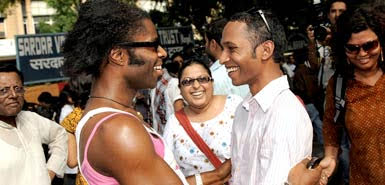
Celebrating India’s decriminalization!
It has always struck me that as queer people of color, we too often must venture outside our ethno-cultural communities to meet gay people. I came out at 16 and by then only knew gays within my age-group. Fortunately, in that era of grand community building, a local charity had organized a gay youth group. There, in addition to comradery, the adult facilitation and guest speakers provided mentorship and what we now understand as inter-generational knowledge. They also alerted me to queer writers: Through Sister Outsider, I’d traveled around the world with Audre Lorde long before I stepped foot outside of north-America. This is a powerful glue that can sustain solidarity within any community.
By attempting to transport certain functions of the gay club scene into the virtual world, we have certainly lost a core opportunity for inter-generational bonding. The ominous gay club also functions as a platform for the exchange of knowledge and experience. This phenomenon is sustained by travel, particularly tourism, migration, immigration. Or, how long did it take for nations to consider asylum for queers fleeing in deadly homophobic regimes? Flawless:
Don’t you know, you’ve got to go to the city
You’ve got to reach the other side of the glass
I think you’ll make it in the city baby
I think you know that you are more than just
Some F-ed up piece of ass
Pride – both metaphorically and literally – has circulated the globe, first and foremost through travel and tourism, then through globalizing the fight against AIDS. By the mid-90’s, the attention of gay rights advocates had widened to confronting homophobia. If health was a human right, then surely freedom from stigma is, too. Mind you, this same argument fueled the successful campaign in India to decriminalize same-sex sex, which was based on colonial legislation. Rights advocates in India had successfully used case law to articulate access to healthcare as a civil right, showing how stigma impeded this for queers.
Sadly, the exact same Victoria-era law has been strengthened and extended in many African nations, legitimizing jungle justice! For many, travel is a lifeline, including asylum. For queers in the African Diaspora, this is yet another form of exile – banishment from the motherland.
Under the bridge downtown…
If there were ever a community consumed with travel, it would be LGBTQ+ folk. Our folk knowledge is transmitted in myth and music, for example, lyrics urging gays to head to the shelter of the city. Whether chants about finding a YMCA, or told to Go West to be “together” in the sanctuary, mythical San Francisco, for gays to achieve self-realization, we needed to ‘know’ urban life to counter traditional values in the homestead. “I think you’ll make it in the city, baby.” There -away- we’re promised a new beginning with freedom. I’m very proud to have seen this through.
Gay civil rights have advanced globally far faster than those of any other recognized minority group, and certainly, one factor is… (drumroll) …we’re everywhere, even where there’s no Pride! Like ether, our pride travels through the stratosphere.
Share this:


That old familiar feeling

It would seem it’s human nature to seek out similarities in times of uncertainty. An indication that someone somewhere has experience they can share. Some sort of wisdom they can provide or at the very least a recognisable element that can somehow be interpreted to give an indication, that when it happened before everything turned out ok in the end. With the current world pandemic leaving so much free time to think and observe what is going on, one has to wonder at some point if the differences should be a more prominent focus point.
Historically world pandemics are not new. The plague, small pox, Spanish flu, all form part of a collective historical account of the global devastating impacts a new disease has on mankind. I found myself re-reading The Plague (Camus, 1947/2002) and pondering the similarities. Self-isolation and whole town isolation, the socioeconomic impacts on the poor seeking employment, despite the risk to health these roles carried and the heart-breaking accounts of families unable to say goodbye to loved ones or bury the dead in a dignified, ordinary manner.
Early on politicians and media were quick to compare the pandemic with war. Provocative language became commonplace. Talk of fighting the invisible enemy in the new ‘war’, with the ‘frontline’ NHS staff our new heroes giving the country hope we could win. It came as no surprise to wake one morning and see ‘memes’ shared on social media portraying Boris Johnson as the new Churchill.
Media quickly changed. Suddenly films which dramatised pandemics grew in popularity. These fictitious accounts of how the world would respond, the mistakes which would be made and the varying outcomes individual responses towards official advice would have on their chances of survival. Even I have to admit a scene from Contagion discussing the use of hand washing and refraining from touching your face seemed to echo government advice. Fortunately, the scenes of supermarket looting were overdramatic but the empty supermarket shelves and panic buying hysteria was all the same.
There were however, some comparisons made, which haunted me. I’m sure everyone has their own reasons for finding distaste and maybe mine were unique to me. A combination of my academic knowledge and background mixed amongst my own personal views and current situation. As a mother of three, I had suddenly become a teacher with the closure of schools. My recent master’s degree in education fortunately allowed me a basic, self-researched understanding of mainstream education and home education methods.
I watched as friends and family members concerns grew about how they as parents could provide an education. Initially most looked-for similarities once again. Similar timetables to school, similar methods of teaching, trying as a parent to morph into a similar role their children’s teacher has. I think most parents felt overwhelmed quite early on. Many most likely still do, because the thing is, home education is not comparable to mainstream education in many ways at all. That’s not to say one is superior, this is certainly not my opinion. Quite simply, they’re fundamentally different approaches.
I often find myself throughout my academic journey looking for comparison with concepts and areas in which I’m familiar. My undergrad in law and criminology makes occasional appearance in most of my writing, perhaps more often than not, in fact, I used my continued interest in criminological and legal concepts to make my education MA my own. Further reinforcing the idea, familiarity provides some sort of comfort as we enter something unknown.
One comparison which deeply worried me that finds its roots in criminological concepts, is those who have compared self-isolation with prison. Having experienced a long, heated debate previously following a comment I made displaying my disgust for the re-introduction of the death penalty, it seemed futile to raise the issues with this in the only social environment I had access to currently, social media. I remain hopeful, most criminologists recognise the obvious differences between the two.
In the end when we look back at this moment in history, there will no doubt be many more comparisons made. We often look to history to learn lessons and I’m not sure we can do that without recognising some sort of parallels with the situation. Whether that be for comfort, guidance, information or to learn, entirely depends on the individual. I will leave you with a quote of something I heard a few days ago which has stuck with me and provided inspiration for this writing…
“History doesn’t repeat itself but it often rhymes”
With that in mind, I would suggest we take comfort in the familiarity of similar situations, that this pandemic won’t last forever, but the difference it may make on our lives will always be our personal experiences. When we look back and search for comparison of life during the pandemic and life afterwards, we may well appreciate the experiences we once took for granted.
Reference
Camus, A (2002). The Plague. London: Penguin classics
Share this:

Coronavirus (Covid-19): The greatest public health crisis in my lifetime
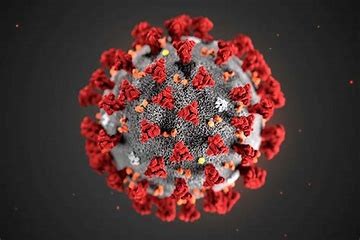
The coronavirus has caused an ongoing pandemic of coronavirus disease 2019 (COVID-19), caused by severe acute respiratory syndrome. The outbreak started in Wuhan, Hubei province, China, as early as November 2019. The World Health Organization (WHO) declared the outbreak to be a Public Health Emergency of International Concern on 30 January 2020 and recognized it as a pandemic on 11 March 2020. Whilst we all have an interest in the ongoing spread and consequence of the greatest public health crisis in generations it holds a specific interest for me given my visits to Wuhan and Hubei province whilst working for Coventry University. Wuhan is a massive city with over 11 million of a population, but little heard of until this outbreak. It is believed that its origins are most likely linked to the Huanan Seafood Wholesale Market, in Wuhan which also sold live animals, and one theory is that the virus came from one of these kinds of animals. The virus spread quickly through the population of Wuhan City which led to comprehensive lockdown to contain the virus. However, the virus spread beyond the city across China and into other countries. The scale of the spread has been significant and by the time the World Health Organisation declared the outbreak a full pandemic in March 2020 there were cases recorded in hundreds of countries.
Cases in the UK emerged on January 31st 2020, which prompted a government response to manage the outbreak. In the early stages there was some discussion about “taking it on the chin” and allowing the virus to spread through the population in order to gain “herd immunity”. However, the public health, medical and scientific experts at Imperial College London suggested that the death toll through their modelling exercises, if this strategy played out, could be in excess of 500,000. This was a situation that would be socially and politically unpalatable, and a change of thinking emerged with a combination of social distancing, public health advice on washing hands and a strategy to protect the capacity of the NHS to cope with escalating cases. A new lexicon emerged that we are now all familiar with: flattening the curve, delaying the spread, the peak of the infection and latterly the language of the health professionals in the frontline supporting and caring for people acutely ill with Covid-19; Personal Protective Equipment (PPE), Continuous Positive Airway Pressure (CPAP), ventilation and oxygen saturation and therapy. This is because the virus can attack the respiratory system leading to pneumonia and in several cases an immune response that leads to multi-organ shutdown. The media presentation of this crisis is all very frightening.
At the time of writing the pandemic has progressed relentlessly in the UK with currently over 65,000 people have tested positive and of those hospitalised nearly 8,000 patients have died. Some commentators have suggested that the UK was slow to recognise the seriousness of the virus and was slow to initiate the “lockdown” measures required to halt the spread. In addition, the UK’s position on testing for the virus has been criticised as slow, lacking preparation despite the global warnings from WHO and a shortage of the essential materials required. Whether these criticisms are valid only time will tell but the UK’s data on cases, hospitalisation, need for critical care and deaths is on a trajectory like other countries which could be described as liberal democracies. Here is the first clue to the timing of the response. The measures required to halt the spread of the virus have massive economic consequences. Balancing these two issues is incredibly difficult and has led to some commentators suggesting all liberal democracies will struggle to respond quickly enough.
What is now abundantly clear is that this is going to take some time for us to get through as a society and the consequences for large sections of our society are going to be devastating. However, what I’d like to discuss in the remainder of this blog are a number of early lessons and personal observations in terms of what we are seeing play out.
First, the data emerging indicates that the narrative about the “virus does not discriminate” is a false one. It is clear that health professionals are much more greatly exposed and that the data on cases and deaths indicate higher numbers of the socially deprived and BAME community. This should not be a surprise as the virus will be keenest felt in communities negatively impacted by health inequalities. This has been the case ever since we recognised this in the “Black Report” (DHSS 1980). The Report showed in detail the extent to which ill-health and death are unequally distributed among the population of Britain and suggested that these inequalities have been widening rather than diminishing since the establishment of the National Health Service in 1948. It is generally accepted that those with underlying health issues and therefore most at risk will be disproportionately from socially deprived communities.
Second, the coronavirus will force the return of big government. The response already supports this. In times of real crisis, the “State” always takes over. Will this lead to more state intervention going forward? If so then we will witness the greatest interventionist Conservative government in my lifetime.
Third, the coronavirus provides one more demonstration of the mystique of borders and will help reassert the role of the nation state. Therefore, the coronavirus is likely to strengthen nationalism, albeit not ethnic nationalism. To survive, the government will ask citizens to erect walls not simply between states but between individuals, as the danger of being infected comes from the people we meet most often. It is not the stranger but those closest to you who present the greatest risk.
Fourth, we see the return of the “expert”. Most people are very open to trusting experts and heeding the science when their own lives are at stake. One can already see the growing legitimacy that this has lent to the professionals who lead the fight against the virus. Professionalism is back in fashion, including recognition of the vital role of the NHS.
Fifth, the coronavirus could increase the appeal of the big data authoritarianism employed by some like the Chinese government. One can blame Chinese leaders for the lack of transparency that made them react slowly to the spread of the virus, but the efficiency of their response and the Chinese state’s capacity to control the movement and behaviour of people has been impressive.
Sixth, changing views on crisis management. What governments learned in dealing with economic crises, the refugee crisis, and terrorist attacks was that panic was their worst enemy. However, to contain the pandemic, people should panic – and they should drastically change their way of living.
Seventh, this will have an impact on intergenerational dynamics. In the context of debates about climate change and the risk it presents, younger generations have been very critical of their elders for being selfish and not thinking about the future seriously. Ironically the coronavirus reverses these dynamics.
Finally, I return to a point made earlier, governments will be forced to choose between containing the spread of the pandemic at the cost of destroying the economy or tolerating a higher human cost to save the economy. In conclusion, I have heard many say that this crisis is different to others we may have faced in the past 30 years and that as a result we can see society changing. Whilst I’m sure a number of the issues raised in this blog could potentially lead to society change it is also a truism that our memories are short, and we may return to life as it looked before this crisis quite quickly. Only time will tell.
Reference
“The Black Report” (1980): Inequalities in Health: Report of a Research Working Group. Department of Health and Social Security, London, 1980.
Share this:


A utilitarian argument for human rights
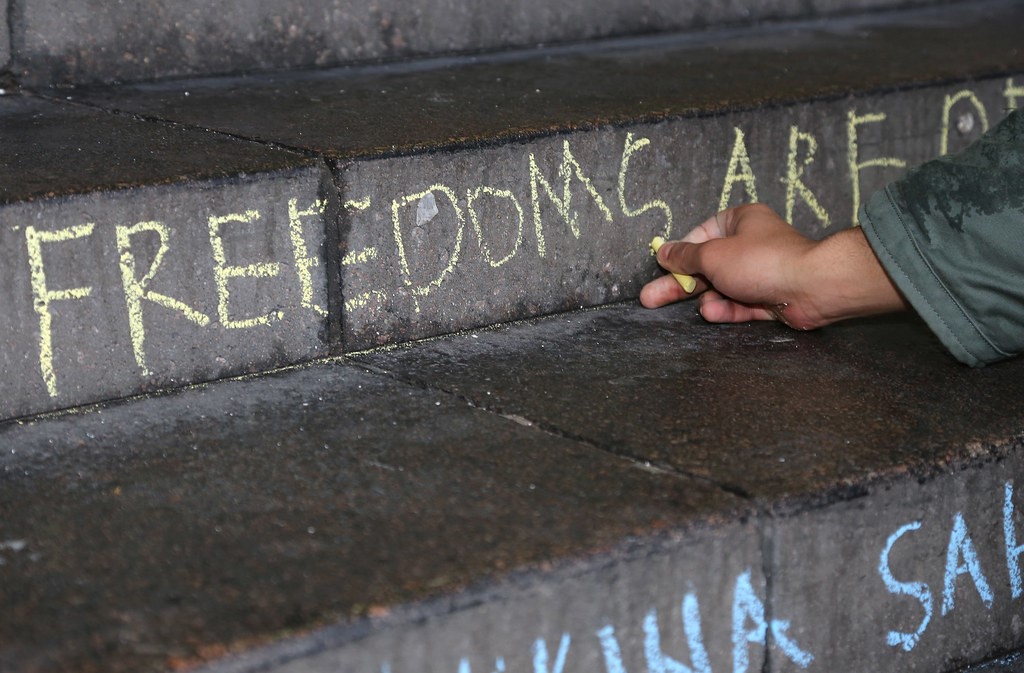
I am minded to write something about both utilitarianism and human rights as a consequence of watching the news the other night. Two separate but linked news articles struck a chord. The first about police being heavy handed in applying the emergency laws surrounding the restricting of movement and the second about the emergency laws being passed to suspend jury trials in Scotland. Both have an impact in respect of human rights.
Turning to the first, the complaint is that the police across England and Wales have in some cases been disproportionate in their dealing with the public when attempting to manage the restrictions around movement. The example shown was the uploading of videos onto social media depicting people walking around the Peak District. The captions simply asked whether the trip was necessary.
The government guidance is pretty clear regarding staying at home but perhaps is a little less clear about travelling to a location to partake in exercise. I must admit though I am a little perplexed at the accusation of heavy handedness. The Human Rights Act 1998 provides for a right to life and it has been held that the government and its agencies have a positive obligation to facilitate this. There are of course some caveats as it would be almost impossible to ensure this in all circumstances. There is no doubt that people are dying from Covid-19. The approach to enforce social distancing, presently predominantly through information and the reliance on responsibility and good will, seems to be the only current viable approach to combating this killer. The curtailment of some Human Rights is it seems necessary to ensure the greater good and to preserve life. The latter of course is a primary duty that most police officers would recognise. The greater good for the many is it seems compatible with a key principle of human rights.
Turning to the second news article. The right to a fair trial is a fundamental human right. The suspension of a jury may be against longstanding legal principles but, the Human Rights Act does not specify that the trial should be before a jury, merely an independent judge. The argument could be made that trials should be suspended but this might be impinging on rights in respect of defendants being held in custody awaiting trial. The convening of a jury would flout the rationale behind current legislation in place to enforce social distancing and would quite simply be contrary to obligations to protect life.
The notions of utilitarianism are often viewed as in conflict with individual rights and therefore the Human Rights Act. Many see the two as incompatible, one relates to the many and the other the individual. This argument though fails to have vision, it is not truly consequentialist. Human Rights are utilitarian in their very nature. Is it not to the greater good that people have a right to life, a right to freedom of association, a right to a fair trail to name but a few? Should it not be considered that every individual case that is examined under the Human Rights Act has consequences for the many as well as the individual? A breach of the Act if unchallenged opens the way for abuses by governments and their agencies, it is utilitarian in nature, it is there for the greater good, not just the individual circumstances that are being examined. But should we also not consider that there is a need to prioritise rights, particularly in the circumstances the country and world finds itself in? Some parts of the Act are in clearly on occasions, incompatible with others. Curtailment of some freedoms and rights is necessary for the greater good but more importantly, it is necessary to save lives, perhaps even the life of the individual complaining of the curtailment. We can but hope that amidst all of this, good sense prevails.
Share this:


Information overload

If you’re anything like me, the last few weeks you’ve probably found yourself fighting your way through a tsunami of information that’s coming from all directions. Notifications are going into overdrive with social media apps, news apps and browsers desperate to deliver more and more content, at ever increasing frequencies. Add to this all the stories, videos and memes friends and family are also sharing and it’s hard to know where to look first. The sheer volume of content makes it harder than ever to know what is fact, fake or opinion. In honesty, it can all be a bit overwhelming.
How do you even begin sorting the information that’s being thrown at you when you can’t keep up with how quickly your news feeds are moving
1. Sort the fact from the fiction
There’s nothing like a pandemic to send the fake news mills into overdrive. Many are easy to spot, the 2020 version of an urban myth (My neighbour’s, brother’s dog is a top civil servant and says….) others are much more sophisticated and purport to be from trusted sources. The Guardian (Mercier, 2020) reports on the danger of these stories and the tragic consequences that can occur when people believe them.
Why are we so susceptible to fake news stories though? They use “truthiness” to play on our fears and biases. If it sounds like something we think could be true, if it confirms our prejudices or worries, we’re more likely to believe it.
Fact checking is more important than ever. Take a moment to think before you share – what is the source? where are their sources? For more tips on spotting fake news check out this guide (IFLA, 2020) or use an independent reputable fact checking site such as Full Fact. This blog article from the Information Literacy Group (Bedford, 2020) pulls together a selection of reliable information sources related to Covid-19.
2. Bursting your bubble
Personalised content from news feeds can be useful, but we often don’t even realise the news stories and content we’re seeing in apps has been chosen by an algorithm. Their purpose is to feed us stories they think we will like, to keep us reading longer. This can be convenient, but it can also be misleading. We get trapped in a filter bubble that feeds us the type of content we like and usually from a perspective that agrees with our own way of thinking.
Sometimes we need to know what else is going on in the world outside our specific areas of interest though and sometimes we need to consider viewpoints we don’t necessarily agree with, so we can make an informed judgement.
These algorithms can also get things wrong. My own Google news feed weirdly seems to think I’m interested in anything vaguely related to British Airways, Coventry City Football Club and Meghan Markle (I’d like to state for the record I’m not particularly interested in any of these things). This is without considering the inherent biases they have built into them, before they even start their work (algorithm bias is a whole other blog article in itself).
It’s human nature to want to hear things that agree with our way of thinking and reinforce our own world view, we follow people we like and admire, we choose news sources that confirm our way of thinking, but there is a risk of missing the bigger picture when sat in our bubble. Rather than letting the news come to you, go direct to several news sources (maybe even some that have a different political leaning to you, if you feel like being challenged). Be active in seeking news stories, rather than passively consuming them.
3. Step away from the news feed (when you need to)
It’s a bit of a balancing act, we need to know enough to be informed and stay safe without spending 24/7 plugged in. We’re not superhuman though and sometimes we need to accept that just because it’s on our feed, we’re not obliged to engage. Give yourself permission to skip stories, mute notifications and be selective when you need to. We all have different saturation points, mine will vary day to day, but listen to yourself and know when it’s time to switch off. If it helps, set reminders on your apps to give you a nudge when you’ve spent a certain amount of time on them. The Mental Health Foundation (2020) have some tips for looking after your mental health in relation to news coverage of Covid-19.
If you need help finding information or want support evaluating sources the Academic Librarian team are offering online tutorials and an online drop-in service. You can also contact us by emailing librarians@northampton.ac.uk
Cheryl Gardner
Academic Liaison Manager, LLS
References
Bedford, D. (2020) Covid-19: Seeking reliable information in difficult times. Information Literacy Group [online]. Available from: https://infolit.org.uk/covid-19-seeking-reliable-information-in-difficult-times/ [Accessed 31/03/2020].
IFLA (2020) How to spot fake news. IFLA [online]. Available from: https://www.ifla.org/publications/node/11174 [Accessed 31/03/2020].
Mental Health Foundation (2020) Looking after your mental health during the Coronavirus outbreak. Mental Health Foundation [online]. Available from: https://mentalhealth.org.uk/publications/looking-after-your-mental-health-during-coronavirus-outbreak [Accessed 31/03/2020]
Mercier, H. (2020) Fake news in the time of coronavirus: how big is the threat? The Guardian [online]. 30th March. Available from: https://www.theguardian.com/commentisfree/2020/mar/30/fake-news-coronavirus-false-information [Accessed 31/03/2020].
Share this:


“TW3” in Criminology
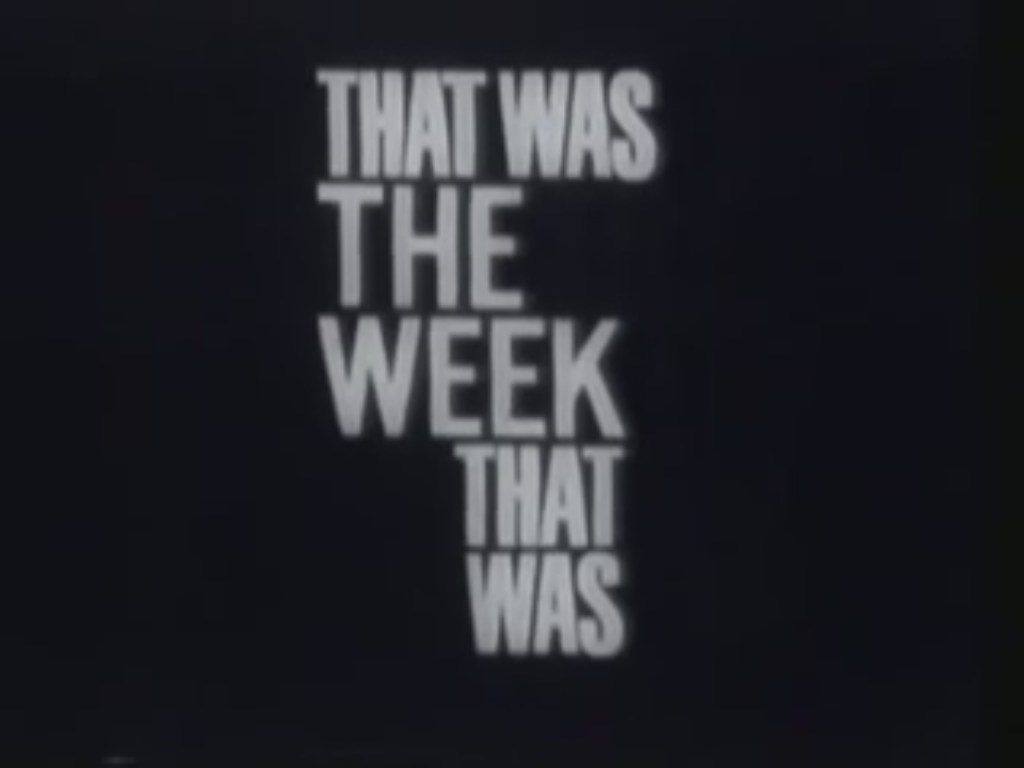
In the 1960s, or so I am told, there was a very popular weekly television programme called That Was The Week That Was, informally known as TW3. This satirical programme reflected on events of the week that had just gone, through commentary, comedy and music. Although the programme ended before I was born, it’s always struck me as a nice way to end the week and I plan to (very loosely) follow that idea here.
This week was particularly hectic in Criminology, here are just some of the highlights. On Monday, I was interviewed by a college student for their journalism project, a rather surreal experience, after all, ‘Who cares what I think?’
On Tuesday, @manosdaskalou and I, together with a group of enthusiastic third years, visited the Supreme Court in London. This trip enabled a discussion which sought to unpack the issue of diversity (or rather the lack of) within justice. Students and staff discussed a variety of ideas to work out why so many white men are at the heart of justice decisions. A difficult challenge at the best of times but given a new and urgent impetus when sat in a courtroom. It is difficult, if not impossible, to remain objective and impartial when confronted with the evidence of 12 Supreme Judges, only two of which are women, and all are white. Arguments around the supposed representativeness of justice, falter when the evidence is so very stark. Furthermore, with the educational information provided by our tour guide, it becomes obvious that there are many barriers for those who are neither white nor male to make their way through the legal ranks.

Wednesday saw the culmination of Beyond Justice, a module focused on social justice and taught entirely in prison. As in previous years, we have a small ceremony with certificate presentation for all students. This involves quite a cast, including various dignitaries, as well as all the students and their friends and family. This is always a bittersweet event, part celebration, part goodbye. Over the months, the prison classroom leaves its oppressive carceral environment behind, instead providing an intense and profound tight-knit learning community. No doubt @manosdaskalou and I will return to the prison, but that tight-knit community has now dissipated in time and space.

On Thursday, a similarly bitter-sweet experience was my last focused session this year on CRI3003 Violence: From Domestic to Institutional. Since October, the class has discussed many different topics relating to institutional violence focused on different cases including the deaths of Victoria Climbié, Blair Peach, Jean Charles de Menezes, as well as the horror of Grenfell. We have welcomed guest speakers from social work, policing and the fire service. Discussions have been mature, informed and extremely sensitive and again a real sense of a learning community has ensued. It’s also been my first experience of teaching an all-female cohort which has informed the discussion in a variety of meaningful ways. Although I haven’t abandoned the class, colleagues @manosdaskalou and @jesjames50 will take the reins for a while and focus on exploring interpersonal violence. I’ll be back before the end of the academic year so we can reflect together on our understanding of the complexity of violence.
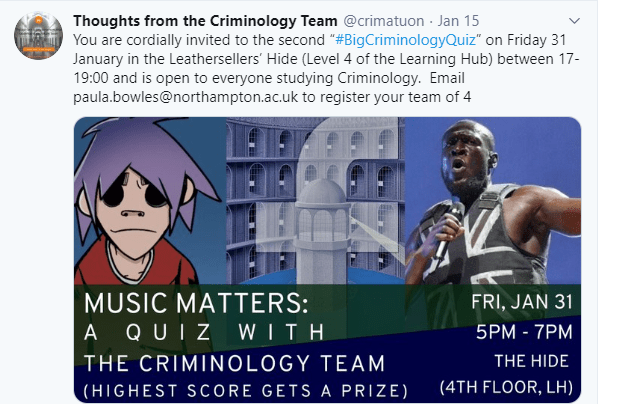
Finally, Friday saw the second ever #BigCriminologyQuiz and the first of the new decade. At the end of the first one, the participants requested that the next one be based on criminology and music. Challenge completed with help from @manosdaskalou, @treventoursu, @svr2727, @5teveh and @jesjames50. This week’s teams have requested a film/tv theme for the next quiz so we’ll definitely have our work cut out! But it’s amazing to see how much criminological knowledge can be shared, even when you’re eating snacks and laughing. [i]
So, what can I take from my criminological week:
- Some of the best criminological discussions happen when people are relaxed
- Getting out of the classroom enables and empowers different voices to be heard
- Getting out of the classroom allows people to focus on each and share their knowledge, recognising that
- A classroom is not four walls within a university, but can be anywhere (a coach, a courtroom a prison, or even the pub!)
- A new environment and a new experience opens the way for discord and dissent, always a necessity for profound discussion within Criminology
- When you open your eyes and your mind you start to see the world very differently
- It is possible (if you try very hard) to ignore the reality of Friday 31 January 23:00 ☹
- It is possible to be an academic, tour guide, mistress of ceremonies and quiz mistress, all in the same week!
Here’s looking forward to next week….not least Thursday’s Changemaker Awards where I seem to have scored a nomination with my #PartnerinCriminology @manosdaskalou.
[i] The first quiz was won by a team made up of 1st and 2nd years. This week’s quiz was won by a group of third years. The next promises to be a battle royale 😊 These quizzes have exposed, just how competitive criminologists can be….

 Thoughts from the criminology team