
Home » Young offenders
Category Archives: Young offenders
A Criminal Called Bob

It was years ago that Bob was born in St. Mary’s Hospital. His mum delivered a relatively healthy baby that she called Robert, after her father despite kicking her out when he found out that she was pregnant from a casual encounter. Bob’s early memory was of a pain in the arm in a busy place he could not remember what it was. His mother was grabbing his arm an early sign that he was unwanted. He would remember many of these events becoming part of everyday life. He remembers one day a stern looking woman came to the place he was living with his mother and take him away. This was the last time he would ever see his mother; he was 5 or 6. A few years afterwards his mother will die from a bad heart. Later, he would find out it was drugs related.
The stern looking lady will take him to another place to live with a family. One of many that he would be placed in. At first, he tried to get to know the hosts but soon it became difficult to keep track. He also lost track of how many times he moved around. There were too many to count but the main memory was of fear going into a place he did not know to stay with people who treated him as an inconvenience. He owned nothing but a bin bag with a few clothes and people will always comment on how scruffy he looked. He remembers discovering some liquorice allsorts in a drawer with the kid he was sharing the room with. He cannot forget the beating he got for eating some of them. The host was very harsh, and they used the belt on him.
School was hell for Bob. As he moved from place to place the schools also changed. The introduction to the class was almost standard. Bob is joining us from so and so and although he lives in foster care, I hope you will be making him feel welcomed…and welcomed he was. The bullying was relentless so was the name calling and the attacks. On occasion he would meet an aloof man who was his “designated tutor”. His questions were abrupt and focused only if he was behaving, if he was making any trouble, if he did as was told. It was hardly ever about education or any of his needs. He remembers going to see him once with a bruised eye to be asked “what did you do?”
And he did a lot! Early on he learned that in order not to go hungry he must hide food away. If he was to meet a new person, he had to show them that he is cannot be taken for granted, he needed to show them he can handle himself. Sometime during his early teenage years his greeting gesture was a headbutt. Violence was a clear vehicle for communication. One person is down the other is up. This became a language he became prolific in. He could read a room quickly and in later years be able to assess the person opposite. If he can take him or not!
The truth that others kept talking about around him became a luxury and an unnecessary situation. Lying about things got him to avoid punishment and any consequences to any of his actions. The only problem was when he was get caught lying. The consequences were dire. So, what he needed to do was to become very good at it. He did. He could lie looking people straight in the eye and not even blink about it.
Later in life he discovered this was an amazing talent to possess. It was useful when he was stealing from shops, it was good when people asking him for the truth, it was profitable when his lies covered other people’s crimes. Before he turned 18, he was an experienced thief and a creative liar. His physique allowed him to take to violence should anyone was to question his “honesty”. When he was 15, he discovered that a combination of cider and acid gives him such a buzz. To mute his brain and to relax his body even for little was so welcomed. This habit became one of his most loyal relationships in his life.
In prison he didn’t go until he was 22 but he went to a young offender’s institution at the age of 17 for GBH. The “victim” was a former friend who stole some of his gear. That really angered him; even days after the event in court he was still outraged with the theft. He was still making threats that he will find him and kill him, in some very graphic descriptions! The court sought no other way but to send him away. From the age of 22 he would become a “frequent flyer” of the prison estate! A long list of different sentences ranging from everything on offer. Usually repeated in pattern; fine, community sentence, prison….and back again! By the time he was 35 he had been in prison for more than 8 years collectively. He did plenty of offender management courses and met a variety of probation and prison officers, well-meaning and not so good. Some tried to help, and others couldn’t care but all of them fade in the background.
Now at the ripe age of 45 he is out of the prison, and he is sofa surfing and claiming universal credit. He gets nothing because he has unpaid fines, so he is struggling financially. In prison he did a barista apprenticeship, but he cannot find any work. As it stands, he is very likely to be recalled back to prison, if the cold weather doesn’t claim him first.
In context, there are some lives that are never celebrated or commemorated. There are people who exist but virtually no one recognises their existence. Their lives are someone else’s inconvenience and in a society that prioritises individual achievement and progression they have none. Bob is a fictional character. His name and circumstances are made up but form part of a general criminological narrative that identifies criminality through the complexity of social circumstance.
Share this:


A year on… semantics, semantics and semantics?

In October 2024, I wrote a blog on the recently opened Secure School- Oasis Restore. The shiny new edition to the Children and Young People Secure Estate (CYPSE) in England and Wales. In the introduction I pondered on whether this would bring about change within the CYPSE or if this was more of the same. There were lots of positives to consider with the resources, ethos and style of the new Secure School but I, and many others, had concerns that these changes were just words and would amount to little substance. Serious issues within the YJS such as the use of remand, the increasing number of Black and dual heritage children in the CYPSE (despite the overall downwards trend), the continued use of isolation and the high rates of self-harm all appeared to be forgotten with the unveiling of the new Secure School. However, a year on, and the CYPSE failing children appears to be continuing.
Oasis Restore had to ‘temporarily’ close in the summer of 2025 over safety concerns (BBC, 2025). Upon closer reading, and looking at the Ofsted report from April 2025, the main issue is around doors not being able to close properly due to how they were initially made and the damage they have sustained. The Ofsted report (2025) also highlights the use of physical restraint but is positive in how this is only used as a last resort and recorded effectively. The report claims there is a nurturing environment at Oasis Restore, and is overall relatively positive (Ofsted, 2025). The concern is the harm the displacement will have on the children. And why, a CYPSE institution which has cost approximately £40million, was not built fit for purpose?
The children who are placed in CYPSE, for welfare or justice grounds, are incredibly vulnerable. They have often experienced trauma, oppression and isolation at various stages in their childhood from various people and institutions (especially care and CJS). The reality is, these children have been failed multiple times before their arrival in the CYPSE and these failures continue whilst they are there. Oasis Restore was supposed to be different: it was supposed to help, support, nurture and protect. And whilst that appeared to be very much on the agenda, the closing and displacement of these vulnerable children is going to add to being failed by society. I ended my previous blog, reflecting on John Rawls’ when thinking about justice, if an institution cannot be reformed then it should be abolished. I asked, if it was finally time to abolish the CYPSE. I whole heartedly believe it is.
Bibliography:
Askew, J. (2025) Young Offenders School Closes After Safety Concerns, BBC. [online] Available at: https://www.bbc.co.uk/news/articles/cde3g28gxp4o [Accessed 14.10.25]
End Child Imprisonment (2024) Why child imprisonment is beyond reform: A review of the evidence August 2024. [online] Available at: https://article39.org.uk/wp-content/uploads/2024/08/Why-child-imprisonment-is-beyond-reform.-A-review-of-the-evidence-August-2024.pdf
Share this:


Just semantics?

This summer has seen the opening of the first secure school in England and Wales. The idea of secure schools was first introduced in 2016 in line with reforming the youth secure estate given a wide range of failings across institutions and harms experienced by children placed in there. The original proposed date for opening one of the schools was 2020; but what is a four-year delay? In 2022 the National Audit Office reported the refurbishment of Medway Secure Training Centre (closed down in March 2020 following the harrowing findings by Panorama), where the new secure school would be, was costing approximately £36.5 million (National Audit Office, 2022). But will this new secure school actually change something within the youth secure estate, or this is more of the same but with a new sparkly name?
Oasis Restore (the first secure school in England and Wales) opened this summer and can hold up to 49 children. It is registered jointly as a Secure Children’s Home (SCH) and a secure academy which has raised concerns by Ofsted due to difference in size of Oasis Restore in comparison to other SCHs. Education is central to the secure school (although haven’t we heard this before with Secure Training Centres), with comments from Youth Justice Board (YJB) Chief Executive Steph Roberts-Bibby comparing Oasis Restore with University accommodation (Youth Justice Board, 2024). Apparently, the new secure school is a far cry from the unsafe, violent, prisons which already exist in the youth secure estate (SCT and YOIs). On a tour of the secure school earlier in the year, the Chief Executive was very positive about the physical environment and philosophies underpinning Oasis Restore where ‘strong relationships between staff and children are at the heart of the Oasis model’ and the importance of ‘having a space promoting learning, togetherness and care’ as being essential in line with rehabilitation (Youth Justice Board, 2024). So far, so good. The right words are being uttered, changes appear to have been made, but… we have been here before. The same rhetoric of the child’s best interests being promoted and being seen as ‘children first’: which is good. But is this round of reform just more of the same with different semantics?
End Child Imprisonment (2024) demonstrates how child imprisonment, which Oasis Reform still is, is beyond reform. There are ample examples of how the Youth Secure Estate has historically, and remains, a harmful unsafe environment which does not address the needs of the children they come into contact with. Missing from the positive comments from the Chief Executive of the YJB is the highlighting that the children who come into contact with the YJS are incredibly vulnerable and have often experienced traumas before their incarceration. The language is still all wrong: the myriad of challenges these children have already faced and will face within the YJS remain overlooked. In 2023 the United Nations Committee on the Rights of the Child urged the UK to introduce legislation directly prohibiting the use of solitary confinement, due the continuing harms/findings of its use: but so far, no comment from the UK Government. Time and time again, we see reforms brought in but with little to no actual change or improvement. Will Oasis Restore be the face of change of just another failure in a long line of failing reforms?
Something which rings true: “A recurrent theme in the history of child imprisonment is that evidence of failure and maltreatment is met with promises of reform which too frequently involve semantic amendment rather than changes of substance” (End Child Imprisonment, 2024, p.28). And as John Rawls argues when thinking about justice, if an institution cannot be reformed then it should be abolished. Is it finally time to abolish the child prisons which exist within society?
References:
End Child Imprisonment (2024) Why child imprisonment is beyond reform: A review of the evidence August 2024. [online] Available at: https://article39.org.uk/wp-content/uploads/2024/08/Why-child-imprisonment-is-beyond-reform.-A-review-of-the-evidence-August-2024.pdf [Accessed 14th October 2024].
Monster Ztudio/Shutterstock (2017) Change. [Online] Available at: https://ziplinelogistics.com/blog/navigating-change/ [Accessed 21.10.24].
National Audit Office (2022) Children in custody: secure training centres and secure schools. [online] London: National Audit Office. Available at: https://www.nao.org.uk/wp-content/uploads/2022/04/Children-in-custody-secure-training-centres-and-secure-schools.pdf [Accessed 17.10.24].
Rawls, J. (1971/1999) A Theory of Justice. Oxford: Oxford University Press
Youth Justice Board (2024) Inside the Oasis Restore Secure School. GOV.UK [online]. Available at: https://www.gov.uk/government/news/inside-the-oasis-restore-secure-school [Accessed 17.10.24]
Share this:


Youth or Adult: can you tell?

This week’s blog begins with a game: youth or adult, secure estate in England and Wales. Below are some statements, and you simply need to guess (educated guesses please), whether the statement is about the youth, or adult secure estate. So, are the statements about children in custody (those under the age of 18 years old) or adults in custody (18+). When you’re ready…
- 70% decrease in custody in comparison to 10 years ago
- Segregation, A.K.A Solitary Confinement, used as a way of managing the most difficult individuals and those who pose a risk to themselves or others
- Racial disproportionality in relation to experiencing custody and being remanded to custody
- Self-harm is alarmingly high
- 1/3 have a known mental health disability
- Homelessness after release is a reality for a high proportion of individuals
- Over half of individuals released from custody reoffend, this number increases when looking at those sentenced to 6months of less
How many did you answer youth secure estate, and how many adult secure estate? Tally up! Did you find a 50/50 split? Did you find it difficult to answer? Should it be difficult to spot the differences between how children and adults are treated/experience custody?
All of the above relate specifically to children in custody. The House of Commons Committee (2021) have argued that the secure estate for children in England and Wales is STILL a violent, dangerous set of environments which do little to address the needs of children sentenced to custody or on remand. Across the academic literature, there is agreement that the youth estate houses some of the most vulnerable children within our society, yet very little is done to address these vulnerabilities. Ultimately we are failing children in custody! The Government said they would create Secure Schools as a custody option, where education and support would be the focus for the children sent here. These were supposed to be ready for 2020, and in all fairness, we have had a global pandemic to contend with, so the date was pushed to 2022: and yet where are they? Where is the press coverage on the positive impact a Secure School will make to the Youth estate? Does anyone really care? A number of Secure Training Centres (STCs) have closed down across the past 10 years, with an alarmingly high number of the institutions which house children in custody failing Ofsted inspections and HM Inspectorate of Prisons (2021) found violence and safety within these institutions STILL a major concern. Children experience bullying from staff, could not shower daily, experience physical restraint, 66% of children in custody experienced segregation which was an increase from the year prior (HM Inspectorate of Prisons, 2021). These experiences are not new, they are re-occurring, year-on-year, inspection after inspection: when will we learn?
The sad, angry, disgusting truth is you could have answered ‘adult secure estate’ to most of the statements above and still have been accurate. And this rings further alarm bells. In England and Wales, we are supposed to treat children as ‘children first, offenders second’. Yet if we look to the similarities between the youth and adult secure estate, what evidence is there that children are treated as children first? We treat all offenders the same, and we treat them appallingly. This is not a new argument, many have raised the same points and concerns for years, but we appear to be doing very little about it.
We are kidding ourselves if we think we have a separate system for dealing with children who commit crime, especially in relation to custody! It pains me to continue seeing, year on year, report after report, the same failings within the secure estate, and the same points made in relation to children being seen as children first in England and Wales: I just can’t see it in relation to custody- feel free to show me otherwise!
References:
House of Commons Committees (2021) Does the secure estate meet the needs of young people in custody? High levels of violence, use of force and self-harm suggest the youth secure estate is not fit for purpose [Online]. Available at: https://houseofcommons.shorthandstories.com/justice-youth-secure-estate/index.html. [Last accessed 4th April 2022].
HM Inspectorate of Prisons (2021) Children in Custody 2019-2020: An analysis of 12-18-year-old’s perceptions of their experiences in secure training centres and young offender institutions. London: Her Majesty’s Inspectorate of Prisons.
Share this:


Thinking “outside the box”
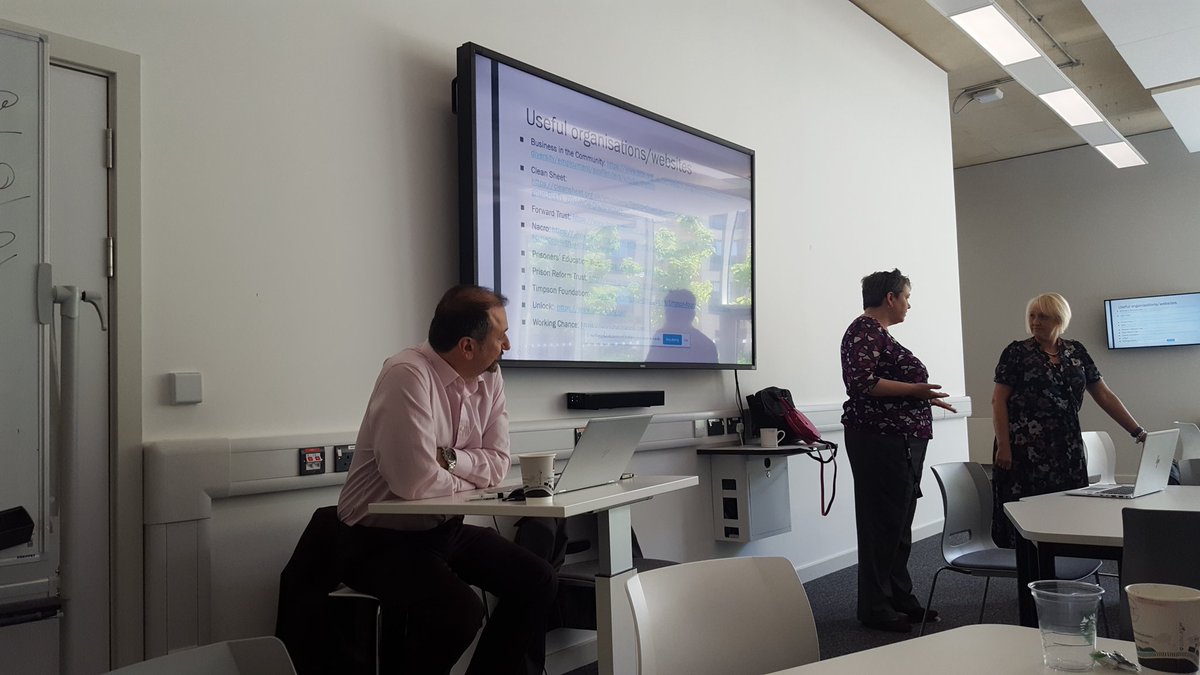
Having recently done a session on criminal records with @paulaabowles to a group of voluntary, 3rd sector and other practitioners I started thinking of the wider implications of taking knowledge out of the traditional classroom and introducing it to an audience, that is not necessarily academic. When we prepare for class the usual concern is the levelness of the material used and the way we pitch the information. In anything we do as part of consultancy or outside of the standard educational framework we have a different challenge. That of presenting information that corresponds to expertise in a language and tone that is neither exclusive nor condescending to the participants.
In the designing stages we considered the information we had to include, and the session started by introducing criminology. Audience participation was encouraged, and group discussion became a tool to promote the flow of information. Once that process started and people became more able to exchange information then we started moving from information to knowledge exchange. This is a more profound interaction that allows the audience to engage with information that they may not be familiar with and it is designed to achieve one of the prime quests of any social science, to challenge established views.
The process itself indicates the level of skill involved in academic reasoning and the complexity associated with presenting people with new knowledge in an understandable form. It is that apparent simplicity that allows participants to scaffold their understanding, taking different elements from the same content. It is easy to say to any audience for example that “every person has an opinion on crime” however to be able to accept this statement indicates a level of proficiency on receiving views of the other and then accommodating it to your own understanding. This is the basis of the philosophy of knowledge, and it happens to all engaged in academia whatever level, albeit consciously or unconsciously.
As per usual the session overran, testament that people do have opinions on crime and how society should respond to them. The intriguing part of this session was the ability of participants to negotiate different roles and identities, whilst offering an explanation or interpretation of a situation. When this was pointed out they were surprised by the level of knowledge they possessed and its complexity. The role of the academic is not simply to advance knowledge, which is clearly expected, but also to take subjects and contextualise them. In recent weeks, colleagues from our University, were able to discuss issues relating to health, psychology, work, human rights and consumer rights to national and local media, informing the public on the issues concerned.
This is what got me thinking about our role in society more generally. We are not merely providing education for adults who wish to acquire knowledge and become part of the professional classes, but we are also engaging in a continuous dialogue with our local community, sharing knowledge beyond the classroom and expanding education beyond the campus. These are reasons which make a University, as an institution, an invaluable link to society that governments need to nurture and support. The success of the University is not in the students within but also on the reach it has to the people around.
At the end of the session we talked about a number of campaigns to help ex-offenders to get forward with work and education by “banning the box”. This was a fitting end to a session where we all thought “outside the box”.
Share this:


Should reading be a punishment?

Gillian is an Academic Librarian at the University of Northampton, supporting the students and staff in the Faculty of Health and Society.
I was inspired to write this blog post by an article from the BBC news website that my friend sent me (BBC, 2019). A reading list was used as a punishment for teenagers who were convicted of daubing graffiti across a historically significant building in the state of Virginia, USA. Normally such an offence would earn a community service order. In this case, due to the nature of the crime – using racially charged symbols and words, the Prosecutor and Deputy Commonwealth Attorney Alejandra Rueda decided education may be the cure. She provided the five teenagers with a reading list that they had to read, and write assignments on, over the course of their 12-month sentence.
“Ignorance is not an excuse” is a principle expressed regularly throughout society, yet are we doing anything to address or dispel this ignorance? Rueda realised that books may help these teenagers to understand the impact of what they’d done and the symbols and language they had used in the graffiti. She chose books that would help educate them about racism, anti-Semitism, apartheid and slavery, to name just a few of the topics covered in the reading list. These were the books that helped her understand the wider world, as she grew up. Rueda’s approach indicated that punishment without an understanding of the impact of their crime, would not help these teenagers to engage with the world around them. These books would take them to worlds far outside their own and introduce them to experiences that were barely covered in their High School history lessons.
It’s not the only time an ignorance of history has been highlighted in the news recently. A premiere league football player was investigated for apparently making a Nazi salute. Although he was found not guilty, the FA investigation found him to be appallingly ignorant of Fascism and Hitler’s impact on millions of people across the globe (Church, 2019). Whilst the FA lamented his ignorance, I’m unsure they have done anything to help him address it. Would he be willing to read about the Holocaust and impact of Fascism in Europe? Would being forced to read about the lives of people over 70 years ago, help him understand how a chance photograph can affect people?
Should reading be a punishment, would it help people understand the impact of their actions? As a Librarian, people often assume that all I do all day is read. For me, reading is a luxury I indulge in daily, when I’m at home. I find a distinct difference between reading by choice, for escapism, and reading because you have to. I remember studying English Literature at school and finding any books I was forced to read, quickly lost their charm and became a chore rather than a pleasure. I’m not sure reading should be a punishment; it could disengage people from the joy and escapism of a good book. However, I understand the value of reading in helping people to explore topics and ideas that may be well outside their own world.
There is a growing body of literature that reflects on bibliotherapy and how reading can help people in varying stages of their life (Hilhorst et al., 2018; Brewster et al., 2013). A recent report by Hilhorst et al., (2018) advocates reading to transform British society, address isolation and improve social mobility. I believe reading can help improve our quality of life, helping us improve literacy, understand complex social issues and offer escapism from the everyday. However, I hesitate to view reading as a magical solution to society’s problems. Some people advocate the literary classics, the numerous lists you can find online that extort the virtues of reading the finest of the literary canon – but how much of it is just to conform to the social snobbery around reading ‘good literature’, a tick list? We should encourage reading, not force it upon people (McCrum, 2003; Penguin Books Ltd, 2019; Sherman, 2019).
Reading can help expand horizons and can have a tremendous impact on your world view, but it shouldn’t be a punishment. What Rueda did in Virginia, is illustrate how an education can help us address the ignorance in our society. We should encourage people to explore beyond their community to understand the world around us. Reading books can offer an insight and allow us to explore these ideas, hopefully helping us to avoid repeating or perpetuating the mistakes of the past.
References:
BBC (2019) Graffiti punished by reading – ‘It worked!’ says prosecutor, BBC News [Online]. Available from: https://www.bbc.co.uk/news/stories-47936071 [Accessed 18/04/19].
Brewster, L., Sen, B. and Cox, A. (2013) ‘Mind the Gap: Do Librarians Understand Service User Perspectives on Bibliotherapy?’, Library Trends, 61(3), pp. 569–586. doi: 10.1353/lib.2013.0001.
Church, B. (2019) Wayne Hennessey: EPL player showed ‘lamentable’ ignorance of Fascism, CNN [Online]. Available from: https://edition.cnn.com/2019/04/16/football/wayne-hennessey-fa-nazi-salute-english-premier-league-crystal-palace-spt-intl/index.html [Accessed 18/04/19].
Hilhorst, S., Lockey, A. and Speight, T. (2018) “It’s no exaggeration to say that reading can transform British society…”: A Society of Readers, DEMOS [online] Available from: http://giveabook.org.uk/wp-content/uploads/2018/11/A_Society_of_Readers_-_Formatted__3_.pdf [Accessed 15/04/19]
McCrum, R. (2003) The 100 greatest novels of all time: The list, The Guardian [Online]. Available from: https://www.theguardian.com/books/2003/oct/12/features.fiction [Accessed 18/04/19].
Penguin Books Ltd (2019) 100 must-read classic books, as chosen by our readers, Penguin [Online]. Available from: https://www.penguin.co.uk/articles/2018/100-must-read-classic-books/ [Accessed 18/04/19].
Sherman, S. (2019) The Greatest Books, The Greatest Books [Online]. Available from: https://thegreatestbooks.org/ [Accessed 18/04/19].
Share this:


Reflection: From student to professional

I graduated in July 2017 with a Criminology BA from the University of Northampton with a 2:2. In university I did two research placements at youth offending services and from there realised that this is what I wanted a career in.
I applied for a job in the Youth Offending Service with little belief that I could get the job. However I was offered the job and started working from September. As it nears to my first year being completed I have reflected on the transition from student to professional.
The past year has been a rollercoaster and I have a steep learning curve through this. University life especially all the deadlines and time management required only scratched the surface for what awaited me in the world of work.
One thing I wasn’t fully prepared for was the difficulties faced as a young professional. particularly when you’re the youngest member of staff by around 8 years. Many people do not take you seriously when you first start and it takes a while to ‘prove yourself’ as a professional to colleagues, other agencies and to the service users. I have even been mistaken for a young person when out on reparation (like community service) so it has been hard overcoming these barriers.
A positive is working with young people and I am enjoying this immensely. My job role means I work with low level offenders and prevention work with young people and this seems to be successful for most young people to avoid the criminal justice system. However I support those on higher orders as well as assisting on Reparation; so doing things like gardening, painting and decorating, to indirectly repair the harm caused. It’s great fun!
Restorative justice, something I learnt about at university, is something that as a youth offending service we try to incorporate with every young person we work with. Restorative justice is not at the forefront of all professionals however I’ve seen the benefits it can bring to both offender, victim and those indirectly affected by this.
I think the main points I’ve learnt over this past year is even after university you are constantly learning and that education doesn’t finish once you graduate. Alongside this is to go for it… no matter whether you think you will achieve it or not, we all have to start somewhere.
Share this:

The Other Side of Intelligence

After I graduated I had a bit of tunnel vision of what I wanted to do. I wanted to either work with young offenders or work with restorative justice. Many opportunities actually came up for me to do several different things, but nothing really worked out and nothing felt right.
I carried on working in retail till February 2018; I was honestly starting to lose hope that I would find something that I would enjoy. I started working for a security company that does many things; from employment vetting to gaining intelligence of various kinds. Although the role is not focused on the criminality side entirely, the theme is very much apparent. I find myself thinking about all the different concepts of criminology and how it ties in to what I am doing.
A big part of my role is intelligence and at first, I didn’t think I would enjoy it because I remember in third year in the module, Violence: Institutional Perspectives*; we looked at the inquiry Stockwell 1; an inquiry into the metropolitan police force following the death of Jean Charles de Menezes. Jean Charles was mistaken by intelligence officers for Hussain Osman, one of the terrorists responsible for the failed bomb attacks in London. This particular inquiry frustrated me a lot, because I just felt like, how is it possible for the police to mistake an individual for an innocent person. I just couldn’t accept when we were going through this case how trained officers were able to fail to identify the correct person, regardless of all the other factors that pointed to Jean Charles being the culprit. However, now being in a similar position I understand more how difficult it actually is to identify an individual and being 100% sure. There have been times in my line of work that I have had to question myself 2, 3, even 8 times if the person I found was really who I was looking for.
I do think I question it a lot more because I know how much my job can affect a person’s life and/or future. I do think criminology has been one of the best decisions I made. I know that I view things differently from other people I work with, even my family. Just little things that people tend not to notice I see myself. Thinking, but could it be because of this, or could it be because of that. Criminology really is part of everyday life, it is everywhere, and knowing everything I know today I wouldn’t have it any other way.
*Now CRI3003 – Violence: From Domestic To Institutional

 Thoughts from the criminology team