
Home » United Nations (Page 2)
Category Archives: United Nations

#EveryCanHelps? Why are we normalising foodbanks and poverty?
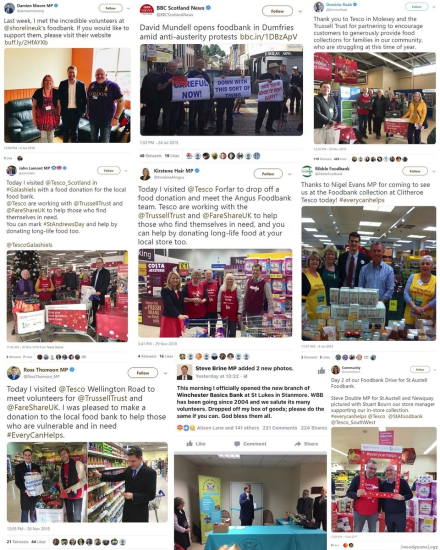
Over the last two weeks, twitter was littered with Conservative MPs posing at foodbanks, thanking the public for donations and showing their support for this vital service. On seeing the first one I thought this was a strange way to show compassion for those in need, given how the increased use of foodbanks is directly linked to austerity policies, the rollout of universal credit and is one of the issues raised by a recent report on the impact of poverty in the UK (Equality and Human Rights Commission, 2018). The report states that spending cuts from austerity led policies have put Britain in breach of its human rights obligations and highlights discriminatory issues, as these cuts have adversely affected low income and lone parent families, ethnic minorities and the disabled. It recommends more investment in health, social care, education and housing, and a rethink of Universal Credit. In addition, a report by the United Nations has described current government policies as ‘punitive, mean-spirited and often callous’ in their impact on the most vulnerable, more alarming given we are still one of the richest countries in the world (UN, 2018).
The responses on twitter articulated what I was feeling, ranging from incredulity, to anger and shock. It is a strange state of affairs when politicians see this as a cause for celebration, but then, there is little else to choose from, in relation to policies introduced in the last two years. The cognitive dissonance between thinking this presents them as compassionate and caring about problems they have created is quite an achievement. But then, I also know I really should not be surprised – I never believed Conservatives could be considered compassionate and anything but concerned with their own interests and dismissive of those in need. When Conservative MPs received the memo to pose at foodbanks, I wonder how many refused? Or how many believed this would be accepted as an example of celebrating charity, because even at Christmas, we all too easily normalise this level of deprivation, and rationalise it as due to individual circumstances, and not structural inequalities.
The wording of the UN report is clear in its condemnation and recognition that in Britain, the government lack the political will to help those most in need, given that tax cuts signalling the ‘end of austerity’ have once again benefitted the rich, under the auspices of this wealth trickling down in the form of jobs and increased wages. However, the EHRC and UN reports have emphasised how these policies are disproportionately affecting those who cannot work, or can only do part time work, or who face discrimination and disadvantage, including employment opportunities and prospects. When foodbanks were first set up, I honestly believed this was a temporary fix, never did I think still in 2018 they would be still be needed and indeed, be increasingly used. I also never would have imagined they would be held up as an example of the good work of charities adopted as a PR stunt by the very people who have created the inequalities and harm we see today.
The small glimmer of hope is the protest in one of these pictures, and the responses via twitter which reflected how I felt. There was a clear backlash in Scotland, where it was reported that a record number of supplies were needed as Universal Credit was rolled out, and where there were calls to foodbanks and supermarkets to refuse to pose with Conservative MPs. Alas, my fear is beyond the twittersphere, most people can rationalise this as acceptable. After all, should we not celebrate charity and helping those in need at this time of year? Is this just an example of good will and thinking of others? Well, yes of course, and if these photos were simply asking people to donate without the MPs responsible being there, I would think most of us would perhaps be reminded we can do our bit to help, and we should. The presence of the MPs and acceptance of this as good PR is what really worries me, that people will still vote for a party which has been described as cruel and punitive and believes this sort of promotion makes them look good. The irony that our current Prime Minister once herself warned that the Conservatives were becoming the ‘nasty party’ is staggering. For what she now resides over are policies which are internationally condemned as harmful, discriminatory and callous.
The other slight glimmer of hope is some commentators suggest this stunt reflects rumours of a general election on the horizon, as while Theresa May celebrated the ‘success’ of negotiating a deal with the European Union, it seems this was short-lived once parliament began to debate the deal and may trigger an election. The UN report suggested that Brexit has been so much of a distraction for MPs and the public that we are not seeing domestic problems as a priority. I think for many there is a sense that once this deal is done, we can get on with resolving other issues. But for this government, I don’t think that is the case. I think for Conservatives, these negotiations and now parliamentary debates are a welcome distraction and a narrative which fits their lack of will to actually address the harms caused by austerity. A general election may bring about change and force MPs to confront where we are today as a result of political choices, but this depends on how we all really feel about poverty, homelessness, discrimination and disadvantage. I wonder if too many feel these are insurmountable problems, inevitable and therefore, beyond the abilities of government to address. But the UN and EHRC reports clearly tell us this is not the case. I hope we do get an opportunity to hold this government to account sooner rather than later. But most of all, I hope that more of us actually take up this opportunity and not allow what we see today to continue.
Susie Atherton
Senior Lecturer in Criminology
Equality and Human Rights Commission (2018) The cumulative impact on living standards of public spending changes, available from https://www.equalityhumanrights.com/en/publication-download/cumulative-impact-living-standards-public-spending-changes
United Nations (2018) Statement on Visit to the United Kingdom, by Professor Philip Alston, United Nations Special Rapporteur on extreme poverty and human rights, see https://www.ohchr.org/EN/NewsEvents/Pages/DisplayNews.aspx?NewsID=23881&LangID=E
Share this:


San Francisco: A City of Contrast

Haley Read is an Associate Lecturer teaching modules in the first and third years.
Often when I visit different cities around the world, I notice that huge contrasts in the standards of life experienced by others are ‘plain for the eye to see’ within such small spaces.
What seems interesting is that inequality between the rich and poor are striking within western countries that are often perceived as being quite wealthy, ‘forward thinking’ and technologically advanced. This brings me to my recent trip to San Francisco, a city partly characterised by the beautiful red Golden Gate bridge which is situated near a beach where sun kissed, athletic and healthy-looking San Francisco residents seem to spend their free time socialising, sailing on boats, walking their pedigree dogs and playing sports. Of course, the view of the isolative Alcatraz prison to the East of the bridge dampens the illusion that San Francisco is a city which has historically upheld progressive and rehabilitative ideas. Whilst today, within this very same space, and more evidently, within a few blocks walk from this location, residents experience life in a very different manner. Many individuals are homeless, have significant physical and mental problems, the occasional prostitute hangs around attracting business and drugs are taken and offered out to passers-by. And on that very same red bridge many individuals attempt to and/or take their own lives out of desperation. So, for me, San Francisco exemplifies a city that is steeped in inequality.
In fact, a recent United Nations (2017) report points to high housing prices, the lack of social, educational and healthcare services for poorer Californian populations and tough responses to issues of homelessness and petty crime as being key to the increasing and continued levels of inequality within cities such a San Francisco. Last week in seminar sessions [CRI1007] we discussed the Universal Declaration of Human Rights (1948). What appears interesting here is that despite an international agreement that every individual should have a Right to Life, domestically, San Francisco’s approach to the provision of social and medical care for individuals results in the lesser quality and length of life for poorer populations. As in San Francisco the Right to Life is limited, as the city does not seem to be obliged to protect individuals who may die due to ill mental or physical health, the lack of medical insurance or the numerous experiences of poverty.
Prior to visiting San Francisco, I was quite excited to revel in its famous music scene and its picturesque charm. Yet, despite it being a fantastic place to visit that is full of eccentricity and character, the sombre tone of the city was made blatantly clear. I did however, leave feeling incredibly grateful for non-government organisations and communities who often provide for those who are viewed as being ‘deviant’ and not worthy of help. Such as the Gubbio Project, which, with the help of volunteers and public donations, provides Church shelter and basic provisions for the homeless. However, it is clear that a greater amount of support is required for the poorer residents of San Francisco.
Photo by Life Of Pix on Pexels.com
Share this:


Are we facing an ‘arms race’ on the streets of the UK?

Dr Helen Poole is Deputy Dean in the Faculty of Health and Society and Lead for University of Northampton’s Research Centre for the Reduction of Gun Crime, Trafficking and Terrorism
As the Government’s Violent Crimes Bill passes through its second hearing, the emphasis is clearly on controlling corrosive substances and knives. This is entirely appropriate since the vast majority of armed crime resulting in death or injury in the UK currently involves one or the other. Other than proposing tighter controls on 0.5 calibre rifles and bump-stock devices, the Bill is virtually silent on firearms, although it is surprising that either of these devices are not more tightly regulated already.
However, what is of greater concern is that the UK and other EU jurisdictions are not taking stronger heed of the findings of the EU funded Project SAFTE, published by the Flemish Peace Institute in April 2018. SAFTE alludes to what it calls an ‘arms race’ based on the fact that there are more weapons entering the illicit market than are being seized. Thus, according to basic economic principles of supply and demand, firearms, and particularly military grade firearms, will become cheaper on the illicit market. Furthermore, as organised crime groups and gangs weaponise, there will be a greater need for their foes to be equally equipped.
The question of where these firearms and small arms and light weapons emanate from is key to understanding the potential problem this poses on the streets of the UK. The vast majority of firearms are produced legally, by states such as the UK and USA. However, the reason that there are so many illicit weapons in circulation, is that these firearms are often diverted into illicit hands, either through corruption or criminal activity. This diversion into what is commonly referred to as the ‘grey market’, contributes to more than 200,000 global firearms deaths every year, excluding conflict zones.
The firearms black-market, whereby weapons and ammunition are produced illegally, is of relative insignificance in the overall global picture of firearms related harm. Therefore, tackling the diversion of firearms from lawful production is more likely to have a positive impact on firearms related harm, and also combat the emerging arms race identified through Project SAFTE. Considering the scale of the grey market problem, it would appear that this is where resources should be directed if states and international organisations are serious about reducing the harm caused to societies by firearms. Indeed, the United Nations regard firearms as one of the obstacles to obtaining Sustainable Development Goal 16 on Peace Justice and Strong Institutions, particularly 16.4 which aims to ‘significantly reduce illicit financial and arms flows, strengthen the recovery and return of stolen assets and combat all forms of organized crime’ by 2030.
The international arms trade and its subsequent implications for state sponsored and criminal diversion it clearly a politically sensitive topic. However, it is at the core of addressing the tens of thousands of lives that are lost to firearms annually.

 Thoughts from the criminology team