
Home » Thinking
Category Archives: Thinking
Festive Frights

The festive season is almost upon us, and for many of us this means a well-deserved break! As the calendar wraps up and the holidays beckon, why not give your criminological mind a holiday, too? It’s the perfect opportunity to let your imagination soar and dive headfirst into the thrilling world of paranormal fiction.
Taking a temporary step away from cold, hard facts allows us to explore narratives that defy easy explanation, using different parts of our investigative minds. This shift from reality to the realm of the supernatural can be a refreshing break and a wonderful way to recharge before heading into a new year.
This year, something spooky happened! The core mission of the Kids’ Criminology Club, which focuses on expanding knowledge, logic, deduction, and evidence, was temporarily suspended. For a one-off Halloween-esque special, the club transformed into the Kids Paranormal Club.
I am a senior lecturer in Law with a keen interest in the paranormal, and I took our young investigators on a journey into the inexplicable. Together, we explored theories such as the Stone Tape Theory and shared accounts of supernatural phenomena. Following our fascinating session, I challenged the kids to channel their inner storytellers and enter a paranormal story writing competition, with a strict limit of no more than 500 words. The results were chilling, creative, and certainly a departure from Criminology and the Law! All entries, including the winning entry, can be found below.
As you settle in for your holiday break, we hope you’ll find inspiration in these young authors’ terrifying tales. Whether you’re investigating a fictional haunting or simply enjoying a peaceful evening, remember to let your mind wander beyond the police tape and evidence markers. Enjoy the comfort and quiet, and maybe keep an ear out for any strange sounds in your own home…
And finally, while you’re enjoying the comfort and safety of the season and your well-earned break from reality, spare a thought for those who may be facing their own real-life terrors, or simply without the security, warmth, company and peace we often take for granted at Christmas time.
🏆 The Winning Stories
Here are those standout entries that captured our imaginations and sent shivers down our spines.
🥇 Winner: The Radio in Number 13 by Paisley G., age 10
9th October 1967 11:00 pm I have been prompted to start this journal because of an experience I have had in which I don’t feel safe, so I am creating this just in case. My first experience was at night. I was listening to the radio like I always do before bed, there was some show on, I wasn’t really listening; I never really listen, it was just something to do, I suppose. I’m sitting at my desk when I hear footsteps. I live alone and don’t have any pets, that’s when I realised the voices had stopped with a shocking realisation. I knew that the footsteps were coming from the radio. It sounded like heavy boots on stone. I live in a large house with a stone road leading up to the front door. There was a static noise and then the voices were back. I was unsettled but didn’t think much about it. My wife had died only a couple of weeks ago, and I had an odd feeling that they were connected somehow. She was a lovely woman,n and she used to always wear a pair of big black boots.
10th October 1967 11:00 pm Slept uneasy last night – I had a nagging feeling of not being alone. I went about my usual business as normal and had the same experience again: same time, same show, same footsteps.
11th October 1967 11:00 pm Uneasy sleeping again. In the morning, when I left my house, I saw my neighbour Lucy. She is usually a lovely old lady, but when I walked past he house, she ran outside and grabbed me by the hands, looked right into my eyes and said ‘Don’t do it! Don’t open the door! They’re coming!’ Then she ran back inside. It was unsettling, but again didn’t think much of it. The noises were different tonight, footsteps and again they stopped, and I thought the talking would start again, but no, not yet there was the sound of knocking on a door, then it cut back to the show.
12th October 1967 11:00 pm Decided to test it tonight I don’t know what made me do it, but I left the front door open, brought the radio down and sat on a chair by the door. The old lady’s words were ringing in my head, but I had a weird feeling of wanting to prove her wrong. I turned on the radio there was more knocking th-
3:41 am I woke up in my bed, confused about what happened. I ran downstairs to check the door, but it was closed, the chair back in its place, the radio on my desk, as if it had never happened.
13th October 1967 I just turned on the radio the footsteps were going upstairs. They stopped, then the sound of a door rattling my my my door is being shaken help help please pleas ple-
Note from the doctor: The subject had no apparent injuries; they just… died.
Note from the builder: The walls have a trace of a type of mould that could lead to possible madness.
Ghost Mary by Riddhi P., age 11
Fourteen-year-old Isabel Smith and her best friend Anna Hazel live in Riverbend town. Isabel’s twin sister Mary had died two years ago from mysterious reasons, but when Isabel and Anna begin getting chilling messages from her, they find out, she had been taken by wicked blood ghosts that can only take souls on the Day of the Dead! The girls discover a book that says they may be able to bring Mary back by going to the ghost underworld. Desperate, the girls decide to do a ritual that can teleport them to the ghost world! They lit one hundred candles in a perfect circle,e and they both sat in the middle and whispered the forbidden words. When Isabel opened her eyes, she wasn’t in her room anymore; she was in a dark, gloomy place that looked like a graveyard. Fog pressed her skin, whispering, never lifting. Isabel and Anna looked around when Isabel froze. Her heart stopped! Mary was standing just a couple of feet away from them! Mary’s face looked white, her eyes were a pit of black, her clothes were torn and filthy, a black mist surrounded her body. Mary opened her mouth to say something, but before she could, the girls grabbed her hand and pulled her in the circle of candles. “We have to chant the forbidden words backwards fifteen times,” they told her. They began chanting the words once, twice, three times…. “Wait! We have to get the book and burn it, or the blood ghosts will be able to take me and many others again,” cried Mary. Anna dashed to grab the book, but in the shadows, she saw something terrifying – the blood ghosts! Their hollow eyes oozing blood staring at her, their skeleton hands reaching out trying to catch her. Anna grabbed the book and ran towards the circle where Isabel’s voice trembled as she started to chant the words for the tenth time. “Quick, burn the book!” yelled Mary. Just then, the blood ghosts lunged at them and grabbed Mary’s arm. Mary screamed; they were pulling her away from them! Isabel quickly grabbed Mary and dragged her back into the circle. As soon as she did, Anna threw the book in the flames. There was a gust of wind, a ball of energy cloaked the circle of candles like a shield, and the blood ghosts screamed in agony, fading to dust. Isabel finished chanting, the world flippe,d and they were back in Isabel’s room. “What just happened?” Whispered Mary. “It’s over. We’re home!” answered Isabel. They hugged. No more blood ghosts, underworlds or magic words. They were safe. Or were they?.
The Towers of Terror by Quinn G., age 12
Welcome to the Towers of Terror annual story release. Ok, I’m hoping you know what the stone tape theory is. If not, here is a quick rundown: basically, it is the theory that buildings or places have a memory and can replay it, hence ghosts. But what happens at sea? Well, I can tell you that they go to the nearest lighthouse house which then replays them through its beam, and it’s my job to tell the world the stories of wrecked ships, crashed planes and fallen sailors.
Southwold Lighthouse, Norfolk 31/10/2020 Keeper John 12:30 am I’m in for a night tonight with it being Halloween and all. 6:00 pm, just some light activity, a couple of fishing boats, S.S.Mary, an unnamed skipper, a rowboat and a cliff jumper who didn’t want to come to the surface. 7:00 pm, it’s weird that the projections have just stopped. 7:30 pm still nothing. Wait! It is back. No. It’s me, I’m on shore – wait – I’m crumpling to the ground, there is a figure behi-
That’s where his lighthouse log ends, when his colleague went up to take over and found him dead with his pen still clutched in his hand. It is not unusual for things to creep out of the projections. That is why he was there in the first place, to monitor the lighthouse. Even though it is not in operation for ships, you can’t have all those stories building up in such a small space because they will find a way out. But what happened that night was different. Never before has one of the projections interacted with the world outside the projections. There are several other accounts that all go the same way: projections stop, they start again, you see yourself crumble to the floor, and … dead, so we can’t just have people dropping like flies, someone will notice! But if we leave them unattended, they will cause more destruction. So, what would you do? Well, I will tell you what I did/am doing. Finding what came out and how to stop it from coming out again.
That was 5 years ago, and now I can bring you up to date: The entity that was coming out of the projections is now known as the Siren Reaper of the drowned and lost and cannot be explained away. Believe me, I’ve tried, but to no avail. Now to get on to the solution: the one thing that connects the deaths of those keepers was that they had all had a connection with the se, old captains, anglers, sea goers and other jobs that are to do with the sea. After years of contemplation, I have a theory. I think that the Reaper has killed these people because it thinks that they have escaped from it. The solution is to make the keepers not connected with the sea, because then the Reaper will have no business with them. But this does not explain why the projections just stop beforehand, or why the Reaper shows them their death….
Share this:


School’s out!

The end of the academic year comes in many forms and guises. The end of the examination period, the submission of a final piece of work, the release of the grades and many more ways you can say that’s the end of this year! Unlike the calendar year, the end of the academic year comes in the summer as a natural end to work. It is like the school year that was shaped centuries ago! The reason for the summer break was the need for the kids to work in the harvest, a tradition that has remained past the agrarian society.
So, what does the end of an academic year signifies? For the students, there is a sense of accomplishment as they have completed their course or level of study. All the hard work, coming to class, long hours of making notes to complete THAT assignment, and all the heartache preparing the exams finally paid off and they can see their labours paying off. It is also a natural intellectual boundary that takes them a step up in the way they see the world through the lens of their subject. For colleagues the end of an academic year is slightly different…the next academic year’s preparation is upon them, the paper that needed writing is now facing a fast-approaching deadline and the resetting of all these priorities as set by management.
Since joining academia, the process of end of summer, has changed significantly from the working on research and scholarly output to administrative tasks! For those interested in a career in academia, on top of working with others, enjoying a discipline and being involved in education a wider question on how well they can handle paperwork, albeit virtual, is part of the job description. That comes as part of the job, always did, it is that it feels more intertwined with what we do.
There is undoubtedly a change in the role education plays in peoples lives especially Higher Education. This is a sector that in the 1970s recruited less than half a million to now being near the three million mark. This massive rise on student number has changed the way we see high education and the role it plays in our society. This is not the education of the elite but the opportunity for all to embrace opportunities and explore areas of interest that will allow them to find themselves, employment, build a career and ultimately a life! Whilst HE is still expanding the job market is becoming increasingly competitive and the cost of living is forcing people to adjust in how they plan the future.
So, what will the future hold for the end of year hiatus? Financially HE is facing challenges, culturally it is under attack, and socially it is being critiqued around whether it offers what it was set up to do. All these are short- and long-term challenges and they are not going away. Some will affect in future, access to HE, others will question the content and the basis of academic freedom and finally with the onset of Ai, the scope of HE itself. Despite all, I am still hopeful that HE is not a degree nor a job opportunity but a moment in any person’s life that takes a step up. It is a very important human need to fulfil curiosity and to embrace a path that wasn’t clear at the beginning of the journey. The first academia was founded in an agora under a tree and maybe we get back to that, but in the end human intellect will need stimulation and that is where, despite all challenges, HE prevails.
Perhaps the future of higher education won’t be defined by buildings or systems, but by the enduring human need to learn, to question, and to grow. Whether under a tree in an agora or through the lens of AI, the pursuit of knowledge remains a profoundly human act—and that is where higher education will always find its purpose.
Share this:


Criminology in the neo-liberal milieu
I do not know whether the title is right nor whether it fits what I want to say, but it is sort of catchy, well I think so anyway even if you don’t. I could never have imagined being capable of thinking up such a title let alone using words such as ‘milieu’ before higher education. I entered higher education halfway through a policing career. I say entered; it was more of a stumble into. A career advisor had suggested I might want to do a management diploma to advance my career, but I was offered a different opportunity, a taster module at a ‘new’ university. I was fortunate, I was to renew an acquaintance with Alan Marlow previously a high-ranking officer in the police and now a senior lecturer at the university. Alan, later to become an associate professor and Professor John Pitts became my mentors and I never looked back, managing to obtain a first-class degree and later a PhD. I will be forever grateful to them for their guidance and friendship. I had found my feet in the vast criminology ocean. However, what at first was delight in my achievements was soon to be my Achilles heel.
Whilst policing likes people with knowledge and skills, some of the knowledge and skills butt up against the requirements of the role. Policing is functional, it serves the criminal justice system, such as it, and above all else it serves its political masters. Criminology however serves no master. As criminologists we are allowed to shine our spotlight on what we want, when we want. Being a police officer tends to put a bit of a dampener on that and required some difficult negotiating of choppy waters. It felt like I was free in a vast sea but restrained with a life ring stuck around my arms and torso with a line attached so as to never stray too far from the policing ideology and agenda. But when retirement came, so too came freedom.
By design or good luck, I landed myself a job at another university, the University of Northampton. I was interviewed for the job by Dr @manosdaskalou., along with Dr @paulaabowles (she wasn’t Dr then but still had a lot to say, as criminologists do), became my mentors and good friends. I had gone from one organisation to another. If I thought I knew a lot about criminology when I started, then I was wrong. I was now in the vast sea without a life ring, freedom was great but quite daunting. All the certainties I had were gone, nothing is certain. Theories are just that, theories to be proved, disproved, discarded and resurrected. As my knowledge widened and I began to explore the depths of criminology, I realised there was no discernible bottom to knowledge. There was only one certainty, I would never know enough and discussions with my colleagues in criminology kept reminding me that was the case.
Why the ‘neo-liberal milieu’ you might ask, after all this seems to be a romanticised story about a seemingly successful transition from one career to another. Well, here’s the rub of it, universities are no different to policing, both are driven, at an arm’s length, by neo liberal ideologies. The business is different but subjugation of professional ideals to managerialist ideology is the same. Budgets are the bottom line; the core business is conducted within considerable financial constraints. The front-line staff take the brunt of the work; where cuts are made and processes realigned, it is the front-line staff that soak up the overflow. Neo-Taylorism abounds, as spreadsheets to measure human endeavour spring up to aide managers both in convincing themselves, and their staff, that more work is possible in and even outside, the permitted hours. And to maintain control, there is always, the age-old trick of re-organisation. Keep staff on their toes and in their place, particularly professionals.
The beauty of being an academic, unlike a police officer, is that I can have an opinion and at least for now I’m able to voice it. But such freedoms are under constant threat in a neo-liberal setting that seems to be seeping into every walk of life. And to be frank and not very academic, it sucks!
Share this:


Concrete Jungle

The 6th February 2025 marked what would have been the 80th birthday of Bob Marley. Despite his passing at the age of 36, his iconic legacy remains through various means; from his music being played and passed down from generation to generation, to the work of his wife, children and grandchildren that work to keep his message and music alive.
I myself was introduced to the music of Bob Marley at a young age by my father. My father played bass guitar in a band and music in our household was very important and a way in which we bonded. My father also had the pleasure to watch Bob Marley play live in the 1970s.
Whilst Bob Marley and Bob Marley and the Wailers have a massive catalogue in which I have many favourites, I wanted to share a personal favourite that may be slightly less known.
I’ve been getting first year students to choose songs and then getting them to try to apply criminological theories that link to the song. I think this would be a good way of getting them thinking and applying their knowledge.
Concrete Jungle by Bob Marley and the Wailers
I love this song for many reasons which I will mention briefly.
Firstly, the lyrics are emotive and powerful. The introductory lyrics state:
No sun will shine in my day today.
The high yellow moon won’t come out to play.
Darkness has covered my light
and has changed my day into night!
These initial lyrics highlight the plight of many individuals living in Kingston, Jamaica at the time. It alludes to the lack of resources, opportunities and hope.
The song continues in this vein
Must be somewhere (sweet life) to be found (out there somewhere for me)
Instead of a concrete jungle
Where the living is harder
Oh man, you’ve got to do your best, yeah (concrete jungle)
No chains around my feet but I’m not free.
I know I am bound here in captivity.
And I’ve never known happiness.
The lyrics are deep and meaningful and Bob Marley sings them with such unrivalled conviction, pain and emotion.
Another poignant lyric in the song is:
I’ve got to pick myself from off the ground, yeah
In this yah concrete jungle
These lyrics highlight two things to me, the bitter feeling of knowing no one is there to help but themselves and second, the sheer resilience of individuals in such situations that pick themselves up from the disadvantage, poverty, and discrimination they face.
Whilst Bob Marley’s voice is unmatched, a moment must be spared to discuss the background vocals, the bass guitar and the guitar solos. Peter Tosh and Bunny Wailer’s background vocals are just as important and the higher key provides a great contrast.
Additionally, the bass guitar in this song is an important constant throughout the song, there in the background but still a key element. The guitar solo also adds an extra element to the song and arguably moves this song beyond the genre of reggae to the realm of rock and perhaps a new audience. It’s no wonder rock bands at the time were influenced by reggae music and vice versa. A good example being The Clash’s version of ‘Police and Thieves’, originally sung by Junior Murvin.
So if you have time, listen to the song, maybe a few tunes as each time you may hear and appreciate different elements of the song. I particularly encourage you to watch the performance of Concrete Jungle on The Old Grey Whistle Test, which can be found on YouTube. The live performance shows the emotion in a new way!
Share this:


Britain’s new relationship with America…Some thoughts

Within the coming weeks, Keir Starmer is due to meet Donald Trump and in doing so has offered an interesting view into the complexities of managing diplomacy in the modern age. Whilst the UK and US work collaboratively through bi-lateral trade agreements, and national security collaborations, the change in power structures within the UK and USA marks significant ideological difference that can arguably present a myriad of implications for both countries and for those countries who are implicated by these relations between Britain and America. In this blog, I will outline some of the factors that ought to be considered as we fast-approach this new age of international relations.
It can be understood that Starmer meeting Trump, despite some ideological difference is rooted in a pragmatic diplomacy approach and for what some might say is for the greater good. In an age of continual risk and uncertainty, allyship across nations has seldom been more necessary nor consolidated. On addressing issues including climate change, national security, trade agreements within a post-Brexit adversity, the relationship between America and Britain I sense is being foregrounded by Starmer’s Labour Government.
Moreover, I consider that Starmer should tread carefully and not appear globally as though he is too strongly aligned with Trump’s policies, especially on foreign policy. This mistake was once made by Tony Blair, following the New Beginnings movement after 9/11. It is essential that whilst we maintain good relations with America, this does not come at a cost to our own sovereignty and influence on global issues. I see here an opportunity for Starmer to re-build Britain’s place on the global stage. Despite this as what some strategists might call a ‘bigger picture’, it goes without saying that Starmer may face backlash from his peers based on his willingness to enter a liaison with Trump’s Government. For many inside and outside of the Labour Party, the politics of Trump are considered dangerous, regressive, and ideologically dumbfounded. I happen to agree with much of these sentiments, and I think there is a risk for Starmer… that will later develop into a dilemma. This dilemma will be between appeasing the party majority and those who hold traditional Labour values in place of moving further into the clutches of the far right, emboldened by neoliberalism. It is no secret however that the Labour party has entered a dangerous liaison with neoliberalism and has alienated many traditional Labour voters and has offered no real political alternative.
Considering this, I sense an apprehension is in the air regarding Starmer’s relationship building with America and Donald Trump, that some might argue might be more counter-productive than good. Starmer must demonstrate political pragmatism and arguably the impact of this government and the governments to come will weigh on these relations… Albeit time will tell in determining how these future relations are mapped out.
Share this:


Welcome to the University: How can I help you?

In recent years, and to be more specific, ever since universities were forced to introduce fees, a wider discussion emerged regarding what the Universities are for. The fees changed the nature of education and from a right, it became a privilege. The choice of going to Higher Education [HE] to improve oneself was combined with what the universities can offer to make their education “value for money”! This of course had to be done in line with consumer policy and practice. That led to a shift from educational principles to commercial concerns. Changing the process from what universities do, to what they can offer for their prospective students. Talking consumer law and setting thing up to align with what we can offer, not what students can achieve. This led to a fierce competition in the sector about which university offers the greatest value for money.
“Come to our university, we have nice buildings”, “come to us we have nicer laptops”, “no, come to us we have fabulous sports facilities” “no please come to us we will take you away on great trips”. Although telling students what to expect and how this is offered is great, it does miss the fundamental principle of what a university is! Universities evolved from philosophical academies that posed questions about the world. The participants engaged in dialogue that challenged their perspectives and viewpoints. Out of their works our collective understanding on nature and the world, was and is still, being shaped.
A university is an annex of learning. It covers a wide variety of disciplines and provides opportunities for advancing education locally, nationally and internationally. Academics who teach are experts in their field, having undergone a long educational process themselves. The people who come to the university to learn, are adults, the majority still young adults, who wish to develop their skills and advance their education to the highest level. The last point is the most poignant when it comes to Higher Education. It builds up learning experience together with hard and soft skills on academic writing and articulation, advancing disciplinary knowledge and a profound understanding of self; “a know thyself” moment.
The services offered pale into comparison with what students can really acquire from a university education. No amount of consumer products can replace the insight and of course the transformative nature of Higher Education. A number of helpful services are a great addition to the educational experience, and I am forever grateful to the hard work to all of our colleagues in students’ services and other administrative services that makes our lives, and the lives of the students so much better, but they are not the main reason why so many come through the doors of HE. The university has its place in education and what it does is already clear. It gives people the opportunity for employment and personal advancement, and that is great, but what it really does is to be transformative. People get time to consider things they may have never thought before and discuss them with people who have spent a considerable time in studying them.
As this week marks the start of the academic year and we are all happy welcoming our students, I would like to remind everyone that Higher Education is not a passive process but an active one that allows each participant to interact with and to interrogate the materials and ideas they are presented with. Whilst some students influenced by a consumer mentality may be asking what I am getting, this may not be a satisfactory question because each person wants different things, but we all aspire to improve ourselves in the process. So to paraphrase a US president: “Ask not what your University can do for you – ask what you can do for your University studies”.
Share this:


Reflecting on my viva experience
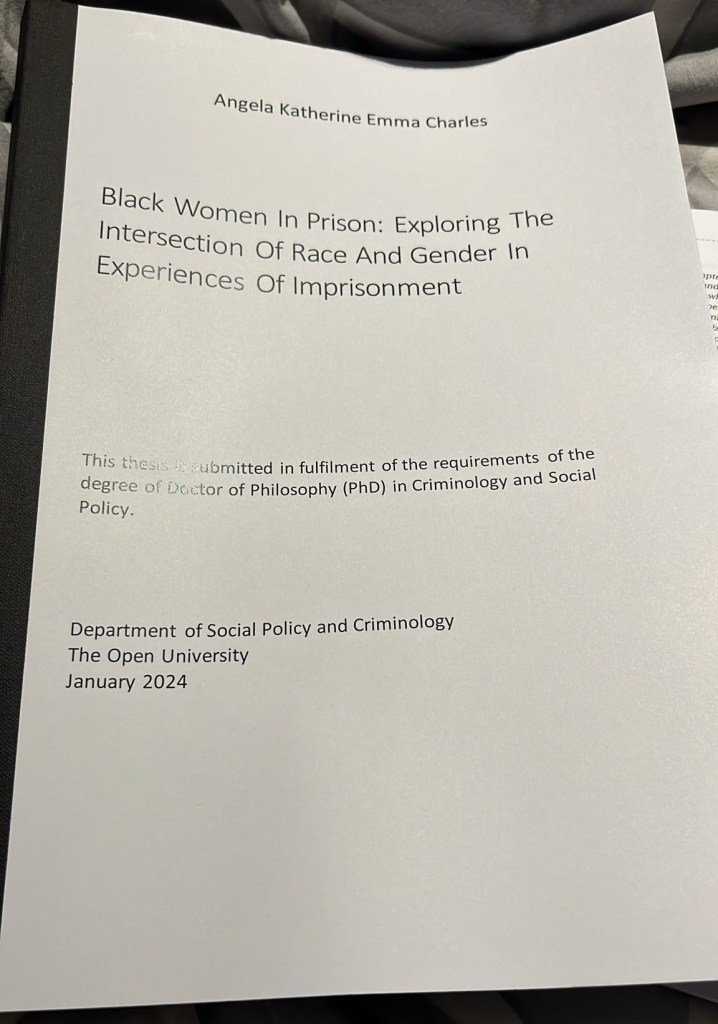
I reflect one week after one of the most important examinations in academia, the viva. Like any examination you never know what is going to come up and therefore you have to be prepared for anything. This makes preparation tricky, uncertain and at times perplexing. There were areas I thought might come up, and in those cases I had a response ready.
On the day, despite all the preparation there were questions that required pause, thought, navigation and discussion. Upon reflection, there were times where I would have liked to provide a more polished and articulate answer, but I am not a robot and therefore my answers are human, with stutters and pauses, passion and dedication; they are unpolished and there is a beauty to that.
What made the difference was having two very supportive examiners that were approachable, interested in my research and wanting me to fulfil my potential. Their additional years in the field/academia over mine were not used to demonstrate their superiority, but instead to guide me in the final process of completing my thesis.
The process acted as a reminder to me that how you approach a situation is so important. In academia, whilst we may be trying to highlight the flaws in a potential project or correcting errors or misconceptions in student’s writing so they can improve, we also ought to put the effort into seeing the good in someone’s work where possible. Think about whether your approach is constructive, how can that individual be supported to the finish line. It pays to maybe think back to the time when your work was being dissected, analysed, with the outcome affecting your academic career in front of you, what type of examiner would you have wanted, maybe that is the one you need to strive to be to others.
I passed with minor corrections that they stressed would only take a few days work. I hope this is acts a testament to what is possible. As a first-generation Black woman that tentatively stepped into academia, achieved a first-class honours degree, navigated a masters at Oxford University, was successful in achieving a funded PhD to then pass with minor corrections, challenge yourself and dare to dream!
Share this:


The True Crime Genre and Me

I have always enjoyed the true crime genre, I enjoyed the who dunnit aspect that the genre feeds into, I also enjoyed “learning” about these crimes, and why people committed them. I grew up with an avid interest in homicide, and the genre as a result. So, studying criminology felt like it was the best path for me. Throughout the three years, this interest has stayed with me, resulting in me writing my dissertation on how the true crime genre presents homicide cases, and how this presentation influences people’s engagement with the genre and homicides in general.
With this being my main interest within the field of criminology, it was natural that True Crime and Other Fictions (CRI1006) module in first year caught my attention. This module showed me that my interest can be applied to the wider study of criminology, and that the genre does extend into different areas of media and has been around for many years. Although this module only lasted the year, and not many other modules- at least of the ones that I took- allowed me to continue exploring this area, the other modules taught me the skills I would need to explore the true crime genre by myself. Something- in hindsight- I much prefer.
I continued to engage with the wider true crime genre in a different way than I did before studying criminology- using the new skills I had learnt. Watching inaccurate and insensitive true crime dramas on Netflix, watching YouTubers doing their makeup whilst talking about the torture of a young girl, podcasts about a tragic loss a family suffered intercut with cheery adverts. This acts as a small snapshot of what the genre is really like, whereas when I originally engaged with it, it was simple retellings of a range of cases, each portrayed in slightly different ways- but each as entertaining as the next. To me, I think this is where the genre begins to fall apart, when the creators see what they are producing as entertainment, with characters, rather than retellings of real-life events, that affects real people.
Having spent so much time engaging with the genre and having the skills and outlook that comes with studying criminology, you can’t help but to be critical of the genre, and what you are watching. You begin to look at the reasoning behind why the creators of this content choose to present it in such ways, why they skip out on key pieces of information. It all makes a bit more sense. Its just entertainment. A sensationalist retelling of tragic events.
Although studying criminology may have ruined how I enjoy my favourite genre of media, it also taught me so many skills, and allowed me to develop my understating in an area I’ve always been interested in. These skills can be applied in any area, and I think that is the biggest take away from my degree. Considering I now work as the Vice President of Welfare at the Students Union– and getting some odd looks when I say what my degree was- I have no regrets. Even if I walk away from my time at university and never use the knowledge I gained from my studies, I can walk away and know that my time was not wasted, as the skills I have learnt can be applied to whatever I do moving forward.
Share this:

Watch Out: Inspirational Women Coming Through

In my blog post about My favourite Things I mentioned that Jane Eyre was somebody who inspires me. Upon reflection, she is somebody who inspired me a lot when I was younger, and still today, but not with the same force. Over the past 9 years there have been 4 women who at various points over these years have inspired me in one way or another and remain inspirational to this very day. These four wise, wonderful women have had a humongous impact on my life and in my character development. This blog post is a sort of thank you letter to these fabulous women, as well as an outline of how and why they inspire me. They will remain unnamed to protect myself against certain death!
The first woman I have known the longest, and whilst I would class them as a close friend now, we did not start out as such. Neither did we dislike each other (I HOPE)! This person has had a direct impact on my identity as a criminologist but also as a feminist: something I will always be grateful for. They inspire me daily to be more understanding, empathetic and kind to myself. To challenge the status quo and to think critically at all times! For me they represent whom I want to be in the future. They are hard-working, generous, morally impeccable and a fan of Toy Story (massive plus points in my book). They have overcome a number of academic obstacles and inspire me to persevere with academia and its frustrations on the toughest of days. If I turn out to be half the woman they are; I feel like I will have succeeded in life.
The second woman is one of my closest friends. They are the perfect combination of weird and wonderful. We have had similar journeys in academia, but arguably they went first, and seeing them succeed inspired me to do similar! This woman has the patience of an actual real-life saint (although it has been tested on occasion-possibly by myself)! They inspire me to let the little things go and to recognise and check my own privilege. When I feel myself wobble, I think to this person and know that we can do this together! They might not know this: but I am continuously looking up to them.
The third woman has had a very recent inspirational impact on my life. I’ve known them for a number of years, but the last few years has changed the dynamic of our relationship to a beautiful friendship: one where they kick my backside at the Switch, but share my love for cheeseboards! This woman, other than keeping me sane, has inspired me to stand up for my own self-worth and to generate a backbone (metaphorically speaking). Our challenging discussions around race and gender, her open-mindedness and critical thinking all encourage me to follow suit. Life has thrown a number of obstacles her way, and whilst she may get a little knocked, she brushes it off and continues to smash her goals! All of this leaves me in awe: not to mention their stamina when it comes to shopping!
The final, and by no means least, woman is the most recent addition to the inspirational gang of fabulous women, who bless my life and keep me grounded. They keep me motivated in things I am passionate about outside of academia, are always there as a sounding board for me to air out my frustrations, and totally gets my need for doughnuts! They balance a ridiculous work-life balance as a single parent, and do so with flare, generosity and hard-work! Her non-traditional route into academia serves as inspiration to all, that if you are passionate about something; pursue it!
All four of these women manage ridiculous work/life/study loads, are empathetic, caring and always make time for me. All of them inspire me to be a better academic, friend and human being. They have had an impact on me as a student (Undergraduate and Postgraduate) as an academic (Associate Lecturer and Lecturer) and most importantly as a person. I cannot thank them enough. But if they are reading this, which they should be as I’ll be sharing it on social media; THANK YOU WISE, WONDERFUL WOMEN!

Share this:

Higher education, students, the strikes and me*

It was somewhat disappointing to read some of the comments purportedly from a university student in our local newspaper the other week. Critical of the current UCU industrial action and its impact on students, the student suggested that lecturers knew what they were signing up for and should just get on with it. I found it interesting and somewhat incongruent with what the national student union stance is (actually, I was livid). I know there has been a response to the article from the local union representative and other comments perhaps suggesting that my previous blog should be read (I wouldn’t think anyone in their right mind would have signed up for what I described). But just to be clear, I signed (or my union did on my behalf) a contract that states I am required to work 37 hours a week with the occasional evening or weekend work and that the normal working week is Monday to Friday. I take the meaning of ‘occasional’ as the definition found in the English dictionary (take your pick as to which one you’d like to use), which is not ‘permanently’ or ‘all of the time’ or ‘ad infinitum’. I can only speak for myself and not for my colleagues, but I don’t mind working a little longer at times and working the weekend to do marking or open days, but I didn’t sign up to be working all of the time. So, for me the industrial action is not just about my working conditions but about a contract, a legal obligation, which I am fulfilling but my employer seems to suggest that I am not because I am not working far in excess of my contracted hours. That to me, is illogical.
I remember a discussion where a senior manager stated that bullying included giving someone excessive workloads. I wonder whether that means that most lecturers are being bullied by management, isn’t there a policy against that? And then I seem to recall that there is some legislation against inequality, would that not include paying lower wages to women, disabled staff and people from minority ethnic groups? Systemic bullying and discrimination, not a pretty picture in higher education.
But perhaps the most important point is that as lecturers we don’t want to impact our student’s education, and this shouldn’t be about us versus the students. It’s what management would like because it detracts from so many issues that plague our higher education system. Students should quite rightly be unhappy with their lot. A system that plunges students into a lifetime of debt that they will rarely if ever be able to repay and at the same time lines the pockets of private companies seems to me to be immoral. A system that requires students to pay extortionate fees for accommodation is completely bonkers especially when it means the less affluent students have to work to afford to live. A system that requires students to study for approximately 46 hours per week in semester time (If we accept that they are entitled to holiday time) seems overly punitive. Couple this with the need to work to afford to live and it becomes unsustainable. Add to that any caring responsibilities or anything else that complicates their lives, and it starts to look impossible. I and my colleagues are not really surprised that so many fail to properly engage, if at all, and that there are so many stressed students and students with mental health issues. Of course, if we add to that individual capabilities, think unconditional offers and low school grades and let’s be honest widening participation becomes simply a euphemism for widening deBt, misery and, more importantly establishment profit.
The students were on strike for one day the other week, someone asked me why, well I rest my case. Whilst I understand student anger about the strikes, that anger is directed at the wrong people. We all signed up for something different and it’s simply not being delivered.
*The first part of this entry can be found here.

 Thoughts from the criminology team