
Home » Student (Page 5)
Category Archives: Student

Meet the Team: Hannah Smith, Associate Lecturer in Criminology

Making that choice…
As semester two is now upon us, I thought it would be a nice time to introduce myself to you all.
My name is Hannah Smith and I started at UoN in 2015, although I began my degree in Criminology in 2014. I completed my first year at Sheffield Hallam University and then transferred to UoN to complete my final two years and graduated in 2017.
To be honest, when I graduated, I was not ready to give up studying. I enjoyed reading, analysing topics, and debating for hours in seminars. I really enjoyed Criminology as it gave me the passion to ask why and look deeper into issues. Because of this, I carried on my studies and completed a Master’s degree in International Criminal Law and Security at UoN, as I wanted to learn more about the legal aspects of certain areas such as migration and I felt this was a sensible step with my knowledge from Criminology.
Since graduating from my Master’s degree, I began an internship at a local anti-poverty charity where I learned lots about voluntary sector working, governance, as well as working on some of the matters we talked about a lot in Criminology. After a year, I decided to take a leap into the world of migration and began working for a regional organisation who works in partnership with the Home Office and local authorities. I spend my days challenging practices, influencing policy, and working to try and help people who experience isolation, victimisation, discrimination and much more resettle and integrate into the UK. I also joined the UoN Criminology team at the end of 2020 and support the team as an Associate Lecturer.
One thing I have learnt along my short career journey so far is that it is not always about having the bit of paper that counts. Don’t get me wrong, it helps to have it written down on your CV, but it ultimately is about what you do with it and what you do with the skills you develop along the way. I never thought that a Criminology degree would lead me to a career in migration, but each and every day I use the skills I gained. Being analytical, being able to have the confidence to have a debate, working on my own to deadlines, working in groups, presenting to professionals and lots more.
So, if there is any advice I could give to you, it would be to focus on what you want to get from your degree rather than where you want to be. I remember being asked ‘what do you want to do when you leave university’, which was so much pressure as I just didn’t know! But there is no harm in not knowing. I would say enjoy and embrace the moment you are in and also get stuck in. Try new things, challenge yourself and enjoy learning all the new concepts and ideas that come your way. Keep using those the skills that feel natural to you as these will just strengthen and challenge yourself with the ones that need some extra attention! Because one day it will help out and pay off. You won’t know when that will be until a time of reflection in a few years’, similar to my time of reflection right now.
& When that happens – I would love to see a blog from you on this page!
Look forward to seeing you all on campus this semester!

Share this:


Auschwitz – secrets of the ground
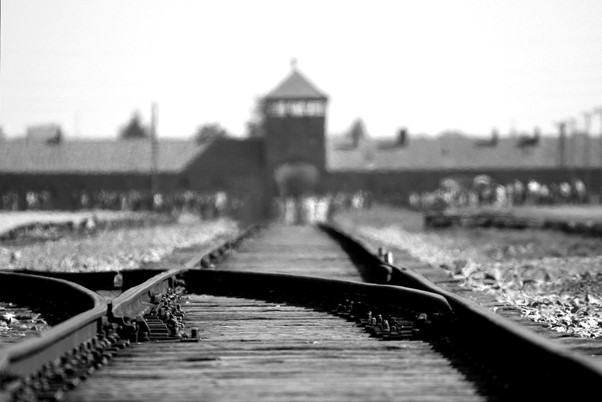
Indifference is not a beginning; it is an end. And, therefore, indifference is always a friend to the enemy, for it benefits the aggressor – never his victim
Elie Wiesel
I have been fortunate enough in my life to have been able to live and travel abroad, a luxury you should never take for granted. Having traveled in every continent there are plenty of things I will never forget, mostly good but one thing that will stay with me will be Auschwitz. It is hard to get excited about visiting Auschwitz, but it is also hard to not get excited about visiting Auschwitz. The day I visited Auschwitz, on the journey there a flurry of strange thoughts went through my head, perhaps ones you would only have when attending a funeral where you are supposed to be in grief. What do you wear, should I smile, what do you talk about, essentially you are creating a rule book inside your head of how not to be offensive. It’s a strange thought process and perhaps completely irrational, one of which I will probably never go through again. If I had to describe Auschwitz in one word, that word would be haunting and I could write for hours about Auschwitz without ever being able to get across the feeling of visiting it, but instead, I am going to share with you a poem I wrote on the journey back from Auschwitz, this poem has never seen the light of day and has been in my diary for over a decade, until now, but it feels like a perfect time to finally share, it’s called secrets of the ground.
Dark skies and tearful eyes,
only God knows the secrets this ground hides.
The flowers mask the crimes of old,
the walls are chipped by bullet holes.
Haunting sounds drowned out by hymns,
the shoes of children too scared to blink.
A cold wind howls in these Polish fields,
one million people how can this be real.
A train stands alone on the blackened track,
barb wire fences to hold them back.
The secrets out, the grounds have spoken,
we must never forget the lives that were taken.
Share this:


Holocaust Memorial Day: 27th January
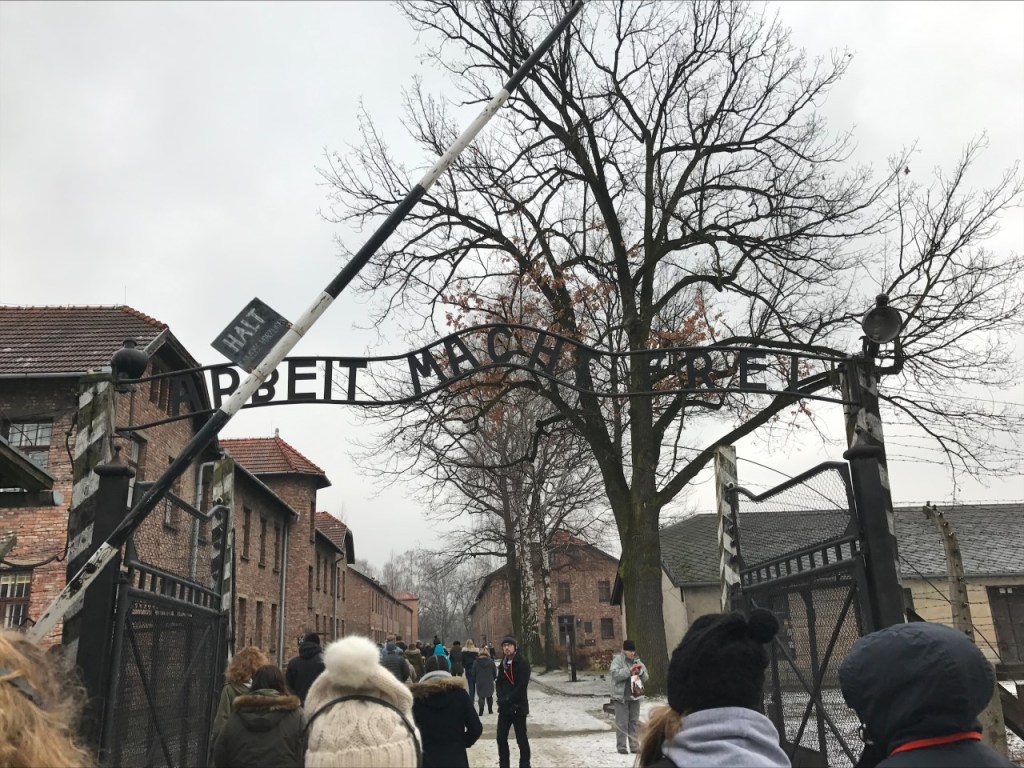
The 27th January marks an important event, Holocaust Memorial Day. This is a day to remember those who were murdered by the cruel Nazi regime, including 6 million Jews. These people were subject to the worst treatment that the modern world has ever seen. The Holocaust reminds us of how dangerous humankind can be to one another. These Nazi men went to work each morning knowing what they were doing and going home to their family at the end of their day of murders. This is something that I cannot comprehend, people that were so truly evil to degrade a whole group of people just because of who they are.
As someone who has had the opportunity to visit Auschwitz on an education trip while at school, I can say that the place is like nothing I could have ever imagined. The vast size and scale of both camps was inconceivable. To be in a place where so many people suffered their worst pains and lost their lives, it was a harrowing experience. From the hair to the scratch marks on the gas chamber walls, the place felt like no other. There was an uncomfortable feeling when you enter the gates of Arbeit macht frei, meaning, work will set you free. To know that so many walked under these gates not knowing what their fate held. And all of this for the Jews was because of their religion and the threat Hitler perceived them to have on Germany.
This is a topic that has always interested me, questioning why the Jewish community? My dissertation research so far has shown how the Jews were scapegoated by the Nazis for their successful businesses in and around Germany. Many Jewish families owned banks, jewellers and local businesses. The Nazis used this peaceful group of people and turned them into the enemy of the Nazi regime. The Jewish community was seen as a financial threat to the Nazis and needed to be eradicated for Nazi German to be successful. The hatred of the Jews developed, bringing in more dated views of the Jewish community. Within Nazi Germany, they were treated like filth and seen as subhuman because of their ‘impure’ genetics. Anyone seen to be from Jewish decent was seen as dirty and an unwanted member of society.
The stereotypes that the Jews are rich continued even after the war and still to this day, along with the stereotypes that Jews are the evil of society. Since March 2020, there have been conspiracy theories circulating on social media that the Jewish community was behind the COVID 19 pandemic. Many are suggesting that the Jewish people are trying to gain financially from the pandemic and destroy the economy. This is not something that is new, the Jewish community has faced these prejudices for as long as time.
My dissertation incorporates a study on social media and archival research. This project has taken me to the Searchlight Archives, located at the University of Northampton. The information held here shows how Britain’s far right movements carried on their anti-Semitic hate after the end of WWII. It’s very interesting to find that antisemitism never went away and still has not. Recently, the Texas Synagogue hostage crisis has show how much anti-Semitic hate is still in society. Three days after the Texas crisis, there was no longer headline news about it and those tweeting about it were part of the Jewish community.
Does this suggest that social media is anti-Semitic? Or is anti-Semitic hate not shared on social media because it is not of interest to people? Either way, Jews are still treated horribly in society and seen as a subhuman by many. This is the sad truth of antisemitism today, and this needs to change.
Share this:


Meet the Team: Tré Ventour, Associate Lecturer in Criminology

Hello everyone. My name is Tré and I will be one of the student success mentors [SSMs] starting from December 2021. Some of the now third-year criminology students reading this may remember me from when I attended some sessions within my role as a student union sabbatical officer (2019-2020) in their first year. However, as an SSM, I have previously been in some of the same situations many students have as I was also a student at the university (2016-2019).
The BTEC / A-Level-to-University pipeline can be challenging, but not impossible to navigate while the transition from school to university, is a social and cultural change that takes getting used to. Particularly the codes of acting and being so ingrained in university learning and working cultures.
I did my undergraduate degree in Creative Writing at Northampton. But I did my postgraduate degree in a completely different area of study — reading Race, Education, and Decolonial Thought within Leeds Beckett’s Centre for Race, Education, and Decoloniality. My academic interests are in race and social inequalities (but I previously used creative writing to discuss it), with my undergraduate dissertation being Permission to Speak: On Race, Identity, and Belonging. Furthermore, lots of my experience comes from the many talks I have done on Black history and race (including whiteness), further to the social investments I have in the local Northampton community where I grew up. Most recently, I am co-leading a Windrush project with a charity called NorFAMtoN built off an earlier largely Black community-led response to inequalities exasperated from issue relating to the COVID-19 pandemic (a project that is ongoing).
In 2018, I started using my knowledge on race to help organisations and that started with a theatre company called Now and Then Theatre where I was consultant on their play about Walter Tull. This took place in Buckingham and Northants. I became a student union sabbatical officer for Global Majority students in June 2019 where more questions about race occured. Leaving that role in July 2020, the overlap with the murder of George Floyd also saw more questions. And though I had done this sort of work prior to that summer, this time saw me and many of my colleagues being asked to do things where I have been freelancing as a race and Black history educator more consistently since September 2020.
Yet, I fell into criminology (as a sabbatical officer) when criminology programme leads @manosdaskalou and @paulaabowles contacted me to discuss my SU role, possibly in the July or August 2019. Unknown to me then, lots of the work I had done in the community including the types of poetry events I did (could be considered criminological). Over my year in the student union, I did think a lot about what my life would have been like had I done a creative writing-criminology joint honours degree rather than single honours creative writing. Anyhow, enough of whatifs. My life with the team since meeting Paula and Manos has not been the same, as they and Stephanie (@svr2727) convinced to go for my MA.
I didn’t study criminology in a formal capacity, but in terms of understanding crime — race and thus whiteness certainly have roles (which is my area). Criminology via many conversations with the team, pertinently interacting with Paula’s module on violence (and engaging with these students when I was sabb), showed me a context for my institutional experiences at university and elsewhere. Criminology simply added more layers to my understandings of the world. As an artist, I find criminology to be multidisciplinary informing some of my poetry as what happened when I went to Onley Prison in February 2020 showing criminology’s relevance in life beyond theory (as valuable as theory is).
As an artist, I try to approach as much as possible with an open-mind. Yet, as an academic as well, I also try my best to think how the issues we teach also have a human cost. For example, we must not only talk about violence as a purely academic matter. The decisions we make can have consequences. So, here then in your study time, I encourage you to think about the human cost of research (as there is both good and bad). Remember, there is no such thing as ‘being objective’ (there’s always a perspective or an agenda … see what I did there?). Debate with your lecturers, but more importantly debate with each other.
As an SSM, my role is about helping all students. Those that are just starting and also students that have been here for a while. I am here to help students that study at Northampton, including those who came straight from school all the way to those that came to university after a working career before going back to study. However, as an associate lecturer, I’m here specifically for criminology students.
My name is Tré and will be back at the university on a part-time basis starting from December 2021, and I look forward to meeting you all very soon! 😀
More on me here – https://linktr.ee/treventoured
Share this:


Striking is a criminological matter

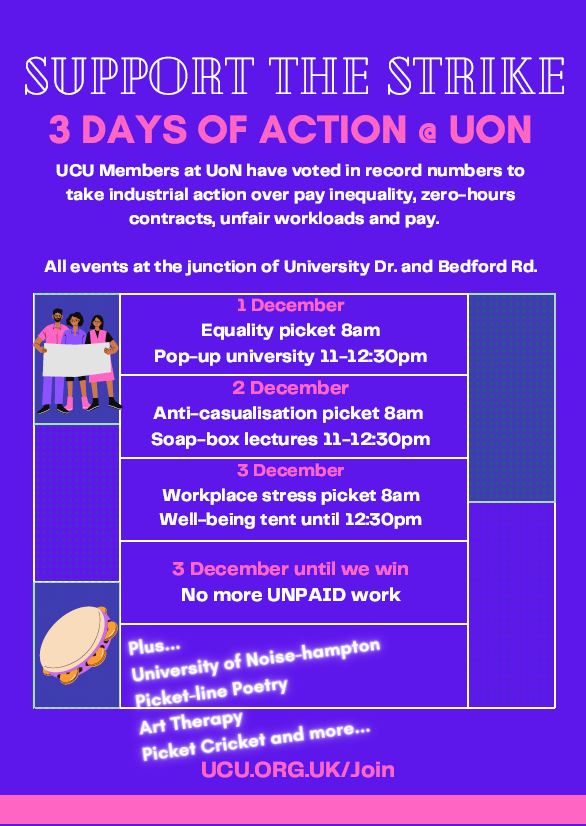
You may have noticed that the University and College Union [UCU] recently voted for industrial action. A strike was called from 1-3 December, to be followed by Action Short of a Strike [ASOS], in essence a call for university workers to down tools for 3 days, followed by a strict working to contract. For many outside of academia, it is surprising to find how many hours academics actually work. People often assume that the only work undertaken by academics is in the classroom and that they spend great chunks of the year, when students are on breaks, doing very little. This is far from the lived experience, academics undertake a wide range of activities, including reading, writing, researching, preparing for classes, supervising dissertation students, attending meetings, answering emails (to name but a few) and of course, teaching.
UCU’s industrial action is focused on the “Four Fights“: Pay, Workload, Equality and Casualisation and this campaign holds a special place in many academic hearts. The campaign is not just about improving conditions for academics but also for students and perhaps more importantly, those who follow us all in the future. What kind of academia will we leave in our wake? Will we have done our best to ensure that academia is a safe and welcoming space for all who want to occupy it?
In Criminology we spend a great deal of time imagining what a society based on fairness, equity and social justice might look like. We read, we study, we research, we think, and we write about inequality, racism, misogyny, disablism, homophobia, Islamophobia and all of the other blights evident in our society. We know that these cause harm to individuals, families, communities and our society, impacting on every aspect of living and well-being. We consider the roles of individuals, institutions and government in perpetuating inequality and disadvantage. As a theoretical discipline, this runs the risk of viewing the world in abstract terms, distancing ourselves from what is going on around us. Thus it is really important to bring our theoretical perspectives to bear on real world problems. After all there would be little point in studying criminology, if it is only to see what has happened in the past.

Criminology is a critique, a question not only of what is but might be, what could be, what ought to be. Individuals’ behaviours, motivations and reactions and institutional and societal responses and actions, combine to provide a holistic overview of crime from all perspectives. It involves passion and an intense desire to make the world a little better. Therefore it follows that striking must be a criminological matter. It would be crass hypocrisy to teach social justice, whilst not also striving to achieve such in our professional and personal lives. History tells us that when people stand up for themselves and others, their rights and their future, things can change, things can improve. It might be annoying or inconvenient to be impacted by industrial action, it certainly is chilly on the picket line in December, but in the grand scheme of things, this is a short period of time and holds the promise of better times to come.
Share this:




The ‘Dangers’ of Travelling

This month, during the brief lull between the teaching and marking season, I had allocated myself a bit more free-time than usual. I have not been able to indulge in my hobby of travelling for a while, so instead of this, I have been watching travel related-television programmes with the hope that these will provide me with some kind of joy.
This attempt has been a partial success; an influx of comedy travel shows have worked wonders to uplift my spirits whilst simultaneously reminding me about the beauty of nature; animals, plants, sea, land…(and even humans).
Covid has taken over travel related news at the moment, but in ‘usual’ times it does not require much effort to come across travel documentaries or news reports that seem to encourage prejudice by depicting other countries and travelling as being strange or dangerous. I do worry that this type of coverage might discourage people from wanting to explore the world.
It is difficult to assess the extent to which the television influences our opinions, but when I was a bit younger and discussing my travel plans with others, sometimes I would be met with the following comments:
Response: I would love to travel but I can’t
Me: Why can’t you?
Response: It is dangerous!
Me: How do you know this?
Response: …It said so on the television
There are many genuine reasons that prevent people from travelling, such as, money, responsibilities, health, conflict, misogyny and racism etc. But I find the above reason to be such a shame.
I have encountered many myths over the years which seem to have been gained from watching the television. Here are some of my favorites:
Myth 1: If you see a [insert wild animal here], it will eat you alive
My experience: Take crocodiles for example, these are not as bad as they seem. Yes, arguably crocodiles are death machines but I have seen many in the wild and I am still alive.
Myth 2: The local ‘criminals’ are dangerous
My experience: On very rare occasions I have witnessed crime being committed whilst abroad. I once sat on a coach full of people who were attempting to smuggle cocaine to Brazil. I have also stumbled upon situations which the media described as ‘riots’ and I have also witnessed a few thefts. In these situations, the locals were not a danger to myself, but crime seemed to be a way of being able to afford to live or the result of the occasional angry outburst amongst crowds of protesters, motivated by frustrations with the state.
Myth 3: If you accept the hospitality of strangers you will be murdered in your sleep
My experience: The chances of this happening are very slim. Travelling tends to restore my faith in humanity, the people that I meet whilst travelling can be incredibly kind and helpful.
I found that whilst I was a student, I was able to travel to many places on relatively limited over-draft funds. I hope that the students that I teach are able to do the same, as travel really can broaden the mind. Although, maybe I am wrong for encouraging others to travel, as travelling also makes you very aware of the damage that has been caused to the world, and my own part with in it.
Share this:


Reality and the fairy tale world of policy and procedures

In the concept of managerialism, we see that both policy and procedures form part of the techniques employed to enhance productivity and cultural changes. These changes use a ‘calculative and rationalistic knowledge base’ which appears both ‘universalistic’, and [at first sight] ‘seems entirely good sense’ (Gilling, 2014:82).
However, this knowledge base is far from universalistic and to the ‘street level bureaucrat’ (Lipsky, 1980) often falls little short of complete naivety. Lipsky (2010) provides a valuable insight into how individuals in public service adapt unworkable policies and procedures as the idealistic meets the reality of overstretched resources and ever demanding and needy consumers of services.
Whilst both working in and studying the police as an organisation subjected to and adopting managerialist policies, I witnessed the nonsensical notions of measuring activities and the subjugation of professionalism to management ideals (Hallam, 2009). Perhaps, there could be no better example than the measurement of the length of time a call handler spent dealing with a call. This derived from the need to answer calls within a target time period. It all made sense until you begin to take into account reality – the lack of resources and the nature of calls which demanded that on some occasions operators ought to spend far longer on the phone to deal with more protracted matters, such as someone in crises who really needed help and a comforting voice whilst someone was on their way. The result of the measurements was often counterproductive, officers being sent to incidents that amounted to little more than a waste of time, ‘My Jimmy is missing and I haven’t seen him for three days’ – when the officers turn up, Jimmy turns out to be a cat or, officers being sent to locations where information regarding the incident is scant because little time has been spent on the phone to get sufficient details. In the clinical world of the policy maker, there are ideal call takers, those that have knowledge about every eventuality, and ideal call makers, those that are precise, unemotional and to the point. Nothing of course could be further from reality.
Disappointingly, I find little solace in academia. Policy and procedures abound. Teaching styles are based, not on the nuances of student types but on the ideal student. The student that has the requisite skills to read and write and think critically. The student that is always engaged and always turns up and above all else, teaching is based on idealistic (see Morse and Lewis for tutorial sizes) small student classes. Policies that are well meaning such as catering for additional needs, become unworkable in an environment where class sizes and teaching demands outstrip available resources. Like the call handler, for the lecturer, it becomes impossible to cater for those that need more attention and time. And like the call handler, lecturers are subjected to managerialist idealistic measurements of success and failure. I once heard of a manager that referred to academics as ‘slackademics’, I think is probably just an indication of how far removed from reality managers are. There are two worlds in organisations that provide a service to the public, one is based on reality the other, a fairy tale world of policies and procedures based on the ideal.
References
Gilling, D. (2014) Reforming police governance in England and Wales: managerialisation and the politics of organisational regime Change, Policing and Society, 24 (1): 81-101.
Lipsky, M. (2010) Street-Level Bureaucracy: Dilemmas of the Individual in Public Services. New York: Russell Sage Foundation.
Share this:


A commuting student and how to be as organised as possible

As a commuting student, I have a very different experience to most students. Many go to uni to get a sense of freedom away from their parents and away from their hometown. I knew this was not something for me. I had no reason to want to get away, I have a job and friends around me that I am not ready to leave.
I would say most students think that those of us who commute are not experiencing a sense of freedom, however I found the opposite. I would feel more trapped being in student accommodation and not having the freedom of leaving whenever I pleased. Keeping university and my home life separate meant my life didn’t really need to change that much, compared to the traditional student.
For me, university is a part of my life, not my whole life. This balance was much more manageable for me. I wouldn’t have been able to make my whole life about uni because that is not who I am. Completing my assignments in a quiet place at home, with my dog by my side was much more appealing to me than being in halls surrounded by noise and distractions.
As I have said, I was not ready to leave my job and all the friends I have made there over the years. Without my job, I wouldn’t have the freedom that I do. My job pays for my car and that is my lifeline when it come to getting anywhere. I need it to get to uni and to get my education.
I have really enjoyed the balance of university and home life. However, I can see the appeal of it, it’s just not something for me. I couldn’t imagine moving away from my parents and my little dog. I didn’t want university to change my day-to-day life much and it hasn’t.
As a commuting student, to some it may seem difficult to keep motivated as you are surrounded by home comforts and home life. I do believe you have to be very disciplined with yourself, especially when you have a deadline due and you can’t join in with a family night. Although I did try my best to get assignments done as soon as I could for the sake of this and if I was desperately needed at work. Although at sometimes I felt swamped by assignments and overtime at work, if you manage your time right, in the end you wonder why you even worried yourself about it.
Another way I keep my uni and home separate is by using my uni laptop for assignments and society related tasks. I do not use it for anything else and this helps me keep my two lives completely separate. This way I never get them mixed up and confused. My uni email strictly stays on my uni computer, which keeps it as only a part of my life and not overtaking it.
I would say to anyone wishing to commute to university to go for it. It’s the best thing I have ever done. But you need to remember to keep uni separate and make sure it doesn’t swamp the rest of your life. In my house, uni consists of one shelf and a desk. And if you are fortunate enough to have your own car, it makes a world of difference as you can come and go as you please from uni, with no strings attached.
To anyone beginning their studies, I would say start prepping your assignments before you think you should. Get ahead and then you’ll never fall behind. If you have a day where you just want to take some time to yourself, you will be able to as you have already prepared in advance. If you let it slip and fall behind with assignments, you have no space to breath when it comes to needing a break. I think this may be easier for commuting students due to the lack of distraction, but even in halls, separate your time according to how much work you have to do and if you need to take time out for yourself.
Overall, I would say to those commuting, be organised, be on time and get ahead. And to those in halls, ignore distractions when you have deadlines to achieve, be organised and make time for yourself.
Share this:


Betty Broderick

I’m sure many of you are aware of the Dirty John series two, Betty Broderick. Although it has not had as much coverage as I’d have hoped. Now true crime documentaries are not always the best way to find out the truth, after delving deep into the history of this case, I found it does represent it well. If you haven’t given it a watch, I would definitely recommend it and would love to know your thoughts on the case.
Betty was married to Daniel Broderick, having 4 children and helping him become a doctor and then through law school. Of course, it all ended in 1989 when Betty had finally had enough of the torturous years with her husband’s affair with Linda Kolkena, killing them both. Not that I am condoning what she did at all, it was wrong for her to end his and Linda’s life. Although I do understand why she did do it and believe others in her situation could be led to this end too. After she kept them afloat with money while he went through law school, having his children and being the perfect housewife, he decided she was too old and needed a young wife to suit his new high class life-style.
This is not to say that Daniel was the sole person to blame, Betty was in the wrong too. However, taking a woman’s children away from her and brainwashing them tipped her over the edge, as it would do with many women. Betty brought the children up alone, with Daniel always too busy with his company to care about them. It seems Daniel did love Betty to begin with, but to me, it seems it became easy and stayed with her to do everything for him.
Daniel began socialising with his new girlfriend, rubbing his success in Betty’s face. This really does make me sad for Betty, she had no money because all her time was invested in her husband’s career. When it came to the divorce, it became a game for Daniel, trying to leave her with next to nothing and only supervised visits with her own children. He really did drive her to the point of destruction.
This woman is now 72 and has been in prison since 1989. I may be too generous, but I believe that this woman should be let to live her final years as a free woman. Free from having to fight for her children, fight for money to live and fight for her sanity. Daniel took all these away from her. And, although he did not get to live, Betty merely existed in the years of their divorce. She lost her spark and became depressed.
What do you believe?

 Thoughts from the criminology team